6
I
January 2018
Improve the Copy Move Forged Detection by
Feature Selection and Matching by Ant Colony
Optimization
Madhu verma1, Sanjay2 1
Scholar, Department of computer science, Technical University, Hamirpur, Himachal Pradesh, India.
2
Head of computer science, SIRDA institution of engineering technology, Sundernagar, (H.P), India.
Abstract: In our society digital images are a powerful and widely used communication medium. They have an important impact on communication and IT industry. The proposed versatile over division calculation sections the host picture into no overlapping and sporadic blocks adaptively. Then, the element focuses are removed from each block as block elements, and the block components are coordinated with each other to find the named highlight focuses; this technique can around show the presumed forgery districts. In past few years, research goes to detecting and classified for copy move forgery images for forensic requirement. So detection is very important challenges for testing in forensic science. In this paper detection and classification by point base and block base features SIFT and SURF Respectively but use ant colony optimization in matching and feature selection phases ,in case of SIFT features and proposed SIFT with ACO features which also use in classification with support vector machine with Gaussian and polynomial kernel.
Keywords: copy move forgery, ACO, SIFT, SURF, SVM.
I. INTRODUCTION
Digital images play a very important role in areas like forensic investigation, insurance processing, surveillance systems, intelligence services, medical imaging. But the basic requirement to believe what we see is that the images should be authentic. With the availability of powerful image processing software’s like Adobe Photoshop it is very easy to manipulate, alter or modify a digital image. Any image manipulation can become a forgery, if it changes semantic of original image. There can be many reasons for a forgery to be occurred by a forger like: To cover objects in an image in order to either produce false proof, to make the image more pleasant for appearance, to hide something in image, to emphasize particular objects etc.
II. APPROACH
In this dissertation, we are implementing SIFT-ACO algorithm using MATLAB R2011a. The simulation is
performed on window XP or above.
III. IMPLEMENTATIONANDRESULT
Proposed method uses Ant Colony optimization technique to detect copy dragooning digital image. ACO agents can help in finding the solution in optimized way. It would speed up the process of forged image detection as parallel processing agents would converge to an optimal solution. Agent ants would help in converging to an optimal solution with increase accuracy and negate false positive detections. Inspiration from SWARN intelligence has led to some highly successful optimization algorithm – one of those algorithms is ANT colony algorithm. It is a way to solve optimization problems based on the behaviour of ants searching for food. There is an indirect coordination between agents or actions. Ants communicate using pheromones. ACO algorithm consists of two parts that is edge selection and pheromones update.
ACO is an optimization technique proposed by Marco Dorrigo in the early ’90. It has become more interesting and fruitful research area. The inspiring source of ant colony optimization is the forging behaviour of real ant colonies.
ACO technique has been used in many ways to optimized solution to difficult problems. In ACO artificial agents called ant search for good solutions to an optimization problem providing good optimized solution.
2) Output: S best: The feature selection solution Begin
a) Parameters initial values are set
b) While termination not condition do
c) from starting point, the transferring m ants on the graph directed in accordance to their probability formula for each node. After the node is reached by all m ants, forming the m feature subsets.
d) Evaluating the m feature subsets fitness by the training image sets classification.
e) Updating the heuristic information and pheromone for each arc;
f) Selecting the solution with found the highest fitness value as Sbest;
g) End While;
h) The resultant output; End
B.SVM Classifier
Support vector machines in the machine learning, basically are supervised learning models based on associated learning algorithms which analyzes data utilized for regression and classification analysis. System has a technique called kernel trick. These are functions which take low dimensional input space and transform it to a higher dimensional space.
Svm training algorithm in which new examples are assigned either for one of the categories making it binary non probabilistic linear classifier. Support vector machine is a frontier which is differentiates into two classes which are hyper-plane and line. It converts non separable problems into separable problems, these functions are called kernels. It uses a subset of training points in the decision functions (called support vectors), so it is also memory efficient.
An example representation of a SVM model as points (in space), mapped in a way that separate categories examples are divided with a clear gap which can be wide as possible. And in that similar space, mapping a new example and a prediction is made to which category it belongs based on the gap side they fall in.
The computation of the SVM classifier:
Sufficient small value is choosing for yields the classifier for linear data that is linearly classifiable.
IV. EXPERIMENTALRESULT
A. Detection
Figure 4.2: Analysis of SuRF features Detection
[image:4.612.145.462.339.714.2]Above given figure 1 and figure 2show the experiment on two types of feature SIFT with ACO and SURF feature but results show SURF features not able to detect forgery part in image but ACO optimization features detect.
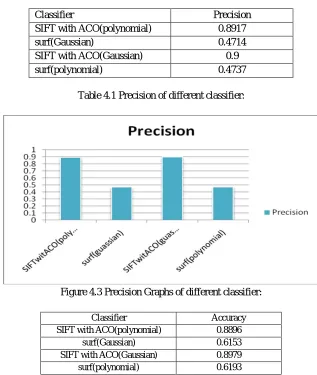
Table 4.1 Precision of different classifier:
Figure 4.3 Precision Graphs of different classifier:
Table 4.2 Accuracy of different classifier:
Classifier Precision
SIFT with ACO(polynomial) 0.8917
surf(Gaussian) 0.4714
SIFT with ACO(Gaussian) 0.9
surf(polynomial) 0.4737
Classifier Accuracy
SIFT with ACO(polynomial) 0.8896
surf(Gaussian) 0.6153
SIFT with ACO(Gaussian) 0.8979
[image:4.612.147.468.447.633.2]Figure 4.4 Accuracy Graphs of different classifier:
Table 4.3 Recall of different classifier:
[image:5.612.178.445.93.264.2]Figure 4.5 Accuracy Graphs of different classifier:
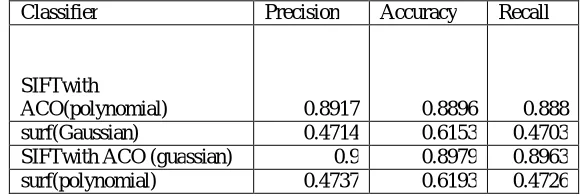
Table 4.4 Comparison between parameters (Precision, Accuracy, Recall) of different classifiers:
Classifier Recall
SIFT with
ACO(polynomial) 0.888
surf(Gaussian) 0.4703
SIFT with
ACO(Gaussian) 0.8963
surf(polynomial) 0.4726
Classifier Precision Accuracy Recall
SIFTwith
ACO(polynomial) 0.8917 0.8896 0.888
surf(Gaussian) 0.4714 0.6153 0.4703
SIFTwith ACO (guassian) 0.9 0.8979 0.8963
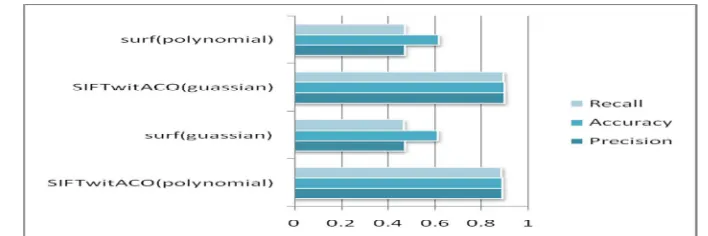
[image:5.612.159.451.608.706.2]Figure 4.6 Comparison Graph between parameters (Precision, Accuracy, Recall) of different classifiers:
IV.CONCLUSION
Proposed versatile over division calculation sections the host picture into no overlapping and sporadic blocks adaptively. Then, the element focuses are removed from each block as block elements, and the block components are coordinated with each other to find the named highlight focuses; this technique can around show the presumed forgery districts. In past few years, recopy-move forgery is a very common way to tamper an image. Many researchers have proposed various schemes to detect the tampered images. Sometimes the copied regions are rotated or flipped before being pasted. In this paper propose Detection and classification method by machine learning and optimization method. In our experiment detection and classification with sift ACO and SVM Gaussian and polynomial kernel. SIFT with ACO with polynomial kernel show significance high accuracy, precision and recall.
V.
ACKNOWLEDGMENT
I would like to take this opportunity to express my deepest gratitude to my advisor Mr.Sanjay for providing excellent guidance, encouragement and inspiration throughout the dissertation work. His extreme energy, creativity and excellent skills have always been a constant source of motivation for me. The perfection that he rings to each and every piece of work that he does always inspired me to do things right at first time. Without his invaluable guidance, this work would never have been a successful one. He is a great person and one of the best mentors.
I would also like to thank the faculty of Computer Science department (SIRDA institute of Engineering Technology) and to all my friends whose constant inspiration and support towards better work throughout my study proved to be valuable.
My utmost gratitude is to the College for providing me assistance in the form of necessary library and laboratory facilities during the course and research work.
To all acknowledged, I solemnly owe this work.
REFERENCES
[1] Ustubioglu, Beste, et al. "A new copy move forgery detection technique with automatic threshold determination." AEU-International Journal of Electronics and Communications 70.8 (2016): 1076-1087
[2] Chen, Bolun, Ling Chen, and Yixin Chen. "Efficient ant colony optimization for image feature selection." Signal processing 93.6 (2013): 1566-1576.
[3] Ranjani, M. Buvana, and R. Poovendran. "Image Duplication Copy Move Forgery Detection Using Discrete Cosine Transforms Method." International Journal of Applied Engineering Research 11.4 (2016): 2671-2674.
[4] Wenchang, Shi, et al. "Improving image copy-move forgery detection with particle swarm optimization techniques." China Communications 13.1 (2016): 139-149.
[5] Bay ram, Sevinc, HusrevTahaSencar, and NasirMemon. "An efficient and robust method for detecting copy-move forgery." Acoustics, Speech and Signal Processing, 2009.ICASSP 2009.IEEE International Conference on.IEEE, 2009
[6] Cao, Yanjun, et al. "A robust detection algorithm for copy-move forgery in digital images." Forensic science international 214.1 (2012): 33-43.
[7] Huang, Di, et al. "Local binary patterns and its application to facial image analysis: a survey." IEEE Transactions on Systems, Man, and Cybernetics, Part C (Applications and Reviews) 41.6 (2011): 765-781
[8] Boxes, G. A., Digital Image Processing: Principles and Applications. New York: John Wiley & Sons, Inc, 1994
[9] Brinkman, R., The Art and Science of Digital Compositing. San Diego: Academic Press, 1999.
[10] Chandramouli, R., N. Memo, and M. Rabbani, Encyclopaedia of Imaging Science and Technology: Digital Watermarking. J. Hornak, Editor. John Wiley, October2001.
[11] Fan, Z. and R. L. de Quiroz, “Identification of Bitmap Compression History: JPEG Detection and Quantizer Estimation,” IEEE Transactions on Image Processing, Vol. 12, No. 2: 230-235, February 2003.