Technology (IJRASET)
PLC based Greenhouse Automation
Prashik Satish Dhakne1, Vivek Dattu Aldar2, Sandip Jayavantrao Patil3, Chetan Laxman Ghuge4, Prof. Kiran P. Varade5
1,2,3,4
Electrical Engineering, Savitribai Phule Pune University
5
Assistant Professor, SVIT, Nashik
Abstract: Plants are everywhere around us, Plants need water, nutrients, air, water, light, temperature, space and time to grow. Plants needs both water and nutrients to survive as our human body needs this too. And same as like human beings they need water and nutrients in proper proportion to grow, too much or too little can be harmful to plants. Besides water and nutrients plants also needs fresh air and healthy soil for its proper and healthy growth, Plants also needs sunlight to grow, light is used as energy for making food, that process is called as photosynthesis, and temperature is important too, different types of plants requires different temperature and climatic conditions. A plant needs air, soil, light, temperature, water and nutrients in proper proportion to grow and hence the crops. To create such favourable environment, PLC based greenhouse automation system is designed which will control the measure such as temperature, humidity, light intensity, soil moisture in a ploy house, that are continuously monitored and controlled using PLC.
Keywords: Plants, Greenhouse, Automation, PLC, Air, Nutrients.
I. INTRODUCTION
Various sensors are used in the system which gives signal to the PLC and so it controls the values of various limits with use of output devices connected such as heater, cooler, pump, etc. Sensors used are namely, soil moisture sensor, temperature sensor, light sensors and level sensor. The PLC continuously monitors the digitized limits of various sensors and verifies with predetermined value and takes proper action for the instance of time. Automation is a process control and thereby replacing human operators. Additionally, making the greenhouse automated enables people to grow their own food or plants at home without having to constantly look after them.
The research and study of this paper was to analyse if it is possible to keep up the greenhouse temperature for the growth of plant using a temperature control system and light and moisture. Another goal was to investigate if the watering system is reliable, that is whether it can get a perfect soil moisture level for the chosen plant.
II. RELATEDWORK
Greenhouse is one of the representative models of modern agriculture business. As discussed earlier, in the greenhouse the necessary or crucial elements that influence the growth of crops, there is light, air, temperature and soil. This system controls light intensity, temperature and humidity. To PLC’s input sensors are connected and to the output bulb, heaters, pump and fans are connected. Overall project is control using programmable logic controller. 24V DC is used for PLC and by means of SMPS 230V AC supply is converted to 24V DC. PLC has become a very important part of industrial application. It is important for the personnel who is involved in control of PLC to understand the basic function and capabilities of PLCs. A PLC is a digital computer used for control of hydraulic drives, pneumatic systems, conveyor systems and various industrial drives using electromechanical automation. Like computers, PLCs are designed for multiple inputs and outputs. Programs to control machine operation are typically stored in battery-backed or non-volatile memory. A PLC is an example of a real-time system since output results must be produced in response to input conditions within a bounded time, otherwise unintended operation will result.
III.PROPOSEDSYSTEM
A. System Design
This paper gives the main information to write a program using ladder logic and implement the same using PLC that will help in monitoring the parameters like temperature, light intensity, soil moisture, level detector inside the greenhouse. Greenhouse technology is a technique which provides optimal and healthy environmental condition to the plants even in extreme adverse climatic condition where no crops can grow, growing crops in a greenhouse is becoming new and efficient way of farming and man is developing it.
Technology (IJRASET)
environmental conditions to get optimum growth and productivity.
[image:3.612.103.526.140.335.2]Our main aim is to design automated greenhouse monitoring and controlling system using PLC. There we are using various sensors which are kept inside the greenhouse which senses and variations parameters which are being monitored inside the greenhouse, PLC continuously compares with that of the standard condition required for greenhouse.
Figure 1: A Complete hardware
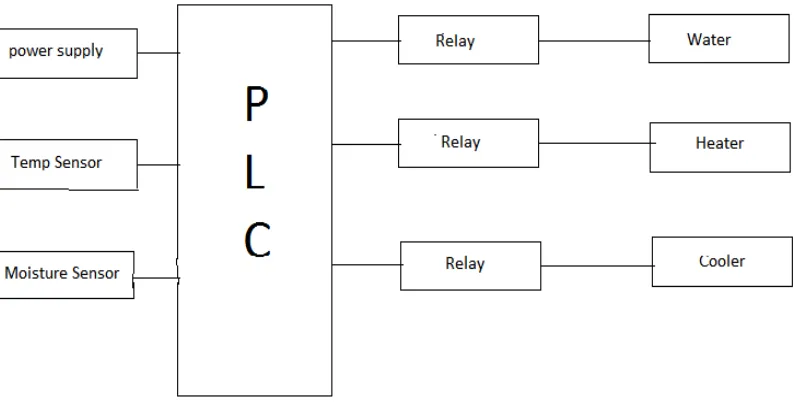
1) PLC: PLC stands for programmable logic controller. A PLC is user friendly, microprocessor based specialised computer that carries out control instructions of many types and level of complexity. A purpose of PLC is to monitor crucial process, parameters and adjust process operation accordingly. The software that is used to burn the program in PLC device is “LOGO SOFT” and the programming language is ladder logic.
Figure 2: Block diagram of PLC connected to various sensors and output devices
B. Temperature Sensor
[image:3.612.113.510.419.620.2]Technology (IJRASET)
digital output depending upon the status of temperature, it has a potentiometer to set at suitable temperature for plants. The output of temperature sensor is relay driven to be compatible with the PLC logic.
C. Soil Moisture Sensor
Plants needs water in a large quantity but in proper proportion. The most important factor driving water movement in plants is a process known as transpiration. Transpiration is the loss of water from plants in the form of vapour (evaporation). Plants use most of the water absorbed from the soil for transpiration (95%), but a small part of the water absorbed is used during photosynthesis for producing the carbohydrates necessary for plant growth (5%). HT7S11 with probes is used as a sensor to detect moisture in soil. The operation of the comparator is that when the input voltage at non inverting terminal is greater than that at inverting terminal, then the output of the comparator is high. If soil is dry, then resistance between two terminals of the probe gets high, so voltage at inverting terminal would be less than comparator is low. The output is relay driven to be compatible with PLC.
D. Light Intensity Sensor
The plants need some fix amount exposure to light, for carrying out the process of photosynthesis, it is important process. Plants use light, mostly is in the visible range. In plant photosynthesis, red and blue light are the wavelength of light which mostly used. Old plants need more light than do younger plants. A voltage divider circuit based on light dependent resistor (LDR) is used for monitoring the ambient light intensity. LDR is resistor whose resistivity decreases with increase in incident light intensity. The output voltage available taken across the LDR is given directly to the analogue input of the PLC.
F. Ladder Diagram
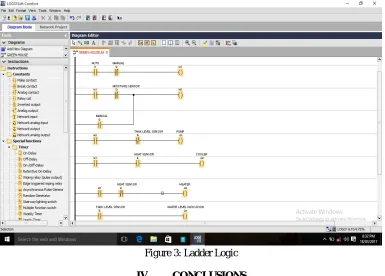
[image:4.612.115.500.390.666.2]The ladder diagram is a standard way of representing electrical sequence of operation. These diagrams represent the interconnection of field devices in such a way that the activation or turning ON, of one device will turn ON another device according to a predetermined sequence of events. Figure 2 illustrates a simple electrical ladder diagram. The original ladder diagrams were established to represent hardwired logic circuits used to control machines or equipment.
Figure 3: Ladder Logic
IV. CONCLUSIONS
Technology (IJRASET)
REFERENCES
[1] Mittal, M., Tripathi, G., “Green House Monitor and Control Using Wireless System Network”, VSRDIJEECE, Vol. 2 (6), 2012, 337- 345, 2012. [2] Parallax.,"Sensirion SHT11 Sensor Module". Available [Accessed: 22 December 2012]:
http://www.parallax.com/Portals/0/Downloads/docs/prod/acc/SensirionDocs.pdf
[3] Sensirion the Sensor Company. “Datasheet SHT 1x (SHT 10, SHT 11, SHT 15)".
[4] Available[Accessed:23December2012]:http://www.sensirion.com.cn/down/downimg/DatasheetSHT1x%20V5.pdfIEEE Standards, “Get IEEE 802®: Local and Metropolitan Area Network Standards”.Availabe[Accessed:22Desember2012]:http://standards.ieee.org/getieee802/download/802.11g-2003.pdf
[5] Rangan, K.., Vigneswaran, T. “An Embedded Systems Approach to Monitor Green House”, IEEE Conference Publications. Page(s): 61 - 65, 2010.
[6] Lihong, Z., Lei, S., “Measurement and Control System of Soil Moisture of Large Greenhouse Group Based On Double CAN Bus”, IEEE Conference Publications. Page(s): 518-521, 2011.
[7] Yuquan, M., Shufen, H., Qingzhu, W., “New Environment Parameters Monitoring and Control System for Greenhouse Based on Master-Slave Distributed”, IEEE Conference Publications. Page(s): 31-35, 2010
[8] Tantau H.J. and Lange D., 2003. Greenhouse climate control: an approach for integrated pest management. Computers and Electronics in Agriculture, Vol. 40, pp. 141-152.
[9] Poorna Prakash dondapati, K. Govindaraju,-“An automated multisensory greenhouse management”, international journal of technological exploration and learning, august 2012, pp. 2319-2135.
[10] Akshay C,Nitin Karnwal, Abhfeeth K.A, Rohan Khandelwal,Tapas Govindraju, Ezhilarasi D, Sujan Y- “Wireless sensing and control for precision greenhouse management”, sixth international conference on sensing technology,2012.
[11] Nilimamayee Samal and Umesh Chandra Pati-“Multichannel data acquisition and data logging for greenhouse application”, IEEE Students’ Conference on Electrical, Electronics and Computer Science 2014.
[12] Zhou Xiaobo,Wang Chengduan,Lanhong-“The research and PLC application of fuzzy control in greenhouse environment”, 6thinternational conference on fuzzy systems and knowledge discovery,2009.