Technology (IJRASET)
©IJRASET 2015: All Rights are Reserved
130
An Energy-Efficient Routing Algorithm Based On
Pristine Approach for WSN
R.Alwin1, S.Monica2 1
Asst. professor, Dept. of ECE, Coimbatore Institute of Engineering and Technology, Tamil Nadu, India.
2
PG Scholar, Dept. of ECE, SNS College of Technology, Tamil Nadu, India.
Abstract - Wireless Sensor Network is a self-configurable system based on the need it will build up the route for data forwarding. Wireless sensors are conveyed to accomplish network load balancing, improving network coverage, and prolonging network lifetime. To accomplish these objectives, energy efficiency directly influences battery life and hence it is a essential configuration for WSNs. In this paper, we propose an Network Coding based Energy Efficient Routing Algorithm in WSNs to prolong lifetime (NC-ER), which has the capacity to significantly prolong network lifetime while effectively improve energy efficient. Sensors are a detecting component; it will sense the changes in nature, for example, temperature, air contamination. . At that point it will forward the information in which the sensors accessible on the same network for data forwarding. Regularly, WSN networks will prefer the shortest path for data forwarding. These sensors are sent to accomplish network load balancing, drawing out network lifetime, and enhancing network coverage. The most essential issue that must be illuminated in designing a data transmission algorithm is the means by which to save sensor node energy while addressing the needs of applications as the sensor nodes are battery constrained. While fulfilling the energy saving requirement, it is additionally important to accomplish the quality of service. In order to achieve this requirement, Network Coding based Energy-Aware routing protocol for WSN is recommended that saves the energy by productively selecting the energy efficient path in the routing process.
Key Words: WSN, throughput, network lifetime, Network Coding based Energy Efficient Routing Algorithm (NC-ER), multicast routing
I. INTRODUCTION
Wireless sensor network (WSN) consists of many small, inexpensive distributed sensor nodes that organize themselves into a multi-hop wireless sensor network. WSNs are important for a number of pervasive applications such as coordinated target detection, surveillance, and localization. In such networks, the nodes are often powered by battery, and energy efficient operations are critical to prolong the lifetime of the connections. Designing an energy efficient and maximize lifetime for such networks is a challenging issue. However, for real-time sensing, latency and reliability are of paramount importance, whereas in battery powered sensor networks, energy efficiency is an important metric.
In the WSN, sensor nodes are constrained in energy supply. A sensor node is unable to function while its energy is exhausted. The network being wireless operate on batteries which have limited life. The wireless devices have limited bandwidth and the network provides unreliable service resulting in high packet loss and throughput. These networks are not scalable. As a mobile device, the limited battery volume cannot supply the durable power to the sensor node known as power wall. Depending on the applications, the sensors are deployed randomly or using a systematic approach to gather the information from the environment. Wang et al propose an energy efficient and collision aware (EECA) node-disjoint multipath routing algorithm. The data collection rate in pervasive healthcare systems is high. The development of efficient data and energy processing techniques are of great importance. One of the bottlenecks of sensor devices is the batteries. Considering the likelihood of forgetting to recharge the batteries of several sensors, this is a significant issue to be solved. The Network Coding (NC) technique emerged at the beginning of the previous decade with the primary aim of improving the throughput of communication networks.
Technology (IJRASET)
©IJRASET 2015: All Rights are Reserved
131
problem is that we can apply ideas from the area of network coding. Use of network coding has been examined in the literature in conjunction with multicasting, when a single source transmits common information to a subset of the nodes of the network.If we allow intermediate nodes to code, the problem of minimizing the energy per bit when multicasting can be formulated as a linear program and thus accepts a polynomial-time solution. In this paper we show that use of network coding allows to realize energy savings when routing in WSNs. By routing we refer to the problem where each node is a source node that wants to transmit packet to destination node.
II. RELATED WORKS
A. Energy Efficient Routing By Balanced Clustering
The wide usage of Wireless Sensor Networks (WSNs) is blocked by the seriously restricted energy constraints of the individual sensor nodes. This is the reason behind a large part of the exploration in WSNs concentrates on the advancement of energy efficient routing protocols. In this algorithm, another protocol called Equalized Cluster Head Election Routing Protocol (ECHERP), which seeks energy preservation through balanced clustering, is proposed. ECHERP models the network as a linear system and, utilizing the Gaussian elimination algorithm, calculates the combinations of nodes that can be picked as cluster heads in mind the end goal to extend the network lifetime. The performance evaluation of ECHERP is brought out through simulation tests, which manifest the viability of this protocol in terms of network energy efficiency when compared against other well-known protocols. The wide usage of Wireless Sensor Networks (WSNs) is blocked by the seriously restricted energy constraints of the individual sensor nodes. This is the reason behind a expansive part of the research in WSNs concentrates on the improvement of energy efficient routing protocols. The performance evaluation of ECHERP is brought out through simulation tests, which show the viability of this protocol as far as network energy efficiency when compared against other well-known protocols. The primary characteristic of ECHERP is the head determination process. In this protocol, in order to choose a cluster head, the routing data and the energy spent in the network are planned as a linear system, the arrangement of this is processed using the Gaussian elimination algorithm. Therefore, cluster heads are chosen as the nodes that minimize the total energy consumption in the cluster. In a large portion of the protocols proposed in this way, the node with the most residual energy in a cluster is chosen as the cluster head. This choice may prompt inefficiencies, as can be seen by the accompanying. Let us assume that node x has higher residual energy than the other nodes having a place to the same cluster. At that point, this node is chosen as the new cluster head. Be that as it may, this strengths the rest of the nodes to send data in the opposite direction to the base station, bringing about higher energy consumption.
Our work is a dedicated study of network layer, describing and ordering the different approaches for data routing. In addition, our work reflects the current state of art in routing research by including a comprehensive list of recently proposed routing protocols. Once deployed, it is frequently infeasible or undesirable to re-charge sensor nodes or supplant their batteries. In this way, energy conservation gets to be significant for sustaining a sufficiently long network lifetime. Among the different strategies proposed for enhancing energy-efficiency, cross-layer optimization has been acknowledged as an effective approach Because of the way of wireless communication, one execution metric of the network can be influenced by different factors across layers. Consequently, a holistic approach that simultaneously considers the optimization at multiple layers enables a larger design space within which cross-layer tradeoffs can be effectively explored.
B. Clustering Algorithm For Energy Efficient
One of the major constraints of wireless sensor networks is limited energy available to sensor nodes because of the small size of the batteries they use as source of power. Clustering is one of the routing techniques that have been using to minimize sensor nodes’ energy consumption during operation. In this paper, A Novel Clustering Algorithm for Energy Efficiency in Wireless Sensor Networks (ANCAEE) has been proposed. The algorithm achieves good performance in terms of minimizing energy consumption during data transmission and energy consumptions are distributed uniformly among all nodes. ANCAEE uses a new method of clusters formation and election of cluster heads. The algorithm ensures that a node transmits its data to the cluster head with a single hop transmission and cluster heads forward their data to the base station with multi-hop transmissions.
Technology (IJRASET)
©IJRASET 2015: All Rights are Reserved
132
data between two clusters. Furthermore, many different traditional clustering algorithms for wireless ad-hoc networks have been proposed.
Fig 1 overview of communication between sink and cluster
These clustering algorithms are not suitable for sensor networks because in ad-hoc networks, the primary concern is quality of service (QoS) and energy efficiency is the secondary. But in WSNs, the primary concern is the energy efficiency in order to extend the utility of the network. However, Low Energy Adaptive Clustering Hierarchy (LEACH) Protocol was proposed. This protocol is one of the most famous hierarchical routing algorithms for energy efficiency in WSNs. Other algorithms developed thereafter were based on this algorithm. Clustering is a good method in wireless sensor networks (WSNs) for effective data communication and towards energy efficiency. It involves grouping of sensor nodes together, so that nodes communicate their sensed data to the CHs. CHs collect, aggregate and transmit the aggregated data to the processing centre called base station for further analysis . Clustering provides re-source utilization and minimizes energy consumption in WSNs by reducing the number of sensor nodes that take part in long distance transmission. Cluster based operation consists of rounds. These involve cluster heads selection, cluster formation, and transmission of data to the base station.
III. PROPOSED WORK
A. Network Model And Network Coding
The network is represented by a directed acyclic graph G=(V, E) with V = |V| nodes and E = |E| edges. There are r independent, discrete source nodes s V processes with messages belonging to GF(28), and destination node dV (d > 1) receivers. Each receiver node has L > r incoming edges. The multicast requirement is that each receiver node can decode every source message from the signals on its incident edges. If the min-cut value to each receiver is d, then there exists a multicast transmission scheme over a large enough finite field GF(28), in which intermediate network nodes linearly combine their incoming information symbols over GF(28) and are responsible to deliver the information from the sources simultaneously to each receiver at a rate equal to d.
For example, a wireless network coding scheme depicted. We consider three nodes, 1, 2, and 3. Node 1 wants to send a packet x to node 3, while node 3 wants to send a packet y to node 1. Due to the limitation of transmission range, both of these packets have to pass through an intermediate node 2. In case of the non-NC scheduling based scheme, four time slots are required to complete these transmissions. Using XOR operation (on packet x and y), node 2 generates a new packet x y and broadcasts it to both node 1 and node 3 as shown . This simple example of wireless NC demonstrates that through the application of NC, three instead of four (in traditional routing) a transmission achieves the same packet transfer effect, and therefore improves the network throughput and save energy. The binary symbol x , y is a mathematical function of x and y. Calculation of a function from received data is called coding. This shows the merit of mixed coding among multiple messages at an intermediate node. This is called network coding.
Technology (IJRASET)
©IJRASET 2015: All Rights are Reserved
133
B. Energy Consumption Model
In this section, we derive the energy efficient gains that can be achieved. We assume that the source node S, needs to transmit symbols to the destination node D. Without loss of generality, it is assumed that the symbol period for each symbol is normalized to one second. In a WSN network, each sensor node can operate in a role-dependent (source, destination or router) state that changes temporarily. These states include one of the following:
If the transmit power of a node reaches the destination node and receiving nodes around the thermal noise power ratio in line with the required SNR that there is a link between two nodes,
Pi>=rj*daij
where Pi is the transmission power of node i, dij the distance between node i and node j, and α the link attenuation coefficient with the value from 2 to 4, rj signal to noise ratio (SNR) for node j.
The energy consumption of the multicast tree for all involved in the multicast nodes in the network transmit power to minimize this value is our goal.
SumP= P1 + P2 + … + Pn
where SumPrepresents to all the sending nodes of the sum power of the multicast tree, P1, P2, …, Pn is representative of the transmit
power of each sending node of the multicast tree.
In order to calculate the energy consumption of the multicast tree or link set, we specially define link set, we specially defined the energy consumption expressions, as equations below, where Plinkrepresents the power consumption of each link:
Sump=Plink1+Plink2+….+Plinkk
Plink1= rj*daij
C. Energy Consumption Analysis
In this section, we have performed the analysis of energy consumed by the sensors in the network. In the analysis, we have considered the energy consumed in packets communication as well as computations required for data aggregation. N sensor nodes are distributed according to two dimensional Poisson process with intensity λ in squared sensing region with each side 2a units. Hence the area (R2) of the sensing region becomes 4a2 square units. Now, we calculate the energy consumption of a wireless sensor node i. Every sensor node is supposed to consist of a set of member nodes that only involves in sampling and transmitting the aggregate of sampled data.
The radio propagation within a sensor node is assumed to free space, i.e. the transmission signal attenuates over the square of distance towards the sensor node. The energy used in transmission for sending b bits of packet to the node i is:
Pi(b,d)=b(Pi + εd2)
where, ε signifies the energy used by the amplifier module.
Now, we estimated distance E[d2] between the wireless sensor node x and the other nodes for Poisson Distributed nodes E[d2]= ∫ [(x−Cx)2 + (y−Cy)2].φ.
IV. SIMULATION AND RESULTS
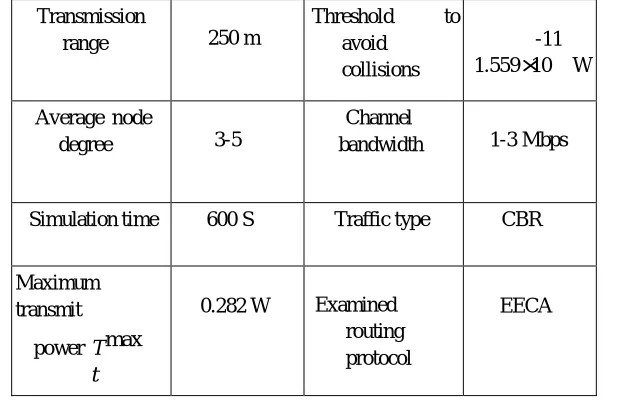
In this section, we present the numerical results for the systems discussed in the previous sections. We consider a network of randomly distributed nodes within a specified square area. The source and the destination nodes are located in the diagonal corners of the network.To effectively evaluate NC-ER’s performance, we compare it with other famous multipath routing protocols, EECA [3] for cost to control information, average link-connect time, the success rate to find the path and the feature of data transmission. Table 1 lists the simulation parameters which are used as default values unless otherwise specified.
Number of nodes 100 Initial node energy 40 J
Terrain range 1000m
×1000m
Correct receive
threshold -10
Technology (IJRASET)
©IJRASET 2015: All Rights are Reserved
134
Transmission
range 250 m
Threshold to
avoid collisions
-11 1.559×10 W
Average node
degree 3-5
Channel
bandwidth 1-3 Mbps
Simulation time 600 S Traffic type CBR
Maximum transmit
power T max t
0.282 W Examined
routing protocol
[image:6.612.154.468.77.279.2]EECA
Table 1 Simulation Parameters
In order to evaluate and validate our proposed model, we executed extensive simulations using Network Simulator version 2 (NS-2). NS-2 is a discrete event simulator targeted at networking research. NS-2 provides substantial support for simulation of TCP, routing, and multicast protocols over wired and wireless networks. Figure 2 represents the energy consumption for the NC-ER algorithm with EECA under different network size, which the network topology of each network size of the algorithms is the same. We observe that energy efficient outperforms the other schemes: it achieves the lowest energy consumption for most of the number of nodes.
Fig 2 energy consumption, throughput efficiency, delay for the NC-ER algorithm
V. CONCLUSION AND FUTURE WORK
Different energy efficiency and network lifetime definitions have been considered in the literature for WSNs. This paper discusses energy efficiency, network coding, routing and problem, which may deal with the network coding model for researching the WSN routing problem. In this paper, we propose a Network Coding based Energy Efficient Routing Algorithm in WSNs to prolong lifetime (NC-ER). Then we evaluate the performance of various schemes through simulation. Numerical results show that network coding scheme has better performance in throughput, network lifetime and energy efficiency. In terms of future work, we would definitely consider optimizing the timeout values and other parameters used in NC-ER for further evaluation via simulation. Use of the network coding and energy efficiency in parallel to improve the performance and increase the network utilization, is left as our future work.
REFERENCES
[image:6.612.195.420.392.535.2]Technology (IJRASET)
©IJRASET 2015: All Rights are Reserved
135
476-489.
[2] S. Choudhury, S. Akl, andK. Salomaa, “Energy efficient cellular automaton based algorithms for mobile wireless sensor networks,” in Proceedings of IEEE Wireless Communications and Networking Conference (WCNC ’12), April 2012, pp. 2341–22346.
[3] Z. J. Wang, E. Bulut and B. K. Szymanski, “Energy Efficient Collision Aware Multipath Routing for Wireless Sensor Networks,” In Proceedings of IEEE ICC 2009, Dresden, Germany, 14-18 June 2009, pp. 1–5.
[4] J. Yoo, L. Yan, S. Lee, Y. Kim, and H.-J. Yoo, “A 5.2 mW self-configured wearable body sensor network controller and a 12μW wirelessly powered sensor for
a continuous health monitoring system,” IEEE Journal of Solid-State Circuits, 2010, Vol. 45, No. 1, pp. 178–188.
[5] R. Ahlswede, N. Cai, S. R. Li, and R. W. Yeung, “Network information flow,” IEEE Transactions on Information Theory, 2000, Vol. 46, No. 4, pp. 1204– 1216.
[6] S.-Y. R. Li, R. W. Yeung, and N. Cai, “Linear network coding,” IEEE Transactions on Information Theory, 2003, Vol. 49, No. 2, pp. 371-381.
[7] Sengupta S, Rayanchu S, Banerjee S, “Network coding-aware routing in wireless networks,” IEEE/ACM Transactions on Networking, 2010, Vol. 18, No. 4, pp. 1158–70.
[8] M. Cagalj, J.-P. Hubaux, and C. Enz, “Minimum-energy broadcast in all-wireless networks: NP-completeness and distribution issues,” in ACM/IEEE MOBICOM, Atlanta, GA, USA, September 23-28, 2002 ,172-182.
[9] Y. Wu, P. A. Chou, and S.-Y. Kung, “Minimum-energy multicast in mobile ad hoc networks using network coding,” IEEE Transactions on Communications, 2005, Vol. 53, No. 11, pp. 1906-1918.
[10] M. Tariq, M. Macuha, Y. J. Park, and T. Sato, “An energy estimation model for mobile sensor networks,” in Proceedings of the 4th International Conference on Sensor Technologies and Applications (SENSORCOMM ’10), pp. 507-512, July 2010.
[11] G. Angelopoulos, M. M´edard, and A. P. Chandrakasan, “Energy-aware hardware implementation of network coding,” in Proceedings of the IFIP TC 6 Workshops on Performance Evaluation of Cognitive Radio Networks, Valencia, Spain, 2011, pp. 137–144.
[12] Zhi Chen, Teng Joon Lim, Mehul Motani, “Digital Network Coding Aided Two-Way Relaying: Energy Minimization and Queue Analysis,” IEEE Transactions on Wireless Communications, 2013, Vol. 12, No. 4, pp. 1947-1957.
[13] Campo A T, Grant A., “On Random Network Coding for Multicast,” IEEE International Symposium on Information Theory (ISIT 2007), Nice, France, 24-29 June 2007, pp. 1591 - 1595
[14] B. Waxman, “Routing of Multipoint Connections,” IEEE Journal on Selected Areas in Communications, 1988, Vol. 6, No. 9, pp. 1617–1622. [15] The Network Simulator – NS–2: http://www.isi.edu/nsnam/ns/.