BUCKLING O F CYLINDRICAL
SHELLS
WITH RANDOM IMPER FEGTIONST h e s i s by Rena S c h e r F e r s h t
In P a r t i a l Fulfillment of the R e q u i r e m e n t s F o r the D e g r e e of
Doctor of Philosophy
California Institute of Technology Pasadena, California
ACKNOWLEDGMENT
The author wishes t o e x p r e s s h e r gratitude and s i n c e r e
appreciation to D r , E, E. S e c h l e r f o r h i s help, advice and encourage- m e n t which enabled h e r t o c a r r y out this study. The advice and
suggestions of D r , C. D. Babcock a r e a l s o v e r y m u c h appreciated.
This opportunity is a l s o taken to thank D r , T , K , Caughey f o r m o s t
helpful d i s c u s s ions.
P a r t i c u l a r appreciation is e x p r e s s e d to my husband, D r , S. No F e r s h t , to whom this work is dedicated. His patience, understanding
and encouragement w e r e a s o u r c e of inspiration during my e n t i r e
engineering studies.
This study was supported in p a r t by the National Aeronautics
and Space Administration under R e s e a r c h G r a n t NsG 18-59 and t h i s
ABSTRACT
The buckling stability analysis of long cylindrical shells with
random imperfections subjected to axial load i s t r e a t e d using two
different approaches. The f i r s t study i s based on a Eyapunov method
which enables one t o establish sufficient conditions for buckling
stability of a long cylindrical s h e l l with axisyrnmetric random i m p e r -
fections. A perturbed s y s t e m of equations in the neighborhood of the prebuckling solution i s investigated, By reducing the problem to a
s y s t e m of integral equations, it is observed that the stability boundary
value problem of a long s h e l l i s s i m i l a r t o that s f a dynamical system with random p a r a m e t r i c excitations,
Initial imperfections were a s seurmed to have Gaussian dis t r i -
bution and a n exponential cosine c o r r e l a t i o n function, The c r i t i c a l
load was obtained a s a function of the root m e a n s q u a r e of the imperfections. Results obtained a r e qualitatively s i m i l a r to those
of Koiter for a periodic imperfection (Ref. 1).
The second p a r t i s based on the approximate method of
truncated hierarchy. The prebuckling s t a t e of equilibrium f o r
a s y m m e t r i c imperfections i s found by a successive substitution
technique, A homogeneous variational s y s t e m of equations i s s e t up
in o r d e r to examine the existence of bifurcation in the neighborhood
of the equilibrium state. These l a s t equations involve random
p a r a m e t r i c t e r m s , The truncated h i e r a r c h y method i s applied and
correlation functions associated with asymmetric imperfections are
examined numerically. Qualitatively the results obtained are as
T A B L E O F CONTENTS
P a r t
-
P a g eI INTRODUCTION 1
11 ALMOST SURE STABILITY O F LONG CYLINDRICAL SHELLS WITH AXISYMMETRIC RANDOM
IMPERFECTIONS
6
1. P r e l i m i n a r i e s
6
2. B a s i c Equations 10
3 . Methad of Solution 11
4. Derivation of Stability Condition 5. NurnericaP E x a m p l e
6.
Concluding R e m a r k sI11 APPROXIMATE STABILITY ANALYSIS O F LONG
CYLINDRICAL SHELLS WITH ASYMMETRIC
RANDOM IMPERFECTIONS
1. P r e b u c k l i n g Equilibrium with A s y m m e t r i c ICmperfections
2 , V a r i a t i o n a l Equations and Stability Analysis
3 , P a r t i c u l a r C a s e s
i. A x i s y m m e t r i c I m p e r f e c t i o n s
ii. A s y m m e t r i c I m p e r f e c t i o n s
4. Concluding R e m a r k s REFERENCES
LIST O F SYMBOLS
Constant defined on P a g e 1 3
Constant defined on P a g e 13
M a t r i x defined on P a g e 17
M a t r i x defined on P a g e
6
M a t r i x defined on P a g e 1 0
€h3/ l 2 ( 1 - ~ 2 )
E
Young' s modulusF'
S t r e s s function-
f=-
P a r a m e t r i c coefficient m a t r i x- f ~
S c a l a r function defined on P a g e 1 0+(X,QI)
,
4,
tr,%
,
,%,(r,*1)
T r a n s f e r functions
3a(t,q)
)h(3j
q)
1 ht(389),h2tsJq)G*
G r e e n ' s function defined om P a g e 13G L
Constant m a t r i x defined on P a g e 1 0W e
G r e e n ' s function defined on Page 1 3T r a n s f o r m e d t r a n s f e r fumctions
c,(a,p),
H ( ~ , B ) ~ . H ~ ( ~ , P ) ,
H ~ ( ~ , P B )
&k
Shell thicknessI
Unit m a t r i xLIST O F FIGURES
F i g u r e
1 T y p i c a l P o w e r S p e c t r u m C u r v e s
P a g e 7 2
2
S t a b i l i t y B o u n d a r y . f o r a C y l i n d r i c a l S h e l lwith A x i s y r n m e t r i c I m p e r f e c t i o n s 7 3
3 Buckling S t r e n g t h Dependence f o r D i f f e r e n t
P o w e r S p e c t r u m P a r a m e t e r s 74
4 Buckling S t r e n g t h Dependence f o r D i f f e r e n t 8(,
LJST O F SYMBOLS (continued)
k
Non-dimensional c i r c u m f e r e n t i a l wave numberConstant defined on P a g e 21
Constant defined on P a g e 2 1
Constant defined on P a g e 21 Constant defined on P a g e 21
Membrane s t r e s s r e s u l t a n t s
Axial wave n u m b e r
T r a n s f o r m a t i o n m a t r i x defined on P a g e 17 H e r m i t i a n m a t r i x defined on P a g e 9
G r e e n s s function defined on P a g e 1 8
C o r r e l a t i o n functions
Radius of the s h e l l
P h a s e function defined on P a g e 40
Power s p e c t r u m functions
Non-dimensional r a d i a l deflection of buckled mode
\%
H e r m i t i a n m a t r i x defined on P a g e9
W
Radial deflection of s h e l lrn
Initial r a d i a l deflection of s h e l l (imperfection)bQd # G
) G
Non-dimensional r a d i a l deflections
,
w,
8 Axial coordinate
LIST O F SYMBOLS (continued)
Y
C i r c u m f e r e n t i a l coordinateIndependent v a r i a b l e s in the t r a n s f o r m e d domain
c
,r*
Functions defined on P a g e 1 5$
(4 D i r a c ' s d e l t a functionE
j &w P a r a m e t e r s of the power s p e c t r u m function5
( A ] Function defined on P a g e 2 3'7,
1
qco
Eigenvalues ofBi
8
I P a r a m e t e r s of the power s p e c t r u m function65'
T r a n s f o r m a t i o n m a t r i x defined on P a g e 21K j
K I
Kt
Root m e a n s q u a r e s of initial imperfections)a
s./5&
Diagonal m a t r i x defined on P a g e 17
Eigenvalues of
d%
Eigenvalues of
V
P o i s s o n f s s a t i s
Applied a x i a l s t r e s s
LIST O F SYMBOLS (continued)
Non-dimensional s t r e s s function associated with
buckled mode
I, INTRODUCTION
In the l a s t t h r e e decades it h a s been recognized that s m a l l
g e o m e t r i c a l imperfections a r e the m a j o r c a u s e f o r the reduction in
the buckling s t r e n g t h of c y l i n d r i c a l s h e l l s , subjected to a x i a l loads.
P a r t i c u l a r analytical studies of the problem, using approximate
techniques and considering s i m p l e periodic modes of imperfections,
have been c a r r i e d out by Moiter (Refs. 1, 2 ) , Donne11 and Wan (Ref. 3 ) , Hutchinson (Ref, 4), Budiansky and Hutchinson (Ref. 5))
Babcock and S e c h l e r (Ref.
6 )
and o t h e r s . F e w a t t e m p t s have beenm a d e to study p r o b l e m s a s s o c i a t e d with local imperfections, a l m o s t
p e r i o d i c and s t a t i o n a r y random imperfections, In o t h e r words, the
s t u d i e s that have been c a r r i e d out s o f a r a r e r e l a t e d to i d e a l c a s e s
and give qualitative insight to the problem.
In the s e a r c h f o r a m o r e r e a l i s t i c d e s c r i p t i o n of the geometry
of i m p e r f e c t i o n s , i t was suggested by Bolotin (Ref. 7 ) that the i m p e r - fection function should b e considered as a random v a r i a b l e , B y using s t a t i s t i c a l techniques b a s e d on probability distributions and their
t r a n s f o r m a t i o n s one could evaluate the probabilities f o r buckling
f a i l u r e . This outlined p r o c e d u r e is p e r h a p s too g e n e r a l and becomes
i m p r a c t i c a l a s the number of random v a r i a b l e s i n c r e a s e s ,
The f i r s t a t t e m p t to s e l e c t a l e s s g e n e r a l c l a s s of random
imperfections, a s s u m i n g s t a t i o n a r i t y and ergodicity, has been made
imperfections. In a r e c e n t work by Amazigo (Ref.
9),
the problem of buckling of long cylindrical s h e l l s under axial load h a s been solvedf o r the c a s e of a x i s y m m e t r i c initial imperfections. The approximate
technique of truncated h i e r a r c h i e s h a s been utilized in this solution.
In both s t u d i e s , a n exponential c o s i n e c o r r e l a t i o n function f o r the
imperfections has been examined. It should b e noted that the solution
techniques in t h e s e two studies w e r e based on the a s s u m p t i o n s that
t h e initial imperfections w e r e s m a l l .
In the p r e s e n t work two different techniques have been used.
The f i r s t p a r t c o n s i s t s of a stability analysis which is based upon
Lyapunovss d i r e c t method, and h a s been utilized f o r the axisyrnmetric
s t a t e of imperfections. No attempt h a s been m a d e t o extend i t to a
m o r e g e n e r a l s t a t e s f imperfections, although i t is felt that this c a n
a l s o b e achieved. The a n a l y s i s is b a s e d on a study by Caughey and
Gray (Ref. 10) f o r dynamical s y s t e m s with s t a t i o n a r y random
p a r a m e t r i c excitations.
Considering the problem of long cylindrical s h e l l s , a p a r -
t i c u l a r c l a s s of random imperfections, which is of p r a c t i c a l
significance, is the s t a t i o n a r y s t a t e of imperfections with r e s p e c t to
the axial variable, By expanding the imperfection function in F o u r i e r s e r i e s i n the c i r c u m f e r e n t i a l direction, one can s e t up the problem
considering the F o u r i e r coefficients as the random v a r i a b l e s . T h e s e coefficients a r e a s s u m e d to b e s t a t i o n a r y with r e s p e c t to the axial
independent v a r i a b l e and m a y b e c r o s s c o r r e l a t e d . In addition i t is
a s s u m e d that the joint probability distribution f o r t h e s e coefficients
random variables satisfy the ergodic property.
By considering the perturbation equations of the prebuckling
solution it i s possible to obtain a l i n e a r s y s t e m of ordinary differ-
ential equations with constant and random p a r a m e t r i c coefficients.
By disregarding the t e r m s with p a r a m e t r i c coefficients the s y s t e m i s
reduced to a stable one a s long a s the load i s below the c l a s s i c a l
buckling load.
When the p a r a m e t r i c coefficients a r e included by reducing the
problem into a s e t of integral equations i t was observed that, with
proper modifications, the stability analysis i s s i m i l a r to that of a
dynamic s y s tem where the axial variable replaces the time variable,
As soon a s this p a r t of the analysis i s established, the application of
the Lyapunov technique becomes straightforward.
Lyapunov's method yields sufficient conditions f o r stability,
but it often occurs that this technique leads to extremely conservative
conditions. One of the m a j o r problems with Eyapunovq s method i s
that of determining the proper m a t r i x inequalities in o r d e r to derive
s h a r p e r stability conditions. This p a r t of the problem has been
handled with particular c a r e , yet i t i s felt that this p a r t i s s t i l l open,
a s in dynamical s y s t e m s , to improvement,
The p r e s e n t method of stability has been tested numerically
f o r the particular c a s e s f a x i s y m m e t r i c random imperfections, By
considering a Gaussian distribution and a n exponential cosine
correlation function, the c r i t i c a l load was obtained a s a function of the root mean s q u a r e of the imperfections, The curves obtained a r e
s p e c t r u m function coincides with the frequency of the c r i t i c a l l i n e a r
buckling mode.
Finally one should point out that the p r e s e n t study is perhaps
only the f i r s t s t e p in this direction. By using the s a m e technique,
sufficient conditions f o r stability of cylindrical s h e l l s , subjected to
o t h e r types of loads, a s well a s d e t e r m i n i s t i c , a l m o s t periodic s t a t e s
of imperfections, can b e obtained.
The second p a r t of the p r e s e n t work i s b a s e d on the approx-
i m a t e method of truncated h i e r a r c h y , A prebuckling approximate
solution is obtained by using the method of s u c c e s s i v e substitutions,
which is valid under the r e s t r i c t i o n that the root m e a n s q u a r e of the imperfections is s m a l l compared to the s h e l l thickness. Once this
p a r t of the problem is solved one c a n t u r n to the stability analysis.
In o r d e r to verify the existence of a second solution in the neighbor-
hood of the prebuckling equilibrium s t a t e , a v a r i a t i o n a l homogeneous s y s t e m of equations is s e t up.
In
o t h e r words t h e s e equations willenable one to examine the existence of bifurcation. Assuming that
the initial imperfections a r e s m a l l , the method of truncated h i e r a r c h y
can be applied following (Refs. 11, 12,
91,
As a r e s u l t one obtains a s y s t e m of integro-differential equations f o r the p r o p e r c o r r e l a t i o nfunctions, This problem is f u r t h e r reduced by applying double
F o u r i e r t r a n s f o r m s which l e a d s t o a s y s t e m of homogeneous
equations f o r the p r o p e r power s p e c t r u m functions. The condition
f o r existence of a non-trivial solution yields the d e s i r e d relation f o r egistence of bifurcation. Naturally the lowest load and the associated
Exponential cosine correlation functions a r e examined
numerically for combinations of a s y m m e t r i c and axisymmetric modes
of imperfections. The correlation function p a r a m e t e r s a r e selected
carefully in o r d e r to justify the applicability of the numerical results
obtained. This l a s t argument naturally i s based on physical intuition
r a t h e r than on experimental evidence. In a work by Arbocz and
Babcock (Ref. 13) imperfections have been m e a s u r e d by e l e c t r i c a l
m e a n s ; however, the record was too s h o r t and therefore reliable
c o r r e l a t i o n functions could not be established. Although the m e a s u r e d
r e s u l t s a r e p r e c i s e and carefully obtained, the number of c r o s s
sections of the cylinder for which imperfections were m e a s u r e d i s
not sufficient f o r data reduction in o r d e r to s e t up numerically the
s t a t i s t i c a l p r o p e r t i e s s f the imperfections. This, for the time being,
l e a v e s only the possibility of examining known c s r r e l a t i o n functions
f o r testing the theory. As mentioned before, the p a r a m e t e r s in these
functions a r e selected on the b a s i s s f intuition which really relies on
speculations
.
It i s hoped that, in the future, the p r e s e n t m e a s u r e m e n t techniques will be improved considerably, and perhaps new means
f o r the m e a s u r e m e n t sf imperfections will be found, Then the
11. ALMOST SURE STABILITY O F LONG CYLINDRICAL SHELLS WITH AXISYMMETRIC RANDOM IMPERFECTIONS
1. P r e l i m i n a r i e s
The p r e s e n t study t r e a t s the stability of a boundary value problem. In general Lyapunovls second method t r e a t s asymptotic
stability of dynamic s y s t e m s , in other words it i s related to initial
value problems. In o r d e r to r e l a t e the boundary value problem to an
equivalent dynamic s y s tern in a steady s t a t e response o r a stationary
response in a s t a t i s t i c a l s e n s e Pet u s investigate the following system of equations.
where
%
i s a n N-column vector with the components x.x 9
-
i
=
1 2 N Itj i s a constant N x N m a t r i x andFQsj
i s an N x N m a t r i x whose nonzero elements a r e stochastic p r o c e s s e s :It is assumed that the m a t r i x
8
h a s a t l e a s t one s q u a r e rootA
,
the eig,envaPues of which a r e distinct and have negative r e a l parts.
with the conditions a t infinity
The solution of (1.3) as
5
-r+
as
can be obtained from theequation
F u r t h e r m o r e , a s
5
-
-og the solution can be obtained fromEquations (1.5) and (1.4) can be combined to one equation a s
follows
The stability is defined in the s e n s e that a s
3
-9 thel a t e r a l deflection of the shell tends to zero. This i s known a s
asymptotic stability, and the t e r m almost s u r e stability is associated
with it, One can therefore s t a t e that conditions (1.4) can be met i f
and only if there i s a m a t r i x P%
,
the eigenvalues of which havenegative r e a l p a r t s , This l a s t condition together with (1.4) a s s u r e s
stable solutions a s
1%
o r by considering (1.7) andTurning now to (1.1) and assuming that f o r
(3)
=
0
this s y s t e m i s stable, let it a l s o be assumed that the elements ofhf)
,
fi*
( l )
,
satisfy the following properties,a. The p r o c e s s e s a r e continuous in -00 (
5
00b e
The p r o c e s s e s a r e s t r i c t l y stationary, c, The p r o c e s s e s satisfy an ergodic property,guaranteeing the equality of the a v e r a g e s with r e s p e c t to
5
and the ensemble a v e r a g e s ,On the b a s i s of the assumptions with r e s p e c t t o
A
and the boundary conditions a t5
=
448
,
one can construct a Green'sfunction m a t r i x associated with (1.3) o r (1.7)
Equations ( 1 , l ) can therefore be converted into a s y s t e m of integral equations of the form,
By observation one r e a l i z e s that equations (1.9) can be obtained f r o m the s y s t e m of equations
be reduced to the f o r m
where a proper condition a t X,(o)
= &
can be selected.F r o m this point, the analysis will follow Caughey and Gray
(Ref. 10). If
A
i s a stability matrix, there exists a Hermitian positive definite m a t r i xV
,
such that (Ref. 14)where
A*
=
A'
0A Hermitian m a t r i x
Q(x)
can be formed a s followswhere
vi
andv-t
a r e positive definite Hermitian m a t r i c e s obtained a s follows : Since is a positive definite Hermitian m a t r i x there exists a n orthogonal transformation@
such thatV
p o s s e s s e s a u n i q u e s q u a r e root~f
a l s o
Now, l e t
I
Q(g)II
be the norm ofQ(F)
;
ifE
s u r e l y stable in the large.
-
In the particular c a s e that
Fkx)
may be written in the formwhere
Gi
a r e constant m a t r i c e s andfi(r)
a r e s c a l a r functionsof and
M
<
N~
,
i t is possible to have a s h a r p e r condition of Mstability. If
I
fP'I,
E{fJT;)
1
exists and i s l e s s than&-I
/
then equation (1.11) is almost s u r e l y stable in the large, where(
q")I,
i s the numerically l a r g e s t eigenvalue of them a t r i x
2, Basic Equations
Let a point on the cylindrical surface of radius
R
bespecified by its axial and circumferential coordinates x and 'j
Due to the presence of imperfections each point is radially displaced
from the cylindrical surface by Q(%) It is assumed that
In the absence of s u r f a c e loads, the equations expressing equilibrium
in the
x
andy
direction for a shallow shell involve only theequations a r e satisfied by introducing the s t r e s s function
f=
(%,YJ
,
F L Y
Ny
=
5 x aNEY
=
-
F;xyLet
W(X,Y)
(positive inwards) be the radial displacement of the shell. In the c a s e of axisymmetric imperfections the functions F(x,)r) andW(%,Y)
satisfy the following two nonlinear equations,where is Young's modulus, V Poissons s ratio,
k
is the shell1 thickness,E
k
=
membrane rigidity,~ r p 3
=
a ( , - J )
= bending rigidityEquation 42,1) i s the compatibility equation in membrane s t r a i n s and (2,2) i s the radial equilibrium equation.
3 . Method of Solution
Equations (2. l ), (2.2) admit, f o r a n axisymmetrie: imperfect cylindrical s h e l l under axial compression, a n axisynnmetric
w h e r e
8*
is the, axial compressive s t r e s s . Substituting (3.1 ) into(2.1 ) and ( 2 . 2 ) yields
T h e s e equations can be simplified by reducing them to a nondirnen-
s i o n a l form, Let
Introducing these relations into ( 3 , 2 ) and ( 3 . 3 ) yields
where
Go
(
5-
7)
andHe(
5
-?)
a r e the Green's functions associated with the homogeneous p a r t of (3.5). These functions a r ewhere
This solution remains finite a s long a s 6
1
Considering the c a s e of stationary and ergodic random imperfections with z e r o mean, the autocorrelation functions a r e defined a s follows
is the expectation of the function
f
NowThis i s the d e s i r e d relation f o r the l i n e a r p a r t of the solution. Following Koiter (Ref. 1 ), the nonlinear equations (2.1 ), ( 2 . 2 ) may admit a n a s y m m e t r i c solution adjacent t o the s y m m e t r i c one which is specified by
W,(X~Y)
and( E , ( x ~ ~ )
.
Henceconsidering
and taking into account that the deviation f r o m the axisymmetric configuration i s infinitesimal one may l i n e a r i z e the equations with r e s p e c t to
WI
('1 91 and9,
(%,
Y ) The compatibility condition and the e q u i l i b r i w equation t h e r e f o r e a r eIntroducing the l a s t expressions into ( 3 . 1 3 ) and ( 3 . 1 4 ) yields
As before, these equations can be reduced to a nondirnensional form using ( 3 , 4 ) and the relations,
which is
where
I-',
(5
1 9equations ( 3 . 1 8) and (3.14) yield
g,''
=
g ~ ,
+
x3
=
k2x2
+
X,X;
=
k2x3
-
( h ' ~ ~ +
x4)
+
1 ; ~ )
x 2
where p r i m e denotes differentiation with r e s p e c t to
5
In
m a t r i x notation (3,201m a y
be w r i t t e n as4 . Derivation of Stability Condition
F o r the following analysis, the autocorrelation function
a,
(XI
will be assumed a s an exponential cosine functionR
=
K z
e-'Ml
&so5
(4.1)and
fie)
will be assumed to havea Gaussian distribution.
Obviously
K
r e p r e s e n t s the root m e a n s q u a r e of the imperfections.F o r a function
f
with Gaussian distributionIn the c a s e of the cylindrical shell,
and
and
00
where
To complete the stability analysis established in Section 1, one has to find the Hermitian matrix
V
such thatA * V + V A =
- 1
where
A
i s formulated a s shown in(3.24),
Then one has to.find the transformation matrix@
such thatwhere/(*; a r e the eigenvalues of
V
LetG,
andC1
be the following m a t r i c e sand
Let
qy'
be the eigenvalues ofBl
andq y
the eigenvalues of A+Ba
The stability condition for the cylindrical shell will then beNow from (4.3), (4.41, (4,6) and (4. 7)# it is easily s e e n that
and
where Go and
$Ite
a r e constants.Introducing these relations into (4.
B
1 ) yields5. Numerical Example
In o r d e r to evaluate the stability boundary determined in equation (4.12) a specific numerical example has been c a r r i e d out. The following p a r a m e t e r s were used in the calculation,
%/h
=
800Lp
=
0.3=
0.28
=
1 . 0The data
(&,@)
for the correlation function of the initial imperfections w e r e selected s o that the peak of the power spectrum. would be in the neighborhood of the peak of the response k e r n e l for We&) This will a s s u r e consideration of the m o s t c r i t i c a l situation, Thenumerical evaluation determines the following relation.
The shell will r e m a i n stable a s long as 4
5 h 1
The calculation was c a r r i e d out varying the wave number
k
i n the vicinity ofk =
The stability boundary obtained i s shown in F i g u r e 2 , This r e s u l t is s i m i l a r qualitatively t o the deter- ministic c a s e s associated with sinusoidal imperfections.6.
Concluding R e m a r k sThe stability condition i s only a sufficient c r i t e r i a f o r the
stability of the shell. The buckling p r o b l e m is s t i l l open f o r s h a r p e r
conditions, n e v e r t h e l e s s the p r e s e n t condition does not r e q u i r e any
f u r t h e r assumptions with r e s p e c t to
>
o r the power s p e c t r u mfunctions of the initial imperfections.
It should b e pointed out that, f o r c e r t a i n p a r t i c u l a r c a s e s ,
a s h a r p e r stability condition can be obtained by m e a n s of o t h e r
techniques. F o r example, where the load is c l o s e to the l i n e a r
c r i t i c a l one and the power s p e c t r u m function of the imperfections
v a r i e s slowly in the vicinity of the a x i s y m m e t r i c a ? respolgse
function, the Case c a n be solved in a simplified m a n n e r , considering
a n a r r o w band f i l t e r technique. The stability condition obtained will
III. APPROXIMATE STABILITY ANALYSIS OF LONG CYLINDRICAL
SHELLS WITH ASYMMETRIC RANDOM IMPERFECTIONS
1. Prebuckling Equilibrium with Asymmetric Imperfections
This p a r t of the work i s based on the approximate method of
truncated h i e r a r c h i e s which has been used before f o r the axis y r n - m e t r i c c a s e by Amazigo (Ref.
9).
No attempt will be made to study the validity of this technique, however comparisons between r e s u l t sobtained by truncated h i e r a r c h i e s and those obtained by other
approximate techniques, such a s perturbation techniques f o r
particular cases, are in good numerical agreement. In o r d e r to
a s s u r e justification for adopting the truncated h i e r a r c h y method a s
used in the following, one should a s s u m e that the root m e a n square
of the imperfections i s s m a l l compared to the shell thickness. The
l a s t assumption s e e m s to be r a t h e r r e s t r i c t i v e , nevertheless the
c a s e s which f a l l into this c l a s s a r e of g r e a t p r a c t i c a l significance,
Considering again the nondimens ionall equations of an
imperfect cylindrical shell subjected to axial load,
Consider a solution of equation ( 3 . 1 ) of the f o r m
The functions
t(f
,?)
andW$,
7)
satisfy the following s y s t e m of l i n e a r equatiansOne r e a l i z e s that these t r a n s f e r functions exist for a l l
,
as long a s
A
I
and, in particular, for=
oand
Introducing (1.2) into (1.1) and neglecting higher o r d e r t e r m s
in
.
4t
( ~ ~ 7 )
and WI ($,7)
a s well a s multiplications of sub-zeroAt this point consider the following useful identity
The solution of ( I , ? ) can be formally written in the form
-
1
w,,~
tr-
r,
,
1-13
Q,I,
c s - 3 , ~ -
.zd
d ~ ,
where the double Fourier transforms of
3
kg(fJ7)
.
F r o m the expressions f o r
Hl(d,p)
andC2(r(,II)
one can observethat, for
e=
0 these expressions have a singularity a t 0 ( = 0 ,,A question a r i s e s a s to the existence of the f o r m a l solutions s e t up
in f
1.9).
The answer to this question l i e s in (1.8)- This nonlinear differential operation enables one t o utilize only second derivativesHence, the use of only second derivatives of the t r a n s f e r functions
will remove the singularities a t
p
= O and d m o.
This completes the solution to the second o r d e r of approx-
imation. A higher o r d e r of approximation can be achieved by
proceeding further with the s u c c e s s i v e substitutions, which will not
be sought h e r e .
2 . Variational Equations and Stability Analysis
With the assumption that a solution of equations (1.1) can be
found to a satisfactory o r d e r of approximation, one can consider the
stability problem by seeking the possibility of admittance of a second
solution. In other words, a variational equation will be s e t up in the neighborhood of the existing solution to verify the existence of
bifurcation.
Returning to equations (1. P ) and, assuming that they admit a
second solution specified by
" ( 3 , ~
)
and9
(5)
r)
.
the deviation of which f r o m the b a s i c solution i s small, one may l i n e a r i z e theequations with r e s p e c t to
M t $ l q )
and?(Spy)
.,
The compatibilityc - .
-w h e r e w = W I + W l and
+=+,,++,
*where p r i m e denotes differentiation with r e s p e c t to the f i r s t
argurnent in the function and dot denotes differentiation with respect to the second .argument in the function.
Let the following correlation functions now be defined
where the double integrals associated with the expectation a r e taken over the repeated variables.
At this point one should also consider the proper a p p r o x - imation for truncation in the technique to be used. The correlation discard approximation in the p r o c e s s of closing the hierarchy in a typical c a s e i s
"(Y+PJ
'I+
5 )
E ~ I + P #
r
q.5,)
~ ( ' S + / U . ~ J
%IT,)
u l 1 ~ 1 )
p e r t u r b a t i o n solutions in s i m p l e d e t e r m i n i s t i c buckling problems.
F o r reasonably s m a l l imperfections the a g r e e m e n t between the two
techniques is good and t h e r e f o r e this technique will b e adopted f o r
the problem of s h e l l s f o r the c a s e of s m a l l imperfections a s
compared to the s h e l l thickness.
Equations ( 2 , 2 ) and ( 2 . 3 ) c a n be w r i t t e n f o r the point
( r * g
,*r+
?)
,
in which c a s e a l l differentiations a r e applied withr e s p e c t to the p r o p e r a r g u m e n t s . Doing so, and multiplying equation
( 2 . 2 ) (written f o r the point
( ' 1 ' 3 ,
q*?)
) byq(3,
7)
,
taking theexpectation of t h e r e s u l t and using the c o r r e l a t i o n d i s c a r d approx-
(2.7)
Considering equation (2.2) a g a i n a t the point
(5+5
19'3)
multiplying by
~
(
JY)
1
and taking the expectation of the r e s u l t i n gThe s a m e procedure a s described for equation ( 2 , 2 ) w i l l be
and
To obtain the expressions f o r
all(%
q
;,acr,5 )
a ,
(31q;
P ,31
% ( j A j r + , ~ >
andR ~ ( S I ~ > P I S )
one has to multiply equations ( 2 , Z ) and ( 2 , 3 ) written out a t the pointr-59%)
~ e q )
byu ( ~ ~ r l ) a ( 8 + / ~ ~
" 1 5 ) take the expectation with r e s p e c t to3
and,
u s e the correlation*
-
-
i
4
-q,-
s,
4,
d?,
and
(2.14)
and
+
4
't(51j9,)
K;
y%,q%)+
-Feo(tt
jq@)h:(tsj
Q?*)
-
2 J # * ( ~ # J vt9 Q v (53,qa)+
a:'($-
r,,
?-q,)j"(z,,~)
One can observe that the four equations obtained consist of two identical s e t s of equations for different s e t s of correlation funetions. It will therefore be s d f i c i e n t to concentrate in the
Upon applying double F o u r i e r transform using proper convolution relations, the following equations a r e obtained
where
Equation (2.26) i s an implicit relation between )r
,
o(and
[.1
.
Naturally the lowest value of3
i s to be sought.Formally,by m i n i m i z i n g w i t h r e s p e c t to o( and f4
,
w i l l r e s u l t two m o r e relations which will uniquely determine the minimum value of a s well a s the corresponding d. andP
at which i t will occur.Since
1,
4 ),
I&(&)
P)
andIs(&,
P)
involveh
in a n implicit f o r m in a r a t h e r complex fashion, the treatment of the solution f r o m h e r e on will be numerical r a t h e r than proceeding with cumbersome analytical relations. Finally one should point out that by minimizing with r e s p e c t tod
andP
one commits himself to a p a r t i c u l a r solution of the variational equation r e p r e - sented by a double simple harmonica1 mode, Since the variational equations a r e introduced in o r d e r to investigate the existence of a second solution in the neighborhood of a given solution, and since one i s concerned with double continuous s p e c t r u m s , i t is possible to choose any a r b i t r a r y non-trivial s p e c t r u m mode. Naturally the double periodic s p e c t r u m modes a r e associated with the lowest value of $B *3 . P a r t i c u l a r Cases
P r i o r to considering numerical examples of particular e a s e s , one should investigate the power s p e c t r u m function
SG
(dl
P)
of the imperfections. This function i s dependent on the two arguments-60-
Considering f i r s t the argument
[j
,
representing a c i r c u l a r modified frequency in the circumferential direction, i t is obvious that this variable i s d i s c r e t e , and can only be of the formF o r 2)
1 ,
p
can be considered a s a continuous variable for all practical numerical computations, this will be followed only by insignificant numerical e r r o r s . The axiallys y m m e t r i c mode of imperfections i s naturally the c a s e of
k s o
*Hence, since any general s t a t e of imperfections can be expanded i n F o u r i e r s e r i e s in the circumferential direction i n the f o r m
where
and, since the concept of correlation function can be utilized not
The l a s t expression leads to some interesting conclusions; for c a s e s where the phase
Sm(8)
i s constant (independent of3
), thecorrelationfunction
Rse(p,s)
takes the particular f o r mwhich physically means that these a r e no "torsional imperfections" present in the shell. On the other hand, for the m o r e general case where the phase 5% i s a function of
$
,
sttorsional imper- fectionss' a r e present in the shell and the correlation functionR g
(.u)3 )
takes a m o r e complicated form.independent of
5
.
F u r t h e r m o r e , exponential cosine correlation functions f o r k ( 8 ) a r e examined numerically. The l a s tfunctions a r e often used in control s y s t e m s , and s e e m to be acceptable f o r stationary s t a t e s of random imperfections (Ref. 8,
9).
However, the selection of p a r a m e t e r s in this p a r t i c u l a r correlation function i s of m a j o r significance, since imperfections m a y occur in a certain range of frequencies. P a r t i c u l a r attention should be paid to those modes of the power s p e c t r u m which a r e m o s t effective in reducingthe buckling strength yet r e m a i n reasonably practical.
Since, i n the following the power s p e c t r u m
5%
(d, (3) will be needed, one should note that the double F o u r i e r t r a n s f o r m ofexpression (39 2 ) for constant
9
,
yieldswhere
S4(d)
m
=
0, I , I J.-
.
i s the F o u r i e r t r a n s f o r m of the correlation functionwhich in the following analysis will be taken in the f o r m
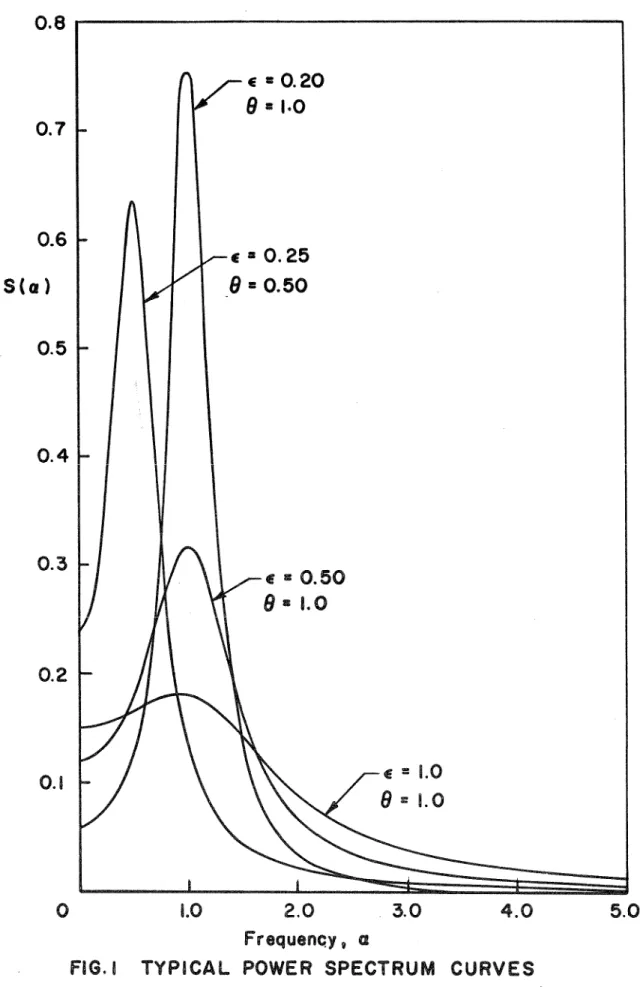
Typical power spectrum curves a r e presented i n F i g u r e 1 . At this point l e t us turn to particular c a s e s *
f i l
Axisvmmetric ImperfectionsF i r s t , considering the c a s e of axisymmetric imperfections
for which
Introducing these expressions into (2.26) yields the final d e s i r e d form
for the c h a r a c t e r i s t i c equation, i n the axisymmetric case. A com- parison between the equation obtained and the one obtained by
Amazigo (Ref,
9) r e v e a l s
a slight difference. However, a numerical comparison between the r e s u l t s obtained f r o m the two equations i salmost in perfect agreement.
The integrals w e r e evaluated numerically by m e a n s of
Simpson's quadrature which has the f e a t u r e of selecting the proper
s i z e of integration subintervaPs according to the d e s i r e d number of
significant figures. Minimization of
h
a s o( andf3
varycontinuously has been c a r r i e d out numerically, With the assumption
that the number of waves in the circumferential direction i s l a r g e
enough t o justify continuous variation of f%
,
which not always wasthe case, the final minimum values have been obtained.
F r o m the expression for the power spectrum (3.6) one
-
r e a l i z e s that, f o r the axisymmetric case, the mode shape of
Sse(d)
i s dependent on two p a r a m e t e r s , namely,
1,
Qe, The c a s e1E,= 0 and i s the deterministic c a s e of a s i m p l e
periodic imperfection. The p r e s e n t analysis h a s been examined
numerically, in addition to the deterministic case, for Qe 1 and
various
&
between O andii
These r e s u l t s a r e presented-65-
imperfections i t was expected that the c h a r a c t e r i s t i c equation w i l l be
reduced to the one obtained in (Ref.
9).
It turned out that a slightly different c h a r a c t e r i s t i c equation was obtained. Nevertheless,applying the present numerical integration technique for the integral
t e r m s in both c a s e s revealed that quantitatively the r e s u l t s obtained
from both c h a r a c t e r i s t i c equations w e r e identical. However, these
numerical r e s u l t s were not i n agreement with those obtained in
(Ref. 9). As explained in this reference the integrals have been
evaluated numerically using calculus of residues. Since this
technique has not been given in detail, i t was impossible to investigate
further the cause for the discrepancy and no further comments can be
made,
(ii) Asymmetric Imperfections
Another c a s e of practical significance i s the one where, in
addition to the axisymmetric mode of random imperfection, a n
a s y m m e t r i c mode of random imperfection i s present, Let the power
spectrum for this c a s e be
Introducing this power spectrum into
(2,251
yieldsI,
(.c,
p,
=
I;
(6%p)
+
-
a""
-67-
Introducing e x p r e s s i o n s (3.8) p r o p e r l y into (3.11) and the resulting
e x p r e s s i o n s into ( 2 . 2 6 ) yields the f i n a l d e s i r e d f o r m f o r the c h a r a c - t e r i s t i c equation f o r this p a r t i c u l a r a s y m m e t r i c c a s e , where the
instability mode o c c u r s a t
p
=
k
.
A
,
in this c a s e is minimized with r e s p e c t tod
.
The i n t e g r a l s (3.10) o r (3.11) w e r e a l s o evaluated nurner-
ically using S i m p s o n ' s rule. Minimization of
h
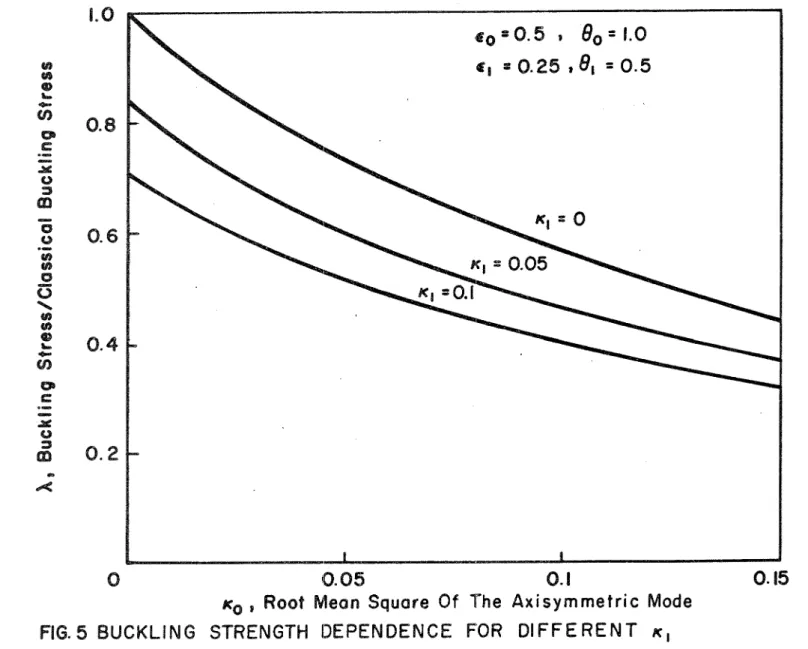
has beenc a r r i e d out n u m e r i c a l l y , The v a r i o u s r e s u l t s a r e p r e s e n t e d in
F i g u r e s 4 and 5. The family of c u r v e s obtained a r e qualitatively a s anticipated. Quantitatively t h e s e r e s u l t s a r e valid f o r s m a l l i m p e r
-
fections which, in m o s t p r a c t i c a l applications, a r e the c a s e . As theimperfections b e c o m e in magnitude of the o r d e r of the s h e l l thickness
the p r e s e n t approach is no longer valid and o t h e r techniques will have
to be sought, This is naturally coupled a l s o into questions of validity
of the equations s f the s h e l l and r e m a i n s f o r future investigations.
P e r h a p s s f a l l known techniques f o r stability analysis i t s e e m s
that the Lyapunov approach is the m o s t powerful tool f o r establishing
sufficient conditions to s u c h questions, This will involve the appli-
- 6 9 -
4. Concluding Remarks
The method of truncated h i e r a r c h y proved to be a powerful
tool in the stability analysis of the cylindrical shell with s m a l l
imperfections. Although this technique i s limited to a narrow class
of imperfections, i t i s this c l a s s which i s of m a j o r concern in
engineering applications. Any attempt to adopt this technique for
m o d e r a t e imperfections will be followed by cumber s o m e computations
associated with higher h i e r a r c h i e s . P e r h a p s a m o r e difficult task
would be to justify the r e s u l t s obtained. This naturally suggests the
examination of other techniques which a r e not based on a d i r e c t s ~ l u t i o n of the eqaations, yet r a t h e r investigate the p r o p e r t i e s of the
solutions. As pointed out before, the kyapunov analysis i s one way
t o approach this problem.
In conclusion, the analysis presented in P a r t 111 and in
particular the c h a r a c t e r i s t i c equation obtained, a r e sufficient to
establish the buckling load in practical applications f o r cylindrical
shells with stationary random imperfections. The p a r t i c u l a r
numerical c a s e s considered in this work a r e only the f i r s t s t e p in
investigating numerically the nature of the problem where a m o r e
complicated s t a t e of imperfections i s concerned, Finally the present
study can easily be extended to the buckling problem where, in
REFERENCES
1. Koiter, W. T., "On the Stability of Elastic Equilibrium", Ph.D. Thesis, Delft, H, J. P a r i s , Amsterdam, 1945.
2. Koiter, W, T., "The Effect of Axisymmetric h p e r f e c t i o n s on the Buckling of Cylindrical Shells under Axial Compression", Koninkl. Nederl. Akademie van Wetenschappen, Amsterdam, S e r i e s B, ,66 (1963)
No.
5.3, Donnell, L. H. and Wan,
C.
C., "Effect of Emperfections on Buckling of Thin Cylinders and Columns under Axial Compression", J. of Appl, Mech., March 1950,4. Hutchinson, J. -W., "Axial Buckling of P r e s s u r i z e d Imperfect Cylindrical Shellsse, AEAA Journal, Vol, 3, No, 8, August
5.
Budiansky, B.
and Hutchins on, J. W., "Dynamic Buckling of Imperfection Sensitive S t r u c t u r e s",
App. PAech, P r o c . of the 11th Intern. Congress, Munich, 1964.6. Babcock, C. D. and Sechler, E. E., "The Effect of Initial
Imperfections on the Buckling S t r e s s of Cylindrical Shells
",
NASA TN D-2005, 1963,7, Bolotin, V. V., B'Statistical Methods in the Nonlinear Theory of E l a s t i c Shells
",
NASA TT F-85,P
962 (originally written in Russian i n 1956)-9. Amazigo, J . C., "Buckling under Axial Compression of Long Cylindrical Shells with Random Axis y m m e t r i c Imperfections
",
Harvard Rep. SM-20, November 1967.
10. Caughey, T, K. and Gray, A. W., "On the Almost S u r e Stability of Linear Dynarnic Sys tems with Stochastic Coefficients ' I ,
J. of Appl. Mech., June 1965.
11. Keller, J. B., "Stochastic Equations and Wave Propagation in Random Media", P r o c . on Sy-mposia in Applied Mathematics, XVI, Rhode Island: American Math. S c , , p. 145-170, 1964. 12, Richardson, J . M., e'The Application of Truncated Hierarchy
Techniques in the Solution of a Stochastic Linear Differential Equation'@, Proc. on Symposia in Applied Mathematics, XIV, Rhode Island: American Math. Sc., p, 298-302, 1964,
13. Arbocz, J. .and Babcock,
C.
D,,
@'Experimental Investigation of the Effect of General h p e r f e c t i o n s on the Buckling ofCylindrical Shells Galcit Rep. SM 48-7, F e b r u a r y 1 968. 14, Gantrnacher,
F,
R . , "The Theory of Matrices", 1959.15, Laning, J.
W.
and Battin, Re H., "Randorn P r o c e s s e s i n Auto- matic Controls', McGraw-Hill, 1956,1 6. Hahn,