Technology (IJRASET)
An Efficient QOS-Oriented Distributed Routing
Protocol for Hybrid Wireless Networks
Dhanya Dileepkumar1, Asha T.S2
1,2
Electronics and Communication Department, Calicut University
Abstract— It has been observed that, from last few decades wireless technology is gaining popularity in the communication world. In these days, a person sitting at one place can communicate and access the resources of another place with the help of wireless technology. Recent advances in portable computing and wireless technologies are opening up exciting possibilities for the wireless hybrid networks. A hybrid wireless network combines a mobile wireless ad hoc network (MANET) and an infrastructure wireless network. Hybrid wireless networks are a viable networking way to fight with the limitations of infrastructured wireless networks and provide Internet connectivity to ad hoc networks and these hybrid wireless networks has been proven to be a better alternative for the next generation wireless networks. But how to guarantee the QoS in hybrid networks remains an open issue. So an Efficient QoS-Oriented Distributed routing protocol (QOD) is proposed to enhance the QoS support capability of hybrid wireless networks. This protocol incorporates the following algorithms: 1) a QoS-guaranteed neighbour node selection algorithm to meet the transmission delay demand and for choosing qualifies neighbours, 2) a Distributed packet scheduling algorithm for data packet routing and to further reduce transmission delay, 3) a mobility based packet resizing algorithm that adaptively adjusts size of the data segment as per the node mobility in order to decrease transmission time 4) a traffic redundant elimination algorithm to increase the transmission throughput of the system, and 5) a data redundancy elimination algorithm to discard the redundant data to further enhance the transmission QoS. The results are shown using simulations on NS-3.
Keywords— Hybrid Wireless Networks; MANET; Wireless Infrastructure Networks; Quality of Service (QoS), Routing.
I. INTRODUCTION
Technology (IJRASET)
©IJRASET 2015: All Rights are Reserved
748
But how to ensure QoS in hybrid wireless networks with high mobility still remains an open problem. In the wireless infrastructure networks, QoS provision (e.g., Intserv [2], RSVP [3]) has been proposed for QoS routing, which often requires negotiation of node, admission control, reservation of resources, and scheduling of packets priority wise [4]. Nevertheless, it is much harder to attain QoS in MANETs due to their unique features like mobility of nodes, channel errors, and bandwidth limitation. So the QoS remedies for infrastructure wireless networks cannot incorporated be into MANETs. Various reservation-based QoS routing protocols have been proposed for MANETs [5], [6], [7], [8] that makes routes created by nodes and links that reserve their resources to fulfil the QoS conditions. However, not much effort has been made to enhance QoS routing in hybrid wireless networks. Most of the present works in hybrid networks [9], [10], [11], [12], [13] concentrate on increasing network capacity or routing reliability but cannot provide QoS-oriented services. If the reservation-based QoS routing protocols of MANETs are directly applied into hybrid networks, they may experience problems like invalid reservation and race condition problems. Invalid reservation problem is that if the data transmission path between a source node and a destination node breaks, the set aside resources become useless. Race condition issue implies allocating the same resource to two separate QoS paths. So it is important to inquire new routing methods that can provide QoS routing and can better adapt to the hybrid wireless networks with different traffic composition and application requisite. So an efficient QoS Oriented Distributed (QOD) routing protocol is proposed to provide QoS routing in wireless hybrid networks. QOD routing protocol aims at minimizing end-to-end transmission delay and increasing network throughput. This paper is organized as follows: Section II exposes a study of the related work, Section III explains the QOD routing protocol and Section IV discusses the simulation results for the system. Finally, the conclusions are detailed in Section V.
II. RELATEDWORKS
A. Wireless Infrastructure Networks
As the internet evolves into a global communication system, there is an increasing need to support more sophisticated services (e.g., traffic management, QoS) than the traditional best effort service. Two classes of solution emerge: the scheme which is maintaining the stateless property of the original IP architecture, and the scheme which is requiring a new stateful architecture. Examples of stateless solutions are RED for congestion control and Differentiated Service (Diffserv) for QoS. The corresponding examples of stateful solutions are Fair Queuing for congestion control and Integrated service (Intserv) for QoS. In general, stateful solutions can provide more powerful and flexible services. IntServ provides per-flow QoS assurance in which routers have four basic functions: RSVP, admission control routing, packet scheduler and classifier. These functions create high control overhead and consume power, which is limited in ad hoc networks. The DiffServ affords a limited number of aggregated classes. It uses fine grained mechanism to manage traffic in the network [14]. But the packet dropping ratio and bandwidth cannot be minimized. So it fails to fulfil QoS.
B. Wireless Ad hoc Networks
An ad hoc wireless network (AWN) is a collection of mobile nodes forming an impermanent network, without using any fixed infrastructure. Characteristics of Ad-hoc Networks such as lack of central coordination, host mobility, dynamically changing network topology, and limited handiness of resources make QoS provisioning very challenging in such networks. The Mobile Ad hoc Networks working group of the Internet Engineering Task Force (IETF) has been actively evaluating and standardizing several routing protocols, e.g. Ad hoc On-demand Distance Vector (AODV) Routing, Dynamic Source Routing (DSR), Topology Dissemination based on Reverse-Path Forwarding (TBRPF) Routing and Optimized Link State Routing (OLSR).However, most routing solutions only provide best-effort routes which do not satisfy the QoS requirements of growing multimedia applications in ad hoc networks, such as delay and bandwidth constraints. Perkins [15] proposed AODV protocol which is a distance vector routing
[image:3.612.245.386.90.181.2]Technology (IJRASET)
protocol and it is the most popular routing protocol for ad hoc networks, and has been investigated widely by many researchers for a large number of network topologies and environments. AODV protocol is a pure on demand routing protocol in which a route is only discovered when it is required by a source node. In AODV, there is a frequent link break down between the source node the Destination node. So, it will degrade the network performance. The Dynamic Source Routing Protocol (DSR) [16] is a simple and efficient routing protocol designed specifically for use in multi-hop wireless ad hoc networks of mobile hosts. DSR makes the network to be fully self-organizing and self-configuring, without the requirement of any existing network infrastructure or administration. But it does not consider the transmission delay.
C. Hybrid Wireless Networks
Routing is the main research issue in the development of hybrid wireless networks. Most of the techniques used for routing focus on improving network capacity and routing reliability. A Unified Cellular and Ad Hoc Network Architecture (UCAN) is proposed by Luo et al [17]. In UCAN, the 3G BS forwards packets in a hybrid manner only for destination clients with poor channel quality and it improves network throughput. But it’s hardware is complex which may cause MNs to quickly run out of battery. An integrated cellular and ad hoc relaying (iCAR) system [18] is proposed that enables a cellular network to achieve a throughput closer to its theoretical capacity. But it has some limitations like signalling overhead, non-optimal routes and hardware complexity. Many of the routing approaches for hybrid networks have been borrowed from mobile ad hoc networks (MANETs) to achieve routing solutions in these networks but are not ideal or optimal and cannot provide QoS routing. So it is necessary to define new routing schemes with QoS routing guarantee which can better adapt to the hybrid wireless networks.
III.THEQODPROTOCOL
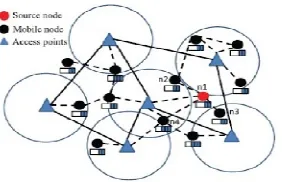
In order to improve the QoS support capability of hybrid networks, a QoS-Oriented Distributed routing protocol (QOD) is proposed. Usually, a hybrid wireless network has widespread base stations. The QOD protocol converts the packet routing problem into a dynamic resource scheduling problem. The main objective of QOD is to reduce transmission time and increase the network capacity based on queuing condition, channel condition and user mobility. In QOD routing protocol, if a source node is not within the transmission range of an AP, a source node chooses the nearby neighbour nodes that can provide QoS services to forward its packets to the APs in a distributed fashion. The source node schedules the data packet streams to the neighbouring nodes based on their queuing status, channel state, and mobility, with an objective to decrease transmission time and improve network capacity. The neighbouring nodes then forward these packets to AP, which further forward these packets to the destination node. The QoS assured transmission in QOD routing protocol is achieved through five algorithms which includes a QoS-guaranteed neighbour node selection algorithm for reducing the transmission delay, a distributed packet scheduling algorithm for packet routing which reduces the total transmission time, a mobility dependent packet resizing algorithm which further reduces the transmission time, a Soft-deadline-based forwarding and scheduling algorithm for improving network throughput and a data redundancy elimination algorithm for improving the QoS of the packet transmission.
A. Overview Of QOD
The source node generates the data packet periodically. The source node transmits the packet directly to the destination node if the source node is within the coverage area of access points. Otherwise the source node has to send the request message to adjacent neighbour nodes to reach the destination. The neighbour node compares the space utility (Us) with the threshold and reply to the
source node. Then a neighbour node ni having space utility Us less than a threshold value replies to the source node after receiving a
forward request message from that source node. Based on the replies from the neighbour nodes the source node computes the queuing delay (Tw) and packet size (Sp(i)) and then finds the qualified neighbour nodes. The neighbour nodes get sorted in the
descending order based on the queuing delay (Tw). Depending upon the workload of neighbour nodes the source node chooses the
excellent neighbour. Then workload rate Ai is calculated for each sorted intermediate neighbour node and send packets to ni with the
transmission interval Sp(i)/ Ai from the source node.
B. Applicability Of The QOD Routing Protocol
Technology (IJRASET)
©IJRASET 2015: All Rights are Reserved
750
sends out packets, it sends a Request To Send (RTS) message to the next hop node indicating the duration time required for the subsequent data transmission. The destination node then reply with a Clear To Send (CTS) message to establish a connection with the source node. The neighbour nodes overhearing these RTS and/ or CTS messages set their Virtual Carrier Sense indicator or Network Allocation Vector (NAV) to the message’s transmission time, so that it can avoid transmitting data into the channel within
the time duration. Channel utility is defined as the fraction of time a channel is busy over a unit time. Assume is a constant time
interval used for channel utility updating, by referring to NAV and update interval , each node ni can statistically calculate its
channel utility by Uc(i) =TNAV/ , where TNAV is the number of time units that ni is interfered which is recorded by NAV. The
available bandwidth for ni is Wi = (1−Uc(i)).Ci, where Ci is the transmission link capacity of node ni. The workload of a node is
defined as the accumulated number of packets received by the node through the entire simulation period.
C. QoS-Guaranteed Neighbour Node Selection Algorithm
Since short delay is the major real-time QoS requirement for transmission of data traffic, QOD incorporates the Earliest Deadline First scheduling algorithm (EDF) [19], which is a deadline driven scheduling algorithm for data traffic scheduling in intermediate nodes. As per this algorithm, an intermediate node gives the highest priority to the data packet with the closest deadline and forwards the packet with the highest priority first. Let Sp(i) denote the size of the packet steam from node ni, Wi denote the
bandwidth of node i, and Ta(i) denote the packet arrival interval from node ni. The QoS of the packets going through node ni can be
satisfied if
Similar to the random early detection (RED) algorithm [20], in which a queue length threshold is set to avoid queuing congestion, a space utility threshold TUs is set up for each node as a safety line to make the queue scheduling feasible. Let Uas(i) denote the
available space utility and Uas(i) = TUs − Us(i). In QOD, after receiving a forward request message from a source node, an
intermediate node ni with space utility less than threshold TUs replies the source node. The replied node ni informs the source node
about its available workload rate Uas(i) ∗ Wi, and the necessary information to calculate the queuing delay of the packets from the
source node. Based on the calculated queuing delay, the source node then selects the replied neighbour nodes that can meet its QoS deadline for packet forwarding. After the source node determines the qualified nodes that can satisfy the deadline requirement, the source node needs to distribute its packets to these qualified nodes based on their available workload rate Uas(i) ∗ Wi to make the
scheduling feasible in each of the adjacent nodes. Consider the packet generating rate of the source node is Wg kb/s, the number of
QoS qualified neighbours is Nq , the available workload rate of the intermediate node i is Uas(i) ∗ Wi, and the workload rate
allocation from source node to immediate node i is Ai = (Sp(i))/Ta(i), where 0 < i < n. Then, the following equations is solved to get
an allocation set A:
Any results that satisfy this equation can be used by the source node.
D. Distributed Packet Scheduling Algorithm For Data Packet Routing
The distributed packet scheduling algorithm for packet routing is proposed to further decrease the transmission delay. This algorithm assigns previously generated packets to forwarders with higher queuing delays and scheduling feasibility, while assigns more lately generated packets to forwarders with lower queuing delays and scheduling feasibility, so that the transmission time of an entire packet stream can be reduced. Let us use t to denote the time when a packet is generated, and use TQoS to denote the delay QoS
requirement. Let Ws and WI denote the bandwidth of a source node and an intermediate node respectively, TS→I = Sp/Ws represents
the transmission delay between a source node and an intermediate node, and TI→D = Sp/WI represents the transmission delay between
Technology (IJRASET)
queuing delay requirement is computed as Tw < TQoS − TS→I − TI→D. As the values of TQoS, TS→I, and TI→D are already known, the
source node is required to calculate Tw of each intermediate node to select intermediate nodes that can send its packets by the
deadline, i.e., the nodes that can satisfy the condition Tw < TQoS − TS→I− TI→D.
An intermediate node can find the priorities of its data packets based on their deadlines Dp. A packet with a lesser priority value x
has a higher priority. The queuing time Tw(x) of a packet with priority x is estimated as
where x denotes a packet with the xth priority in the queue, and TI→D(j) and Ta(j) respectively denote the transmission delay and
arrival interval of a packet with the jth priority. is the number of packets arriving during the packet’s queuing time Tw(x) ,
which are sent out from the queue before this data packet.
After receiving the reply messages from neighbouring nodes along with the scheduling information of all flows in their queues, the source node computes the queuing time Tw of its packets in each intermediate node and then chooses the intermediate node ni that
meets the condition Tw(i) < TQoS − TS→I − TI→D. After scheduling data packets to qualified intermediate nodes based on equation (3),
the previously generated packet from source node is transmitted to a node with longer queuing delay but still within the deadline bound. Taking advantage of the different values of Tw in different neighbouring nodes, the entire traffic stream transmission time can
be decreased by making the queuing of previously generated packets and the generation of new packets be conducted in parallel.
E. Mobility Dependent Packet Resizing Algorithm
In a highly dynamic mobile wireless networking environment, the transmission link between two nodes breaks frequently. This may lead to delay in packet transmission due to the re-transmission of data packets. The delay generated may degrade the QoS of the transmission of a data packet flow. On the other hand, a node in a highly fluctuating network has higher probability to meet different mobile nodes and APs, which is an advantage for resource scheduling. The space utility of an intermediate node that is used for
forwarding a packet p is . That is, reduced packet size can improve the scheduling feasibility of an intermediate node and
reduces packet dropping probability. However, it is not possible to make the size of the packet too small as it generates more packets to be transmitted, producing higher packet overhead. So a mobility dependent packet resizing algorithm is proposed for QOD. The basic idea is that the bigger sized packets are assigned to lower mobility intermediate nodes and smaller sized packets are assigned to higher mobility intermediate nodes that ensure the QoS- guaranteed packet transmissions. Specifically, in a QOD routing protocol implemented system, as the mobility of a node step up, the size of a packet Sp sent from a node to its neighbour nodes i decreases as
following:
where is a scaling parameter and is the relative mobility speed of the source node and intermediate node and Sp(unit) = 1 kb. F. Soft-Deadline-Based Forwarding And Scheduling Algorithm
As per the EDF algorithm, an intermediate node first send the data packets with the earliest deadlines and then forwards the data packets with the farthest deadlines. If an intermediate node has no problem to meet deadlines of all packets in forwarding, that is, if all of the packets are scheduling feasible, the EDF algorithm works satisfactorily. However, when an intermediate node has large number of packets to forward out and the deadlines of some packets must be missed, EDF forwards out the packets with the earliest deadlines but may delay the data packets with the farthest deadlines. Therefore, EDF is suitable for hard-deadline driven applications (e.g., online conferences) where packets must be forwarded before their deadlines but may not be fair to all the incoming packets in soft-deadline driven applications (e.g., online TV), where the deadline missing is sometimes allowed.
The Least slack first scheduling (LSF) algorithm is used for soft-dead line driven applications for achieving fairness in the packet forwarding. The slack time of a packet can be computed by Dp −t−c’, where Dp is the packet deadline,t is the current time of the
Technology (IJRASET)
©IJRASET 2015: All Rights are Reserved
752
forwarding and scheduling can be achieved. Based on the nature of applications, QOD chooses EDF or LSF algorithm.
G. Data Redundancy Elimination Algorithm
In a mobile wireless networking environment, the mobile nodes set their NAV values based on the overhearing message’s transmission duration. A large NAV leads to a small available bandwidth and a small scheduling possibility of the mobile nodes. Therefore, if the NAV value is lowered, the scheduling possibility of the intermediate nodes can be increased and it will sequentially increase the QoS of the data packet transmission. Because of the broadcasting feature of the wireless networks, in a hybrid wireless network, the APs and mobile nodes can overhear and cache packets. Based on this property, an end-to-end traffic redundancy elimination (TRE) algorithm [21] is proposed to eliminate the redundancy data to improve the QoS of the packet transmission in QOD. TRE algorithm uses a chunking scheme to find the boundary of the chunks in a stream of data packets. The data packet which is sent out by the source node is saved in its cache and the receiver node also caches its received data. In QOD with TRE, the AP and mobile nodes can overhear and cache data packets. As a result of overhearing, the nodes can know who have received the packets. When a source node begins to send packets, it scans the content for duplicated chunks in the cache memory of the source node. If the sender node notice a duplicated chunk in its cache and it knows that the AP receiver has received this chunk before, then it replaces this chunk with its signature (i.e., SHA-1 hash value). When the AP receives the signature, it searches for the signature in its local cache memory. If the AP has the data chunk associated with the signature, the AP sends a confirmation message to the sender and replaces the signature with the corresponding data chunk. Otherwise, the AP requests the data chunk associated with the signature from the sender.
IV. PERFORMANCEEVALUATION
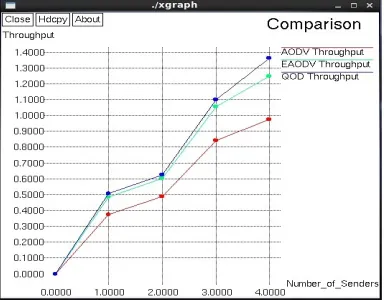
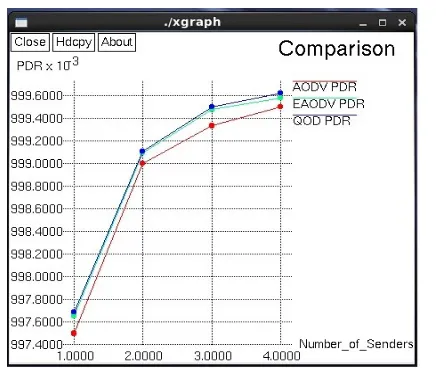
This section compares the performance of QOD with that of EAODV and AODV through simulations on NS3. E-AODV is Extended Ad-hoc On Demand Distance Vector routing protocol. This protocol extends AODV routing protocol by appending additional information such as maximum delay and minimum available bandwidth of each neighbour nodes in their respective routing tables. AODV is Ad-hoc On Demand Distance Vector routing protocol which is the most popular routing protocol for wireless ad hoc networks. Here the scenario considered is the networks with different number of source nodes. Then, the parameters like throughput, packet delivery ratio and delay is calculated for the networks with different number of source nodes. Throughput is defined as the total number of data packets which are successfully transmitted per unit time. Delay is defined as the entire time duration for transmitting the data packet from the source node to the destination node. Packet delivery ratio is defined as the number of packets that are successfully received to the number of packets that are sent by the source node. From the simulation results as shown in the figures 2, 3 and 4, it is clear that the network with QOD as the routing protocol has the highest throughput, improved packet delivery ratio and minimum transmission delay compared to the networks with EAODV and AODV as the routing protocols. Figure 2 represents the comparison of throughput of three networks which is implemented with QOD, EAODV and AODV routing protocol respectively. Figure 3 represents the comparison of packet delivery ratio of three networks which is implemented with QOD, EAODV and AODV routing protocol respectively. Similarly, figure 4 represents the comparison of transmission delay of three networks which is implemented with QOD, EAODV and AODV routing protocol respectively.
[image:7.612.211.403.542.692.2]Technology (IJRASET)
V. CONCLUSIONS
Hybrid wireless networks that unite MANETs and infrastructure wireless networks have proven to be a better network pattern for the next generation wireless networks. However, not much effort has been done to enhance QoS routing in hybrid wireless networks. Also, the direct application of the QoS routing techniques of MANETs into hybrid networks causes their drawbacks. So a QoS oriented distributed routing protocol (QOD) is proposed for hybrid networks to provide QoS services in a highly dynamic scenario. Specifically, QOD uses five algorithms. The QoS-guaranteed neighbour node selection algorithm chooses qualified neighbours for data packet forwarding and reducing delay. The distributed packet scheduling algorithm for packet routing which schedules the packet transmission to further decrease the packet transmission time. The mobility-dependent packet resizing algorithm that resizes packets and assigns smaller packets to nodes with faster mobility to guarantee the routing QoS in a highly mobile environment. The soft-deadline-based forwarding and scheduling algorithm achieves fairness in packet forwarding and scheduling and can further increase the transmission throughput. The data redundancy elimination algorithm to discard the redundant data to further enhance the transmission QoS. Experimental results show that QOD can achieve high mobility-resilience, scalability, and contention reduction. In future, the performance of QOD can be improved by allocating double channel.
VI.ACKNOWLEDGMENT
[image:8.612.171.399.70.213.2]The author would like to thank all the teaching and non-teaching staffs of Electronics and Communication Department, NSS College of Engineering, Palakkad for their timely guidance and motivation for preparing this paper. The author is also thankful to parents, friends and all who supported to complete the paper in time.
Fig. 3. Comparison of packet delivery ratio of different networks Fig. 4. Comparison of transmission delay of different
[image:8.612.191.414.258.442.2]Technology (IJRASET)
©IJRASET 2015: All Rights are Reserved
754
REFERENCES
[1] Ruay-Shiung Chang, Wei-Yeh Chen, and Yean-Fu Wen, Hybrid Wireless Network Protocols, IEEE Transactions on Vehicular Technology, Vol. 52, No. 4, July 2003.
[2] R. Braden, D. Clark, and S. Shenker, Integrated Services in the Internet Architecture: An Overview, IETF RFC 1633, 1994. [3] ] E. Crawley, R. Nair, B. Rajagopalan, and H. Sandick, Resource Reservation Protocol RSVP, IETF RFC 2205, 1998.
[4] I. Jawhar and J. Wu, Quality of Service Routing in Mobile Ad Hoc Networks: Network Theory and Applications, Springer, 2004.
[5] T. Reddy, I. Karthigeyan, B. Manoj, and C. Murthy, Quality of Service Provisioning in Ad Hoc Wireless Networks: A Survey of Issues and Solutions, Ad Hoc Networks, vol. 4, no. 1, pp. 83-124 , 2006.
[6] X. Du, QoS Routing Based on Multi-Class Nodes for Mobile Ad Hoc Networks, Ad Hoc Networks, vol. 2, pp. 241-254, 2004.
[7] S. Jiang, Y. Liu, Y. Jiang, and Q. Yin, Provisioning of Adaptability to Variable Topologies for Routing Schemes in MANETs, IEEE J. Selected Areas in Comm., vol. 22, no. 7, pp. 1347-1356 , Sept. 2004.
[8] M. Conti, E. Gregori, and G. Maselli, Reliable and Efficient Forwarding in Ad Hoc Networks, Ad Hoc Networks, vol. 4, pp. 398-415, 2006.
[9] S. Ibrahim, K. Sadek, W. Su, and R. Liu, Cooperative Communications with Relay-Selection: When to Cooperate and Whom to Cooperate With? IEEE Trans. Wireless Comm., vol. 7, no. 7 , pp. 2814-2827, July 2008.
[10] A. Bletsas, A. Khisti, D.P. Reed, and A. Lippman, A Simple Cooperative Diversity Method Based on Network Path Selection, IEEE J. Selected Areas in Comm., vol. 24, no. 3, pp. 659-672 , Mar. 2006.
[11] T. Ng and W. Yu, Joint Optimization of Relay Strategies and Resource Allocations in Cellular Networks, IEEE J. Selected Areas in Comm., vol. 25, no. 2, pp. 328-339, Feb. 2004.
[12] J. Cai, X. Shen, J.W. Mark, and A.S. Alfa, Semi-Distributed User Relaying Algorithm for Amplify-and-Forward Wireless Relay Networks, IEEE Trans. Wireless Comm., vol. 7, no. 4, pp. 13481357, Apr. 2008.
[13] Y. Wei and D. Gitlin, Two-Hop-Relay Architecture for Next Generation WWAN/WLAN Integration, IEEE Wireless Comm., vol. 11, no. 2, pp. 24-30, Apr. 2004.
[14] Y.E. Sung, C. Lund, M. Lyn, S. Rao, and S. Sen, Modeling and Understanding End-to- End Class of Service Policies in Operational Networks, Proc. ACM Special Interest Group Data Comm. (SIGCOMM), 2009.
[15] C.E. Perkins, E.M. Royer, and S.R. Das, Quality of Service in Ad Hoc On-Demand Distance Vector Routing, IETF Internet draft, 2001. [16] D.B. Johnson and D.A. Maltz, Dynamic Source Routing in Ad Hoc Wireless Networks, Mobile Computing, vol. 353, pp. 153181, 1996. [17] H. Luo, R. Ramjeey, P. Sinhaz, L. Liy, and S. Lu, UCAN: A Unified Cell and Ad-Hoc Network Architecture, Proc. ACM MobiCom, 2003.
[18] H. Wu, C. Qiao, S. De, and O. Tonguz, Integrated Cell and Ad Hoc Relaying Systems: iCAR, IEEE J. Selected Areas in Comm., vol. 19, no. 10, pp. 2105-2115, Oct. 2001.
[19] C. Liu and J. Layland, Scheduling Algorithms for Multiprogramming in a Hard Real-Time Environment, J. ACM, vol. 20 , pp. 4661, 1973. [20] D. Lin and R. Morris, Dynamics of Random Early Detection, Proc. ACM Special Interest Group Data Comm. (SIGCOMM), 1997.