Calculating Threshold Current Density and
Output Power of Vertical Cavity Surface
Emitting Laser
Jayati Nandy1, Sayan Das2, Sourav Das3, Mouli Biswas4, Arpan Deyasi5
1,2,3,4,5
Department of Electronics & Communication Engineering, RCC Institute of Information Technology
Abstract— In this paper, threshold current density and output power of the vertical cavity surface emitting laser is analytically calculated as a function of different electrical and optical parameters, and their interdependency is also studied. Quantum confinement factor and doping density can greatly influence the threshold current, and hence the power, which, in turn, depends on the mirror surface smoothness, i.e., reflectivity. Results suggest that increase of active region dimension enhances threshold current density, which reduces output power level. Increase of doping density increases threshold current at the cost of higher dark current. Hence an optimization is required based on the application point of view.
Keywords—VCSEL, Threshold current density, Output power, Active region thickness, confinement factor, Doping density
I. INTRODUCTION
Vertical cavity surface emitting laser is one of the most improved optical transmitters for photonic integrated circuit [1]. Its performance can be analyzed by tuning the structural parameters of the multiple quantum well embedded in the active region, and also by tuning the various design parameters [2-3]. Resonant cavity or this structure is along the perpendicular plane of the active layer, and electromagnetic wave resonates between the mirrors to allow photons to emit within a very narrow passage of the active medium. It is now used in very low dispersion window (1470 -1610 nm) for optical fiber communication [4].
The working principle of VCSEL is explained by the physics of Bragg reflection. Kavokin analyzed the effect of light absorption [5] using transfer matrix method in multilayer semiconductor devices. Brovelli showed the dependence of light penetration depth [6] in a Bragg mirror on reflectivity of the top and bottom mirrors. This physics is used to analyze the mode propagation in one-dimensional photonic crystal waveguide [7] in recent past. Su and his co-workers find the temperature effect on photonic properties [8] of VCSEL. Iga analyzed the relation between output power and quantum efficiency [9] for optimum performance. Seurin developed a
efficiency. Some design rules considering GaN/AlGaN structure [11] are suggested for 300 nm operating region. Reflectivity effect is also analyzed recently [12] for obtaining higher output power.
In this paper, threshold current density and output power per unit area of the VCSEL is analytically estimated as function of device dimension, doping density, confinement factors and reflectivities of the top and bottom surfaces. Interdependencies of the various parameters are studied for optimized design.
II. MATHEMATICAL MODELING
For a Febry-Perot type VCSEL with linear gain approximation, threshold current density can be expressed as
2 2 1 0 0)
/
1
ln(
)
2
(
1
tr b b eff eff eff thN
R
R
A
L
A
L
L
qdB
J
(1)where d is the active region thickness, Beff is recombination
constant, A0 is differential gain coefficient, Leff is effective
Ntr is the transparency current density, ζ is the confinement
factor.
The variation of output power with threshold current density may be expressed as
)
(
)]
/
1
ln(
2
[
1
)
/
1
ln(
2 1 2 1 th b b b bJ
J
R
R
L
R
R
q
ih
Peff
(2) [image:3.612.312.563.103.493.2]III. RESULTS AND DISCUSSION
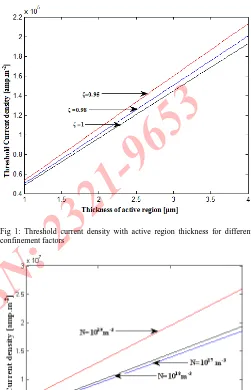
Fig 1 shows the threshold current density with active region width for different confinement factors. Profile shows a linear nature which suggests that current density can be estimated at any thickness if nature of the slope is known from the available dataset. It is seen form the plot that the reduction of confinement increases current density. This is due to the fact that lower confinement increases loss factor of a Febry-Perot cavity which in turn, decreases the effective gain, and thus the threshold current density. Unity value of the factor suggests that thickness of active quantum well region is uniform, whereas a slight deviation from unity value gives non-uniformity in the well which gives lower probability of escaping carriers, hence threshold current density increases.
Fig 2 shows the threshold current density with active region thickness for different transparency concentration. This concentration is required to obtain transparency current density, which effectively increase threshold current. It effectively adds with the equivalent carrier concentration responsible for optical gain in a Febry-Perot cavity, and thus with increase of transparency concentration, threshold current density increases.
Fig 1: Threshold current density with active region thickness for different confinement factors
Fig 2: Threshold current density with active region thickness for different doping density
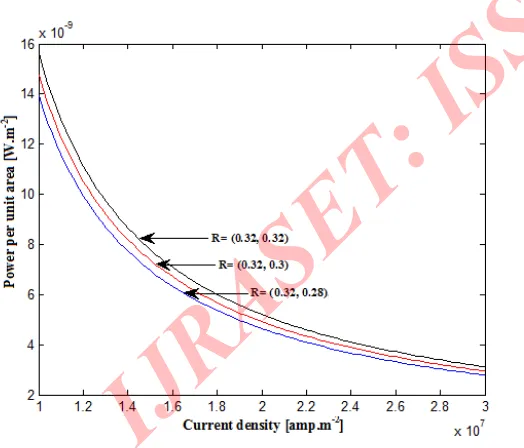
[image:3.612.59.215.180.248.2] [image:3.612.310.558.320.554.2]The difference of mirror reflectivity becomes almost indistinguishable for higher current.
[image:4.612.53.296.142.348.2]Fig 3: Output power per unit area with threshold current density for different reflectivity
Fig 4: Output power per unit area with threshold current density for variation for asymmetric reflectivity
Fig 4 shows the power per unit area with current density for asymmetric mirror properties, and results are compared with symmetric reflective faces. It is observed that due to the
difference between reflective values between two faces, output power decreases. This is true for any value of the current. Hence for design of VCSEL with optimum performance, symmetric reflectivity is the best choice.
IV. CONCLUSION
From the result, it has been observe that increase in thickness of active region increases threshold current density, which in turn, reduces output power per unit area. Hence for higher power requirement, current density should be minimized, which is not desirable for all cases. Again, it can be increased by reducing confinement factor, which is not good from application point of view. Increase of doping density increases threshold current, which increases dark current. This is also undesirable. Hence a proper optimization of design parameters is required for better performance.
REFERENCES
[1] K. D. Choquette, K. L. Lear, R. P. Schneider, and K. M.
Geib, "Cavity Characteristics of Selectively Oxidized AlGaInP Vertical-cavity Lasers," Electronics Letters, vol. 31, pp. 1145-1146, 1995.
[2] C. Qi, X. Shi, G. Wang, J. Hu, “A New Circuit Model of
Multi-quantum Well Vertical-Cavity Surface-Emitting Lasers”, 3rd International Nanoelectronics Conference, pp. 1449 –1450, 2010.
[3] K. Kumarajah, P. S. Menon, M. Ismail, B. Y. Yeop, S. Shaari, Multi-quantum Well Design Parameter Variation in InP-based VCSEL”, Proceedings of the 8th WSEAS
International Conference on Microelectronics,
Nanoelectronics, Optoelectronics, pp. 115-117, 2010.
[4] D. Wiedenmann, R. King, C. Jung, R. Jager, R.
Michalzik, P. Schnitzer, M. Kicherer, K. Ebeling,
“Design and Analysis of Single-mode Oxidized VCSELs
for High-speed Optical Interconnects”, IEEE Journal of Selected Topics in Quantum Electronics, vol. 5, pp. 503-511, 1999.
[5] A. V. Kavokin, M. A. Kaliteevski, “Light absorption
effect on Bragg Interference in Multilayer
Semiconductor heterostructure”, Journal of applied Physics, vol. 79, pp. 595-598, 1996.
[6] L. R. Brovelli, U. Keller, “Simple Analytical
[image:4.612.49.311.383.607.2]Depth of a Bragg Mirror between Arbitrary Media”, optics Communications, vol. 116, pp. 343-350, 1995.
[7] B. R. West, A. S. Helmy, “Properties of the Quarter -wave Bragg Reflection Waveguide: Theory”, Journal of Optical Society of America B, vol. 23(6), pp. 1207-1220, 2006.
[8] S. T. Su, S. F. Tang, T. C. Chen, C. D. Chiang, S. T. Yang, W. K. Su, “Temperature Dependent VCSEL Optical Characteristics based on Graded AlxGa
1-xAs/GaAs Distributed Bragg Reflectors: Reflectivity and
Beam Profile Analyses”, Proceedings of SPIE, vol. 6132, p. 61320L, 2006.
[9] K .Iga, “Vertical-Cavity Surface-Emitting Laser: Its
Conception and Evolution”, Japanese Journal of Applied Physics, vol. 47(1), pp. 1-10, 2008.
[10] J. F. Seurin, C. L. Ghos, V. Khalfin, A. Miglo, G. Xu, J. D. Wynn, P. Pradhan, L. A. D. Asaro, “High-power
High-efficiency 2D VCSEL Arrays”, Proceedings of
sPIE, vol. 6908, p. 690808, 2008.
[11] C. A. Gelas, P. Heroin, M. Abi, J. Jacquet, S. Gautier, A. Ougazzaden, “Design Rules of High reflectivity Bragg
GaAlN Mirrors for 300 nm VCSEL’s”, Proceedings of
sPIE, vol. 7229, p. 72290N, 2009.
[12] F. Z. Jasim, K. Omar, Z. Hassan, “The Effect of
Reflectivity on VCSEL Output Performance”,