Full Length Research Article
STUDY OF PRIME NUMBERS THROUGH THEIR HISTORICAL DEVELOPMENT APPLYING MATLAB
*1Carlos Figueroa, N.,
2Julio Campos, G. and
3Lamberto Castro, A.
1Universidad de Sonora, Departamento de Ingeniería Industrial, Rosales y Luis Encinas, Hermosillo Sonora, México 2Universidad de Sonora, Unidad Cajeme. Cd. Obregón, Sonora, México
3Universidad de Sonora, Unidad Regional Sur. Navojoa, Sonora, México
ARTICLE INFO ABSTRACT
Our objective is to analyze the theoretical development of prime numbers commenting on the historical constructs; and, through the application of Matlab, propose new forms to study the polynomials, the functions and the theorems involved. The idea is that the software facilitates the comprehension of a complicated subject and helps to carry out demonstrations necessary in the mathematical analysis of the subject. In addition, it promotes the interest in numbers theory among more students.
Copyright © 2014 Carlos Figueroa et al. This is an open access article distributed under the Creative Commons Attribution License, which permits unrestricted use, distribution, and reproduction in any medium, provided the original work is properly cited.
INTRODUCTION
Over the last few years, the subject of prime numbers has produced abundant literature in the research world. There has been research in number theory both basic and using computer application. One of the subjects most celebrated by the mathematicians is the Riemann hypothesis even though there are many problems of prime numbers open to edge research, such as the list of the Landau problems of 1912, which have been enlarged over the years. This hypothesis is special, given the fact that it can have connection with physics such as German Sierra (Germán Sierra, 2013) stated, who highlights the importance the Riemann zeta functionhas in the study of other physical phenomena as Quantum Chaos. Ivan Iliev (Ivan I. Iliev, 2013) has conducted a research about Riemann zeta function and hydrogen spectrum; this eventsopen a fascinating world of new applications and for a long time it has been applied in cyber security through cryptography; other works connect them with quantum computer software (Peter Shor, 1996). The study of the prime numbers theory with analytical
*Corresponding author: Carlos Figueroa, N.
Universidad de Sonora, Departamento de Ingeniería Industrial, Rosales y Luis Encinas, Hermosillo Sonora, México
functions is very much related to the intensive use of software and we think that it needs numerical methods, an area where we would like to participate. Another motivation is the work of Enrique Gracián (2014), a book that deserves a numeric-graphical correlate similar to the work of (Jaime Ramos Gaytán, 2003; Goldstein, 1973; Saldívar, 2002 and Bateman and Diamond, 1996), which inspires the application of a software such as Matlab to approach the subject. Historically speaking, prime numbers are of great importance because they join a chain of events related to great personalities of exact sciences such as Euclides, Mersenne, Goldbach, Fermat, Euler, Gauss, Riemann and Ramanujan. The book of Marcus du Sautoy (Marcus du Sautoy, 2003) tells the story of these brilliant men who contributed to the advancement of this subject, a very excellent work for those who want to get deeper into the subject; moreover, it tells the story up to our time.For more than 2000 years, mankind has been surpassed by a mathematical problem requiring a lot of effort. Prime numbers are important since they form the fundamental basis of mathematics. All other numbers that are not prime can be built multiplying prime numbers. Similarly, as atoms form the framework of molecules and matter, prime numbers are the “atoms” of which all numbers are formed. We start making a chronological account of some historical milestones involved
ISSN: 2230-9926
International Journal of Development Research
Vol. 4, Issue, 12, pp. 2750-2756, December, 2014
International Journal of
DEVELOPMENT RESEARCH
Article History:
Received 30thSeptember, 2014 Received in revised form 29thOctober, 2014
Accepted 29thNovember, 2014 Published online 27thDecember, 2014
Key words:
Fundamental theorem or arithmetic, Laundau problems,
in the construction of the theory that explains this old science enigma. Our method is based on using Matlab to generate certain functions and theorems with the style and purpose used by Rovenski (Rovenski, 2010).
Euclides Theorem
The pioneer theory is the so-called “fundamental theory of arithmetic” which is attributed to the Greek mathematician Euclides; his theorem states ‘all natural number can be decomposed as product of prime numbers’, that is, prime numbers are the fundamental elements with which all numbers are built, such as:
This means that with all natural numbers it will always be possible to determine a decomposition of prime numbers. Euclides was the first one to mention the existence of prime numbers. They are considered infinite but, as they grow, the distance that separates them is larger each time and, therefore, more complicated to locate. As if that were not enough, between this group already rare by itself, there is another group more peculiar; the twin prime numbers, that is, pairs of prime numbers separated by two units (for example, 3 and 5, 11 and 13, 41 and 43...). It is also presumed that they are infinite but it is only an assumption, unconfirmed up to this day.
Mersenne Numbers
This great mathematician from the XVII century affirmed that
the number is prime only if the value of is one of the following (primes) but without the number 11
It was not until 1947, that it was found that the Mersenne numbers are
Currently, only 48 Mersenne prime numbers are known.
Goldbach Conjecture
Euler’s friend, Goldbach proposed him the following. All even numbers larger than two can be written as the sum of two prime numbers
Goldbach’s conjecture has not been demonstrated yet and is considered a challenge. Indeed, at the international congress of mathematics in 1912, it was considered as an intractable problem along with other problems of the same type (José M. Sánchez Muñoz, 2011).
Fermat numbers and the little theorem
This is a natural number with the following appearance:
(1)
It is symbolized with the letter F of Fermat, and the first elements are:
Fermat conjectured that all the numbers that were obtained in this way were prime numbers; the first five, that is, 3,5,17,257 and 65537, are prime numbers. When the value of n is 5, the number that is obtained is:
Fermat never knew if it was prime or not, but it seems that Euler knew, and in 1732 he found a characterization of this number as product of the other two:
Euler solved Fermat’s doubt. In spite of this, Fermat numbers are useful in the primality test. Fermat’s little theorem is a great contribution since it represents the initiation of modular arithmetic, and we have that if a is a natural number and p is a prime number, this can be written as:
(2)
Modular arithmetic is similar to a clock, where the numbers complete a turn after reaching certain value called module. Here, we used Gauss notation. Congruence relations are those such as are congruent, module , for example 63 and 83 leave the same number (3) if they are divided by 10, that is, is similar to a clock, where the numbers complete a turn after reaching a certain value a module. Here we used the Gauss notation
Congruence relations are those such as a , bare congruent, module n, for example 63 and 83 leave the same number (3) if they are divided by 10,
Euler, the master of all
Euler amassed a vast amount of scientific achievements, which is why he is considered a pioneer in the serious study of prime numbers. Although Euler’s literature abounds, we recommend (Meneses et al., 2009 and Dunham, 2006). Euler defined a function based in the harmonic series:
(3)
Euler found that this was related to the number
(4)
2 2
14 2 7 11 11 1 202 5 282 7
2
p
1
p
2 , 3, 5, 7 ,1 3,1 7 ,1 9 , 3 1, 6 7 ,1 2 7 , 2 5 7
2, 3, 5, 7 ,1 3,1 7 ,1 9, 3 1, 6 1, 8 9,1 0 7 ,1 2 7 , ....
8 5 3, 1 2 5 7
2
2
n1
n
F
0 3, 1 5, 2 1 7 , 3 2 5 7 ...
F F F F
5
2 32
5 2 1 2 1 4, 294, 967, 297
F
4 , 2 9 4 , 9 6 7 , 2 9 76 4 1 6 , 7 0 0 , 4 1 7
1
1 mod
p
a
p
mod
a
b
n
63
83 mod10
2
7
7
42
7
42 mod 2
1
1 1 1 1 1 1
....
1x 2x 3x 4x x x
n x
n n
2 ,
46 90
Euler set forth a relation between this function and prime numbers. It is said that with this discovery, the analytical study of prime numbers began.
(5)
Legendre’s conjecture
In 1798, Legendre proposed the following expression that approaches the function
(6)
where A and B are constant. Sometimes B=1.08366 which is calledLegendre’s constant.However, one of Landau problems is Legendre’s conjecture that expresses always a prime number between two perfect squares, that is, between n2and (n+1).
Gauss and the prime number theorem
The prince of mathematics discovered that the randomness of prime numbers follows a definite order; he found that there is an average law, defined that a function such that π(x) is the amount of prime numbers smaller than x, accordingly
From the latter, it is referred to 1,2,3,7,11 and 13. This law is related to the integral logarithmic function defined by:
(7)
The contributions of Dirichlet and Chebyshev
In 1836, the germanDirichlet generalizedEuler’s idea to link the Z function of Riemann with the product of prime numbers. The Z function of Riemann is a special case of the L functions. With this, the application of infinitesimal methods to the theory of numbers began, as well as the asymptotic distribution of prime numbers, where Chebyshev made great applications.
Riemann hypothesis
Riemann studied Gauss conjecture and proposed to make the zeta function for complex numbers, which converts into Riemann zeta function
, (8)
Bernhard Riemann was Gauss’ student. He asked him to develop the prime number theorem. In 1859 his hypothesis (José Luis Muñoz, 2006) (the famous Riemann hypothesis) was published. Thirty years following his death, there were few advancements regarding problems of prime number distribution, although, based on his works, other mathematicians of the standing of J. Hadamard and C. J. de la
Vallée-Poussin, had demonstrated the main formula of its distribution, the Prime number theorem, conjectured a century before by Gauss and Legendre.Riemann’s idea was based on the relationship of the functionπ(x) with the zeta function, but considering the function with a complex variable. The conjecture begins if the function is expressed in a different way; indeed, it can be demonstrated that this is of the form
(9)
Where is the known Gamma function. If the written
function is observed in this form, it can be seen that it has certain values called nontrivial zeros; for example, However, there are other complex values between 0<Re(s)<1 where the function is cancelled, these are called nontrivial zeros.Riemann’sconjecture states: the real part of all nontrivial zero of the zeta function is1∕2. Riemann zeta function has a deep connection with prime numbers and in 1901 Hege von Koch demonstrated that the Riemann hypothesis is equivalent to the prime number theorem. David Hilbert placed the Riemann hypothesis in eighth place of his twenty-three problems presented at the famous International Congress of Mathematics of 1900 in Paris. Likewise, in the year 2000, the Clay Institute of Mathematics based in Cambridge University Massachusetts still finds most of the problems unsolved, except the conjecture of Poincare which was solved in the year 2004 by Perelman; therefore, the Riemann hypothesis has been the center of many investigations up to this present day.
Hardy, Littlewood, Ramanujan
Godfrey Hardy and John Littlewood of Trinity College of Cambridge, England, at the beginning of the twentieth century tried to solve the famous Waring program, suggests that in all numbers is the sum of at least four squares, or nine cubes, or 19 numbers to the fourth power. Also, they established the Hardy-Littlewood conjecture, set forth by the following equations:
(10)
Ramanujan, the Hindu mathematical genius, joined this team. In 1916 Ramanujan set forth a new Euler product, and related the logarithmic integral with Euler Gamma constant.
The contributions of Erdos and Selberg
After the mathematician J. Hadamard and CH. de la Valle-Poussin demonstrated the prime number theorem at the beginning of the twentieth century in a very complex form, almost 50 years passed before P. Erdos and A. Selberg separately found an elemental demonstration of the theorem. There are many other mathematicians that were not mentioned such as Landau, Ivan Vinagodrov, Chen Jingrun, Schnirelmann and von Koch. However, approach focuses on the possibilities to perform numeric analyses of this subject. That is, we are
1 1 1 1 x x n p x n p
x
log
x
x
A
x
B
1 0 4 ; 1 5 6
2log
xdt
x
Li
t
1 1 s n s n
s a b i R e s 1
1
2 sin 1 1
2
s s s
s s s
1 s
2,
4,...
s
s
strying to combine elements of the history leading to the formation of the theory applying software such as Matlab in order to complement the understanding of the subject. First, some polynomials that generate prime numbers are plotted; second, a graph for the prime number theorem is generated and finally, there is a graph of the zeta function, its zeroes, and the integral logarithmic function. The following table presents a state-of-the-art list of mathematicians and their contributions in this area.
Table 1. Honor roll and models chronology
Character Contribution
Euclides (325-265 BC) Arithmetic fundamental principle Marin Mersenne (1588-1648) Mersenne prime numbers Pierre Fermat (1601-1665) Fermat numbers and little theorem Christian Goldbach (1690-1764) Conjecture
Leonhard Euler (1707-1783) Zeta function linked to prime numbers
Adrien-Marie Legendre (1752-1833) Legendre conjecture Friedrich Gauss (1777-1855) Prime number theorem Peter Dirichlet (1805-1859) and
Pafnuty Chebyshev (1821-1894) L functions for prime numbers Bernhard Riemann (1826-1866) Zeta function with complex
argument
Srinvasa Ramanujan (1887-1920) Generalization of the product of Euler primer numbers Jackes Hadamard (1865-1963) Demonstration of the prime
number theorem Charles J. de la Valle-Poussin
(1866-1962)
Demonstration of the prime number theorem
Paul Erdos (1913-1996) and Atle Selberg (1917-2007)
Elemental demonstration of the prime number theorem
Polynomials that generate prime numbers
Euler found a polynomial that generated prime numbers, but up to certain value. An example of which is the polynomial that is generated in Figure 1
[image:4.595.35.290.188.393.2](11)
Figure 1. Euler polynomial
This generates prime numbers for n0 and 39. Adrien-Marie Legendre found another that takes values of , which is generated in Figure 2
[image:4.595.312.551.296.522.2](12)
Figure 2. Legendre polynomial
Legendre proposed another polynomial valid for , which is generated in Figure 3
(13)
Figure 3. Legendre polynomial.
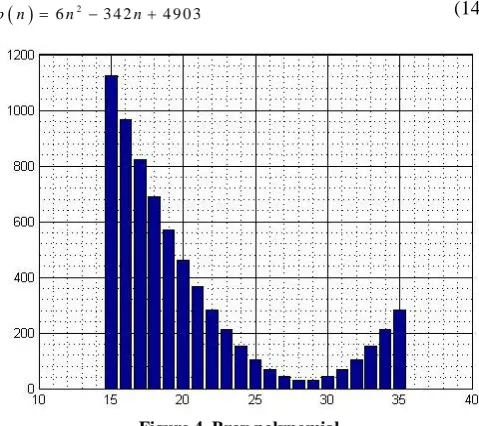
In 2006 Brox found the polynomial for , which is
generated in Figure 4
(14)
Figure 4. Brox polynomial
241 p n n n
0 n1 5
217 p n n n
0 n 29
22 39
p n n
0 n5 7
2
6 3 4 2 4 9 0 3
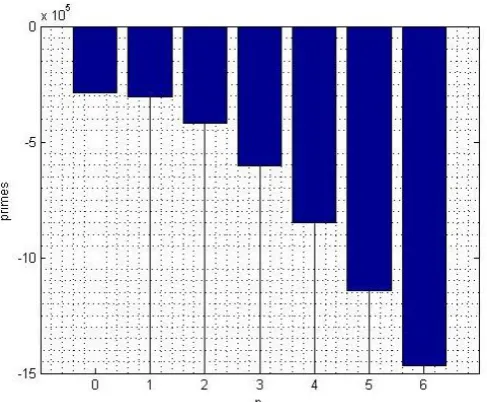
[image:4.595.38.289.473.711.2] [image:4.595.313.553.564.777.2]This same year, Wrobleswski and Meyrignac found this one where negative prime numbers appear for , which is generated in Figure 5.
[image:5.595.42.286.126.327.2](15)
Figure 5. Wrobleswski and Meyrignac polynomial.
Prime number theorem
The following table provides the first values in multiples of 10. The third row provides more precise information since it calculates so, for example:
(16)
It means that the proportion of prime numbers in this interval is
[image:5.595.310.554.247.495.2]10 100 1000 10,000 100,000 4 25 168 1,229 9592 0.400 0.250 0.168 0.1229 0.0952
Figure 6 shows the function
Figure 6. Prime number theorem
The third row of the table shows how this is decreasing as advances to larger numbers. Gauss found a relationship with the natural logarithm
(17)
Independently, Legendre and Gauss established that
(18)
which is known as the prime number theorem or Gauss conjecture. Figure7 shows its evolution. Other forms to represent it are
(19)
(20)
Figure 7. Prime number theorem
Riemann conjecture
[image:5.595.52.278.566.775.2]Riemann found a tridimensional image of the zeros of the zeta function, where there is a critical band whose real values are located between 0 and 1 and that is related to prime numbers.
Figure 8. Zeros of Riemann zeta function
0 n 5 4
5 4 3 2
( ) 9 9 3 5 8 8 5 6 8 2 2 3 4 8 2 7 2 2 8 6 3 9 7
p n n n n n n
x x
1000
168 0.1681000 1000
x x
x
x
x
x
x x
1 ln xx x
1 lnlim
x
x
x x
67log 0.5
x
x x
x
3 2log 1.5
x
x x e
x
[image:5.595.328.539.594.765.2]Jacques Hadamard and Charles de la Vallee-Poussin demonstrated in 1896 the prime number theorem set up by Gauss. Riemann says that all nontrivial zeros of the zeta function of the form , which is equivalent to saying
that the real part of all nontrivial zero of the zeta function is
(José Luis Muñoz, 2006). Next, in Figure 8 the
function is plotted, where the first zeros of the Riemann function (14.13, 21.02, 25.01, 30.42, 32.93, 37.58) can be seen.
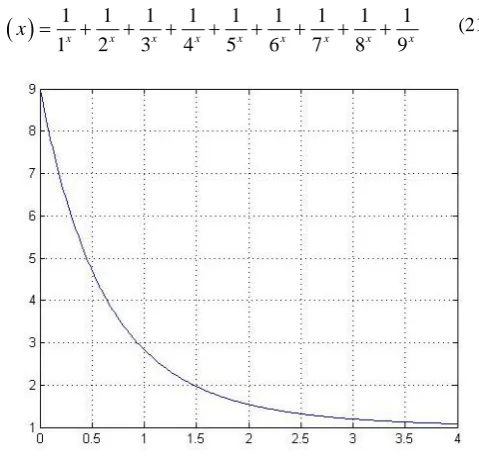
Next, in Figure 9, Riemann zeta function is plotted
[image:6.595.42.282.202.434.2](21)
Figure 9. Riemann zeta function
Dirichlet found a more general way of Euler equation for prime numbers; indeed, he proposed the so-called L function
(22)
function is called Dirichlet character, which classifies
the prime numbers in a special way; is the complex number with . Riemann zeta function is considered a special case when , the key is to make the infinite product of
prime numbers
(23)
(24)
Hardy-Littlewood conjecture establishes that the amount of prime numbers such as asymptotically tends to the following expression
(25)
Finally, the prime number theorem can be plotted. For the study of the integral logarithmic function we have to proceed in the manner of Gauss, who observed the frequency of the prime number close to x big is , and therefore the
probability that at random a number is a primer number is
(26)
(27)
(28)
(29)
The last one is called integral logarithmic function
(30)
y are very similar errors thus
(31)
[image:6.595.315.551.428.626.2]Is fulfilled. Figure 10 shows the integral logarithmic function.
Figure 10. Integral logarithmic function
Ramanujan’s contributions to the study of prime numbers were made along with Hardy and Littlewood, these individuals made great contributions due to the acute talent of Ramanujan. In 1916, this Hindu genius defines the conjecture
(32)
Louis Joel Mordell carried out this demonstration in 1920;the function is called Ramanujan tau function, and it is
linked to prime numbers through 1 2i
1 2
0.5 ix
1 1 1 1 1 1 1 1 11x 2x 3x 4x 5x 6x 7x 8x 9x x
,
1
2
3
1s 2s 3s 4s
s L s
m
s Re1
1 1
1
1
1
1
,2 3 5 7
1 1 1 1
2 3 5 7
L s
,
1
1p p L s p
2 1n x
2 1 1 1 1 log p x
p p x
lo g x x 10 1 1log x numbers of digits of x
2
prob n x
x n prime error
1
2 1 log
n x
x E x
n
2 2 1 log log x n x dt n t
i L x
x L xi
E2
x
1
E x E2
x2 2 1 2 log log x n x dt n t
11 11
1 s s
n p
n
n p p p
n(33)
Likewise, Ramanujan set forth another conjecture
(34)
The largest prime number that is not fulfilled is 38, 358 837 677.
RESULTS AND DISCUSSION
In this approach of prime numbers several conclusions can be obtained. For example, equation (5) is easy to demonstrate, and at the same time, it is important to make this demonstration; Matlab can help with this. We have to remember that this expression, produced by Euler, was generalized by Dirchlett and Ramanujan equations (22) and (32). Equation (7) is acknowledged as the prime number theorem. Equation (6) is the Legendre polynomial and it has a graph almost equal to figure (7). Equation (9) is an important manner to represent Riemann zeta function. It well explains the necessary mathematical developments. Equation (8) can be plotted, similar to the fact that equation (9) and are able to be demonstrated using Matlab.. The generation of the graph of the complex function in ·3D is pending, as well as to observe the critical line that locates prime numbers. Overall, we can see how useful it is to assist the study with the proper software.
Conclusions
Throughout this work we have demonstrated in a graphic form some polynomials, conjectures, and important theorems. However, there are pending analyses of other functions involved such as the so-called arithmetic functions or Euler’s totient function. Likewise, the Mobius function can have a numeric treatment, as well as that of Mangoldt, that of Chebychev, and the function of Liouville. The Riemann zeta function has to be plotted in three dimensions in order to revise if the distribution of prime numbers is verified in the straight line that this conjecture says.
Additionally, Landau has a group of problems about prime numbers that can be addressed with Matlab such as the Goldbach conjecture, the twin prime conjecture, and the Legendre conjecture. Our work presents a general overview and is able to describe the historical development and in addition, it shows how a software can be applied to a subject of number theory that presently is studied based on the analysis of mathematical functions. Finally, it is worth to mention that the Riemann conjecture is the cornerstone and foundation of other posterior works.
REFERENCES
Germán Sierra, 2013. La hipotesis de Riemann y la fisica. www.youtube.com/watch?v=WBpKUrM5tf4
José M. Sánchez Muñoz, 2011. Revista Pensamiento Matemático 1.
Ivan I. Iliev, 2013. Riemann Zeta Function and Hidrogen Spectrum. Electronic Journal of Theoretical Physics. 10; 28; pp: 111-134
Peter Shor, 1996. Polynomial–time algorithms for prime factorization and discrete on a quantum computer.arXiv-ph/95080278.
Enrique Gracián, 2014. El misterio de los números primos. Edit. National Geographic.
Jaime Ramos Gaytán, 2003. El teorema de los números primos. Miscelánea Matemática, 3815-31.
Goldstein, L. J. 1973. History of the prime number theorem. Amer. Math. Monthly, 80; 599-614.
Saldívar, F. 2002. La función zeta de Riemann. Miscelánea Matemática, 36; 63-82.
Bateman, P.T. and H.G. Diamond, 1996. A hundred years of prime numbers. Amer. Math. Monthly 103 9 729-741. Marcus du Sautoy, 2003. La Música de los Números Primos
Edit. El acantilado. Spain
Rovenski, V. 2010. Modeling of Curves and Surface with Matlab Edit. Springer 14-108. USA.
Meneses, A., J. Delgado and F. Monroe, 2009. El legado matemático de Leonhard Euler. Edit. UAM. México Dunham, W. 2006. Euler el maestro de todos los matemáticos.
Edit. Nivola España.
José Luis Muñoz, 2006. Riemann. Una nueva visión de la geometría. Edit. Nivola, Spain.
11 22
p p
2
log
ex x
x
x e