A 10-BIT 50 MEGA-SAMPLES-PER-SECOND PIPELINED
ANALOG-TO-DIGITAL CONVERTER
YUZMAN BIN YUSOFF
A 10-BIT 50 MEGA-SAMPLES-PER-SECOND PIPELINED ANALOG-TO-DIGITAL CONVERTER
YUZMAN BIN YUSOFF
A thesis submitted in fulfilment of the requirements for the awards of the degree of
Master of Engineering (Electrical)
Faculty of Electrical Engineering
Universiti Teknologi Malaysia
iii
ACKNOWLEDGMENTS
First, I would like to express my deep appreciation to my supervisor and co-supervisor, Dr. Muhammad Nadzir Marsono and Mr. Mohd Shahiman Sulaiman, for their invaluable guidance, their kindness, and support throughout my long journey as a graduate student. Without their encouragement and patient support, this work would not have been possible.
Thanks to Mr. Reza Lotfi from Mars Semiconductor Technology for his helps on MATLAB programming.
I would like to thank my fellow colleague, Mr Wee Leong Son and friends from Microelectronics department in MIMOS Berhad for their helps, suggestions and inspirations toward the success of this project.
My warmest appreciation also goes to my family who has given their unfailing support and patience; especially to my beloved wife.
iv
ABSTRACT
v
ABSTRAK
Hampir keseluruhan alat komunikasi moden diimplementasi pada sistem mudah alih
yang dikuasai oleh tenaga bateri yang terbatas. Disebabkan oleh kebergantungan alat-alat
kominukasi ini kepada bateri, sesuatu usaha perlu dilakukan untuk mengurangkan
penggunaan kuasa mereka. Salah satu pendekatan ialah dengan menggunakan penukar
analog kepada digital (analog-digital) yang berkuasa rendah. Tesis ini memberi tumpuan
pada pelaksanaan rekabentuk penukar analog kepada digital jenis talian paip kuasa rendah
untuk digunakan di dalam sistem komunikasi tanpa wayar. Penukar analog-digital talian
paip ini dihasilkan dengan menggunakan struktur 1.5-bit disetiap peringkat bersama dengan
litar pembetulan ralat. Untuk mengurangkan penggunaan kuasa, litar khusus untuk sampel
dan pegang yang lazimnya digunakan di bahagian hadapan kebanyakan senibina penukar
analog-digital talian paip telah disingkirkan. Tambahan lagi, analisis mengenai penggunaan
kuasa di dalam beberapa struktur rekabentuk telah dilakukan dengan bantuan perisian
MATLAB® bagi menentukan senibina terbaik untuk resolusi di dalam setiap peringkat
talian-talian paip ini. Pembanding dinamik juga turut digunakan untuk mengurangkan lagi
penggunaan kuasa di dalam semua peringkat talian-talian paip ini. Penukar analog-digital
yang berkuasa rendah ini telah dihasilkan dengan menggunakan teknologi 0.18µm
pelengkap logam oksida semiconduktor daripada Siltera dengan dua lapisan polisilikon dan
lima lapisan logam. Penukar analog-digital yang telah direkabentuk ini berjaya mencapai
resolusi 10-bit pada kelajuan 50 Mega sampel per satu saat dan nisbah isyarat kepada
hingar dan herotan adalah 50.82dB. Disamping itu, nombor bit berkesan ialah 8.15-bit.
Nilai ketaklurusan kebezaan dan ketaklurusan kamiran masing-masing ialah ±1 bit bererti
terkecil. Penggunaan kuasa oleh penukar analog-digital yang direkabentuk ini ialah
sebanyak 97mW pada voltan bekalan 3V dan seluruh keluasan bentangan termasuk pad
vi
TABLE OF CONTENTS
CHAPTER TITLE PAGE
DECLARATION ii
ACKNOWLEDGEMENTS iii
ABSTRACT iv
ABSTRAK v
TABLE OF CONTENTS vi
LIST OF TABLES x
LIST OF FIGURES xi
LIST OF ABBREVIATIONS xv
LIST OF APPENDICES xvii
LIST OF PUBLICATIONS xviii
1 INTRODUCTION 1
1.1 Motivation 2
1.2 Problem Statement 4
1.3 Research Contribution 5
1.4 Thesis Organization 6
2 LITERATURE REVIEWS 7
2.1 Performance parameters 7
2.1.1 Differential and Integral Non-Linearity 8
vii
2.1.3 Total Harmonic Distortion 10
2.1.4 Signal-to-Noise Distortion Ratio 10
2.1.5 Spurious Free Dynamic Range 10
2.1.6 Effective Number of Bits 11
2.1.7 Latency 11
2.2 Overview of Analog-to-Digital Converter Architecture (ADC) 12
2.2.1 Flash ADC 12
2.2.2 Successive Approximation ADC 13
2.2.3 Pipelined ADC 14
2.2.4 Over-Sampled ADC 15
2.2.5 Summary of ADC Architectures 15
2.3 Basic Building of Pipelined ADC 17
2.3.1 Multiplying Digital-to-Analog Converter (DAC) 17
2.3.2 Sub-ADC 21
2.3.3 Operational Amplifiers 22
2.3.4 Comparator 31
2.3.5 Digital Error Correction 33
2.4 Chapter Summary 34
3 SYSTEM DESIGN ARCHITECTURE 35
3.1 ADC Specifications 35
3.2 Power Optimization 36
3.2.1 Bit Per Stage Architecture 36
3.2.2 Sample and Hold Removal 40
3.2.3 Stage and Capacitor Scaling 41
3.3 System Level Simulation 42
viii
4 DESIGN IMPLEMENTATIONS 45
4.1 1.5-bit Multiplying DAC 45
4.1.1 Operational Amplifier 46
4.1.2 Common Mode Feedback 50
4.1.3 Bias Circuit 51
4.1.4 Sub-DAC 51
4.1.5 Switches 54
4.1.5.1 Transmission gate 54
4.1.5.2 Bootstrap Switch 55
4.1.6 Non Overlapping Clock Generator 56
4.1.7 MDAC Characterizations 57
4.2 Sub-ADC 59
4.3 Digital Error Correction Circuit 62
4.4 Fully Integrated 10-bit 50MS/s Pipelined ADC 64
4.5 Chapter Summary 66
5 ADC CHARACTERIZATION 67
5.1 Functionality 67
5.2 Static Linearity 70
5.3 Dynamic Linearity 71
5.4 Chapter Summary 74
6 CONCLUSION 76
6.1 Thesis Contributions 76
ix
REFERENCES 79
x
LIST OF TABLES
TABLE NO. TITLE PAGE
1.1 ADC applications and their design constraints 2
3.1 Design specifications for pipelined ADC for wireless
communication system application. 36
3.2 Different configurations for different pipelined architecture 39
3.3 Pipelined ADC preliminary result using MATLAB 44
3.4 Design requirements for MDAC design 44
4.1 Possible state for Sub-DAC outputs 52
4.2 Summary of FFT results for 1.5-bit MDAC 59
4.3 Lists of required comparators in the designed pipelined ADC 61
5.1 Summary of functional simulation results 69
xi
LIST OF FIGURES
FIGURE NO. TITLE PAGE
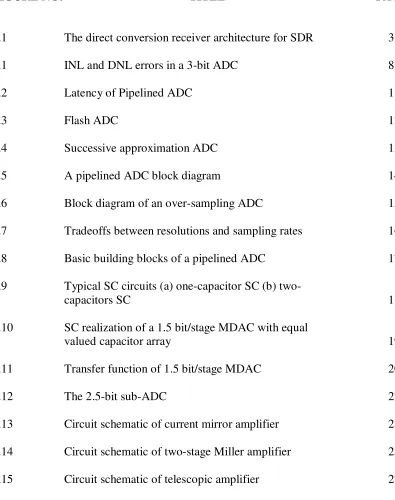
1.1 The direct conversion receiver architecture for SDR 3
2.1 INL and DNL errors in a 3-bit ADC 8
2.2 Latency of Pipelined ADC 11
2.3 Flash ADC 12
2.4 Successive approximation ADC 13
2.5 A pipelined ADC block diagram 14
2.6 Block diagram of an over-sampling ADC 15
2.7 Tradeoffs between resolutions and sampling rates 16
2.8 Basic building blocks of a pipelined ADC 17
2.9 Typical SC circuits (a) one-capacitor SC (b) two-
capacitors SC 18
2.10 SC realization of a 1.5 bit/stage MDAC with equal
valued capacitor array 19
2.11 Transfer function of 1.5 bit/stage MDAC 20
2.12 The 2.5-bit sub-ADC 22
2.13 Circuit schematic of current mirror amplifier 23
2.14 Circuit schematic of two-stage Miller amplifier 25
xii
2.16 Circuit schematic of folded-cascode amplifier 29
2.17 Input/output characteristic of an ideal comparator 31
2.18 A CMOS regenerative latch 32
2.19 Digital error correction techniques used for 1.5-bit stage 33
3.1 Flow chart of a power optimization algorithm 38
3.2 MATLAB simulation result for power consumption
estimations 40
3.3 Conceptual diagram of scaled pipelined ADC architecture 41
3.4 Histogram plot for 100 Monte Carlo runs versus SNDR 42
3.5 Histogram plot for 100 Monte Carlo runs versus SFDR 42
3.6 MATLAB simulation results for DNL 43
3.7 MATLAB simulation results for INL 43
4.1 1.5-bit MDAC with fully differential configuration 46
4.2 Gain boosting cascode amplifier 47
4.3 (a) Schematic and (b) layout of fully differential
gain-enhancement telescopic amplifier 48
4.4 AC and bode plots for simulated gain and phase margin
of gain-boosted op-amp 49
4.5 Gain-boosted op-amp settling behaviors in 3 corners 49
4.6 A common mode feedback circuit 50
4.7 Biasing circuit of op-amp 51
4.8 Circuit schematic of sub-DAC for 1.5 bit per-stage 52
4.9 Simulation result for sub-DAC 53
4.10 Sub-DAC layout 53
xiii
4.12 Bootstrap switch (a) circuit and its (b) layout 55
4.13 Simulated results for bootstrap switch 55
4.14 Non-overlapping clock generator 56
4.15 Timing simulation for non-overlapping clock generator 56
4.16 Layout of 1.5-bit MDAC 57
4.17 Post simulation result for MDAC residue 57
4.18 Post simulation result for functional MDAC 58
4.19 64-points FFT plots for MDAC 58
4.20 Dynamic resistive comparator (a) circuit and (b) layout 60
4.21 Simulation results of comparator with threshold of +¼Vref 61
4.22 Digital error correction circuit 62
4.23 Illustration of simulation results for digital error correction
circuit. 63
4.24 Layout design for digital error correction circuit. 63
4.25 Block diagrams for all ADC’s sub-circuits 64
4.26 Top level schematic of 10-bit 50MS/s pipelined ADC 65
4.27 Layout of 10-bit 50MS/s pipelined ADC 65
5.1 Post simulation result for functionality check on pipelined
ADC. 68
5.2 ADC functional characterizations using ideal DAC 69
5.3 Partial result of HSPICE simulation for ADC static
performances 70
5.4 Simulated (a) DNL and (b) INL for pre layout pipelined
ADC 71
5.5 Simulated (a) DNL and (b) INL for post layout pipelined
xiv
5.6 32-Points FFT spectrum for pre layout pipelined ADC 72
5.7 32-Points FFT spectrum for post layout pipelined ADC. 72
5.8 ADC power distributions 73
xv
LIST OF ABBREVIATIONS
ADC - Analog to digital converter
CMFB - Common mode feedback
CMOS - Complimentary Metal Oxide Semiconductor
DAC - Digital to analog converter
DEC - Digital error correction
DNL - Differential non linearity
DPFM - Double poly five metals
ESD - Electro static discharge
ENOB - Effective number of bit
FFT - Fast Fourier Transform
GBW - Gain bandwidth
IF - Intermediate frequency
INL - Integral non linearity
I/O - Input-output
LNA - Low noise amplifier
LSB - Least significant of bit
LO - Local Oscillator
MDAC - Multiplying digital to analog converter
MSB - Most significant of bit
NMOS - n-channel metal oxide semiconductor
PMOS - p-channel metal oxide semiconductor
SAR - Successive approximate register
SC - Switch capacitor
xvi
SFDR - Spurious free dynamic range
S/H - Sample and hold
SNR - Signal to noise ratio
SNDR - Signal to noise and distortion ratio
SR - Slew rate
Sub-ADC - Sub-Analog to digital converter Sub-DAC - Sub-Digital to analog converter
THD - Total harmonic distortion
xvii
LIST OF APPENDICES
APPENDIX TITLE PAGE
A MATLAB® code for INL and DNL simulation
at system level 85
B MATLAB® code for SNDR and SFDR simulation
at system level 88
C MATLAB® code for SNDR and SFDR simulation
for MDAC 91
D MATLAB® code for DNL and INL characterization
for pipelined ADC at circuit level 92
E MATLAB® code for SNDR, SFDR and ENOB
xviii
LIST OF PUBLICATIONS
NO. TITLE
1 Yuzman Yusoff, Rohana Musa, Nazaliza Othman, Mohd Shahiman
CHAPTER 1
INTRODUCTION
Over the past few decades, silicon integrated circuit (IC) technology has evolved rapidly. This evolution has been driven mostly by the industry in digital circuits such as microprocessor and memories. As IC fabrication technology has improved, more analog signal processing functions have been replaced by digital circuitries. Despite of this trend, analog-to-digital converters (ADCs) play an important role in most modern electronic systems. The reason is that most of interests signals are analog in nature and must to be converted to digital signals for further signal processing in the digital domain [1].
2
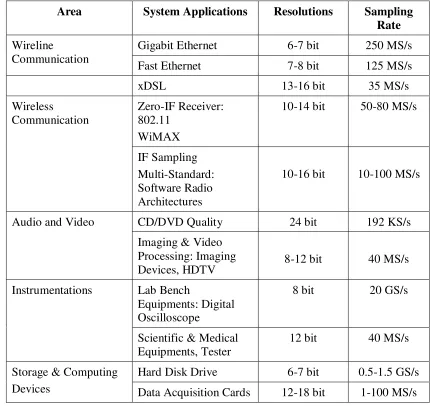
Table 1.1: ADC applications and their design constraints.
Area System Applications Resolutions Sampling
Rate
Gigabit Ethernet 6-7 bit 250 MS/s
Wireline
Communication
Fast Ethernet 7-8 bit 125 MS/s
xDSL 13-16 bit 35 MS/s
Zero-IF Receiver: 802.11
WiMAX
10-14 bit 50-80 MS/s
Wireless Communication IF Sampling Multi-Standard: Software Radio Architectures
10-16 bit 10-100 MS/s
CD/DVD Quality 24 bit 192 KS/s
Audio and Video
Imaging & Video Processing: Imaging
Devices, HDTV 8-12 bit 40 MS/s
Lab Bench
Equipments: Digital Oscilloscope
8 bit 20 GS/s
Instrumentations
Scientific & Medical Equipments, Tester
12 bit 40 MS/s
Hard Disk Drive 6-7 bit 0.5-1.5 GS/s
Storage & Computing
Devices Data Acquisition Cards 12-18 bit 1-100 MS/s
1.1 Motivation
3
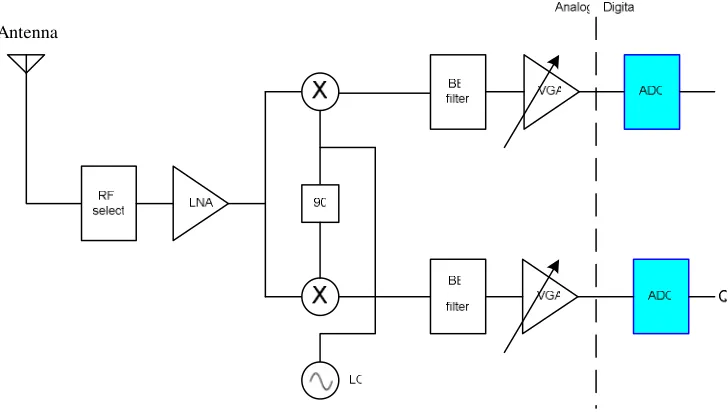
software-defined-radio (SDR) [3]. The system architecture of SDR receiver is shown in Figure 1.1.
Depending on the receiver architecture, analog filtering, and gain control range, the ADCs with a resolution of 10-16 bits and a sample rate between 10 and 100 MS/s are required [4]. Because of growing market on wireless digital communication, ADCs with medium-to-high resolutions and medium-to-high sampling rates are in high demand. However, since these kinds of ADCs are often designed solely for maximum speed, they tend to consume significant amount of power. Consequently, the demand for increased functionality in high-speed ADCs also carries with it the need for low power dissipation. As the above architecture is mostly used on mobile device, the power dissipation is an important design constraint and must be kept low to extend battery life.
Figure 1.1 The direct conversion receiver architecture for SDR.
Another trend in implementing wireless telecommunication systems is toward higher-level circuit integration for lower cost and smaller feature size. The goal of this trend is to have a single chip solution, in which analog and digital circuits are placed on the same die with advanced CMOS technology. Although advanced fabrication technology benefits digital circuits, it poses great challenges for analog circuits. The
4
scaling of CMOS devices degrades important analog performance. For instance, lowering output resistance lowers amplifier gain, although cascading transistors or an added gain stage can compensate for this lowered gain. However, the use of cascoding transistors runs into a limitation on the number of transistors that can be stacked, a limitation that is imposed by the low power supply voltage of scaled CMOS technology. Turning to the solution of additional stages has the disadvantages of increased power dissipation and more complicated circuitry.
The low power supply voltage of scaled CMOS technology also limits the performance of analog circuits. Therefore, just as is the case with digital circuits, simply lowering the power supply voltage in analog circuits does not necessarily result in lower power dissipation. In addition, requirements for high gain and high speed make it more difficult to lower their power consumption. This is especially true for already complicated analog systems like ADCs; reducing their power consumption requires careful analysis of system requirements and special strategies.
1.2 Problem Statement
5
1.3 Research Contribution
This research concentrates on pipelined ADC for wireless communication system. Requirements and optimization of the pipelined ADCs, at the circuit and architectural levels, are addressed to meet the specifications of this target application. Although the proposed ADC is designed according to the specifications of the target systems of wireless communication system, it can be exploited in other applications as well. Based on this research work, some of the analysis and circuit implementations have been partially reported in a related publication [5]. The contributions of this research work are:
(i) Pipelined ADC MATLAB system model: MATLAB behavior models are
developed for the proposed pipelined ADC characterizations on its static and dynamic linearity.
(ii) A low power 10-bit pipelined ADC architecture: Different architectures on pipelined stages are investigated in order to determine the optimum bit per stage structure in term of low power operation.
(iii) Transistor level pipelined ADC sub-circuits design and analysis: The ADC sub-blocks such as amplifiers, comparators, non-overlapping clock generator, switches, and digital error correction are designed and simulated at circuit level.
(iv) Pipelined ADC layouts: The layout for 10-bit 50MS/s Pipelined ADC is
6
1.4 Thesis Organization
79
REFERENCES
[1] B. Razavi. Designof Analog CMOS Integrated Circuits, McGraw-Hill. 2000
[2] S. Rapuano, P. Daponte, E. Balestrieri, L. De Vito, S. J. Tilden, S. Max, and J. Blair. ADC parameters and characteristics. Instrumentation & Measurement Magazine, vol.8, no.5, 2005. pp. 44-54.
[3] M. Sawan, A. Djemouai, K. El-Sankary, H. Dang, A. Naderi, Y. Savaria, and F. Gagnon. High speed ADCs dedicated for wideband wireless receivers. IEEE Northeast Workshop on Circuits and Systems (NEWCAS) Conference, June 2005. Quebec, Canada. pp. 283-286
[4] L. Sumanen. Pipelined Analog-to-Digital for Wide-Band Wireless Communications. Ph.D. Thesis. Helsinki University of Technology, Finland; 2002
[5] Y. Yusoff, R. Musa, N. Othman, M. S. Sulaiman and M. N. Marsono. A High-Gain and High-Speed OTA for 10-bit 50MS/s Pipelined ADC. Student
Conference on Research and Development (SCORed), November 2008.
Skudai, Malaysia. Pp. 58-1-- 58-5.
[6] B. Razavi and B. A. Wooley. A 12-b, 5-Msample/s two-step CMOS A/D converter. IEEE Journal of Solid-State Circuits. vol. 27, no.12, 1991. pp. 1667-1678.
[7] R. L. Geiger, P. E. Allen, N. R. Strader. VLSI Design Techniques for Analog and Digital Circuits, McGraw Hill, 1990.
80
[9] T. Cho. Low-power Low-voltage Analog-to-Digital Conversion Technique using Pipelined Architectures. Ph.D Thesis. University of California, Berkeley; 1995.
[10] B. Nejati and 0. Shoaei. A 10-bit, 2.5-V, 40Msample/s, Pipelined Analog-to-Digital Converter in 0.6-um CMOS. IEEE International Symposium on Circuits and Systems. May, 2004. Vancouver, Canada. pp. I-73 -- I-76.
[11] H. Chen, B. Song and K. Bacrania. A 14-b 20-Msamples/s CMOS Pipelined ADC. IEEE Journal Solid-State Circuits, vol. 36, no.6, 2001. pp. 997-1001.
[12] L. Williams and B. A. Wooley. A third-order sigma-delta modulation with extended dynamic range,” IEEE Journal Solid-State Circuits, vol. 29, no. 3, 1994. pp. 193-202.
[13] B. P. Brandt, D. Wingard, and B. A. Wooley. Second-order sigma-delta modulation for digital-audio signal acquisition. IEEE Journal on Solid-State Circuits, vol. 26, no.4, 1991. pp.618-627.
[14] A. Reddy. Noise Shaping with Sigma Delta Modulators in Fractional-N Synthesizers. IEEE International Workshop on Radio-Frequency Integration Technology. December 2007, Singapore. pp. 329-332.
[15] J. Goes, J. C. Vital, J. E. Franca. A CMOS 4-bit MDAC with Self-Calibrated14-bit Linearity for High-Resolution Pipelined A/D Converters. Proceedings of theIEEE Custom Integrated Circuits Conference. May 1996, San Diego, California. pp. 105-108.
[16] R. Gregorian, Introduction to CMOS Op-Amps and Comparators, John Wiley and Sons. 1999.
[17] S. Kwak, B. Song, and K. Bacrania. A 15-b, 5-Msample/s Low-spurious CMOS ADC. IEEE Journal Solid-State Circuits, vol. 32, no. 12, 1997. pp. 1866-1875.
81
[19] G. Nicollini, P. Confalonieri, D. Senderowicz. A Fully Differential Sample and Hold Circuit for High-Speed Applications. IEEE Journal on Solid-State Circuits, vol. 24, no. 5, 1989.pp. 1461–1465.
[20] K. Gulati and H. S. Lee. A High-Swing Telescopic Operational Amplifier. IEEE Journal on Solid-State Circuits. vol. 33, no. 12, 1998. pp. 2010-2019.
[21] M.Yavari and O. Shoaei. Low-voltage Low-power Fast-settling CMOS Operational Transconductance Amplifier for Switch Capacitor Applications. IEEE Proceeding of Circuits, Devices and System, vol. 151, no. 6, 2004. pp. 573-578.
[22] B. Razavi, Principles of Data Conversion System Design, IEEE Press, 1995.
[23] N. Carter. A 12-b 50Msample/s Pipelined Analog to Digital Converter. MSc. Thesis. Worcester Polytechnic Institute; 2000
[24] K. Kim, N. Kusayanagi, and A. Abidi. A 10-b, 100-MS/s CMOS A/D Converter. IEEE Journal Solid-State Circuits. vol. 32, no.12, 1997. pp. 447-454.
[25] S. H. Lewis. Optimizing the stage resolutionin pipelined, multistage, analog-to-digitalconverters for video-rate applications. IEEE Transaction on Circuits and Systems-II. vol.39, no.8,1992. pp. 516-523.
[26] P. T. F. Kwok and H. C. Luong. Power Optimization for Pipelined Analog-to-Digital Converters. IEEE Transaction on Circuits and Systems-II. vol. 46, no. 5, 1999. pp. 549-553.
[27] D. Kelly, W. Yang, I. Mehr, M. Sayuk and L. Singer. A 3V 340mW 14b 75MSPSCMOS ADC with 85dB SFDR at Nyquist. IEEE International Solid-State Circuit Conference Digest of Technical Papers. February 2001. pp. 134-135.
[28] L. Reza, T. S. Mohd, M. Y. Azizi and O. Shoei. A Low-Power Design Methodology for High-Resolution Pipelined Analog-to-Digital Converter.
Proceeding of International Symposium on Low Power Electronics and
82
[29] Y. Chiu. High-Performance Pipelined A/D Converter Design in Deep-Submicron CMOS. Doctoral dissertation. University of California, Berkeley; 2004
[30] K. Bult, G. J. G. M. Geelen. A Fast-Settling CMOS Op Amp for SC Circuits with90-dB DC Gain. IEEE Journal Solid-State Circuits. vol. 25, no. 6, 1990. pp. 1379-1384.
[31] P. C. Yu, H-S. Lee, A High-Swing 2-V CMOS Operational Amplifier with Replica-Amp Gain Enhancement, IEEE Journal Solid-State Circuits. vol. 28, no. 12, 1993. pp. 1265–1272.
[32] M. Das. Improved design criteria of gain-boosted CMOS OTA with high-speed optimization. IEEE Transaction on Circuit and System-II. vol.49, no. 3, 2002. pp. 204-207
[33] A. M. Abo. Design for Reliability of Low-Voltage, Switched-capacitor Circuits. Doctoral dissertation. University of California, Berkeley; 1999.
[34] M. Dessouky and A.Kaiser. Very low-voltage digital-audio Σ∆ modulator with 88-dB dynamic range using local switch bootstrapping. IEEE Journal Solid-State Circuits. vol. 36, no. 3, 2001. pp. 349-355.
[35] A. Hasting. The Art of Analog Layout. Prentice-Hall, Inc. 2001
[36] J. Li, X. Zeng, J. Chen, J. Zhang, and Y. Guo. A 1.8-V 22mW 30MS/s Subsampling Pipelined CMOS ADC. IEEE Custom Integrated Circuit Conference. September, 2006. San Jose, California. pp. 513-516.
[37] W. Yang, D. Kelly, I. Mehr, M. Sayuk, and L.Singer. A 3-V 340mW 14-b 75Msample/s CMOS ADC with 85-dB SFDR at Nyquist Input. IEEE Journal on Solid-State Circuits, vol.36, no12, 2001. pp. 1031-1936.
83
[39] J. Talebzadeh, M. R. Hasanzadeh, M. Yavari, and O. Shoaei. A 10-bit 150-MS/s, Parallel Pipelined A/D Converter in 0.6-um CMOS. Proceeding of
IEEE Symposium on Circuits and Systems. May 2002, Arizona, USA, pp.
III-(133-136).
[40] H. Liu, and M. Hassoun. A 9-b 40-MSample/s Reconfigurable Pipelined Analog-to-Digital Converter. IEEE Journal on Solid-State Circuits, vol. 49, no. 7, July 2002. pp. 449-456.
[41] M. Byung-Moo, P. Kim, F. W. Bowman, D. M. Boisvert, A. J. Aude. A 69-mW 10-bit 80-MSample/s Pipelined CMOS ADC. IEEE Journal on Solid-State Circuits, vol. 38, no. 12, December 2003. pp. 2031-2039.
[42] P. Jong-Bum, Y. Sang-Min, K. Se-Won, C. Young-Jae, and L. Seung-Hoon. A 10-b 150-MSample/s 1.8-V 123-mW CMOS A/D Converter with 400-MHz Input Bandwidth. IEEE Journal on Solid-State Circuits, vol. 39, no. 8, August 2004. pp. 1335-1337.
[43] L. Jipeng, and Un-Ku Moon. A 1.8-V 67-mW 10-bit MS/s Pipelined ADC Using Time-Shifted CDS Technique. IEEE Journal on Solid-State Circuits, vol. 39, no. 9, September 2004. pp. 1468-1476.
[44] H. Mohamad-Faizal, Y. Yuzman, and M. Rais-Ahmad. A 10-bit 50-MSPS Pipelined CMOS ADC. Proceeding of International Conference on Semiconductor Electronics. Nov 2006, Kuala Lumpur, Malaysia. pp. 459-463.
[45] N. Sasidhar, K. Youn-Jae, S. Takeuchi, K. Hamashita, K. Takasuka, P. K. Hanumolu, and Un-Ku Moon. A 1.8V 36-mW 11-bit MS/s Pipelined ADC Using Capacitor and Opamp Sharing. IEEE Asian Solid-State Circuits Conference, November 2007, Jeju, Korea. pp. 240-243.
[46] R. Seung-Tak , S. Bang-Sup, and K. Bacrania. A 10-bit 50-MS/s Pipelined ADC With Opamp Current Reuse. IEEE Journal on Solid-State Circuits, vol. 42, no. 3, March 2007. pp. 475-485.
84
IEEE Journal on Solid-State Circuits, vol. 43, no. 2, February 2008. pp. 321-329.
[48] C. Junmin, C. Zhongjian, L. Wergao, and Z. Baoying. A Low Power 12-Bit 20 MSample/s Pipelined ADC. Proceeding of International Conference on Signal Processing System. May 2009, Singapore.
[49] L. Jin-Fu, C. Soon-Jyh, L. Chun-Cheng, and H. Chih-Hao. A 10-bit 60-MS/s Low-Power Pipelined ADC with Split-Capacitor CDS Technique. IEEE Transactions on Circuits and Systems, vol. 57, no. 3, March 2010. pp. 163-167.