2019 International Conference on Artificial Intelligence, Control and Automation Engineering (AICAE 2019) ISBN: 978-1-60595-643-5
Adaptive Anti-occlusion Moving Object Tracking of Intelligent Video
Surveillance System
Fa-cang DU
*, Ying ZHANG and Meng-xin LI
College of Information and Control Engineering, Shenyang Jianzhu University, Shenyang, 110168, China
*Corresponding author
Keywords: Motion target tracking, Meanshift algorithm, Kalman filter, Bhattacharrya coefficient, Anti occlusion, Double discrimination.
Abstract. In recent years, moving target tracking technology has been widely used in video surveillance and other fields. But there are many factors that are not conducive to the system. Among them, the large area occlusion are the main factors leading to tracking failure. In addition, the interference of illumination and some similar colors is also an important factor affecting the tracking accuracy. Aiming at the disadvantage of moving target tracking, this paper proposes a dual discriminant adaptive tracking algorithm based on mean shift algorithm and Kalman filter algorithm. When the target is tracked with illumination, large area occlusion, long time occlusion, background interference and similar color interference, the algorithm can track the target well, with good accuracy and stability.
Introduction
Moving object tracking target tracking is widely used in intelligent video surveillance, traffic surveillance, human-computer interaction, medical diagnosis and so on. In the process of tracking, there are many factors that cause the tracking accuracy to decline or even fail, such as background chaos, illumination changes, target scale changes, changes in the surrounding environment [1, 2].
Meanshift Algorithm
Object model description
As a feature of the object, the color histogram is not sensitive to the object object gender, and is able to extract the color information of object effectively. In color video sequences, the range of image pixels is RGB space, each sub space of RGB color space, R, G and B are respectively divided into m sub interval according to the histogram modes, and each interval, called a bin, which
constructs a corresponding feature space with corresponding number of features k3. In the object
region, pixels in different positions have different color histogram of pixel distance, the farer to regional center the less weight. Thus, the pixel far away has little effect avoiding the boundary pixels affected by occlusion.
The central coordinates of the object template is x0, supposed that {xi},i 1,2,n is the set
of pixel coordinates for each pixel in the object region, mis the number of kernel histogram
characteristic bin, Probabilistic characteristics u1,,m, and the color features of the object
model can be described as[9,10]:
2 0 1 ( ) n i u i i x x
q C k b x u
h
(1)Where, C is normalization factor made
qu 1. k(x) is a convex kernel function that isisotropic and monotonically decreasing, used for weighting points. is Kronecker Delta function
Used to determine whether the color values of pixel xi in the object region belong to the uth bin.
) (x
b is index function for pixels in the color histogram.
Candidate model description
As defined in 1.1, set {xi},i1,2,nh as the set of coordinates of each pixel location in the
candidate region. Then, the candidate template color features can be described as:
2 0 1 ( ) n i
u h i
i
x y
p C k b x u
h
(2)h
C
is normalization factor of color histogram of candidate model made
pu 1, y0 is theobject center position in the current frame.
Moving Object Tracking Using Meanshift Algorithm
Meanshift tracking algorithm has the advantages of real-time, robustness and easy to realize. Bhattacharyya distance is the standard optimality criteria of Meanshift algorithm. If the Bhattacharyya distance reaches the minimum value, it means the current frame position tracked to be found. The key operation of the Meanshift tracking algorithm is to calculate the offset from the
current position y0 to the new position y1 [7]:
2 1 0 1 2 1 0 ( ( ) / ) ( ( ) / ) h h n
i i i i
n
i i i
x g y x h
y
g y x h
(3)Where, g x( ) is kernel function, his the width of g x( ), xi is the pixel kernel function of the
1 0
[ ( ) ]
( )
j
u
i i
u u
q
b x u
p y
(4)When y1 y0 , the mean local optimization iteration process will stopped, and the current
candidate patch is taken as the output position of the current frame.
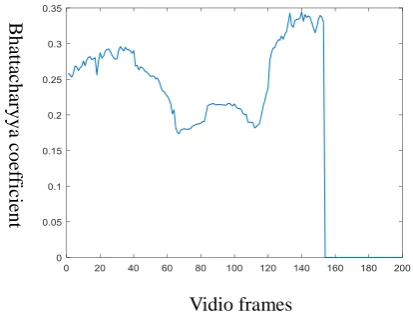
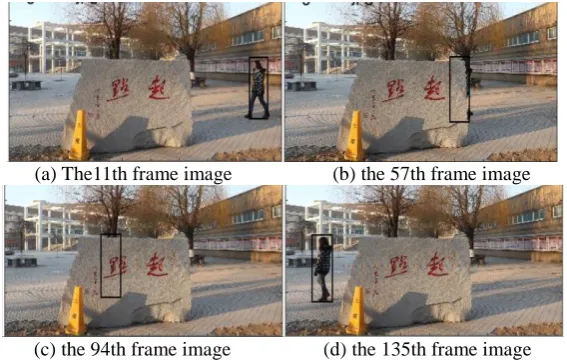
The Meanshift algorithm is simple in principle, less computation. But when the background color disturbance, the object model and candidate model has certain error, the algorithm will be unable to accurately track the object. In addition, if the object speed is beyond the scope of algorithm vector calculation or encountered occlusion, Meanshift algorithm is difficult to adaptively rebuild the object model and candidate model, lead to tracking failure. if there is no case of obstructions, the use of this method can be very good to complete the whole process of tracking. As shown in Figure 1, Meanshift tracking algorithm overcome the interference caused by light and similar color of background and complete the tracking of moving object, where the moving object meets 57 frames before occlusion (Fig1.(a) and Fig.1(b)),but in 58 frames, moving object is whole occluded, the tracking rectangle cannot track the object (Fig.1(c) and Fig.1(d)). The change of the Bhattacharrya coefficient in the whole tracking process is as shown Figure 2.
(a) the 6th frame image (b) the 57th frame image
[image:3.595.149.448.305.471.2](c) the 93th frame image (d) the 135th frame image
Figure 1. Object tracking based on Meanshift algorithm.
Figure 2. Change of Bhattacharrya coefficient in object tracking in Fig.1.
Improved Meanshift Algorithm Using Double Bhattacharrya Coefficients Discrimination
The variation of Bhattacharrya distance by using the Meanshift algorithm in object tracking shown in Figure 2, what can we see is when there is occlusion, the moving object is lost, the Bhattacharrya coefficient becomes larger, when occlusion is ended, Bhattacharrya coefficient becomes small again. The paper puts forward the method of double Bhattacharrya coefficient adaptive object tracking.
Vidio frames
B
h
attac
h
ar
y
y
a
co
ef
ficien
[image:3.595.184.391.502.658.2]histogram of candidate template pu is:
m
u
u
u y q
p y
1
1 ) ( )
(
(5)
When there is occlusion, update the the Bhattacharrya coefficient of object template qu1 and the
candidate template pu,:
m
u
u u y q
p y
1
2 ) ( ) 1
(
(6)Step1: input video, select the object template by rectangle box, and use RGB color histogram to describe the template;
Step2: calculate centroid deviation according to Meanshift algorithm, obtain the centroid
coordinates of the next frame1, and iterative algorithm, then realize the object tracking;
Step3: set the threshold T1, when occlusion happens, the current object centroid coordinates as the initial value of Kalman filter to predict object centroid initial position under occlusion, update
the object template, calculate coefficient 2, and continue to calculate 1 base on the original
calculation method;
Step4: when2 1, the object template was updated and Meanshift algorithm was used to track
the moving object
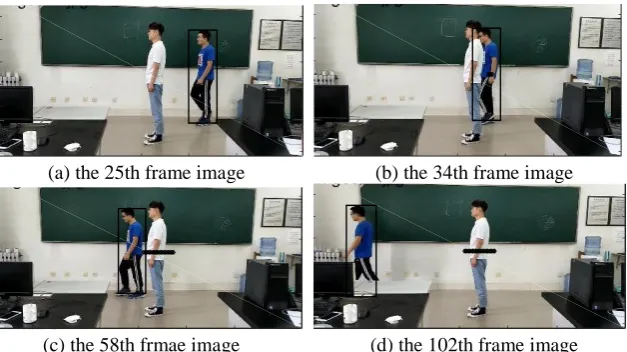
[image:4.595.156.440.533.713.2]Results of complete occlusion tracking experiment realized by proposed method are shown in Figure 3. It can be seen that Meanshift algorithm can overcome the influence of background color and illumination and track the object accurately under situation of no obstructions. When occlusion occurs at the fifty-seven frame, algorithm switches to the Kalman filter automatically to start the moving object centroid forecast model, and mark the position changes of the centroid. And at the ninety-four frame, moving object is under partial occlusion, Kalman filter is used still to predict moving object centroid. Till to 135th frame, occlusion completely removed, then, switch to the new Meanshift algorithm to tracking. Another experiment for tracking under multiple moving objects is realized too, as shown in Figure 4. The experiment shows that the proposed method can adaptively adjust the tracking algorithm and prediction algorithm, and according to the centroids predicted and the size of rectangular frame calculated in initial template frame to relocate the moving object template, and complete the update by reusing Meanshift to implement the trace.
(a) The11th frame image (b) the 57th frame image
(c) the 94th frame image (d) the 135th frame image
(a) the 25th frame image (b) the 34th frame image
[image:5.595.142.456.69.245.2](c) the 58th frmae image (d) the 102th frame image
Figure 4. Anti occlusion tracking of multiple moving objects based on improved method.
Summary
Aiming to solve the poor results of moving object tracking in the region of occlusion for a long time, an improved Meanshift algorithm based on double Bhattacharrya coefficient is proposed, which can realize moving object adaptive tracking by using double discriminant method, according to the change of Bhattacharrya coefficient of object template and candidate template before and after occlusion, to adjust adaptive tracking and forecasting process. And reliability of proposed algorithm of object tracking in a single motion and multiple moving objects is tested by simulation, and meanwhile, the robustness of the tracking and anti-shielding ability are improved.
Acknowledgement
Scientific Research Projects of Liaoning General Colleges and Universities [LJZ2017030].
References
[1] Na-na Zhang; Chun-xue Wu; Yan Wu; Neal N. Xiong. An improved target tracking algorithm and its application in intelligent video surveillance system[J]. Multimedia Tools and Applications, 2018:1-19.
[2] Xue-lian Jin; Jian-hua Yang; Wei Lu; Research on motion target detection and tracking algorithm based on complex scene[C]. Proceedings of the 37th Chinese Control Conference. 2018:3537-3540.
[3] Mojtaba Asgarizadeh, Hossein Pourghassem. A Robust Object Tracking Synthetic Structure Using Regional Mutual Information and Edge Correlation-based Tracking Algorithm in Aerial Surveillance Application [J]. Signal, Image and Video Processing, 2015,9(1):175-189.
[4] Fabio Previtali, Domenico D.BLOISI, Luca Iocchi. A Distributed Approach for Real-time Multi-camera Multiple Object Tracking [J]. Machine Vision and Applications, 2017:1-10.
[5] Severine Dubuisson, Christophe Gonzales. A Survey of Database for Visual Tracking [J]. Machine Vision and Applications, 2016(27):23-52.
[6] J Badenas, JM Sanchiz, F Pla. Motion-based Segmentation and Region Tracking in Image Sequences [J]. Pattern Recognition, 2001,34(3):661-670.
[8] Jae Pil Hwang, Jeonghyun Baek, and Baehoon Choi et al. A Novel Part-Based Approach to Mean-shift Algorithm for Visual Tracking [J]. International Journal of Control, Automation, and Systems, 2015, 13(2):443-453.
[9] Jia Zhu, Pei-hua Li. An Improved Meanshift Algorithm for Object Tracking [J]. Journal of North University of China, 2016, 37(6):633-637.