Available online on www.ijpsr.com 748
IJPSR (2011), Vol. 2, Issue 4 (Review Article)
Received on 14 December, 2010; received in revised form 11 February, 2011; accepted 08 March, 2011
CHEWING GUM AS A DRUG DELIVERY SYSTEM
Y Patel*, A. Shukla, V Saini, N. Shrimal and P. Sharma
Department of Medicinal Chemistry and Drug Discovery, Gyan Vihar University, Jaipur, Rajasthan, India
ABSTRACT
It is well known fact that the right drug delivery system is critical to the success of a pharmaceutical product.A novel drug delivery system creates additional patient benefits that will add new competitive advantages for a drug and, thus, conserve or increase revenue. Chewing gum as drug delivery system holds tremendous potential not only in smoking cessation and oral health care arenas but also in other indications.
Keywords:
Chewing Gum, Buccal delivery, Sustained release,
Dental health, Smoking cessation, Medicated chewing gum
Correspondence to Author:
Y Patel
Available online on www.ijpsr.com 749
INTRODUCTION: Man has experienced the pleasure of chewing gum since ancient times. One thousand years ago, the Mayan Indians chewed tree resin (chicle) from the sapodilla tree in order to clean their teeth and fresh their breath. Later on, the tradition was passed on to the white colonists. The first commercial chewing gum appeared in 1848, and the first patent on chewing gum was taken out in 1869. Shortage of natural gum bases during World War II enhanced development of the synthetic gum bases used today. The first medical chewing gum, Aspergum, was launched in 1928. This chewing gum is still available and contains the analgesic substance acetylsalicylic acid known from Aspirin tablets. Another commercially available medical chewing gum is dimenhydrinate-containing chewing gum for motion sickness. However, chewing gum did not gain acceptance as a reliable drug delivery system until 1978, when nicotine chewing gum became available. Today 1, 2, 3,chewing gum is highly accepted as a drug delivery system, especially in smoking cessation. All major pharmaceutical suppliers of nicotine products market a chewing gum formulation. Furthermore, chewing gum plays an important role in dental health, and chewing gum containing e.g. fluoride or carbamide is available worldwide.
There are many reasons for selecting the chewing as a drug delivery system, the following are the some reasons highlighted.
Easy for administration without water promotes higher patient compliance 4
Children and for patients who find swallowing tablets difficult are obvious Local effect 5
Systemic Effect Fast onset of action 6 Less side effects Less risk of overdosing Effective on Dry mouth
The Composition of Chewing Gum: A piece of chewing gum usually consists of a gum core, which may or may not be coated. The core is composed of an insoluble gum base (resins, elastomers, emulsifiers, fillers, waxes, antioxidants and softeners), sweeteners, flavoring agents, and in the case of medical chewing gum, active substances. The coating may be composed of e.g. sweeteners, flavors, coloring, and active substances (fig. 1).
The water content of chewing gum is very low and no preservatives are needed. The gum base determines the basic characteristics of the product, e.g. the texture: Is it soft or hard to chew? Does it crumble? Does it stick to the teeth? 7, 8. The gum base also determines the release profile of active substances, and changing the gum base composition may therefore change the release profile.
FIG. 1: COMPONENTS OF CHEWING GUM
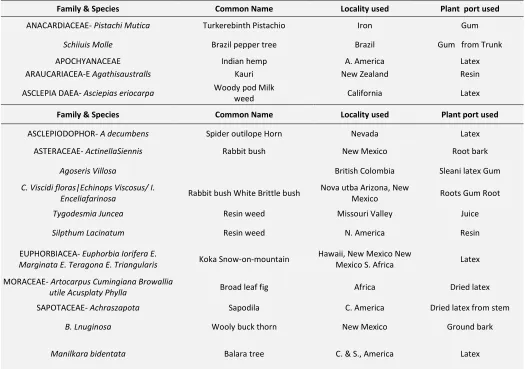
As many active substances are lipophilic, they will adhere to the gum base and may therefore be released slowly and incompletely. Methods to increase rate and extent of the release include the addition of buffering agents or solubilizing agents and coating/encapsulation of active substances. In contrast, hydrophilic active substances are rapidly released and it may therefore be necessary to slow down the release rate by means of various methods, e.g. by encapsulating the active substance or by increasing the amount of gum base 9, 10. Table 1
Available online on www.ijpsr.com 750
TABLE 1: VARIOUS SOURCES OF CHEWING GUMS 7
Family & Species Common Name Locality used Plant port used
ANACARDIACEAE- Pistachi Mutica Turkerebinth Pistachio Iron Gum
Schiiuis Molle Brazil pepper tree Brazil Gum from Trunk
APOCHYANACEAE Indian hemp A. America Latex
ARAUCARIACEA-E Agathisaustralls Kauri New Zealand Resin
ASCLEPIA DAEA- Asciepias eriocarpa Woody pod Milk
weed California Latex
Family & Species Common Name Locality used Plant port used
ASCLEPIODOPHOR- A decumbens Spider outilope Horn Nevada Latex
ASTERACEAE- ActinellaSiennis Rabbit bush New Mexico Root bark
Agoseris Villosa British Colombia Sleani latex Gum
C. Viscidi floras|Echinops Viscosus/ I.
Enceliafarinosa Rabbit bush White Brittle bush
Nova utba Arizona, New
Mexico Roots Gum Root
Tygodesmia Juncea Resin weed Missouri Valley Juice
Silpthum Lacinatum Resin weed N. America Resin
EUPHORBIACEA- Euphorbia Iorifera E.
Marginata E. Teragona E. Triangularis Koka Snow-on-mountain
Hawaii, New Mexico New
Mexico S. Africa Latex
MORACEAE- Artocarpus Cumingiana Browallia
utile Acusplaty Phylla Broad leaf fig Africa Dried latex
SAPOTACEAE- Achraszapota Sapodila C. America Dried latex from stem
B. Lnuginosa Wooly buck thorn New Mexico Ground bark
Manilkara bidentata Balara tree C. & S., America Latex
Manufacturing of Chewing Gum: The
manufacturer of Chewing gum begins with the preparation and mixing of the gum base materials. The gum base is first ground and then melted using steam under pressure. Then centrifuging purifies the sterilized gum-base then sieved with fine mesh screens. In this state the mixture resembles thick syrup.The next step in chewing gum manufacture is addition of the sweeteners and the flavoring agents. These ingredients are placed together I huge mixing kettles having capacity of about 455-910 kg. The mixing is continued till the mass shows consistency of bread dough. Then this mass is kneaded and passed through a series of rollers and gradually reduced to a long flat continuous, ribbon of about 50 cm width. Then the ribbon is scored
and sticks of desired size separated and wrapped in suitable material for packing. Thus the chewing gum formulation contains the following components 11, 12:
The gum base The sweeteners Flavoring agents,
Available online on www.ijpsr.com 751
Gum bases used in chewing gums: From ancient time natural gums are used. The most popular gum base used is "Chicle".
CMD: Chicle is natural latex obtained from the Sapodilla tree The latex is obtained from 'V shaped cuts made on the trunk of the tree the cuts are made about 30 cm a part from the side of trunk until the lowest branch is reached. Generally, the tapping cuts are destructive to the tree. In addition to vvoundine the bark and wood the cambium is also injured thus retarding the growth of new wood and bark. After cuts are made, the gum that oozes out is collected and processed for further purification till a desired consistency is obtained. latex collected is dried carefully to remove excess water crude. Chicle is purified by repeatedly washing with strong alkali and then neutralizing with sodium acid Phosphate followed by drying and powdering. The resultant powder is insoluble, amorphous powder which softens on heating. Chemical Composition: Crude chicle contains
50 to 20% hydrocarbons a yellow resin and polyisoprenes. Polyisoprenes is a mixture of low molecular weight C is -1, 4 and trans-1, 4 Unit in approximate ratio 2:7. The yellow resin content is about 55%. It consists of lupeol eicetatic with minor amount of amyrina and, spinasterol acetates. Refined chicle is used for chewing gum contains only water-insoluble ingredients.
Uses :
Cosmetics: It has been used in hair dressing and pomades.
Food: The primary use of chicle is in chewing gum.
Synthetic gum bases used in chewing gums: The gum base generally used consists of natural rubber type synthetic rubber gum and mixture there of. The most popular synthetic gum base is:
Elastomer
Styrene butadiene co-polymer SBR.
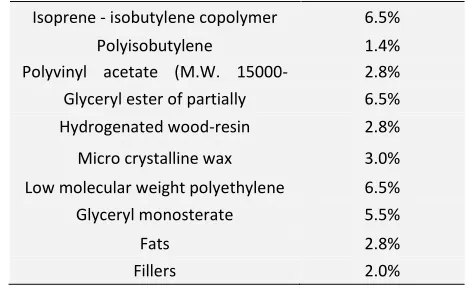
[image:4.612.328.555.403.491.2]The gum bases usually adhere to dental surfaces. Adhesion and deletion of some ingredient in the composition is there of needed. In U.S. patent No. 2,076, 112 the use of talc as anti sticking agent is described 13. Tannic acid is also another anti sticking agent 8. The polymer can be used along with polyisoprene or styrene butadiene copolymer 14. The use of titanium dioxide along with fillers such as calcium carbonate is also reported to produce non sticky gum 15. Yet another attempt to produce non-sticky bubble-gum is claimed with polyvinyl acetate, polyvinyl alcohol along with an elastomer and oleaginous plasticizer an elastomer solvent fatty acid and other 16. U.S. Patent No. 4, 387, 108 which is directed to a non-sticky chewing gum has the following composition (Table 2).
TABLE 4: COMPOSITION OF NON-STICKY CHEWING GUM
Elastomer 8-30%
Oleaginous Plasticizer 9-40%
Mineral Adjuvant 10-15%
Non-toxic vinyl polymer 16-32%
emulsifier 05-10%
Elastomer Solvent 2.5-13%
Indian patent No. 161215 discloses the process for manufacture of non-sticky chewing gums (Table 3).
TABLE 3: MANUFACTURE OF NON-STICKY CHEWING GUMS
Isoprene - isobutylene copolymer 6.5%
Polyisobutylene 1.4%
Polyvinyl acetate (M.W. 15000- 2.8% Glyceryl ester of partially 6.5%
Hydrogenated wood-resin 2.8%
Micro crystalline wax 3.0%
Low molecular weight polyethylene 6.5%
Glyceryl monosterate 5.5%
Fats 2.8%
[image:4.612.327.562.556.703.2]Available online on www.ijpsr.com 752 Indian patent No. 160941; discloses the process for
manufacturing non caloric, non carcinogenic chewing gum. The composition has employed Aspartame as sweetener 17, 18. Thus the manufacture of chewing gum has been under going tremendous innovative changes and the general procedure can serve as guidelines only. The manipulations in the processes and the composition can be made according to the desired properties of the resultant product. The process should therefore not to be absolutely and blindly followed but to be used as guideline only. Modifications based on the general principle are always permissible. The chewing gum industry is still undergoing many changes and every year newer formulations are being tried and few of them proved successful.
Rosin: Apart from conventional gum-bases now-a-days, rosin derivatives are being tried as the gum base for chewing gums. Rosin is a solid, resinous material find as oleoresin of Pine trees. It is obtained from three major sources:-
Oleoresin exudates of living pine trees. Oleoresin contained in aged stumps of the
long leaf-pines.
Tall-oil produces rosin as a by-product in the paper industry.
[image:5.612.322.568.337.451.2]Rosin grades and test: The Indian standards Institution has graded rosin into color grades as X, WW, WG, N, M,K,D. The specifications for these grades are given below in table 4:
TABLE 4: GRADES OF ROSIN
Color Grades X, WW, MG, N Medium M, K, H DsARK
Softening point 70-75°c 70-75°c 70-75°c Relatively density 1.05-1.08 1.05 to 1.08 1.05 to 1.08
Acid Value 160 155 155
% Volatile matter (max)
2.0 2.0 2.0
% ash content 0.05 0.2 0.5
% insoluble content 0.1 6.0 6.0
% unsaponificable matter
6.0 6.0 6.0
Chemical Composition: Rosin comprises of about 90% rosin - acids and 10% non-acidic materials. The rosin acids are monocarboxylic acids having the general formula C20 H30 O
The acids are of two types: Abietic acid type Pimaric acid type.
It also contains non-acidic materials. The non-acidic materials are know to affect the crystallinity and the softening point of rosin, but only a small fraction out of the 10% content has been identified.
[image:5.612.321.568.561.678.2]Derivatives and reactions 19, 20: Various reactions of rosin acids are given below (Table 5).
TABLE 5: VARIOUS REACTIONS OF ROSIN ACIDS
Reaction at the double bond Reaction at the carboxylic bond
Isomerization Salt formation
Addition of Maleic anhydride and
maleic acid Esterification
Other addition reaction Hydrogenation
Oxidation Aminolysis
Hydrogenation Decarboxylation
Polymerization Hydrolysis
The carboxylic group of rosin acid is attached to a tertiary carbon atom and is highly hindered. Therefore, more drastic conditions such as high temperature are required for carrying out the esterification (table 6).
TABLE 6:ESTERS OF ROSIN ACIDS
Alcoholic Substances Use
Giycerol and rubber Ester gum for varnish
Poly glyceral Varnished
Ethylene glycol giycerol mixture Lacquer production
Malic acid adduct Surface coating Penta erthrytol Hard, elastic compound
[image:5.612.47.296.587.701.2]Available online on www.ijpsr.com 753 Rosin is conventionally used in the manufacture of
printing inks lionleum, varnishes and electrical insulators. The main usage of rosin derivatives is:
Excellent Film-Forming properties. Formation of moisture protective Films. Formation of acid resistant films. Excellent binding properties. Electrical insulators.
It is also used in textile industry as wetting and emulsifying agents 15, adhesive, water-proof coating on fruit packages. Chewing gum bases 16, preservatives, elastomers for pharmaceutical plasters and it is also reported to posses bacteriostatic properties. The rosin - glycerol esters and rosin- esters with mannitol are found to be useful as coating materials.
Shellac:
Non-proprietary name: NF. Shellac
Function Category : U.S.P. Coating agent Synonyms : Lacca, Lac, dewaxed
orange, orange shellac, refined bleached shellac regular bleached shellac, pharmaceutical grade.
Chemical names: Shellac, lacca, lac (9000-59-3).
Empirical Formula/Molecular Weight: Undefined.
Composition: Shellac is a refined natural product. The main component (about 95%) of shellac is resin which on mild basic hydrolysis gives a mixture of aliphatic and alicyclic hydroxy acids. The composition of the hydrolysate is variable, but in general there are about 50% aliphatic and 5-1.0% of alicyclic acids. Aleuntic acid and shellac acid are the major aliphatic and alicyclic components respectively. Shellac also contains about 5-6% was and a small amount of pigment.
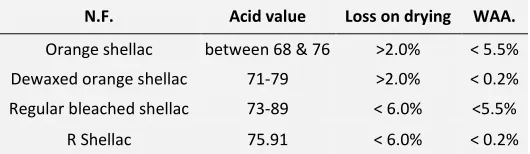
Commercial availability: Many different grades of shellac are available. The main division is into orange shellac and bleached. Shellac whereas the latter can be further divided into regular bleached shellac and refined (Wax Free) bleached shellac; there are many grades of orange - shellac which differ in color, insoluble matter and details of the extraction process used. Shellac can also be obtained commercially in pharmaceutical grades in which the appropriate grade of shellac has been dissolved in ethanol. Specifications for shellac are given below (Table 7).
[image:6.612.314.579.344.421.2]Description: Thin, hard, brittle, transparent, pale lemon, yellow to brownish orange flakes of varying sizes and shapes, also available as powder, odorless or with a paint odor, tasteless.
TABLE 7: PHARMACEUTICAL SPECIFICATION
N.F. Acid value Loss on drying WAA.
Orange shellac between 68 & 76 >2.0% < 5.5% Dewaxed orange shellac 71-79 >2.0% < 0.2% Regular bleached shellac 73-89 < 6.0% <5.5%
R Shellac 75.91 < 6.0% < 0.2%
Melting range: 115 -120C
Application of Chewing Gums
Available online on www.ijpsr.com 754 Indications for fluoride chewing gum are
prevention of dental carries in children in fluoride-deficient areas, in adults with a high incidence of caries, and in patients with xerostomia. The caries-preventive effect of fluoride chewing gum has been compared with the effect of placebo chewing gum in experiments with artificial enamel lesions on teeth mounted into removable mandibular appliances worn in situ in volunteers for several days. The remineralization process proved to be faster when using the fluoride chewing gum 23, 24.
Oral infections caused by bacteria or fungi are often seen, especially in patients with impaired immune system. Chlorhexidine chewing gum can be used for alleviation of gingivitis, periodontitis, and other oral and pharyngial infections 25, 26. It can also be used for inhibition of plaque growth and has proven valuable in oral health care of the elderly. Furthermore, chlorhexidine in a chewing gum formulation gives less staining of the teeth and is more convenient to use than a chlorhexidine mouth rinse.
The chlorhexidine released by chewing is distributed evenly in the oral cavity and is present there for a prolonged period of time. The bitter taste of chlorhexidine can be masked quite well in a chewing gum formulation Clinical trials involving patients with oral candidosis have shown that miconazole chewing gum is at least as efficient as miconazole oral gel in the treatment of fungal infections in the mouth. Furthermore, patients preferred chewing gum to oral gel due to convenience and fewer side effects. A miconazole chewing gum is yet to be launched.
Systemic Therapy: Chewing gum as a drug delivery system also provides benefits to
systemic drug delivery, especially if the active substance is absorbed through the buccal mucosa. From a patient point of view, a number of benefits appear: Fast and acute treatment, convenience, no need for water and thereby easy administration anytime anywhere reduced risk of gastrointestinal side effects, and no attention drawn to the condition requiring medication. These benefits apply not only to the treatment of adults, but also to the treatment of children and adolescents. Chewing gum as a drug delivery system could be beneficial to a number of indications, some of which are discussed below.
Available online on www.ijpsr.com 755
Smoking Cessation: Chewing gum
formulations containing nicotine, lobeline and silver acetate have been clinically tested as aids to smoking cessation. A comparison of success rates and adverse reactions showed that nicotine was superior to the other two substances 27, 28, 29. Several clinical studies have proven the efficacy of nicotine chewing gum as an aid to smoking cessation. Nicotine chewing gum can be regarded as a convenient formulation for breaking an "oral habit" like smoking as the "oral habit" of smoking is substituted by another oral activity, namely gum chewing. The cessation rates observed after one year of treatment vary from 13-63% in various clinical trials involving nicotine chewing gum, whereas the cessation rate using placebo chewing gum ranges from 9-45% 30, 31
.
Obesity: Several chewing gum formulations containing caffeine, guarana or chromium are available. Caffeine and guarana are central stimulating anorectic agents that have proved to increase the metabolic rate. Moreover, they stimulate lipolysis, have a thermogenic effect (increase energy expenditure) and reduce the feeling of hunger. Chromium is claimed to reduce the craving for food due to an improved blood glucose balance. However, none of the existing products are registered as pharmaceutical products with a documented and approved effect on obesity. Chewing gum has proven efficient in treatments involving instant craving and ‘oral habits’ 32. Hence there is a rationale for administering weight reducing active substances in a chewing gum formulation.
Other indications: Allergy, nausea, motion sickness, diabetes, anxiety, dyspepsia, osteoporosis, and cough and cold are all indications for which chewing gum as a drug
delivery system could be beneficial. Chewing gum containing antacids or mucolytics also presents advantages for patients. Chewing gum is known to be a potent stimulant of salivary secretion. Therefore, several clinical trials have been performed substantiating the claim that gum chewing can relieve symptoms of xerostomia in certain diseases, e.g. in Sjogren's syndrome. A further increase in salivary secretion may be achieved by adding a saliva-stimulating agent like pilocarpine to the chewing gum. Stimulated saliva has a buffering capacity and may therefore help reduce acidity of gastric fluid. Clinical trials have demonstrated that use of chewing gum without active substances in fact reduces the postprandial reflux. Addition of an antacid to chewing gum could enhance this effect.
Chewing gum as a drug delivery system offers convenience in the treatment/ prevention of motion sickness and nausea. Medical chewing gum containing dimenhydrinate for motion sickness is already on the market, however, active substances like scopolamine, metoclopramide, ondansetron and dolasetron may be candidates for a chewing gum formulation for the prevention of motion sickness and nausea 33.
Several chewing gum formulations containing calcium are available on the market. Adolescents constitute a potential target group for a calcium chewing gum, as the calcium intake of young people is often very low. Calcium chewing gum with a pleasant taste is an attractive and convenient alternative to tablets.
Limitation of Chewing Gum as a Drug Delivery System:
Available online on www.ijpsr.com 756 The concentration of drug in the oral cavity
always tends to decrease as result of salivary dilution.
Drug release from chewable formulations has shown to be strongly influenced by the way patient chews the formulation.
Administration of such dosage form is restricted to short period of time because the presence of the delivery system in the oral cavity causes disturbance in drinking, eating and speaking.
[image:9.612.41.304.441.595.2]Marketed Products of Chewing Gum as a Drug Delivery System: Man has a habit of chewing the chewing gum since ancient times. Today it is one of the most popular dosage form, used for delivering the many active components 34, 35. Most of the chewing gum were used for smoking cessation (containing the nicotine) and also used for oral and dental hygiene (consisting of fluoride and carbamide etc). Some marketed products of chewing gum are (Table 8) as follows:
TABLE 8: MARKETED PRODUCTS OF CHEWING GUM
Product Drug Indication
Nicorette Nicotine Smoking cessation
Nicotinell Nicotine Smoking cessation Niquitin CQ Nicotine Smoking cessation
Fluorette Fluoride Prevention of dental caries
Vitaflo CHX Chlorhexidine Antibacterial
Advanced ® Chlorhexidine Prevention of dental caries
Hexit Chlorhexidine Antibacterial
Stay alert Caffeine Motion sickness
Future Prospects of Chewing Gum as a Drug Delivery System: Previously, chewing gum was mainly considered a confectionery product, however, fluoride chewing gum, and especially nicotine chewing gum which was launched in the 1970s, paved the way for a more general
acceptance of chewing gum as a drug delivery system 36.Inclusion of medical chewing gum in the European Pharmacopoeia (under medicated chewing gum) in 1998 has further contributed to full acceptance. Medical chewing gum meets the high quality standards of the pharmaceutical industry and can be formulated to obtain different release profiles of active substances, thus enabling distinct patient group targeting. A few decades ago, the only treatment for some diseases was surgical procedures (e.g., gastric ulcers), however, today more and more diseases are treated by medication 37. This trend is likely to continue as sophisticated research methods allow the development of medication for an increasing number of diseases. At the same time there is a demand for efficient and convenient drug delivery systems. Generally, it takes time for a new drug delivery system to establish itself on the market and gain acceptance by both professionals and patients.
REFERENCES:
1. http://www.pharmainfo.net 2. http://www.business.briefing.com
3. Squier, C.A,. Wertz P.W., Rathbone M. Oral Mucosal Drug Delivery, Marcel Dekker, Inc., New York, NY, USA, 1996; 1-26, 121-156.
4. Nielsen, H.M., In: Lehr C.M: Cell Cultural Models of Biological Barriers: In Vitro Test Systems for Drug Absorption and Delivery, Harwood Academic Publishers, Reading, UK. 2002; 230-242.
5. Imfeld, T: Stimulation of Salivary Secretion, Crit. Rev. Oral Bio. Med. 1999; 10, 405-419.
6. Mc.Elnay, J.C : Buccal Absorption of Drug, (Encyclopedia of Pharmaceutical Technology Vol II) Swarbick, J. Boylan J.C. (eds), Marcel Dekkar, New York,1990; 189-209.
7. Nozaki, Y. Kakumot, M. Ohta, M. and Yukimastu, M: A New Transmucosal Therapeutic System: An Over View of Formulation Development and In-Vitro/In-Vivo Clinical Performance, Drug Development Ind. Pharm.1993; 19, 221.
8. Lamey, P.J. and Lewis, M.A.O: Buccal Subligual Delivery of Drugs in Routes of Administration, London, 1990; 30-47. 9. Merckle, H.P. Anders, R. and Wermers Krichin, A:
Available online on www.ijpsr.com 757 10. Veillard M.M., Longer, M.A. and Robinson, J.R: Preliminary
Studies of Oral Mucosal Delivery of Peptide Drug, J. Controlled Release. 1987; 6, 123
11. Mikos, A.G. and Peppas, N.A: Bioadhesive Analysis of Controlled Relaease System-IV, J. Controlled Release.1960; 12, 31 11.
12. Vamahara, H. Suzuki, T. Mizobte, N. Noda, K. and Somejina, M : In Situ perfusion System for Oral Mucosal Absorption in Dogs, J. Pharm. Sci.,1990; 97, 963 Mouth Wash Procedure J. Pharm. Pharmacol, 19,31S-41S. 13. Nagai T., and Machida Y : Mucosal Adhesive Dosage
Forms, Pharmacy International,1996; 6.
14. Marrola, M. Vahervov, K. and Rajaneimi, M: Development of a Method of Study of Tendancy of Drug Product to Adhere to the Oesophagus, J. Pharm. Sci., 1982; 71, 975. 15. Smart, J. A. (1992). Some Formulation Factors Influencing
the Rate of Drug Release from Bioadhesive Matrix, Drug Dev. Ind. Pharm. 18, 223.
16. Squier, C.A. and Johnson N.W: Permeability of the Oral
Mucosa, Br. Med. Bull, 1975; 31, 37 169. 17. Rathbone, M.J. and Hadgraft J: Absorption of Drugs from
the Human Oral Cavity, Int. J. Pharma, 1991; 74.
18. Gerson, S.J. Harris, R.R. (1984). Structure and Function of Oral Mucosal, Oxford, 31-51.
19. Netter, F. H: The. Ciba Collection of Medical Illustrations III Digestive System, New York, 1959; 24-26, 28.
20. Beckett, A.H. Triggs: In Vivo Study of Mouth Wash Procedure, J. Pharm. Pharmacol, 1967; 19, 31S-41S.
21. Lamb,W.J :Local Therapy of Fluoride Chewing Gum, Carries Res.,1993; 27, 111-116.
22. Medical botany: Plants Affecting Man’s Health W.H. Lewis and Memory P.F. Elevin Lewis Johnwiely and Sons Inc, 1977; 247-267
23. Borker, U. S. Patent, 1941; 2,076, 112. 24. Wringley Co. British Patent, 1967; 1,025, 958. 25. Comollo, U. S. Patent, 1976; 3,984, 574. 26. Wringley, U. S. Patent, 1976; 3,974, 293. 27. Kochetal, U. S. Patent, 1977; 4,357, 355. 28. Kochetal, U. S. Patent, 1977; 4,387, 108. 29. Gum base Co. Spa Indian Patent, 1987; 16, 941. 30. Borglin, J. N. U. S. Patent, 1945; 2,366 589. 31. Boydziew, A. Stomatologiya Patent, 1969; 51, 421. 32. Pathak. V. and Dorle A.K: Controlled Release, Int J.
Pharm., 1987; 5, 63-68.
33. Smith, A. J: Local Therapy of Oral Infection, J. Dent. Res., 1996; 19-23.
34. Rindum J.L: Local Therapy of fungal infection, J. Dent. Res., 1993 101, 386-390.
35. Perdsosn, M. Rassisng M.R: Nicotine Tested as Aids to Smoking Cessation, Adv. Drug Delivery Rev. 1994; 13, 89-121.
36. Beckett, A. H. and Mofftat A. C., 1970.
37. Kinetics of Buccal Absorption of Carboxylic Acids and Correlation of Rate Constant With n-Heptane Aqueous Phase Partition Coefficients, J. P. Pharm. Sci. 15, 22