Comparative Study of Different Paper Currency and Coin
Currency Recognition Method
Dipti Pawade
Assistant Professor, I.T. K. J. Somaiya College of Engg
Mumbai, India
Pranchal Chaudhari
Lecturer, I.T.
K. J. Somaiya College of Engg Mumbai, India
Harshada Sonkamble
Assistant Professor, I.T. K. J. Somaiya College of Engg
Mumbai, India
ABSTRACT
Currency has great importance in day to day life and may be because the currency recognition is a great area of interest for researchers. Different methods have been proposed by researchers for both coin and paper currency recognition. On the basic of vigorous literature survey, we can conclude that image processing is the most popular and effective method of currency recognition. Image processing based currency recognition technique consists of few basic steps like image acquisition, its pre-processing and finally recognition of the currency. Normally camera or scanner is used for image acquisition. Then these images are processed by using various techniques of image processing and various features are extracted from the images which are the key concept behind currency classification. In this paper, we have discussed various currency recognition methods proposed by different researchers and summarized their work.
General Terms
Paper Currency, Coin Currency, Currency Recognition
Keywords
Image acquisition and processing, Feature Extraction.
1.
INTRODUCTION
Currency is used almost everywhere. It is the indispensable part of everyone’s daily routine. Currency has great importance in day to day life and may be because of that currency recognition is a great area of interest for researchers. Different methods have been proposed by researchers for currency recognition. In this paper we are discussing various approaches and systems that are available for currency recognition.
Currency can be of two types: first one is coin currency and second one is paper currency. So there are different approaches for both types of currency recognition. Here we have focused on image processing based currency recognition method. Image processing based currency recognition method consists of few basic steps like image acquisition, pre-processing and finally using some technique currency is recognized. Normally camera or scanner is used for image acquisition. Then these images are processed by using various techniques of image processing and various features are extracted from the images which is the key concept behind currency are recognition.
The paper is arranged as follows: In section 2, we briefly discuss the various techniques and systems for coin recognition. Section 3 presents discussion on different methods for paper currency recognition. Finally, conclusion is drawn in section 4.
2.
COIN CURRENCY RECOGNITION
METHOD
In 2000, Yasue Mitsukura et al. [1] proposed a method to design a neural network (NN) by using a genetic algorithm (GA) and simulated annealing (SA) for coin recognition. Input signals (Fourier spectra) are trained by a three-layered Neural Network. The inputs selection for Neural Network is done by using Genetic Algorithm with Simulated Annealing. Simulation results carried out by author shows that the proposed scheme is effective to find a small number of input signals for coin recognition.
Salient features of the method:
Small Size neural network is developed for coin recognition using genetic algorithm and simulated annealing.
Low cost coin recognition system.
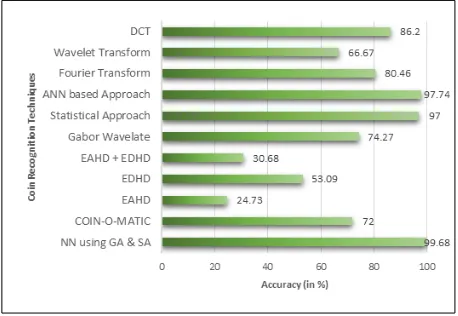
Accuracy of proposed coin recognition system is 99.68%
In 2006, L.J.P. van der Maaten et al. [2] presents a new coin classification system called “COIN-O-MATIC” specially designed to perform reliable classification of heterogeneous coin collections. COIN-O-MATIC uses a combination of coin photographs and sensor information in the coin classification. COIN-O-MATIC performs automatic classification of coins in five stages:
Stage 1. Segmentation:
It tends to separate a coin from the background of a coin photograph. Author proposed two-stage approach for the segmentation of coins. First one is fast segmentation procedure. The fast segmentation procedure consists of three steps: thresholding, edge-detection, and application of morphological operations. In this stage, failed segmentation is detected by checking whether the bounding box of the segmented coin is approximately square and reasonably large. If a failed segmentation is detected, then next step is applied which is computationally more expensive segmentation procedure. This process is same as the fast segmentation procedure; only thresholding is replaced by a convolution with a box filter. The convolution with the box filter removes the conveyor belt structure from the coin photographs, allowing for successful edge-detection on dark coins. Stage 2. Feature extraction:
It is used to extract efficient and coin-specific features from coin images. The resulting features can be used to train a classifier. COIN-O-MATIC uses edge angle-distance distributions for feature extraction which combines angular and distance information in order to achieve a good characterization of the distribution of edge pixels over a coin.
Stage 3. Pre-selection:
coins, whereas thickness measurements are obtained from a thickness sensor.
Stage 4. Classification:
For the classification of a coin, nearest-neighbour approach is applied in the constructed feature space. Advantage of using nearest-neighbour approaches is that it usually yields good performances on problems with a high number of classes. In COIN-O-MATIC, author has used 3-nearest neighbour classifier. Since a coin has two sides, two coin images are evaluated in order to classify a coin. Images of two sides of the coin are first classified separately and if both images (front and back side of same coin) belongs to same class, then coin is classified accordingly.
Stage 5. Verification:
Here it is checked whether two coin images have identical labels, based on visual comparison. Verification is necessary because the test sets contain unknown coins that are not available in the training set.
According to authors, they have shown promising results for the proposed system on a test set available for the MUSCLE CIS benchmark and achieved a good classification ratio with computational efficiency.
Salient features of the method:
Reliable for classification of heterogeneous coin collection.
Edge angle-distance distribution is used for feature extraction.
Nearest-neighbour approach is used for classification. Accuracy efficiency is about 72%.
In 2007, Abdolah Chalechale [3] introduced image abstraction and spiral decomposition based system for coin recognition. First step of the proposed system is to obtain the abstract image. By considering strong edges of the coin; abstract image is derived from the original coin image. This abstract image is then used for feature abstraction process. For feature extraction; Spiral Decomposition method is used in which spiral distributions of pixels in the abstract image is employed as the key concept and enables the system to recognize the similarity between full color multiple component coin images. The basic advantage of proposed system is that; here cost intensive image segmentation is not done. In order to prove the accuracy and efficiency of proposed approach, author has compared their results with other techniques like QVE, Polar Fourier Descriptor (PFD) and Edge Histogram Distribution (EHD) and came to the conclusion that proposed system shows better performance than other.
Salient features of the method:
Image segmentation is not required.
In 2009 Linlin Shenet al. [4] present an image based approach using Gabor wavelet for coin classification. Gabor wavelets are used to extract features for local texture representation. Concentric ring structure is used to divide the coin image into a number of small sections in order to achieve rotation-invariance. Statistics of Gabor coefficients within each section is then concatenated into a feature vector for whole image representation. Matching between two coin images are done via Euclidean distance measurement and the nearest neighbour classifier. To test the performance of proposed method, it is compared with two edge based methods, i.e. Edge Distance Histogram Distribution (EDHD) and Edge Angle Histogram Distribution (EAHD). On the basis of comparative study, it is concluded that EAHD achieve 24.73% accuracy, EDHD achieve over 53.09% accuracy and EAHD in combination with EDHD achieves 30.68% accuracy. Since the representative Gabor feature is applied,
the discrimination power of proposed system is significantly improved and as high as 74.27% accuracy has been achieved. Salient features of the method:
Gabor feature is used for coin classification.
Proposed method is robust to illumination variance and noise.
Have better refinement power.
In 2010, Hussein R. Al-Zoubi et al. [5] proposed a coin recognition system using a statistical approach for Jordanian coins. This method depends on two features: first is the color of the coin, and second its area. The recognition approach proposed in this paper consists of several steps which can be summarized as follows:
1. The image of the coin under test is loaded.
2. The gray-level image is generated from the colored image of the previous step.
3. Using the gray-level image, a gray-level histogram is drawn. A threshold value (T) for the image under test is calculated as the value between the two peaks of the histogram.
4. The threshold value (T) calculated in the previous step is used to obtain a black and white image of the coin under test: if a pixel in the gray image of Step 2 has a value less than the threshold, that pixel is assigned the value 0 (black); otherwise it is assigned the value 255 (white). 5. The binary image is then cleaned by opening and closing
through erosion and dilation. The purpose of this step is to smooth the boundaries of the coin to be recognized, maintain its size, and eliminate any noise.
6. The area of the coin under test is calculated by counting the number of white pixels.
7. The average value for each of the RGB colors is calculated by summing up the individual color values for every pixel of the original image of Step 1 and dividing that by the total image area (Height × Width).
8. The value of the area (Step 6) and average red, average green, average blue (Step 7) for the coin under test is compared against standard values for each of the seven coin categories. The coin with the minimum error is considered to be the target.
9. The standard values for the areas and average colors are updated using the new values obtained from the image under test.
The experimental analysis carried out by the author shows that high recognition rates more than 97% could be achieved using statistical approach. This fact makes statistical approach suitable for many applications.
Salient features of the method:
Color of a coin and its area are the key feature for classification.
In July 2011, Shatrughan Modi [6] presented an ANN (Artificial Neural Network) based Automated Coin Recognition System for the recognition of Indian Coins of denomination `1, `2, `5 and `10. This system is capable of recognizing coins from both sides as they have considered images from both sides of coin. Features are extracted from images using techniques of Hough Transformation, Pattern Averaging etc. Then, the extracted features are passed as input to a trained Neural Network. The whole process is explained as follows:
a. Acquire RGB Coin Image: This is the first step of coin recognition process. In this step the RGB coin image is acquired. Indian coins of denominations `1, `2, `5 and
b. Convert RGB Coin Image to Gray scale: From the first step a bit RGB image is obtained. In this step, the 24-bit RGB image is converted to 8-24-bit Gray scale image. c. Remove Shadow of Coin from Image: In this step,
shadow of the coin from the Gray scale image is removed. After that, edge of the coin is detected using Sobel Edge Detection and then shadow of the coin from the Grayscale image is removed using Hough Transform for Circle Detection. Now based on the center coordinates and radius, the coin is extracted from the background. So, in this way the shadow of the coin is removed completely.
d. Crop and Trim the Image: After shadow removal, the image is cropped to make its dimension equal to 100×100.
e. Generate Pattern Averaged Image: The 100×100 trimmed coin images become the input for the trained neural network. But to reduce the computation and complexity in the neural network, these images are further reduced to size 20×20 by segmenting the image using segments of size 5×5 pixels, and then taking the average of pixel values within the segment.
f. Generate Feature Vector and pass it as Input to Trained NN: In this step, the 20×20 image generates a feature vector of dimension 400×1 i.e. all the pixel values are put into a vector of 1 column. Then, this feature vector of 400 features is passed as input to trained neural network. g. The neural network classifies the given coin image into one of these class and based on the classification the results get generated to the denomination the given coin belongs.
Salient features of the method:
It has been observed that the system provides 97.74% correct recognition.
In 2012, Rahele Allahverdi et al. [7] developed coins classification method using discrete cosine transform (DCT) for Sasanian Coins. The whole process consists of three steps: First step is pre-processing step. The basic aim of this step is to extract the area of coins from cluttered-background images. This can be done by creating a binary gradient mask using Sobel operator, which is followed by dilation as well as filling holes and removing small undesired objects. Finally, the binary mask is applied to the image and the coin’s region is extracted. In second step, feature extraction is done using Discrete Cosine Transform (DCT). Finally, in third step; classification of coins is done using voting strategy in which each binary classifier votes for a class and the test sample is assigned to the class with highest vote number.
Salient features of the method:
In proposed method, support vector machine is used for classification.
Support Vector Machine is supervised learning method which gives promising solution to multiclass problems. Feature extraction is carried out using DCT which shows
better accuracy over Fourier transform and wavelet transform.
[image:3.595.312.541.73.231.2]Figure 1, shows graphical representation of comparison between various coin recognition techniques discussed so far.
Figure 1. Comparison between Accuracy of Various Coin Recognition Techniques
3.
PAPER CURRENCY RECOGNITION
METHOD
In 2003, Masato Aoba et al. [8] proposed paper currency recognition system for euro. Here three layer perception and radial Basis function (RBF) is used for paper currency recognition.
Salient features of the method:
Author has used three layer perception for classification and RBF for validation.
Three layer perception is used for pattern recognition which is very effective tool for classifying paper currency.
RBF network has a potential to reject invalid data because it estimates probability distribution of sample data effectively.
In 2003, Ali Ahmadi et al [9] postulated method to remove non-linear dependencies among variables and extract the main principal features of data. Initially the data space is partitioned into regions by using a self-organizing map (SOM) model and then the PCA is performed in each region. A learning vector quantization (LVQ) network is employed as the main classifier of the system.
Salient features of the method:
Complexity of data and correlation between variables is modeled by using a simple linear mode.
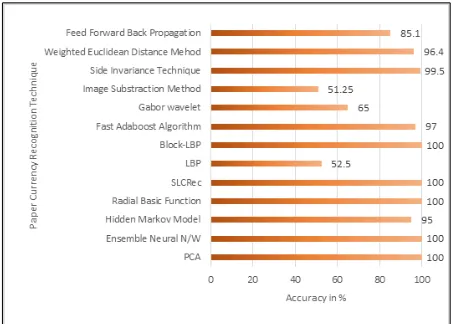
Accuracy of system can be extended to 100%.
The neural network is trained with notes representing different operational conditions in terms of color brightness, noise, dust, effect, etc. for these four classes. Since it is supervised learning, neural network is expected to give expected results when notes with similar or slight differences are presented for classification.
Salient features of the method:
Canny algorithm is used for edge detection because of
its low error rate and good ability to localized edge points properly.
Three layer back propagation neural network is used
for currency classification.
The experiments carried out by author showed good classification results and proved that the proposed methodology has the capability of separating classes properly in varying image conditions.
In 2010, Kalyan Kumar Debnath et al. [11] present a currency recognition system using ensemble neural network (ENN) particularly for TAKA (Bangladeshi currency). The individual neural networks (NNs) in an ensemble neural network (ENN) which in fact is a classifier and trained via negative correlation learning. The negative correlation learning (NCL) is to expertise the individuals on different parts or portion of input patterns in an ensemble. The image of different types note is converted in gray scale and compressed in the desired range. Each pixel of the compressed image is given as an input to the network. This system is able to recognize highly noisy or old image of TAKA. Ensemble network is very useful for the classification of different types of currencies. It reduces the chances of misclassification than a single network and ensemble network with independent training. To prove the efficiency of proposed ENN method author has compared it with the other methods like Hidden Markov Model (HMM), radial basis function (RBF) and Feature Extraction method called SLCRec.
Salient features of the method:
Negative correlation learning is for training.
System can recognize the currency even though input pattern is noisy.
In 2010, Junfang Guo et al. [12] used block-LBP algorithm for characteristic extraction from paper currency. Block-LBP is improved version of traditional local binary pattern (LBP) method. The proposed currency recognition system works in two phases. The first phase is the model creating phase which consist of preparing template for paper currencies and feature extraction using block-LBP algorithm. The feature vectors of template images are obtained as an output of first phase and will be used as input for second phase. The second phase is the verification phase. In verification phase template matching is done by calculating the similarity between the sample image and template image.
Salient features of the method: High recognition speed.
Robustness to noise and illumination change.
Higher classification accuracy can be achieved by Block LBP algorithm as compared with traditional LBP algorithm.
In 2011, Hai-dong Wang et al. [13], proposed paper currency number recognition method called fast Adaboost weak classifier training algorithm which sort the Eigen values to an array from small to large, and then traverse the sorted array once to find the best threshold and bias.
Salient features of the method:
Training speed can be increased to great extent.
In 2012, Chetan B. V. et al. [14] proposed side invariance paper currency recognition method which is two phase approach based on matching an input note image with a database of note image. The two phases are as follows:
1. Identifying matching dimension database notes. 2. Secondly, template matching is performed by
correlating the edges of input and matching dimension database note images.
The different stages involved in the overall process are described one by one.
Step 1. Image Acquisition and Segmentation
A digital camera is used for image acquisition. The next step of the paper currency recognition system is image segmentation. Segmentation is also three step process. In first step of segmentation, sobel operator is used to detect the edges of input image. Filtering of noisy edges is done in second step. In third step, the boundary coordinates of the currency note are noted down. With the help of the boundary coordinates, the currency note part is cut out of the original input image. Thus, the note is segmented.
Step 2. Dimension Matching
After paper currency segmentation, the numbers of pixels row-wise and column-wise are noted down. A dimension of the paper currency in terms of pixels is obtained from these pixel counts. After finding the dimensions of the input note, its dimensions are matched with the dimensions of all database notes. The matching dimension database notes are noted down.
Step 3. Template Matching
The template matching is performed by correlating the edges of input and database notes. Entire process of template matching process consists of edge Detection, template matching by displacement of database note and threshold comparison.
Step 4. Decision Making
During threshold comparison, there is a chance of more than one note yielding matching score greater than threshold. So, there is a need of decision making. The database note yielding the maximum matching score is taken as final match of the input note. Hence, the input note stands recognized.
The author has compared the proposed side invariance paper currency recognition method with existing currency recognition methods like Gabor wavelet, image subtraction method and Local Binary Pattern (LBP) based method. They came to the conclusion that Gabor wavelet based paper currency recognition method shows 65% accuracy, Image Subtraction method gives 51.52% accuracy, and Local Binary Pattern (LBP) based method gives 52.5% accuracy while proposed method gives 99.5% accuracy for the given set of paper currency.
In 2012, Amir Rajaei et al. [15] proposed a method to extract the texture features of currency note images. In order to do that first, the Discrete Wavelet Transform (DWT), in particular, Daubechies 1 (DB1) is utilized on a currency note and the approximate coefficient matrix of the transformed image is obtained. A set of coefficient statistical moments are then extracted from the approximate efficient matrix. The extracted features are stored in a feature vector. The extracted features can be used for recognition, classification and retrieval of currency notes.
In pre-processing step four different kinds of images are obtained from color image, viz. the binary image; the gray scale image using Sobel mask; the gray scale image using Prewitt mask; and the gray scale image using Canny mask. Then features are extracted by calculating the sum of pixels of each of the four images. Also, the Euler number is calculated for each of the images, then computed the correlation coefficient of input image after converting it to gray scale. After feature extraction paper currency classification is done by using two different methods called Weighted Euclidean Distance (WED) and Neural Networks using feed forward back propagation. The minimum distance classification method by taking the Weighted Euclidean Distance shows 96.4% accuracy rate while the Neural Network with feed forward back propagation classification technique provides almost 85.1% average of accuracy for the best case. Therefore, author concluded that the Weighted Euclidean Distance approach is better than the Neural Network.
Figure 2, shows graphical representation of comparison between various paper currency recognition techniques discussed so far.
Figure 2. Comparison between Accuracy of Various Paper Currency Recognition Techniques
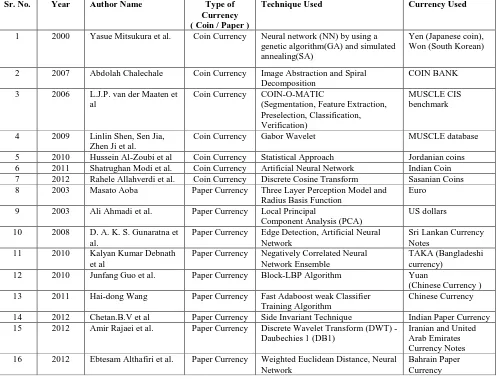
Various techniques used for coin and paper currency are summarized in Table 1.
4.
CONCLUSION
This paper focused on existing techniques and systems for currency recognition based on image processing. We have discussed both coin recognition and paper currency recognition methods separately. Finally we summarized their work in tabular form which is very helpful for study at a glance. Even though there is lot of research work done on this topic, still there are some issues related to the accuracy and efficiency of the method. Thus achieving maximum efficiency and getting 100% accuracy for heterogeneous currency, when physical state of currency is not that much good, will always be a challenge for researchers.
5.
REFERENCES
[1] Yasue Mitsukura, Minoru 'ukumi, Norio Akamatsu, “Design and Evaluation of Neural Networks for Coin Recognition by Using GA and SA” in proceedings of the IEEE-INNS-ENNS International Joint Conference on Neural Networks, 2000, IJCNN 2000, Vol. 5, Pp. 178 – 183
[2] Laurens J.P., van der Maaten and Paul J. Boon, “Coin-o-matic: A fast system for reliable coin classification” in
Proceedings of the MUSCLE CIS Coin Computation Workshop, Sep. 1, 2006, Germany, pp. 7-17.
[3] Chalechale A., “Coin Recognition Using Image Abstraction And Spiral Decomposition”, 9th International Symposium on Signal Processing and Its Applications, 2007. ISSPA 2007.
[4] Shen L., Jia S., J, Z., and Chen W. S., “Statistics of Gabor features for coin recognition”, IEEE International Workshop on Imaging Systems and Techniques, 2009. [5] Al-Zoubi H.R., “Efficient coin recognition using a
statistical approach”, 2010 IEEE International Conference on Electro/Information Technology (EIT), 2010.
[6] Shatrughan Modi, Dr. Seema Bawa, “Automated Coin Recognition System using ANN” International Journal of Computer Applications (0975 – 8887) Volume 26– No.4, July 2011, Pp. 13-18.
[7] Rahele Allahverdi, Azam Bastanfard, Daryoosh Akbarzadeh, “Sasanian Coins Classification Using Discrete Cosine Transform”, in IEEE proceedings of The 16th CSI International Symposium on Artificial Intelligence and Signal Processing (AISP 2012), 2012, Pp. 278-282.
[8] Masato Aoba, Tetsuo Kikuchi, Yoshiyasu Takefuji, “Euro banknote recognition system using a three layer perceptron and RBF networks”, IPSJ Transaction on Mathematical Modeling and Its Application, Vol 44, No. SIG 7 (TOM 8), May 2003, Pp. 99-109.
[9] Ali Ahmadi, Sigeru Omatu, Toshihisa Kosaka, “A Reliable Method for Recognition of Paper Currency by Approach to Local PCA) used local principal component analysis PCA”, in IEEE proceedings of the International Joint Conference on Neural Networks, 20-24 July 2003,Vol. 2, Pp. 1258 – 1262.
[10]D. A. K. S. Gunaratna, N. D. Kodikara and H. L. Premaratne, “ANN Based Currency Recognition System using Compressed Gray Scale and Application for Sri Lankan Currency Notes-SLCRec”, in proceedings of world academy of science, engineering and technology, Nov 2008,vol. 35,ISSN 2070-3740, Pp. 235-240. [11]Kalyan Kumar Debnath, Sultan Uddin Ahmed, Md.
Shahjahan, “A Paper Currency Recognition System Using Negatively Correlated Neural Network Ensemble”, Journal Of Multimedia, December 2010, Vol. 5, No. 6, Pp. 560-567.
[12]Junfang Guo, Yanyun Zhao, Anni Cai, “A reliable method for paper currency recognition based on LBP” in proceeding of 2nd IEEE International Conference on Network Infrastructure and Digital Content, 24-26 Sept. 2010, Pp. 359 – 363.
[13]Hai-dong Wang, Leye Gu, Linping Du, “A paper currency number recognition based on fast Adaboost training algorithm”, in IEEE proceedings of International Conference on Multimedia Technology (ICMT), Pp. 4772 – 4775.
[image:5.595.54.280.295.457.2][15]Amir Rajaei, Elham Dallalzadeh, Mohammad Imran “Feature Extraction of Currency Notes: An Approach Based on Wavelet Transform” in IEEE proceedings of Second International Conference on Advanced Computing & Communication Technologies -2012, 7-8 Jan. 2012 ,Pp. 255 – 258.
[image:6.595.51.549.196.575.2][16]Ebtesam Althafiri, Muhammad Sarfraz, Muhannad Alfarras, “Bahraini Paper Currency Recognition” Journal of Advanced Computer Science and Technology Research, June 2012, Vol. 2 No.2, Pp. 104-115.
Table 1. Summary of Techniques Used for Currency Detection
Sr. No. Year Author Name Type of Currency ( Coin / Paper )
Technique Used Currency Used
1 2000 Yasue Mitsukura et al. Coin Currency Neural network (NN) by using a genetic algorithm(GA) and simulated annealing(SA)
Yen (Japanese coin), Won (South Korean)
2 2007 Abdolah Chalechale Coin Currency Image Abstraction and Spiral Decomposition
COIN BANK
3 2006 L.J.P. van der Maaten et al
Coin Currency COIN-O-MATIC
(Segmentation, Feature Extraction, Preselection, Classification, Verification)
MUSCLE CIS benchmark
4 2009 Linlin Shen, Sen Jia, Zhen Ji et al.
Coin Currency Gabor Wavelet MUSCLE database
5 2010 Hussein Al-Zoubi et al Coin Currency Statistical Approach Jordanian coins 6 2011 Shatrughan Modi et al. Coin Currency Artificial Neural Network Indian Coin 7 2012 Rahele Allahverdi et al. Coin Currency Discrete Cosine Transform Sasanian Coins 8 2003 Masato Aoba Paper Currency Three Layer Perception Model and
Radius Basis Function
Euro
9 2003 Ali Ahmadi et al. Paper Currency Local Principal
Component Analysis (PCA)
US dollars
10 2008 D. A. K. S. Gunaratna et al.
Paper Currency Edge Detection, Artificial Neural Network
Sri Lankan Currency Notes
11 2010 Kalyan Kumar Debnath et al
Paper Currency Negatively Correlated Neural Network Ensemble
TAKA (Bangladeshi currency)
12 2010 Junfang Guo et al. Paper Currency Block-LBP Algorithm Yuan
(Chinese Currency ) 13 2011 Hai-dong Wang Paper Currency Fast Adaboost weak Classifier
Training Algorithm
Chinese Currency
14 2012 Chetan.B.V et al Paper Currency Side Invariant Technique Indian Paper Currency 15 2012 Amir Rajaei et al. Paper Currency Discrete Wavelet Transform (DWT)
-Daubechies 1 (DB1)
Iranian and United Arab Emirates Currency Notes 16 2012 Ebtesam Althafiri et al. Paper Currency Weighted Euclidean Distance, Neural
Network