Munich Personal RePEc Archive
Financial Liberalization: The African
Experience
Reinhart, Carmen and Tokatlidis, Ioannis
University of Maryland, College Park, Department of Economics
2000
First draft: November 30, 2000 This draft March 15, 2001
A shorter revised version of this paper was published: “Financial Liberalisation: The African Experience,”Journal of African Economies, Vol. 12 Supplement 2, 2003, 53-88.
Financial Liberalization: The African Experience
Carmen M. Reinhart* University of Maryland and NBER
Ioannis Tokatlidis University of Maryland
African Economic Research Consortium December 2-7, 2000
Nairobi, Kenya.
Abstract
Almost a decade after their initiation, financial reforms appear to have had little effect on the economies of Sub-Sahara Africa. Whether the blame is to fall on their initial design itself, or on the partial nature of their implementation, liberalization policies have not mobilized savings, deepened intermediation or raised investment. Yet, Africa needs properly functioning financial markets for a more efficient allocation of resources for growth and risk diversification. How can African
. I. Introduction
By the late 1980's and early 1990's, against an unfavorable background of rapidly deteriorating economic and financial conditions, many countries in Sub-Sahara Africa undertook far reaching economic reforms. Within the framework of IMF and World Bank supported structural adjustment programs, these countries were to restructure their economies, in order to achieve private sector led growth, through a market based system.1
Financial liberalization was a significant component of these reforms. Countries were to grant their central banks more autonomy in conducting monetary policy, liberalize interest rates, avoid or abolish the direct allocation of credit, implement monetary policy through indirect instruments,
restructure and privatize banks and, more generally, develop and foster the environment for the proper functioning of financial markets. 2 All in the hope of reversing decades of financial repression, and enabling their economies to grow faster.
1
See Wold Bank(1994) 2
Today, almost a decade after their initiation, financial reforms appear to have affected the economies in Sub-Sahara Africa very little. 3 Whether the blame is to fall on their initial design itself, or on the difficulties and partial nature of their implementation, liberalization policies have seemed insufficient in mobilizing savings, deepening intermediation through the financial sector, or raising investment. Yet, Africa needs properly functioning financial markets badly. Both for a more efficient allocation of resources, and, perhaps more importantly, for a more efficient and growth inducing risk diversification. How can African governments refine, correct and invigorate their approach towards financial policy reform? How can they enhance the effectiveness of their interventions and measures? The first step towards refining future policy choices requires an accurate assessment of the short African experience with financial reform. How has progress in institutional and policy reform, whatever its extent, affected the financial depth of the African economies? How have the gains in financial depth, if any, affected saving, consumption and investment? How does the African reform experience in these regards, so far, compare with that of other developing countries? Has the
experience of the poorer countries in the region been comparable to that of the more advanced middle income countries? Has the level of indebtedness affected the experience with financial liberalization in Sub-Sahara Africa? How do the countries that during the period of reforms experienced substantial increases in aggregate saving compare to the countries that experienced substantial declines.
3
See Nissanke and Aryeetey(1998) for a comprehensive analysis and a detailed investigation of financial reforms in Ghana, Malawi, Nigeria and Tanzania. Collier and
These questions inspire our study, which proceeds as follows. In section II, we briefly review the main analytical lenses through which we can understand the consequences of financial
liberalization on consumption and saving. In section III, we review the relevant empirical evidence on the effects of financial liberalization in developing countries. In section IV, we describe our
methodology and proceed to establish the aggregate profile of the reform process in Africa. First, we compare the experience of Sub-Saharan countries to that of other developing countries. Second, in order to understand the diversity of responses within the African group, we examine the association of the progress in financial development, the level of income, and the level of indebtedness with the picture that emerges after the reforms. Finally we take a closer look at those countries that did
substantially better or worse, in terms of aggregate saving ratios during liberalization. The last section discusses some of the policy implications of our findings.
Section II. Analytical Background
Financial liberalization entails reform along a number of distinct but interrelated dimensions: liberalization of the interest rates, reduction in reserve requirements, partial or complete abandonment of directed credit, privatization of the banking and wider financial sector, establishing and fostering the development of securities markets. The above exercises in deregulation and building of market
mechanisms are expected to be accompanied by an exercise in re-regulation: measures that enhance the competitiveness of the financial environment and guarantee the soundness of operations through increased prudential oversight. Finally, but no less importantly, the reforms adopted on the domestic front may be accompanied by measures that increase openness through the current and capital account transactions.
investment through their effect on asset returns and their characteristics, and through their effect on the availability and allocation of credit. We discuss in turn the models that may shed some light on the anticipated effects of financial liberalization through each one of these prime channels of influence.
1. The interest rate channel
At least since McKinnon(1973) and Shaw(1973), the presumption is that growth in a financially repressed environment is hindered primarily by the low level of saving, not the lack of investment opportunities. Controlled interest rates reflect capital scarcity inaccurately, inducing inefficient mis-allocation of resources. They prohibit appropriate risk-taking by financial institutions, as they eliminate or reduce the scope for risk premia. Lifting controls on interest rates, allows them to increase to levels that stimulate higher saving. Assuming a strong responsiveness of saving to interest rates, higher interest rates are expected to reduce disintermediation. Within this optimistic framework, financial liberalization produces higher interest rates and higher savings that, in turn, induce higher and better quality investment, and, ultimately economic growth.
Of course, within the standard intertemporal model the effect of a change in interest rates on consumption and saving is ambiguous. Its income and substitution effects work in opposite directions. Higher returns on saving raises the stream of future income and wealth, raising current consumption. At the same time, postponing current consumption allows for higher future consumption, as returns on saving have gone up. In such a framework the intertemporal elasticity of substitution is crucial in determining the direction of change in savings that follows an increase in the interest rate.
guide their consumption choices for the residual of their budget left after subsistence needs are met. Hence, in countries where the representative household consumption is close to subsistence levels, consumption and saving will be insensitive to changes in the real rate of interest In wealthier countries, consumption would decline and saving increase following an increase in the real interest rate.4
2. The credit channel
4
For models that stress the role played by subsistence considerations in consumption and saving decisions, see Rebelo(1992) and Easterly(1994).
Not all households have access to credit markets. Consequently, some households have no ability to smooth consumption over time, at least through intermediation afforded through the formal financial sector. Liquidity constrained households determine their consumption and saving on the basis of their current income. Relaxing the liquidity constraints on borrowers that used to be rationed out of the market, may produce a consumption boom and a decline in aggregate saving. The more binding the constraints and the greater the proportion of constrained consumers before the
The idea that aggregate consumption and saving patterns respond not just to changes in
permanent income, but also to changes in current income is associated with the work of Campbell and Mankiw (1989, 1993)5. Hence, a reduction in reserve requirements may make more resources available for lending, especially to households. Also, a redirection of credit may also favor consumers, loosening their liquidity constraints. At the microeconomic level, a privatized and more competitive banking sector may search the additional business of consumer lending.
Many of the past liberalization episodes unleashed a period of rapid growth in bank lending, asset price booms, and increases in consumption that often coincided with a decline in private saving rates. Many of those episodes also ended in a full-fledged financial crisis. Hence, no analysis of saving is complete without an assessment of the pervasiveness of liquidity constraints.
Section III Financial Liberalization in Developing Countries: A Review of the Empirical Literature
5
The empirical literature tends to reflect the theoretical ambiguities presented above.6 Though it mostly confirms the separate importance of subsistence consumption and the pervasiveness of
liquidity constraints for the understanding of saving patterns in developing countries, it remains inconclusive on their relative weight, and their ultimate combined effect on savings after financial reform..
There is little consensus, however, on the interaction between saving and the real rate of interest.7 Some research detected only unimportant effects of changes in real interest rates on domestic saving in developing countries. For example, Giovannini (1985), who examines this issue for eighteen developing countries, concludes that for the majority of cases, the response of
consumption growth to the real rate of interest is insignificantly different from zero. One should therefore expect negligible responses of aggregate saving to the real rate of interest.
In a model with a single consumption good, Ostry and Reinhart (1992) confirm these findings. However, when they use a disaggregated commodity structure to account substitution between traded and nontraded goods, they find higher and statistically significant estimates of the sensitivity of consumption to interest rates. On the other hand, Ogaki, Ostry and Reinhart(1996) establish that, where subsistence consumption considerations are important, the saving elasticity is not very sensitive
6
Reinhart(1999) offers a useful collection of country case studies that complements the empirical literature briefly reviewed in this paper.
7
to the level of the real interest rate. In their results, if the country in question is at the lower end of the income spectrum, higher saving rates may not follow, even after large increases in real interest rates. The growth effects of higher interest rates would also tend to be small for the relatively poor countries.
Saving may be less responsive to changes in real interest rates in low-income than in middle-income countries because of the way the credit channel is working in less developed financial systems. Rossi (1988), for example, argues that in low-income developing countries that are characterized by pervasive liquidity constraints, consumption growth is more likely to follow income growth than changes in expected rates of return.8 The empirical evidence confirms the pervasiveness of liquidity constraints in many developing countries; however, Haque and Montiel (1989) highlight that the severity of these constraints varies considerably across countries. More recently, Vaidyanathan (1993) showed that the incidence of liquidity constraints among households is inversely related to the degree of economic development which would imply--following Rossi (1988)--that saving in poorer countries should be less responsive to interest rate changes.9
8
Deaton (1989) has also emphasized the importance of liquidity constraints in explaining consumption/saving behavior in developing countries.
9
This is not necessarily the case for industrial countries. The available, sporadic, econometric evaluation of the effects of liberalization on savings tends to favor the scenario of declining savings after financial deregulation. Bayoumi(1993) shows that in an overlapping generations framework deregulation increases the sensitivity of saving to wealth, current income, real interest rates and demographic factors. Following deregulation, savings decline, to recover only partially over time. The scenario is tested successfully with U.K. data. Though his results imply that much of the decline in savings was caused by the rise in wealth, financial deregulation also played an important role.
Lehmussaari(1990) provides similar evidence for a sharp decline in saving and increased sensitivity of consumer responses to real wealth after deregulation in the Nordic countries, testing a model inspired by the life-cycle tradition. Jappeli and Pagano(1994) generalize the decline-in-savings result for the OECD countries for the period from 60 to 87. In their overlapping generations model, capital market imperfections, in the form of liquidity constraints on consumers, increase saving and strengthen the effect of growth on saving. Their empirical tests suggest that the deregulation of the 80's contributed to the decline in savings in the OECD countries.10
10
In a somewhat different line of research that focuses on effects of financial deregulation through the housing market, Miles(1992) and Koskela et. all (1992) present additional evidence that reducing borrowing constraints affects household savings negatively. Miles for the US and UK, Koskela et all for Finland.
index of financial liberalization on the basis of eight different dimensions: interest rate deregulation, pro-competition measures, reserve requirements, directed credit, bank ownership, prudential
regulation, securities markets deregulation and capital account liberalization. This index is used as an independent variable along with the log of per capital disposable income, the real interest rate,
inflation and the government saving rate, to explain the variation in the private saving rate. In country-by-country estimations, they find no evidence of a positive effect of the real interest rate on saving. In most cases the relationship is negative, and significantly so in the cases of Ghana and Indonesia. The effects of the financial liberalization index are mixed: they are negative and significant in Korea and Mexico, but, positive and significant in Turkey and Ghana. The long run impact of liberalization is sizeable. Corresponding to the realized change in the index, the estimated model indicates a permanent decline in the saving rate of 12% and 6% in Korea and Mexico, and a rise of 13% and 6% in Turkey and Ghana. A likelihood ratio test within the context of a panel estimation rejects the hypothesis that the coefficients are equal across countries.
By estimating augmented Euler equations, a la Campbell and Mankiw, they find evidence for the presence of liquidity constraints: for the majority of countries, income is significant at conventional levels, and its coefficient is positive and significant when constrained to be equal across countries. Nevertheless, they were not able to pin down whether financial liberalization relaxes liquidity
constraints. Assuming away econometric problems, they suggest that their Euler equation results may indicate, at best, that financial liberalization has had little impact on the amount of credit available to consumers through the formal financial sector. In summary, they identify no strong and reliable real interest rate effect on saving, while the aggregate liberalization index has a mixed record.
which is of some importanceΒthe household and the business sector may not be reacting similarly to the effects of financial reforms. Honohan and Atiyas(1993) using a simple model of intersectoral financial interactions, and with data mainly form the early 1980's for developing countries, find empirical support for a Αbusiness spending crowding-out≅ scenario: a change in the flow of funds from the foreign and government sectors causes, at most, a small response in the flow from the household sector by comparison to the response of the business sector. Exogenous swings in the availability of foreign finance, or in the government=s surplus are absorbed, almost entirely, by changes in the rate of investment by the business sector. The household sector does not come forward, to any large extent, with additional financial saving to compensate for the shortfall in foreign financing or government borrowing.
Section IV. Financial Liberalization in Africa: Some Stylized Evidence
Most countries made substantial progress in liberalizing the current account and in developing foreign currency interbank markets. Much less progress was achieved in liberalizing capital account transactions. According to the IMF survey, most countries were still following restrictive policies regarding the capital account transactions, maintaining controls over capital receipts and outflows. Also, controls over portfolio investment, seemed to discourage private capital flows, in combination with the current limitations and inadequacies of the domestic capital markets.11
11
In what follows, we are interested in establishing the emerging patterns of response of the Sub-Saharan economies to these attempts at financial reform, at the aggregate level. We look at a sample of 29 of the 48 Sub-Saharan countries for the period from 1970 to 1998.12 For each country we split the sample in a ΑBEFORE≅ and ΑAFTER≅ period. The ΑBEFORE≅ period is one of financial repression,
(interest rate controls, directed credit, etc) of diverse forms and intensity. The ΑAFTER≅, is the period after the authorities in the country undertook commitments and adopted measures to move towards a more liberal financial system. In other words, ΑAFTER≅, for the purposes of this study, is not
synonymous to Αafter liberalization≅ but with Αafter entering a process of financial policy reforms
towards liberalization≅.
Appendix Table 1 reports the dates/years that were chosen as the Αturning points≅ for each country. The same table reports the corresponding dates for the other developing countries that serve as a comparison group for our study. In the table we report both the domestic and the external
liberalization Αturning points≅. Our study, however, focuses on the before/after split of the domestic liberalization. The corresponding external liberalization dating offers few observations for any
statistically meaningful testing. Interest rate deregulation was the focal point in deciding the date of the
Αturning point≅ for domestic liberalization, but not the only consideration, given the many
components of liberalization. The dating was based on information found in Mehran et all(1998), Gelbard and Pereira Leite(1999), numerous IMF Staff country reports for the countries in the sample,
12
and sources from national monetary authorities in the respective countries.
For each of the groups that we identify later in the study, we compare the average behavior of a number of aggregate indicators in the BEFORE period to its average behavior in the AFTER period. The indicators, besides availability and sufficient length of the series, were chosen on the basis of the theoretical and empirical clarifications of the previous part of this paper. Our concern is with
establishing, to the extent possible: First, the impact of the process of financial liberalization,
understood as institutional and policy reform on the real interest rate, the spread between deposit and lending rate, and the financial depth of the economy, as captured by the monetary aggregates M1/M2, M2/GDP, M3/GDP, (Total credit to the private sector)/GDP, (Domestic Credit provided by the Banking Sector)/GDP. Secondly, the impact of interest rate increases and financial deepening on saving consumption and investment, as measured by the ratios Gross Domestic Saving/GDP, Gross National Saving/GDP, Gross Domestic Investment/GDP, Private Consumption/GDP Government Consumption/GDP and Total Consumption/GDP..
aggregate savings equation through a comparative static lense.13 Whatever the groups of comparison are, we contrast average behavior DURING the process of liberalization, for most countries the 1990's, to the average historical behavior of the roughly two decades of financial repression that preceded the reforms.
13
See Loayza et all(2000) for one of the most recent reduced form studies of savings determinants in panels, that also surveys previous literature. and Hadjimichael et all (1995, 1996) for cross country estimation of savings and investment equations.
The comparisons involve first, Sub-Saharan Africa, as a group, versus other developing countries. After establishing the post-reform profile for the whole African group, we delve into the diversity of experiences within it. We compare the responses of the countries that made more progress in financial development to the countries that made little progress in that respect. We then contrast the behavior of the low income countries to that of the middle income countries, as well as the behavior of the severely indebted countries to those that are moderately or less indebted. Finally we contrast the group of countries that improved significantly their aggregate saving ratios to a group of countries that saw their saving ratios decline significantly, during the liberalization period.
1. A Comparison of the Sub-Saharan African Experience to Other Developing Countries
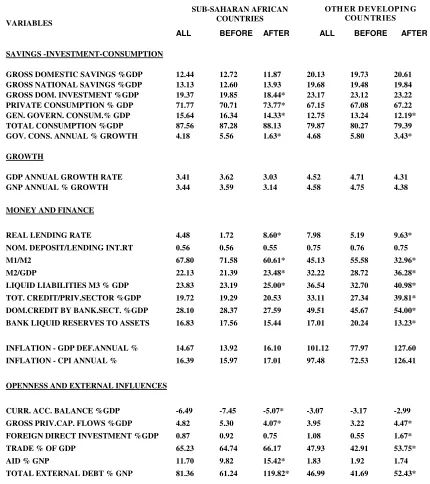
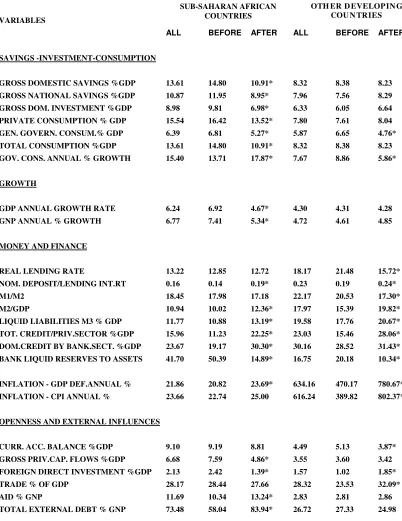
Tables 1 and 2 report the means and standard deviations for the relevant indicators for the comparison groups. Tables 1 and 2 also report the results of two kinds of hypothesis tests: A t-test for the equality of means Αbefore≅ and Αafter≅ within each group; an F-test on the equality of standard
deviations Αbefore≅ and Αafter≅ within each group.
deposit to lending rate ratios remained at roughly pre-liberalization levels. The spreads are higher in Africa. The monetary and credit aggregates go in the same direction for both groups. However, the other developing countries start from a deeper position and make more significant progress than African countries do. Moreover, while the monetary aggregates show some deepening for Africa, the credit aggregate remain statistically indistinguishable from pre-liberalization levels.
As regards changes in aggregate savings ratios, there appear to be none. When we look at the averages for the groups, neither domestic nor national saving ratios are statistically different in the post-liberalization times from their respective pre-liberalization levels. Saving ratios, of course, remain much higher in the other developing countries. The levels of domestic investment are somewhat closer. However, Africa records a statistically significant decline in its gross domestic investment ratio.
Total consumption stagnates (=no statistically significant difference in the level of the ratio before and after) in both groups, with Africa at a much higher level. Interestingly, there is a reallocation of
consumption between the private and the public sector in Africa. The private ratio increases while the government ratio declines. In the other developing countries private consumption stagnates, and government consumption declines slightly.
While growth stagnates in both groups, at higher levels for the other developing countries, the gap between them in average per capita income widens dramatically. While both groups experience declines in average current account deficit ratios, which are lower for the other developing countries both before and after financial reform, both gross private capital flows and foreign direct investment decline in Africa and rise in the other developing countries. Crucially, the average gap between the two groups with respect to aid dependency and debt burden widens.
experience with financial reform, but they also have a Αdeeper≅ experience. Besides the dramatic
increase of the real interest rate after liberalization and the indiscernible effect of Αliberalization≅ on saving , the two groups have little in common. Africa as a group experiences growth rate and income stagnation (factors that do not enhance aggregate saving) and high and volatile rates of inflation. Inflation in industrial country settings is understood as a signal of uncertainty that triggers the
precautionary motive for savings. In Africa, it is more likely to be treated as a signal of uncertainty that induces consumers to stay away of the intermediation circuit (correlation coefficients and panel
estimates show inflation to be negatively correlated with saving in Africa instead of the positive correlation in industrial countries).
2. A comparison among the fast and slow reformers
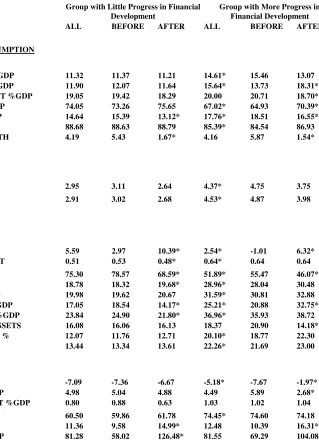
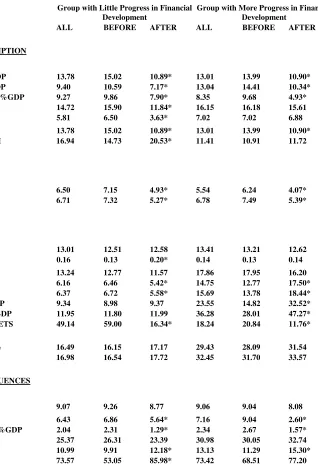
Appendix Tables 3 and 4 report the means and standard deviations for the relevant indicators, and the results of the hypothesis tests. Table 3 presents the results on the equality of means Αbefore≅
and Αafter≅ within each group with an asterisk in the after columns, and a test of equality of means
Αafter≅ across groups in the last column of the table with a double asterisk. The classification of the
African countries in the sample according to their level of progress in financial development, -understood here as pertaining to institution building and policy stance, not as financial deepening on the basis of monetary and credit indicators- is based on Mehran et all(1998).15
Appendix Table 2 reports the classification of the countries in the sample according to this criterion. Splitting the sample into two groups, only, obscures somewhat the within group diversity. Nevertheless it allows a sufficiently clear first approximation to the issues involved with the
assessment of the consequences of financial reforms. The classification is based on the profile of the financial setting and policy environment of these countries at the end of the period, that is by 1997. The less advanced group is characterized on the domestic front by: some progress in developing indirect instruments of monetary policy, at least some limited activity in secondary markets. Operating stock markets, liberalized (or partially liberalized) financial markets in general; market-determined interest rates. On the external front they are characterized by restrictiveness in terms of both current and capital account convertibility. The more advanced group has made substantially more progress than the less advanced group along the dimensions referred to above in the domestic sector and they
15
have achieved, at least, some partial liberalization on the current account, (if not the capital account). Our results show that countries with less advanced financial sectors experienced the surge in real lending rates, as the more advanced countries did, but also, unlike this second group, they
experienced, on average, an increase in spreads between deposit and lending ratios. All monetary and credit aggregates indicate that the more advanced countries recorded substantial gains in financial depth too. The less advanced, made little progress in monetary expansion, and credit, either as total credit to the private sector or domestic credit provided by the banking sector declined. Inflation was higher on average and more volatile in the advanced group. Domestic saving ratios stagnated for the two groups; it seems at slightly higher levels for the advanced group, but the difference between the two after reforms is not significant. While national savings also stagnated for the less advanced group, it increased substantially and significantly for the more advanced countries. Domestic investment declined for the two groups, significantly for the more advanced.
reach statistically similar levels during the liberalization years in the sample. The two groups differ however, along the total external debt dimension. The less advanced are also more heavily indebted by the end of the period, though they started at a more favorable position debt-wise.
The most telling result of this comparison is that the actual setting and policy environment matters for the consequences of liberalization. The countries that have made more progress in reforms, record also some degree of financial deepening. In fact their record resembles that of the other
developing countries.
In the less advanced countries pre-reform patterns persist in saving and investment. The subsistence consumption argument would indicate for this group little effect or no effect from the increase in the real interest rate on consumption and saving. Credit declines rather than increase. In this context, if liquidity constraints remained at pre-liberalization levels for the government or the private sector, the offset may have come from abroad: aid and foreign borrowing. A timid version of the Αliquidity- contraint scenario≅ of financial liberalization, which results in a decline in saving and an increase in private consumption probably applies to the more advanced group.
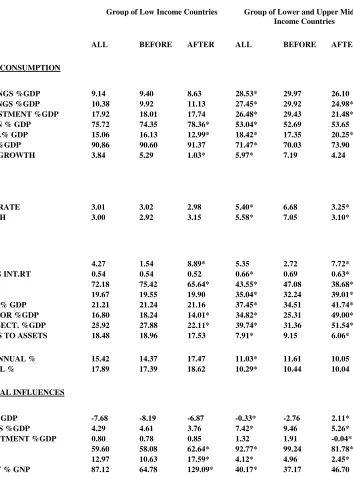
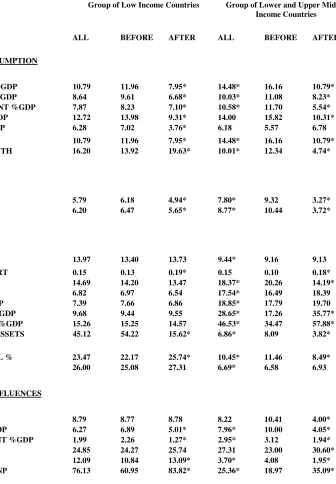
3. Comparison between the low- and middle-income countries
consideration they have few things in common besides that the real lending rate increased substantially in both. The spreads between deposit and lending rate remain higher in the low income countries. While the middle income countries made substantial and significant advances in terms of financial depth, both in terms of the monetary and credit aggregates, the low income countries stagnated in terms of M2 and M3 ratios and receded substantially and significantly in terms of the credit aggregates. In one word, the gap in financial depth between the two groups widened quite spectacularly by the end of the period under consideration.
Inflation has been substantially higher and more volatile in the low income group during this period of transition to a more liberal financial regime. The middle income group had experienced higher growth rates before liberalization. After liberalization average growth rates declined in this group too, so that by the end of the period the two groups recorded statistically similar rates. Despite this negative trend, the income gap further widened between the two groups after liberalization. Given the above, it follows naturally that the middle income group has substantially higher levels of saving and investment than the low income group(both before and after the reforms). It is important to notice however, that while the after liberalization decline in domestic saving and investment for the low income group are small and statistically insignificant, the decline of national saving and domestic investment are important and significant for the middle income countries.
Among the low income countries we observe the substitution between private and government consumption that we noticed elsewhere too: significant decline in government consumption and significant increase in private consumption. In the middle income group, private consumption remains at pre-liberalization levels, while government consumption rises. The consequent rise in total
middle income group. Both groups register declines in the current account deficit ratios and the gross private capital flows ratios, with the declines being greater and significant for the middle income countries. Foreign direct investment rises but not significantly in the low income group but declines substantially in the middle income group. Exposure to trade flows declines for the middle income group; despite the decline, middle income countries remain more open to trade than low income countries. At the same time, they become less dependent on aid, and their debt burden rises but not significantly . For low income countries aid dependency and debt burden climb to precipitous levels.
In other words, the comparison of the experience of the low income group to middle income group offers a similar picture than the one afforded by the comparison across financial development levels. The low income group is also the group that has made less progress in financial reforms. The contrast between groups however is much sharper between income level groups than financial development level groups. The middle income country group pre- and post- reform profile strongly resembles that of the other developing countries, the low income group profile sharply contrasts with it.
classification for 2000. Appendix Table 2 reports this and other classifications we use. We group the severely indebted countries on the one hand, and the moderately and less indebted on the other. The tables with these results are not reported here in the interest of space but the picture that emerges is similar to that of the other cuts in our sample. Specifically, because of the significant overlap between low income and severely indebted countries, the results of this comparison are to some extent similar to those obtained for the comparison between low and middle income countries.
The gap in domestic and national savings between the two groups is smaller than the respective gap between low and middle income groups. Domestic investment is comparable across groups.
The severely indebted group registered the significant decline in government consumption with a significant increase in private consumption that we observed elsewhere, while maintaining similar levels of total consumption before and after liberalization. For moderately indebted group, the increase in private consumption and the decline in government consumption are not statistically significant, and total consumption remained at pre-liberalization levels.
Though the income gap favors the moderately indebted countries, its magnitude is smaller between severely and moderately indebted countries than between low and middle income countries. Also, the severely indebted countries have a higher aid dependency and a total debt ratio than the low income countries, while the moderately indebted countries have a higher aid dependency and total debt ratio than the middle income countries. Foreign direct investment ratios and urbanization rates are similar across debt level groups, while differences in trade openness and age dependency ratios are less pronounced between debt level groups than between income level groups. Moderately indebted
tended to register a worsening: their monetary aggregates remained stagnant while their credit aggregates declined significantly.
Severely indebted countries registered in the post liberalization times inflation rates that were almost double those of the moderately indebted, and with standard deviations almost triple those of the moderately indebted. In so doing however, the two groups did not deviate significantly from their pre-liberalization record. Basically, the tale of two Africas does not change significantly -qualitatively- when we look at the contrast through the lense of the debt levels.
V. Conclusions
Financial reform in Sub-Sahara Africa started later and under more unfavorable circumstances than in other developing countries. Some progress has been made in the front of institution building and policy stance as reported by the assessments of international financial institutions. This progress however was not sufficient to transform the preexisting patterns of saving and investment in Africa. This picture of course is shaped by the overwhelming presence in the sample of the low income, severely indebted countries, that are the countries that also made less progress in financial reform. In a certain sense, this is the tale of two Africas. The small group of middle income, less indebted
Taking the results of the preceding section at face value, it appears that financial liberalization delivers: higher real interest rates (possibly reflecting the allocation of capital toward more productive, higher return projects); lower investment, but not lower growth (again, possibly owing to a shift to more productive uses of financial resources). Liberalization appears to deliver financial deepening, as measured by the credit and monetary aggregates--but, again, low income countries do not appear to show as clear signs of such a benefit. Financial deepening has not followed financial liberalization in Africa, as it has in other regions. The monetary aggregates made some progress, but the credit aggregates stagnated. In fact there has been a credit crunch in many countries in Africa in the last decade. One can speculate that, unlike in many other liberalization episodes in other regions,
liberalization in Africa has not been accompanied by the kind of fiscal discipline that allows credit to flow to the private sector. Indeed, the evidence presented in the previous section is not incompatible with a Αcrowding-out≅ environment.
As regards saving, anything goes. In some regions saving increased following financial liberalization; but in the majority of cases saving declined following the reforms. Thus our findings, which are in line with several earlier studies, do not settle the issue of the impact of liberalization on saving. It would appear, though, that those that stress the relaxation of liquidity constraints effects are on a more solid footing.
As noted, financial liberalization does not appear to deliver unambiguous gainsΒat least from the standpoint of growth. However, the evidence presented in Levine (1992) suggests that to the extent that financial deepening does take root, it has positive and significant consequences for long term growth. Yet, our results suggest that for Africa as a whole, but for the low income countries in particular, financial deepening is not guaranteed following liberalization.
Why then liberalize? The answer to this question depends importantly on learning from history. Financial liberalization may fall short of delivering the rosy outcome depicted in the earlier literatureΒbut given the track record of financial repressionΒit still appears to dominate the alternative. From the numerous financial crises of the 1990s, we know that for emerging markets access to
international capital markets is precarious in the best of times and nonexistent in the worst.
International capital flows are volatile and in some regions, notably Asia, appear to become even more so following liberalization. Yet, for countries that need to import capital from abroad, the absence of liberalization usually leaves them shut out of international capital markets even in the best of times. It could be said that liberalization is like running in a race, you may run and not winΒbut you can=t win
REFERENCES
Aryeetey E., H. Hettige, M. Nissanke and W. Steel, (1996) Financial Market Fragmentation and Reforms in Sub-Saharan Africa, Working Paper, Private Sector Development and Economics Division, World Bank.
Bandiera, G. Caprio, P. Honohan, and F. Schiantarelli (2000). ΑDoes Financial Reform Raise or Reduce Saving?, Review of Economics and Statistics, May, 82(2): 239-263
Bayoumi, T. (1993). ΑFinancial Deregulation and Household Saving,≅ Economic Journal, 103, November, 1432-1443.
Campbell J. and G. Mankiw(1989) Consumption Income and Interest Rates: Reinterpreting the time series evidence, in O. Blanchard and S. Fischer eds. NBER Macroeconomics Annual 1989, MIT Press
Campbell J. and G. Mankiw(1993) The Response of Consumption to Income: A cross country investigation, European Economic Review, 35, pp. 723-767
Collier P. and J.W. Gunning, (1999) Explaining African Economic Performance, Journal of Economic Literature, Vol XXXVII, pp. 64-111.
Collier P., and C. Pattillo eds, (2000) Investment and Risk in Africa, St.Martin=s Press
Collier P., A. Hoeffler and C. Pattillo, (1999) Flight Capital as a Portfolio Choice, Working Paper, WP/99/171, International Monetary Fund
Deaton, Angus,(1989). ΑSaving in Developing Countries: Theory and Review,≅ in Proceedings of the World Bank Annual Conference on Development Economics 1989, (Washington: World Bank).
de Melo, Jaime, and James Tybout, (1986). ΑThe Effects of Financial Liberalization on Savings and Investment in Uruguay,≅ Economic Development and Cultural Change,. 561-87.
Easterly, William, (1994). ΑEconomic Stagnation, Fixed Factors, and Policy Thresholds,≅ Journal of Monetary Economics, Vol. 33, (1994), pp. 525-57.
Faruqee, H., and A. Husain, ΑSaving Trends in Southeast Asia: A Cross-country Analysis,≅ IMF Working Paper WP/ 95/ 39, April 1995.
Gelbard E. A., and S. Pereira Leite, (1999) Measuring Financial Development in Sub-Saharan Africa, Working Paper, WP/99/105, International Monetary Fund
Hadjimichael M.T., D. Ghura, M. Muhleisen, R. Nord, and E. M. Ucer, (1995) Sub-Saharan Africa: Growth, Savings, and Investment, 1986-93, Occasional Paper 118, International Monetary Fund
Hadjimichael M.T., M.Nowak, R. Sharer and A. Tahari (1996) Adjustment for Growth: The African Experience, Occasional Paper 143, International Monetary Fund
Haque, N.U., and P. Montiel, Consum ption in Developing Countries: Tests for Liquidity Constraints and Finite Horizons,≅ R ev iew of Econ om ics an d Statistics LXXI, (198 9), 40 8 -415.
Honohan, P. and Atiyas (1993). ΑIntersectoral Financial Flows in Developing Countries,≅ Economic Journal, May, 103, 666-679
Jappelli and Pagano (1994). ΑSaving, Growth and Liquidity Constraints,≅ Quarterly Journal of Economics, 109, 83-109.
Koskela, Loikkanen, and Viren (1992). ΑHouse Prices, Household Saving and Financial Market Liberalization in Finland,≅ European Economic Review, 36, 549-558.
Lehmussaari. O.P., (1990). ΑDeregulation and Consumption: Saving Dynamics in the Nordic Countries,≅ IMF Staff Papers, March, 37, 1, 71-93
Loayza N., K. Schmidt-Hebbel, and L. Serven (2000). ΑWhat Drives Private Saving Across the World? Review of Economics and Statistics, May 2000, 82(2) :165-181
McKinnon, Ronald I., (1973). Money and Capital in Economic Development, (Washington:The Brookings Institution).
Mehran H., P. Ugolini, J.P.Briffaux, G Iden, T. Lybek, S. Swaray, and P. Hayward, (1998) Financial Sector Development in Sub-Saharan African Countries, Occasional Paper 169, International Monetary Fund
Miles, D, (1992). ΑHousing Markets, Consumption and Financial Liberalization in the Major Economies,≅ European Economic Review, 36, 1093-1136
Reinhart, C. Accounting for Saving: Financial Liberalization, Capital Flows, and Growth in Latin America and Europe, (Washington DC: John Hopkins University Press for the Inter-American Development Bank,1999).
Rossi, Nicola, "Government Spending, the Real Interest Rate and the Behavior of Liquidity
Constrained Consumers in Developing Countries," IMF Staff Papers, Vol. 35, (1988), pp. 104-40.
Savastano, Miguel, "Private Saving in Fund Programs," (Unpublished manuscript, IMF (1994)). Schmidt-Hebbel, Klaus, Steven B. Webb, and Giancarlo Corsetti, "Household Saving in Developing
Countries: First Cross-Country Evidence," The World Bank Economic Review, Vol. 6, (1992), pp. 529-47.
Shaw, Edward, (1973). Financial Deepening in Economic Development, (New York: Oxford University Press).
Wold Bank (1994) Adjustment in Africa: Reforms, Results and the Road Ahead , Oxford University Press
Vaidyanathan, G. (1993). "Consumption, Liquidity Constraints and Economic Development," Journal of Macroeconomics, Vol. 15, 591-610.
Source: World Bank, World Development Indicators 2000. Period covered in study: annual observations for 1970-1998.
Series: Gross domestic savings (% of GDP) (NY.GDS.TOTL.ZS)
Gross domestic savings are calculated as the difference between GDP and total consumption. For more information, see WDI table 4.9.
Series: Gross national savings, including NCTR (% of GDP) (NY.GNS.ICTR.ZS)
Gross national savings including net current transfers is equal to gross domestic savings plus net income and net current transfers from abroad.
Series: Gross domestic investment (% of GDP) (NE.GDI.TOTL.ZS)
Gross domestic investment consists of outlays on additions to the fixed assets of the economy plus net changes in the level of inventories. Fixed assets include land improvements (fences, ditches, drains, and so on); plant, machinery, and equipment purchases; and the construction of roads, railways, and the like, including commercial and industrial buildings, offices, schools, hospitals, and private residential dwellings. Inventories are stocks of goods held by firms to meet temporary or unexpected fluctuations in production or sales. For more information, see WDI tables 1.4 and 4.9.
Series: Private consumption, etc. (% of GDP) (NE.CON.PETC.ZS)
Private consumption is the market value of all goods and services, including durable products (such as cars, washing machines, and home computers) purchased or received as income in kind by households. It excludes purchases of dwellings but includes imputed rent for owner-occupied dwellings. It also includes payments and fees to governments to obtain permits and licenses. In practice, private consumption may include any statistical discrepancy in the use of resources relative to the supply of resources. For more information, see WDI table 4.9.
Series: General government consumption (% of GDP) (NE.CON.GOVT.ZS)
General government consumption includes all current spending for purchases of goods and services (including wages and salaries). It also includes most expenditures on national defense and security, but excludes government military
expenditures that are part of government capital formation. For more information, see WDI table 4.9.
Series: Total consumption, etc. (% of GDP) (NE.CON.TETC.ZS)
Total consumption is the sum of private and general government consumption. This estimate includes any statistical discrepancy in the use of resources. For more information, see WDI table 4.9.
Series: General government consumption (annual % growth) (NE.CON.GOVT.KD.ZG)
Annual percentage growth of general government consumption based on constant local currency. Aggregates are based on constant 1995 U.S. dollars. General government consumption includes all current spending for purchases of goods and services (including wages and salaries). It also includes most expenditures on national defense and security, but excludes government military expenditures that are part of government capital formation. For more information, see WDI table 4.10.
Series: GDP growth (annual %) (NY.GDP.MKTP.KD.ZG)
Annual growth rate of GNP at market prices based on constant local currency. Aggregates are based on constant 1995 U.S. dollars. GNP is the sum of gross value added by all resident producers plus any taxes (less subsidies) that are not included in the valuation of output plus net receipts of primary income (employee compensation and property income) from nonresident sources. For more information, see WDI table 1.1.
Series: Real interest rate (%) (FR.INR.RINR)
Real interest rate is the lending rate adjusted for inflation as measured by the GDP deflator. For more information see WDI table 5.6
The ratio of the nominal deposit to the nominal lending rate is constructed using the following two series: Series: Deposit interest rate (%) (FR.INR.DPST)
Deposit interest rate is the rate paid by commercial or similar banks for demand, time, or savings deposits. For more information, see WDI table 5.6.
Series: Lending interest rate (%) (FR.INR.LEND)
Lending interest rate is the rate charged by banks on loans to prime customers. For more information, see WDI table 5.6.
The ratio of M1 to M2 is constructed using the following two series: Series: Money (current LCU) (FM.LBL.MONY.CN)
Money is the sum of currency outside banks and demand deposits other than those of central government. This series, frequently referred to as M1 is a narrower definition of money than M2. Data are in current local currency. For more information, see WDI table 4.16.
Series: Money and quasi money (M2) (current LCU) (FM.LBL.MQMY.CN)
Money and quasi money comprise the sum of currency outside banks, demand deposits other than those of the central government, and the time, savings, and foreign currency deposits of resident sectors other than the central government. This definition of money supply is frequently called M2; it corresponds to lines 34 and 35 in the International Monetary Fund's (IMF) International Financial Statistics (IFS). Data are in current local currency. For more information, see WDI table 4.16.
Series: Money and quasi money (M2) as % of GDP (FM.LBL.MQMY.GD.ZS)
Money and quasi money comprise the sum of currency outside banks, demand deposits other than those of the central government, and the time, savings, and foreign currency deposits of resident sectors other than the central government. This definition of money supply is frequently called M2; it corresponds to lines 34 and 35 in the International Monetary Fund's (IMF) International Financial Statistics (IFS). For more information, see WDI tables 1.5 and 4.16.
Series: Liquid liabilities (M3) as % of GDP (FS.LBL.LIQU.GD.ZS)
Liquid liabilities are also known as broad money, or M3. They are the sum of currency and deposits in the central bank (M0), plus transferable deposits and electronic currency (M1), plus time and savings deposits, foreign currency transferable deposits, certificates of deposit, and securities repurchase agreements (M2), plus travelers checks, foreign currency time deposits, commercial paper, and shares of mutual funds or market funds held by residents. For more information, see WDI table 5.4.
Series: Credit to private sector (% of GDP) (FS.AST.PRVT.GD.ZS)
Credit to private sector refers to financial resources provided to the private sector-such as through loans, purchases of nonequity securities, and trade credits and other accounts receivable-that establish a claim for repayment. For some countries these claims include credit to public enterprises. For more information, see WDI table 5.1.
Series: Domestic credit provided by banking sector (% of GDP) (FS.AST.DOMS.GD.ZS)
Series: Bank liquid reserves to bank assets ratio (FD.RES.LIQU.AS.ZS)
Ratio of bank liquid reserves to bank assets is the ratio of domestic currency holdings and deposits with the monetary authorities to claims on other governments, nonfinancial public enterprises, the private sector, and other banking institutions. For more information, see WDI table 5.4.
Series: Inflation, GDP deflator (annual %) (NY.GDP.DEFL.KD.ZG)
Inflation as measured by the annual growth rate of the GDP implicit deflator. GDP implicit deflator measures the average annual rate of price change in the economy as a whole for the periods shown. For more information, see WDI table 4.16.
Series: Inflation, consumer prices (annual %) (FP.CPI.TOTL.ZG)
Inflation as measured by the consumer price index reflects the annual percentage change in the cost to the average consumer of acquiring a fixed basket of goods and services that may be fixed or changed at specified intervals, such as yearly. The Laspeyres formula is generally used. For more information, see WDI table 4.16.
Series: Current account balance (% of GDP) (BN.CAB.XOKA.GD.ZS)
Current account balance is the sum of net exports of goods, services, net income, and net current transfers. For more information, see WDI table 4.17.
Series: Gross private capital flows (% of GDP, PPP) (BG.KAC.FNEI.GD.PP.ZS)
Gross private capital flows are the sum of the absolute values of direct, portfolio, and other investment inflows and outflows recorded in the balance of payments financial account, excluding changes in the assets and liabilities of monetary
authorities and general government. The indicator is calculated as a ratio to GDP converted to international dollars using purchasing power parities (see WDI tables 4.10 and 4.11 for a discussion of PPP). For more information, see WDI table 6.1.
Series: Foreign direct investment, net inflows (% of GDP) (BX.KLT.DINV.DT.GD.ZS)
Foreign direct investment is net inflows of investment to acquire a lasting management interest (10 percent or more of voting stock) in an enterprise operating in an economy other than that of the investor. It is the sum of equity capital, reinvestment of earnings, other long-term capital, and short-term capital as shown in the balance of payments. For more information, see WDI table 5.1.
Series: Trade (% of GDP) (NE.TRD.GNFS.ZS)
Trade is the sum of exports and imports of goods and services measured as a share of gross domestic product. For more information, see WDI table 4.9.
Series: Aid (% of GNP) (DT.ODA.ALLD.GN.ZS)
Official development assistance and net official aid record the actual international transfer by the donor of financial resources or of goods or services valued at the cost to the donor, less any repayments of loan principal during the same period. Aid dependency ratios are computed using values in U.S. dollars converted at official exchange rates. For more information, see WDI table 6.10.
The series Total External Debt as a % of GNP is constructed using the following two series: Series: External debt, total (DOD, current US$) (DT.DOD.DECT.CD)
APPENDIX TABLE 1.1 :DATES INDICATING THE SWITCH TOWARDS A MORE LIBERALREGIME
SUB-SAHARAN AFRICA OTHER DEVELOPING COUNTRIES
DOMESTIC EXTERNAL DOMESTIC EXTERNAL
Benin 1989 1996 India 1992 1991
Botswana 1991 1995 Indonesia 1983 1985
Burkina Faso 1989 1996 Malaysia 1978-85,1987 1987
Cameroon 1990 1996 Pakistan 1991 1994
Central Afr. Rep. 1990 1996 Philippines 1981 1992
Chad 1990 1996 South Korea 1991 1991
Congo, Rep. 1990 1996 Sri Lanka 1980 1978
Cote d=Ivoire 1989 1996 Thailand 1989 1991
Gabon 1990 1996
Gambia 1986 1988 Argentina 77-82,87,91 77-82,91
Ghana 1988 1994 Bolivia 1985 1985
Guinea-Bissau 1989 1996 Brazil 76-79,89 1984
Kenya 1991 1993 Chile 74-81,84 1979
Madagascar 1994 1996 Colombia 1980 1991
Malawi 1988 1995 Mexico 1988 1985
Mali 1989 1996 Peru 1991 1990
Mauritania 1990 1995 Uruguay 1976 1974
Mauritius 1993 1993 Venezuela 91-94,96 89-94,96
Mozambique 1994 1994
Namibia 1991 1995 Egypt 1991 1991
Niger 1989 1996 Israel 1987 77-79,87
Nigeria 1987-91,1995 1995 Morocco 1989 1993
Senegal 1989 1996 Turkey 80-82,87 1989
South Africa 1980 1983
Tanzania 1991 1996
Togo 1989 1996
Uganda 1988 1990
Zambia 1992 1994
APPENDIX TABLE 2: CLASSIFICATION OF SUB-SAHARAN AFRICAN COUNTRIES
Countries PROGRESS IN FINANCIAL DEVELOPMENT INCOME LEVEL/ WORLD BANK CLASSIFICATION DEBT LEVEL/ WORLD BANK CLASSIFICATION
Benin LESS ADVANCED LOW MODERATELY
Botswana MORE ADVANCED UPPER MIDDLE LESS
Burkina Faso LESS ADVANCED LOW SEVERELY
Cameroon LESS ADVANCED LOW SEVERELY
Central Afr. Rep. LESS ADVANCED LOW SEVERELY
Chad LESS ADVANCED LOW MODERATELY
Congo, Rep. LESS ADVANCED LOW SEVERELY
Cote d=Ivoire LESS ADVANCED LOW SEVERELY
Gabon LESS ADVANCED UPPER MIDDLE SEVERELY
Gambia LESS ADVANCED LOW MODERATELY
Ghana MORE ADVANCED LOW MODERATELY
Guinea-Bissau LESS ADVANCED LOW SEVERELY
Kenya MORE ADVANCED LOW MODERATELY
Madagascar LESS ADVANCED LOW SEVERELY
Malawi MORE ADVANCED LOW SEVERELY
Mali LESS ADVANCED LOW SEVERELY
Mauritania LESS ADVANCED LOW SEVERELY
Mauritius MORE ADVANCED UPPER MIDDLE MODERATELY
Mozambique LESS ADVANCED LOW SEVERELY
Namibia MORE ADVANCED LOWER MIDDLE LESS
Niger LESS ADVANCED LOW SEVERELY
Nigeria LESS ADVANCED LOW SEVERELY
Senegal LESS ADVANCED LOW MODERATELY
South Africa MORE ADVANCED LOWER MIDDLE LESS
Tanzania LESS ADVANCED LOW SEVERELY
Togo LESS ADVANCED LOW MODERATELY
Table 1. A Comparison of the Sub-Saharan African Experience to Other Developing Countries: Means
VARIABLES
SUB-SAHARAN AFRICAN COUNTRIES
OTH ER D EVELOPIN G COU N TRIES
ALL BEFORE AFTER ALL BEFORE AFTER
SAVINGS -INVESTMENT-CONSUMPTION
GROSS DOMESTIC SAVINGS %GDP 12.44 12.72 11.87 20.13 19.73 20.61 GROSS NATIONAL SAVINGS %GDP 13.13 12.60 13.93 19.68 19.48 19.84 GROSS DOM. INVESTMENT %GDP 19.37 19.85 18.44* 23.17 23.12 23.22 PRIVATE CONSUMPTION % GDP 71.77 70.71 73.77* 67.15 67.08 67.22 GEN. GOVERN. CONSUM.% GDP 15.64 16.34 14.33* 12.75 13.24 12.19* TOTAL CONSUMPTION %GDP 87.56 87.28 88.13 79.87 80.27 79.39 GOV. CONS. ANNUAL % GROWTH 4.18 5.56 1.63* 4.68 5.80 3.43*
GROWTH
GDP ANNUAL GROWTH RATE 3.41 3.62 3.03 4.52 4.71 4.31
GNP ANNUAL % GROWTH 3.44 3.59 3.14 4.58 4.75 4.38
MONEY AND FINANCE
REAL LENDING RATE 4.48 1.72 8.60* 7.98 5.19 9.63*
NOM. DEPOSIT/LENDING INT.RT 0.56 0.56 0.55 0.75 0.76 0.75
M1/M2 67.80 71.58 60.61* 45.13 55.58 32.96*
M2/GDP 22.13 21.39 23.48* 32.22 28.72 36.28*
LIQUID LIABILITIES M3 % GDP 23.83 23.19 25.00* 36.54 32.70 40.98*
TOT. CREDIT/PRIV.SECTOR %GDP 19.72 19.29 20.53 33.11 27.34 39.81*
DOM.CREDIT BY BANK.SECT. %GDP 28.10 28.37 27.59 49.51 45.67 54.00* BANK LIQUID RESERVES TO ASSETS 16.83 17.56 15.44 17.01 20.24 13.23*
INFLATION - GDP DEF.ANNUAL % 14.67 13.92 16.10 101.12 77.97 127.60
INFLATION - CPI ANNUAL % 16.39 15.97 17.01 97.48 72.53 126.41
OPENNESS AND EXTERNAL INFLUENCES
CURR. ACC. BALANCE %GDP -6.49 -7.45 -5.07* -3.07 -3.17 -2.99
GROSS PRIV.CAP. FLOWS %GDP 4.82 5.30 4.07* 3.95 3.22 4.47*
FOREIGN DIRECT INVESTMENT %GDP 0.87 0.92 0.75 1.08 0.55 1.67*
TRADE % OF GDP 65.23 64.74 66.17 47.93 42.91 53.75*
AID % GNP 11.70 9.82 15.42* 1.83 1.92 1.74
Table 2. A Comparison of the Sub-Saharan African Experience to Other Developing Countries: Standard Deviations
VARIABLES
SUB-SAHARAN AFRICAN COUNTRIES
OTH ER D EVELOPIN G COU N TRIES
ALL BEFORE AFTER ALL BEFORE AFTER
SAVINGS -INVESTMENT-CONSUMPTION
GROSS DOMESTIC SAVINGS %GDP 13.61 14.80 10.91* 8.32 8.38 8.23 GROSS NATIONAL SAVINGS %GDP 10.87 11.95 8.95* 7.96 7.56 8.29
GROSS DOM. INVESTMENT %GDP 8.98 9.81 6.98* 6.33 6.05 6.64
PRIVATE CONSUMPTION % GDP 15.54 16.42 13.52* 7.80 7.61 8.04
GEN. GOVERN. CONSUM.% GDP 6.39 6.81 5.27* 5.87 6.65 4.76*
TOTAL CONSUMPTION %GDP 13.61 14.80 10.91* 8.32 8.38 8.23 GOV. CONS. ANNUAL % GROWTH 15.40 13.71 17.87* 7.67 8.86 5.86*
GROWTH
GDP ANNUAL GROWTH RATE 6.24 6.92 4.67* 4.30 4.31 4.28 GNP ANNUAL % GROWTH 6.77 7.41 5.34* 4.72 4.61 4.85
MONEY AND FINANCE
REAL LENDING RATE 13.22 12.85 12.72 18.17 21.48 15.72* NOM. DEPOSIT/LENDING INT.RT 0.16 0.14 0.19* 0.23 0.19 0.24*
M1/M2 18.45 17.98 17.18 22.17 20.53 17.30*
M2/GDP 10.94 10.02 12.36* 17.97 15.39 19.82*
LIQUID LIABILITIES M3 % GDP 11.77 10.88 13.19* 19.58 17.76 20.67*
TOT. CREDIT/PRIV.SECTOR %GDP 15.96 11.23 22.25* 23.03 15.46 28.06*
DOM.CREDIT BY BANK.SECT. %GDP 23.67 19.17 30.30* 30.16 28.52 31.43* BANK LIQUID RESERVES TO ASSETS 41.70 50.39 14.89* 16.75 20.18 10.34*
INFLATION - GDP DEF.ANNUAL % 21.86 20.82 23.69* 634.16 470.17 780.67*
INFLATION - CPI ANNUAL % 23.66 22.74 25.00 616.24 389.82 802.37*
OPENNESS AND EXTERNAL INFLUENCES
CURR. ACC. BALANCE %GDP 9.10 9.19 8.81 4.49 5.13 3.87*
GROSS PRIV.CAP. FLOWS %GDP 6.68 7.59 4.86* 3.55 3.60 3.42
FOREIGN DIRECT INVESTMENT %GDP 2.13 2.42 1.39* 1.57 1.02 1.85* TRADE % OF GDP 28.17 28.44 27.66 28.32 23.53 32.09*
AID % GNP 11.69 10.34 13.24* 2.83 2.81 2.86
Table 3.A comparison among the fast and slow reformers: Means
VARIABLES Group with Little Progress in Financial Development
Group with More Progress in Financial Development
ALL BEFORE AFTER ALL BEFORE AFTER
SAVINGS -INVESTMENT-CONSUMPTION
GROSS DOMESTIC SAVINGS %GDP 11.32 11.37 11.21 14.61* 15.46 13.07 GROSS NATIONAL SAVINGS %GDP 11.90 12.07 11.64 15.64* 13.73 18.31* GROSS DOMESTIC INVESTMENT %GDP 19.05 19.42 18.29 20.00 20.71 18.70* PRIVATE CONSUMPTION % GDP 74.05 73.26 75.65 67.02* 64.93 70.39* GEN. GOVERN. CONSUM.% GDP 14.64 15.39 13.12* 17.76* 18.51 16.55* TOTAL CONSUMPTION %GDP 88.68 88.63 88.79 85.39* 84.54 86.93 GOV. CONS. ANNUAL % GROWTH 4.19 5.43 1.67* 4.16 5.87 1.54*
GROWTH AND INCOME
GDP ANNUAL GROWTH RATE 2.95 3.11 2.64 4.37* 4.75 3.75
GNP ANNUAL % GROWTH 2.91 3.02 2.68 4.53* 4.87 3.98
MONEY AND FINANCE
REAL LENDING RATE 5.59 2.97 10.39* 2.54* -1.01 6.32* NOM. DEPOSIT/LENDING INT.RT 0.51 0.53 0.48* 0.64* 0.64 0.64
M1/M2 75.30 78.57 68.59* 51.89* 55.47 46.07*
M2/GDP 18.78 18.32 19.68* 28.96* 28.04 30.48
LIQUID LIABILITIES M3 % GDP 19.98 19.62 20.67 31.59* 30.81 32.88 TOT. CREDIT/PRIV.SECTOR %GDP 17.05 18.54 14.17* 25.21* 20.88 32.75* DOM.CREDIT BY BANK.SECT. %GDP 23.84 24.90 21.80* 36.96* 35.93 38.72 BANK LIQUID RESERVES TO ASSETS 16.08 16.06 16.13 18.37 20.90 14.18* INFLATION - GDP DEF.ANNUAL % 12.07 11.76 12.71 20.10* 18.77 22.30 INFLATION - CPI ANNUAL % 13.44 13.34 13.61 22.26* 21.69 23.00
CURR. ACC. BALANCE %GDP -7.09 -7.36 -6.67 -5.18* -7.67 -1.97* GROSS PRIV.CAP. FLOWS %GDP 4.98 5.04 4.88 4.49 5.89 2.68* FOREIGN DIRECT INVESTMENT %GDP 0.80 0.88 0.63 1.03 1.02 1.04
TRADE % OF GDP 60.50 59.86 61.78 74.45* 74.60 74.18
AID % GNP 11.36 9.58 14.99* 12.48 10.39 16.31*
Table 3.A comparison among the fast and slow reformers: Standard deviations
VARIABLES Group with Little Progress in Financial Development
Group with More Progress in Financial Development
ALL BEFORE AFTER ALL BEFORE AFTER
SAVINGS -INVESTMENT-CONSUMPTION
GROSS DOMESTIC SAVINGS %GDP 13.78 15.02 10.89* 13.01 13.99 10.90* GROSS NATIONAL SAVINGS %GDP 9.40 10.59 7.17* 13.04 14.41 10.34* GROSS DOMESTIC INVESTMENT %GDP 9.27 9.86 7.90* 8.35 9.68 4.93* PRIVATE CONSUMPTION % GDP 14.72 15.90 11.84* 16.15 16.18 15.61 GEN. GOVERN. CONSUM.% GDP 5.81 6.50 3.63* 7.02 7.02 6.88
TOTAL CONSUMPTION %GDP 13.78 15.02 10.89* 13.01 13.99 10.90* GOV. CONS. ANNUAL % GROWTH 16.94 14.73 20.53* 11.41 10.91 11.72
GROWTH AND INCOME
GDP ANNUAL GROWTH RATE 6.50 7.15 4.93* 5.54 6.24 4.07*
GNP ANNUAL % GROWTH 6.71 7.32 5.27* 6.78 7.49 5.39*
MONEY AND FINANCE
REAL LENDING RATE 13.01 12.51 12.58 13.41 13.21 12.62 NOM. DEPOSIT/LENDING INT.RT 0.16 0.13 0.20* 0.14 0.13 0.14
M1/M2 13.24 12.77 11.57 17.86 17.95 16.20
M2/GDP 6.16 6.46 5.42* 14.75 12.77 17.50*
LIQUID LIABILITIES M3 % GDP 6.37 6.72 5.58* 15.69 13.78 18.44* TOT. CREDIT/PRIV.SECTOR %GDP 9.34 8.98 9.37 23.55 14.82 32.52* DOM.CREDIT BY BANK.SECT. %GDP 11.95 11.80 11.99 36.28 28.01 47.27* BANK LIQUID RESERVES TO ASSETS 49.14 59.00 16.34* 18.24 20.84 11.76*
INFLATION - GDP DEF.ANNUAL % 16.49 16.15 17.17 29.43 28.09 31.54 INFLATION - CPI ANNUAL % 16.98 16.54 17.72 32.45 31.70 33.57
OPENNESS AND EXTERNAL INFLUENCES
CURR. ACC. BALANCE %GDP 9.07 9.26 8.77 9.06 9.04 8.08
GROSS PRIV.CAP. FLOWS %GDP 6.43 6.86 5.64* 7.16 9.04 2.60* FOREIGN DIRECT INVESTMENT %GDP 2.04 2.31 1.29* 2.34 2.67 1.57*
TRADE % OF GDP 25.37 26.31 23.39 30.98 30.05 32.74
AID % GNP 10.99 9.91 12.18* 13.13 11.29 15.30*
Ta ble 5 . Comparison between the low- and middle-income countries: Me a n s
VARIABLES Group of Low Income Countries Group of Lower and Upper Middle Income Countries
ALL BEFORE AFTER ALL BEFORE AFTER
SAVINGS -INVESTMENT-CONSUMPTION
GROSS DOMESTIC SAVINGS %GDP 9.14 9.40 8.63 28.53* 29.97 26.10 GROSS NATIONAL SAVINGS %GDP 10.38 9.92 11.13 27.45* 29.92 24.98* GROSS DOMESTIC INVESTMENT %GDP 17.92 18.01 17.74 26.48* 29.43 21.48* PRIVATE CONSUMPTION % GDP 75.72 74.35 78.36* 53.04* 52.69 53.65 GEN. GOVERN. CONSUM.% GDP 15.06 16.13 12.99* 18.42* 17.35 20.25* TOTAL CONSUMPTION %GDP 90.86 90.60 91.37 71.47* 70.03 73.90 GOV. CONS. ANNUAL % GROWTH 3.84 5.29 1.03* 5.97* 7.19 4.24
GROWTH
GDP ANNUAL GROWTH RATE 3.01 3.02 2.98 5.40* 6.68 3.25*
GNP ANNUAL % GROWTH 3.00 2.92 3.15 5.58* 7.05 3.10*
MONEY AND FINANCE
REAL LENDING RATE 4.27 1.54 8.89* 5.35 2.72 7.72*
NOM. DEPOSIT/LENDING INT.RT 0.54 0.54 0.52 0.66* 0.69 0.63*
M1/M2 72.18 75.42 65.64* 43.55* 47.08 38.68*
M2/GDP 19.67 19.55 19.90 35.04* 32.24 39.01*
LIQUID LIABILITIES M3 % GDP 21.21 21.24 21.16 37.45* 34.51 41.74* TOT. CREDIT/PRIV.SECTOR %GDP 16.80 18.24 14.01* 34.82* 25.31 49.00* DOM.CREDIT BY BANK.SECT. %GDP 25.92 27.88 22.11* 39.74* 31.36 51.54* BANK LIQUID RESERVES TO ASSETS 18.48 18.96 17.53 7.91* 9.15 6.06*
INFLATION - GDP DEF.ANNUAL % 15.42 14.37 17.47 11.03* 11.61 10.05 INFLATION - CPI ANNUAL % 17.89 17.39 18.62 10.29* 10.44 10.04
OPENNESS AND EXTERNAL INFLUENCES
CURR. ACC. BALANCE %GDP -7.68 -8.19 -6.87 -0.33* -2.76 2.11* GROSS PRIV.CAP. FLOWS %GDP 4.29 4.61 3.76 7.42* 9.46 5.26* FOREIGN DIRECT INVESTMENT %GDP 0.80 0.78 0.85 1.32 1.91 -0.04* TRADE % OF GDP 59.60 58.08 62.64* 92.77* 99.24 81.78*
AID % GNP 12.97 10.63 17.59* 4.12* 4.96 2.45*
[image:44.612.165.518.70.554.2]