Towards action-refinement in process algebras
L.
Aceto
M.
Hennessy
Computer Science
University
of Sussex
Falmer, Brighton
BNI 9QH,
England
Abstract
ory of concurrency; the symbol ; representsWe present a simple process algebra which supports a form of refinement of a n action
by a process and address the question of a n
appropriate equivalence relation for it. The main result of the paper is that an adequate
equivalence can be defined in a very intu-
itive manner and moreover can be axioma-
tized in much the same way as the standard behavioural equivalences.
1
Motivations
sequential composition,
+
represents choice,11
represents concurrency and * iteration.We wish t o re-examine the formal seman-
tic basis for this language. Specifically, we suggest a new semantic interpretation for the
language, justify it from a behavioural point
of view and show that it can be finitely ax-
iomatized. For simplicity the Kleene closure operator
*
is omitted. However, part of ourjustification involves the introduction of a new operator. In formal language terms this
operator stands for the homomorphic sub-
stitution of languages for variables, whereas
from the perspective of process algebras it Regular expressions augmented by a shuffle
operator,
11,
have been used extensively in the represents the Of an action by aprocess. Indeed, much of the novelty of our theory of concurrency. This language of ex-
approach is in the formal treatment of this tended regular expressions consists of all the
words which can be constructed from set operator and the investigation of the conse- quences of introducing it into the language. of generators using the symbols ;,
+,
11
and*.
Intuitively, the generators may be looked One simple semantic theory may be based upon as variables, as in formal language the- on interpreting each expression as a languageas regular expressions; a generator a is in-
terpreted as the language { a } , ; as language concatenation,
11
as the shuffle of languages,+
as set-theoretic union and the new opera- tor, p [ a-
q ] , as language substitution.It is well-known that this is inadequate
as a semantic basis for concurrent processes.
There are two problems. The first is that the
interpretation of
I]
does not properly reflect our intuitive ideas about processes runningconcurrently, [Pr86], [Gi84]. The second is
that set-theoretic union is not adequate as a n
interpretation of non-determinism, (Mi1801. In [Pr86], [Gr81] and many other publica-
tions the first problem is addressed by re-
placing strings with partial strings (or, more
formally, pomsets) but terms are still inter-
preted as sets of partial strings. In [Mi180],
[HM85], on the other hand,
11
is interpreted asshuffle but non-determinism is handled more
subtly; formally, terms not involving refine- ment are interpreted as equivalence classes
of terms, where the equivalence is generated
by a n operational equivalence called obserua-
tional equivalence.
In this paper we propose to combine both
of these approaches thereby treating both
non-determinism and
I(
correctly. We justifyour approach by showing that it is consistent
with the idea that the semantics should only
identify terms if there is no observable differ-
ence among their behaviours. We also show
that the theory we propose is as elegant and
as manageable as the more traditional ones
by proving that it can be finitely axiomatized.
Finally this theory also supports the refine-
ment of a n action by a process, a concept
which does not appear in other process alge-
bras.
All the proofs are omitted from this pre-
sentation and can be found in the full version
of the paper, [AH88].
2
The
Language
The language whose semantic properties will
be investigated in this paper is a Process Algebra in the style of CCS (Mil801, CSP
[Ho85] and ACP [BK85], equipped with a new combinator for refining a n action by a
process.
Let A be an uninterpreted set of actions,
ranged over by a, b . .
. .
The .set & C of pro-cesses over the set of generators A is defined
by the following syntax:
p ::= nil
I
aI
p+
pI
p ; pand will be ranged over
will use
BC
t o denotePIP
I
PYPI
P[a-
PI, by p , q, p'. ,. .
We the subset of &C-processes not involving occurrences of the re-
finement operator p [ ~
-
q].The intuition captured by most of the op-
erators of the calculus has already been indi-
cated in the previous section, both in terms of
process algebras and formal language theory.
Following Milner [Mi180], we use the constant
symbol nil t o denote inaction, the process
that cannot do anything; the auxiliary oper-
ator
/',
read left-merge, has been introducedan essential technical tool to give a finite ax- predicate
dBl
over terms which may easily iomatization of our semantic equivalence. We be defined by structural induction over terms.refer to
[CH87]
and [H88) for the discussion With the above definition we have givenof the properties of
y.
The new operator, (BL,A,{&[ a E A}) the structure of ap [ u
-
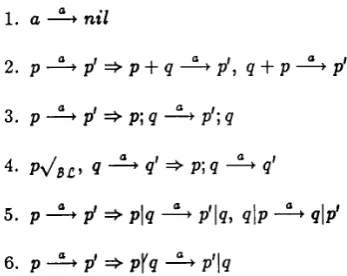
q ] , allows the refinement of action a Labelled Transition System (LTS), (Ke1761. by process q in the behaviour of process p . We can now define a standard observationalAs already pointed out, this operator bears equivalence on BC using the (strong) bisimu- resemblance with the formal language notion lation technique introduced by Park, [Pa81].
of language homomorphism and with the no- A relation
R
B C 2
is a bisimulation if it is tion of pomset homomorphism introduced in symmetric and satisfies the following clause[Gi84], [Pr86]. for each ( p , q ) E
R ,
a E A:The operational behaviour of & C-processes
can be defined by giving a standard opera- ( p ' , q ' ) E R .
tional semantics for
B C
following Plotkin's Following standard lines it is possible toSOS, [P181], and by interpreting p[a q] show that there exists a maximum such re- as indicating the syntactical substitution of lation, which we will denote by
-,
and thatprocess q for each occurrence of action a in p . -=
U{R
I
R
is a bisimulation}. As argued With this interpretation we reduce each pro- by several authors, e. g. [Mi180], [Ab87],-
is cess p E &L
t o a process red(p) EB L
and p's a natural notion of equivalence onB C
and its operational behaviour is determined by that properties are investigated in depth in severalof red(p) according to the operational seman- papers in the literature, e. g. [HM85], (Mi188).
tics of BLf-processes. In the full version of The equivalence
-
can be inherited by&l
the paper, [AH88], we have given an explicit via red(.) as follows
operational semantics for &
c
and we havevp,
E & C ,-
red(p)-
red(q).shown that the associated semantic equiva- this way every equivalence on
~2
canlence for & C agrees with the One presented be conservatively extended to an equivalence
here. on
E L .
However, it turns out that-
is notFor each a E A , ".Will denote the least an adequate semantic equivalence for & C . In
fact,
-
is not a congruence with respect t o the q ] . For example,it can be easily Seen that alb
-
( a ; b ) +( 4
a )but (alb)[a RA c ; d ]
+
((a; b ) + ( b ; a))[. c ; d ] . p5
p' iff p may perform action a and This means that-
would not support com-positional proof techniques for & C . However,
The rules defining 5 use a termination we have a standard way of associating an
p p'
+
3q' such that q -% q' andbinary relation on
B
C which satisfies the ax-iom and rules in Figure 1. Several interprets- refinement operator, [a
tions of these relations are possible. A stan-
dard one, [Mi180], is the following:
Figure 1: Axiom and rules for --%
&L-congruence with
-.
As shown by Mil-ner [Mi180], it is sufficient to close
-
with re-spect t o all & &contexts. The resulting &
t-
congruence, denoted by w e , is known to be the largest congruence contained in
-.
Weclaim t h a t - c is a n adequate semantic equiv-
alence for
E t .
The basic relation-
can beviewed as arising by virtue of observing or
testing processes, see [Ab87], and
-‘
arisesby applying these tests to processes in ar-
bitrary contexts. However, the definition of
W c given above does not shed light on its behavioural significance. Our main results,
sketched in what follows, are that has a
simple behavioural characterization and that it is mathematically tractable. In fact we
show that it can be finitely axiomatized.
3
Characterizing
w CAs pointed out in the previous section, the
view of processes enforced by interleaving-
style equivalences is not adequate if we want
t o describe the behaviour of concurrent pro-
cesses t o allow for a refinement of the actions
they perform. Essentially this depends on
the fact that a n interleaving view of the be-
haviour of concurrent processes strongly de-
pends on what are regarded t o be the atomic actions processes may perform (this point has
been stressed clearly by P r a t t in [Pr86]). As
we allow for a n operation which changes the
level of atomicity of actions without enforc-
ing any mutual exclusion policy, we can no
longer consider actions as atomic events. A
minimal consequence is that actions lose their
“all-or-nothing” character and have distinct
beginnings and endings. This is exactly the
intuition underlying timed-equivalence, [H88].
This is a version of bisimulation equivalence
based on actions which are not necessarily in-
stantaneous. We refer the reader t o [H88] for
a comprehensive description of the resulting
3.1
Timed-equivalence
Definition 3.3 For all s ES ,
sd
++
s EBL:
and
sdBC.
We will assume that beginnings and termi-
nations of actions are distinct events which For each e E E, the next-event relation
=!+
can be observed. For each a E A we will use is defined as the least binary relation on
S
S ( a ) and F ( a ) t o denote the beginning and which satisfies the axioms and rules in Fig-
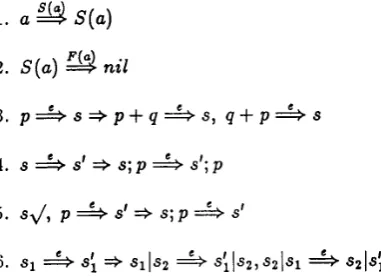
termination of a n a-action, respectively. We ure 2. Rules 1 and 2-of Figure 2 are the new
will view
s(a),
F ( a ) as a new class of events rules which make explicit our view of pro-and define the operational semantics for
B L
cesses. They state that an atomic processin terms of next-event relations
3,
3.
a may perform the beginning of the action aand enter state S ( a ) . Moreover, when in state Definition 3.1 E = d e l { S ( a )
1
a E A} US ( a ) , it can only perform the termination of
{ F ( a )
1
a E A} will be culled the set of eventsthe action it has started.
and will be ranged over b y e.
A standard behavioural equivalence may As pointed Out in [ H 8 8 ] Y the language for pro- now be defined using the relations
&
andcesses is not sufficiently expressive t o describe
the notion of bisimulation. The resulting a possible state a process may reach by
equivalence relation will be denoted by N t
cuting the beginning Of an action*
To
Over- and will be called timed (observational) equiv-come this problem we introduce into the lan- alence. The following proposition states that V a g e a new for each a E
*'
N t is contained in
-
Over the language B f.S ( a ) will denote the state in which the action
a is being executed but is not terminated yet. Proposition 3*1 ' P , q E
B L : ~
p -t qDefinition 3.2 Let
S,
the set of process states, be the least set which satisfies:*
P - Q.
The converse implication does not hold as shown by the following example.
e p ~ B L : + p e S ,
0 a E A =+ S ( a ) E
S ,
0 s E
S ,
P EBL:
+
s ; p ~ S ,Example 3.1 Consider p = ( a ; b )
+
( b ; a ) and q = alb. Then pI n fact, p
s(3
S ( a ) ; b which is a state inq but p + t q.
SI, s2 E
s
*
SllS2 E S. which p can only perform the termination of S will be ranged over b y s, sl, s'.. . .
the action a. No such state can be reached b yq via S(a). I n fact, q
3
s implies s = S ( a ) Ib The operational semantics for process statesand s may perform the start of action b.
will be defined using standard lines; the ter-
mination predicate
d B e
can be easily ex- The equivalence -: can be inherited by& L
1. a
s(o3
S(a) 2. ~ ( a )3
nil3. p & s = + p + q = % s , q + p + s
4. s
4
s'=+
s ; p s ' ; p [image:6.613.95.286.92.232.2]5 . SJ, p
44
5' +- s ; p-44
stFigure 2: Axioms and rules for
&
state our first main result, namely that w t can cal means in section 2, has indeed an intu-
be finitely axiomatized for the language
B
t.
itively appealing characterization. This re-Let = E b e the least
B
t-congruence which sat- sult, combined with the equational character-isfies the axioms in Figure 3. We can show ization given in Theorem 3.1, shows that
-'
the following result: has many of the properties of the traditional interleaving semantic equivalences.
Theorem 3.1 V p , q E
B L ,
p = E q++
p -t q .We end this account of our work with a
This theorem shows that N t is as mathemati- description of the proof techniques used in
cally tractable as the traditional interleaving- showing Theorem 3*2. The proof Of
based equivalences proposed in the literature, this result, which is unfortunately very tech- nical and by no means trivial, can be found
in the full version of this paper [AH88]. [HM85], [DH84].
The if part of the theorem can be shown
3.2
- tcharacterizes
w CS(a);F(a)]
-
q[g-
This section is devoted to stating our main
s(
a); F ( a ) ] implies p -: q, where we have characterization result and to a sketch of its used [a S ( ~ ) ; F ( ~ ) ] to denote the refine-incides with -t for the language
& L .
by proving that p [ a
Proof. The main theorem states that
-'
CO- ment of each action a occurring in p and q byS ( a ) ; F ( a ) .
The proof of the only if part is much
more involved. We show t h a t Nt is an
& L -
Theorem 3.2 For each p , q E
ELC,
p -t qP N c Q -
congruence. As -t is contained in
-
byThis result shows that the congruence rela- Proposition 3.1 and
-'
is the largest& L -
Figure 3: Complete set of axioms for - t
will then follow. Report 3/88, April 1988, University of
Sussex T h e essential step in showing that - t is
p N t q A r -: r’
+
p [ a TJ N t q[u r’]. Abstraction, TCS 37,1, pp.. 77-121, 1985 To prove this result we introduce a new equiv-alence relation on
S ,
denoted by w r andcalled refine-equivalence. Intuitively, s1 s2 ensures that whenever a n occurrence of
s(a)
[CH87] 1. C a s t e l h i and M. HennessY, Dis-
tributed Bisimulations, Report 5/87,
July 1987, University of Sussex (to aP-
Pear in JACM)
in is matched by a n occurrence of S(a) in
s2, their F(u)’s are also matched. We show
that -r coincides with - t for our language,
[DH84] R. De Nicola and M. Hennessy,
Testing Equivalences for Processes, TCS
34,1, pp. 83-134, 1985
Finally, using this intermediate notion of
equivalence, we can show that [Gi84] J. L. Gischer, Partial Orders and the Axiomatic Theory of Shufle, Ph. D.
Thesis, Stanford University, December
p q and r N t r f implies p [ r / a ] -t q [ r ‘ / a ] .
1984
4
References
[Gr81] J. Grabowski, On Partial Languages,
Fundamenta Informaticae IV. 2, pp. 427-
498, 1981
[Ab871 S. Abramsky, Observation Equiva-
lence as a Testing Equivalence,
TCS
53,pp. 225-241, 1987
[H88] M. Hennessy, Axiomatising Finite
[
AH881 L. Aceto and M. Hennessy, TowardsAction-Refinement in Process Algebras,
Concurrent Processes, SIAM Journal of
[HM85] M. Hennessy and R. Milner, Al- gebraic Laws for Nondeterminism and
Concurrency, J. ACM 32,1, pp. 137-161,
1985
[Ho85] C. A. R. Hoare, Communicating Se- quential Processes, Prentice-Hall, 1985
[Ke176] R. Keller, Formal Verification of
Parallel Programs, CACM 19,7, pp. 561-
572, 1976
[Mi1801 R. Milner, A Calculus of Communi-
cating Systems, LNCS 92, Springer Ver-
lag, 1980
[Mil881 R. Milner, Operational and Al-
gebraic Semantics of Concurrent Pro-
cesses, LF C S Report Series, EC S-LF C S-
88-46, February 1988 (to appear as a
chapter of the Handbook of Theoretical
Computer Science)
[Pa811 D. Park, Concurrency and Au-
tomata on Infinite Sequences, LNCS 104,
Springer Verlag, 1981
[P181] G . Plotkin, A Structural Approach t o
Operational Semantics, Report DAIMI
FN-19, Aarhus University, 1981
[Pr86] V. P r a t t , Modelling Concurrency
with Partial Orders, International Jour-
nal of Parallel Programming 15, pp. 33-