R E S E A R C H A R T I C L E
Open Access
Systemic sclerosis associated interstitial
lung disease - individualized
immunosuppressive therapy and course of
lung function: results of the EUSTAR group
Sabine Adler
1*, Dörte Huscher
2,3, Elise Siegert
3, Yannick Allanore
4, László Czirják
5, Francesco DelGaldo
6,
Christopher P. Denton
7, Oliver Distler
8, Marc Frerix
9, Marco Matucci-Cerinic
10, Ulf Mueller-Ladner
9,
Ingo-Helmut Tarner
9, Gabriele Valentini
11, Ulrich A. Walker
12, Peter M. Villiger
1, Gabriela Riemekasten
13and EUSTAR
co-workers on behalf of the DeSScipher project research group within the EUSTAR network
Abstract
Background:Interstitial lung disease in systemic sclerosis (SSc-ILD) is a major cause of SSc-related death.
Imunosuppressive treatment (IS) is used in patients with SSc for various organ manifestations mainly to ameliorate progression of SSc-ILD. Data on everyday IS prescription patterns and clinical courses of lung function during and after therapy are scarce.
Methods:We analysed patients fulfilling American College of Rheumatology (ACR)/European League against
Rheumatism (EULAR) 2013 criteria for SSc-ILD and at least one report of IS. Types of IS, pulmonary function tests (PFT) and PFT courses during IS treatment were evaluated.
Results: EUSTAR contains 3778/11,496 patients with SSc-ILD (33%), with IS in 2681/3,778 (71%). Glucocorticoid (GC) monotherapy was prescribed in 30.6% patients with GC combinations plus cyclophosphamide (CYC) (11.9%), azathioprine (AZA) (9.2%), methotrexate (MTX) (8.7%), or mycophenolate mofetil (MMF) (7.3%). Intensive IS (MMF + GC, CYC or CYC + GC) was started in patients with the worst PFTs and ground glass opacifications on imaging.
Patients without IS showed slightly less worsening in forced vital capacity (FVC) when starting with FVC 50–75%
or >75%. GC showed negative trends when starting with FVC <50%. Regarding diffusing capacity for carbon monoxide (DLCO), negative DLCO trends were found in patients with MMF.
Conclusions:IS is broadly prescribed in SSc-ILD. Clusters of clinical and functional characteristics guide individualised treatment. Data favour distinguished decision-making, pointing to either watchful waiting and close monitoring in the early stages or start of immunosuppressive treatment in moderately impaired lung function. Advantages of specific IS are difficult to depict due to confounding by indication. Data do not support liberal use of GC in SSc-ILD.
Keywords:Systemic sclerosis, Interstitial lung disease, Immunosuppressants, Follow up, Lung function
* Correspondence:[email protected]
Sabine Adler and Dörte Huscher contributed equally to this work Peter M. Villiger and Gabriela Riemekasten contributed equally to this work 1Department of Rheumatology, Immunology and Allergology, University Hospital and University of Bern, Freiburgstrasse 4, 3010 Bern, Switzerland Full list of author information is available at the end of the article
© The Author(s). 2018Open AccessThis article is distributed under the terms of the Creative Commons Attribution 4.0
International License (http://creativecommons.org/licenses/by/4.0/), which permits unrestricted use, distribution, and
Background
Interstitial lung disease (ILD) in systemic sclerosis (SSc-ILD) is caused by alveolitis-induced fibrosis of the intra-alveolar tissue, leading to progressive decline in lung function [1]. It is the most frequent cause of SSc-associated death [2]. Current treatment options aim at reducing pulmonary interstitial inflammation in order to prevent progression of fibrosis and con-secutive deterioration of lung function.
Cyclophosphamide (CYC) is widely used in the treat-ment of SSc-ILD, especially in induction therapy as reflected by the European League Against Rheumatism (EULAR) recommendations for SSc-ILD treatment [3]. Unfortunately, the toxicity of CYC makes it unsuitable for long-term use. Furthermore, within the first sclero-derma lung study, the effect of CYC waned a few months after cessation [4]. Mycophenolate mofetil (MMF) has been suggested as an alternative for induc-tion and maintenance IS [5] and has been shown to sta-bilise lung function in two studies [6, 7]. There are recent data from the scleroderma lung study II on the risks and benefits of a 2-year course of MMF versus a 1-year course of oral CYC. Herein, MMF displayed a bet-ter safety profile and a 1-year course of CYC improved skin and lung function to a comparable extent [8]. Azathioprine (AZA) reflects the common practice of introducing a steroid-sparing anti-rheumatic agent in patients with idiopathic pulmonary fibrosis yet might be rather harmful [9]. In SSc-ILD, the evidence for AZA is inconclusive [10–12]. Methotrexate (MTX) is recom-mended for treatment of skin manifestations in early dif-fuse cutaneous SSc (dcSSc) [13]. Its use in SSc-ILD remains controversial as lung fibrosis is a rare but po-tentially severe side effect [14] and evidence for anti-fibrotic efficacy in the lungs is lacking. As skin and lung involvement may appear simultaneously, MTX is some-times prescribed in SSc-ILD. Rituximab (RTX) is among the most frequently used biological agents in SSc with a recent case-control study and an observational study suggesting beneficial effects on lung function [15]. As el-evated interleukin-6 (IL-6) in SSc-patients has been as-sociated with higher incidence of progressive pulmonary decline, tocilizumab (TCZ) was recently introduced as a therapeutic strategy within the faSScinate study [16,17]. This randomised controlled trial demonstrated a benefit from TCZ, with a significantly smaller decline in forced vital capacity (FVC); unfortunately, this effect waned at 48 weeks. Low-dose glucocorticoids (GCs) used to be the standard treatment for SSc-ILD. This is remarkable as GCs have never been shown to improve ILD out-comes and are suspected to dose-dependently increase the risk of SSc renal crisis [18]. GCs are variously pre-scribed at least initially in combination therapy in severe and progressive ILD [13, 19]. Overall, current evidence
does not allow convincing recommendations on the use of IS in ILD. The updated EULAR/European League against Rheumatism Scleroderma Trial and Research (EUSTAR) guidelines will be in line with this conclusion [20].
The EUSTAR database offers a unique opportunity to analyse IS therapy in SSc-ILD. The aims of this study were (1) to analyse current use of IS drugs, (2) to test correlation between drug use and lung function tests and (3) to define specific treatments for defined disease characteristics.
Methods
We included patients aged≥18 years fulfilling the American College of Rheumatology (ACR) 1980 or ACR/EULAR 2013 classification criteria for SSc [21] with signs of ILD on pulmonary high resolution com-puted tomography (HRCT) and/or chest x-ray and at least one report on IS.
Data analysis comprised first EUSTAR documentation from 2004 until 6 May 2014. The entire observation period of each patient since initial diagnosis of ILD was considered. In order to receive comprehensive overviews of IS in SSc-ILD we referred to all documented visits at which IS was used. Missing IS information was counted as “never IS” if at least one item from the list of im-munosuppressive therapies was answered. Patients with IS therapy (“ever IS”) at any time were compared to patients who had never received IS (“never IS”). For our analysis of “never IS” versus “ever IS” patients were in-cluded at the visit when IS was documented for the first time or time of first ILD documentation for “never IS”. For comparison of the features of patients receiving dif-ferent IS we selected patients with at least one follow up since the documentation of ILD. We then grouped pa-tients according to forced vital capacity (FVC) and dif-fusing capacity of the lung for carbon monoxide (DLCO) at the initiation of therapy, mimicking the clas-sification by Steen [22] in order to generate three groups with different SSc-ILD severity: “mild” for DLCO >60% and FVC >85%,“moderate” for DLCO 51–60% and FVC 80–85% and“severe”for DLCO <51% and FVC <80%.
Statistics
Continuous parameters were compared by the Mann-Whitney test, frequencies by the chi2 or Fisher exact test; p values <0.05 were considered significant. No ad-justment for multiple testing was done. Course of lung function under treatment was evaluated by linear regres-sion analysis of change in DLCO and FVC from treat-ment start to at least one follow-up measuretreat-ment. Patients were grouped by ranges of starting values (<50%, 50–75% and >75% predicted). Due to small num-bers of cases for many treatment combinations, no indi-vidual combinations could be considered. Instead, additive and multiplicative effects of single drugs on the overall group trend were tested within each stratum: with additive effects indicating patients were taking that drug over the same overall time trend, but at a higher or lower level, meaning better or worse initial lung func-tion, but afterwards the same course of DLCO or FVC; and with multiplicative effects signalling a steeper slope of the trend for patients using that drug, meaning either a better or worse course than the overall trend. We adjusted for the potential confounders of sex, age, extent of skin involvement, disease duration and initial DLCO or FVC values, respectively. Statistical analyses were per-formed using IBM SPSS Statistics, version 19.
Results
Patients on IS have more severe and active ILD compared to those without IS
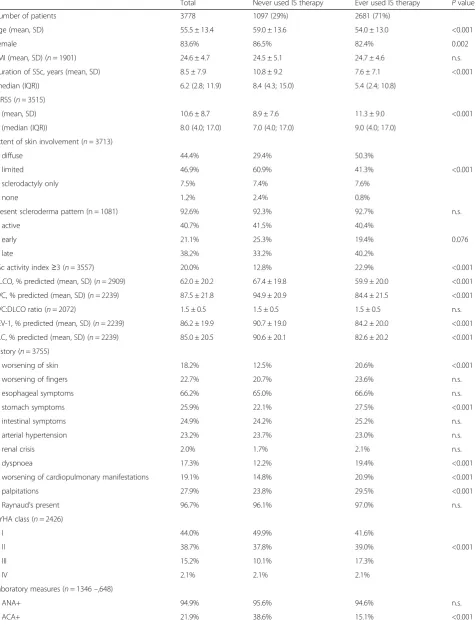
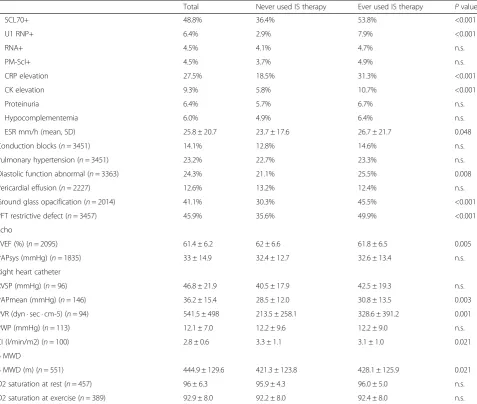
Epidemiological data are shown in Table 1. Overall, IS was used in 2681/3778 (71%) patients with SSc-ILD, but only in 39.8% of patients with SSc without ILD (p <0.05, data not shown).
IS is used in a wide variety of monotherapy or combination therapy
Frequencies of immunosuppressants ever used and high-est therapy combinations ever used per patient are shown in Fig.1. Of the patients taking GC therapy, the average prednisone dosage was > 10 mg/day in 17%, and > 20 mg/day in 5.3% of patients.
Individual treatment regimens are shown in Fig. 2, with more than 3 immunosuppressive drugs being ex-ceptions (n= 17 patients, not shown).
Intensive IS is reserved for patients with severe and active ILD
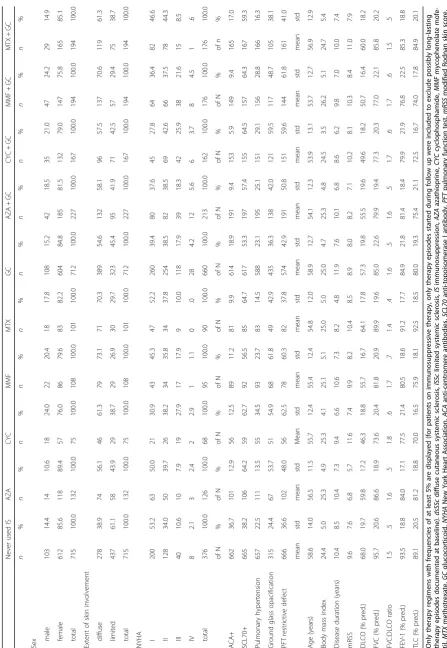
Patient characteristics at the start of the most frequent monotherapy and combination therapy are described in Table2.
Compared to patients in the never IS group, patients receiving GC monotherapy had significantly higher prevalence of SSc-related organ complications except for pulmonary hypertension and renal crisis. Within the
“ever IS” group, patients receiving GC monotherapy were the oldest and had the longest disease duration. Patients who took MTX were only slightly different from patients in the never IS group. Patients who took MTX/ GC had significantly worse DLCO, forced expiratory vol-ume in one second (FEV-1) and modified Rodnan skin score (mRSS), indicating more severe disease and pos-sibly also concomitant obstructive pulmonary disease. Patients who took AZA had significant impairment in FVC and DLCO, but no differences in New York Heart Association (NYHA) class. Interestingly, they had lower mRSS values than the never IS group. AZA/GC was used in patients with a more prominent reduction in DLCO and FVC values and with more patients in NYHA III and IV than in AZA monotherapy. Patients who took MMF had severe impairment of FVC and DLCO, which was even more pronounced when GC was added to MMF. Values for DLCO and FVC were lower and severe NYHA classification more frequent than in MMF monotherapy. Patients who took CYC had the most severely impaired lung function and highest rate of restrictive lung disease. Patients receiving MTX mono-therapy had the best values for DLCO, FVC (p< 0.001) and total lung capacity (TLC), lowest prevalence of pul-monary hypertension (p< 0.05) and shortest disease dur-ation. In contrast, patients who took CYC monotherapy had worst impairment in lung function and the highest rates of ground glass opacifications on imaging, plus the most severe skin fibrosis and highest mRSS values.
A cluster of lung function parameters is associated with specific choices of IS
Sorting different therapy arms by average impairment in FVC and DLCO revealed clusters of ranges of lung func-tion. Consequently, we grouped patients based on mean FVC and DLCO according to the classification of Steen [22]. Group I (mild impairment) had FVC of 86.9% and DLCO of 60.8%; group II (moderate impairment) had FVC of 83.4% and DLCO of 56.7%; and group III (severe impairment) had FVC of 76.6% and DLCO of 49.6%. Next we assessed whether other parameters were associ-ated with specific choices of IS (Fig.3).
Patients in group III had the worst FVC and DLCO, highest mRSS values, worst NYHA class and the highest rates of ground glass opacifications and restrictive defects. Compared to patients in the never IS group, pa-tients in all three groups had significantly worse FVC, DLCO and TLC and more frequent ground glass opacifi-cations. Patients in groups II and III had more severe NYHA class (bothp< 0.001).
Table 1Characteristics of patients with SSc-ILD never or ever using immunosuppressive therapy
Total Never used IS therapy Ever used IS therapy Pvalue
Number of patients 3778 1097 (29%) 2681 (71%)
Age (mean, SD) 55.5 ± 13.4 59.0 ± 13.6 54.0 ± 13.0 <0.001
Female 83.6% 86.5% 82.4% 0.002
BMI (mean, SD) (n= 1901) 24.6 ± 4.7 24.5 ± 5.1 24.7 ± 4.6 n.s.
Duration of SSc, years (mean, SD) 8.5 ± 7.9 10.8 ± 9.2 7.6 ± 7.1 <0.001
(median (IQR)) 6.2 (2.8; 11.9) 8.4 (4.3; 15.0) 5.4 (2.4; 10.8)
mRSS (n= 3515)
(mean, SD) 10.6 ± 8.7 8.9 ± 7.6 11.3 ± 9.0 <0.001
(median (IQR)) 8.0 (4.0; 17.0) 7.0 (4.0; 17.0) 9.0 (4.0; 17.0)
Extent of skin involvement (n= 3713)
diffuse 44.4% 29.4% 50.3%
limited 46.9% 60.9% 41.3% <0.001
sclerodactyly only 7.5% 7.4% 7.6%
none 1.2% 2.4% 0.8%
Present scleroderma pattern (n = 1081) 92.6% 92.3% 92.7% n.s.
active 40.7% 41.5% 40.4%
early 21.1% 25.3% 19.4% 0.076
late 38.2% 33.2% 40.2%
SSc activity index≥3 (n= 3557) 20.0% 12.8% 22.9% <0.001
DLCO, % predicted (mean, SD) (n= 2909) 62.0 ± 20.2 67.4 ± 19.8 59.9 ± 20.0 <0.001
FVC, % predicted (mean, SD) (n= 2239) 87.5 ± 21.8 94.9 ± 20.9 84.4 ± 21.5 <0.001
FVC:DLCO ratio (n= 2072) 1.5 ± 0.5 1.5 ± 0.5 1.5 ± 0.5 n.s.
FEV-1, % predicted (mean, SD) (n= 2239) 86.2 ± 19.9 90.7 ± 19.0 84.2 ± 20.0 <0.001
TLC, % predicted (mean, SD) (n= 2239) 85.0 ± 20.5 90.6 ± 20.1 82.6 ± 20.2 <0.001
History (n= 3755)
worsening of skin 18.2% 12.5% 20.6% <0.001
worsening of fingers 22.7% 20.7% 23.6% n.s.
esophageal symptoms 66.2% 65.0% 66.6% n.s.
stomach symptoms 25.9% 22.1% 27.5% <0.001
intestinal symptoms 24.9% 24.2% 25.2% n.s.
arterial hypertension 23.2% 23.7% 23.0% n.s.
renal crisis 2.0% 1.7% 2.1% n.s.
dyspnoea 17.3% 12.2% 19.4% <0.001
worsening of cardiopulmonary manifestations 19.1% 14.8% 20.9% <0.001
palpitations 27.9% 23.8% 29.5% <0.001
Raynaud’s present 96.7% 96.1% 97.0% n.s.
NYHA class (n= 2426)
I 44.0% 49.9% 41.6%
II 38.7% 37.8% 39.0% <0.001
III 15.2% 10.1% 17.3%
IV 2.1% 2.1% 2.1%
Laboratory measures (n= 1346–,648)
ANA+ 94.9% 95.6% 94.6% n.s.
groups p< 0.001). The same trend was seen in the fre-quency of restrictive defects with the lowest rates in patients in the never IS group (36%) and an increasing frequency of 46.3% in group II and 61.0% in group III (bothp< 0.001).
Specific types of IS display minimal influence on the course of lung function
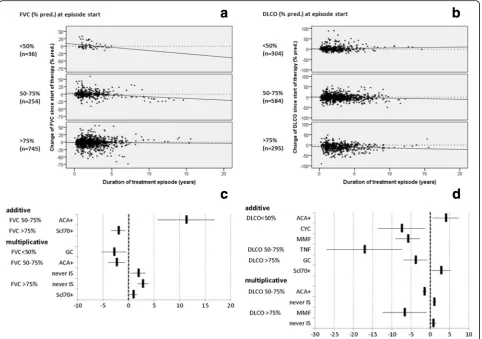
Follow-up documentation ranging from 1 month to 13 years was available in 73.6% of patients with SSc-ILD. Change in lung function over time was analysed in the respective subgroups of patients with <50%, 50–75% and >75% of FVC or DLCO predicted at treatment initiation and are shown in Fig.4.
[image:5.595.60.538.99.503.2]The group starting with < 50% of predicted FVC had the steepest decline in FVC (Fig.4a). Here, GCs had negative multiplicative effects (Fig.4c), thus there was even worse deterioration. In comparison, the group starting between 50 and 75% of predicted FVC had a less steep decline (Fig. 4a), with a positive additive effect in ACA-positive patients (Fig.4b), but at the same time a negative multi-plicative effect, meaning they started at higher FVC levels but had a steeper decline. Here, in patients in the never IS group a positive multiplicative effect was seen, indicating a less steep decline. The group starting with > 75% of pre-dicted FVC had only a slight decline in FVC (Fig. 4a, b) with a negative additive effect in Scl70-positive patients but at the same time a positive multiplicative effect
Table 1Characteristics of patients with SSc-ILD never or ever using immunosuppressive therapy(Continued)
Total Never used IS therapy Ever used IS therapy Pvalue
SCL70+ 48.8% 36.4% 53.8% <0.001
U1 RNP+ 6.4% 2.9% 7.9% <0.001
RNA+ 4.5% 4.1% 4.7% n.s.
PM-Scl+ 4.5% 3.7% 4.9% n.s.
CRP elevation 27.5% 18.5% 31.3% <0.001
CK elevation 9.3% 5.8% 10.7% <0.001
Proteinuria 6.4% 5.7% 6.7% n.s.
Hypocomplementemia 6.0% 4.9% 6.4% n.s.
ESR mm/h (mean, SD) 25.8 ± 20.7 23.7 ± 17.6 26.7 ± 21.7 0.048
Conduction blocks (n= 3451) 14.1% 12.8% 14.6% n.s.
Pulmonary hypertension (n= 3451) 23.2% 22.7% 23.3% n.s.
Diastolic function abnormal (n= 3363) 24.3% 21.1% 25.5% 0.008
Pericardial effusion (n= 2227) 12.6% 13.2% 12.4% n.s.
Ground glass opacification (n= 2014) 41.1% 30.3% 45.5% <0.001
PFT restrictive defect (n= 3457) 45.9% 35.6% 49.9% <0.001
Echo
LVEF (%) (n= 2095) 61.4 ± 6.2 62 ± 6.6 61.8 ± 6.5 0.005
PAPsys (mmHg) (n= 1835) 33 ± 14.9 32.4 ± 12.7 32.6 ± 13.4 n.s.
Right heart catheter
RVSP (mmHg) (n= 96) 46.8 ± 21.9 40.5 ± 17.9 42.5 ± 19.3 n.s.
PAPmean (mmHg) (n= 146) 36.2 ± 15.4 28.5 ± 12.0 30.8 ± 13.5 0.003
PVR (dyn · sec · cm-5) (n= 94) 541.5 ± 498 213.5 ± 258.1 328.6 ± 391.2 0.001
PWP (mmHg) (n= 113) 12.1 ± 7.0 12.2 ± 9.6 12.2 ± 9.0 n.s.
CI (l/min/m2) (n= 100) 2.8 ± 0.6 3.3 ± 1.1 3.1 ± 1.0 0.021
6 MWD
6 MWD (m) (n= 551) 444.9 ± 129.6 421.3 ± 123.8 428.1 ± 125.9 0.021
O2 saturation at rest (n= 457) 96 ± 6.3 95.9 ± 4.3 96.0 ± 5.0 n.s.
O2 saturation at exercise (n= 389) 92.9 ± 8.0 92.2 ± 8.0 92.4 ± 8.0 n.s.
(Fig. 4c), meaning they started at lower FVC levels but had a flatter rate of decline. Here again, there were posi-tive multiplicaposi-tive effects in patients in the never IS group or in those receiving GCs, indicating less or no decline or even slight improvement.
Within the group starting with < 50% of predicted DLCO the overall course was represented by a slightly
improving slope (Fig. 4b). Compared to that general trend, CYC and MMF had negative additive effects, meaning their course was following the same slope, but on a lower level, while ACA positivity had a positive additive effect, hence the course was on a higher level (Fig.4d). In patients starting with DLCO values between 50 and 75% of predicted the overall trend was of slight
Fig. 1Frequencies of immunosuppressants ever used and highest therapy combination ever used per patient.GCglucocorticoids,CYC
cyclophosphamide,AZAazathioprine,MTXmethotrexate,MMFmycophenolate mofetil,RTXrituximab,DPAD-penicillamine,a-TNFanti-tumour necrosis factor,IMAimatinib
[image:6.595.56.538.86.314.2] [image:6.595.59.540.475.694.2]deterioration (Fig. 4b), with a negative additive effect of TNF inhibitors, again meaning it already started at a lower level but had the same gradient of deterioration. Here, ACA had a slightly negative multiplicative effect, meaning DLCO courses had a steeper decrease than the general trend, while in patients in the never IS group a positive multiplicative effect was seen, meaning a flatter decrease (Fig. 4b, d), with a positive additive effect of Scl70 positivity and a negative additive effect of GCs. There was a negative multiplicative effect of MMF, meaning an even steeper decrease than the general
trend, while there was a positive multiplicative effect in patients in the never IS group (Fig.4d), meaning less de-cline or even slight improvement compared to the over-all trend.
Adjusted for potential confounders and initial FVC or DLCO value no other medications than GCs, MMF, or “never IS” showed multiplicative effects on the course of lung function divergent from the general trend of the entire patient population. CYC and TNF inhibitors had only additive effects, pointing toward lower initial DLCO or FVC values in these
Fig. 3Patients grouped according to severity of lung function combined with the respective immunosuppression (IS) and clinical parameters.never IS
patients who had never taken immunosuppressant drugs,FVCforced vital capacity,DLCOdiffusing capacity of the lung for carbon monoxide,SBsingle breath,MTXmethotrexate,GCglucocorticoid,AZAazathioprine,MMFmycophenolate mofetil,CYCcyclophosphamide,PFTpulmonary function test,
[image:8.595.58.539.83.540.2]patients, but no differing time trends compared to pa-tients on other treatments.
Discussion
Our analysis of observational data describes current IS strategies in patients with SSc-ILD from the EUSTAR cohort. It shows clusters of clinical characteristics corre-lated with IS choices and identifies factors that might in-fluence future IS decisions.
A large proportion of patients with SSc-ILD did not receive IS despite having dcSSc (34% of patients), active scleroderma pattern on nail fold capillaroscopy (40% of patients) and Valentini disease activity index (VDAI)≥3 (12% of patients). On average these patients have longer disease duration and show fewer signs of alveolitis on HRCT. These characteristics may suggest that the great-est decline in lung function has already happened and stabilisation of lung function in the absence of active
inflammation is expected without any further IS medi-cation [22], or they might represent patients with over-all benign disease courses. In our analysis, positive trends in lung function over time - especially in pa-tients starting with 50–75% of predicted FVC - support this notion. It contrasts with a scleroderma lung study showing a mild 12-month decline in FVC of 4.2%, and in DLCO of 8.2%, irrespective of disease duration [1]. On the other hand our data are in agreement with a study documenting that FVC values within the first 3 years after disease onset strongly predict SSc-ILD outcome [24].
GCs were used most frequently in 58% of the patients in high proportions and even at dosages >10 mg/day and >20 mg/day. This comes as a surprise and has to be questioned, as the effect of GCs on lung function was marginal at best and only slightly positive in patients with > 75% of predicted FVC who might as well continue
[image:9.595.58.541.88.427.2]without any IS at all. Furthermore, it is well-established that this treatment regimen is associated with higher rates of infection and scleroderma renal crisis [25]. Of note, patients receive combinations of GC with MTX, AZA, MMF or CYC regardless of lung function parame-ters or NYHA class. Collectively our data show that combining GCs with another IS therapy reflects the standard of care in many centres worldwide.
The second most frequently used therapy was CYC, as recommended by the EUSTAR guidelines for patients with severe and progressive SSc-ILD. Two meta-analyses failed to show a significant benefit of CYC on SSc-ILD on lung function tests [26]. However, a statistically non-relevant improvement might still represent a patient-relevant effect on quality of life as reflected by the Short Form-36 (SF-36) data evaluated within the first sclero-derma lung study [4]. In our analysis, patients treated with CYC monotherapy or CYC/GC started with the worst DLCO values, worst NYHA class, highest frequen-cies of restrictive defects and PH, and the highest mRSS. More than 60% of these patients showed signs of active inflammation reflected by high ESR, CRP elevation or ground glass opacifications on HRCT. Stratification of these patients by their starting values did not result in differences in the slope of DLCO or FVC values compared to all other patients. Interestingly, Becker et al. describe the highest SSc-ILD response rates assessed by FVC and DLCO in patients with low FVC values prior to CYC therapy [27] indicating a potential for reversal of fibrosis.
MMF, often regarded as potential maintenance therapy in SScILD, was used as monotherapy in moderate or -combined with GC - severe lung impairment, in our analysis. A prospective open-label trial on MMF de-scribes early and significant improvement in DLCO, non-significant improvement in FVC and reduction in ground glass opacifications in five patients with disease duration between 1.5 and 3 years [28]. A meta-analysis argues along these lines, suggesting that MMF may sta-bilise lung function [29]; however, the superiority of MMF compared to CYC was not verified [7]. The very recent randomized controlled, double-blind, parallel group trial comparing MMF with oral CYC shows sig-nificant improvement in pre-specified measures of lung function over 2 years. It did not reach its primary end-point, i.e. MMF to be more effective than CYC; however, MMF had a better side-effect profile [8].
An uncontrolled study of AZA maintenance therapy after 1-year induction with CYC showed stabilising ef-fects of AZA in SSc-ILD, but involved only 13 patients [30]. Retrospective data on 36 patients with SSc-ILD comparing oral CYC with AZA shows significant effects of AZA on DLCO and FVC, yet no effects of CYC [12]. Our data cannot confirm this as AZA had only a very
slightly positive effect on DLCO in patients starting with DLCO >75%, thus being almost equal to the effect of
“never IS”.
Studies analyzing the effects of MTX on SSc-ILD are rare. This might be due to the fact that ILD is one of the possible side effects of MTX and hence physicians might be hesitant to prescribe it to patients with SSc-ILD. In-deed, there is one study showing no effects of MTX on lung function despite trends towards positive effects on the mRSS [31]. However, this study was small (n= 29) and covered a relatively short timeframe (24 weeks). A study with 11 patients taking MTX describes subjective improvement in dyspnoea in 5 patients, no change in another 5 and worsening in 1 patient [32]. In our data, MTX was used in patients that resembled those of the never IS group except for higher mRSS and more fre-quent ground glass opacifications. Comparing MTX + GC to MTX alone displayed significant differences in mRSS, DLCO, FVC, FEV-1 and rates of ground glass opacifications. Nevertheless, its effect on the course of PFTs was negligible.
Overall, our data describe treatment patterns in patients with SSc-ILD that are used across European centres yet are only partially in accordance with EUSTAR recommendations. Most clinicians chose inten-sive IS in active lung disease. Common choices were not only CYC+/-GC as recommended by current guidelines, but also MMF + GC. None of the specific types of IS was clearly superior to another in influencing the course of lung function in any DLCO or FVC group. The only positive trends seen were in patients in the never IS group and patients taking GC, starting with > 75% of predicted FVC, and in the never IS group, patients tak-ing AZA and MTX starttak-ing with > 75% of predicted DLCO all had a reduced rate of deterioration over time. Thus, if carefully monitored for changes in lung func-tion, patients with SSc-ILD with only small PFT impair-ment might benefit from on-demand IS instead of ongoing IS.
Conclusions
IS is broadly prescribed in SSc-ILD. Clusters of clinical and functional characteristics guide individualised treat-ment. The data favour differential decision-making pointing either to watchful waiting and close monitoring in the early stages or start of immunosuppressive treat-ment in patients with SSc-ILD and moderately impaired lung function. Advantages of specific IS are difficult to depict due to confounding by indication. Data do not support liberal use of GC in SSc-ILD.
Additional file
Additional file 1:EUSTAR co-workers (DOCX 17 kb)
Abbreviations
6MWD:Six minute walk distance; ACA: Anti-centromere antibodies; ACR: American College of Rheumatology; ANA: Anti-nuclear antibodies; a-TNF: Anti-tumour necrosis factor; AZA: Azathioprine; BMI: Body mass index; CI: Cardiac index; CK: Creatin kinase; CRP: C-Reactive protein;
CYC: Cyclophosphamide; dcSSc: Diffuse cutaneous systemic sclerosis; DeSScipher: Study to decipher the optimal management of systemic sclerosis; DLCO: Diffusing capacity for carbon monoxide; PA: D-penicillamine; ESR: Erythrocyte sedimentation rate; EULAR: European League against Rheumatism; EUSTAR: European League against Rheumatism Scleroderma Trial and Research; FEV-1: Forced expiratory volume in one second; FP7: Seventh Framework Programme; FVC: Forced vital capacity; GC: Glucocorticoids; HRCT: High resolution computed tomography; ILD: Interstitial lung disease; IMA: Imatinib; IS: Immunosuppressive treatment; lSSc: Limited systemic sclerosis; LVEF: Left ventricular ejection fraction; MMF: Mycophenolate mofetil; mRSS: Modified Rodnan skin score; MTX: Methotrexate; NYHA: New York Heart Association; O2: Oxygen; PAPmean: Mean pulmonary arterial pressure; PAPsys: Systolic pulmonary arterial pressure; PFT: Pulmonary function test; PM SCL: Polymyositis scleroderma antibody; PVR: Pulmonary vascular resistance; PWP: Pulmonary wedge pressure; RNA: Ribonucleic acid antibody; RTX: Rituximab; RVSP: Right ventricular systolic pressure; SCL 70: Anti-topoisomerase I; SSc: Systemic sclerosis; TCZ: Tocilizumab; TLC: Total lung capacity; U1RNP: U1-small nuclear ribonucloprotein particle; VDAI: Valentini disease activity index
Acknowledgements
We appreciate the work of all members of the participating EUSTAR centres represented by the list of co-workers on behalf of the DeSScipher project research group within the EUSTAR network, which is provided as Additional file1.
Funding
This work was funded by the EU research grant HEALTH-F5-2012-305495 and by the research funds of the Department of Rheumatology, Immunology and Allergology, University of Bern, Switzerland.
Availability of data and materials
Data that support the findings of this study were extracted from the EUSTAR database and were used under license for the current study, and so are not publicly available. Data are available upon reasonable request.
Authors’contributions
SA and DH extracted and analysed the data and drafted and edited the manuscript. ES analysed the data and edited the manuscript, YA, LZ, FDG, CD, OD; MF, MMC, UML, IT, GV and UW were involved in analysis and interpretation of the data and revised the manuscript. PV analysed and interpreted the data and drafted and edited the manuscript. GR designed the study, analysed and interpreted the data and edited the manuscript. All authors agreed to be accountable for all aspects of the work in ensuring that questions related to the accuracy or integrity of any part of the work are appropriately investigated and resolved, and gave final approval of the version to be published.
Ethics approval and consent to participate
Prior to inclusion into the database each patient gave informed consent. Ethics approval was obtained from local ethics committees prior to start of the evaluation. Local ethics committees are represented by the locations listed after each author’s name and after each co-worker’s name as provided in Additional file1.
Consent for publication Not applicable.
Competing interests
The authors declare that they have no competing interests.
Publisher’s Note
Springer Nature remains neutral with regard to jurisdictional claims in published maps and institutional affiliations.
Author details
1Department of Rheumatology, Immunology and Allergology, University Hospital and University of Bern, Freiburgstrasse 4, 3010 Bern, Switzerland. 2German Rheumatism Research Center, A Leibniz Institute, Berlin, Germany. 3Department of Rheumatology and Clinical Immunology, Charité University Hospital, Berlin, Germany.4Department of Rheumatology A, Descartes University, APHP, Cochin Hospital, Paris, France.5Department of Rheumatology and Immunology, University of Pecs, Pecs, Hungary. 6University of Leeds, Leeds, UK.7UCL Division of Medicine, Centre for Rheumatology, Royal Free Hospital, London, UK.8Department of Rheumatology, University Hospital Zurich, Zurich, Switzerland.9Department of Rheumatology and Clinical Immunology, Osteology and Physical Therapy, Justus-Liebig-University Giessen, Kerckhoff Klinik, Bad Nauheim, Germany. 10Department Experimental and Clinical Medicine, Division of Rheumatology AOUC, University of Florence, Florence, Italy.11Department of Rheumatology, Second University of Naples, Naples, Italy.12Department of Rheumatology, University of Basel, Basel, Switzerland.13Department of Rheumatology, University Medical Center Schleswig-Holstein, Kiel, Germany.
Received: 27 July 2017 Accepted: 11 January 2018
References
1. Khanna D, Tseng CH, Farmani N, Steen V, Furst DE, Clements PJ, et al. Clinical course of lung physiology in patients with scleroderma and interstitial lung disease: analysis of the Scleroderma Lung Study Placebo Group. Arthritis Rheum. 2011;63(10):3078–85.
2. Steen VD, Medsger TA. Changes in causes of death in systemic sclerosis, 1972-2002. Ann Rheum Dis. 2007;66(7):940–4.
3. Kowal-Bielecka O, Landewe R, Avouac J, Chwiesko S, Miniati I, Czirjak L, et al. EULAR recommendations for the treatment of systemic sclerosis: a report from the EULAR Scleroderma Trials and Research group (EUSTAR). Ann Rheum Dis. 2009;68(5):620–8.
4. Tashkin DP, Elashoff R, Clements PJ, Roth MD, Furst DE, Silver RM, et al. Effects of 1-year treatment with cyclophosphamide on outcomes at 2 years in scleroderma lung disease. Am J Respir Crit Care Med. 2007; 176(10):1026–34.
5. Nihtyanova SI, Brough GM, Black CM, Denton CP. Mycophenolate mofetil in diffuse cutaneous systemic sclerosis−-a retrospective analysis.
Rheumatology (Oxford). 2007;46(3):442–5.
6. Koutroumpas A, Ziogas A, Alexiou I, Barouta G, Sakkas LI. Mycophenolate mofetil in systemic sclerosis-associated interstitial lung disease. Clin Rheumatol. 2010;29(10):1167–8.
7. Panopoulos ST, Bournia VK, Trakada G, Giavri I, Kostopoulos C, Sfikakis PP. Mycophenolate versus cyclophosphamide for progressive interstitial lung disease associated with systemic sclerosis: a 2-year case control study. Lung. 2013;191(5):483–9.
8. Tashkin DP, Roth MD, Clements PJ, Furst DE, Khanna D, Kleerup EC, et al. Mycophenolate mofetil versus oral cyclophosphamide in
scleroderma-related interstitial lung disease (SLS II): a randomised controlled, double-blind, parallel group trial. Lancet Respir Med. 2016; 4(9):708–19.
pulmonary fibrosis: a prospective double-blind, randomized, placebo-controlled clinical trial. Am Rev Respir Dis. 1991;144(2):291–6.
10. Poormoghim H, Rezaei N, Sheidaie Z, Almasi AR, Moradi-Lakeh M, Almasi S, et al. Systemic sclerosis: comparison of efficacy of oral cyclophosphamide and azathioprine on skin score and pulmonary involvement-a retrospective study. Rheumatol Int. 2014;34(12):1691-9.
11. Nadashkevich O, Davis P, Fritzler M, Kovalenko W. A randomized unblinded trial of cyclophosphamide versus azathioprine in the treatment of systemic sclerosis. Clin Rheumatol. 2006;25(2):205–12.
12. Hoyles RK, Ellis RW, Wellsbury J, Lees B, Newlands P, Goh NS, et al. A multicenter, prospective, randomized, double-blind, placebo-controlled trial of corticosteroids and intravenous cyclophosphamide followed by oral azathioprine for the treatment of pulmonary fibrosis in scleroderma. Arthritis Rheum. 2006;54(12):3962–70.
13. Walker KM, Pope J, participating members of the Scleroderma Clinical Trials C, Canadian Scleroderma Research G. Treatment of systemic sclerosis complications: what to use when first-line treatment fails–a consensus of systemic sclerosis experts. Semin Arthritis Rheum. 2012;42(1):42–55. 14. Arakawa H, Yamasaki M, Kurihara Y, Yamada H, Nakajima Y.
Methotrexate-induced pulmonary injury: serial CT findings. J Thorac Imaging. 2003;18(4): 231–6.
15. Lepri G, Avouac J, Airo P, Anguita Santos F, Bellando-Randone S, Blagojevic J, et al. Effects of rituximab in connective tissue disorders related interstitial lung disease. Clin Exp Rheumatol. 2016;34 Suppl 100(5):181–5.
16. De Lauretis A, Sestini P, Pantelidis P, Hoyles R, Hansell DM, Goh NS, et al. Serum interleukin 6 is predictive of early functional decline and mortality in interstitial lung disease associated with systemic sclerosis. J Rheumatol. 2013;40(4):435–46.
17. Khanna D, Denton CP, Jahreis A, van Laar JM, Frech TM, Anderson ME, et al. Safety and efficacy of subcutaneous tocilizumab in adults with systemic sclerosis (faSScinate): a phase 2, randomised, controlled trial. Lancet. 2016; 387(10038):2630–40.
18. Steen VD, Medsger Jr TA. Case-control study of corticosteroids and other drugs that either precipitate or protect from the development of scleroderma renal crisis. Arthritis Rheum. 1998;41(9):1613–9. 19. Mouthon L, Berezne A, Guillevin L, Valeyre D. Therapeutic options for
systemic sclerosis related interstitial lung diseases. Respir Med. 2010;104 Suppl 1:S59–69.
20. Kowal-Bielecka O, Fransen J, Avouac J, Becker M, Kulak A, et al. Update of EULAR recommendations for the treatment of systemic sclerosis. Ann Rheum Dis. 2017;76(8):1327–1339.
21. Rodnan GP, Medsger TA, Altman RD, D'Angelo WA, Fries JF, LeRoy EC, Kirsner AB, MacKensie AH, MacShane DJ, Myers AR, Sharp GC. Preliminary criteria for the classification of systemic sclerosis (scleroderma). Subcommittee for scleroderma criteria of the American Rheumatism Association Diagnostic and Therapeutic Criteria Committee. Arthritis Rheum. 1980;23(5):581-90.
22. Steen VD, Conte C, Owens GR, Medsger Jr TA. Severe restrictive lung disease in systemic sclerosis. Arthritis Rheum. 1994;37(9):1283–9.
23. Walker UA, Tyndall A, Czirjak L, Denton C, Farge-Bancel D, Kowal-Bielecka O, et al. Clinical risk assessment of organ manifestations in systemic sclerosis: a report from the EULAR Scleroderma Trials And Research group database. Ann Rheum Dis. 2007;66(6):754–63.
24. Morgan C, Knight C, Lunt M, Black CM, Silman AJ. Predictors of end stage lung disease in a cohort of patients with scleroderma. Ann Rheum Dis. 2003;62(2):146–50.
25. Iudici M, van der Goes MC, Valentini G, Bijlsma JW. Glucocorticoids in systemic sclerosis: weighing the benefits and risks - a systematic review. Clin Exp Rheumatol. 2013;31(2 Suppl 76):157–65.
26. Nannini C, West CP, Erwin PJ, Matteson EL. Effects of cyclophosphamide on pulmonary function in patients with scleroderma and interstitial lung disease: a systematic review and meta-analysis of randomized controlled trials and observational prospective cohort studies. Arthritis Res Ther. 2008; 10(5):R124.
27. Becker MO, Schohe A, Weinert K, Huscher D, Schneider U, Burmester GR, et al. Responders to cyclophosphamide: results of a single-centre analysis among systemic sclerosis patients. Ann Rheum Dis. 2012;71(12):2061–2. 28. Liossis SN, Bounas A, Andonopoulos AP. Mycophenolate mofetil as first-line
treatment improves clinically evident early scleroderma lung disease. Rheumatology (Oxford). 2006;45(8):1005–8.
29. Tzouvelekis A, Galanopoulos N, Bouros E, Kolios G, Zacharis G, Ntolios P, et al. Effect and safety of mycophenolate mofetil or sodium in systemic sclerosis-associated interstitial lung disease: a meta-analysis. Pulm Med. 2012;2012:143637.
30. Paone C, Chiarolanza I, Cuomo G, Ruocco L, Vettori S, Menegozzo M, et al. Twelve-month azathioprine as maintenance therapy in early diffuse systemic sclerosis patients treated for 1-year with low dose
cyclophosphamide pulse therapy. Clin Exp Rheumatol. 2007;25(4):613–6. 31. van den Hoogen FH, Boerbooms AM, Swaak AJ, Rasker JJ, van Lier HJ, van
de Putte LB. Comparison of methotrexate with placebo in the treatment of systemic sclerosis: a 24 week randomized double-blind trial, followed by a 24 week observational trial. Br J Rheumatol. 1996;35(4):364–72.
32. Krishna Sumanth M, Sharma VK, Khaitan BK, Kapoor A, Tejasvi T. Evaluation of oral methotrexate in the treatment of systemic sclerosis. Int J Dermatol. 2007;46(2):218–23.
• We accept pre-submission inquiries
• Our selector tool helps you to find the most relevant journal
• We provide round the clock customer support
• Convenient online submission
• Thorough peer review
• Inclusion in PubMed and all major indexing services
• Maximum visibility for your research
Submit your manuscript at www.biomedcentral.com/submit