Journal of Criminal Law and Criminology
Volume 71
Issue 2
Summer
Article 7
Summer 1980
The California Career Criminal Prosecution
Program One Year Later
Joel Phillips
Charlsey Cartwright
Follow this and additional works at:
https://scholarlycommons.law.northwestern.edu/jclc
Part of the
Criminal Law Commons
,
Criminology Commons
, and the
Criminology and Criminal
Justice Commons
This Symposium is brought to you for free and open access by Northwestern University School of Law Scholarly Commons. It has been accepted for inclusion in Journal of Criminal Law and Criminology by an authorized editor of Northwestern University School of Law Scholarly Commons.
Recommended Citation
THE JOURNAL OF CRIMINAL LAW & CRIMINOLOGY Vol. 71, No. 2
Copyright © 1980 by Northwestern University School of Law Prined in U.S.A.
THE CALIFORNIA CAREER CRIMINAL PROSECUTION PROGRAM
ONE YEAR LATER*
JOEL PHILLIPS** AND CHARLSEY CARTWRIGHT***
INTRODUCTION
During the past three years, the State of Califor-nia has intensified its efforts to target and prosecute vigorously the serious and persistent offender. By amending several state statutes and through the use of federal Law Enforcement Assistance Admin-istration (LEAA) funds, the state focused its atten-tion and resources on the active career criminal population. This focus began with Senate bill 42, which replaced a policy of indeterminate sentenc-ing with one of determinate sentencsentenc-ing. Later mod-ifications of this act increased sentence sanctions in several important areas. Concurrent with these efforts, the state legislature enacted the Career Criminal Act' in 1977. This legislation appropri-ated approximately $6 million of general state funds to establish special career criminal prosecu-tion units (CCP units) to prosecute these individ-uals who qualify as career criminals. This program continues to receive strong state support.2
More recently, in its continued effort to assist prosecutors and law enforcement agencies, the state legislature passed legislation establishing the Cali-fornia Career Apprehension program in eight ju-risdictions.3 Modeled after LEAA's successful In-tegrated Career Apprehension program, this pro-gram provides approximately $2 million to local law enforcement agencies to help structure their decisionmaking and service-delivery activities in order to apprehend serious career offenders. Al-though this paper will focus on the results achieved
by the CCP program, it is important to view this
program in the context of the changing attitudes
* This article is based on the results presented by the California Office of Criminal Justice Planning in its Second Annual Report to the Legislature on California Career Criminal Prosecution Program. The evaluation report was ajoint effort between MetaMetrics, Inc.,.and the Offices of Criminal Justice Planning.
** Vice President, MetaMetrics, Inc.
*** Evaluation Unit Chief, Office of Criminal Justice Planning for the State of California.
I CAL. PENAL CODE § 999b-999h (West Supp. 1979).
2 The continued support of the program is exemplified by the $3.2 million appropriation that Governor Edmund G. Brown, Jr., included in his proposed 1980-81 budget.
3 CAL. PENAL CODE § 999e (West Supp. 1979).
and policies occurring in California's criminal jus-tice system.
The State Office of Criminal justice Planning (OCJP) is responsible for establishing and moni-toring the CCP program. During the first year, twelve of the largest counties in the state developed CCP units. These twelve units are the subject of this article. Later, in 1978 and in 1979, another nine counties received LEAA funds to operate CCP units within their district attorney's offices. To-gether, approximately $4 million in state and fed-eral funds were committed to the twenty-one proj-ect sites. These units are located in the following counties: Alameda, Contra Costa, Fresno, Los An-geles, Orange, Riverside, Sacramento, San Bernar-dino, San Diego, San Francisco, San Mateo, Santa Clara, Ventura, Stanislaus, San Joaquin, Yolo, Santa Barbara, Marin, Solano, Imperial, and Pla-cer.
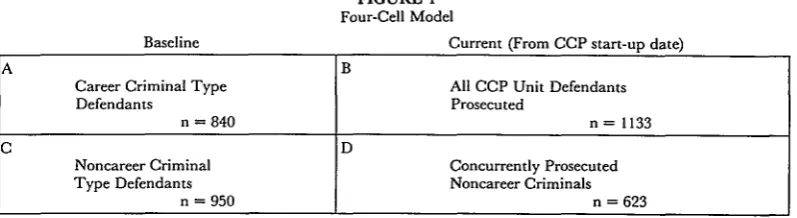
Measurement of the stated objectives of the ca-reer criminal program was determined by a pre/ post comparison of current career criminal defend-ants with a selected baseline career criminal group (cells A and B). Slightly less than 2,000 cases comprised these two data cells. In addition, infor-mation was collected on a pre/post basis for non-career criminal defendants from each major site involved in the evaluation (cells C and D). This data base consisted of 1,573 cases. The analysis of the noncareer criminal population provided a means to compare the differences observed in the career criminal groups. This study represents the first statewide evaluation of a CCP program to utilize a four-cell evaluation model. (See Figure 1). Generally, this type of evaluation involves only a pre/post analysis of a control or baseline group matched with the current group of defendants.
PHILLIPS AND CARTWRIGHT
FIGURE I Four-Cell Model
Current (From CCP start-up date)
(preprogram) noncareer criminals, baseline career criminals, and current noncareer criminal popula-tions. Moreover, all. participating programs were responsible for completing a quarterly summary sheet providing case status information.
The scope of the study, the diversity of the project sites with problems peculiar to each county, and the numerous issues involved with this type of program required an extensive reliance upon inter-views conducted with key personnel in each of the jurisdictions. MetaMetrics and the OCJP staff con-ducted over 250 interviews of CCP unit and the district attorneys' staff members; defense attorneys; members of the judiciary, probation departments, and law enforcement agencies; victims; and wit-nesses.
PROGRAM DESCRIPTION
The overall focus of the California career crimi-nal prosecution program does not differ substan-tially from similar types of programs operating throughout the country. Its goal is one of identify-ing, vigorously prosecutidentify-ing, and incarcerating re-cidivistic offenders. This subsection will examine the characteristics of CCP programs in California.
TARGET POPULATION
The California CCP program does differ sub-stantially from other career criminal prosecution programs in that it was established through a state statute that made the definition of the target pop-ulation (career criminals) crime-specific. To be se-lected as a career criminal by any of the units, a defendant must be charged with one of the seven identified target offenses. These are arson, bur-glary, drug offenses, receiving stolen property, theft, grand theft auto, and robbery.
Once the defendant is charged with one of the seven target offenses, the legislation requires that he also satisfy one of three listed criteria before he is tried as a career criminal. If the defendant is charged with three or more target offenses arising from separate transactions, he may be prosecuted
under the act. Second, if the defendant is charged with at least one target offense and has at least one prior felony conviction for arson, burglary of the first degree, forcible rape, kidnapping for rape, lewd and lascivious conduct committed on a child, murder, sodomy or oral copulation committed with force, or armed robbery within the last ten years, excluding prison time, he may be prosecuted as a career criminal. Third, if the defendant is charged with one or more target offenses and has two prior felony convictions for arson, assault with a deadly weapon, burglary of the second degree, unlawful use of a controlled substance, grand theft, grand theft auto, kidnapping for robbery, receiving stolen property, or robbery within the last ten years, excluding prison time, he may be prosecuted under the act.3 Each jurisdiction was permitted to em-phasize one or more of the crimes specified in the legislation based on existing levels of criminal ac-tivities within that county. Consequently, not all the CCP units focused their resources on each of the seven targeted crimes. Most units focused their resources on burglary and robbery cases.
CCP PROGRAM GOALS AND OBJECTIVES
As specified in the enabling legislation, the CCP program sought to modify current prosecutorial activities to ensure the vigorous prosecution of the identified career criminal defendant. Specifically, these enhanced prosecutorial activities were to in-clude vertical prosecution representation, assign-ment of highly qualified prosecutors and investi-gators to the units, and a significant reduction of caseloads for prosecutors and investigators assigned to the unit. Additionally, the CCP program sought to establish and maintain a system by which the prompt identification of the career criminal of-fender could occur. Finally, the program sought to establish a set of policies and procedures to govern career criminal prosecution. Specifically, this was to be achieved through the following practices: a plea of guilty or a trial conviction would be sought for the most serious offense charged, negotiated Baseline
A B
Career Criminal Type All CCP Unit Defendants
Defendants Prosecuted
n = 840 n= 1133
C D
Noncareer Criminal Concurrently Prosecuted
Type Defendants Noncareer Criminals
n = 950 n = 623
[image:3.454.35.434.38.147.2]CAREER CRIMINAL SYMPOSIUM
case settlements with defense counsel would be eliminated or minimized, and all reasonable pro-secutorial efforts would be made to resist the pre-trial release of a career criminal defendant.
PROGRAM STAFFING
The staffing of a CCP unit differed substantially from the overall staffing of the participating district attorneys' offices. Although the COP unit staff typically consisted of several senior trial deputies, a legal secretary, and, in most units, at least one full-time investigator, it was the percentage of at-torneys in the overall staffing pattern that distin-guished CCP units from the general district attor-neys' offices. Of the staff involved in the COP programs statewide, nearly 55% were attorneys. Approximately 19% of the staff were investigators, which is a higher ratio of investigators to cases in the CCP units than typically occurred in a district attorneys' office. The fact that CCP units nearly have doubled the ratio of attorneys to staff as compared with a typical district attorney's office structure, largely accounts for the higher costs as-sociated with operating CCP units.
CASE MANAGEMENT PROCEDURE
Based largely on the legislation but, in part, derived from the experience of other career crimi-nal programs, the California COP units developed certain program policies and procedures that char-acterized their overall efforts. While differences existed among the various COP units in the ways in which they prosecuted targeted cases, the units have developed many parallel mechanisms. Ac-tions taken in each jurisdiction have been designed to improve the prosecution of career criminal cases over that of routine cases through the use of man-agement practices not feasible in the majority of cases. The special treatment accorded career crim-inals in these units can be categorized in the follow-ing ways: changes in case handlfollow-ing (vertical pros-ecution, early and active involvement of CCP at-torneys); changes in resource allocation (senior prosecutors, use of investigators assigned to the units); changes in policy governing case disposition (descriptive pleading); attempts to dispose target cases in as expeditious a manner as possible (objec-tions to court continuances and delays); and at-tempts to maximize the likelihood of lengthy in-carceration periods imposed by the courts upon convictive sentences and/or maximum sentences.
SUMMARY OF PROGRAM ACTIVITIES
Approximately 67% of the cases referred to the
COP units ultimately were accepted. During the
first sixteen months of operation, over 72,000 felon-ies were filed in the district attorneys' offices within the twelve counties. Only 1,585, or slightly more than 2% of these cases, were prosecuted in the COP unit. As of October 1979 the COP units completed 1,133 cases, with a nearly equal amount being adjudicated at that time. Prosecutors in COP units processed a substantially lower caseload per attor-ney than their counterparts. The average caseload per deputy within the COP unit was approximately eight to ten cases, while the caseload in the other prosecution offices averaged nearly thirty-five cases per attorney.
DEFENDANT AND CASE CHARACTERISTICS
Based on completed evaluation data forms, ap-proximately 96% of the defendants whom the COP units have prosecuted have been males. This cor-responds with nationwide findings of career crimi-nal programs. Racially, approximately 40% of the career criminal defendant population were white, 36% black, 18% Mexican-American, and nearly 7% were Native American. The average age of the population was twenty-eight years, with the age being calculated at the time that the evaluation data form was completed. This finding corre-sponded with the results of the National Legal Data Center study of 7,000 career criminal defend-ants prosecuted in thirty jurisdictions.
Nearly 64% of the 1,133 current career criminal defendants were under some form of criminal jus-tice sanction at the time of the commission of the offense. Of that number, slightly more than 35% of them were on some type of parole, either from prison, the California Youth Authority, or the California Rehabilitation Center, while just under 25% were on probation.
Approximately 80% of the career criminal de-fendants were charged with burglary or robbery. In slightly less than 50% of the cases, the defendant qualified for career criminal prosecution based solely on his current criminal activities rathdr than a combination of current activities and past con-victions. This finding suggests that the units are concentrating on individuals currently involved in patterns of career criminality. Thus, the programs are achieving their overall goal. However, it should be noted that defendants who qualified on the basis of three or more target offenses also may have qualified based on their convictions within the previous ten years.
RESULTS OF PROGRAM OBJECTIVES TO DATE
The results of the statistical analysis of the twelve major COP units and the results of MetaMetrics
PHILLIPS AND CARTWRIGHT
and the OCJP staff's monitoring activities indicate that the CCP units are meeting their legislative objectives. This section will examine each of the program's major objectives and indicate the success that the CCP units have achieved. The results are based on the analysis of 1,133 evaluation data forms of current career criminal cases which indi-vidual CCP units submitted and 840 baseline ca-reer criminal EDFs which MetaMetrics identified, collected, and analyzed.
CCP units were to make all reasonable efforts to resist the pretrial release of a charged defendant meeting career, criminal selection criteria. Results showed that 86.4% of the current career criminal defendants were in custody at the time of their preliminary hearings, and 82.3% were in custody when the case was adjudicated. This was in con-trast to the reported 78.9% and 78.8%, respectively, for the baseline group. Additionally, average bail set at the preliminary hearing was $33,700 for the career criminal defendant compared to $10,400 for the baseline career criminal defendant, while av-erage bail set at trial was S34,000 for the current group of defendants as compared to $7,800 for the baseline population.
The program's second objective was to eliminate or reduce the use of plea bargaining. Results showed that slightly less than 61% of all charges (5,070) filed on the current career defendants re-sulted in convictions in comparison with an ap-proximately 42% result for the baseline defendant population (involved in 2,965 charges). Moreover, CCP prosecutors dismissed only 32% of all current charges as compared with 51% for the baseline group. Of those 1,611 current charges that the prosecutor dismissed, "no substantial sentence benefits" was the reason given in 60% of the cases, followed by "facts and evidence problems" in 30% of the cases.
The third objective was to demonstrate an in-creased use of enhancements. As a result of the program, there was an average of 1.2 enhancements per defendant for the baseline group while the average for the current group was 2.7 per defend-ant. Approximately 55% of the enhancements re-sulted in convictions for the current group as com-pared to a 50% conviction rate for the baseline population.
Fourth, the program sought to demonstrate an increase in conviction rates for career criminal offenders whom CCP units prosecuted. Data showed approximately 93% of all current career criminal defendants were convicted of one or riore charges. This was a statistically significant
im-provement (at the .05 level) over results reported for the baseline population (89.5%). The program also sought to demonstrate a higher conviction rate on the most serious charges. As a result, among those convicted; 66.6% of the baseline defendants received convictions for the most serious charges as compared with 87.5% of the current career criminal defendants.
The program's sixth objective was to demon-strate an increase in the length of sentence and the ratio of maximum sentences in career criminal cases. Incarceration rate among convictions (in-cluding state prison, California Youth Authority, California Rehabilitation Center, and jail) was 71.7% for the baseline group and 90.2% for the current convicted career criminals. State prison rates among those convicted was 58.1% for the baseline and 80.9% for the convicted career crimi-nals. Average sentence length increased from four years, six months for the baseline group to over five years, five months for the career criminal defendant sentenced to state prison. (There are sixteen life sentences and two death sentences given to the current defendant population in comparison with only two life sentences for the baseline group.)
The program's seventh objective was to demon-strate a reduction in the amount of time required to prosecute a case. To date, there has been no decrease in the amount of time required to prose-cute career criminal defendant cases. This is the only area in which the CCP units have not met the stated program objectives successfully. Eighth, the program sought to demonstrate a reduction in the prosecutors' caseloads. Results showed that the average caseload for the CCP unit was nearly one-third less than reported for the general district attorneys' offices. Ninth, the program sought to determine whether vertical prosecution, i.e., the use of one prosecutor per case from arraignment to sentencing, occurs with career criminal cases. Al-though many units strived for personal rather than unit vertical prosecution, often this was not possible due to conflicting court schedules and/or available staff resources. In only a few cases were noncareer criminal prosecutors involved, and generally this was at the filing stage.
The program's tenth objective was to improve the quality of prosecutorial efforts. The CCP pro-gram has resulted in statistically significant in-creases for all standard performance measures used to determine prosecutorial effectiveness, e.g., con-viction rate, top-charge concon-viction, incarceration rate, and length of sentence. Additionally, the pro-gram, through its use of reduced caseloads and
CAREER CRIMINAL SYMPOSIUM
vertical prosecution, enabled the CCP units to improve victim/witness and law enforcement re-lations and to upgrade the quality of case prepa-ration.
Eleventh, the program sought to determine the cost factors associated with COP prosecution offices and conduct a cost-effectiveness analysis of the program. Based on caseload information provided to the OCJP on a quarterly basis and on the overall cost for operating the CCP statewide, it costs an average of $2,000 per case prosecuted by the COP units. Because of the higher conviction rate, higher state prison incarceration rate, and the longer pe-riod of incarcerations associated with the CCP programming, increased correctional expenditures will be needed to accommodate this population. Finally, the program sought to determine the impact that the program has had on other com-ponents of the criminal justice system, specifically corrections, courts, law enforcement, and public defenders' offices. The CCP program resulted in a greater number of defendants being convicted and sentenced to state prison. In addition, these defend-ants received, on an average, nearly a year longer term. This has both costs and management impli-cations for the department of corrections. Law enforcement officials have been very pleased with the introduction of CCP units in theirjurisdictions. It has served as a morale booster and has improved prosecutorial/law enforcement relations. There has
been an increase in trial rates associated with career criminal prosecution; however, this has not resulted in any noticeable burden on the courts. The CCP unit's reduced caseload and no plea bargaining posture have placed an additional burden on the public defenders' offices.
OTHER RESULTS
In addition to examining the degree to which the COP units have addressed legislative and OCJP objectives successfully, the analysis of the data base has indicated additional results. Almost 64% of the career criminal defendants were under some form of criminal justice supervision at the time of the offense for which they were being prosecuted. For slightly more than 69% of the career criminal defendants, burglary (25.2%) or robbery (44.5%) was the most serious crime charged. There was an average of 4.5 charges against each current career criminal defendant. Approximately 41% of all charges originally brought against the current career criminal defend-ants resulted in a conviction. Finally, the results of the four-cell analysis indicated that the CCP units showed statistically significant improvement in conviction rates, top-charge conviction, and incar-ceration rates as compared to the differences re-ported for the noncareer criminal data population. (See Table 1).
TABLE 1
FOUR-CELL RESuLTs
Non-Career Criminals Career Criminals
Baseline Current Change Baseline Current Change
Number of Cases
Average Age of Defendant
Popula-tion
Conviction (%) Plead Guilty Jury Court
Unknown/Blank Subtotal
Acquittal (%) Subtotal
Dismissal (%) Prosecution Court Subtotal
72.6 5.3 2.1 0.2 (80.2) n = 762
76.4
4.5 1.0
(81.9)
n = 510
(0.9) (1.1)
n=9 n=7
15.2 3.7 (18.9)
n = 179
13.8 3.2
(17.0)
n = 106
840 27.6
77.9 10.4 1.0 0.2 (89.5) n = 752
(1.3) n= 11
5.7 3.5 (9.2)
n=77
+3.8 -0.8
-1.1
+1.7
+0.2
-1.4
-0.5 -1.9
1133 28.3
74.2 17.4 1.0 0.3 (92.9) n = 1053
(1.6) n= 18
3.4 2.1
(5.5)
n =62
[image:6.454.33.426.398.619.2]PHILLIPS AND CARTWRIGHT
Total
Trial Rate
100.0 n = 950
8.3
n = 79
72.6
n = 690 50.6
n = 932
Plea Rate
Charge Conviction Rate
100.0
n = 623
6.6 n = 41
76.4
n - 476
49.8
n = 606
Strength of Conviction (%) Rate of Conviction to Most
Seri-ous Charge-Among Convic-tions
Rate of Conviction to Most Seri-ous Charge-Among Prosecu-tions
Rate of Pleas to Most Serious Charge-Among Plea Disposi-tions
Enhancement Convictions (%)
Disposition (%) CYA CRC Probation Probation/Jail Prison Other Jail Unknown Total
Incarceration Rates (%)
Incarceration Rate Among Con-victions (includes State Prison, CYA, CRC, and Jail)
Incarceration Rate Among Prose-cution (includes State Prison, CYA, CRC, and .Jail)
52.9
n = 762
64.9
n = 950
52.6
n = 690
44.4
n = 150
60.8
n = 510
49.8
n = 623
77.7 n = 476
38.2 n = 91
8.9 12.0
4.6 2.7
10.0 6.9
50.0 48.2
16.4 17.1
2.2 2.7
7.9 9.8
0.6
100.0 100.0
n = 762 n = 510
32.8 n = 288
30.3
n = 950
41.8 n = 212
34.0 n = 623
+7.9 -15.1 +25.1 +6.2 +3.1 -1.9 -3.1 -1.8 +0.7 +0.5 +1.9 +4.0 +3.7
66.6 87.5
n = 752 n = 1063
59.6
n = 840
65..5
n = 653
81.3 n= 1133
89.9
n = 841
50.1 57.7 n ---568 n ---17R7
4.4 4.8 5.3 21.8 58.1 0.4 4.4 0.8 100.0 n = 752
71.7
n = 539
4.2 3.6 1.6 7.5 80.9 0.8 1.5 0.1 100.0 n = 1053
90.1 n = 950
64.1 83.7
n = 840 n = 1133
CONCLUSIONS
This article briefly examined CCP program per-formance over a sixteen-month period using 3,546 completed evaluation data forms as the data base, as well as extensive interviews conducted with over 250 individuals in the local communities. There is sufficient evidence at this time to conclude that the
programs, at least in the aggregate, are successfully addressing the program objectives defined by the state legislation. Perhaps the most revealing indi-cator of the programs' success has been the infusion of state funds to ensure the continuation of the CCP program in California.
, See note 2 supra.
100.0
n = 840
12.7
n = 107
77.9 n = 654
42.2
n = 1253
100.0 n = 1133
20.0
n = 226
74.2
n = 841
60.9
n = 3088
+20.9 +21.7 +24.4 +7.6 -0.2 -1.2 -3.7 -14.3 +22.8 +0.4 +2.9 +18.4 +19.6