Distance, Throughput and Speed (DTS) Based
Performance Analysis in Vehicular Ad Hoc
Network Architecture
B. Chandrasekaran1, C. Parthasarathy2
1
Research Scholar, SCSVMV University, Enathur, Kanchipuram, Tamil Nadu, India.
2
Assistant Professor, Department of CSA, SCSVMV University, Enathur, Kanchipuram, Tamil Nadu, India.
Abstract:The Vehicular Ad hoc Network is a collection of portable hubs framing a brief system on variable topology, working without a base station and without an incorporated organization. VANETs generally established as reliable networks in that vehicles use for communication reason on expressways or urban conditions. Due to limitation streets and rapid of vehicles directing is an issue in VANET. VANET transforms each vehicle into a remote hub, permitting vehicles about 100 to 300 meters of each other to associate and, make a system with a wide range. Be that as it may, in circumstances where hubs are mobile or when hubs frequently turn on and off, the nearby topology stays settled. Subsequently, it is important that every hub communicates its refreshed hub data to the greater part of its neighbour updates from the nodes known as beacons. Signals are communicated occasionally to maintain a precise neighbour list. In this paper performance evaluation is done based on distance, speed, throughput based beaconing schemes using network simulator.
Keywords : VANET, performance evaluation, throughput, packets, locations
I. INTRODUCTION
VANET is the subclass of Mobile Ad Hoc Networks (MANETs). VANET recognizes MANET as far as the accompanying highlights: -, for example, the fast mobility of the system element or vehicles, to a great degree vast measure of system elements, exceptionally powerful topology of the system, substantial scale systems, irregular development example of vehicles, half and half correspondence design, self-sorting out nature of the system. It does now not rely upon any predictable group framework. Vehicular Ad Hoc frameworks are conceivable to pass on a broad scope of mobility related applications that range from development prepared spread and dynamic course proposing to aware of context advertisement and record sharing. VANET empowers communication between the vehicle to vehicle communication and the road side foundation.
The basic objective of VANET is to build security of road clients and help of travelers. Every hub inside VANET work as the switch and member of the system as the hubs conveys through various transitional hub that exists in their own transmission. The goal of Vehicular Ad Hoc Networks (VANETs) is to enhance vehicle traveler safety by methods for inter vehicle communication. For instance, if there should be an occurrence of a mishap, VANET communication can be utilized to caution different vehicles moving toward the site. VANET framework composed and is executed under the accompanying rigidity: availability and attribute of administrations, security and isolation. Recently car makers and media transmission organizations have been gearing to furnish every vehicle with innovation that enables travelers and drivers to speak with each different and with the roadside framework that might be arranged in some basic areas of the street, for example, at each activity light or any crossing point to enhance the driving background and make driving more secure.
Today, a vehicle isn't only a thermo mechanical motor with couple of electronic gadgets. Or maybe, most recent headway in remote correspondence innovation has brought a chief change of vehicles from a straightforward moving motor to an intelligent framework transporter. The paper is arranged as follows: we have given related work in Section 2, and problem statement in Section 3 took after by the proposed work and results given in the section 4. Section 5 gives the conclusion of the paper.
II. LITERATURE SURVEY
JosianeNzouonta et al [2] Author proposed a reactive protocol RBVT-R and a proactive protocol RBVT-P and contrasted them and conventions illustrative of portable Ad Hoc systems and VANETs. In the event of normal delay, generally simulation comes about show RBVT-P performs best, with as much as a 85% decrease contrasted and alternate protocol and if there should be an occurrence of urban Scenario RBVT-R execution is better regarding normal conveyance rate, with up to a 40% expansion contrasted and some current protocols.
Chih-Hsun Chou et al. [3] Thedead-end decrease (DR) conspire and other two pattern calculations were assessed utilizing the ns2 tool for simulation. The results come about uncover that the DR conspire essentially diminished the quantity of dead end events. Thus, the PDR and normal way length were both enhanced contrasted and the traditional avaricious edge stateless directing (GPSR) plot. In addition, the extra control overhead prompted by the DR plot was under 10% contrasted and the GPSR conspire, even with a 0.5-s reference point interval.
HananSaleet et al. [4] creator numerically figure the QoS routing issue as an obliged advancement issue. Especially, scientific articulations for the network likelihood, end-to-end delay, jump check, and bit error rate (BER) of a course in a two-manner street situation are determined. At that point, proposed a hereditary calculation to take care of the streamlining issue. Recreation comes about demonstrate that the proposed approach gives ideal or close ideal arrangements and altogether enhances VANET execution when contrasted and a few conspicuous routing protocols
Mohammad Al-Rabayah et al. [5] Author propose another hybrid area based directing protocol that is especially intended to address this issue. This protocol consolidates highlights of responsive directing with area based geographic routing in a way that productively utilizes all the area data accessible and is intended to gracefully exit to receptive routing as the area data corrupts. The examination and re-enactment demonstrate that protocol is versatile and has an ideal overhead, even within the sight of high area packets.
Ajay Kumar Singh et al. [6] proposed a network detected directing convention (CSR) for VANETs in urban situation. CSR uses vehicle distribution data gathered by crossing point foundation to enable vehicles to choose a street with advance to goal as well as with better system availability. Additionally, simulation comes about show that the CSR convention accomplishes much lower end-to-end delay, higher conveyance rate, and higher throughput than customary directing conventions.
Prashant Kolandaiswami Arjunan et al. [7] Author accentuated on the issues with traffic load on expressways and proposed a framework to recognize and counteract mischances on interstate utilizing vehicular specially appointed system. Creator actualized a vehicle 2 vehicle correspondence situation with weighted Cluster Algorithm (WCA) and processing the execution on various parameters of system.
KiranPenna et al. [8] Author has created diverse situations with variable speed runs and re-enacted and considered the impact of deferral, jitter in reproduction and watched that the proposed approach is vigorous and a plausible answer for the issue of Active Position identification.
P. B. Kalpande et al. [9] Author proposed a Network Coded Repetition plan to recoup that message misfortune in WAVE framework. This procedure consolidates the bundles from shut by neighbour’s and rehashes that parcel rather than that unique packet, hence making the likelihood of an expanded number of parcels recuperation. It is utilized to enhance packets conveyance in congested vehicular systems.
NET. Once any risky circumstance is anticipated, quickly the imperilled driver gets an alarm alongside a proposal to stay away from threat
GhadahAldabbagh et al. [11] In this article, we propose Zoom Out Broadcast Routing Protocol for driver wellbeing data scattering in VANET. In ZBRP, one jump neighbour revelation messages are utilized as a part of a smart route in view of the speed and between vehicle separation of 1-hop neighbours to choose a front and a behind vehicle.
III. PROPOSED WORK
A. Problem Statement
B. Previous Work
In the previous paper DCIP-WAVE mechanism is proposed for IP addressing and one-hop communications usingWAVE protocol.the quality of VANETs improved by providing internet access with distance-based reduction in power consumption in vehicle’s RSU Units. The RSU provides Distance Cautious Internet Protocol (DCIP) to the OBU for internet access. The WAVE standard and its support of IP based applications is analysed and a Distance Cautious Internet Protocol in WAVE (DCIP-WAVE) is analysed.
IV. RESULTS AND ANALYSIS
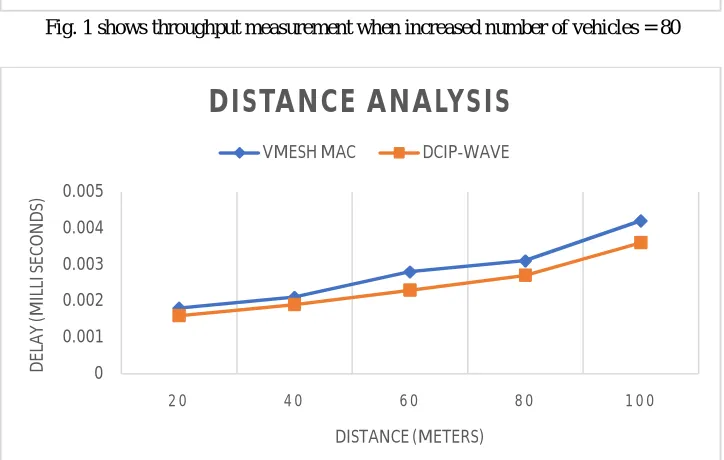
Simulation based performance comparison done using the parameters of distance, location, speed throughput using Network simulator. A scenario is setup to simulate 80 vehicles driving towards the same direction on two lanes with the inter-vehicle distance of 60m. in the distance-based execution examination, a hub transmits a reference point when it has moved a given separation d. The hub removes an outdated neighbour if the hub does not hear any reference points from the neighbour while the hub has moved more than k-times the distance d, or after a greatest time out of 5s. This approach along these lines is versatile to the hub portability, e.g., a quicker moving hub sends reference points all the more every now and again and the other way around. Fig. 2 gives the distance measurement.
In the speed-based execution investigation, the beacon is reliant on the hub speed. A hub decides its signal interval from a predefined run with the correct esteem picked being conversely relative to its speed. Fig. 3 gives the speed estimation when the distance varied.
[image:4.612.129.486.332.485.2]In the throughput-based execution investigation the base and greatest delay are considered for the for the vitality utilization and to compute the life time of the Ad Hoc Networks. Fig. 1 gives the throughput estimation investigation.
Fig. 1 shows throughput measurement when increased number of vehicles = 80
Fig. 2 shows distance measurement when the distance varied between 20m to 100m
0 50 100
1 0 2 0 3 0 4 0 6 0 8 0
% T H R O U GH P U T
NUMBER OF VEHICLES
THROUGHPUT MEASUREMENT
VMESH MAC DCIP-WAVE
0 0.001 0.002 0.003 0.004 0.005
2 0 4 0 6 0 8 0 1 0 0
D EL AY (M IL LI S EC O N D S) DISTANCE (METERS)
DISTANCE ANALYSIS
[image:4.612.125.487.484.714.2]Fig.3 shows speed measurement when the distance is varied between 10m to 70 meters
Fig.4 shows packet delivery ration for the number of iterations
The throughput and defer exhibitions of uplinks, i.e. from OBUs to RSUs when OBUs and RSUs are in communication scope of each other, are appeared in Figure 3 for both VMESH MAC protocol and DCIP WAVE protocol. It can be seen that under low traffic load, the throughput accomplished by the two protocols are very comparative, while the defer execution of DCIP WAVE is superior than the VMESH protocol. This is on the grounds that under light activity conditions, the probability of having impact in WAVE MAC is generally low. The outcomes show the advantage of crash free access protocol in ensuring the steady throughput and additionally the limited packet delay.
V. CONCLUSION
In this work, we evaluated a portion of the fundamental regions that specialists have concentrated on over the most recent couple of years and these incorporate security, steering, QoS, and broadcasting strategies and we featured the most striking outcomes accomplished to date. We exhibited investigation intensive of NS2 recreation device appropriate for VANET condition. In this paper execution performance is done on distance based and speed based beaconing plans, considering the execution measurements in view of throughput, for example, normal delay, speed, throughput based aggregate packets dropped, least delay.The outcomes
0 20 40 60 80 100 120
1 0 2 0 3 0 4 0 5 0 6 0 7 0
SP
EE
D
(%
)
DISTANCE IN METERS
SPEED ANALYSIS
VMESH MAC DCIP-WAVE
0 20 40 60 80 100 120
1 2 3 4 5 6 7 8 9 1 0
P AC K E T D E LI V E R Y R AT IO
NO OF ITERATIONS
PDR MEASUREMENT
demonstrate that the proposed framework superior to anything the current framework regarding speed, distance and throughput. Theoretical investigation and simulation examinations demonstrate that the novel convention has focal points over the current WAVE MAC regarding framework all through.
In the following stage, we will research the execution streamlining of the DCIP WAVE convention utilizing topology data got through beaconing.
REFERENCES
[1] SiddhantJaiswal, D. S. Adane, “Hybrid Approach for Routing in Vehicular Ad-hoc Network Using Clustering Approach”, International Journal of Innovative Research in Computer and Communication Engineering Vol. 1, Issue 5, July 2013.
[2] JosianeNzouonta, NeerajRajgure, Guiling Wang, and CristianBorcea, Transactions on vehicular technology, vol. 58, no. 7, september 2009.
[3] Chih-Hsun Chou, Kuo-FengSsu, and Hewijin Christine Jiau, “Geographic Forwarding with Dead-End Reduction in Mobile Ad Hoc Networks”, IEEE Transactions on vehicular technology, vol. 57, no. 4, july 2008.
[4] HananSaleet, Rami Langar, KshirasagarNaik, RaoufBoutaba, AmiyaNayakand NishithGoel,” Intersection-Based Geographical Routing Protocol for VANETs: A Proposal and Analysis”, IEEE Transactions on vehicular technology, vol. 60, no. 9, november 2011.
[5] Mohammad Al-Rabayah and Robert Malaney,“A New Scalable Hybrid Routing Protocol for VANETs”, IEEE Transactions on vehicular technology, vol. 61, no. 6, july 2012.
[6] Ajay Kumar Singh, Ram ShringarRao, Anurag Singh Baghel,” Position Based Routing Protocols for Vehicular Ad Hoc Network: A Review”, International Journal of Computer Science and Mobile Computing, Vol.5 Issue.2, February- 2016, pg. 206-212.
[7] PrashanthKolandaiswamiArjunan, SaravananJayaram, VigneshSwaminathan,” Low Mobility Based Geographic Routing Strategy”, International Journal of Engineering Trends and Technology (IJETT) – Volume 8, Number 8- Feb 2014.
[8] KiranPenna, VenkateshYalavarthi, Huirong Fu,” Evaluation of Active Position Detection in Vehicular Ad Hoc Networks”, 2014 International Joint Conference on Neural Networks (IJCNN) July 6-11, 2014, Beijing, China.
[9] P. B. Kalpande,J.S.Karnewar Assistant,” Collision Control of Safety Messages in Wave”, International Journal of Computer Applications (0975 – 8887) National Conference on Recent Trends in Computer Science & Engineering (MEDHA 2015.
[10] Qiong WU, Lucas C.K. Hui, C.Y. Yeung, and T.W. Chim,” Early Car Collision Prediction in VANET”, 2015 International Conference on Connected Vehicles and Expo (ICCVE).
[11] GhadahAldabbagh, MaazRehan, HalabiHasbullah, WaqasRehan and Omer Chughtai,” A Driver Safety Information Broadcast Protocol for VANET”, Applied Mathematics & Information Sciences an International Journal
[12] ShalabhPrabhakarRanjan, Kamal Kant Ahirwar,” Comparative Study of VANET and MANET Routing Protocols”, International Conference on Advanced Computing and Communication Technologies,2011.
[13] KayhanZrarGhafoor and Marwan Aziz Mohammed,” Routing Protocols in Vehicular Ad hoc Networks: Survey and Research Challenges”, Network Protocols and Algorithms ISSN 1943-3581 2013, Vol. 5, No. 4.
[14] HumayunKabir,” Research Issues on Vehicular Ad hoc Network”, International Journal of Engineering Trends and Technology (IJETT), Volume 6 Number 4- , Dec 2013.
[15] Saif Al-Sultan, moath m.al-doori,ali h.al-bayatti,hussienzedan,” A comprehensive survey on vehicular Ad Hoc network”, Journal of Network and Computer Applications, 2013.
[16] Quanjun Chen, Salil S. Kanhere, and Mahbub Hassan, “Adaptive Position Update for Geographic Routing in Mobile Ad Hoc Networks”, IEEE Transactions on mobile computing, vol. 12, no. 3, march 2013.
[17] Xiang Ji,HuiQUnYu,GuiShengFan,“SDGR: An SDN-Based Geographic Routing Protocol for VANET “Internet of Things (iThings) and IEEE Green Computing and Communications (GreenCom) and IEEE Cyber, Physical and Social Computing (CPSCom) and IEEE Smart Data (SmartData), IEEE International Conference ,2016
[18] JiaLi,PingWang,ChaoWand”Comprehensive GPSR Routing in VANET Communications with Adaptive Beacon Interval”,IEEE
[19] D.RajiniGirinath ,S.Selvan,” A Novel Cluster based Routing Algorithm for Hybrid Mobility Model in VANET”, International Journal of Computer Applications , pp0975 - 8887 Volume 1 – No. 15,2010.
[20] Jyoti Grover, Manoj Singh Gaur, Vijay Laxmi,” Position Forging Attacks in Vehicular Ad Hoc Networks: Implementation, Impact and Detection”, IEEE,2011. [21] José García-Nieto, Jamal Toutouh, and Enrique Alba,” Intelligent OLSR Routing Protocol Optimization for VANETs”, IEEE Transactions on vehicular
technology, vol. 61, no. 4, may 2012.
[22] Rajeev Sharma, AnilChoudhry,” An Extensive Survey on different Routing Protocols and Issue in VANETs”, International Journal of Computer Applications (0975 – 8887) Volume 106 – No.5, November 2014.