Particle swarm for attribute selection in
Bayesian classification : an application to
protein function prediction
Correa, ES, Freitas, AA and Johnson, CG
http://dx.doi.org/10.1155/2008/876746
Title
Particle swarm for attribute selection in Bayesian classification : an
application to protein function prediction
Authors
Correa, ES, Freitas, AA and Johnson, CG
Type
Article
URL
This version is available at: http://usir.salford.ac.uk/41381/
Published Date
2008
USIR is a digital collection of the research output of the University of Salford. Where copyright
permits, full text material held in the repository is made freely available online and can be read,
downloaded and copied for noncommercial private study or research purposes. Please check the
manuscript for any further copyright restrictions.
Volume 2008, Article ID 876746,12pages doi:10.1155/2008/876746
Research Article
Particle Swarm for Attribute Selection in Bayesian
Classification: An Application to Protein Function Prediction
Elon S. Correa, Alex A. Freitas, and Colin G. Johnson
Computing Laboratory and Center for Biomedical Informatics, University of Kent, Canterbury CT2 7NF, UK
Correspondence should be addressed to Elon S. Correa,[email protected]
Received 29 July 2007; Revised 26 November 2007; Accepted 10 January 2008
Recommended by Jim Kennedy
The discrete particle swarm optimization (DPSO) algorithm is an optimization technique which belongs to the fertile paradigm of Swarm Intelligence. Designed for the task of attribute selection, the DPSO deals with discrete variables in a straightforward manner. This work empowers the DPSO algorithm by extending it in two ways. First, it enables the DPSO to select attributes for a Bayesian network algorithm, which is more sophisticated than the Naive Bayes classifier previously used by the original DPSO algorithm. Second, it applies the DPSO to a set of challenging protein functional classification data, involving a large number of classes to be predicted. The work then compares the performance of the DPSO algorithm against the performance of a standard Binary PSO algorithm on the task of selecting attributes on those data sets. The criteria used for this comparison are (1) maximizing predictive accuracy and (2) finding the smallest subset of attributes.
Copyright © 2008 Elon S. Correa et al. This is an open access article distributed under the Creative Commons Attribution License, which permits unrestricted use, distribution, and reproduction in any medium, provided the original work is properly cited.
1. INTRODUCTION
Most of the particle swarm algorithms present in the litera-ture deal only with continuous variables [1–3]. This is a sig-nificant limitation because many optimization problems are set in a search space featuring discrete variables. Typical ex-amples include problems which require the ordering or ar-ranging of discrete variables, such as scheduling or routing problems [4]. Therefore, the design of particle swarm algo-rithms that deal directly with discrete variables is pertinent to this field of study.
The work in [5] proposed a discrete particle swarm op-timization (PSO) algorithm for attribute selection in Data Mining. Hereafter, this algorithm will be refereed to as the discrete particle swarm optimization (DPSO) algorithm. The DPSO deals directly with discrete variables, and its popu-lation of candidate solutions contains particles of different sizes—the DPSO forces each particle to carry a constant number of attributes across iterations. The DPSO algorithm interprets the concept of velocity, used in traditional PSO, as “probability;” renders velocity as a proportional likelihood; and uses this information to sample new particle positions. The motivation behind the DPSO algorithm is indeed to in-troduce a probability-like approach to particle swarm.
Although specifically designed for the task of attribute se-lection, the DPSO is not limited to this kind of application. By performing a few modifications, one can apply this algo-rithm to many other discrete optimization problems, such as facility location problems [6].
Many data mining applications involve the task of build-ing a model for predictive classification. The goal of such a model is to classify examples—records or data instances— into classes or categories of the same type. Noise or unnec-essary attributes may reduce the accuracy and reliability of a classification or prediction model. Unnecessary attributes also increase the costs of building and running a model— particularly on large data sets. Before performing classifica-tion, it is therefore important to select an appropriate sub-set of “good” attributes. Attribute selection tries to simplify a data set by reducing its dimensionality and identifying rel-evant underlying attributes without sacrificing predictive ac-curacy. As a result, it reduces redundancy in the information provided by the attributes used for prediction. For a more detailed review of the attribute selection task using genetic algorithms, see [7].
space (continuous case) or lattice (binary case) as in the stan-dard PSO algorithms [8]. Instead, they represent a combina-tion of selected attributes. In previous work, the DPSO was used to select attributes for a Naive Bayes (NB) classifier. The resulting NB classifier was then used to predict postsynaptic function in proteins.
The study presented here extends previous work reported in [5,9] in two ways. First, it enables the DPSO to select at-tributes for a Bayesian network algorithm, which is more so-phisticated than the Naive Bayes algorithm previously used. Second, it increases the number of data sets used to evalu-ate the PSO from 1 to 6. All the 6 functional classification data sets used have a much greater number of classes to be predicted—in contrast with the postsynaptic data set used in [5] which had just two classes to be predicted.
The work is organized as follows. Section 2 briefly addresses Bayesian networks and Naive Bayes classifier. Section 3 shortly discusses PSO algorithms. Section 4 de-scribes the standard binary PSO algorithm and Section 5 the DPSO algorithm. Section 6 describes the G-protein-coupled receptors (GPCRs) and Enzyme data sets used in the computational experiments.Section 7reports computa-tional experiments—it also includes a discussion of the re-sults obtained.Section 8presents conclusions and points out future research directions.
2. BAYESIAN NETWORKS AND NAIVE BAYES
The Naive Bayes (NB) classifier uses a probabilistic approach to assign each record of the data set to a possible class. In this work, the NB classifier assigns a protein of a data set of pro-teins to a possible class. A Naive Bayes classifier assumes that all attributes are conditionally independent of one another given the class [10].
A Bayesian network (BN), by contrast, detects probabilis-tic relationships among these attributes and uses this infor-mation to aid the attribute selection process.
Bayesian networks are graphical representations of a probability distribution over a set of variables of a given problem domain [11,12]. This graphical representation is a directed acyclic graph in which nodes represent the variables of the problem and arcs represent conditional probabilistic independencies among the nodes. A directed acyclic graphG
is an ordered pairG = (V,E), whereV is a set whose ele-ments are called vertices or nodes andE is a set whose ele-ments are called directed edges, arcs, or arrows. The graphG
contains no directed cycles—for any vertexv ∈V, there is no directed path that starts and ends onv.
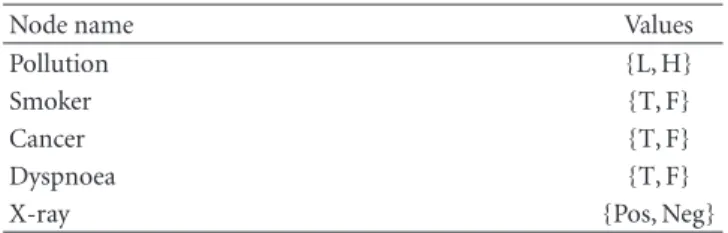
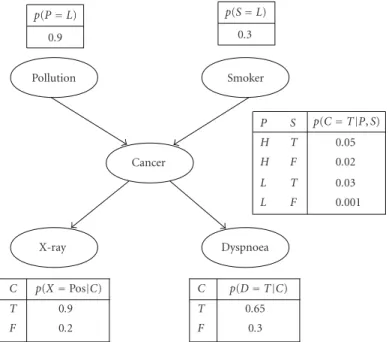
An example of a Bayesian network is as follows. (This is a modified version of the so-called “Asia” problem [13].) Suppose that a doctor is treating a patient who has been suffering from shortness of breath—called dyspnoea. The doctor knows that diseases such as tuberculosis, bronchitis, and lung cancer are possible causes for that. The doctor also knows that other relevant information includes whether the patient is a smoker—increasing the chances of lung cancer and bronchitis—and what sort of air pollution the patient has been exposed to. A positive x-ray would indicate either
Table 1: Bayesian network: nodes and values for the lung cancer
problem. L=low, H=high, T=true, F=false, Pos=positive, and Neg=negative.
Node name Values
Pollution {L, H}
Smoker {T, F}
Cancer {T, F}
Dyspnoea {T, F}
X-ray {Pos, Neg}
tuberculosis or lung cancer. The set of variables for this prob-lem and their possible values are shown inTable 1.
Figure 1 shows a Bayesian network representing this problem. For applications of Bayesian networks on evolu-tionary algorithms and optimization problems, see [14,15].
More formally, let X= {X1,X2,. . .,Xn}be a multivariate random variable whose componentsXiare also random vari-ables. A corresponding lower-case letterxidenotes an assign-ment of state or value to the random variableXi. Parents (Xi) represent the set of nodes—variables or attributes in this work—that have a directed edge pointing toXi. Let us con-sider a BN containingnnodes,X1toXn, taken in that order. A particular value of X= {X1,X2,. . .,Xn}in the joint prob-ability distribution is represented by
p(X)=pX1=x1,X2=x2,. . .,Xn=xn
, (1)
or more compactly, p(x1,x2,...,xn). The chain rule of prob-ability theory allows the factorization of joint probabilities, therefore
p(X)=px1
px2|x1
· · ·pxn|x1,. . .,xn−1
=
i
pxi|x1,. . .,xi−1
. (2)
As the structure of a BN implies that the value of a par-ticular node is conditional only on the values of its parent nodes, (2) may be reduced to
p(X)= i
pXi|Parents
Xi
. (3)
Learning the structure of a BN is an NP-hard problem [16,17]. Many algorithms that were developed to this end use a scoring metric and a search procedure. The scoring metric evaluates the goodness-of-fit of a structure to the data. The search procedure generates alternative structures and selects the best one based on the scoring metric. To reduce the search space of networks, only candidate networks in which each node has at mostk-inward arcs (parents) are considered —k
is a parameter determined by the user. In the present work, k is set to 20 (k=20) to avoid overly complex models.
p(P=L) p(S=L)
0.9 0.3
Pollution Smoker
Cancer
X-ray Dyspnoea
P S H H L L
T F T F
p(C=T|P,S) 0.05 0.02 0.03 0.001
C p(X=Pos|C) C p(D=T|C)
T F
T F
0.9 0.2
0.65 0.3
Figure 1: A Bayesian network representing the lung cancer problem.
Require: Initialize an empty Bayesian network G containing n nodes (i.e., a BN with n nodes but no edges) 1: Evaluate the score of G: Score (G)
2: BEST=Score (G) 3: repeat
4: FROM=0 5: TO=0 6: for i=1 tondo 7: for j=1 tondo
8: G=G
9: ifi /=jthen
10: if there is no edge between the nodes i and j inGthen
11: ModifyG: add an edge between the nodes i and j inGsuch that i is a parent of j: (i→ j) 12: if the resultingGis a DAG then
13: if (Score (G)>BEST) then 14: BEST=Score (G)
15: FROM=i
16: TO=j
17: end if
18: end if
19: end if 20: end if 21: end for 22: end for
23: if FROM>0 then
24: Modify G: add an edge between the nodes FROM and TO inGsuch that FROM is a parent of TO: (FROM→TO) 25: end if
26: until FROM=0
27: return G as the structure of the BN
To evaluate the “goodness-of-fit” (score) of a network structure to the data, an unconventional scoring metric— specific for the target classification task—is adopted. The en-tire data set is divided into mutually exclusive training and test sets—the standard methodology for evaluating classi-fiers, seeSection 7.1. The training set is further divided into two mutually exclusive parts. The first part is used to com-pute the probabilities for the Bayesian network. The second part is used as the validation set. During the search for the best possible network structure, only the validation set is used to compute predictive accuracy. The score of a candi-date network is given by the classification accuracy in the val-idation set. The graphical model of the network that shows the highest predictive accuracy on the validation set—during the entire PSO run—is then used to compute the predictive accuracy on the test set.
Once the best network structure is selected, at the end of the PSO run, the validation set and the other part of the training set are merged and this merged data—that is, the entire original training set—is used to compute the prob-abilities for the selected Bayesian network. The predicted accuracy—reported as the final result—is then computed on the previously untouched test set. This process is discussed again, in more details, in Section 7.1. A similar process is adopted for the computation of the predictive accuracy us-ing the Naive Bayes classifier.
3. A BRIEF INTRODUCTION TO PARTICLE SWARM OPTIMIZATION
Particle swarm optimization (PSO) comprises a set of search techniques, inspired by the behavior of natural swarms, for solving optimization problems [8]. In PSO, a potential so-lution to a problem is represented by a particle, Y(i) =
(Y(i,1),Y(i,2),. . .,Y(i,n)) in ann-dimensional search space. Y(i) represents the ith particle in the population and n repre-sents the number of variables of the problem. The coordi-natesY(i,d)of these particles have a rate of change (velocity)
V(i,d),d = 1, 2,. . .,n. Note that the use of the double sub-script notation (i,d) like inY(i,d)represents thedth compo-nent of theith particle in the swarm Y(i)—the same rationale is used forV(i,d), and so forth.
Every particle keeps a record of the best position that it has ever visited. Such a record is called the particle’s previous best position and denoted by B(i). The global best position attained by any particle so far is also recorded and stored in a particle denoted by G. An iteration comprises evaluation of each particle, then stochastic adjustment ofV(i,d) in the di-rection of particle Y(i)’s previous best position and the pre-vious best position of any particle in the neighborhood [18]. There is much variety in the neighborhood topology used in PSO, but quite often gbest or lbest topologies are used. In the gbest topology, the neighborhood of a particle consists of all the other particles in the swarm, and therefore all the particles will have the same global best neighbor—which is the best particle in the entire population. In the lbest topol-ogy, each particle has just a “local” set of neighbors, typically much fewer than the number of particles in the swarm, and so different particles can have different best local neighbors.
For a review of the neighborhood topologies used in PSO the reader is referred to [8,19].
As a whole, the set of rules that govern PSO are eval-uate, compare, and imitate. The evaluation phase measures how well each particle (candidate solution) solves the prob-lem at hand. The comparison phase identifies the best par-ticles. The imitation phase produces new particle positions based on some of the best particles previously found. These three phases are repeated until a given stopping criterion is met. The objective is to find the particle that best solves the target problem.
Important concepts in PSO are velocity and neighbor-hood topology. Each particle, Y(i), is associated with a ve-locity vector. This veve-locity vector is updated at every gener-ation. The updated velocity vector is then used to generate a new particle position Y(i). The neighborhood topology de-fines how other particles in the swarm, such as B(i) and G, interact with Y(i) to modify its respective velocity vector and, consequently, its position as well.
4. THE STANDARD BINARY PSO ALGORITHM
Potential solutions to the target problem are encoded as fixed size binary strings; that is, Y(i)=(Y(i,1),Y(i,2),. . .,Y(i,n)), whereY(i,j) ∈ {0, 1},i=1, 2,. . .,N, and j =1, 2,. . .,n[8]. Given a list of attributesA = (A1,A2,. . .,An), the first ele-ment of Y(i), from the left to the right hand side, corresponds to the first attribute “A1,” the second to the second attribute “A2,” and so forth. A value of 0 on the site associated to an at-tribute indicates that the respective atat-tribute is not selected. A value of 1 indicates that it is selected.
4.1. The initial population for the standard binary PSO algorithm
For the initial population,Nbinary strings of sizenare ran-domly generated. Each particle Y(i) is generated indepen-dently. For every positionY(i,d)in Y(i), a uniform random numberϕis drawn on the interval (0, 1). Ifϕ < 0.5, then
Y(i,d)=1, otherwiseY(i,d)=0.
4.2. Updating the records for the standard binary PSO algorithm
4.3. Updating the velocities for the standard binary PSO algorithm
Every particle Y(i) is associated to a unique vector of veloc-ities V(i)=(V(i,1),V(i,2),. . .,V(i,n)). Note that, for simplicity, this work uses row vectors rather than column vectors. The elementsV(i,d)in V(i) determine the rate of change of each respective coordinateY(i,d)in Y(i),d=1, 2,. . .,n. Each ele-mentV(i,d)∈V(i) is updated according to the equation
V(i,d)=wV(i,d)+ϕ1
B(i,d)−Y(i,d)
+ϕ2
G(d)−Y(i,d)
,
(4)
wherew(0< w <1), called the inertia weight, is a constant value chosen by the user andd = 1, 2,. . .,n. Equation (4) is a standard equation used in PSO algorithms to update the velocities [20,21]. The factorsϕ1andϕ2are uniform random numbers independently generated in the interval (0, 1).
4.4. Sampling new particle positions for the standard binary PSO algorithm
For each particle Y(i) and each dimensiond, the value of the new coordinateY(i,d) ∈Y(i) can be either 0 or 1. The deci-sion of whetherY(i,d)will be 0 or 1 is based on its respective velocityV(i,d)∈V(i) and is given by the equation
Y(i,d)=
1, ifrand< SV(i,d)
,
0, otherwise; (5)
where 0≤rand≤1 is a uniform random number, and
SV(i,d)
= 1
1 + exp−V(i,d)
(6)
is the sigmoid function. Equation (5) is a standard equation used to sample new particle positions in the binary PSO algo-rithm [8]. Note that the lower the value ofV(i,d)is, the more likely the value ofY(i,d)will be 0. By contrast, the higher the value ofV(i,d)is, the more likely the value ofY(i,d)will be 1. The motivation to use the sigmoid function is to map the in-terval [−V(i,d),V(i,d)] for alli,dinto the interval (0, 1) which is equivalent to the interval of a probability function.
5. THE DISCRETE PSO (DPSO) ALGORITHM
The DPSO algorithm deals directly with discrete variables (attributes) and, unlike the binary PSO algorithm, its pop-ulation of candidate solutions contains particles of diff er-ent sizes. Poter-ential solutions to the optimization problem at hand are represented by a swarm of particles. There areN
particles in a swarm. The size of each particle may vary from 1 ton, wherenis the number of variables—attributes in this work—of the problem. In this context, the size of a parti-cle refers to the number of different attribute indices that the particle is able to represent at a single time.
For example, giveni,j ∈ {1, 2,. . .,N}, in DPSO it may occur that a particle Z(i) in the population has size 6 (Z(i)= {∗,∗,∗,∗,∗,∗}), whereas another particle Z(j) in the same
population has size 2 (Z(i)= {∗,∗}), and so forth, or any
other sizes between 1 andn.
Each particle Z(i) keeps a record of the best position it has ever attained. This information is stored in a separate vector labeled as B(i). The swarm also keeps a record of the global best position ever attained by any particle in the swarm. This information is also stored in a separate vector labeled G. Note that G is equal to the best B(i) present in the swarm.
5.1. Encoding of the particles for the DPSO algorithm
Each attribute is represented by a unique positive integer number, or index. These numbers, indices, vary from 1 to
n. A particle is a subset of nonordered indices without repe-tition, for example, Z(k)= {2, 4, 18, 1},k∈ {1, 2,. . .,N}.
5.2. The initial population for the DPSO algorithm
The original work on DPSO [5] used a randomly generated initial population for the standard PSO algorithm and a new randomly generated initial population for the DPSO algo-rithm, when comparing these algorithms’ performances in a given data set. However, the way in which those populations were initialized generated a doubt about a possible advan-tage of one initial population over the other—which would bias the performance of one algorithm over the other. In this work, to eliminate this possible bias, the initial population used by the DPSO is always identical to the initial population used by the binary PSO. They differ only in the way in which solutions are represented. The conversion of every particle in the initial population of solutions of the binary PSO to the Discrete PSO initial population is as follows.
The index of every attribute that has value 1 is copied to the new solution (particle) of the DPSO initial popula-tion. For instance, an initial candidate solution for the bi-nary PSO algorithm equal to Y(k)=(1, 0, 1, 1, 0) is converted into Z(k) = {1, 3, 4}for the DPSO algorithm—because at-tributes A1,A3, and A4 are set to 1 (are present) in Y(k),
k ∈ {1, 2,. . .,N}. Note that the same initial population of solutions is used to both algorithms, binary PSO and DPSO, to make the comparison between the performances of these algorithms as free from initialization bias as possible.
Initializing the particles Z(i) in this way causes different particles, in DPSO, to have different sizes. For instance, an initial candidate solution Y(j) =(1, 1, 0, 0, 0) (from the bi-nary PSO algorithm) is converted into the initial candidate solution Z(j) = {1, 2}(to the DPSO algorithm) which has size 2, whereas another initial candidate solution Y(k) = (0, 1, 1, 1, 1) (binary PSO) is converted into the initial can-didate solution Z(k)= {2, 3, 4, 5}(DPSO) which has size 4,
j,k∈ {1, 2,. . .,N}andn=5.
In the DPSO algorithm, for simplicity, once the size of a particle is determined at the initialization, the particle will keep that same size during the entire execution of the algo-rithm. For example, particle Z(k)= {2, 3, 4, 5}above, which has been initialized with 4 indices, will always carry exactly 4 indices, Z(k)= {∗,∗,∗,∗}. The values of those 4 indices,
5.3. Velocities = proportional likelihoods
The DPSO algorithm does not use a vector of velocities as the standard PSO algorithm does. It works with tional likelihoods instead. Arguably, the notion of propor-tional likelihood used in the DPSO algorithm and the notion of velocity used in the standard PSO are somewhat similar. DPSO uses M(i) to represent an array of proportional likeli-hoods andM(i,d) to represent one of M(i)’s components.
Every particle in DPSO is associated with a 2-by-narray of proportional likelihoods, where 2 is the number of rows in this array andnis the number of columns—note that the number of columns in M(i) is equal to the number of vari-ables of the problemn.
This is an example of a generic proportional likelihood array
M(i)=
proportional-likelihood-row attribute-index-row
. (7)
Each of thenelements in the first row of M(i) represents the proportional likelihood that an attribute be selected. The sec-ond row of M(i) shows the indices of the attributes associated with the respective proportional likelihoods.
There is a one-to-one correspondence between the columns of this array and the attributes of the problem do-main. At the beginning, all elements in the first row of M(i) are set to 1, for example,
M(i)=
1.0 1.0 1.0 1.0 1.0 1 2 3 4 5
. (8)
After the initial population of particles is generated, this array is always updated before a new configuration for the particle associated to it is generated. The updating of the likelihoods
M(i,d)is based on Z(i), B(i), G and three constant updating factors, namely,α,β, andγ. The updating factors (α,β, and
γ) determine the strength of the contribution of Z(i), B(i), and G to the adjustment of every coordinateM(i,d)∈M(i).
Note thatα,β, andγare parameters chosen by the user. The contribution of these parameters to the updating of
M(i,d)is as follows. All indices present in Z(i) have their corre-spondent proportional likelihood increased byα. In addition to that, all indices present in B(i) have their correspondent proportional likelihood increased byβ. The same for G for which the proportional likelihoods are increased byγ.
For instance, givenn=5,α=0.10,β=0.12,γ=0.14, Z(i)= {2, 3, 4}, B(i)= {3, 5, 2}, G= {5, 2}, and also
M(i)=
1.0 1.0 1.0 1.0 1.0 1 2 3 4 5
, (9)
the updated M(i) would be M(i)=
(1.0) (1.0+α+β+γ) (1.0+α+β) (1.0+α) (1.0+β+γ)
1 2 3 4 5
.
(10)
Note that index 1 is absent in Z(i), B(i), and G. There-fore, the proportional likelihood of attribute 1 in M(i) re-mains as it is. In this work, the values used forα,β, andγ
wereα =0.10,β =0.12, andγ = 0.14. These values were empirically determined in preliminary experiments; but this work makes no claim that these are optimal values. Param-eter optimization is a topic for future research. As a whole, these values make the contribution of B(i) (β=0.12) to the updating of the V(i) a bit stronger than the contribution of Z(i) (α=0.10); and the contribution of G (γ=0.14) even stronger.
The new updated array M(i) replaces the old one and will be used to generate a new configuration to the particle asso-ciated to it as follows.
5.4. Sampling new particle positions for the DPSO algorithm
The proportional likelihood array M(i) is then used to sam-ple a new instance of particle Z(i)—the particle associated to M(i). For this sampling process, a series of operations is performed on the array. To start with, every element of the first row of the array M(i) is multiplied by a uniform random number between 0 and 1. A new random number is drawn for every single multiplication performed.
To illustrate, suppose that
M(i)=
1.00 1.36 1.22 1.10 1.26
1 2 3 4 5
. (11)
The multiplied proportional likelihood array would be
M(i)
=
1.00·ϕ1 1.36·ϕ2 1.22·ϕ3 1.10·ϕ4 1.26·ϕ5
1 2 3 4 5
,
(12)
where ϕ1,. . .,ϕ5 are uniform random numbers indepen-dently drawn on the interval (0, 1).
Suppose that this is the resulting array M(i) after the mul-tiplication
M(i)=
0.11 0.86 0.57 0.62 1.09
1 2 3 4 5
. (13)
A new particle position is then defined by ranking the columns in M(i) by the values in its first row. That is, the ele-ments in the first row of the array are ranked in a decreasing order of value; and the indices of the attributes—in the sec-ond row of M(i)—follow their respective proportional like-lihoods. For example, ranking the array M(i) (shown imme-diately above) would generate
M(i)=
1.09 0.86 0.62 0.57 0.11
5 2 4 3 1
. (14)
Suppose that the particle Z(i) associated to
M(i)=
1.09 0.86 0.62 0.57 0.11
5 2 4 3 1
(15)
has size 3 (Z(i) = {∗,∗,∗}). That makess
i =3—note that Z(j), for instance, may have a different size and consequently a differentsj value. For the Z(i) above, however, assi = 3 the first 3 indices from the second row of M(i) would be se-lected to compose the new particle position. Based on the array M(i) given above andsi=3, the indices (attributes) 5, 2, and 4 would be selected to compose the new particle po-sition, that is, Z(i)= {5, 2, 4}. Note that indices that have a higher proportional likelihood are, on average, more likely to be selected.
The updating of Z(i), B(i), and G follows what is de-scribed inSection 4.2.
Once the algorithms have been explained, the next sec-tion briefly introduces the particular data sets (case studies) used to test the algorithms.
6. CASE STUDY: THE GPCR AND ENZYME DATA SETS USED IN THE COMPUTATIONAL EXPERIMENTS
The experiments involved 6 data sets comprising two kinds of proteins, namely, G-protein-coupled receptors (GPCRs) and Enzymes.
The G-protein-coupled receptors (GPCRs) are a pro-tein superfamily of transmembrane receptors. Their func-tion is to transduce signals that induce a cellular response to the environment. GPCRs are involved in many types of stimulus-response pathways, from intercellular communica-tion to physiological senses. GPCRs are of much interest to the pharmaceutical industry because these proteins are in-volved in many pathological conditions—it is estimated that GPCRs are the target of 40% to 50% of modern medical drugs [22]
Enzymes are proteins that accelerate chemical reac-tions—they participate in many processes in a biological cell. Some enzymes are used in the chemical industry and other industrial applications where extremely specific catalysts are required. In Enzyme Nomenclature, enzymes are assigned and identified by an Enzyme Commission (EC) number. For instance, EC 2.3.4 is an enzyme with class value 2 in the first hierarchical class level, class value 3 in the second class level, and so forth. This work uses the GPCRs and EC data sets de-scribed inTable 2.
These data sets were derived from the data sets used in [23,24]. Note that both the GPCR and the Enzyme data sets have hierarchical classes. Each protein in these data sets is assigned one class at the first (top) hierarchical level, cor-responding to a broad function, another class at the second level, corresponding to a more specialized function, and an-other class at the third level, corresponding to an even more specialized function, and so forth. This work copes with these hierarchical classes in a simple way by predicting classes one level at a time, as explained in more detail later.
The data sets used in the experiments involved four kinds of protein signatures (biological “motifs”), namely, PROSITE
Table 2: GPCR and EC data sets. “Cases” represents the number
of proteins in the data set, “Attributes” represents the total num-ber of attributes that describe the proteins in the data set, and “L1”,. . ., “L4” represent the number of classes at hierarchical class levels 1,. . ., 4, respectively.
# Classes at
Data set Cases Attributes L1 L2 L3 L4
GPCR-PRINTS 330 281 8 36 52 44
GPCR-PROSITE 190 127 8 32 32 —
GPCR-InterPro 580 448 12 43 67 46
EC-PRINTS 500 380 6 43 83 —
EC-PROSITE 570 583 6 42 84 —
EC-Pfam 730 706 6 41 92 —
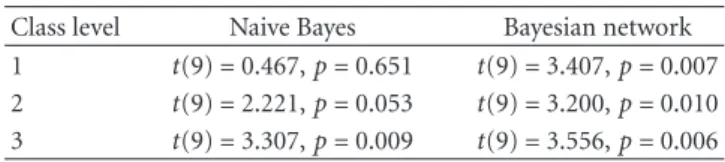
Table 3: Predictive accuracy: binary PSO versus DPSO. Paired
two-tailedttest for the predictive accuracy—significance level 0.05.
Class level Naive Bayes Bayesian network
1 t(9)=0.467,p=0.651 t(9)=3.407,p=0.007 2 t(9)=2.221,p=0.053 t(9)=3.200,p=0.010 3 t(9)=3.307,p=0.009 t(9)=3.556,p=0.006
patterns, PRINTS fingerprints, InterPro entries, and Pfam signatures.
PROSITE is a database of protein families and domains. It is based on the observation that, while there is a huge number of different proteins, most of them can be grouped, on the basis of similarities in their sequences, into a limited number of families (a protein consists of a sequence of amino acids). PROSITE patterns are essentially regular expressions describing small regions of a protein sequence which present a high sequence similarity when compared to other proteins in the same functional family.
In the data sets, the absence of a given PROSITE pattern is indicated by a value of 0 for the attribute corresponding to that PROSITE pattern. The presence of it is indicated by a value of 1 for that same attribute.
PRINTS is a compendium of protein fingerprints. A fin-gerprint is a group of conserved motifs used to characterize a protein family. In the PRINTS data sets, a fingerprint cor-responds to an attribute. The presence of a fingerprint is in-dicated by a value of 1 for that same attribute; the absence by a 0.
Pfam signatures are produced by hidden Markov mod-els, and InterPro integrates a number of protein signature databases into a single database. In this work, Pfam and In-terPro entries also correspond to binary attributes indicat-ing whether or not a protein matches those entries, usindicat-ing the same codification described for the PROSITE patterns and Fingerprints.
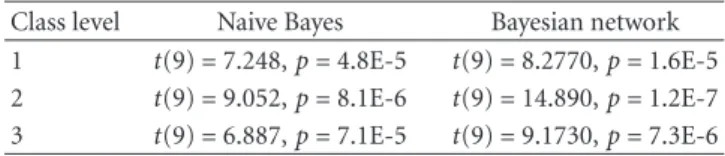
Table 4: Number of selected attributes: binary PSO versus DPSO.
Paired two-tailed t test for the number of attributes selected— significance level 0.05.
Class level Naive Bayes Bayesian network
1 t(9)=7.248,p=4.8E-5 t(9)=8.2770,p=1.6E-5 2 t(9)=9.052,p=8.1E-6 t(9)=14.890,p=1.2E-7 3 t(9)=6.887,p=7.1E-5 t(9)=9.1730,p=7.3E-6
is again applied to assign a class toΥat the second level—no information aboutΥ’s class at the previous level is used. The same process is used to assign a class to proteinΥat the third class level, and so forth.
7. EXPERIMENTS
The quality of a candidate solution (fitness) is evaluated in three different ways: (1) by a baseline algorithm—using all possible attributes; (2) by the binary PSO—using only the attributes selected by this algorithm; and (3) by the discrete PSO (DPSO) algorithm—using only the attributes selected by this algorithm. Each of these algorithms computes the fit-ness of every given solution using two distinct techniques: (a) using a Naive Bayes classifier; and (b) using a Bayesian net-work.
7.1. Experimental methodology
Note that the computation of the fitness function f(·) for the particles Y(i) (binary PSO algorithm) and Z(i) (DPSO algorithm) follows the description given below. For simplic-ity, only the process using Y(i) is described—but the same is applicable to Z(i). f(Y(i)) is equal to the predictive accu-racy achieved by the Naive Bayes classifier—and the Bayesian network—on each data set and using only the attributes se-lected in Y(i).
The measurement of f(Y(i)) follows a wrapper ap-proach. The wrapper approach searches for an optimal at-tribute subset tailored to a particular algorithm, such as the Naive Bayes classifier or Bayesian network. For more infor-mation on wrapper and other attribute selection approaches, see [25].
The computational experiments involved a 10-fold cross-validation method [25]. First, the data set being considered is divided into 10 equally sized folds. The folds are randomly generated but under the following criterion. The proportion of classes in every single fold must be similar to the propor-tion of classes found in the original data set containing all records. This is known as stratified crossvalidation.
Each of the 10 folds is used once as a test set and the re-maining of the data is used as training set. Out of the 9 folds in the training set one is reserved to be used as a validation set. The Naive Bayes classifier and the Bayesian network use the remaining 8 folds to compute the probabilities required to classify new examples. Once those probabilities have been computed, the Naive Bayes (NB) classifier and the Bayesian network (BN) classify the examples in the validation set.
The accuracy of this classification on the validation set is the value of the fitness functions fNB(Y(i)) and fBN(Y(i))— the same for fNB(Z(i)) and fBN(Z(i)). When the run of the PSO algorithm is completed, the 9 folds are merged into a full training set. The Naive Bayes classifier and the Bayesian network are then trained again on this full-training set (9 merged folds), and the probabilities computed in this final, full-training set are used to classify examples in the test set (the 10th fold), which was never accessed during the run of the algorithms.
The reasons for having separate validation and test sets are as follows. In the classification task of data mining, by definition, the goal is to measure predictive accuracy— generalization ability—on a test set unseen during training. Hence, the test set cannot be accessed by the PSO, and is reserved just to compute the predictive accuracy associated with the Bayesian classifier constructed with the best set of attributes selected at the end of the PSO run.
Concerning the validation set, which is used to compute the fitness of particles during the PSO run, this is a part of the original training set which is different from the part of the training set used to build the Bayesian classifier, and the reason for having these two separate parts of the training set is to avoid overfitting of the classifier to the training data; for overfitting in the context of classification, see [7, pages 17, 18]. In other words, if the same training set that was used to build a Bayesian classifier was also used to measure the fitness (accuracy) of the corresponding particle, there would be no pressure to build classifiers with a good generalization ability on data unseen during training, and a classifier could obtain a high accuracy by simply being overfitted to idiosyncrasies of the training set which are unlikely to generalize well to un-seen data. By measuring fitness on a validation set separated from the data used to build the classifier, this is avoided, and a pressure to build classifiers with good generalization ability is introduced in the fitness function.
In each of the 10 iterations of the crossvalidation proce-dure, the predictive accuracy of the classification is assessed by 3 different methods, as follows.
(1) Using all possible original attributes: all possible at-tributes are used by the Naive Bayes classifier and the Bayesian network—there is no attribute selection. (2) Standard binary PSO algorithm: only the attributes
se-lected by the best particle found by the binary PSO al-gorithm are used by the Naive Bayes classifier and the Bayesian network.
(3) DPSO algorithm: only the attributes selected by the best particle found by the DPSO algorithm are used by the Naive Bayes classifier and the Bayesian network.
Since the Naive Bayes and Bayesian network classifiers used in this work are deterministic, only one run—for each of these algorithms—is performed for the classification using all possible attributes.
The population size used for both algorithms (binary PSO and DPSO) is 200 and the search stops after 20 000 fit-ness evaluations—or 100 iterations.
The binary PSO algorithm uses an inertia weight value of 0.8 (i.e.,w =0.8). The choice of the value of this parameter was based on the work presented in [26].
Other choices of parameter values for the DPSO wereα=
0.10,β = 0.12, andγ = 0.14, chosen based on empirical experiments but probably not optimal values.
The measurement of the predictive accuracy rate of a model should be a reliable estimate of how well that model classifies the test examples—unseen during the train-ing phase—on the target problem.
In Data Mining, typically, the equation
standard accuracy rate= TP + TN
TP + FP + FN + TN (16)
is used to assess the accuracy rate of a classifier—where TP, TN, FP, and FN are the numbers of true positives, true neg-atives, false positives, and false negneg-atives, respectively [25].
However, if the class distribution is highly unbalanced, (16) is an ineffective way of measuring the accuracy rate of a model. For instance, in many problems, it is easy to achieve a high value for (16) by simply predicting always the majority class. Therefore, on the experiments reported on this work, a more demanding measurement for the accuracy rate of a classification model is used.
This measurement has been used before in [27]. It is given by the equation
predictive accuracy rate=TPR·TNR, (17)
where, TPR=TP/(TP+FN) and TNR=TN/(TN+FP)—TPR stands for true positive rate and TNR stands for true negative rate.
Note that if any of the quantities TPR or TNR is zero, the value returned by (17) is also zero.
7.2. Discussion
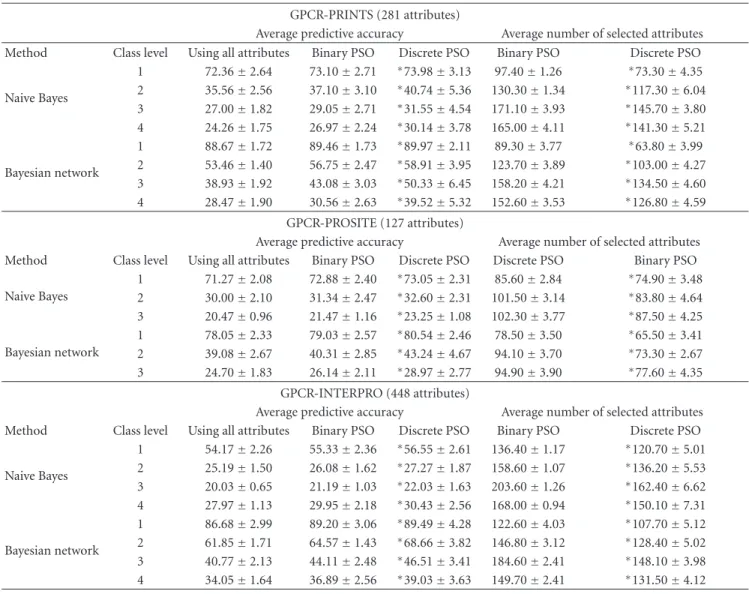
Computational results are reported in Tables5and6. Let us focus the discussion on the results obtained by the 3 algo-rithms (binary PSO, DPSO, and baseline algorithm) for at-tribute selection on the GPCR-PROSITE data set, seeTable 5. The results obtained for the other 5 data sets are similar. To start with, the results obtained using the Naive Bayes classi-fier are presented.
Results obtained using the Naive Bayes classifier approach
To assess the performance of the algorithms, two criteria were considered: (1) maximizing predictive accuracy; and (2) finding the smallest subset of attributes.
The results for the first criterion, accuracy, show that both versions of the PSO algorithm did better—in all class levels—than the baseline algorithm using all attributes.
Furthermore, the DPSO algorithm did slightly better than the binary PSO algorithm also in all class levels. Never-theless, the difference in the predictive accuracy performance
between these algorithms is, in some cases, statistically in-significant.
Table 3shows the results of a paired two-tailedt-test for the predictive accuracy of the binary PSO versus the predic-tive accuracy of the DPSO at a significance level of 0.05.
Table 3 shows that, using Naive Bayes as classifier, the only statistically significant difference in performance—in terms of predictive accuracy—between the algorithms binary PSO and DPSO is at the third class level. By contrast, using Bayesian networks as classifier, the difference in performance is statistically significant at all class levels.
Nevertheless, the discriminating factor between the per-formance of these algorithms is on the second comparison criterion—finding the smallest subset of attributes.
The DPSO not only outperformed the binary PSO in pre-dictive accuracy, but also did so using a smaller subset of attributes in all class levels. Moreover, when it comes to ef-fectively pruning the set of attributes, the difference in per-formance between the binary PSO and the DPSO is always statistically significant, asTable 4shows.
Results obtained using the the Bayesian network approach
Again, the predictive accuracy attained by both versions of the PSO algorithm surpassed the predictive accuracy ob-tained by the baseline algorithm in all class levels.
DPSO obtained the best predictive accuracy of all al-gorithms in all class levels. Regarding the second compari-son criterion, finding the smallest subset of attributes, again DPSO always selected the smallest subset of attributes in all hierarchical levels.
The results on the performance of the classifiers—Naive Bayes versus Bayesian networks—show that Bayesian net-works did a much better job. For all class levels, the pre-dictive accuracy obtained by the 3 approaches (baseline, bi-nary PSO and DPSO) using Bayesian networks was signif-icantly better than the predictive accuracy obtained using Naive Bayes classifier. The Bayesian networks approach also enabled the two PSO algorithms to do the job using fewer selected attributes—compared to the Naive Bayes approach.
The results emphasize the importance of taking relation-ships among attributes into account—as Bayesian networks do—when performing attribute selection. If these relation-ships are ignored, predictive accuracy is adversely affected.
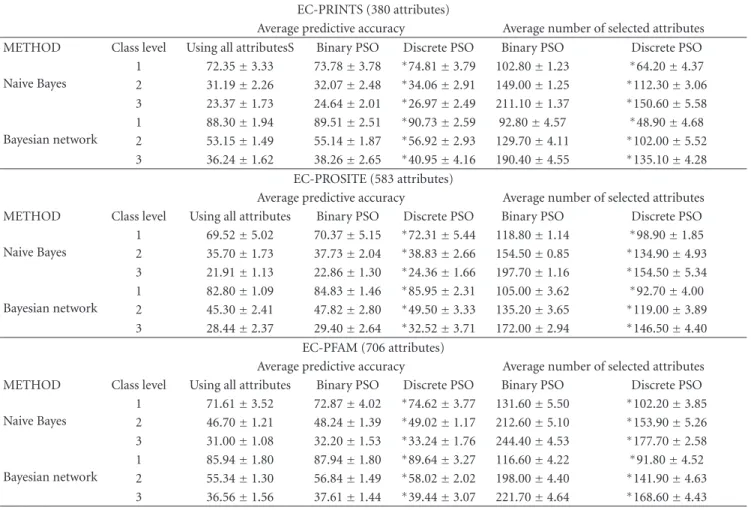
The results also show that for all 6 data sets tested, the DPSO algorithm not only selected the smallest subset of at-tributes, but also obtained the highest predictive accuracy in every single class level.
8. CONCLUSIONS
Table 5: Results for the GPCRs data sets. For the binary PSO and DPSO algorithms, 30 independent runs are performed. The results reported
are averaged over these 30 independent runs. The best result on each line for each performance criterion is marked with an asterisk (∗).
GPCR-PRINTS (281 attributes)
Average predictive accuracy Average number of selected attributes
Method Class level Using all attributes Binary PSO Discrete PSO Binary PSO Discrete PSO
Naive Bayes
1 72.36±2.64 73.10±2.71 ∗73.98±3.13 97.40±1.26 ∗73.30±4.35
2 35.56±2.56 37.10±3.10 ∗40.74±5.36 130.30±1.34 ∗117.30±6.04 3 27.00±1.82 29.05±2.71 ∗31.55±4.54 171.10±3.93 ∗145.70±3.80 4 24.26±1.75 26.97±2.24 ∗30.14±3.78 165.00±4.11 ∗141.30±5.21
Bayesian network
1 88.67±1.72 89.46±1.73 ∗89.97±2.11 89.30±3.77 ∗63.80±3.99
2 53.46±1.40 56.75±2.47 ∗58.91±3.95 123.70±3.89 ∗103.00±4.27 3 38.93±1.92 43.08±3.03 ∗50.33±6.45 158.20±4.21 ∗134.50±4.60 4 28.47±1.90 30.56±2.63 ∗39.52±5.32 152.60±3.53 ∗126.80±4.59
GPCR-PROSITE (127 attributes)
Average predictive accuracy Average number of selected attributes
Method Class level Using all attributes Binary PSO Discrete PSO Discrete PSO Binary PSO
Naive Bayes
1 71.27±2.08 72.88±2.40 ∗73.05±2.31 85.60±2.84 ∗74.90±3.48
2 30.00±2.10 31.34±2.47 ∗32.60±2.31 101.50±3.14 ∗83.80±4.64 3 20.47±0.96 21.47±1.16 ∗23.25±1.08 102.30±3.77 ∗87.50±4.25
Bayesian network
1 78.05±2.33 79.03±2.57 ∗80.54±2.46 78.50±3.50 ∗65.50±3.41
2 39.08±2.67 40.31±2.85 ∗43.24±4.67 94.10±3.70 ∗73.30±2.67
3 24.70±1.83 26.14±2.11 ∗28.97±2.77 94.90±3.90 ∗77.60±4.35
GPCR-INTERPRO (448 attributes)
Average predictive accuracy Average number of selected attributes
Method Class level Using all attributes Binary PSO Discrete PSO Binary PSO Discrete PSO
Naive Bayes
1 54.17±2.26 55.33±2.36 ∗56.55±2.61 136.40±1.17 ∗120.70±5.01 2 25.19±1.50 26.08±1.62 ∗27.27±1.87 158.60±1.07 ∗136.20±5.53 3 20.03±0.65 21.19±1.03 ∗22.03±1.63 203.60±1.26 ∗162.40±6.62 4 27.97±1.13 29.95±2.18 ∗30.43±2.56 168.00±0.94 ∗150.10±7.31
Bayesian network
1 86.68±2.99 89.20±3.06 ∗89.49±4.28 122.60±4.03 ∗107.70±5.12 2 61.85±1.71 64.57±1.43 ∗68.66±3.82 146.80±3.12 ∗128.40±5.02 3 40.77±2.13 44.11±2.48 ∗46.51±3.41 184.60±2.41 ∗148.10±3.98 4 34.05±1.64 36.89±2.56 ∗39.03±3.63 149.70±2.41 ∗131.50±4.12
shows much stronger evidence for the effectiveness of DPSO in 6 data sets. In addition, the 6 data sets mined in this work are much more challenging than the two-class data set mined in [5], because the former have several hierarchical class lev-els per data set, leading to a much larger number of classes to be predicted for each data set.
Even when the difference in predictive accuracy is in-significant, by selecting fewer attributes than the binary PSO, the DPSO certainly enhances computational efficiency of the classifier and is therefore preferable.
The original work on DPSO [5] questioned whether the difference in performance between these two algorithms was attributable to variations in the initial population of solu-tions. To overcome this possible advantage/disadvantage for one algorithm or the other, the present work used the same initial population for both algorithms.
The results demonstrate that, even using an identical ini-tial population of particles, the DPSO is still outperforming
the binary PSO in both predictive accuracy and number of selected attributes. The DPSO is arguably not too different from traditional PSO but still the algorithm has features that enable it to improve over binary PSO on the task of attribute selection.
Another result—although expected—from the experi-ments is the clear difference in performance between Naive Bayes and Bayesian networks used as classifiers. The Bayesian networks approach outperformed the Naive Bayes approach in all experiments and in all hierarchical class levels.
Table 6: Results for the EC data sets. For the binary PSO and the DPSO algorithms, 30 independent runs are performed. The results reported
are averaged over these 30 independent runs. The best result on each line for each performance criterion is marked with an asterisk (∗).
EC-PRINTS (380 attributes)
Average predictive accuracy Average number of selected attributes METHOD Class level Using all attributesS Binary PSO Discrete PSO Binary PSO Discrete PSO
Naive Bayes
1 72.35±3.33 73.78±3.78 ∗74.81±3.79 102.80±1.23 ∗64.20±4.37
2 31.19±2.26 32.07±2.48 ∗34.06±2.91 149.00±1.25 ∗112.30±3.06 3 23.37±1.73 24.64±2.01 ∗26.97±2.49 211.10±1.37 ∗150.60±5.58
Bayesian network
1 88.30±1.94 89.51±2.51 ∗90.73±2.59 92.80±4.57 ∗48.90±4.68
2 53.15±1.49 55.14±1.87 ∗56.92±2.93 129.70±4.11 ∗102.00±5.52 3 36.24±1.62 38.26±2.65 ∗40.95±4.16 190.40±4.55 ∗135.10±4.28
EC-PROSITE (583 attributes)
Average predictive accuracy Average number of selected attributes
METHOD Class level Using all attributes Binary PSO Discrete PSO Binary PSO Discrete PSO
Naive Bayes
1 69.52±5.02 70.37±5.15 ∗72.31±5.44 118.80±1.14 ∗98.90±1.85
2 35.70±1.73 37.73±2.04 ∗38.83±2.66 154.50±0.85 ∗134.90±4.93 3 21.91±1.13 22.86±1.30 ∗24.36±1.66 197.70±1.16 ∗154.50±5.34
Bayesian network
1 82.80±1.09 84.83±1.46 ∗85.95±2.31 105.00±3.62 ∗92.70±4.00
2 45.30±2.41 47.82±2.80 ∗49.50±3.33 135.20±3.65 ∗119.00±3.89 3 28.44±2.37 29.40±2.64 ∗32.52±3.71 172.00±2.94 ∗146.50±4.40
EC-PFAM (706 attributes)
Average predictive accuracy Average number of selected attributes
METHOD Class level Using all attributes Binary PSO Discrete PSO Binary PSO Discrete PSO
Naive Bayes
1 71.61±3.52 72.87±4.02 ∗74.62±3.77 131.60±5.50 ∗102.20±3.85 2 46.70±1.21 48.24±1.39 ∗49.02±1.17 212.60±5.10 ∗153.90±5.26 3 31.00±1.08 32.20±1.53 ∗33.24±1.76 244.40±4.53 ∗177.70±2.58
Bayesian network
1 85.94±1.80 87.94±1.80 ∗89.64±3.27 116.60±4.22 ∗91.80±4.52
2 55.34±1.30 56.84±1.49 ∗58.02±2.02 198.00±4.40 ∗141.90±4.63 3 36.56±1.56 37.61±1.44 ∗39.44±3.07 221.70±4.64 ∗168.60±4.43
ACKNOWLEDGMENTS
The authors would like to thank Nick Holden for kindly pro-viding them with the biological data sets used in this work. The authors would also like to thank EPSRC (grant Extended Particle Swarms GR/T11265/01) for financial support.
REFERENCES
[1] T. Blackwell and J. Branke, “Multi-swarm optimization in dy-namic environments,” in Applications of Evolutionary Comput-ing, vol. 3005 of Lecture Notes in Computer Science, pp. 489– 500, Springer, New York, NY, USA, 2004.
[2] S. Janson and M. Middendorf, “A hierarchical particle swarm optimizer for dynamic optimization problems,” in Proceedings of the 1st European Workshop on Evolutionary Algorithms in Stochastic and Dynamic Environments (EvoCOP ’04), vol. 3005 of Lecture Notes in Computer Science, pp. 513–524, Springer, Coimbra, Portugal, April 2004.
[3] M. Løvbjerg and T. Krink, “Extending particle swarm op-timisers with self-organized criticality,” in Proceedings of the Congress on Evolutionary Computation (CEC ’02), D. B. Fogel, M. A. El-Sharkawi, X. Yao, et al., Eds., vol. 2, pp. 1588–1593, IEEE Press, Honolulu, Hawaii, USA, May 2002.
[4] M. M. Solomon, “Algorithms for the vehicle routing and scheduling problems with time window constraints,” Opera-tions Research, vol. 35, no. 2, pp. 254–265, 1987.
[5] E. S. Correa, A. A. Freitas, and C. G. Johnson, “A new discrete particle swarm algorithm applied to attribute selection in a bioinformatics data set,” in Proceedings of the 8th Annual Con-ference Genetic and Evolutionary Computation (GECCO ’06), M. Keijzer, M. Cattolico, D. Arnold, et al., Eds., pp. 35–42, ACM Press, Seattle, Wash, USA, July 2006.
[6] E. S. Correa, M. T. A. Steiner, A. A. Freitas, and C. Carnieri, “A genetic algorithm for solving a capacityp-median problem,” Numerical Algorithms, vol. 35, no. 2–4, pp. 373–388, 2004. [7] A. A. Freitas, Data Mining and Knowledge Discovery with
Evo-lutionary Algorithms, Springer, Berlin, Germany, 2002. [8] J. Kennedy and R. C. Eberhart, Swarm Intelligence, Morgan
Kaufmann, San Francisco, Calif, USA, 2001.
[9] E. S. Correa, A. A. Freitas, and C. G. Johnson, “Particle swarm and Bayesian networks applied to attribute selection for pro-tein functional classification,” in Proceedings of the 9th Annual Genetic and Evolutionary Computation Conference (GECCO ’07), pp. 2651–2658, London, UK, July 2007.
[10] T. M. Mitchell, Machine Learning, McGraw-Hill, London, UK, 1997.
[12] J. Pearl, Probabilistic Reasoning in Intelligent Systems: Networks of Plausible Inference, Morgan Kaufmann, San Francisco, Calif, USA, 1st edition, 1988.
[13] S. L. Lauritzen and D. J. Spiegelhalter, “Local computations with probabilities on graphical structures and their applica-tion to expert systems,” Journal of the Royal Statistics Society, vol. 50, no. 2, pp. 157–224, 1988.
[14] P. Larra˜naga, R. Etxeberria, J. A. Lozano, B. Sierra, I. Naki Inza, and J. M. Pe˜na, “A review of the cooperation between evolu-tionary computation and probabilistic models,” in Proceedings of the 2nd International Symposium on Artificial Intelligence and Adaptive Systems (CIMAF ’99), pp. 314–324, La Havana, Cuba, March 1999.
[15] J. M. Pe˜na, J. A. Lozano, and P. Larra˜naga, “Globally multi-modal problem optimization via an estimation of distribution algorithm based on unsupervised learning of Bayesian net-works,” Evolutionary Computation, vol. 13, no. 1, pp. 43–66, 2005.
[16] R. R. Bouckaert, “Properties of Bayesian belief network learn-ing algorithms,” in Proceedlearn-ings of the 10th Annual Conference on Uncertainty in Artificial Intelligence (UAI ’94), I. R. L. de Mantaras and E. D. Poole, Eds., pp. 102–109, Morgan Kauf-mann, Seattle, Wash, USA, July 1994.
[17] D. M. Chickering, D. Geiger, and D. Heckerman, “Learning Bayesian networks is NP-hard,” Tech. Rep. MSR-TR-94-17, Microsoft Research, Redmond, Wash, USA, November 1994. [18] J. Kennedy and R. C. Eberhart, “A discrete binary version of the
particle swarm algorithm,” in Proceedings of the IEEE Interna-tional Conference on Systems, Man, and Cybernetics (SMC ’97), vol. 5, pp. 4104–4109, IEEE, Orlando, Fla, USA, October 1997. [19] J. Kennedy, “Small worlds and mega-minds: effects of neigh-borhood topology on particle swarm performance,” in Pro-ceedings of the Congress of Evolutionary Computation, P. J. An-geline, Z. Michalewicz, M. Schoenauer, X. Yao, and A. Zalzala, Eds., vol. 3, pp. 1931–1938, IEEE Press, Washington, DC, USA, July 1999.
[20] G. Kendall and Y. Su, “A particle swarm optimisation approach in the construction of optimal risky portfolios,” in Proceedings of the IASTED International Conference on Artificial Intelligence and Applications, part of the 23rd Multi-Conference on Applied Informatics, pp. 140–145, Innsbruck, Austria, February 2005. [21] R. Poli, C. D. Chio, and W. B. Langdon, “Exploring extended
particle swarms: a genetic programming approach,” in Pro-ceedings of the Genetic and Evolutionary Computation Confer-ence (GECCO ’05), pp. 169–176, ACM Press, Washington, DC, USA, June 2005.
[22] D. Filmore, “It’s a GPCR world,” Modern Drug Discovery, vol. 11, no. 7, pp. 24–28, 2004.
[23] N. Holden and A. A. Freitas, “Hierarchical classification of G-protein-coupled receptors with a PSO/ACO algorithm,” in Proceedings of the IEEE Swarm Intelligence Symposium (SIS ’06), pp. 77–84, IEEE Press, Indianapolis, Ind, USA, May 2006. [24] N. Holden and A. A. Freitas, “A hybrid particle swarm/ant colony algorithm for the classification of hierarchical biologi-cal data,” in Proceedings of the IEEE Swarm Intelligence Sympo-sium (SIS ’05), pp. 100–107, IEEE Press, Pasadena, Calif, USA, June 2005.
[25] I. H. Witten and E. Frank, Data Mining: Practical Machine Learning Tools and Techniques, Morgan Kaufmann, San Fran-cisco, Calif, USA, 2nd edition, 2005.
[26] Y. Shi and R. C. Eberhart, “Parameter selection in particle swarm optimization,” in Proceedings of the 7th International Conference on Evolutionary Programming (EP ’98), pp. 591– 600, Springer, San Diego, Calif, USA, March 1998.