Skill competency development strategies
by a contractor
Oyegoke, AS, McDermott, P, Aouad, GF and Cleary, MW
http://dx.doi.org/10.1680/mpal.2009.162.3.121
Title
Skill competency development strategies by a contractor
Authors
Oyegoke, AS, McDermott, P, Aouad, GF and Cleary, MW
Type
Article
URL
This version is available at: http://usir.salford.ac.uk/23354/
Published Date
2009
USIR is a digital collection of the research output of the University of Salford. Where copyright
permits, full text material held in the repository is made freely available online and can be read,
downloaded and copied for noncommercial private study or research purposes. Please check the
manuscript for any further copyright restrictions.
Adekunle Sabitu Oyegoke Research Fellow, University of Salford, UK
Peter McDermott Professor of Management, University of Salford, UK
Ghassan Aouad
Professor and Pro-Vice Chancellor for Research and Innovation, University of Salford, UK
Martin Cleary Researcher, University of Salford, UK
Proceedings of the Institution of Civil Engineers
Management, Procurement and Law 162
Month 2009 Issue MP0 Pages 1–10
doi:10.1680/mpal.2009.162.0.1 Paper 900016
Received 21/02/2009 Acc
Q1 epted 19/04/2009
Keywords:
Skill competency development strategies by a contractor
A. S. Oyegoke
HND,
MSc (Tech.),
Lic. Sc. (Tech.),
DSc,
MACostE,
MCIOB, P. McDermott
MSc,
PhD,
G. Aouad
MSc,
PhD,
FCIOB,
FHEAand M. Cleary
BA,
PGCEConstruction skill is one of the vital aspects of
construction work which is growing in importance due to skill gaps and skill shortages during different economic cycles. The aim of this study was to investigate competence development strategies by a traditional construction company within its own pool of skill resources and among its supply chain members. The study was carried out via literature review, empirical studies involving a focus study, analysis of documentary evidence supported by unstructured interviews and a report of skill development/supply chain conference. The study demonstrates how long-term skill development can be achieved through: (a) strategic capacity planning which allows high retention, continuous training, and balanced construction demand and contractor’s supply capacity over a long-term; (b) updating and upgrading the knowledge base of the supply chain through conferences and training schemes; (c) strategic investment in the workforce through training, vocational and higher degrees; and (d) acquaintance with different sources of finance. This study will assist small traditional firms in building competencies in skill development and improvement. It will assist an international audience who may face similar issue with their construction firms.
1. INTRODUCTION
Construction, as in other production processes, involves a process of transforming inputs into outputs by using necessary resources. These resources are accumulated stocks of means of production and overall productivity performance. Skills have been one of the most important issues in the construction industry due to the fact that the construction methods are largely primitive; hence the necessity of a labour-intensive workforce. The fact that the structure of the industry is highly fragmented entails the need for many different skill sets.
There are a number of factors that are attributed to skills shortage, the foremost being the impact of demand and supply interaction through construction demand and supply side capacity
constraints,1the effect of new technologies,2demographic issues and lack of interest by young people,3issues related to training resources,4and the effects of market cycles, namely the cyclical nature of the industry market.5
The skill problem is compounded in the UK due to a lack of investment during the recession in the late 1980s and early 1990s. Blyth refers to this period as6‘the Brain Drain’ and a sequence of events which led to significant shortages in human resources. He emphasises6that, ‘during that time the industry stopped taking on new graduates, those who had recently graduated from building-related courses were unable to find work, universities axed construction courses and the construction industry suffered greatly and stopped recruiting’. According to Mackenzieet al. the effects7were seen during the economic recovery with considerable skills shortages in both traditional and new skills areas.
There are three dynamics in developing construction skill competencies: first, an attainment of equilibrium between construction demand and supply capacities. On construction demand and supply capacity issues the government commissioned
a study to improve long-term capacity planning.8The report
recommended among other things the need to take a much more systematic and strategic approach to the markets in which it operates. Second, building competencies to address skills shortages, which are a result of the imbalance between demand and supply of workforce, and third, addressing the skill gaps which occur as a result of knowledge deficiencies that might be due to new construction materials, means, techniques and technology.
On skills shortages and skill gaps the ConstructionSkills9 negotiated a series of agreements between training providers, employers and government that were designed to address the construction industry’s current and future skills needs. According to the ConstructionSkills,9this agreement significantly increased
employer commitments to training and skills in partnership with further and higher education and government agencies. In addition to considerable investment by individual companies employers have agreed a financial strategy in which they will provide funding of over £120 million per year for collective training activity.
Construction skills have been a recurring and topical issue because
of the cyclical nature of the market. Huemannet al.10viewed
construction skills have been addressed by many authors: skill training in relation to business processes;11operative training;12 the UK vocational training policy;13and the contribution of National Vocational Qualifications (NVQ) to the growth of skills in the UK.14It also includes the decline of apprenticeship training in Britain;15relationships between training and turnover;16 formulation of common training policy in the context of
European development;17and apprenticeship training.18
Other studies have looked at the developing project management
competency;19project management practitioner development;20
skills in terms of self employment;21the importance of human
skills in project management success;22the importance of
‘soft’ skills or ‘micro-social’ skills in successful project
management;23project workforce management;24and skills in
relation to productivity.25Pheng and Chuan examined the area of
improving a project manager’s performance26by identifying the
working environment variables which affect his performance. Lobo and Wilkinson assess solutions to skills shortages in the
construction industry27drawing on research from New Zealand.
They suggested27increase in wages, overseas recruitment and
reformatting training requirements through a joint focus on education and training. Mackenzieet al.7describe seven existing industry and government schemes that helped in tackling skills shortages, and a further nine alternative response strategies to the construction skills shortage.
The aim of this paper was to present skill competency strategies by a small traditional contractor. The paper describes how some of the government and industry initiatives have been successfully implemented in addition to the contractor’s own initiatives. The study looked at the period when the demand capacity was at its highest in the UK between 2002 and the first and second quarter of 2008.
2. RESEARCH METHODS
The study was carried out via literature review and empirical studies involving a focus study, data analysis from construction statistics, analysis of documentary evidence with unstructured interviews, and a skill development/supply chain conference. A focus group study was carried out as a preliminary study aimed at understanding the most pressing issues in skill development and improvement. Although the causes of the skill shortage in the UK construction industry are well documented, this focus group study approach enabled the authors to discover the most pressing issues and to know how far the industry has moved on from some of the problems in the literature.
The attendees were part of the North West (NW) ConstructionSkills Observatory meeting. There was a balanced distribution of participants from young professional to experienced practitioners and highly experienced retired people. There were sixteen participants, nine from a contracting background, four from a consulting background and three from academia. The participants came from different backgrounds having worked or currently working for specialist trade contractors, main contractors, developers, consulting firms and in academia.
The group was asked about their experiences and the problems in skill development and improvement in the UK. The issues dealt with in a 90 min meeting/study can be categorised under: (a) skills finances, (b) training standards and (c) general issues.
2.1. Financing: funding in skill sets
(a) Funding is said to be a major impediment to skill
development. The small specialist trade firms are not aware of funding sources and/or capable of self funding. A good example is the ConstructionSkills Certification Scheme (CSCS) which was problematic due to training time and funding.
(b) Self financing for the large companies and greater flexibility in releasing employees for training.
(c) Contractor’s cash flow inhibits training of the workforce, most especially the small medium enterprises (SMEs).
(d) Extra labour costs due to the delay caused by unforeseen
circumstances, for example, archaeological findings on the site.
2.2. Training standards
(a) Qualification criteria in higher institutions.
(b) Training standards in vocational institutions/apprenticeship. (c) Old skills versus new skill sets; for example, the use of
formwork is plummeting and in time will not be critical in construction.
(d) Skill shortage across the board at both management and
operative levels.
(e) The industry needs quick qualification and learning from overseas; for example, the prefabrication systems in Finland and Scandinavia.
(f) Education reform: changing perceptions of young people’s
view of the industry.
(g) Diversity of the industry – with diversified opinion.
2.3. General effects
(a) Technological effects, for example, in plumbing where new technology is been developed.
(b) Effects of the developers are paramount.
(c) Effects of highly specialised skills versus multi-skills.
(d) Effects of the modern construction or offsite manufacturing.
(e) Data-sharing problems.
(f) Effects of a huge number of interventions, for example, health and safety, levies, sustainability.
(g) The influence of the movers and shakers of the industry, such as town planning authorities and how their decisions shape the future. A good example is the planner instruction SSG 304 in which maximum use of the land is advocated in order to eliminate parking on a share or limited basis. But now those properties cannot be sold due to demand for parking space. (h) Retirements: useful and valuable knowledge is lost in
retirement. It could have served as a useful means of improving skills. The opportunities for the retiree to come out of retirement is hampered by low incentives even when such positions are available.
(j) The effects of the black economy, for example, about 25 000 gas workers are assumed not to be registered.
From the focus study it was found that some of the problems identified and government response strategies highlighted by Mackenzieet al. are still prevalent today.7For instance, issues about new technology and techniques, economic stability within the industry, effects on direct employment, adult training and other problems associated with training.
problems have been managed. The study was based in part on documentary evidence that was used to win a gold certificate under the CSCS scheme, other human resources documentary evidence and unstructured interviews, and participation in a supply chain conference.
3. DYNAMICS IN THE UK CONSTRUCTION INDUSTRY
One of the causes of the skills shortage in the UK construction industry is the changing nature of construction markets and the demand capacity problem which has been attributed to a higher demand for operatives with many traditional skills. At the peak of the demand capacity problem in 2006, the government of
the UK through the Office of Government Commerce (OGC)1
commissioned a study of the demand capacity problem. This section will examine the dynamics in the demand and supply side of the construction industry through construction statistical data.
3.1. Dynamics in the demand side of the industry The UK construction industry is heavily invested in by the public and private sectors. The Construction Statistic data by the Office for National Statistics28shows that about £6.88 billion, £19.81 billion, £15.12 billion and £16.04 billion were the combined new orders by both private and public in housing sector in 1999, 2003, 2005 and 2007, respectively. The increment in investment extends to the new order for infrastructure which amounted to about £4.12 billion, £4.89 billion, £5.53 billion and £5.63 billion as well as in the non-housing sector (excluding infrastructure) which amounted to about £15.02 billion, £18.26 billion, £23.28 billion and £28.92 billion in 1999, 2003, 2005 and 2007, respectively.
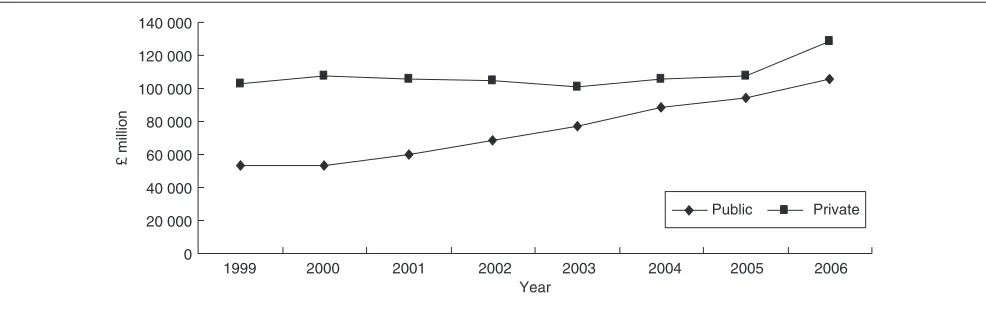
Figure 1 presents the analysis of the gross fixed capital formation at 2008 purchaser’s prices for the total economy under public and private sectors. The trap-like shape of the figure shows the rise in the government commitment in spending by narrowing the gap in capital formation by the private and public sectors. The increase in public and private investment, the pressure to attain a decent level of sustainability, the sizeable amount of renovation and maintenance work, and the relatively slow but steadily increase in the practice of new methods of construction have triggered higher demand for different levels of skills.
3.2. Government response/intervention to demand capacity issues
On the demand side, there has been a robust government strategy to intervene and aggregate public construction demand through framework agreements. The pattern of government investment, which has been increasing since year 2000 with a nominal increase on the supply side, calls for an intervention strategy to pool government requirements together for fewer and larger contracts. The method of pooling demand and supply
requirements together is known as aggregation. On the demand side is the coordination of project requirements and on the supply side is the consolidation of supply in response to the ways the demand is placed in the market. The OGC report on aggregation
states29that the decision to use aggregation should be made
during the development of organisational procurement strategies and during strategic planning stage prior to a programme or project. The OGC report advocates8a stronger lead from the centre and a professional approach to business planning, programme/ project management and procurement.
A demand aggregation decision involves three important steps according to the OGC report29
(a) Providing management information through trends analysis of purchasing trends.
(b) Providing information on the future common or similar requirements within or between organisations.
(c) Assessing the potentials in combining or collaborating within and between organisations.
When the combinations of requirements include diverse but related requirements it is referred to as bundling.
3.3 Dynamics in supply side of the industry
The supply side of the UK construction industry is fragmented both from the consulting and contracting point of view. Cox and Ireland suggest30there exist a range of supplier’s relationships ranging from a purely independent transactional, price-based interaction to highly interdependent relationships and then to a dependent sourcing arrangement. In consulting practice, different firms across different disciplines are represented by different professional bodies and these firms engage in different tasks and activities. For instance, the survey of UK construction
professionals undertaken in 2001/2002 shows31that there were
8882 architectural firms, 6309 civil and structural engineering firms, 1875 building services engineering firms, 1871 quantity
0 20 000 40 000 60 000 80 000 100 000 120 000 140 000
1999 2000 2001 2002 2003 2004 2005 2006 Year
£ million
[image:4.595.58.551.599.754.2]Public Private
surveyors firms, 1558 other surveyors firms, 722 firms for managers and 2293 other firms (including planners). Each of these disciplines has a range of specialisations resulting in a further fragmentation of the professional supply chain. In 2001/2002, the industry employed about 225 000 people with estimated income of about £12.3 billion in fee income.
The structure of the industry indicates a high level of collaboration as the number of firms under main trade (general builders, building and civil engineering contractors, non-residential building, housing and civil engineering) declined in number whereas specialist trades increased in number as shown in Figure 2. The number of main trades decline by 33% from 60 858 in 1999 to 45 706 in 2005 whereas the number of specialist trades surged by 39% from 104 703 in 1999 to 145 792 firms in 2007.
[image:5.595.41.413.423.554.2]The influence of specialist trades in UK construction industry has been immense as shown in Figure 3. The value of work done by both main and specialist trades increased due to the economic boom. The share of specialist trades rose by 46% in 1999 to 51% in 2005. The main trades have seen a £744 million average growth between 1999 and 2007 and specialist trades grew by average of £961 million between the same years.
Table 1 compares the percentage share of number of firms and their value of work done. This categorisation is based on the number of employees in accordance with the construction statistical data. From 1999 to 2007, the number of firms in the small-scale firms (SSFs) category decreased by 2.5% and the value
of work done in this category slumped by 15%. In the medium-scale firms (MSFs) category, the number of firms increased by 2.4% and the value of work done in this category increased by 5.8%. The large-scale firms (LSFs) category showed an increase in the number of firms by 0.20% and in value of work done by 9.3% between 1999 and 2007. There are two implications of this analysis: (a) the specialists are actively engaged; and (b) the specialist engagement is in the form of a collaborative
arrangement under subcontracting arrangements. This assertion is
supported by ConstructionSkills,9which emphasises that the
construction industry is seeing a growth in demand for specialist trades throughout the supply chain in both new build and in repair and refurbishment.
The upper part of Table 1 is the percentage share of the number of firms along three business classifications based on the number of employees in accordance with the categorisation in the
construction statistical data. The lower part consists of value of work done in each of the categories between 1999 and 2007.
It is evident from the demand and supply chain data that the construction market in the UK had capacity problems until the third quarter of 2008. On the demand side is the increasing capacity due to the surge in the workload across both private and public sectors. The supply chain data indicates the surge in the number of specialist firms due to the risk transfer mechanism by larger firms to the smaller firms. Morton and Jaggar argued in
favour of alternative strategy of direct employment32to promote
commitment and improve workers efficiency. Mackenzieet al.
emphasise7that the growth in labour-only subcontracting and
self-employment has led to a decline in training.
4. SKILLED AND UNSKILLED LABOUR The balance between the level of the required category of labour and the amount required to successfully execute the projects in a given year will show the trends in skills. This section brings together analysis from demand and supply sides of economy to analysis skill trends in the industry. This will be based on the unfilled demand on the demand side and lack of relevant skills in the market. In a nutshell, the skills shortages relate to a shortage of individuals with the required skills in the external labour market. This problem is unnecessarily compounded because of the skill gaps which indicate deficiencies in the skills of the current workforce and the sizeable number of craft-based occupations (plumber, electricians, etc.) which are for domestic and maintenance works.
Main trade Specialist trade
1999 2000 2001 2002 2003 2004 2005 2006 2007 Years
No
. of fir
ms
[image:5.595.41.415.604.743.2]160 000 140 000 120 000 100 000 80 000 60 000 40 000 20 000 0
Figure 2. Comparison of the value of work done by main and specialist trades in UK (1999–2005). Source:Construction Statistics Annual28
Main trade Specialist trade
1999 2000 2001 2002 2003 2004 2005 2006 2007 Years
£ millions
16 000 14 000 12 000 10 000 8000 6000 4000 2000 0
The construction statistical data reveal28the growth in construction specialist trades between 1999 and 2005. For instance, the number of scaffolding firms grew by 40%, installation of electrical wiring and fitting firms by 28%, joinery installation by 81%, and roofing firms have grown in number from 5636 to 7086 which represents a 26% increase. However, the number of painting firms has reduced from 8921 in 1999 to 7621 in 2005 and the plant hire firms were reduced by 27%. The underlying reason for this mixed signal the boom in the market which leads to an increase in the number of the firms and the shortages of required skill workers (crafts).
The ConstructionSkills report,The Blueprint for UK Construction
Skill 2006–2010forecasts33that 348 000 more employees will be needed for the construction industry by 2010 to meet
expected demand, amounting to an average of 87 000 new recruits per year. The requirement for skilled craft/trade specialist cuts across all trades. On the top of this predicted future average requirement of employees are those in wood trades 11 090, electricians 8130, plumbers 5330, bricklayers 4730, etc. On the administrative and managerial side there is an average requirement of 10 530 managers, 8610 clerical staff, 4790 engineering, information technology (IT) and other professionals and 3260 technical staff.
The CIOB survey 2006 on skills shortages34in the UK
construction industry reported on a significant skills shortages. The OGC construction demand/supply capacity report1attested to the fact that there are some skills gaps in certain trades and significant skills shortages in specific professional
disciplines; leadership, project management and specific aspect of design (e.g.
Q2 M&E
design). It supports the assertion above that management and craft levels are one of the areas in which skill shortages are pronounced. The influx of migrant workers has not filled the skill gap.34
The ConstructionSkills report33paints a grim picture of how site workers enter the industry through informal routes, learn on the job and have no formal qualifications. It is estimated that 500 000 workers do not have qualifications at Vocational Qualification Level 2 or equivalent. Ruiz35claims that there is no clear evidence
of whether skills shortages in construction and metal trades may be long term and linked to the structural change in the economy, or short term and linked to the economic business cycle.
[image:6.595.181.552.539.744.2]Figure 4 presents a measure of the notional trend of costs to contractors by comparing the changes in the cost of labour, materials and plant by application of the Price Adjustment Formulae for Building and Specialist Engineering Works for housing and non-housing. The notional trends for the costs of labour and plant for housing and non-housing have the same incremental costs with over 48% growth 1999 to 2005. In the same period of time the material cost increased just by 23 and 18% in non-housing and housing sectors, respectively. There was a growth in manpower of over 26% in the same period. The implication is that supply did not meet the demand in both labour and plant which resulted in extra costs to contractors.
Figure 5 presents the yearly percentage difference of investment and the number of the manpower. The lack of investment in
Categories No. of employees
1999 2000 2001 2002 2003 2004 2005 2006 2007
Number of firms
SSFsn 1–13 95.7% 96.0% 94.6% 93.6% 93.3% 93.3% 93.3% 93.2% 93.2%
MSFsn 14–79 3.7% 3.5% 4.8% 5.7% 6.0% 6.0% 6.0% 6.1% 6.1%
LSFsn 80–1200+ 0.5% 0.5% 0.6% 0.7% 0.7% 0.7% 0.7% 0.7% 0.7%
Total 100.0% 100.0% 100.0% 100.0% 100.0% 100.0% 100.0% 100.0% 100.0%
Value of work done
SSFsv 1–13 34.4% 36.4% 33.0% 20.0% 24.0% 20.0% 20.8% 19.9% 19.4%
MSFsi 14–79 22.4% 23.9% 23.8% 28.4% 25.7% 27.0% 26.4% 26.4% 28.1%
LSFsv 80–1200+ 43.2% 39.7% 43.2% 51.7% 50.6% 53.2% 52.9% 53.7% 52.5%
Total 100.0% 100.0% 100.0% 100.1% 100.3% 100.2% 100.0% 100.0% 100.0%
Table 1. Percentage share of number of firm (n) and value of work done along business classification. Source:Construction Statistics Annual28
95 115 135 155 175 195 215
1999 2000 2001 2002 2003 2004 2005 2006 2007
Resource cost index
Years
Non-housing L&P Non-housing M Housing L&P Housing M
Housing L&P
Non-housing L&P
Non-housing M Housing M
construction skills during the recession in the late 1980s and early 1990s is reversed. This is due in part to a number of initiatives introduced by the ConstructionSkills and the influx of foreign workers which contributed to an increase to the workforce in general. The amount of investment grew in 2003 and the number of manpower deepened due in part to the return of some foreign workers. The yearly difference of the amount of
investment and number of manpower substantially increased in 2004 and 2006 when compared with 2003 and 2005, respectively.
5. CASE STUDY 5.1. Introduction
The case company undertakes general contracting work for the public and private sectors, together with its own property development work. The company became an investor in people in December 2001 and won a CSCS gold certificate in 2008. All the company’s sites are registered under the Considerate Construction Scheme and follow the scheme’s eight-point codes under the three code areas: the environment, the workplace and the general public. The company focuses on the general skill development and improvement of the all employees at different levels in the business, in terms of investment and quality.
5.2. Strategic capacity planning
The company prefers to follows its strategic plans rather than opportunistic jobs. The company has a 5-year short-term plan and
a 15-year long-term plan. Even during the boom period, the company avoids the temptation to become involved in many opportunistic jobs. The underlying philosophy is strategic capacity planning which is focused on manageable growth and workforce retention which is about 90%. ‘Partnered or repeated clients’ work makes up approximately 50% of turnover and the company has seen significant levels of organic growth over the past 5 years from £8.4 million in 2002 to £31 million in 2007.
Their strategic plan is to increase their turnover to around £41 million and £44 million in 2008 and 2009, respectively, with prospective monthly turnover of £3.67 million. The company’s ethos is to have a realistic strategic plan that will enable it to have a higher retention rate among its workforce and long-term training and improvement. The company focuses on client satisfaction, organic growth, business success, repeat client and investment in people. The nature of their procurement activities follows tendered, negotiation and partnering. The company belongs to three frameworks already and sees partnering and collaboration working arrangements as the future trend in the company.
5.3. The nature of training
The company training arrangement over a 5-year period can be categorised into three as shown in Figure 6: further education courses and NVQs; health and safety and technical issues; and management, general, IT and continuing professional
Investment All manpower
2000 2001 2002 2003 2004 2005 2006 Year
Increment %
[image:7.595.48.540.46.175.2]18 16 14 12 10 8 6 4 2 0 –2
Figure 5. The yearly percentage difference in the amount of investment and number of manpower from 1999 to 2006. Source:Construction Statistics Annual28
288 644
285 280
270
121
214
324
100
104
384
106
164
228
112
309
0 200 400 600 800 1000 1200
No. of days
0 2 4 6 8 10 12
No. of days
2002 2003 2004 2005 2006 2007 Year
2002 2003 2004 2005 2006 2007 Year
Overall training days 2002–2007 Average training days/employee
Further education courses & NVQs Health & safety, and technical Management, general, IT & CPD
Average training days/employee
11.4 8.9
6.3
5.3 5.9 6.1
74 114
[image:7.595.44.541.567.755.2]development. A high retention rate among their workers, a rigorous employment policy and a buoyant construction market resulted in lower average training days per employee, dropping from 11.4 days/employee in 2002 to 5.3 days in 2004 and a slight rise to 6.1 days in 2007.
The nature of the training covers sustainable issues, health and safety, contractual issues, skill training, and business
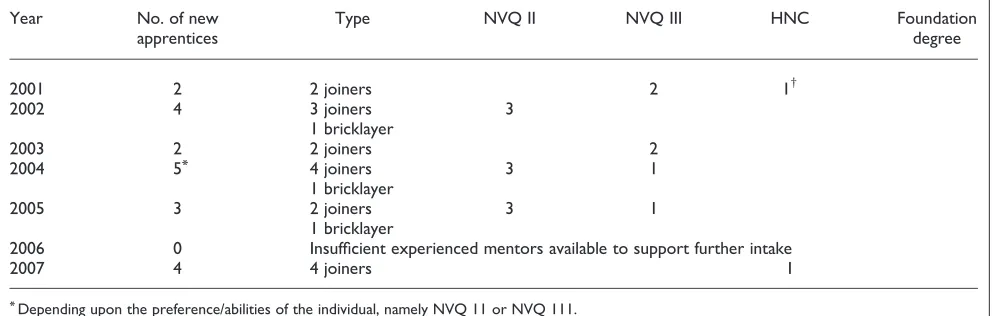
development and improvement. Table 2 also indicates that all the employees both in construction and administration are eligible for the training activities. In recent time, supply-chain subcontractors are also now being included in training provision. 14% of the site-based workforce are apprentices (company target = 10%) and the company has developed a reputation for the quality of its apprentice training and support. The company’s ethos is very much ‘train to retain’. In addition the company apprentice training provides for a 4-year training period including one or two years spent as ‘improvers’ to help newly-qualified apprentices in order to improve quality and productivity in a supportive environment.
Support provided to all apprentices includes
(a) thorough induction and health and safety training (b) provision of tools
(c) assistance with transport
(d) nominated ‘mentor’ to help with learning and development
(e) regular meetings and reviews
(f) study leave, if necessary to help revise and pass exams (g) inclusion in other training initiatives being offered to the
workforce, e.g. operator training (where appropriate) (h) inclusion in employee ‘away days’ and discussion groups (j) in some case, assistance with financial difficulties (k) general support.
The company operates 4-year training schemes in site joinery, bench joinery and bricklaying. The first 2 or 3 y
Q3 ears* is spent
undertaking day-release courses. In the third and fourth years, as appropriate, the apprentices are viewed as ‘improvers’ in order to assist them to hone their skills, gain more experience and improve their productivity in a supportive environment. To date, the company has achieved a 90% retention rate following completion of the scheme and two joiners are now studying further education courses with a view to progressing to trainee site managers in the future.
The company is not only receiving training but also disseminates its competence in building in skills to other companies. The human resources (HR) director is regularly invited by
ConstructionSkills to present at training sessions for other small and medium construction companies with regard to topics such as: the benefits of implementing the Investors in People Standard and designing and introducing performance review systems. In addition, the HR director actively participates in the Best Practice Club. This assists the company to keep abreast with the
opportunity for funding.
The document provided by the company shows that in 2008, over 250 days of training have taken place. This precludes some training under the ConstructionSkills Training Plan route to funding for internal training, for example, inductions and tool box talks, etc. This figure also excludes training days related to day-release for employees who attend college on a day-release basis (seven people in total), or those who attend courses in the evenings.
5.4. Selection of training and the trainees
Training is chosen on the basis of the following factors.
(a) Individual training needs (assessed upon commencement and at the annual performance review). This is achieved through performance reviews which are undertaken annually, usually in the spring. At the reviews, training is discussed with individuals. Department heads are responsible for providing to the HR director a list of all training identified with individuals at review time for incorporation into the company training planning process.
(b) Ongoing requirements, for example, for health and safety purposes, renewal upon expiry of certificates. Training is assessed at the time of induction for new starters. As a matter of urgency regarding health and safety training and then for integration into the training planning process.
(c) Changes in legislation, client requirements, etc.
(d) The needs of the business/business improvement activities;
for example, new software. The company’s annual training plan is drawn up in July/August for submission to ConstructionSkills for purposes of Grant B funding. The company has been using this route to training for some years as they are now able to claim funding for a full range of management, administration and IT training across all
Year No. of new
apprentices
Type NVQ II NVQ III HNC Foundation
degree
2001 2 2 joiners 2 1†
2002 4 3 joiners 3
1 bricklayer
2003 2 2 joiners 2
2004 5* 4 joiners 3 1
1 bricklayer
2005 3 2 joiners 3 1
1 bricklayer
2006 0 Insufficient experienced mentors available to support further intake
2007 4 4 joiners 1
*Depending upon the preference/abilities of the individual, namely NVQ 11 or NVQ 111.
†
[image:8.595.58.554.44.202.2]Currently now embarking upon a trainee site manager role.
Table 2. The summary of apprenticeship scheme fr
employee groups. Training is also chosen based on any business improvement targets or aims. The company embarked upon a series of customer care training days for all their key suppliers, their employees and clients.
5.5. Types of training
5.5.1. Construction skill certification scheme (CSCS). This scheme shows the proof of the level of competence in a company by raising the standard of health and safety, providing a high-quality workforce with a recognised skills, competences and qualifications. The company ensures that all the relevant employees (i.e. excluding accounts, personnel and administration staff) are in possession of a CSCS card, or are currently working towards achievement of an NVQ qualification in order to qualify for one. In this case, the company was awarded the Gold Certificate of Achievement by CSCS in January 2008 to recognise 89% of employees are certified. The employees are motivated for this scheme because of recognition of skills, competences and qualifications. It also helps the employer in job commissioning as evidence of promotion of greater health and safety, personnel training awareness and confidence by clients.
5.5.2. Investor in People – Team Building and Business Improvement Training Days. The investors in people (IiP) standard was instituted in 1990 to help firms adopt best practice in integrating training and human resource development with business performance objectives. Since 2001 the case company has been holding team-building and business improvement days for office and construction staff. The focus was to improve both their soft and technical skills in the area of IT, business and financial management, and customer relations.
5.5.3. Considerate constructors scheme (CCS). This scheme outlaws unsafe and untidy construction sites and improves the image of the industry by improving the standard of site management and the behaviour of site operatives. All the company’s site follows CCS guidelines and abides by the CCS special codes. The training on how to show respect for people who live and work near sites is delivered through many different routes. For example, during the designing and managing of work process, Business Improvement Days which are held twice a year, supply chain conference, etc.
5.5.4. Supply chain conference. This conference was organised by the company and attended by representatives from 30 subcontracting firms. The conference was aimed at the following activities.
(a) Sharing best practice skills through indirect training of all the subcontracting firms.
(b) Promoting the image of the company in order to retain all the members of the chain due to stiff competition in the market.
(c) Presenting an elaborate future strategic plan to the supply chain members.
(d) Discussing the business standards as well as raise the awareness about recent developments both in policy and practices in the industry.
For instance, the company’s key performance indicators were presented. The issues of the Pre-Qualification Requirements for the subcontractors were discussed. A lecture about soft issues in the industry was given, for example, on the importance of CSCS
card, the construction skills of the subcontractor’s staff and making sure that all their workers pass the Criminal Records Bureau checks. The company also called for conduct and appearance improvement, which will impress their clients with regards to their professionalism. Regarding the quality control issues a group discussion about the procedure and checkpoint in quality control was arranged. The company agreed to provide each subcontractor with quality control specification afterwards. The conference also discussed safety and sustainability issues.
5.5.5. Other schemes to help young people. The company is involved in the Future Build Scheme, which is an initiative to assist unemployed youngsters enter the building industry. A good example is Youth Works and Positive Futures – this scheme helps under-achieving youngsters gain work experience and
employment with local businesses. One place has been offered this year. This youngster has been attending college in the evenings. The company helped him with transport and provision of tools and he remains employed with them.
5.5.6. Curriculum enhancement. The company has worked with schools as part of the curriculum enhancement scheme run by the Construction Industry Training Board (CITB). This scheme is aimed at encouraging more youngsters to take up construction as a career and educate them as to the wide variety of jobs available in the industry.
5.5.7. Work experience. The company provided at least three work placements per annum, both to schools in the local area and also for unemployed people who need to gain site experience. Figure 7 presents skill competency building by the contracting firm. The competency building is focused on the internal workforce and external supply chain members, with their integral internal and external funding mechanisms and types of training they offered. The overarching aim is to train/educate both the internal and external (supply chain) through knowledge sharing and learning in order to fill the skills gaps or create a new workforce. Some types of training by internal workforce and external supply chain member are highlighted in the figure, such as CSCS, OSAT, technical and soft skills, etc. These activities are carried out with internal and external funding mechanisms.
5.6 Benefits and achievements from investment in training to the company
The company believes that there are inextricable links between the level of investment in training and the fortunes of the company in terms of turnover and profitability. The turnover and profit rose from £10 million in 2002 to £32 m in 2007. In the same vein, the profit rose from £102 000 in 2002 to over £1 million in 2007. This link is supported from the human capital perspective where training is seen as an investment that increases worker productivity. A number of merits have been derived by the case company in training its workforce: less job mobility, higher productivity, improvement in key performance indicators (KPIs), increase in organisational commitment by the workforce and high retention rate.
place since 2000 to assist the business to adopt up-to-date business processes. All office staff as well as site managers and site supervisors are fully trained in appropriate IT systems and equipped with lap-tops for site administration and quality purposes.
5.6.2. Partnering. The company document revealed that as soon as it was short-listed for its first ‘partnered’ project in 2001 the company invested in partnering training for the director responsible. The company has taken part in two long-term partnering frameworks and undertaken many other single-project partnering schemes, in the public sector, namely
(a) 37 projects in total
(b) 58% of turnover (in the past 3 years).
5.6.3. Communication, education and teamwork. Two Business Improvement Days are held annually, for site and joiner’s shop employees and for staff. These are designed to:
(a) involve employees in formulating the business objectives for the year
(b) bring employees up-to-date on industry initiatives (c) review KPIs
(d) promote teamwork
(e) review CCS performance
(f) identify business improvements
(g) solve problems
(h) transfer knowledge/understanding via departmental and project team presentations.
5.6.4 Bi-annual business plan updates. This is held in March and August for all staff, reporting on all the above and achievements against company and departmental targets. As a result of the company’s improved concentration on communication,
teambuilding and training it has been short-listed for the ‘Best Places to Work in Construction in 2007 and 2008’.
6. CONCLUSIONS
Long-term workforce retention and continuous training through realistic strategic planning should be of the primary importance for all the companies. This will allow a long-term industry training plan that promotes the training of staff during different economic periods and eliminates cyclical market effects to reaching crisis levels. The case company has successfully been involved in a series of projects under government training initiatives and specific training driven by company’s needs.
The case company has shown the importance placed on young people, which enabled the company to recruit young people under different schemes from the project locality. The young are encouraged to remain in the industry by offering several types of assistance and clear career progression as demonstrated by the case company. Therefore efforts should not be relented in retaining and training the workforce and improving the industry’s image. This will place the industry in a position to respond to a sudden upturn in the market.
The contractors should be aware of construction skills grants and funds for training. The CITB-ConstructionSkills grants are available to support a wide variety of training within the industry, covering key initiatives such as qualifying existing workers, improving health and safety, and training new recruits. The contracting firms should also organise a forum where such information can be passed onto the subcontractors. This was effectively demonstrated by the case company by organizing a supply chain conference.
An effective training plan is important because of the diversity of construction training requirements, management of the workforce and for subcontractors in obtaining funding. Funding has been one of the major obstacles in training especially for SMEs. SMEs need a training and development plan to be prepared and submitted on time. Firms can claim grants for training in many disciplines that benefit their business – this is not limited only to construction-based programmes but also includes computer skills, accountancy and administration as demonstrated by the case company.
REFERENCES
1. OFFICE OFGOVERNMENTCOMMERCE.2005–2015 Construction Demand/capacity Study, Full Report. Deloitte, Office of
[image:10.595.57.424.43.314.2]Government Commerce, 2006. Q4
2. CONSTRUCTIONINDUSTRYTRAININGBOARD.Technological Change and Construction Skills in the 1990s. Construction
Industry, Training Board, Bircham Newton, 1999, Research document.
3. DRUCKERJ. and WHITEG.Managing People in Construction. Institute of Personnel and Development, London, 1996, pp. 107–111.
4. THOMASJ. C. Direct action.Building, 1999, 3 M
Q5 ay, 36–38.
5. GRUNEBERGS. L.Construction Economics – An Introduction. Macmillan, London, 1997.
6. BLYTHA. Hard labor – the drive for new blood http:// www.rics.org/Knowledgezone/Journalsandmagazines/ RICSBusiness/lab_020207.html. Accessed: January 2008. 7. MACKENZIES., KILPATRICKA. R. and AKINTOYEA. UK
construction skills shortage response strategies and an
analysis of industry perceptions.Construction Management
and Economics, 20
Q6 00,18, 853–862.
8. OFFICE OFGOVERNMENTCOMMERCE.Increasing Competition and Improving Long-term Capacity Planning in the Government Market Place (Kelly report).Office of Government
Commerce, 20
Q4 03.
9. CONSTRUCTIONSKILLS. Sector skill agreement, http:// www.constructionskills.net/sectorskillsagreement/. Accessed: October 2008.
10. HUEMANNM., KEEGANA. and TURNERJ. R. Human resource
management in the project-oriented company: a review. International Journal of Project Management, 20
Q6 07,25,
315–323.
11. GANND. and SENKERP. Construction skills training for the
next millennium.Construction Management and Economics,
19
Q6 98,16, 569–580.
12. AGAPIOUA. A review of recent development in construction
operative training in the UK.Construction Management and
Economics, 19
Q6 98,16, 511–520.
13. STEVENSM. Human capital theory and UK locational
training policy.Oxford Review of Economic Policy, 1999,
15, No. 1, 16–32.
14. GRUGULISI. The contribution of national vocational qualifications to the growth of skills in the UK.British Journal of Industrial Relations, 2003,41, No. 3, 457–475. 15. GOSPELH. The decline of apprenticeship training in Britain.
Industrial Relation Journal, 1995,26, No. 1, 32–44. 16. SIEBENI. Does training trigger turnover – or not? The
impact of formal training on graduates’ job search behaviour.Work, Employment & Society, 2007,21, No. 3, 397–416.
17. CLARKEL. and WALLC. UK construction skills in the context
of European development.Construction Management and
Economics, 19
Q6 98,16, 553–567.
18. GOSPELH. The modern apprenticeship: new wine in old
bottles?Human Resources Management Journal,1998,8,
No. 1, 5–22.
19. EDUM-FOTWEF. and MCCAFFERR. Developing project management competency: perspective from the construction industry.International Journal of Project Management, 2000,18, No. 2,111–124.
20. CRAWFORDL., MORISP., THOMASJ. and WINTERM. Practitioner development: From trained technicians to reflective practitioners.International Journal of Project
Management, 2006,24, 722–733. Q6
21. WINCHG. The growth of self-employment in British
construction.Construction Management and Economics,
1998,16, 531–542.
22. PANTI. and BAROUDIB. Project management education: The
human skills imperative.International Journal of Project
Management, 2008,26, 124–128. Q6
23. MUZIOE., FISHERD. J., THOMASE. R. and PETERSV. Soft skills quantification (SSQ) for project manager
competencies.Project Management Journal, 2007,38, No. 2,
30–38.
24. MELIKR. The rise of the project workforce.Project Management Journal, 2007,38, No. 4, 70.
25. ABDEL-WAHABM. S., DAINTYA. R. J., ISONS. G., BOWENP. and HAZLEHURSTG. Trends of skills and productivity in the
UK construction industry.Engineering, Construction and
Architectural Management, 2008,15No. 4, 372–382.
26. PHENGL. S. and CHUANQ. T. Environmental factors and
work performance of project managers in the construction
industry.International Journal of Project Management,
2006,24, 24–37. Q6
27. LOBOY. B. and WILKINSONS. N. New approaches to solving
the skills shortages in the New Zealand construction
industry.Engineering, Construction and Architectural
Management,2008,15, No. 1, 42–53.
28. OFFICE FORNATIONALSTATISTICS.Construction Statistics
Annual. Palgrave Macmillan, 2008. Q4
29. OFFICE OFGOVERNMENTCOMMERCE. Is bigger always better –
aggregation. Office of Government Commerce, 2001. Q4
30. COXA. and IRELANDP. Managing construction supply
chains: the common sense approach.Engineering
Construction and Architectural Management, 2002,9, Nos. 5/6, 409–418.
31. DEPARTMENT OFTRADE ANDINDUSTRY.The Construction Statistics Annual 2006 Edition. TSO Publishing.
32. MORTONR. and JAGGERD.Design and the Economics of
Building. E & FN Spon, London, 1995.
33. CONSTRUCTONSKILLSREPORT.The Blueprint for UK Construction Skill 2006–2010. ConstructionSkills, 2006. 34. CHARTEREDINSTITUTE OFBUILDING.Skills Shortages in the UK
Construction Industry. CIOB, 2006.
35. RUIZY.Skills Shortages in Skilled Construction and Metal
Trade Occupations, Labor Market Trends. National Statistics Feature, 2004.
What do you think?
To comment on this paper, please email up to 500 words to the editor at [email protected]