International Journal of Emerging Technology and Advanced Engineering
Website: www.ijetae.com (ISSN 2250-2459, ISO 9001:2008 Certified Journal, Volume 3, Issue 5, May 2013)
76
Improvement of Input Power Factor and Reduction in Harmonic
Content of a Single Phase AC-DC Converter Via sPWM
Technique
Dr. S.K.Gupta
1, Rachit Goyal
2, Ashutosh Tripathi
3, Akash Deep
4, Arvind Garg
51Chairman Electrical Engineering Department, DCR University of Science & Technology, Murthal, Sonepat 2,3,4,5
UG scholar Department of Electrical Engineering, DCR University of Science & Technolgy, Murthal, Sonepat, Haryana
Abstract— Electrical machines utilise power electronic
devices to start, stop and run the machines smoothly and efficiently. The harmonics produced, distort the source current to be a non- sinusoidal current. Input power factor also suffers due to low displacement factor. The classical control of switching devices results into a poor power factor. The harmonic content of the input current is very high and thus there is a requirement of a large filter. Sinusoidal PWM control attempts to correct all the above shortcomings of an AC/DC converter. In this paper, an improvement in the input power factor and the total harmonic distortion is demonstrated by comparing conventional two pulse converter with a Sinusoidal PWM converter with appropriate switching scheme. The analysis is done using MATLAB SIMULATIONS and different conclusions are drawn.
Keywords-Sinusoidal PWM technique, AC-DC conversion, Input power factor improvement, THD improvement.
I. INTRODUCTION
It is known that the power control of a DC load fed by the grid is achieved by the use of an AC-DC converter structure operating through a sPWM technique [1]. The sPWM operation is performed by comparison of a sinusoidal voltage waveform in phase to the source voltage with a high frequency triangular waveform in order to obtain a switching pulse waveform.. It is observed that pulse of the maximum width is located exact at the middle of the half period, while the pulse of the minimum width appears at the beginning of the waveform [1].
In the conventional firing scheme used for single phase full bridge converter the source current contains higher order harmonics and also a low power factor is exhibited [3].
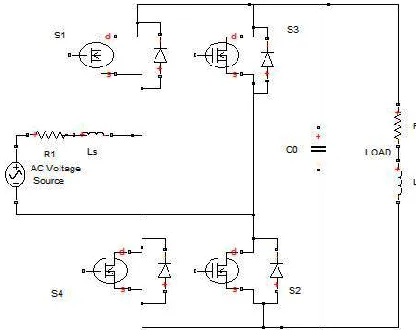
[image:1.612.339.547.370.535.2]Figure1 shows the basic circuit configuration for an AC-DC bridge converter. Now these switches can be fired by different switching schemes. First the switches will be fired by the conventional firing and later by the sPWM switching scheme and a comparison of input power factor and THD is done.
International Journal of Emerging Technology and Advanced Engineering
Website: www.ijetae.com (ISSN 2250-2459, ISO 9001:2008 Certified Journal, Volume 3, Issue 5, May 2013)
77
[image:2.612.63.286.138.393.2]II. FIRING SCHEME
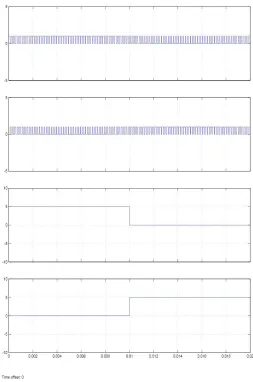
Figure 2 Gate pulses for (S1, S2) and (S3, S4) respectively for conventional converter.
Figure1 shows four switches connected to form a bridge rectifier. The bridge is connected to a RL load with a capacitor filter at load end.
Figure 2 shows the conventional firing scheme for the switches. For 0-π, switch S1 and S2 are fired and for π-2π switch S3 and S4 are fired.
Figure 3 shows the sPWM firing scheme that can be used to obtain a very good input power factor in AC-DC conversion. The upper switches are controlled by the PWM generated pulses and lower half is controlled by the pulse generator. The PWM pulses can be generated by comparing a rectified sine wave with a high frequency triangular wave. The gate pulses are given according to the following scheme [4]:
1.0-π: Switch S-4 is closed and S-2 is open while in the upper half of the bridge switches S-1 and S-3 are switching complementary with sPWM pulses.
2.π-2π: Switch S-2 is closed and S-4 is open while in the upper half of the bridge switches S-1 and S-3 are switching complementary with sPWM pulses.
[image:2.612.330.583.200.582.2]On the input side the source inductance is being modelled by an inductor of value 0.5 mH [2] and on the output side a capacitor of value 400 µF is used to regulate the DC output.
Figure 3 Gate pulses for S1, S3, S2, and S4 respectively for sPWM converter
III. INVESTIGATING POWER FACTOR AND THD USING
SIMULINK/MATLAB
International Journal of Emerging Technology and Advanced Engineering
Website: www.ijetae.com (ISSN 2250-2459, ISO 9001:2008 Certified Journal, Volume 3, Issue 5, May 2013)
78
The circuit in figure 2 is modelled in the MATLAB for conventional firing and sPWM firing. The results are compared for different loads and for different firing angles.
Different firing angles used were 0, 30, 45, 60 and 90 degrees. The analysis was done using the FFT analysis available in MATLAB.
Harmonic distortion is given by: [2]
THD=√∑ (i)
Where Ik representsthe magnitude of the k th
harmonic component and I1 represents the magnitude of the
fundamental component.
Input Power factor is given by: [2]
Pf=
√
⁄
*
) (ii)
Where
is called the Displacement Factor (DF) where (α1) is the angle between the fundamental
components of the input current and the input voltage.
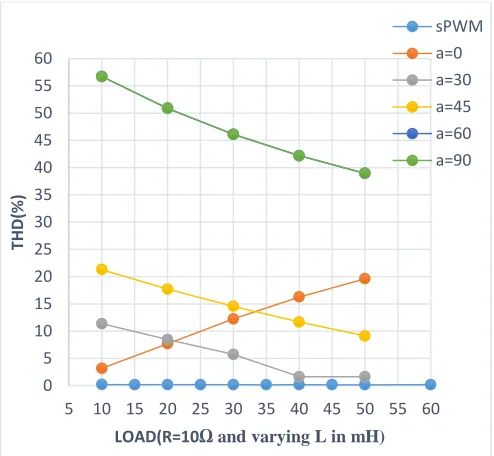
Various loads have been taken and THD and input power factors were calculated for different firing angles in case of conventional converter and for sPWM firing technique the results have been calculated using the FFT analysis using the above formula. The frequency of switching in PWM scheme has been taken as 5 kHz (50 pulses per half a cycle) and the graphical representation is done in figure 5 and figure 6. The graphs are plotted for fixed value of resistance and varying inductive loads. The fix value of resistance is taken to be 10Ω and the different values of inductive load are plotted on X axis. While for the conventional firing the power factor can be reached up to a maximum of .95 and that too for the case of a (firing angle) =0, for the sPWM scheme the power factor remains majorly equal to 1.
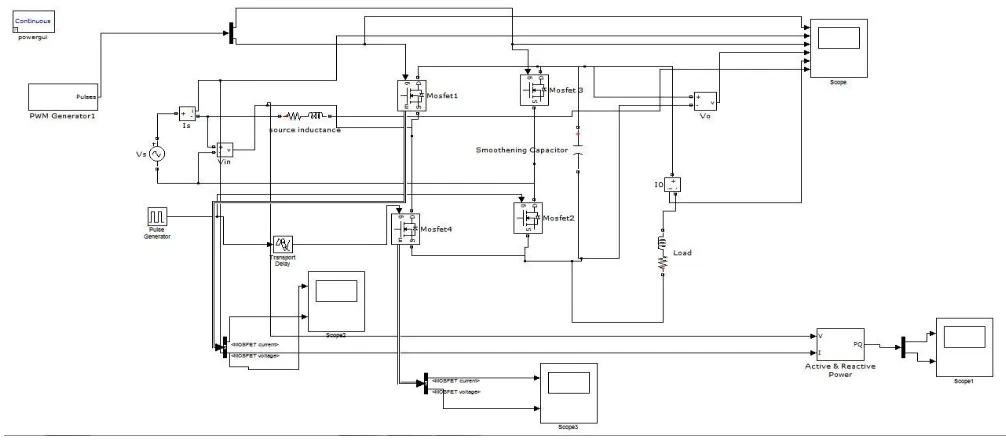
[image:3.612.61.564.393.617.2]The THD analysis is also studied for fixed resistance and varying inductive load. The harmonic distortion is going very high, it’s only for the PWM technique that the THD is almost equal to zero. Figure 4 shows the MATLAB model for the study of sPWM technique.
Figure 4 MATLAB MODEL
When the bridge circuit is controlled by the conventional firing scheme the power factor can’t be achieved equal to 1. Even if the simple diode bridge is used for rectification of AC voltage and a proper filter is used the best THD and power factor achieved is 5.591 % and .931 respectively [6].
But as is clear from the figure 5 and 6 obtained by the readings taken from the MATLAB simulations the THD obtained for sPWM firing scheme is almost 0 and the power factor obtained is found to be unity.
International Journal of Emerging Technology and Advanced Engineering
Website: www.ijetae.com (ISSN 2250-2459, ISO 9001:2008 Certified Journal, Volume 3, Issue 5, May 2013)
79
For different cases as the input power factor is falling the Reactive Power intake is increasing which is uneconomical for the supply system [5]. In the sPWM technique where the input power factor is unity the Reactive Power intake is minimum.
Table 2 shows the observation taken in the MATLAB simulations for the sPWM technique for different loads. The THD can be seen to have an improved value as compared to the conventional case. The input power factor is seen to be unity for all the loads considered.
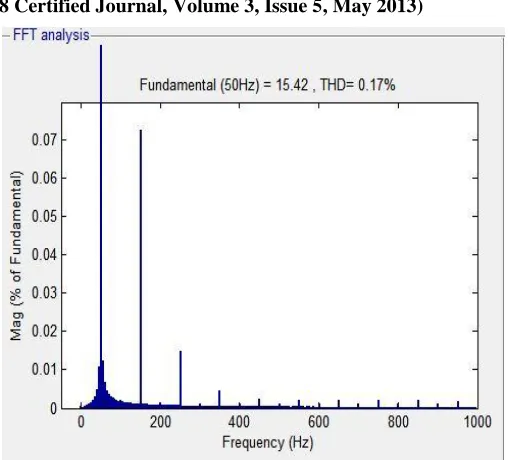
Figure 7 and Figure 8 shows the amplitude of different frequency components of the input source current for a load of resistance of 10 Ω and an inductance of 30 mH for conventional firing and sPWM firing. It can be clearly seen that the different frequency components of source current for conventional firing results in a net distortion of 42.18% whereas it’s only equal to 0.17 % in the case of the used firing scheme. Also the magnitude of the fundamental component for conventional firing was only 5.413 amperes whereas it was 15.42 amperes in the case of the used firing scheme. The FFT analysis of all the loads was calculated similarly and was found to be larger than the sPWM firing scheme.
[image:4.612.324.563.134.360.2]Once the THD is calculated and the FFT analysis done, the input power factor can be calculated using (ii) and it can be compared in the similar manner and the results represented graphically in figure 6.
[image:4.612.317.568.251.643.2]Figure 5 Graph showing variation of THD for various loads computed in case of conventional and sPWM converter
Figure 6 Graph showing variation of input power factor with different loads computed for conventional and sPWM converter
TABLE I
COMPARISON BETWEEN P, Q, THD, POWER FACTOR FOR VARIOUS FIRING CONFIGURATIONS
Configu ration Active Power(W) Reactive Power(VAR S) THD( %) PF
a=0 1501 322.95 12.24 .96
a=30 1382 540 5.73 .93
a=45 1254 624 14.55 .88
a=60 1074 686 23.8 .82
sPWM 2398 18.15 0.17 1
0 5 10 15 20 25 30 35 40 45 50 55 60
5 10 15 20 25 30 35 40 45 50 55 60
TH
D
(%
)
LOAD(R=10Ω and varying L in mH)
sPWM a=0 a=30 a=45 a=60 a=90 0.5 0.55 0.6 0.65 0.7 0.75 0.8 0.85 0.9 0.95 1 1.05
10 15 20 25 30 35 40 45 50 55 60
PO WE R F A C TOR
LOAD(R=10Ω and varying L in mH)
sPWM a=0 a=30
[image:4.612.48.295.451.679.2]International Journal of Emerging Technology and Advanced Engineering
Website: www.ijetae.com (ISSN 2250-2459, ISO 9001:2008 Certified Journal, Volume 3, Issue 5, May 2013)
[image:5.612.323.577.122.352.2]80
TABLE IISIMULATION RESULTS FOR sPWM CONTROL SCHEME
Load
Active Power(W)
Reactive Power(Vars)
THD( %)
PF
10,10 2398 18 .19 1
10,15 2397 18.16 .17 1
10,20 2397 18.1 .17 1
10,25 2397 18.15 .17 1
10,30 2398 18.15 .16 1
10,35 2397 18.1 .17 1
10,40 2397 18.1 .16 1
10,45 2398 18.1 .16 1
10,50 2397 18.08 .16 1
[image:5.612.45.294.158.612.2]10,60 2398 18.07 .17 1
Figure 7 FREQUENCY SPECTRUM OF TWO PULSE CONVERTER
Figure 8 FREQUENCY SPECTRUM OF sPWM CONVERTER
IV. CONCLUSIONS
From the analysis done using the MATLAB simulations some conclusions are reached.
It's clear from the graphs (figure 5, figure 6) that the Total Harmonic Distortion and the input power factor is much better in the sPWM firing than in the conventional firing scheme. The highest power factor for conventional controller is obtained for zero firing angle but if we wish to change/control the output voltage and also want good power factor then we have to go for sPWM firing as it does not change the displacement angle for changing the output voltage but changes the modulating index [2]. The second factor that controls the power factor is the harmonic content. In the sPWM circuit the source inductance is enough for the removal of harmonic distortion for small loads but as the load will increase we will require a filter to remove these harmonics but the size of that filter will be comparatively smaller.
REFERENCES
[1 ] K. Georgakas and A. Safacas, July 27-29, 2007. Power Factor Improvement of an AC-DC Converter via Appropriate sPWM Technique Mediterranean Conference on Automation, Athens-Greece.
International Journal of Emerging Technology and Advanced Engineering
Website: www.ijetae.com (ISSN 2250-2459, ISO 9001:2008 Certified Journal, Volume 3, Issue 5, May 2013)
81
[3 ] Ali I. Maswood and M. H. Rashid, 1991. Input current harmonicreduction in high power ac/dc rectifiers. Industrial Electronics, Control and Instrumentation, Proceedings. IECON '91.
[4 ] http://nptel.iitm.ac.in/video.php?subjectId=108101038.
[5 ] IEEE SM 519-1992 IEEE Recommended Practices and Requirements for Harmonic Control in Electrical Power Systems. [6 ] Rohit Gupta,Ruchika,JUNE 2012“ A Study of AC/DC Converter