International Journal of Emerging Technology and Advanced Engineering
Website: www.ijetae.com (ISSN 2250-2459, Volume 2, Issue 4, April 2012)146
A Digital Watermarking Based on Integer Wavelet Packet
Transform and Feed Forward RBFN Network
Ruchi Kshatri
Department of Information Technology, RGPV University, M.P., INDIA
Abstract—A new digital watermarking algorithm for color
images based on Integer Wavelet Packet Transform and Feed Forward RBF (Radial Basis Function) Neural Network was proposed in this paper. Currently, there are some shortcomings such as weak resistance on the intentional attacks of geometric distortion and noise in some digital watermarking algorithm. Now we are introducing an approach using IWPT, as it yields a representation which is lossless, as it maps an valued sequence onto integer-valued coefficients in the transformed domain. . Finally, the RBF (Radial Basis Function) neural network is used for memorizing the original image and watermark and then the trained neural network is used to extract the watermarked image. A scheme for detect and recovering intentional attacks is applied before watermark detection. Experimental results show that proposed algorithm increases robustness of watermarked images under attacks like cropping, shearing, noise etc. as compared to DWT.
Keywords- digital watermarking, IWPT, RBF neural network, PSNR, NC
I. INTRODUCTION
A. Overview of Digital Watermarking
[image:1.612.50.268.627.695.2]Digital watermarking is an important branch of the information hiding technology. In recent years as digital information is circulating through the world by means of the rapid and extensive growth in internet technology, therefore there is a need to develop newer techniques to protect copyright, ownership and content integrity of digital media. Digital Watermarking technology allow users to embed digital information into audio, images, video and printed materials in a way that is persistent, imperceptible and easily detected by computers and digital devices, shown in fig.(1).
Figure 1. Digital Watermarking
Digital watermarking is a promising solution for copyright protection, it promises extra robustness n embedded information. The embedded information is called watermarks. We have used a digital watermark which is transparent, invisible information pattern that is inserted into a suitable component of the data source (image) by using a specific computer algorithm.
B. Properties of Digital Watermarking
Imperceptibility-the watermark should be invisible not to degrade data quality and to prevent an attacker from finding and deleting it.
Readily detectable-the data owner or an independent control authority should easily detect the watermark. Unambiguous-retrieval of it should unambiguously and unequivocally identify the owner of the data with a high degree of confidence.
Robust-difficult to remove without producing a remarkable degradation in data fidelity.
Security-unauthorized parties should not be able to read or alter the watermarking.
A. Watermarking Technique Used
International Journal of Emerging Technology and Advanced Engineering
Website: www.ijetae.com (ISSN 2250-2459, Volume 2, Issue 4, April 2012)147
We have used IWPT (Integer Wavelet Packet Transformation) which yields a representation which can be lossless, as it maps an integer valued sequence onto integer valued coefficients. Due to the property of integer-to-integer transformation, it has recently being used for image watermarking applications [8–11].
B. IWPT (Integer Wavelet Packet Transformation)
[image:2.612.96.249.276.378.2]In this section the wavelet transform and of the filter bank scheme are given, and the wavelet packets transform are introduced. The block scheme of the single level wavelet transform is shown in Fig.2
Figure 2. One level transforms function [14]
The low-pass analysis filters and the high-pass ones are followed by down sampling of a factor two. At the reconstruction side, the low-pass and band-pass branches are p sampled and filtered with the synthesis filters H(z) and G(z) in order to obtain the original signal. A wavelet transform on J levels is obtained by iterating the filter bank J-1 times on the low-pass branch. The wavelet transform coefficients consist of the J high-pass and the terminal low-pass node sequences output by the filter bank tree. Given a perfect reconstruction filter bank, the iterated scheme represents an either orthonormal or biorthogonal (non-redundant) representation of the original signal. Differently from the wavelet transform, the J-level WPT are achieved by iterating the one level filter bank on both the low-pass and the high-pass branch, and then applying a pruning algorithm to select a suitable representation. An algorithm has been proposed in [12], which selects the best representation of a sequence across the entire tree based on some proper cost function, which must measure the compactness of the representation.
C. RBFN Network (Radial Basis Function Neural Network)
In this paper, a RBF neural network and IWPT based digital watermarking technique is proposed to gain computational efficiency as well as memory requirements. The scheme is having increased robustness.
The radial basis function (RBF) neural network has an universal approximation capability. A typical radial function is the Gaussian which, in the case of a scalar input, is h(x) = exp (-(x-c)2/r2).Its parameters are its center c and its
[image:2.612.352.526.352.471.2]radius. In a RBF model, the layer from input nodes to hidden neurons is unsupervised and the layer from hidden neurons to output nodes is supervised. The transformation from the input to the hidden space is nonlinear, and the transformation from the hidden to the output space is linear. The hidden neurons provide a set of „functions‟ that constitute an arbitrary „basis‟ for the input patterns. These are the functions known as radial basis functions. Through careful design, it is possible to reduce a pattern in a high-dimensional space at input units to a low- high-dimensional space at hidden units. RBF neural network makes use of weighted sum of the Gaussian basic function with diagonal covariance matrix as posterior probability of training data.Fig.3 shows the basic structure of RBF.
Figure 3. The architecture of a radial basis function neural network.
D. PSNR (Peak Signal to Noise Ratio)
International Journal of Emerging Technology and Advanced Engineering
Website: www.ijetae.com (ISSN 2250-2459, Volume 2, Issue 4, April 2012)148
It is most easily defined via the mean squared error (MSE) which for two m×n monochrome images I and K where one of the images is considered a noisy approximation of the other is defined as:
1
1
1
2
[ ( , )
( , )]
0
0
m
n
MSE
I i j
K i j
mn i
j
The PSNR is defined as: 2 MAXI PSNR = 10× log10
MSE
MAX
I
= 20× log
10
MSE
=20× log10(MAXI ) - 10× log10(MSE)
Here, MAXI is the maximum possible pixel value of the
image. When the pixels are represented using 8 bits per sample, this is 255. More generally, when samples are represented using linear PCM with B bits per sample, MAXI is 2B−1. For color images with three RGB values per
pixel, the definition of PSNR is the same except the MSE is the sum over all squared value differences divided by image size and by three. Alternately, for color images the image is converted to a different color space and PSNR is reported against each channel of that color space.
E. NC (NORMALIZED CORRELATION)
The similarity measurement between the referenced watermark and extracted watermark is given by Normalized Correlation.
N M i=0 j=0
N M 2
i=0 j=0
W(i, j)×W * (i, j) NC =
W(i, j)
Where, W (i,j)→Original watermark image W
(i,j)→Extracted watermark imageN and M→Width and Height of the watermark image
II. WATERMARKING ALGORITHM
The main objective of the proposed research is to compare the watermarking algorithms-i) Wavelet analysis trained with BPN network[13] & ii) IWPT analysis trained with RBFN network(proposed one).
Algorithms proposed to perform robust watermarking are selected for comparison. Their robustness is obtained for several images and the results are extensively analyzed for various attacks. The following subsections provide a detailed description of the embedding and extracting.
A. Existing Watermarking Algorithm [13] 1) Watermarking Embedding Process.
The watermarking sequences are generated. Then wavelet packet transform for the original image is done. Then position for embedding watermark is selected. After this the BP neural network model is established for watermarking. Then watermarking is embedded. Then Image embedded watermarking is obtained by taking inverse wavelet transformation.
2) Watermarking Extracting Algorithm.
The algorithm firstly decomposed the image of embedded watermarking by discrete wavelet packet. Then determine the embedding position by using the key, according to that, the input of BP network is determined. The simulation result of wavelet packet coefficient is obtained by the trained BP network simulation. Then extracted the watermarking. At the last, rearranged the extracted watermarking sequence according to the key, binary watermarking image was obtained.
B. Proposed Watermarking Algorithm.
1) Watermarking Embedding Process
a) The watermarking sequences are generated. b) Performing Integer Wavelet Packet Transformation for original image.
c) Select the position for embedding watermark. d) Establish RBFN network for watermarking. e) Embed watermarking.
f) The Image embedded watermarking. After embedding the watermarking, the image embedded watermarking is obtained by taking 2) Watermarking Extracting Process
a) The algorithm firstly decomposed the image of embedded watermarking by Integer wavelet packet transformation.
b) Determine the embedding position by using the key, according to that, the input of RBFN network is determined. The simulation result of Integer wavelet packet coefficient is obtained by the trained RBFN network simulation.
International Journal of Emerging Technology and Advanced Engineering
Website: www.ijetae.com (ISSN 2250-2459, Volume 2, Issue 4, April 2012)149
d) At the last, rearranged the extracted watermarking sequence according to the key, binary
watermarking image was obtained.
III. RESULTS &CONCLUSIONS
A. Results
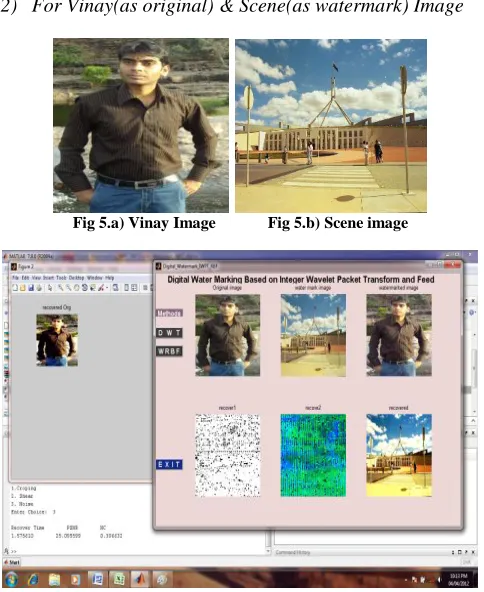
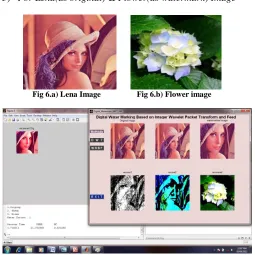
The results have been calculated for various attacks like cropping, shearing, noise for DWT trained with BP network & Integer wavelet packet transformation trained with RBFN. Results shows increase in PSNR value and reduced recovery time. Thus the increased robustness of proposed algorithm is proved. We have proved the results for 3 sets of images, those are:-
i) Lena (as original) & Lake (as watermark) Image. ii) Vinay(as original) & Scene(as watermark) Image. iii) Lena (as original) & Flower(as watermark) Image.
B. Figures, Data sheets, Charts
1) For Lena (as original) & Lake (as watermark) Image
Fig 4.a) Lena Image Fig 4.b) Lake Image
Figure 4.c) Watermarked Image & its retrieval after various attacks (Eg: Shearing)
Fig (i) Fig (ii) Fig (iii)
Figure 4.d) Watermarked Image [Fig(iii)] formed from Fig(i), Fig(ii) and shearing attack
Fig (i) Fig (ii) Fig (iii)
Figure 4.e) Various stages of recovering watermark Image [Fig (iii)]
Figure 4.f) Recovered Original Image
[image:4.612.324.552.120.241.2] [image:4.612.324.549.264.367.2] [image:4.612.49.291.368.671.2]International Journal of Emerging Technology and Advanced Engineering
Website: www.ijetae.com (ISSN 2250-2459, Volume 2, Issue 4, April 2012)150
Figure 4.h) Comparison chart for Lena and Lake Image
2) For Vinay(as original) & Scene(as watermark) Image
Fig 5.a) Vinay Image Fig 5.b) Scene image
Figure 5.c) Watermarked Image & its retrieval after various attacks (Eg: Noise)
Fig (i) Fig (ii) Fig (iii)
Figure 5.d) Watermarked Image [Fig(iii)] formed from Fig(i), Fig(ii) and noise attack
Fig (i) Fig (ii) Fig (iii)
Figure 5.e) Various stages of recovering watermark Image [Fig (iii)]
Figure 5.f) Recovered Original Image
[image:5.612.49.297.128.325.2] [image:5.612.324.555.261.361.2] [image:5.612.48.290.354.650.2]International Journal of Emerging Technology and Advanced Engineering
Website: www.ijetae.com (ISSN 2250-2459, Volume 2, Issue 4, April 2012)151
Figure 5.h) Comparison chart for Vinay and Scene image3) For Lena(as original) & Flower(as watermark) Image
Fig 6.a) Lena Image Fig 6.b) Flower image
Figure 6.c) Watermarked Image & its retrieval after various attacks (Eg: Cropping)
Fig (i) Fig (ii) Fig (iii)
Figure 6.d) Watermarked Image [Fig(iii)] formed from Fig(i), Fig(ii) and cropping attack
Fig (i) Fig (ii) Fig (iii) Figure 6.e) Various stages of recovering watermark Image [Fig (iii)]
Figure 6.f) Recovered Original Image
Figure6.g) Experimental result for Lena and Flower image
[image:6.612.49.291.131.288.2] [image:6.612.46.301.317.572.2] [image:6.612.48.280.607.712.2]International Journal of Emerging Technology and Advanced Engineering
Website: www.ijetae.com (ISSN 2250-2459, Volume 2, Issue 4, April 2012)152
REFERENCES
[1] Kundur D, Hatzinakos D. Towards a telltale watermark techniques for tamper-proofing. Proc IEEE Int Conf Image Process 1998;2:409– 13.
[2] Ng TM, Garg HK. Maximum-likelihood detection in dwt domain image watermarking using Laplacian modeling. IEEE Signal Process Lett 2005;12(4):285–8.
[3] Bao P, Xiaohu M. Image adaptive watermarking using wavelet domain singular value decomposition. IEEE Trans Circuits Syst Video Technol 2005;15(1):96–102.
[4] Vizireanu DN, Preda, RO. A new digital watermarking scheme for image copyright protection using wavelet packets. In: 7th international conference on telecommunications in modern satellite, cable and broadcasting services, vol. 2, 2005. p. 518–21.
[5] Lu CS, HYL, Sze CJ. Combined watermarking for image authentication and protection. In: Proceedings of IEEEinternational conference on multimedia and expo, vol. 3, 2000. p. 1415–8. [6] Lu CS, Liao, HY. Oblivious cocktail watermarking by sparse code
shrinkage: a regional and global-based scheme. In: Proceedings of international conference on image processing proceedings, vol. 3, 1987. p. 13–6.
[7] Sweldens W. The lifting scheme: a construction of second generation wavelets. SIAM J Math Anal 1998;29(2):511–46.
[8] Zou D, Shi YQ, ZN, Su W. A semi-fragile lossless digital watermarking scheme based on integer wavelet transform. IEEE Trans Circuits Syst Video Technol 2006;16(10): 1294–300. [9] Yuan Y, H D, Liu D. An integer wavelet based multiple logo-
watermarking scheme. In: 1st international multi-symposiums on computer and computational sciences, vol. 2, 2006. p. 175–9. [10] Liu HM, Liu JF, JWHDRH, Shi YQ. A robust dwt-based blind data
hiding algorithm. Proc IEEE Circuits Syst 2002;2: 672–5.
[11] Xiaoyun W, Junquan H, G Z, Jiwu H. A secure semi-fragile watermarking for image authentication based on integer wavelet Australasian information security workshop, vol. 44, 2005. p. 75–80. [12] F. Maesa, A. Collignon, D. Vandermeulen, G. Marchal, and P. Suetens, “Multimodality image registration by maximization of mutual information”, IEEE Transactions on Medical Imaging, vol. 6,no.2,pp.187–198,1997.
[13]Qiao Baoming , Zhang Pulin, Kang Qiao “A Digital Watermarking Algorithm Based on Wavelet Packet Transform and BP Neural Network”, Seventh International Conference on Computational Intelligence and Security 2011

![Figure 2. One level transforms function [14]](https://thumb-us.123doks.com/thumbv2/123dok_us/8735585.888415/2.612.96.249.276.378/figure-level-transforms-function.webp)
![Figure 4.e) Various stages of recovering watermark Image [Fig (iii)]](https://thumb-us.123doks.com/thumbv2/123dok_us/8735585.888415/4.612.49.291.368.671/figure-various-stages-recovering-watermark-image-fig-iii.webp)