BREAKDOWN CHARACTERISTIC OF PALM OIL AND COCONUT OIL UNDER AC AND DC VOLTAGE WITH DIFFERENT MOISTURE RATE
NOOR ATIQAH BINTI AZALI
A project report is submitted in partial fulfillment of the requirement for the award of the
Degree of Master of Electrical Engineering
Faculty of Electrical and Electronic Engineering Universiti Tun Hussein Onn Malaysia
iv
Specially dedicated to my precious father and mother
ACKNOWLEDGEMENT
All praises due to Allah S.W.T, Lord of universe, The Most Merciful and Gracious. Prayer for peace and prosperity to prophet, Nabi Muhammad S.A.W, his companion and his beloved friends.
Alhamdulillah, here I would like to express my honest acknowledgement to Dr. Nor Akmal Binti Mohd Jamail for her careful guidance, patience and advices which invaluable direction during the course of this project. Her encouragement, understanding and patience throughout the project and preparation of the thesis are always appreciated.
Special thanks and sincere appreciation to my dear family for their support, prayer, encouragement, patience and endurance. Not to forget, a million of gratitude and many thanks to all my friends whom been involved while making this report a success completion.
vi
ABSTRACT
ABSTRAK
viii
TABLE OF CONTENT
TITLE i
DECLARATION ii
DEDICATION iv
ACKNOWLEDGEMENT v
ABSTRACT vi
ABSTRAK vi
TABLE OF CONTENT viii
LIST OF FIGURES xi
LIST OF TABLES xiii
LIST OF SYMBOLS AND ABBREVIATIONS xiv
LIST OF APPENDICES xv
CHAPTER 1 INTRODUCTION 1
1.0 Project Background 1
1.1 Problem Statement 2
1.2 Project Objectives 2
1.3 Project Scope 3
1.4 The Organization of Thesis 3
CHAPTER 2 LITERATURE REVIEW 5
2.0 Introduction 5
2.1 Transformer Failures 5
2.1 Liquid Insulation 6
2.2.2 Vegetable oils 7 2.2.3 Properties of Palm Oil 7
2.2.3.1 RBDPO Oil 8
2.2.3.2 PFAE Oil 9
2.2.4 Properties of Coconut Oil 10
2.3 Breakdown Voltage 11
2.3.1 Breakdown in liquid of test cell 12 2.3.2 Breakdown in Palm Oil 12 2.3.3 Breakdown in Coconut Oil 15 2.4 Summary of Previous Related Work on
Liquid Insulator
16
CHAPTER 3 EXPERIMENTAL SETUP 22
3.0 Introduction 22
3.1 Project Activities 22
3.2 Experimental Setup 24
3.2.1 HVAC & HVDC Circuit and Block Diagram
24 3.2.2 List of Components Used in HVAC
and HVDC Circuit
26 3.2.3 HVAC and HVDC Measurement
Procedure
31 3.2.4 Experiment Methods 33
3.3 Summary 36
CHAPTER 4 RESULT AND DISCUSSION 37
4.0 Introduction 37
4.1 Result 37
4.1.1 AC Breakdown Voltageof RBDPO Oil
38 4.1.2 AC Breakdown Voltage of Coconut
Oil
x
4.1.3 DC Breakdown Voltage of RBDPO Oil
43 4.1.4 DC Breakdown Voltage of Coconut
Oil
45 4.2 Comparison for breakdown voltage 48
4.3 Physical Change 49
4.4 Summary 50
CHAPTER 5 CONCLUSIONS AND RECOMMENDATIONS 51
5.0 Conclusions 51
5.2 Recommendations 52
REFERENCES
LIST OF FIGURES
2.1 Structure of palm fruit. 9
2.2 Structure of palm nuts. 9
2.3 Dielectric strength versus water content. 14
3.1 Project flowchart. 23
3.2 Circuit connection for HVAC experiment. 24
3.3 Circuit connection for HVDC experiment. 25
3.4 Block diagram of HVAC experiment. 25
3.5 Block diagram of HVDC experiment. 26
3.6 The control desk front panel. 32
3.7 Flowchart of experiment method. 33
3.8 Mixing water with oil using hotplate stirrer. 34
3.9 Test setup of HVDC testing. 35
3.10 Connection of test cell to high voltage and ground. 35 4.1 AC Breakdown voltage of RBDPO Oil when added with
water.
39
4.2 AC Breakdown voltage of RBDPO Oil with different gap distance
40 4.3 AC Breakdown voltage of Coconut Oil when added with
water.
42
4.4 AC Breakdown voltage of Coconut Oil with different gap distance.
42 4.5 DC breakdown voltage for RBDPO oil when added with
water.
44
4.6 DC Breakdown voltage of RBDPO Oil with different gap distance.
45
xii
water.
4.8 DC Breakdown voltage of Coconut Oil with different gap distance.
47
LIST OF TABLES
2.1 Cause of Failures. 6
2.2 Composition of fatty acids in vegetable oils. 10
2.3 Physical Properties of Coconut Oil. 11
2.4 AC breakdown voltage of different types of vegetable. 13 2.5 Breakdown Voltage of RBDPO at Different Temperature. 14
2.6 Comparison of oil. 14
2.7 Breakdown strength of Coconut Oil. 15
2.8 Summary of previous study related to vegetable oils. 16 2.9 Summary of previous study related to palm oils. 19 2.10 Summary of previous study related to coconut oils. 20
3.1 List of testing equipment. 27
4.1 AC Mean breakdown voltage for RBDPO oil. 38
4.2 AC Mean breakdown voltage for coconut oil. 40
4.3 DC Mean breakdown voltage for RBDPO oil. 43
4.4 Average breakdown voltage for coconut oil. 45
xiv
LIST OF ABBREVIATIONS
AC - Alternating Current
CO - Coconut Oil
CPO - Crude Palm Oil
DC - Direct Current
HV - High Voltage
HVAC - High Voltage Alternating Current
HVDC - High Voltage Direct Current
RBDPO - Refined, Bleached and Deodorized Palm Oil
RCO - Refined Coconut Oil
LIST OF APPENDICES
APPENDIX TITLE PAGE
A AC Breakdown voltage for RBDPO oil 57
B AC Breakdown voltage for Coconut oil 58
C DC Breakdown voltage of RBDPO oil 59
CHAPTER 1
INTRODUCTION
1.0 Project Background
In high voltage system such as power transformers, the insulating liquid is commonly used as it caters electrical insulation, reduces corona and serves as a coolant to avoid the transformer from overheating Good insulating liquid must have high breakdown voltage, good chemical stability, low dielectric dissipation factor, reasonable economical price and act excellent cooling medium. Petroleum-based mineral oils fit almost all the factor as the good insulating oil; therefore, it has been used as liquid insulator for a long time. Mineral oils have negative impact to environment because it poorly biodegradable and someday petroleum product will have none left.
making such insulating liquids more available and affordable for power transformers [4].
Coconut oil also falls in vegetable oils type. Coconut oil is a colorless to pale brownish-yellow liquid. In temperate climates, it appears as greasy, somewhat crystalline, and white to yellowish solid fat. Coconut oil is extensively used for edible and industrial purposes. Products derived from coconut oil and its fatty acids find numerous applications in food, soap, textile and synthetic resin industries, and recently even as an auto lubricant [5].
1.1 Problem Statement
The oil used in transformers are mineral oils that are not biodegradable. If there are accident happened like a tank rupture, leak or explosion in the transformer, oil filled transformer will give a harmful impact on the environment. In Malaysia, the mineral oil is used in transformers as insulating medium. The importance of the environment has increased the awareness in people; biodegradable vegetable oil has been produced to be used as liquid insulator in transformers. Many researchers actively studied how to make palm based oil and coconut oil as liquid insulator in transformers as one of the other alternative.
3
1.2 Project Objectives
Objectives of this project are as follows:
1) To identify the breakdown characteristic of palm oil and coconut oil under AC and DC voltage when different moisture rate is applied
2) To compare breakdown strength between palm oil and coconut oil as insulating with effect of moisture rate.
3) To evaluate the relationship between specified electrode gap and moisture content while breakdown occurs.
1.3 Project Scope
There are several scopes of this project. The scopes are:
a) Only palm oil and coconut oil were used as an insulating medium
b) The gap of electrode is set at 2.5 mm, 3.0 mm, 3.5 mm, 4.0 mm and 4.5 mm c) The distilled water of 0.5 ml, 1.0 ml, 1.5 ml and 2.0 ml by volume per sample
were used
d) This experiment being conducted using AC and DC voltage with the ambient room temperature (26℃) being contemplates.
1.4 The Organization of Thesis
This thesis consists of five chapters including this chapter:
Chapter 2: This chapter discusses the previous related research associated with this project.
Chapter 3: This chapter covers with the methodology used in this project.
CHAPTER 2
LITERATURE REVIEW
2.0 Introduction
Insulation has been a major concern in high voltage electrical power apparatus including transformer. Insulators protect the live parts of transformer from failure. Not limited to that, depending on the type of insulators it also. Insulators in transformer consist of two types which are the combination of solid and liquid. In oil-filled transformer, paper/pressboard immersed in transformer oil to provide insulation between the core windings and other internal live parts of the transformer [6]. There are three common insulating materials:
i. Liquid ii. Gas
iii. Solid insulating
2.1 Transformer failures
caused failures as shown in table below. Referring to Table 2.1, the leading cause of transformer failures was due to the insulation failure. Insulation deterioration is caused by four factors; pyrolosis (heat), oxidation, acidity, and moisture. But moisture is reported separately [7]. Despite the low percentage of failure caused by moisture, the transformer operation still can be affected, and maintenance costs will also increase. There are several categories of moisture that caused transformer failures including bushings or fittings failures due to water entering the tanks, and other forms of oil contamination.
Table 2.1: Cause of Failures [7]
Cause of Failure Number Total Paid
Insulation Failure 24 $ 149,967,277
Design/ Material / Workmanship 22 $64,696,051
Unknown 15 $29,776,245
Oil Contamination 4 $11,836,367
Overloading 5 $8,568,768
Fire / Explosion 3 $8,045,771
Line Surge 4 $4,959,691
Improper Maint / Operation 5 $3,518,783
Flood 2 $2,240,198
Loose Connection 6 $2,186,725
Lightning 3 $657,935
Moisture 1 $175,000
$286,628,811
2.2 Liquid Insulation
Liquid insulators are widely used in high voltage application such as transformer, capacitor, high voltage cable and switchgear. Its function is to provide electrical insulation, suppress corona and arcing, and to serve as a coolant. The insulating oil must possess high dielectric strength, high thermal stability, low dielectric losses and reasonable economical prices [7].
7 to its present availability and the low cost. Nowadays, environmental friendly oil like vegetables oil being used as alternative to the hazardous mineral oils. In this project, palm oil and coconut oil will be discussed.
2.2.1 Mineral oil
Since the past century, the usage of petroleum-based transformer oils is commonly used in the world as electrical insulating liquids. The quality of oil in transformer plays a very important role in performing its function satisfactorily. Petroleum-based mineral insulating oils are specifically refined so that their applications in transformer can meet the requirements of electrical insulation and heat transfer. The transformer is expected to provide reliable and efficient service for a period of at
least forty years [9].
2.2.2 Vegetable oil
Vegetable oils are triglyceride obtained from plant. Basically, vegetable oils are environmental friendly, biodegradable, renewable, cheap, highly available and safer alternative insulating and cooling medium for transformer.
2.2.3 Properties of Palm Oil
composition of fatty acids that consist of different types of carbon. This carbon composition contributes to the good oxidation stability [10,11].
Palm oil has a balanced fatty acid composition in which the level of saturated fatty acids is almost equal to that of the unsaturated fatty acids. Palmitic acid (44%-45%) and oleic acid (39%-40%) are the major component acids, with linoleic acid (10%-11%) and only a trace amount of linolenic acid. The low level of linoleic acid and virtual absence of linolenic acid make the oil relatively stable to oxidative deterioration [8].
Preliminary studies found that palm oil is a good candidate as an alternative fluid for mineral oil in liquid insulator. In term of viscosity, the performance of most of the palm based oil is comparable to other types of vegetable oils such as natural ester and synthetic ester.
2.2.3.1 RBDPO oil
9
Figure 2.1: Structure of palm fruit
2.2.3.2 PFAE oil
Production of palm oil and palm kernel oil reached 36 million tons in 2005, and palm-derived oil has become the most abundant and consistently supplied vegetable oil in the world, including soybean and rapeseed oils. Furthermore, palm-derived oil contains a wide range of fatty acids as shown in table, a variety of fatty acids esters can be manufactured [11]. Figure 2.2 shows the structure of palm nuts.
Figure 2.2: Structure of palm nuts [11] Kernel
[image:22.595.163.476.538.702.2]Further development of palm origin saturated fatty acids will produce PFAE. PFAE has 0.6 times less viscosity and 1.3 times higher dielectric constant than mineral oil [10, 12] and has higher biodegradability than mineral oil. Due to this matter, the cooling efficiency in PFAE-immersed transformer can be improved. Table 2.2 shows the composition of fatty acids in vegetable oils.
Table 2.2: Composition of fatty acids in vegetable oils [11]
Fatty acid Soybean
oil
Rapeseed
oil
Sunflower
oil
Palm Coconut
oil
Palm oil Palm
kernel oil
C8: caprylic - - - - 3.3 7.8
C10: capric - - - - 3.1 7.6
C12: lauric - - - - 45.7 44.8
C14: myristic - - 0.2 1.1 16.4 18.1
C16: palmitic 6.7 5.4 7.1 44.4 8.9 9.5
C18: stearic 3.3 2.0 2.8 4.3 2.3 2.4
C18: oleic 41.7 68.0 30.0 39.9 17.1 8.2
C18: linoleic 41.3 21.0 59.5 9.4 27 1.5
C18: linolenic 5.9 - - - - -
others 1.1 3.6 0.4 0.9 0.5 0.1
2.2.4 Properties of Coconut Oil
Coconut oil is a member of tropical oils, which also include palm, palm fatty acid ester, cocoa, and shea nut oils [2]. Coconut oil is a colorless to pale brownish-yellow liquid. In temperate climates, it appears as greasy, somewhat crystalline and white to yellowish solid fat [13]. Coconut oil is widely used for food and industrial processes. Products obtained from coconut oil and their fatty acids can be found in many applications such as food, textile and synthetic resins industries.
11 found in coconut oil. The amount of moisture in coconut oil varies depending on the source. Apparently, the coconut from dried copra or fresh coconut (virgin coconut oil) contains more moisture compared to coconut derived from well-dried copra.
[image:24.595.107.515.317.444.2]Studies on physical properties, chemical composition and electrical properties of coconut oil have been carried out by some researchers, and studies on using purified coconut oil as insulation have also been carried out. The important properties considered are the dielectric strength and the pour point [14]. The basic properties such as flash point, pour point, viscosity, specific gravity, etc. are above the recommended limits for transformer insulation according to IEC 60296 [15]. Table 2.3 shows physical properties of coconut oil.
Table 2.3: Physical Properties of Coconut Oil [15]
Property Coconut oil Recommended level [IEC 60296]
Dielectric Strength [kV] 60 50
Viscosity [cSt at 40℃] 29 13
Pour point [℃] 23 -40
Flash point [℃] 170-225 154
Specific gravity at 20℃ 0.917 0.895
Moisture content [mg/kg] 1 1.5
The relatively higher values of crude coconut oil were and may vary considerably from mineral oils depending on selected brands. The conductivity levels could be enhanced to a satisfactory limit with different purification processes such as heating, and neutralization as described in the previous study [1].
2.3 Breakdown Voltage
and conducts. In general, there were higher breakdown voltages of most vegetable oils compared to mineral oils. Despite that, the properties such as viscosity, conductivity, acidity and water solubility are still to be improved [3].
Dielectric strength of insulating material depends on the dielectric stress developed subject to high voltage. There is some factor that affects the dielectric breakdown strength such as temperature, impurity in dielectric substance and humidity [15]. In general, there was higher breakdown voltage of most vegetable oils compared to mineral oils. Despite that, the properties such as viscosity, conductivity, acidity and water solubility are still to be improved [3].
2.3.1 Breakdown in liquid of test cell
The most frequently used parameter to estimate the electrical performance of dielectric insulating liquid is breakdown voltage. It is vital to ensure the breakdown voltage for the new oil is high because after ageing the value could be lowered due to the presence of contaminants such as ageing by-products. The breakdown voltage measurement was conducted according to ASTM D 1816 [17].
The volume of the oil used for measurement was 400 ml and the voltage ramping rate was set to 0.5 kV/s. The time between breakdowns was set to 5 minutes. It was set longer than the recommended time in ASTM D 1816 to give time for expulsion of breakdown by products since vegetable oils such as RBDPO and coconut oil have higher viscosities as compare to mineral oil [18, 19].
2.3.2 Breakdown in Palm Oil
13 2.4 were passed with the standard from ASTM D6871 (standard specification of vegetable oil) which is 35 kV.
Table 2. 4: AC breakdown voltage of different types of vegetable [16]
Types of palm based oil Breakdown voltage (kV) at 2.5 mm gap distance
CPO Between 17 and 23
RBDPO Between 52 and 86
RBDPO Olein Between 44.78 and 60
PKO Alkyl ester Between 42.1 and 42.6 at 1 mm gap distance
PFAE Between 81 and 84
Natural ester 56 at 2 mm gap distance
Synthetic ester 75
A previous paper [18] stated that water can be presence in some different states within the transformer. Three basic types of water can be found in transformer oil as below:
i. Dissolved water which is the hydrogen bonded to the hydrocarbon molecules of which oil is composed.
ii. Supersaturated in solution but has not yet totally separated from the oil is known as emulsified water.
iii. Free water which is also supersaturated in solution but in a high enough concentration to produce water droplets and separate from the oil [18].
The reduction of the dielectric breakdown voltage of insulating liquid caused by the
Figure 2.3: Dielectric strength versus water content [18]
On the other hand, the breakdown voltage of RBDPO Oleum at three different temperature; 25℃, 40 ℃, and 60℃ being discussed in prior research paper. The breakdown voltage increased when the temperature is increased. The result from the research paper is shown below [19].
Table 2.5: Breakdown Voltage of RBDPO at Different Temperature
Electrical property Temperature (℃)
25 40 60
Breakdown Voltage (kV) 57 >60 >60
[image:27.595.111.520.668.767.2]In another research, the PFAE as an insulating oil for transformer being discussed. In breakdown voltage experiment of 2.5 mm of air gap, clearly that PFAE oil has the highest voltage (81 kV) compared to mineral oil which only between 70 – 75 kV [21]. Table 2.6 shows the comparison of oil which breakdown voltage experiment has been done.
Table 2.6: Comparison of oil [21]
Properties PFAE Vegetable oil Mineral oil
Density (40˚C) g/cm3 0.86 0.93 0.88
Pour point ˚C -32.5 -20 -45
Flash point (COC) ˚C 186 330 152
Kinetic viscosity(40˚C) mm2/s 5.06 32.9 8.13
Total acid value mgKOH/G 0.005 0.035 <0.01
Moisture content ppm 15 43 <10
15
Relative permittivity (80˚C) 2.95 2.91 2.2
Tanδ(80˚C) % 0.8 0.7 0.001
Volume resistivity (80˚C) Ω.cm 1.9 x 10¹³ 3.7 x 10¹² 7.6 x 10¹⁵
Based on the previous result that shown above, PFAE can be a good choice as substitute liquid for mineral oil in electrical system because it has higher breakdown voltage compared to mineral oil. In addition, breakdown of palm oil is as good as natural ester and synthetic ester in term of electrical performance.
2.3.3 Breakdown in Coconut Oil
Reduction of dielectric strength due to moisture absorption is observed when oil samples is kept open to air for a right amount of time. Moisture absorption weakens the dielectric strength of coconut oil because it rises the water content in the sample [5]. All types of transformer oil facing the same problem, usually mineral oil where moisture absorption is one of its natural properties.
[image:28.595.110.518.70.110.2]The pour point of coconut oil is higher compare to what is stated for mineral oil in the IEC 296 standard, investigation have been carried out to find the chance of solidification of the coconut oil during operation under cold environmental conditions [15]. Dielectric test was carried out for different states of oil (fully solidified, partially solidified and liquid) as shown Table 2.7.
Table 2.7: Breakdown strength of Coconut Oil [15] State of
solidification
Breakdown voltage (kV)
of 2.5mm gap
Liquid 60.00 60.21 60.07 60.07 60.00
Partially solid 59.65 59.79 60.07 60.21 60.21
2.4 Summary of Previous Related Work on Liquid Insulator
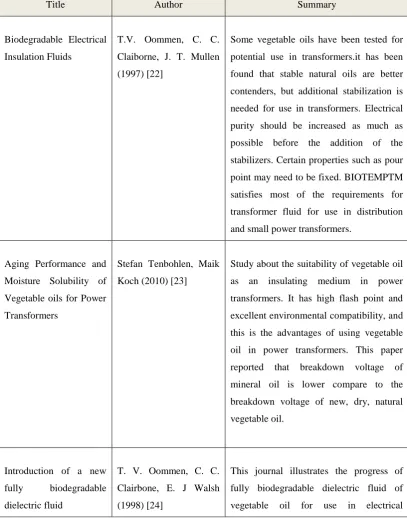
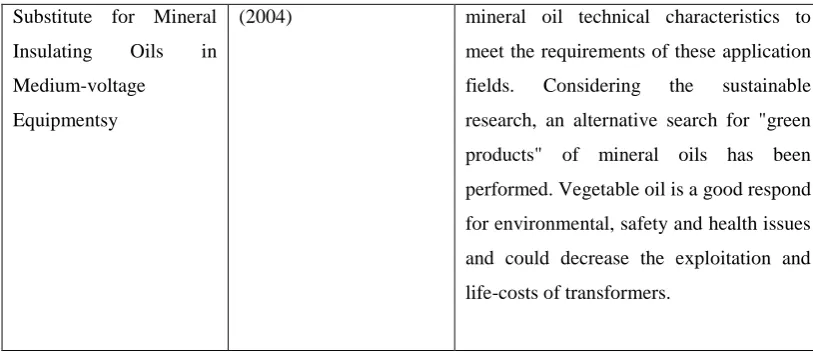
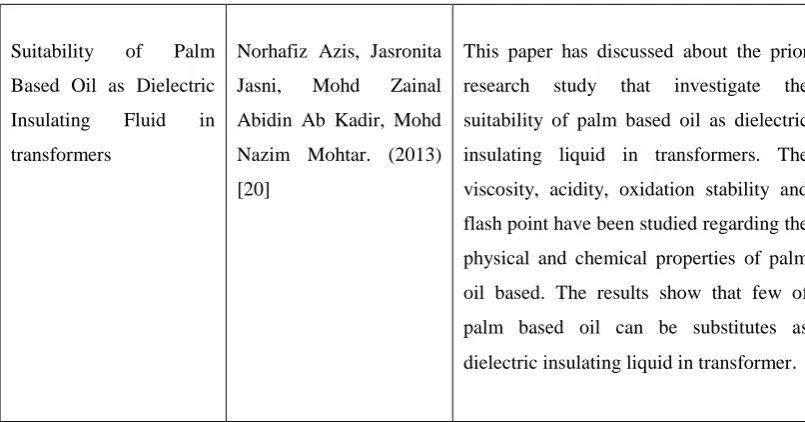
[image:29.595.109.517.237.756.2]Past researches are very helpful for the writer to get some familiar ideas related to the project. Table 2.8 until Table 2.10 show the summary of previous study related to vegetable oils, palm oils and coconut oils respectively.
Table 2.8: Summary of previous study related to vegetable oils
Title Author Summary
Biodegradable Electrical
Insulation Fluids
T.V. Oommen, C. C.
Claiborne, J. T. Mullen
(1997) [22]
Some vegetable oils have been tested for
potential use in transformers.it has been
found that stable natural oils are better
contenders, but additional stabilization is
needed for use in transformers. Electrical
purity should be increased as much as
possible before the addition of the
stabilizers. Certain properties such as pour
point may need to be fixed. BIOTEMPTM
satisfies most of the requirements for
transformer fluid for use in distribution
and small power transformers.
Aging Performance and
Moisture Solubility of
Vegetable oils for Power
Transformers
Stefan Tenbohlen, Maik
Koch (2010) [23]
Study about the suitability of vegetable oil
as an insulating medium in power
transformers. It has high flash point and
excellent environmental compatibility, and
this is the advantages of using vegetable
oil in power transformers. This paper
reported that breakdown voltage of
mineral oil is lower compare to the
breakdown voltage of new, dry, natural
vegetable oil.
Introduction of a new
fully biodegradable
dielectric fluid
T. V. Oommen, C. C.
Clairbone, E. J Walsh
(1998) [24]
This journal illustrates the progress of
fully biodegradable dielectric fluid of
17 appliances. The material used are high
oleic vegetable oils which then stabilized
and purified. This test is considered
environmentally friendly because it is high
biodegradability. It is good substitutes to
presently used liquid such as mineral oils
and silicone that have low
biodegradability.
Electrical properties of
vegetable oil-based
dielectric liquid and
lifetime estimation of the
oil-paper insulation
Caixin Sun, Jian Li,
Xiohu Li, S. Gzrybowski
(2006) [4]
Study of the electric properties of refined
rapeseed oil that can be used as
transformer oils. The step-stress test being
performed to estimate the lifespan of
rapeseed oil-immersed paper. For contrast
examples, the step-stress test also being
performed on mineral oil-immersed paper
specimen. The results show that rapeseed
oil-immersed paper has longer life
expectancy than mineral oil-immersed
paper.
Use of Natural Vegetable
Oils as Alternative
Dielectric Transformer
Coolants
S M Bashi, U. U
Abdullahi, Robia Yunus,
Amir Nordin (2006) [6]
This paper explains the current efforts by
developing and providing some alternative
methods of cooling and insulating
transformers. Natural vegetable oils have
been found to fit the specifications as they have high flsh point (300℃), high fire points (250° - 300℃), low pour points (-10℃) and have high dielectric breakdown
voltage (>50kV).
Karateristik Pengujian
Minyak Nabati Sebagai
Alternatif Isolasi
Pengganti Minyak
Transformator Distribusi
20kV
Muhammad Suyanto
(2014) [25]
This paper has presented that in electrical
power system, isolation is one of the
systems protection that must be observed.
This project used the vegetable oils which
are palm oil, corn oil, and sunflower oil as
the insulating oil in the distribution
transformer of 20kV. When it gets a
properties, it can be used as alternative
substitute for the distribution transformer
of 20kV and it is easy to get and renewable
energy.
Partial Discharge
Behaviour of an
Alternative Insulating
Liquid Compare to
Mineral Oil
R. Eberhardt, H. M.
Muhr, W. Lick, B.
Wieser (2010) [26]
Characterization of insulating material can
be performed through several different
methods including AC-Breakdown tests,
partial discharge tests, lightning and
impulse switched voltage test, and so on.
Partial discharge behaviour is a feature
that distinguishes between insulation
medium. This project demonstrates the
partial discharge behaviour of some of the
alternative insulation liquids such as
synthetic and natural esters, compared to
usually used mineral oils. Voltage up to
30kV is used to generate PD patterns, and
arrangement of inhomogeneous tests were
used. The used of sheets of pressboard as a
model of the oil / board insulation system
has been created.
Analysis Results for
Insulating Oil
Components in Field
Transformers
Shigemitsu Okabe,
Shuhei Kaneko,
Masanori Kohtoh (2010)
[27]
This project analyses the material effect
the transformer insulating oil characteristic
due to aging process. Some material such
as water contents and electrostatic charge
could affect the electrical characteristic of
insulating oil and perhaps by trace
elements in the insulating oil. The result of
this paper has been summarizing on the
relationships between the concentrations
of elements and the insulating oil ages
based on the results analysis of the oil
components.
19 Substitute for Mineral
Insulating Oils in
Medium-voltage
Equipmentsy
(2004) mineral oil technical characteristics to
meet the requirements of these application
fields. Considering the sustainable
research, an alternative search for "green
products" of mineral oils has been
performed. Vegetable oil is a good respond
for environmental, safety and health issues
and could decrease the exploitation and
[image:32.595.107.514.69.247.2]life-costs of transformers.
Table 2.9: Summary of previous study related to palm oils
Title Author Summary
Effect of Water on
Electrical Properties of
Refined, Bleached, and
Deodorized Palm Oil
(RBDPO) as Electrical
Insulating Material
Nazera Ismail, Yanuar Z.
Arief, Zuraimy Adzis,
Shakira A. Azli, Abdul
Azim A. Jamil, Noor
Khairin Mohd., Lim Wen
Huei, Yeong Shoot Kian.
(2013) [30]
The properties of refined, bleached, and
deodorized palm oil (RBDPO) have been
explained in this paper for having the
likely to be used as insulating liquid. This
report results explain the breakdown
voltage of RBDPO is lower than
commercial mineral oil (Hyrax) because
the effect of water. The results also
revealed that RBDPO id highly influenced
by water, leading to the decreasing of
breakdown voltage and increasing of
dissipation factor and this resultant to the
high amounts of dissolved water.
Study on the
Characteristics of Palm Oil and it’s Derivatives
as Liquid Insulating
Materials
Suwarno F. Sitinjak,
Ichwan Suhariadi, Lutfi
Imsak. (2003) [30]
The investigation of dielectric-short term
characteristic of palm oil and its
derivatives have been published in this
paper in pursuit to discover the insulating
materials that is environmental friendly.
This project also revealed the value of
flash point, viscosity, specific heat and
pour point. Referring to these data, some
of oil-based palm can be used as liquid
Suitability of Palm
Based Oil as Dielectric
Insulating Fluid in
transformers
Norhafiz Azis, Jasronita
Jasni, Mohd Zainal
Abidin Ab Kadir, Mohd
Nazim Mohtar. (2013)
[20]
This paper has discussed about the prior
research study that investigate the
suitability of palm based oil as dielectric
insulating liquid in transformers. The
viscosity, acidity, oxidation stability and
flash point have been studied regarding the
physical and chemical properties of palm
oil based. The results show that few of
palm based oil can be substitutes as
[image:33.595.108.511.69.280.2]dielectric insulating liquid in transformer.
Table 2.10: Summary of previous study related to coconut oils
Title Author Summary
Laboratory Investigation
of Treated Coconut Oil
as Transformer Liquid
Insulation
D. Hinduja, Gayathri, C.
S. Kalpage and
M.A.R.M. Fernando
(2011) [31]
This laboratory project investigates the
coconut oil as alternative substitute of
liquid insulation in power transformers. By
using heat treatment and neutralization
process, it was found that it can slightly
improving the conductivity of the coconut
oil. Coconut oil that undergo suitable
treatment can be used as other substitute
for transformer insulation liquid.
Coconut Oil Insulated
Distribution Transformer
J R Lucas, D C
Abeysundara, C.
Weerakoon, K B M I
Perera, K C Obadage and
K.A.I.Gunatunga
(2001/2002) [5]
Study of the development of coconut oil
filled distribution transformer for used at
placed with the temperature hardly go to
frozen temperatures. This paper revealed
that coconut oil can be used as insulating
oil convincingly in sealed distribution
transformers. Coconut oil well known
advantageous it is environmental friendly
oil.
Analysis of Insulation
Characteristics of
S.Ranawana,
C.M.B.Ekanayakal,
This project introduced the experimental
21
Coconut Oil as an
Alternative to the Liquid
Insulation of Power
Transformers.
N.A.S.A.Kurera,
M.A.R.M.Fernando,
K.A.R. Perera. (2008)
[14]
analyse the insulation characteristics of
coconut oil to find the suitability as the
power transformers insulation liquid. The
result revealed that at room temperature,
the conductivity values of coconut oil are
noticeably higher than new mineral oil.
This outcome suggest that further
purification process is necessary to ensure
coconut oil up to the required standard to
CHAPTER 3
EXPERIMENTAL SETUP
3.0 Introduction
Methodology refers to the process used to collect information and data to ensure the project objectives is achieved. Before the experiment can be execute, a careful planning is required as a guide to ensure the experiment can be done easily without problem. This project methodology will focus on the breakdown voltage test; HVAC circuit and HVDC circuit which to identify the breakdown strength of palm oil and coconut oil under AC and DC voltage.
3.1 Project Activities
23
Study the properties of palm oil and coconut oil
Selection of palm oil and coconut oil type
Enough information?
Start
Experimental setup for HVAC and HVDC
Data Collection from experiment
Enough data?
Data analysis and discussion
End Yes
No
Yes
[image:36.612.164.489.76.640.2]No
3.2 Experimental Setup
The process to accomplish this experiment has been explained in this section. This
framework is used to attain the HVAC and HVDC testing.
3.2.1 HVAC & HVDC Circuit and Block Diagram
[image:37.612.114.540.389.683.2]The circuit in Figure 3.2 and Figure 3.3 were used to generate voltage which then used in breakdown voltage test to evaluate the palm oil and coconut oil. The test object is placed at the end of the circuit connection. In this experiment, the maximum permissible voltage is 100kV. The voltage and current produced when doing the experiment can be examined at the control desk where the panel meters placed.
REFERENCES
[1] B.S.H.M.S.Y. Matharage, M.A.A.P Bandara, M.A.R.M. Fernando, G.A. Jayantha, C.S. Kalpage, “Aging Effect of Coconut Oil as Transformer Liquid Insulation - Comparison with Mineral Oil”, Industrial and Information Systems (ICIIS), 2012 7th IEEE International Conference, 2012.
[2] Agricultural Product of India
http://www.agriculturalproductsindia.com/edible-oils/edible-oils-coconut-oil.html
[3] Oommen, T.V., Vegetable oils for liquid-filled transformers Electrical Insulation Magazine, IEEE 2002. 18(1): p. 6 – 11
[4] Caixin Sun, Jian Li, Xiohu Li, S.Gzrybowski, “Electrical properties of vegetable oil-based dielectric liquid and lifetime estimation of the oil-paper insulation”, Annual Report Conference on Electrical Insulation and Dielectric Phenomena, 2006.
[5] D.C. Abeysundara, C. Weerakoon and J R Lucas, K.A.I. Gunatunga And K.C. Obadage, “Coconut Oil as An Alternative to Transformer Oil”, Department of Electrical Engineering, University of Moratuwa, Lanka Transformer Ltd, Angulana Station Road, ERU Symposium, November 2001. [6] S. M. Bashi, U. U Abdullah, Robia Yunus and Amir Nordin, "Use of natural
vegetable oils as alternative dielectric transformer coolants", Journal- The institution of Engineers, Malaysia, vol. 67, no. 2, pp.4-9, June 2006.
[8] Malaysian Palm Oil Board (MPOB), Official Palm Oil Information Source http://www.palmoilworld.org/about_palmoil.html.
[9] Ravindra Arora, Wolfgang Mosch (2011). Liquid Dielectrics, Their Classification, Properties and Breakdown Strength. High Voltage and Electrical Insulation Engineering. John Wiley & Sons, Inc.: 275-317.
[10] T. Kanoh, H. Iwabuchi, Y. Hoshida, J. Yamada, T.Hikosaka, A. Yamazaki, Y. Hatta, H.Koide, “Analyses of electro-chemical characteristics of Palm Fatty Acid Esters as insulating oil,” IEEE International Conference on Dielectric Liquids, 2008.
[11] T. Kano, T. Suzuki, R. Oba, A. Kanetani, H.Koide, “Study on the oxidative stability of palm fatty acid ester (PFAE) as an insulating oil for transformers,” IEEE International Symposium on Electrical Insulation, 2012.
[12] T. Hikosaka, Y. Hatta, H. Koide, A. Yamazaki and T. Kanoh, “Basic characteristics of Environment-conscious Transformers Impregnated with Oil Palm Fatty Acid Ester (PFAE)”,15th International Symposium on High Voltage Engineering, T8-13, 2007.
[13] British standard (1996). Insulating liquids – Determination of the breakdown voltage at power frequency – Test method, BS EN 60156:1996
[14] S.Ranawana, C.M.B.Ekanayakal, N.A.S.A.Kurera, M.A.R.M.Fernando, K.A.R. Perera, “Analysis of Insulation Characteristics of Coconut Oil as an Alternative to the Liquid Insulation of Power Transformers”, Department of Electrical and Electronic Engineering Faculty of Engineering University of Peradeniya, Sri Lanka, 2008.
[15] J R Lucas, D C Abeysundara, C. Weerakoon, K B M I Perera, K C Obadage and K.A.I.Gunatunga “Coconut Oil Insulated Distribution Transformer”, Paper 2001/02 presented at the 8th Annual Conference of the IEE Sri Lanka on 22 September 2001.
55
[17] IEEE Std C57.147, “IEEE Guide for Acceptance and Maintenance of Natural Ester Fluids in Transformers,” IEEE Power & Energy Society, 2008.
[18] Lance Lewand, “Understanding Water in Transformer Systems.” NETA World, Spring 2002, pp. 1-4.
[19] Abdul Rajab, Suwarno and S.Aminuddin (2009). Properties of RBDPO Oleum as a Candidate of Palm Based- Transformer Insulating Liquid. 2009 International Conference on Electrical Engineering and Informatics, 548-552.
[20] Norhafiz Azis, Jasronita Jasni, Mohd Zainal Abidin Ab Kadir, Mohd Nazim Mohtar, “Suitability of Palm Based Oil as Dielectric Insulating Fluid in Transformers”, 2013.
[21] Suwarno, Aditama, Dielectric Properties of Palm Oils as Liquid Insulating Materials: Effects of Fat Content, Procedings of 2005 lnternational Symposium on Electrical Insulating Materials, 2005, pp. 91-94.
[22] T.V.Oommen, C.C.Claibrone, J.T. Mullen, “Biodegradable electrical insulation fluids” ABB Power T & D Company Inc. Electric systems Technology Institute, 1997.
[23] Stefan Tenbohlen, Member, IEEE, and Maik Koch, “Aging Performance and Moisture Solubility of Vegetable Oils for Power Transformers”, IEEE Transactions on Power Delivery, VOL. 25, NO. 2, APRIL 2010.
[24] T.V.Oommen, C.C Clairbone, E.J Walsh, “Introduction of a new fully biodegradable dielectric fluid”, ABB Power TtBD Company Inc. Electric systems Technology Institute.
[26] R. Eberhardt, H. M. Muhr, W. Lick, B. Wieser, “Partial Discharge Behaviour Of an Alternative Insulating Liquid Compared to Mineral Oil”, Department of High Voltage Engineering and System Management, Graz University of Technology, Austria, 2010.
[27] Shigemitsu Okabe, Shuhei Kaneko, Masanori Kohtoh, “Analysis Results for Insulating Oil Components in Field Transformers”, Tokyo Electric Power Company. 2010.
[28] Bertrand, L. C. Hoang, “Vegetable Oils as Substitute for Mineral Insulating OilsIn Medium-Voltage Equipmentsy”, http: //www.cigre.org, 2004.
[29] Nazera Ismail, Yanuar Z. Arief, Zuraimy Adzis, Shakira A. Azli, Abdul Azim A. Jamil, Noor Khairin Mohd., Lim Wen Huei, Yeong Shoot Kian, “Effect of Water on Electrical Properties of Refined, Bleached, and Deodorized Palm Oil (RBDPO) as Electrical Insulating Material”, Jurnal Teknologi UTM, 2013.
[30] Suwarno F. Sitinjak, Ichwan Suhariadi, Luthfi Imsak, “Study on the Characteristics of Palm Oil and it’s Derivatives as Liquid Insulating Materials” Department of Electrical Engineering Bandung Institute of Technology, Proceedings of the 7th Intemational Conference on Properties and Applications of Dielectric Materials ,2003, Nagoya.
[31] D. Hinduja, Gayathri, C.S. Kalpage and M.A.R.M. Fernando, Senior Member, IEEE, “Laboratory Investigation of Treated Coconut Oil as Transformer Liquid Insulation”, 6th International Conference on Industrial and Information Systems, 2011.
![Table 2.1: Cause of Failures [7]](https://thumb-us.123doks.com/thumbv2/123dok_us/8750815.891853/19.595.107.520.267.522/table-cause-of-failures.webp)
![Figure 2.2: Structure of palm nuts [11]](https://thumb-us.123doks.com/thumbv2/123dok_us/8750815.891853/22.595.144.495.69.295/figure-structure-of-palm-nuts.webp)
![Table 2.2: Composition of fatty acids in vegetable oils [11]](https://thumb-us.123doks.com/thumbv2/123dok_us/8750815.891853/23.595.109.524.213.448/table-composition-of-fatty-acids-in-vegetable-oils.webp)
![Table 2.3: Physical Properties of Coconut Oil [15]](https://thumb-us.123doks.com/thumbv2/123dok_us/8750815.891853/24.595.107.515.317.444/table-physical-properties-coconut-oil.webp)
![Table 2. 4: AC breakdown voltage of different types of vegetable [16]](https://thumb-us.123doks.com/thumbv2/123dok_us/8750815.891853/26.595.106.525.154.297/table-ac-breakdown-voltage-different-types-vegetable.webp)
![Figure 2.3: Dielectric strength versus water content [18]](https://thumb-us.123doks.com/thumbv2/123dok_us/8750815.891853/27.595.208.423.77.248/figure-dielectric-strength-versus-water-content.webp)
![Table 2.7: Breakdown strength of Coconut Oil [15]](https://thumb-us.123doks.com/thumbv2/123dok_us/8750815.891853/28.595.110.518.70.110/table-breakdown-strength-coconut-oil.webp)