On Power Splitting Games in Distributed Computation:
The Case of Bitcoin Pooled Mining
Loi Luu
∗, Ratul Saha
∗, Inian Parameshwaran
∗, Prateek Saxena
∗, Aquinas Hobor
†,∗ ∗School of Computing,
†Yale-NUS College, National University of Singapore
{
loiluu, ratul, inian, prateeks, hobor
}
@comp.nus.edu.sg
Abstract—Several new services incentivize clients to compete in solving large computation tasks in exchange for financial rewards. This model of competitive distributed computation enables every user connected to the Internet to participate in a game in which he splits his computational power among a set of competing pools — the game is called a computational power splitting game. We formally model this game and show its utility in analyzing the security of pool protocols that dictate how financial rewards are shared among the members of a pool.
As a case study, we analyze the Bitcoin cryptocurrency which attracts computing power roughly equivalent to billions of desk-top machines, over 70%of which is organized into public pools. We show that existing pool reward sharing protocols are insecure in our game-theoretic analysis under an attack strategy called the “block withholding attack”. This attack is a topic of debate, initially thought to be ill-incentivized in today’s pool protocols: i.e., causing a net loss to the attacker, and later argued to be always profitable. Our analysis shows that the attack is always well-incentivized in the long-run, but may not be so for a short duration. This implies that existing pool protocols are insecure, and if the attack is conducted systematically, Bitcoin pools could lose millions of dollars worth in months. The equilibrium state is a mixed strategy—that is—in equilibrium all clients are incentivized to probabilistically attack to maximize their payoffs rather than participate honestly. As a result, a part of the Bitcoin network is incentivized to waste resource competing for higher selfish reward.
I. INTRODUCTION
Distributed computation enables solving large computa-tional problems by harnessing the availability of machines connected to the Internet. A new paradigm of distributed computation is emerging wherein participants contribute their computational resources in exchange for direct financial gain or monetary compensation. In this paradigm, all participants
compete in performing computation tasks to obtain rewards.
We call such computationcompetitive distributed computation.
There are many examples of such competitive distributed computation today. Public challenges for testing the strength of cryptographic constructions (e.g., the RSA Secret-Key chal-lenge [1]) invites participants to find and exploit weaknesses using huge computational resources in exchange for monetary prizes. Crowd-sourced security testing of applications is an emerging commercial industry (c.f. BugCrowd [2], CrowdCu-rity [3], the HeartBleed challenge [4]), wherein computation is dedicated to penetration testing tasks in software. Here, bug bounties are offered to the first participant that finds exploitable bugs. Perhaps one of the most direct examples
of competitive distributed computation are cryptocurrencies, such as Bitcoin, which attract computation power equivalent to nearly a billion desktop computers. In cryptocurrencies, participants—often called miners—solve cryptographic
puz-zles as “proof-of-work” [5] in exchange for obtaining rewards in cryptocurrency coins.
Distributed computation scales by incentivizing large num-ber of participants to contribute their computation power. When the computation problems demand high resources, participants resort to pooling their resources together in the
competition. This is both natural and useful as it reduces the uncertainity or variance in obtaining rewards for the pool participants. Typically, such computation pools have a designated supervisor who is responsible for distributing
computation sub-tasks to users and distributing the reward obtained from winning the competition. When such delegation of computation tasks is in place, the question of designing fair
pool protocols—which ensure that each participant get paid for
the computation they perform and only for the computation
they perform—become important.
Problems with designing secure or fair pool protocols are relatively less explored, especially in the setting of competitive distributed computation. Previous work have investigated so-lutions to prevent participants from specific forms of cheating, often considering a single supervisor system [6]. Indeed, for example in Bitcoin pool protocols, techniques for preventing misbehaving clients in a single pool are known and have been implemented. For instance, solutions preventing unfair supervisors, lazy clients who claim more than what they have done, and hoarders that keep the results secret to gain extra reward from it (e.g., by gaining lead time for another competition) are known [6, 7, 8, 9]. Many other systems such as the SETI@home project use redundancy to check for mismatch in replicated computation tasks [10]. However, a generic model for security analysis of pool protocols when there are multiple competing supervisors is a subject of open investigation.
in the RSA Secret-Key Challenge [1], a client once finds a possible plaintext should submit to the group supervisor immediately to claim for the reward, otherwise other groups may find it and make the result obsolete. Second, the com-putation tasks can be delegated to anonymous participants— in fact, the primary function of pool operators is to securely delegate tasks. This opens up analysis of the incentives of the participant which can decide to split its computation across multiple supervisors. Protocols that may be secure in a single supervisor setting [6] (e.g. with no delegation) are often used in practice, but can turn out to be insecure in multiple-supervisor setting. Detecting if and how a participant splits its power is difficult since participants are anonymous or can form a large sybil sub-network. Thus, studying the incentive behind the attack is an important goal.
The Computational Power Splitting Game. In this paper, we introduce a new distributed computation model which includes multiple supervisors competing with each other to
solve computationally large problems. Participants with com-putation power play a game of solving comcom-putation problems by acting as a supervisor or joining other pools. We call this the Computational Power Splitting game or the CPS
game. Participants have the choice to contribute their power to one supervisor’s pool or anonymously spread it across many pools. Each participant can choose to either follow the pool protocol honestly or deviate from it arbitrarily. The goal of each participant is to maximize its expected profits. A pool protocol is secure with respect to the CPS game if following the protocol maximizes each participant’s profit. We show an example analysis of the CPS game in the this paper, to illustrate how it acts as a powerful tool in analyzing protocols in competitive distributed computation scenarios.
The Case Study on Bitcoin Network. Bitcoin [5] is the largest cryptocurrency reaching a market capitalization of over 5.5 billion US dollars in2014 [11]. Bitcoin is representative of over 50 new cryptocurrencies or alt-coins which have a similar structure. In Bitcoin, each participating client (or miner) contributes computation power to solve cryptographic puzzles in a process called block mining, which acts as
the basis for minting coins (Bitcoins). The computational resources required for Bitcoin mining increases over time and is already significant: finding a block in late 2014 requires computing about 270
≈ 1021 SHA-256 hashes; the Bitcoin
network as a whole finds a block approximately once every 10 minutes. Since the computational difficulty is high, most users join mining pools, where they aggregate their computational
resources into a pool and share the reward. Pooled mining constitutes 72%of the Bitcoin computation network today.
Bitcoin pools are a direct example of competitive distributed computation. In each round of mining (which roughly takes 10 minutes), pools compete to solve the puzzle and the first one to solve claims a set of newly minted Bitcoins. This can be viewed as the CPS game. Each pool has a designated pool supervisor or operator, who then distributes the earned rewards among pool members using a pool protocol. Existing pool
protocols are designed carefully to block several attacks from its anonymous miners [12]. For instance, the pool protocol ensures that all blocks found by miners can only be reported via the pool operator, thereby ensuring that a lucky miner cannot claim the rewards directly from the network. However, the answer to the question—does a miner maximize its profit by following the pool protocol honestly?—is not yet known.
Findings.In our case study, we investigate the utility of one cheating technique calledblock withholding (or BWH) using
the CPS game formulation of Bitcoin. In a block withholding attack, when a miner finds a winning solution, he does not submit it to the pool, nor can he directly submit it to the Bitcoin network. Instead, he simply withholds the finding, thereby undermining the overall earnings of all miners in the victim pool, including himself. Existing pool protocols are secure against this attack when one considers a single pool in the system. However, when we carefully analyze the existing popular pool protocols using our CPS-game formu-lation, we find that it is insecure. Specifically, we establish that rational miners are well-incentivized to withhold blocks and earn higher profits by being dishonest. In fact, a sybil network of dishonest miners can cost pool operators large fraction of their earnings (often millions of US Dollars per month). This finding implies that big pools can dominate the Bitcoin network by carrying out the BWH attack on new or smaller pools, yet earning more reward than mining honestly by themselves. We study the damage a set of miners (say of one pool) can cause to another pool, and the conditions under which such behavior is well-incentivized. We further show that this game has no Nash equillibrium with pure strategies; in fact, this implies that the pure strategy of all players being honest is not a Nash equillibrium. As a result, in the equillibrium state all miners are devoting some fraction of computation for witholding rather than mining honestly, and therefore the network as a whole is under-utilized. This makes BWH a real threat to the viability of pooled mining with existing protocols in cryptocurrencies.
We point out that witholding attacks are well-known, but their efficacy is a topic of hot debate on Bitcoin forums [13, 14, 15] and recent papers [16, 17]. Intuition and popular belief suggests that these attacks are ill-incentivized [13, 14, 15] because in a single pool game, the attacker strictly loses parts of their profits by withholding. However, we study the incentives with respect to the general CPS game, in which we show existing pool protocols to be insecure. The profitability explains why one such real attack conducted on a Bitcoin pool in April2014could indeed be well-incentivized, though pool operators claimed that such attacks have no incentives for attackers [18]. The attack caused nearly 200,000 USD in damage to the victim pool. We further study whether the attacks are profitable over a short period of time or over a long period of time, and under what conditions.
Game Network
... P2
P1 Pn Pn+1
Playerα αβ0
αβ1
αβ2
αβi αβn
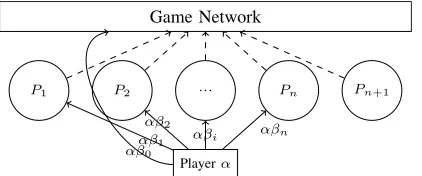
Fig. 1: The CPS game setup ofn+ 1pools with respect to a player
withαfraction of total computational power in the game.
attacks in §VI. We recognize that for a defense to become immediately practical on the existing Bitcoin network, it should be non-intrusive, i.e., should require no incompatibility with the existing Bitcoin protocol—however, our conclusion in achieving a secure solution is still an open problem worthy of future work. Finally, we hope that our work provides a building block for designing cryptocurrencies which support pooled mining natively in their core protocol, unlike Bitcoin. Contributions. To summarize, this work makes the following main contributions:
• Computational Power Splitting Game. We formulate a
new model of distributed computation as a CPS game, in which multiple supervisors compete with each other in exchange for final reward. We pose questions regarding security of protocol, as a game-theoretic analysis. • Analysis of BWH in Bitcoin pooled mining. Applying the
CPS model allows us to systematically study the secu-rity of pooled mining protocols in Bitcoin. We explain why block withholding is well-incentivized for rational miners, providing an algorithmic strategy to gain higher rewards than honest mining. We confirm our findings by experiments running real Bitcoin miners and pools on Amazon EC2.
II. THECOMPUTATIONALPOWERSPLITTINGGAME
A player with non-zero computational power naturally has the ability to choose among different ways of multihoming among pools accessible to him. We intend to analyze strategies for such a player to distribute his power into different pools such that his net reward is maximum. We formulate this prob-lem as a multi-player game where each player independently and anonymously participates in.
A pool is accessible (inaccessible) to the player if he
can (cannot) anonymously join the pool. For simplicity, we consider all inaccessible pools to be grouped into a single inaccessible pool.
TheComputational Power Splitting (CPS)game consists of:
• Computationally Difficult Problem T:A problem that
requires a large amount of computation to solve.
• Partition function φ(T) → {T1, T2, .., Tn}: The
func-tion φ(T) splits T into many smaller tasks Ti, such
that the difficulty of solving T is equivalent to the total difficulty of solving all Ti. For example, in the RSA
Secret-Key challenge, the key value spaceX is split into
various Xi, each of which covers a specific range of
the key space and will be delegated to some particular client to perform the search. Similarly, in crowd-sourced scanner, each client will scan some particular set of program paths to check if one is exploitable. The total number of possible paths may be exponentially large.
• Players:A client with positive computational power is a
player in this game who has a fraction of the total network computational power. In this game, we study the behavior of a miner who has a specific, say,αfraction of the total computational power.
• Information available to all players: There is a finite
set of n+ 1 pools P = {P1, P2, . . . , Pn} ∪ {Pn+1}
where P1, P2, . . . , Pn are accessible pools and Pn+1 is
the inaccessible one to the player. The computational power function cp : P → (0,1] describes the power of each pool as a fraction of the total computational power in the game. Thus, the total computational power in the game is
α+
n+1 X
i=1
cp(Pi) = 1
.
• Actions:For any particular player, aStrategy Distribution
Vector (SDV)β~ = (β0, β1, . . . , βn)is defined such that
(i) the player plays privately with computational power
αβ0,
(ii) for each i∈ {1, . . . , n}, the player mines in pool Pi
with contributionαβi power of the whole network,
(iii) 0≤βi≤1∀ i∈ {0,1, . . . , n} andPni=0βi= 1.
The player moves by choosing an SDVβ~ for one game.
For simplicity, we assume thatβ~remains constant for all
players in one game.
• Payoff Scheme: There is a payoff distribution scheme
applied in a pool where, irrespective of the internal im-plementation, an individual player’s payoff is proportional to the number of smaller tasksTi that he has solved.
• Utility:LetUidenote the random variable describing the
reward the player receives from pool Pi by playing for
one game withβi fraction of his powerα. Let
R=
n X
i=1
Ui
denote the random variable representing total reward for one game for the player. The player’s goal is to maximize the expected rewardE(R).
The CPS game formulation enables us to study a variety of attack strategies that a player can carry out to maximize his profit. Specifically, as a case study in this work, we present a new strategy to utilize theblock withholding attackin
the CPS game:
• A1. Other Players are Honest. The attacker is the only
rational player and hence is carrying out some attack. The rest of the miners will pick the honest strategy, i.e, following the protocol, unless explicitly specified. We discuss effects of relaxing this assumption in Section V. • A2. Known Power Distribution. The computational power
distribution of the game—including the accessibility and payoff mechanism of all the pools—is correctly estimated by the attacker at the start of the game. This is a fairly practical assumption. For example, in Bitcoin, most of the information is publicly available [19] and also easy to estimate by listening on the Bitcoin network for a small period of time.
• A3. Constant power distribution throughout the game.We
assume that the network state stays constant throughout the game. In practice, if there is significant variation in one game, it can be analyzed as multiple smaller games. • A4. Independence of games. We assume that the reward
and the winner in one game have no effect on the outcomes of another game. More specifically, finding a solution in one game does not yield any advantage in wining any subsequent ones.
We do not make any assumption about other properties of the game state, e.g., the total computational power or the problem difficulty remains constant across games. In fact, in Section V, in the case study of Bitcoin pooled mining, we show that these factors do not affect our analysis results significantly. We also demonstrate that our analysis results for Bitcoin pooled mining hold even without the assumptionsA2
andA3.
III. ACASE STUDY OFBITCOIN POOLED MINING A. Background
Mining Bitcoins.Unlike traditional monetary systems, Bitcoin is a decentralized crytocurrency with no central authority to issue fiat currency [20]. In Bitcoin, the history of transactions between users is stored in a global data structure called the
blockchain, which acts as a public ledger of who owns what.
Users perform two key functions: (i) verifying newly spent transactions and (ii) creating a new block (or proof-of-work) to include these transactions. In the Bitcoin protocol, both these functions are achieved via an operation calledmining, in
which aminervalidates the new transactions broadcasted from
other users and in addition solves a computational puzzle to demonstrate a proof-of-work [21], which is then verified by a majority consensus protocol [5]. The first miner to demonstrate a valid proof-of-work is said to have “found a block” and is rewarded a new set of minted coins, which works as an incentive to continue mining for blocks.
In terms of a CPS game, the computationally large problem
T in the Bitcoin protocol is based on the pre-image resistance of a cryptographic hash function SHA-256 [22]. Specifically, the puzzle involves finding a value whose hash begins with some zero bits derived from a variableD, which represents the
global network difficulty. For each block, this value includes the already computed hash for the previous block, information of some transactions and a nonce — the miner’s goal is to find a suitable nonce such that the hash of the corresponding block has at leastf(D)leading zeros [23]. The network self-adjusts
D after every2016blocks found, such that the time to find a valid block is roughly10minutes. Relating to the CPS game model, the search space X of T has the size |X|= 2|f(D)|. At present, f(D) is roughly 70, thus the average hashrate
(H/s—the number of SHA-256 hash computations per second) required to find a block in 10minutes is around1.96×1018
H/s. One can verify that with a standard computer having a hashrate of 1 million H/s, a miner has to mine for on an average of62,000 years to find a block.
Pooled mining.The probability of an individual miner to find a new block every 10minutes is excruciatingly small, which leads miners to combine their computational power into a group orpool. If anyone in the pool finds a block, the block
reward is split among members according to their contributed processing power. This shared mining approach is called
pooled mining, which effectively reduces the uncertainty or
“variance” in the reward for individual miners [12]. Typically, the pool operates by asking its miners to solve easier problems
Ti with a smaller difficulty d(d < D) whose solution, called shares, has probability Dd to be the solution for the new block.
Shares do not have any real value other than acting as the main reference when distributing the reward. For example, instead of searching in a space of size |X|= 270, the pooled miners
only need to search in a smaller space of size |Xi| = 240,
i.e., finding hashes with 40 leading zero bits. Every block is trivially a valid share, because a hash value with 70 leading zeros also has 40leading zeros—however, the probability of a share being a block is 1/230.
When a member in a pool finds a share that is also a valid block, the pool operator submits it to the Bitcoin blockchain and distributes the claimed reward to all miners in the pool. The pool protocol ensures that the work is distributed in a way which prevents miners from directly claiming rewards for found blocks, thereby forcing all rewards to be funneled through the pool operator.1
Payoff schemes in pooled mining. There are multiple ways to design a fair reward distribution system in pooled min-ing [12]. Some of the popular schemes include (i) Pay-per-share (PPS)—where the expected reward per Pay-per-share is paid, (ii) Pay-per-last-N-shares (PPLNS)—the lastN submitted shares
are considered for payment when a block is found. While there are differences among these schemes (and their variations), all of them aim to distribute the reward such that the payoff of an individual miner is proportional to the number of shares he submitted, which in turn is proportional to his individual computational power contributed to the pool.
The main question we study is, given a payoff scheme,
does the miner have incentive to follow the honest mining
strategy—i.e., to honestly contribute all of his available power to pools to maximize his profit? Intuitively, if all pools employ fair protocols and if the miner contributes his complete power to one or more of them, he should receive rewards proportional to his true computational power. We study the correctness of this intuition and whether the attacker can systematically exploit mining pools to extract higher profits.
B. Block Withholding (BWH) attack
Our focus in this paper is on studying the efficacy of one attack strategy called block withholding to gain more reward. When a pool is under BWH attack, the attacker submits all shares he computes to the pool except shares which are also valid blocks. Since these withheld blocks would have directly translated into rewards for the pool, such an attack decreases the overall profit of the pool, thereby decreasing the reward for all individual miners in the pool including the attacker. For example, later in § IV-E, we analytically and experimentally show that miners in a pool with25%of the total computational power in the Bitcoin network will lose10.31%of their reward, if 20% of the pool carries out the BWH attack. Therefore, a naive intuition may suggest that miners do not have any incentive to conduct such an attack. We claim that this intuition is against the rational choice for any miner.
To see if BWH attack is well-incentivized, we consider the two extreme options for a miner—(i) to withhold all blocks or (ii) to submit all found blocks honestly on a pool. In practice, the attacker may withhold some of the blocks he finds and our analysis can be easily extended to model this degree of withholding behavior. With BWH attackers present, the overall efficiency of a pool is no longer proportional to its miners’ actual total computational power—i.e. the overall reward gen-erated by the pool is proportional only to the computational power contributed by honest miners. Nonetheless, the reward earned is shared equitably with all miners, proportional to their submitted shares. This imbalance allows a miner to collect (reduced) reward even from pools in which he withholds. The Block Withholding Attack in the CPS game.To system-atically study the attacker’s advantage, we define a version of the CPS game called the CPS-BWH game. Specifically, the following extension is made to the generic CPS game:
• When the attacker makes a move, in addition to choosing the distribution β~ of his own computational power, he
also decides which pools to withhold in—denoted by the
attack vector ~γ = (γ1, γ2, . . . , γn). The attack vector is
chosen such that γi = 1 if the attacker withholds all
blocks he finds in pool Pi andγi= 0 otherwise.
• All the assumptions stated in A1 — A4 (Section II) are
valid.
The goal is to find the optimal SDV (say)β~a and the attack
vector (say)γ~a, such that the expected gain over honest mining
is maximum. Let Rh denotes the expected reward with the
honest mining strategy, i.e., attack vector ~0. Similarly, let R
denotes the expected reward with the attack vector γ~a. Our
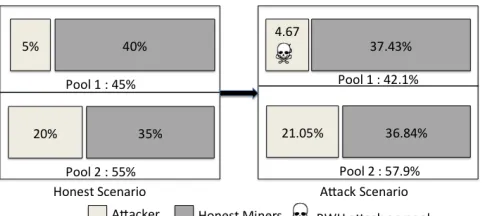
Fig. 2: Simple illustration of the BWH attack: if an attacker with 25% of the mining power of the network attacks Pool 1 with 5% of the network mining power, he gains 25.72% of the reward instead of the expected 25%.
goal is to maximize the expected gain, defined as
∆R=
R−Rh
Rh
.
Incentive for BWH attack. The main insight which incen-tivizes the BWH attack is that Bitcoin mining is azero-sum
game, i.e. to find a block all pools compete and exactly one pool wins by consensus, all others do not get any reward. In this game, although the attacker’s reward drops in the pool being victimized, this loss could be compensated from the reward gained from other pools in which the attacker mines honestly. The victim pool’s loss due to withholding translates into better rewards for other pools competing in the game, since pools with no withholding miners have a competitive advantage of being rewarded a block. Thus, if the attacker mines only on the victim pool, he will definitely share the loss with the pool and earn less reward as in the aforementioned intuition, i.e., the reward protocol is fair and secure in a single supervisor system. However, when he also mines strategically on another pool at the same time, his reward gain from that pool may outweigh his loss on the victim pool and make his overall extra reward positive.
To illustrate this, we show a concrete example (shown in Figure 2) of two pools constituting the Bitcoin network. An attacker with 25% computational power can split his power — 5% to conduct a BWH attack on the first pool, while mining honestly on the second pool with 20%. It is clear that the attacker’s expected reward from the victim pool falls to 4.67%as intuition suggests. However, the total reward earned by other pool increases, as the first pool’s loss shifts to the second pool’s gain, and thus the attacker overall makes more reward.
C. Approach overview
The example above shows the feasibility of a BWH attack. To analyze the scenarios and the extent of damage to pools and honest miners, we study the following research questions in this work.
• Q1. We ask whether the attack is well-incentivized
i.e., whether the attacker always has a strategy to gain more reward than by mining honestly.
• Q2. Given that the BWH attack is well-incentivized,
rational miners will tend to attack the pools to gain extra reward. This raises a question whether the attack is still profitable when the pool is “contaminated” by, say, a factor c, i.e., the BWH miners account for c fraction of the mining power in the pool.
• Q3. We study the best strategy that maximizes the
at-tacker’s expected reward when the attacker attacks one or multiple pools.
• Q4.We seek the stable equilibrium in Bitcoin when block
withholding miners are participating in pooled mining. To answer these questions, we leverage our CPS-BWH game to study the behavior of miners. In this game, a miner is considered to be a player, and he makes a move by distributing his power to pools in order to maximize his reward. Our theoretical analysis uses the CPS game formulation to address questions Q1, Q2 and Q3in several attack scenarios in § IV.
To empirically verify our analysis findings, we run experiments in a custom Testnet Bitcoin network on Amazon EC2 using roughly 70,000 CPU-core-hours for several months with a popular Bitcoin client [24], mining software [25] and pool server software [26]. We answer question Q4in § IV-F.
IV. BLOCK WITHHOLDING ATTACKANALYSIS
Analysis overview. We discuss several Block withholding attack scenarios in this section. In what follows, we treatE(R)
as R. Our goal is to find an optimal strategy for the attacker
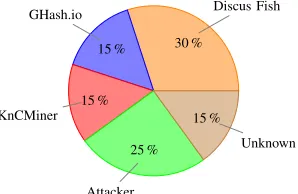
such that his gain in expected reward is maximum. Table I gives an illustrative overview of the attacker gain, given a network distribution before the attack happens (as in Figure 3), in several attack scenarios.
30 %
Discus Fish
15 % GHash.io
15 % KnCMiner
25 %
Attacker
15 %
Unknown
Fig. 3: Mining power distribution before the attack happens. This constructive example is similar to the Bitcoin network state in November 2014 [27].
§ Scenario Victim(s) Rh R ∆R
IV-B One pool Discus Fish 25.00% 25.56% 2.26%
IV-C Multiple pools All,except Unknown 25.00% 26.19% 4.76%
IV-D One
“contaminated” pool Discus Fish,2.5% is contaminated 25.64% 25.86% 0.89%
TABLE I: Example results of several attack scenarios that we study in this paper given the pool distribution as in Figure 3.
In this section and the rest of the paper, for simplicity, we use the term “private mining” to represent the honest mining part of the attacker, which can be from solo mining or joining
a public pool. A careful reader may be concerned about the high variance of reward in solo mining if the attacker’s mining power is not large enough. However, it is easy to avoid that by mining honestly on one pool and carrying out the attack on the target pools to achieve similar expected reward with low variance.
Experiment setup and goals. To support our analysis, we run several experiments in our customized Testnet Bitcoin network using computation resources from Amazon EC2. Each experiment simulates the actual mining in the real Bitcoin network for 2 to 3 months. The details of our experiment setup and methodology are described in Appendix B.
We argue that the empirical validation of Bitcoin attacks is essential to check the correctness of our analysis and to show that our CPS game is faithful to the actual Bitcoin mining software implementation. An algebraic and probabilistic model of computation used in previous work [28] does not capture all the network factors (e.g., geographic placement, latency) and Bitcoin network properties which may considerably affect the validity of the numerical analysis. Thus, to our best knowledge, this work is the first attempt to simulate the exact mining behavior that models the underlying implementation. Moreover, our experiments are motivated by discussions with real Bitcoin pool operators, who suspected that variations in difficulty, distribution of pool power, hashrates, etc., would play a role in the total payoff of the attacker. Our experiments in § V confirm that these intuitive misgivings do not affect results significantly. Thus, our game-theoretic approach is valid to imply practical correctness.
A. Intuition: Bitcoin network as one accessible pool
To demonstrate the intuition behind the BWH attack, we start with a toy attack scenario where the whole Bitcoin network is one large pool accessible to the attacker. We assume that the pool P1 has computational power cp(P1) = 1−α
and naturally the attack vector γ~a = (1). The attacker is the
only rational player in this game, i.e., aware of the BWH strategy and the rest of the players are mining with honest mining strategy. We assume that the attacker attacks with a SDV (1−β, β), i.e., he mines privately with α(1−β) and attacks poolP1withαβfraction of the network computational
power. However, if the attacker were mining honestly, the expected reward would have been directly proportional to his computational power, i.e.Rh=α, no matter how he chooses
the SDV.
In the attack, the fraction of computational power of P1
remains at(1−α), while the reward generated has to be split
with1−α(1−β)fraction of the network. Since only(1−αβ) of the network is actually mining blocks now, the expected reward for the attacker from private mining is
R0=
α(1−β)
1−αβ .
0 0.1 0.2 0.3 0.4 0.5 0
2 4 6 8 10 12
α- power of the attacker
∆R
-%
extra
re
w
ard
gained
β= 0.5
β= 0.4
β= 0.25
β= 0.2
β= 0.9
β= 0
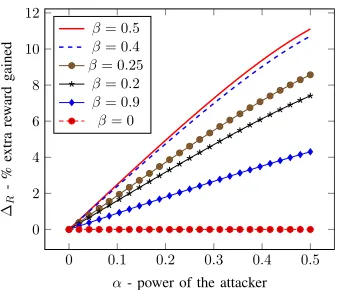
Fig. 4: The attacker’s extra reward (∆R) in the scenario where the
whole network is considered as one public pool. We plot reward gain for severalβto show that the attacker gains maximum reward when β= 0.5.
expected reward for the attacker from the pool is
R1=
1−α
1−αβ ×
αβ
1−α(1−β). Hence the total reward for the attacker is
R=R0+R1= 1−
(1−α)2
(1−αβ)(1 +αβ−α). Comparing the reward after attacking with that of the honest mining, we get
R
Rh
= αβ−αβ
2+ 1
−α
(1−αβ)(1 +αβ−α), and we prove in Appendix C that
∀α, β∈(0,1), R
Rh
>1.
This shows that regardless of his mining power and the strategy vector, the attacker always has an incentiveto carry
a BWH attack in this particular scenario.
We also prove that for β = 0.5, the attacker gains
max-imum relative reward for any α in Appendix C. Thus, by
performing the attack, the attacker of powerαgains maximum
∆R=R/Rh−1 = α−α
2
(2−α)2 more than the original mining2.
More specifically, for α= 0.2, we have ∆R = 0.05, i.e. the
attacker obtains 5% more than mining with honest strategy. We illustrate the percentage of extra reward that the attacker gains corresponding to his power proportion in Figure 4.
Experimental evaluation. We evaluate our results when β= 0.5 for α = 0.2 and α = 0.4. As reported in Section A
of Table V, when α= 0.2, the attacker receives 20.78% of
the network reward, which is close to the 20.98% given by our analysis. Similarly, the attacker receives 43.29% reward, which is 8.2% relatively higher than his honest reward, while controlling only 40% mining power of the network.
2Our result differs here from the previous paper [16], because their analysis overestimatesR1, thus giving imprecise result
B. Multiple pools: attack only one victim pool
We have established that if the attacker can access the whole network, then by spending a fraction of his power for withholding, he can gain extra reward. The intuition behind the result is that the loss of the victim pool, which everyone joins, will go to the private mining part of the attacker. However, in a different attack scenario where part of the Bitcoin network is not accessible to the attacker, or the attacker only wants to attack a specific pool, the loss from the victim pool also pays for the gain of other miners outside the victim pool. Thus, the above result may or may not hold if the attacker spends too much power on attacking the victim pool so that the gain from the private part is not sufficient to compensate for his loss in the victim pool. We study this scenario next.
To study the attack in this particular scenario, we assume that there are two pools—one target poolP1and one
inacces-sible 3 pool P
2. Let the computational power of P1 andP2
be p0 and (1−p0−α)respectively. The SDV is (1−β, β),
i.e. the attacker mines privately with α(1−β) and attacks poolP1withβαfraction of the whole Bitcoin network. Thus,
the computational power of P1 when the attack happens is
p=p0+αβ.
Pool Pool 1 Pool 2 Solo Total
Attacker αβ 0 α(1−β) α
Other miners p0 1−p0−α 0 1−α Pool(s) total p=p0+αβ 1−p0−α α(1−β) 1
TABLE II: Mining power distribution when part of the network is inaccessible to the attacker. Note that0< α, β, p <1.
We now compute the expected reward for the attacker similar to the previous analysis. The reward from honest private mining is:
R0= α(1−β)
1−αβ .
However,P1has to split the reward topfraction of the network
even though onlyp0 =p−αβfraction is legitimately used for actual mining. The reward that the attacker gets from poolP1
is
R1=p−αβ
1−αβ × αβ
p .
The reward Rand the relative gain ∆R for the attacker are
R=R0+R1=−α
2β2+αp
p(1−αβ) ,
∆R=
R
Rh −1 =
αβ(p−β)
p(1−αβ). (1)
From Equation (1), we imply the following results.
Theorem IV-B.1(Always withhold rule). The attacker always
gains more reward by mining dishonestly.
Proof. The attack gains extra reward when ∆R > 0, or
from (1) we havep > β, orβ < 1−p0α. Sincep0>0 &α <1, there always exists β that helps the attacker to gain more
payoff regardless ofαandp0.
(0.25 0.4 0.1) (0.25 0.2 0.2) (0.25 0.2 0.35) (0.3 0.33 0.3) (0.3 0.33 0.4) 20
30 40
25 25 25
30 30
21
.
82 25
.
08
25
.
66 30
.
4
31
.
14
Setting of (α, β, p0)
%
re
w
ard
Rh Rsim.
Fig. 5: Simulated rewardRsimand honest rewardRhof the attacker
αin different CPD-BWH game settings when he spendsαβpower
to attack only one poolp0.
An immediate consequence of Theorem IV-B.1 is that the network state when all players are honest is not a Nash equi-librium. That is, in the Nash equilibrium state, at least some of the miners are withholding, thereby wasting computational resource for competitive gains.
Theorem IV-B.2 (Stay Low rule). The attacker of power α
gains more reward only when the power he spends on BWH attacking a pool less than a specific threshold αβt.
Proof. Equation (1) also shows that the attacker will gain
“negative” extra reward, i.e., start losing, if β > 1−p0α. The
threshold value βtin Theorem IV-B.2 is p
0
1−α.
Theorem IV-B.3 (Target Big rule). The attacker has more
incentive to target big pools than small ones.
Proof. Equation (1) can be rewritten as
∆R= αβ
(1−αβ)−
αβ2
(p0+αβ)(1−αβ).
With a given α, β, it clearly shows that∆R is larger if p0 is
large (sincep0>0), or the pool is big.
Theorem IV-B.4 (Best strategy). There exists aβ that
maxi-mizes the attacker reward.
Proof. We prove that given the attacker power α, the target
pool powerp0, the attacker gets maximum payoff when
β=βmax= −
p
−p02(αp0+α−1))−αp0+p0
α(α+p0−1) ,
if a+p0 <1, otherwiseβ = 1/2.
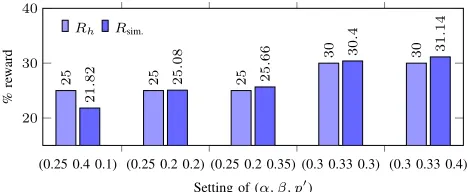
Experimental evaluation. We have run several experiments to simulate different CPD-BWH game settings in which the valueβequal to, less than and greater than the threshold value
p0
1−α. We illustrate our experiment results in Figure 5.
We discuss each of our theoretical results based on our experimental results as follows.
• Stay low rule. Our experiments show that, when β
ex-ceeds the threshold value p0
1−α, the attacker will get less
payoff than from mining honestly. For example, when
p0 = 0.1, β = 0.4, α = 0.25, the attacker receives only 21.82% reward, thus making a relative loss of 12.72%. On the other hand, whenp0= 0.35, α= 0.25, β= 0.2<
0.35
1−0.25 = 0.47, he earns25.65%reward, which is2.64%
relatively more.
• Target bigrule. This rule easily applies to our experiment
results. Specifically, given a specific α= 0.25, β = 0.2,
reward that the attacker earns from carrying out BWH attack is more when target the pool of p0 = 0.35 (R = 25.66%) than to the pool of p0 = 0.2 (R = 25.08%). We experience the same results for the setting of α = 0.3, β= 0.33and two targeted pools of size0.3and0.4. Thus, our experiments support our Theorem IV-B.3. • Always withholdrule andBest strategyrule. Our existing
experimental results for α = 0.25 and α = 0.3 show that the attacker always has incentive to cheat, i.e., BWH attack, the pool if he keeps hisβ smaller than the
thresh-old. TheAlways withhold rule holds in our experiments
although we were not able to split our resource to even finer grained settings, say α= 1%, to intensively verify
them.
C. Mutilple pools: Attack as many as possible
We now consider a general strategy to attack a set of pools such that the SDV is (β0, β1, . . . , βn) and the attack vector
(γ1, γ2, . . . , γn). From § IV-B and § IV-A, one clear intuition
is to attack every pool that the attacker can access. In this section, we formally study the intuition and find the best strategy for the attacker to gain maximum profit.
The expected reward for attacker from poolPi is
cp(Pi)
1−αPn
i=1βiγi ×
αβi
cp(Pi) +αβi
, ifPi is attacked,
αβi
1−αPn
i=1βiγi , if
Pi is not attacked.
Thus the total reward for the attacker is
R=
n X
i=1
cp(P
i)
1−αPn
i=1βiγi ×
αβi
cp(Pi) +αβi ×γi
+ αβi 1−αPn
i=1βiγi ×
(1−γi)
. (2)
Finally, the extra reward that the attacker receives is
∆R=R/Rh−1
= X
1≤i,γi=1
1−αβi
1−αP γi=1βi
×(1αβi(cp(Pi) +αβi−βi)
−αβi)(cp(Pi) +αβi)
= X
1≤i,γi=1
1−αβi
1−αP γi=1βi
×∆i (3)
Note that the term ∆i is the reward gain (∆Ri) that the
attacker gets when he only attacks pool Pi as shown in
Equation (1). Since
∀ βi∈[0,1],
1−αβi
1−αP γi=1βi
≥ 1,
the attacker always gains more reward if he follows the Stay low rule in each pool. From (3), it is clear that attacking
another pool, sayP1, bigger and vice versa. Hence, as proved
in Appendix C.4,∀i γi= 1will give the attacker the maximum
reward, i.e., he is well-incentivized to attack all the pools he can access and privately mine with the rest of his power. However, as explained earlier in this section, if the variance in private mining is a concern, the attacker can honestly mine in one pool and attack the rest.
Thus, the Best strategyproblem is simply finding the
opti-mal SDV(β0, β1, . . . , βn)such thatRis maximum given~γ=
(1,1, . . . ,1). One can use a variety of optimization techniques
to find the optimal value. As an example, we have performed Sequential Least Squares Programming technique [29] with this strategy on the scenario illustrated in Figure 3. We have found that the optimal SDV is
(0.60644771,0.19677677,0.09838776,0.09838776)
i.e., to mine privately with 0.60644771 fraction of the attacker’s power, attack Discus Fish with 0.19677677,
Ghash.io with 0.09838776 and KnCMiner with
0.09838776. The corresponding reward that the attacker receives is 26.19%, which is 4.76% relatively more than his honest reward.
Experimental evaluation. We run an experiment with the above optimal SDV setting and the reward that the attacker of 25% mining power receives accounts for 26.23% of the network reward, which is 4.92% relatively higher than the honest reward. Moreover, our experimental result is close to our analytical result with an experimental error of0.15%(see Section B, Table V).
D. BWH when dishonest miners dominate Bitcoin
In the analysis in § IV-B, we assume that all miners except the attacker are honest. We now consider the case of more than one player being rational and incentivized to carry out the BWH attack. Hence, our attack scenario is quite similar to that in §??with two poolsP1, P2of mining powerp0 and1−
α−p0 respectively, except thatP
1 includes a “contaminated”
or attacking fraction c (0 < c < p0) in its computational power. For simplicity, we also assume that miners in Pool P2
are all honest. Intuitively, the reward when the attacker mines privately honestly is
Rh= α
1−c > α
, since he can enjoy the loss from the contaminated pool. In this section, we ask whether the attacker still gains reward higher than α
1−c by attacking P1. If so, we further study the
validity of Theorems IV-B.1, ??, IV-B.3, and IV-B.4 in this
new scenario.
Our CPS game now has an SDV β~a = (1−β, β)and an
attack vectorγ~a = (1). Thus the power distribution will be as
in Table III.
The analysis is analogous to the previous analyses, but with only(1−αβ−c)power of the network is mining. Thus, the
Pool P1 P2 Solo Total
Attacker αβ 0 α(1−β) α
Other miners
Dishonest c 0 0 c
Honest p0−c 1−p0−α 0 1−α−c
Pool(s) total p=p0+αβ 1−p0−α α(1−β) 1
TABLE III: Mining power distribution while there is other dishonest miners, inP1. Whenc= 0, we have the distribution in § IV-B.
α β c p0 R Rh ∆R
Theory Sim. Sim.
0.2 0.125 0.050.125 0.05 0.350.4 21.32% 20.98% 21.05% -0.33%21.14% 21.27% 21.05% 1.00% 0.25 0.1 0.35 21.08% 20.77% 22.22% -6.43%
0.4 0.125 0.025 0.375 42.29% 42.30% 41.02% 3.33%0.125 0.025 0.325 42.16% 41.74% 41.02% 1.76% 0.25 0.05 0.3 42.64% 41.87% 42.11% -0.57%
TABLE IV: The rewardRand relative reward∆Rgained by attacker
when there is already a “contamination” factor ofcin the pool. We
report the expected (theoretical) results (Theory column) as well as our simulation results (Sim. column) ofRand∆Rin each game.
reward that the attacker will get is as follows:
R0= (1−β)α
1−c−αβ (private mining),
R1=
αβ
p ×
p−αβ−c
1−c−αβ (from poolP1),
R=R0+R1= pα−α
2β2−αβc
p(1−αβ−c) . (4)
Thus, the attacker gets extra reward by conducting a BWH attack when:
R > Rh⇔
pα−α2β2
−αβc
p(1−αβ−c) ≥
α
1−c
⇔β ≤p
0α−c(1−c)
α(1−α−c) . (5)
Equation (5) shows that, if
p0α−c(1−c)≤0, or α < c(1−c)
p0 ,
the attacker will lose out regardless of the strategy that he uses to attack Pool 1. Thus it also shows that, the Always withhold rule in the previous analysis does not hold ifα <
c(1−c)
p0 . However, the following rules still apply and our the experimental results reported in Table IV.
• Stay Low Rule. If β > pα(10α−−c(1α−−c)c), the attacker will get
less payoff than from mining honestly. For example, if
α = 0.20, c = 0.05, p0 = 0.35, the attacker loses his
reward (R = 20.77% < Rh = 22.22%) if he usesβ =
0.25to attack. On the other hand, in the first and second experiment, he still earns more if he attacks with β = 0.125 which is smaller than the threshold in (5). • Target Big Rule. With a givenα, β, c, Equation (4) shows
that R is large if p0 is large, i.e., the pool is big. Thus, the rule still holds. For example, with the same setting of (α = 0.4, c = 0.025, β = 0.125), the attacker gets more reward when targeting a pool with p0 = 0.375 (R = 42.30%) than another one with p0 = 0.325 (R= 41.74%).
0.1 0.2 0.3 0.4
−60
−40
−20 0
p0= 0.1
p0= 0.3
p0= 0p.35 0= 0.4
p0= 0.15
p0= 0.2 p0= 0.3
p0- Pool size before the attack
∆P
-%
re
w
ard
loss
∆P (theory)c= 0.1
∆P (sim.)c= 0.1
∆P(theory)c= 0.05
∆P (sim.)c= 0.05
Fig. 6: The pool’s loss in experiments and in theory for different pool size (p0) and contaminated factor (c).
dishonest strategy for the attacker to maximize his reward. The valueβ for that strategy is the value that maximizes
the Equation (4).
E. Quantifying loss for honest miners
In this section, we discuss the loss of the pool when the BWH attack happens. Intuitively, the pool of size p0, when
attacked by a power of c fraction, will receive only the
following reward:
p0 1−c ×
p0
p0+c ≤p0.
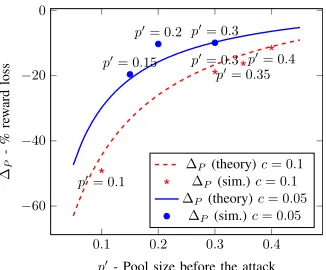
We take the scenario when (α, β, p0) = (0.2,0.25,0.2) as an example. The honest miners in the pool lose∆P = 10.31%of
their reward, although the attacker does not gain or lose any reward. That is because other miners outside the target pool also enjoy the gain, even though they do not attack the pool. We plot the theoretical and experimental loss of the pool in Figure 6.
Although big victim pools bring more reward to the attacker compared to smaller ones, the pool of smaller size will have to bear much more damage than the bigger one. For example, a contaminated factor of c= 0.05causes a 15%-pool around 20% loss in reward, almost twice as much as the 10.31% loss to a 20%-pool.
Relating to current Bitcoin network. Our experiments show that, the pool of size30%(p0 = 0.3)—size of the real biggest pool as of November 2014—will lose9.94% of its reward if attacked with a contamination power of c= 0.05. Given the price of a B is 350 US Dollars in November 2014 and the attack happens for one month, it may cost Discus Fish miners around 1 million USD per month.
F. The Nash Equilibrium
Since we have shown that the BWH attack is profitable and causes a serious loss to honest miners, the implication is that rational miners will be incentivized to form a private group and carry out the attack widely. We study whether there exists a Nash equilibrium with a pure strategy in this game. Specifically, does there exist a deterministic attack strategy for each miner? For sake of simplicity, we assume that the Bitcoin
No. Settings R EErr
#. of blocks
α β p0 c Sim. Theory
A. Bitcoin as one pool
1 0.2 0.5 0.8 0 20.78% 20.98% 0.95% 10929 2 0.4 0.5 0.6 43.29% 43.75% 1.05% 6507
B. Attack multiple pools
1 0.25 Strategy in § IV-C 26.23 26.19 0.15% 2905 1 0.25 Strategy in § V 26.49% N/A N/A 10934
TABLE V: The theoretical and experimental rewards for several experiment settings. The parameters are α: attacker’s power, β:
amount of power that attacker uses for BWH attack, p0: the pool
power before the attack andc: the fraction of BWH attacker already
in the pool.
network comprises of only two accessible pools P1 and P2,
each has only one miner with computational power α1, α2
respectively. We also assume thatP1andP2 are both rational
and motivated to perform the BWH attack on the other pool
withc1(c1< α1)andc2(c2< α2)power. Before each miner
makes a move, the network state is known to everyone. The goal of them is to adjust their attacking powerci properly to
achieve higher reward.
We show that there exists no pure strategy for the miner in this two-pool setting. Thus, this game has only a mixed strategy4 in its equilibrium. For any network state, the miner
always has a strategy for to win back the game. To arrive at this result, we prove the following Theorem IV-F.1.
Theorem IV-F.1. In the two-pool game, given any network
state, if the player i ∈ 1,2 has picked a strategy with
ci fraction of his computational power to attack, then the opponent has a strategy to gain more reward in the game.
Proof. In the two-pool game, given(α1, α2, c2),P1 wants to
determinec1that optimizes his payoutR1, which is computed
in the same fashion as in previous sections:
R1=
1 1−c1−c2
( (α1−c1)
2
α1−c1+c2
+ c1(α2−c2)
α2−c2+c1
).
Similarly, P2 wants to maximizeR2 givenα1,α2, andc1,
R2=
1 1−c1−c2
( (α2−c2)
2
α2−c2+c1
+ c2(α1−c1)
α1−c1+c2
).
As we prove in Appendix C, for any given network state, there exists aci value for the minerPi to increase his reward
Ri and cause the other pool a loss.
Theorem IV-F.1 implies that being honest is not the best strategy in Bitcoin pooled mining. Since there exists a mixed strategy, a fraction of the network is always dishonest (prob-abilistically across many games) and the overall network resource is under-utilized.
V. DO NETWORK STATE AND GAME DURATION MATTER?
This section is partially motivated from our discussion with Bitcoin pool operators to address concerns that variations
in difficulty, distribution of pool power, hashrates and other parameters would not affect our findings.
32,000 34,000 36,000 38,000 40,000 1
1.5 2
·108
Block number
Hashrate
(H/s)
0 0.5 1 1.5 2
Dif
ficulty
D
Hashrate Difficulty
Fig. 7: Hashrate & difficulty of the network in our experiment in § V.
A. Is it necessary to have a constant network state?
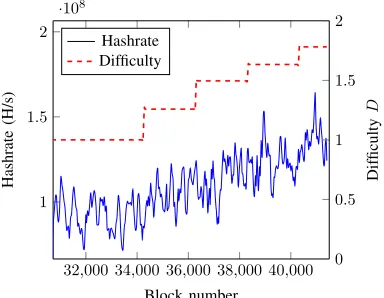
Our aim in this experiment is to show that the attacker gains additional reward even when both the total mining power, the network difficulty, and the power distribution are not stable. We conduct a final set of experiments simulating changes in network. We also show that the attacker only adjusts his power distribution after every change in the network state happens. We only keep the attacker powerαas constant as a fraction of the entire network power, but the difficultyD, the total power, the pool power distribution cp and the vector β~ will change
frequently during this set of experiments. We only use the best strategy vectorβ~ for the attacker initially. When the network
state changes, it takes some time for the attacker to adjust his
~
β. Thus after the first change, the exact power distribution of
the current network is no longer available to the attacker. Typically, we start with the same setup as in § IV-C where the attacker attacks multiple pools and add more mining power to the network for five times. We allocate the additional power to the pools but still keep α= 0.25. We only adjust theβ~ of
the attacker strategy corresponding to the distribution after the
i-th change when the next (i+ 1-th) change happens.
The power and difficulty changes in our experiments are illustrated in Figure 7. The attacker’s power distribution, β~
value, and the attacker’s reward after each change are illus-trated in Figure 8. The attacker always receives more than 25% of the reward has a net gain of 5.96%. This confirms that our assumption about the constant distribution power is fair and practical. Our experimental results also imply two additional important points. First, network state fluctuation does not have any significant impact on the attacker gain, as we expected. Second, since the power distribution change may require the attacker some time to recognize, one “safe strategy” is to set all
βi lower than the value in best strategy and adjust them later
when the attacker is aware of the change. This “safe strategy” will secure the positive gain for the attacker even when he is not able to immediately recognize the power distribution change.
20% 22% 24% 26% 28% 30%
0% 10% 20% 30% 40% 50% 60% 70% 80% 90% 100%
Before
a3ack change 1st change 2nd change 3rd change 4th change 5th change 6th
A"
ac
ke
r Re
w
ar
d
Pro
po
/o
n o
f mi
ni
ng p
ower
Unknown
KNC
Ghash
Discus Fish A3acker
Reward 1
0 0 0 0
0.6 0.2 0.1 0
0.64 0.18 0.09 0.09 0
0.67 0.17 0.08 0.08 0
0.62 0.15 0.08 0.15 0
0.64 0.14 0.07 0.14 0
0.53 0.13 0.13 0.20 0
0.1
Fig. 8: Power distribution, attacker’s strategy and reward vary several times in our experiment. The number in the white box represents theβof the attacker for that pool. The attacker reward, however, is
always greater than the reward he receives when mining honestly.
B. Does duration of BWH attack matter?
In our analysis, we have have ignored the variation in duration of each game and take into account only the profit of the attacker. However, a more meaningful factor to consider is the rate of reward, say per day. Thus, although we have shown that the BWH attack yields a net profit in a game, it is not always the case that the rate of reward is strictly better. In fact, we show that the attacker most likely gains profit by carrying out the attack in a long period of time, but that may not hold in the short term one.
Short-term profit. When BWH attack happens, a fraction of the network is wasted performing the attack, thus taking the network longer to find a block, i.e., finish the game. In fact, the attacker gets better rate of reward in a game only if the condition in Condition V-B.1 holds.
Condition V-B.1. A miner with computational powerαusing
c as the contamination factor to attack will only gain higher rate of reward if the following inequation is satisfied: ∆R
α > c
1−c
Here, ∆R is the extra reward computed in our various
analysis scenarios in § IV. We prove Condition V-B.1 in Appendix C.
Condition V-B.1 implies that in a short period of time, whether the attacker’s rate of reward increases depends on various factors, e.g., c, α, although his reward per game gets
increased.
Long-term profit. We show that, in a longer duration, the BWH attack allows rational miners to gain higher rate of reward. The following theorems establishes the claim.
Theorem V-B.2. Over any fixed number of games, a rational
miner always gains more absolute reward by withholding.
Proof. We have established that there exists a mixed-strategy
game, his total reward in any number of games will be strictly more than that by honest mining.
Note that in a long period of time, the number of blocks mined (or games played) remains constant. This is because Bit-coin is a self- adjusting network, i.e., the difficulty D adjusts after every2,016blocks (~2 weeks), making the average time for a block 10 minutes. This accounts for any computational power lost due to withholding. Therefore, the number of blocks solved in a sufficiently long duration stay constant, which is consistent with the empirical observation [30]. Since the number of games over a given time period (say 3 months) stays constant, Theorem V-B.2 implies that the BWH attack is profitable.
VI. DISCUSSION ONDEFENSES
As the attack becomes better understood it may be popularly used, unless countermeasures are developed. Rational miners will face a troubling choice: mine honestly solo or in private pools with those they trust, or—if dishonest—attack any accessible pool in which honest miners are operating. In this section we first discuss about how to detect a possible BWH attacker in a pool. We then describe several fixes and their drawbacks.
A. Desired properties
In order to determine whether a fix is adequate and practical, we propose a set of desired properties for a pool and a fix. A pool is considered ideal if
• P1.It does not favor either big or small player, and should
treat them equally as long as they are honest.
• P2. It disincentivizes both pool operator and player to drop valid blocks.
The current pooled mining protocol does not satisfy P2, thus
making the fix necessary. We also define several practical properties required in a desirable fix—these are specifically to Bitcoin and may or may not apply in other CPS applications.
• P3. It preserves the existing Bitcoin blockchain.
• P4. It is compatible with existing mining hardware. • P5. It does not affect miners who are not in the pool. • P6. It requires a minor Bitcoin protocol’s change.
• P7. It does not make the pool violateP1orP2.
One possible approach to eliminate the attack and satisfy all properties is to early detect the attacker. We introduce two detection tests using statistics and cross checking technique, then explain why these tests are not robust in Appendix A.
B. Change to payoff scheme
One of the main reasons that make the BWH attack prof-itable is that every share has the same value from the miner’s perspective. Thus, we propose that some shares which are also valid blocks should be considered to be more valuable than others. While this intuition is well founded, the key question is how much more reward is necessary for these shares.
More specifically, we propose to pay x the fraction of the
block reward directly to the block founder. We aim to find
the smallestxthat well-incentivizes the attackers to not drop
blocks. We first prove that this reward scheme is still fair, i.e., proportional to the computational power contribution, in Appendix C. Since the reward for carrying out the BWH attack depends on the amount of computational power αcontrolled by the attacker, it makes sense that xdepends onα. In fact, in Appendix C, we prove thatx=αis the smallest fraction necessary to dissuade an attacker completely. For example, to prevent an attacker with α= 0.25 from withholding blocks, we need to make the valid-block share worthx= 25%of the block reward.
Drawbacks.Although this technique satisfies the above prop-erties P3toP6, it suffers from several drawbacks:
• P1 breaks down: normal shares are worth significantly
lesser. Thus, compared to present experience in pools, variance increases for all pool participants and especially for smaller ones.
• Fundamentally, the technique does not prevent the attack, but merely disincentivizes it. Attackers may have other reasons to attack (such as a desire to discredit the Bitcoin ecosystem by a disapproving state-sponsored actor).
C. Bitcoin protocol with native support for pooled mining
As argued above, changing payoff schemes does not prevent the BWH attack completely. Thus, can we change the Bitcoin protocol to prevent the threat? Despite the fact that the BWH attack has been a controversial topic, some researchers have proposed fixes to mitigate the attack. Till date we know of two proposed solutions, both of which require changes in the proof-of-work (PoW) algorithm [31, 12]. The general idea of these approaches is to not allow miners to recognize which share are valid blocks, thus preventing dishonest miners from withholding block at will.
The first solution is by Luke Dashjr, who proposed to include the next block candidate hash in the PoW of the current block [31]. Thus, the miners never know which share is a valid block until the subsequent block is also found. This solution can defeat the attack but changes the Bitcoin protocol significantly — violating propertyP4andP6, which
the Bitcoin community is highly reluctant to do. Furthermore, it changes the blockchain structure and affects solo miners a lot. For example it takes longer time to validate a transaction now, thus violating propertiesP5.
In [12], Rosenfeld proposes a solution which requires less modification than the above solution by introducing the obliv-ious shareconcept to ensure that miner is unable to determine
if a share is a valid block. More specifically, he suggests a two-part PoW with 3 additional fields to each block, namely
SecretSeed,ExtraHashandSecretHash, in whichExtraHash=
SHA256(SecretSeed). The two-part PoW works as following.
• The hard (public) part.TheExtraHashis included in the
block header which is given to the miner to try all the
Nonce. A hash is a valid share iff it satisfies difficultyd1.
if it satisfies a difficulty d2. If so, the SecretHash is
also a valid block and the operator will broadcast it to the network. Since only the pool operator obtains the SecretSeed, the miners do not know which share is
corresponding to a valid block.
In the above PoW, the total difficulty of both parts d1+d2
is greater or equal to the network difficulty D. Thus, private
mining miners may not need to split the mining into two parts but only set d2= 0 &d1=D to mine as currently.
Drawbacks. We find that this proposal is quite simple and easier to implement. It satisfies all properties mentioned above except the P2, i.e., it is not compatible to the current ASIC
(application-specific integrated circuit) miners [32, 33], which is a substantial mining force in Bitcoin currently.
VII. RELATED WORK
Detection Cheating in Distributed computation. Numerous previous works have considered distributed computation tasks which are not competitive or time-sensitive, and often con-sider a single supervisor system rather than one with many supervisors outsourcing tasks [6]. One practical line of work which focuses more on detecting cheating clients in distributed computation [6, 8, 7]. A complimentary line of work studies the problem of verifiable computing, which enables checking if an arbitrary program has computed correctly from designated inputs using cryptographic constructions or using trusted hard-ware [34, 35, 36, 37, 38, 39, 40]. These techniques can help in ensuring that the pool protocol is strictly followed, disallowing players from diveating from prescribed behavior. In contrast, our work studies the question of eliminating the incentives for cheating by using secure payoff schemes.
Block withholding attacks. BWH attacks have been a subject of a few recent papers. In [12], Rosenfeld et al. discusses
BWH and considers it as a non-incentivized sabotaging attack, simply to sabotage the pool profits. Recently, an initial work by Nicolaset al. showed that the BWH is possibly profitable
and well-incentivized [16]. However, the analysis in [16] is inordinately abstract and an overestimation leads to imprecise results, as we explain in the footnote of § IV-A. Further, their work only analyzes a simplified case where the whole network is one large pool (a special case of our analysis in § IV-A).
We are aware of a recent paper, concurrent and independent to our work, that discusses how pools can use BWH attacks to infiltrate each other [17]. We have privately communicated with the author of [17] in November 2014. The two works are similar—we approach the problem of understanding the incentive structure for miners in an arbitrary CPS game, where the concurrent work aims to calculate infiltration rates of pools at war. Both [17] and our work arrive at some consistent findings, for example, that the honest mining is not the stable equilibrium (§ IV-F) and the amount of loss to pools(§ IV-E). However, our work studies the problem from a different perspective and considers several other scenarios, for example, the general case of attacking multiple pools and when there are multiple dishonest miners in the victim pool.
Our work further explains the temporal conditions under which the attacks are possibly profitable, conduct experimental tests and discuss potential defenses. The work in [17] additionally explains the Nash equilibrium for two pools and multiple pools of symmetric power, which are interesting special cases of the general game.
Other Bitcoin attacks. A number of previous works study non-withholding attacks. Our CPS game model generalizes previous studies and can be useful to systematize the study of these attacks in the future. In particular, in [12] Rosenfeld et al. discusses (i) “pool hopping” in which miners hop across
different pools utilizing a weakness of an old payoff scheme, and (ii) “Lie in wait” attacks where the miner strategically calculates the time to submit the found block. Another line of work studies attacks that subvert the basic guarantees of the Bitcoin consensus protocol, such as preventing double-spending. Eyal et al. introduced “Selfish mining”, where a
pool with more than 1/4th of the total computational power
can subvert the Bitcoin consensus protocol [28], improving over the well-understood51%-attack [41, 42]. Johnsonet al.
distributed denial-of-service (DDoS) attacks between pools, taking a take a game-theoretic approach to understand the economics of DDoS attack [43]. This game-theoretic model is different from our CPS game, since ours is appropriate for studying the incentive structure for individual miners.
VIII. CONCLUSION
In this paper, we introduce a new game called computational power splitting game, which is useful for studying the security of payoff schemes in competitive distributed computation tasks. As a case study, we analyze the susceptibility of existing Bitcoin mining pool protocols. We find that these protocols are insecure against block withholding. Our CPS game model gen-eralizes such reasoning in many other cryptocurrency attacks and is a step towards systematizing the study of such attacks.
IX. ACKNOWLEDGEMENTS
We thank Jason Teutsch, Meni Rosenfeld, Luke Dashjr, Andrew Miller, Jason Hughes, Gregory Maxwell, Ittay Eyal, Alex Cook, and the anonymous reviewers of an earlier draft of this paper for their helpful feedback. This work is supported by the Ministry of Education, Singapore under R-252-000-560-112, Yale-NUS College R-607-265-045-121 and a research grant from Symantec. All opinions expressed in this work are solely those of the authors.
REFERENCES
[1] RSA Secret-Key Challenge. http://en.wikipedia.org/wiki/ RSA Secret-Key Challenge, February 2015.
[2] Bugcrowd - Your Elastic Security Team. https:// bugcrowd.com/, February 2015.
[3] Crowdcurity. https://www.crowdcurity.com, February 2015.