EVALUATION OF DIFFERENT DISPATCHING RULES IN COMPUTER INTEGRATED MANUFACTURING
USING DESIGN OF EXPERIMENT TECHNIQUES
NASRULLAH BIN JAYA
A project report submitted in partial fulfillment of the requirement for the award of the Degree of Master of Mechanical Engineering
Faculty of Mechanical and Manufacturing Engineering Universiti Tun Hussein Onn Malaysia
v
ABSTRACT
vi
ABSTRAK
CONTENTS
TITLE i
DECLARATION ii
DEDICATION iii
ACKNOWLEDGEMENTS iv
ABSTRACT v
ABSTRAK vi
CONTENTS vii
LIST OF TABLES x
LIST OF FIGURES xi
LIST OF ABBREVIATIONS xiii
CHAPTER 1 INTRODUCTION 1
1.1 Research overview 1
1.2 Problem statement 2
1.3 Research objective 2
1.4 Research scope of study 2
1.5 Research Approach 3
CHAPTER 2 LITERATURE REVIEW 5
2.1 Introduction 5
2.2 Reducing Mean Flow Time 5
2.3 Meeting Due Dates 6
2.4 Other studies 7
2.5 Summary on dispatching rules 11
2.6 The simulation model 12
2.7 Model Overview 13
2.8 Detailed Model Description 13
2.8.1 The AS/RS Station 13
2.8.3 CNC Lathe 17
2.9 Model Results 18
2.10 Statistical Analysis of Terminating System 19
2.10.1 Basic Definition 20
2.10.2 The Hypothesis Testing 20
2.10.3 The F-Test : Comparing Variances 21
2.10.4 Calculation Of Effects 22
2.10.5 The Residual Analysis 24
2.10.6 Plot of Normal Probability of Residuals 24 2.10.7 Plot of Residual versus Predicted 24
CHAPTER 3 METHODOLOGY 26
3.1 Flowchart 26
3.2 Factors of interest 28
3.3 Set-up of the run 30
3.4 Characteristics of the system 31
3.5 System Overview in the set-up 32
3.6 Assumptions 34
3.7 Experimental conditions 35
3.7.1 Parts to be produced 35
3.7.2 Due Date Setting 38
3.7.3 Transportation Time 38
3.8 The Performance Measures 39
3.9 Summary 39
CHAPTER 4 RESULT & DISCUSSION 40
4.1 Experimental Results and Analyses 40
4.2 ANOVA on Maximum Queue Length 40
4.3 ANOVA on Machine Efficiency 50
4.4 ANOVA on Total Run Time 58
CHAPTER 5 CONCLUSION & RECOMMENDATION 63
5.1 Conclusions 63
5.2 Contribution of the Research 65
REFERENCE 68
APPENDIX A 69
Table of Full Results from Main Simulation Model Runs 69
APPENDIX B 70
LIST OF TABLES
2.1 Partial Results from the Main Simulation Model Runs 19 2.2 The Analysis of Variance Table for the Three-Factor
Model 23
3.1 Factors-level of the experiment 29
3.2 Set-up of the runs 30
3.3 Level 1 Processing Route 35
3.4 Level 2 Processing Route 36
3.5 Level 3 Processing Route 37
3.6 Production Order for Production Runs 38
LIST OF FIGURES
2.1 Part Flow in the System 12
3.1 Methodology process flow 26
3.2 Overall layout of CIM system 33
3.3 CIM Manager station 33
3.4 Work station 1 33
3.5 Work station 2 34
3.6 Work station 3 34
4.1 Maximum Queue Length – Normal Plot of Residuals 43 4.2 Maximum Queue Length –Residuals vs Predicted 43 4.3 Maximum Queue Length, Number of released parts and
Dispatching Rule with Priority 1 44
4.4 Maximum Queue Length, Number of released parts and
Dispatching Rule with Priority 2 45
4.5 Maximum Queue Length, Number of released parts and
Dispatching Rule with Priority 3 45
4.6 Maximum Queue Length, Number of Part Release and
Number of Priority with FIFO Dispatching Rule 47 4.7 Maximum Queue Length, Number of Part Release and
Number of Priority with Max Priority Dispatching Rule 48 4.8 Maximum Queue Length, Number of Part Release and
Number of Priority with SPT Dispatching Rule 48 4.9 Machine Efficiency- Normally Plot of Residuals 52 4.10 Machine Efficiency- Residuals vs. Predicted 52 4.11 Machine Efficiency, Number of released parts and
Dispatching Rule with Priority 1 53
4.12 Machine Efficiency, Number of released parts and
4.13 Machine Efficiency, Number of released parts and
Dispatching Rule with Priority 3 54
4.14 Machine Efficiency, Number of Part Release And
Number of Priority With FIFO Dispatching Rule 56 4.15 Machine Efficiency, Number of Part Release And
Number of Priority With Max Priority Dispatching Rule 56 4.16 Machine Efficiency, Number of Part Release And
Number of Priority With SPT Dispatching Rule 57
4.17 Total Run Time-Normal Plot of Residuals 59
4.18 Total Run Time –Residuals vs. Predicted 60
4.19 Total Run Time, Dispatching Rule and Number of
Priority with Number of Part Release 3 61
4.20 Total Run Time, Dispatching Rule and Number of
Priority with Number of Part Release 8 61
4.21 Total Run Time, Dispatching Rule and Number of
LIST OF ABBREVIATIONS
CIM - Computer integrated manufacturing CNC - Computer Numerical Control FIFO - First In First Out
SPT - Shortest Processing Time
AS/RS - Automated Storage and Retrieval System QC - Quality Control
D.O.E - Design of Experiment EDD - Earliest Due Date NC - Numerically Controlled LPT - Longest Process Time
FMS - Flexible Manufacturing System SPRT - Shortest Remaining Processing Time SIO - Shortest Imminent Operation time WIP - Work-in-process
1
CHAPTER 1
INTRODUCTION
1.1 Research Overview
This research is based on the study of process planning and scheduling in job shop flexible manufacturing systems. Due to production flexibility, it is possible to generate many feasible process plans for each job. The two functions of process planning and scheduling are tightly interwoven with each other. The optimality of scheduling depends on the result of process planning. The integration of process planning and scheduling is therefore important for an efficient utilization of manufacturing resources.
This project need to evaluate planning algorithms, determine appropriate algorithms and suggest better algorithm as a tool to optimize the process planning. Several strategies are provided to improve the performance of the algorithm and proposed algorithm. Extensive computational experiments are carried out to verify the efficiency of our algorithm using OpenCIM software.
OpenCIM is a system which teaches the principles of automated production using robotics, computers and CNC machines. It also allows advanced users to search for optimal production techniques by experimenting with different production techniques. OpenCIM offers a simulation mode in which different production strategies can be tested without actually operating the CIM equipment.
2
result to determine appropriate algorithms for optimization the entire process planning. Finally, better algorithm as a tool to optimize the process planning is suggested.
1.2. Problem statement
Traditional job shop scheduling literature generally assumed that there is a single feasible process plan for each job. This implies that no flexibility in the process plan is considered. Today's many manufacturing systems are becoming increasingly flexible in processing operations. In such systems, most jobs may have a large number of feasible process plans. Although process planning and job shop scheduling are highly related with each other, many prior researches considered them separately or sequentially. Therefore evaluate of appropriate algorithms for optimization the entire process planning can be determine to suggest the better algorithm as a tool to optimize the process planning.
1.3. Research Objective
The objectives of this research are:
1. To evaluate planning algorithms for optimization the process planning
2. To determine appropriate algorithms for optimization the entire process planning 3. To suggest the better algorithm as a tool to optimize the process planning.
1.4. Research scope of study
The target of this study is to evaluate the performance of selected dispatching rules for different operation on the existing CIM facility using a simulation model against different performance measures and to compare the results with the literature.
3
The existing work stations are as follow:
1. An AS/RS Station (Automated Storage and Retrieval System) supplies raw material to the system, stores parts in the intermediate stages of production, and holds finished products using its robot
2. A Machining Station, where materials are shaped. There are a CNC Lathe machine in the system
3. An Assembly and Quality Control (QC) Station for assembly and inspection of parts using vision machine
Each machine station and the QC station have a serving robot and a buffer area to hold jobs that are waiting to be processed. Once a part is released to the system by the AS/RS based on the processes it visits different machines and equipment‟s in the system.
Scheduling rules prioritize these jobs on a machine. It is possible to assign different priority dispatching rules to each machine in the system, however since the interest of this research is to evaluate the performance of each dispatching rule separately, for each simulation run same dispatching rule is assigned to all the equipment‟s in the system.
1.5 Research Approach
The effect of different dispatching rules is studied through the following methodology: 1. Creating a simulation model of the existing CIM system based on the control
logic that describes the operation of the system. In this regard CIM Manager simulator software is used for modeling the CIM system.
2. Using the Design of Experiment (D.O.E) method to set up runs for the experimental study of combinations of number of environment factors in various levels that influence the performance of the selected dispatching rules on the existing CIM system based on the performance measure of interest as the output. 3. Executing the simulation runs created by the D.O.E on the created simulation
4
4. Evaluating and analyzing the performance of the dispatching rules for each set of experiments based on the performance measures through Design Expert software (analysis of the variance) statistical analysis.
5
CHAPTER 2
LITERATURE REVIEW
2.1 Introduction
As was pointed out in the previous chapter, dispatching rules have been used in the last decades to address scheduling problems for their simplicity and ease of use. Dispatching rules are simple algorithms that have been developed to control the production sequences where their performance depends on the performance criteria under consideration and also on the arrangement of the production system.
The body of literature in this area is sometimes contradictory since the experimental settings and assumptions of these studies are often not the same. Consequently, for each CIM there has to be a separate scheduling study to find the best dispatching rule to accommodate the desired measure of performance.
In general, there are two main performance objective categories that dispatching rules should improve, namely to increase productivity and to meet the due date of the job orders. In the following, the literature directly related to these two aspects of production shops will be reviewed.
2.2 Reducing Mean Flow Time
6
Conway (1965a) considered a shop with nine machine groups each with a single machine. In this experiment, he reported results for over 30 dispatching rules. He used four different performance measures in studying the effect of dispatching rules as follow:
1. Work Remaining: The sum of the processing times of all operations not yet completed or in process for all jobs in the shop.
2. Total Work Content: The sum of the processing times of all operations of all jobs in the shop.
3. Work Completed: The sum of the processing times of all completed operations of all jobs in the shop. Work Completed is equal to Total Work Content less Work Remaining.
4. Imminent Operation Work Content: The sum of the processing times of the particular operations for which jobs are waiting in queue.
In total, 16 different priority dispatching rules tested and concluded that the SPT rule performs relatively better than all other rules in general with respect to average job lateness and in-process-inventory for the four methods of due date assignment as described earlier. He stated that “SPT performance under every measure was very good, it was important factors in each of the rules that exhibit are „best‟ performance under some measure, and it is simpler and, easier to implement that the rules that surpass it in performance. It surely should be considered the „standard‟ in scheduling research which candidate procedures must demonstrate their virtue”. This is especially true where minimization of mean flow time is the goal. The SPT rule reduces mean flow time with following method: by giving priority to the jobs with short process times, it accelerates the progress of production of jobs at the expense of some jobs with long processing time. This way, in total the maximum queue length is reduced, but jobs with long processing time face long waiting times.
2.3 Meeting Due Dates
7
performance measures have also been used such as job lateness and production cost. In general terms, job lateness is the difference between the job completion and its due date. Furthermore, tardiness is the positive lateness. However it is not only the mean of the performance measure but also its variance that accounts for good performance.
A simulation study by Conway (1965b) studied the jobs‟ tardiness as a performance measure with the use of a simulated production shop and the results of the simulation runs with use of number of different priority rules were compared. The following conclusions were made from the experiment:
1. The mean shop time is directly proportional to the mean number of jobs in the shop
2. FIFO rule resulted in a large proportion of tardy jobs
3. SPT rule got a small proportion of tardy jobs because of its low lateness mean that offsets the high lateness variance
4. EDD rule produced a lower variance of job lateness that FIFO or SPT in all the methods of due date assignment
5. Overall, it concluded that the SPT priority rule exhibited the best performance of all the rules tested with less sensitivity to the degree of congestion in the shop.
2.4 Other studies
Choi (1988) described the use of a physical simulator as opposed to computer simulation as an analysis tool in the evaluation of scheduling dispatching rules in an FMS. The use of a real model has a number of advantages including realism and better visual observation of problems. They modeled an actual FMS which consisted of an automatic storage/retrieval system (AS/RS), a parallel machine center structure including six identical numerically controlled (NC) machining centers, one turning cell including a robot, two vertical NC lathes, a washing station and overhead conveyors
8
Each set was simulated for 140 hours of real time; they concluded that the RANDOM rules had high values of actual system effectiveness and low values of production lateness where the SPT had high values of the actual production output, low throughput and low work-in-process inventory. However no rule was found to be best for all performance measures
Montazeri and Van Wassenhove (1990) have also studied the effectiveness of the scheduling rules for various system performance measures using a discrete event simulator. Their system consisted of three machine families, three load/unload stations, three carriers, and 11 work in process buffer positions. Eleven different part types produced by the system and the weekly production of the system were 199 parts. It was assumed that raw material for the parts is readily available. They assigned the same priority rule in every run for all decision points in the system in order to able to study the pure effect of each dispatching rule separately. The decision points in the system included:
1. Select next part to be processed by the machines 2. Select next part to be moved in the system
3. Select next part to be loaded on carrier from facility
They conclude that the SPT priority rule was the second best priority rule for the system under study in terms of average waiting time. No single scheduling rule was found to improve both average waiting average and variance of a job‟s waiting times. They also concluded that SPT based rules minimize average waiting times and Longest Process Time (LPT) based rules maximize machine utilization. Finally, no single scheduling rule was found to be the winner on all performance measures. They suggested that it is up to the user to choose the scheduling rules based on the performance measure that needs to be improved
9
The proposed sub-problems are as follow:
1. Batching: portioning the required parts by the production plan into subsets of parts
2. Batch sequencing: the most appropriate sequence of the batches 3. Batch linking: the transition from each batch to the next
4. Scheduling parts within each batch
The used a simulation model of an FMS cell three machining centers and a washer. Each machine had an input/output buffer for parts. Pallets carrying parts moved automatically. The performance of ten scheduling rules including FIFO, Shortest Remaining Processing Time (SPRT), RANDOM, Shortest Imminent Operation time (SIO) and EDD was evaluated according to two different criteria: the ratio between batch workloads and the corresponding schedule duration, a measure of the work-in-process (WIP). For each part, the due date calculated by the total work-content (TWK) method. They concluded that EDD provided low idle times and high values for and considered the best dispatching rule where the other rules showed a good performance in only one of the two considered criteria.
Veral (2001) studied the possibility of setting reliable static due-dates through operation flow time analysis in an unbalanced, multi-machine job shop with six machines. Three different dispatching rules were used, FIFO (first come first served), SI (*modification to SPT where it separates late jobs from normal ones and prioritizes each subset according to the SPT rule) and MDD (Modified Due Date: modifies the internal due date of a job to its earliest possible completion time if it is already late) with three different levels of shop tightness. Proportion of tardy jobs, maximum tardiness and machine utilization were among other considered performance measures. Each simulation run consisted of 6000 jobs completion where the data related to the first 2000 jobs were discarded and each simulation run replicated 30 times. It was concluded that the proposed methodology was effective under all levels of due date tightness of due-dates. This study showed the advantages of using static job information as opposed to dynamic shop information in setting due dates.
10
mean flow time, maximum flow time, and variance of flow time, proportion of tardy jobs, mean tardiness, maximum tardiness, and variance of tardiness as performance measures. They ran each simulation for the completion of 2500 job and discarded the first 500 jobs to let the system reach steady state. Twenty simulation replicates were made for each run and the total work-content (TWK) method is used in calculating due date. Furthermore, two FMSs with five and ten machines and two levels of shop utilization of 80% and 95% were used. It was concluded that when using the maximum queue length as the performance measure, SPT is the best job dispatching rule except when the number of machine is 5 and utilization rate is high. Additionally, if considering the proportion of tardy jobs, SPT is the best for most. In general it was found that the choice of the dispatching rule is influenced by factors such as, due-date, process time distribution and utilization at each station
In addition to the analysis of job-dispatching rules in an open shop, they also studied the best job dispatching rule for a job shop and a flow shop with similar system configuration. The results show that if considering the same performance criterion, the best dispatching rule for one system is not necessary the same performance criterion, the best dispatching rule for one system is not necessary the same for the others with reducing the percentage of tardy jobs and minimizing the mean flow time
The objective of the study conducted was to investigate the effect of queue length on five dispatching rules:
1. First in, first out (FIFO)
2. Shortest Processing Time (SPT)
3. Least Work Remaining (LWKR): highest priority is given to job having the least total processing time for all operation yet not performed
4. Total Work (TWK) : highest priority is given to job having the least total processing time for all operations
5. Next Queue Length (NXQL): highest priority is given to the job where the direct successor operation station has shortest queue
11
rule, with more than 600 finished parts for each simulation run. It was found that the SPT rule is the best dispatching rule, when the number of jobs in the system is less than or equal to the number of stations.
Chan (2003) used a simulation model of a FMS to study the possibility of minimization of three performance measures at the same time. To this end, the system was designed in such a way that the dispatching rule will be changed dynamically. Based on the value of the performance measure at the time, the next dispatching rule is selected to improve the worst measure.
The FMS used included five machine workstations and one loading/unloading station. The system had a central buffer area to hold in process jobs. Two AGVs were used for transporting the parts. The jobs arrival time was set to be exponentially distributed; the due date was set based on the TWK method and mean flow time, mean tardiness and mean tardiness and mean earliness performance measures were considered along with 14 dispatching rules including FIFO, SPT and EDD. Each simulation run consisted of 2200 job completion where the first 200 jobs were discarded.
For the experiment without machine breakdown, it was concluded that the best dispatching rule to minimize mean flow time of the jobs is SPT. In addition, the best dispatching rule to get minimum mean tardiness is EDD. Other results showed that this method gives a better overall performance compared to the isolated simple dispatching rule assignment.
2.5 Summary on dispatching rules
12
lower variance off performance measures. As a result, the FIFO rule can be used as reference for studying the performance of dispatching rules so that any rule to be considered effective should be perform better than random selection and thus better than FIFO.
Thus according to the reviewed literature the overall best simple dispatching rules among all other simple rules in order of their performance are SPT, EDD and FIFO. However the selections of a „best‟ priority rule depend on factors such as: “Method of due date setting”, “Tightness of the due dates”, “Level of shop load” and “Type of shop”. As result it is extremely difficult to generalize the conclusions of a simulation study. Due to default setting in OpenCIM software MAX PRIORITY rule replaced EDD rule.
2.6 The simulation model
The complex interaction of modern production and manufacturing systems on the one hand and the high capital costs on the other hand requires good system performances to justify their use. Modeling and analysis are important tools to achieve these goals, however the complexity of modern production systems makes the use of analytical tools more difficult, thus discrete-event simulation remains a tool that is used extensively to analyze and improve manufacturing systems performance.
There are two main types of simulation, terminating and steady-state. In the terminating simulation the model specifies the starting and stopping of each run based on the behavior of the target system and the way it operates. A steady-state simulation, on the other hand, is one in which the outputs of the simulation do not matter where normally a warm-up period is defined to eliminate the effect of the starting condition on the output results.
13
2.7 Model Overview
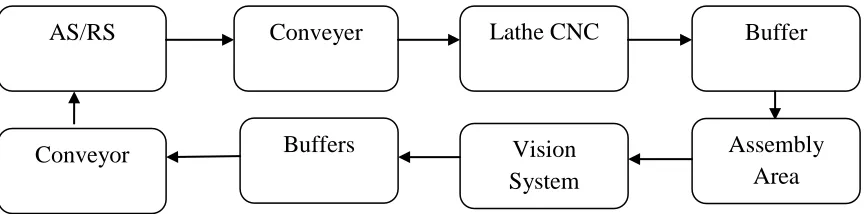
Raw materials are stored in the AS/RS station. Upon start of the production cycle, according to the number of released parts number setup, raw material parts are taken from the AS/RS and put on the conveyer‟s pallet by way of the AS/RS serving robot. The conveyor then delivers the raw material to workstation 1. The part are now taken from the conveyer and put on the workstation 1 buffer by the robot serving that station. The raw materials are then selected from the queue, based on the selected dispatching rule to be processed at the CNC Lathe. Upon completion of this operation, the partially parts are moved to the assembly area and vision system. The robot now puts the finished product back on the workstation 1 buffer. Finally the robot places the finished product on a pallet and the conveyor delivers it back to AS/RS station for final storage. A diagrammatic representation of these tasks is presented in the following figure:
2.8 Detailed Model Description
2.8.1 The AS/RS Station
The load/unload station (AS/RS) is the entrance and exit of simulation model. Figure 2.1 shows the block diagram of AS/RS station. At the beginning entities are created which represent the parts in the system. The Create module is used to generate arrivals of raw material starting at time zero of simulation run. Three separate Create modules exist in the AS/RS, each representing one part type and each creates an equal number of entities.
[image:23.612.114.546.571.678.2]
Figure 2.1: Part Flow in the System
Conveyer Lathe CNC Buffer
AS/RS
Conveyor Vision
System
14
Once created, an entity is sent to an Assign module where five assignments are made. The first is to assign the part to the entity. The part index not only allows to refer to the part type based on the defined part types in the Set data module , but it also allows to refer to the previously defined Part Sequences in the Sequences data module so that the proper sequence will be associated with each part type.
The second assignment is to associate a sequence name with each arriving entity. The assigned sequence names are the same as the ones used in the Sequences data module enabling the part types to get the information of the proper process plan table.
The third assignment is to record the arrival time, the current simulation time, for later data collection.
The fourth assignment is to associate a Process Time period to each arriving entity. This Process time will be used later in the model to decide which part in the queue should be released first in case of SPT dispatching rule.
The fifth assignment is the due date of the entity, which is assumed to be equal for all entities of the same type.
After the Assign module, entities go to the AS/RS station, which represents just one location in the model. The arriving items are then sent to the Hold module. The Hold module holds entities until a matching signal is received from elsewhere in the model. When a matching signal is received , the Hold module releases up to a maximum number of entities based on the specified limit, unless the signal contains additional limit information. As arriving item do not cause a signal to be sent, some other mechanism must be put into the model to cause the start of the first operation.
The Create Scan Entity module, releases only a single entity at time 0. This entity is sent directly to the Hold module that follows. The Scan for Condition Hold module allows holding an entity until the defined condition is true ; at that time, the entity is allowed to depart the module.
15
Batch Size, to be released. This entity then enters a delay module where it waits for three minutes and then the entity is sent to the next signal module to allow the first waiting part at the buffer station to be released and finally it is disposed.
The released entities from the Hold for signal queue will enter the Access module to gain access to the conveyor. Once they gain access to the conveyor they endure a loading delay and finally they are conveyed to the next location in the system based on their process plan. The accumulating conveyor method is used in simulating the conveyor since upon arrival of a pallet at a station for loading or unloading; other pallets keep moving until they are block by the pallet at the station. Upon completion of their processes, entities will return to the AS/RS station (named as Exit System Station) by way of the conveyor. Once they enter the station they endure unloading delay, then signal for the release of the next part to the system, record the required time and are finally disposed.
2.8.2 Workstation 1 Conveyer Station and Buffer
16
In this experiment, as each entity arrives in the system, a due date is assigned to an attribute of that entity. By selecting Low Value First based on the due-date attribute, the EDD dispatching rule is defined. As each successive entity arrives in the queue, it is placed in the position based on the increasing due dates. The same principle is used for the SPT dispatching rule where the Low Value First is used as the queue‟s ranking option based on the entity‟s Process Time attribute.
The capacity of buffer queue is defined by the variable Buffer. This variable is set at the beginning of each simulation run according to the set-up of the experimental design runs. Queued parts wait for the proper signal to be released from the queue according to the defined priority rule in the queue. The initial signal is set by the scanning entity described earlier. Upon receiving the proper signal , the released entity acquires the assistance of the robot , endures the loading delay and is routed to the next destination according to its production plan.
Finished products return to the buffer station and go through the same process as described for the raw material with two major differences. The first difference is the fact that the finished products do not need to wait for a proper signal and they should exit the buffer as soon as possible. The second difference is based on the fact that a separate buffer location is assigned for the final product, yet the buffer is modeled as a resource with the capacity of one and not as a queue. The final product should release this buffer resource before it exit the station. The reason for this difference is twofold. Since there is only once material handling resource available at Cell 1 it is very possible to encounter a deadlock. For this reason the system is modeled based on the Pull strategy, where the final product has the highest priority and entering raw material the lowest priority to receive the robot service. The logic behind this strategy is driven from the fact that since the model is a flow shop there is only one final part that is waiting to exit Cell 1 but there are number of raw materials in the queue waiting to be processed.
17
2.8.3 CNC Lathe
The final set of block diagrams describes the CNC Lathe. The entities normally follow a “seize-hold-released” pattern once they seek the service of a processing unit. The operation is represented by a resource with a certain capacity which should be seized before receiving the required operation. Upon seizing the resource, it will be held for processing based on the specified process time and then it will be released. The time needed for the processing operation is represented by a triangular distribution in the model.
Each machine may have different states, including busy (processing), idle (starved) and blocked. A processing unit is blocked if, after the completion of the current operation, it is unable to pass the part to the next block which may be due to unavailability of the required resource or of the material transporter unit. The following block could be unavailable because it is currently serving another entity or its capacity is reached. In this case the current block must remain idle while it waits for the downstream resource. On the other hand, a current block is starved if an upstream block is currently serving another entity. In other words ,even if operational, a starved station will be idle.
In this research, of particular interest are the blocking and starvation effects, because they are dependent on the buffers and the material handling systems which have a great significance on the performance of the system. Consequently, the capacity of the buffers and material handling systems can be considered as important design factors where a large capacity may increase the in-process inventories and a small capacity may cause the upstream processes to be blocked.
18
necessary to collect the required data about the performance of the CNC machines in the final simulation report.
Next, the entity enters the Seize module and requests robot assistance. Once it has the robot resource, it undergoes a loading delay, releases the CNC Lathe resource, sends the signal to show that the CNC Lathe is available and thus the next part in the buffer queue can be released to gain access of this resource. If the resource is not available, the entity goes through a delay loop until the time that resource becomes free, then the part leaves the decide module. The finished product then goes to the next destination (final product buffer).
2.9 Model Results
19
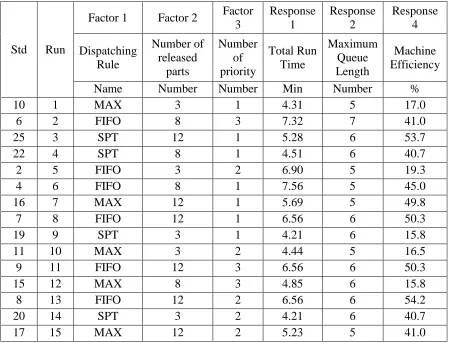
Table 2.1: Partial Results from the Main Simulation Model Runs
Std Run
Factor 1 Factor 2 Factor 3 Response 1 Response 2 Response 4 Dispatching Rule Number of released parts Number of priority Total Run Time Maximum Queue Length Machine Efficiency
Name Number Number Min Number %
10 1 MAX 3 1 4.31 5 17.0
6 2 FIFO 8 3 7.32 7 41.0
25 3 SPT 12 1 5.28 6 53.7
22 4 SPT 8 1 4.51 6 40.7
2 5 FIFO 3 2 6.90 5 19.3
4 6 FIFO 8 1 7.56 5 45.0
16 7 MAX 12 1 5.69 5 49.8
7 8 FIFO 12 1 6.56 6 50.3
19 9 SPT 3 1 4.21 6 15.8
11 10 MAX 3 2 4.44 5 16.5
9 11 FIFO 12 3 6.56 6 50.3
15 12 MAX 8 3 4.85 6 15.8
8 13 FIFO 12 2 6.56 6 54.2
20 14 SPT 3 2 4.21 6 40.7
17 15 MAX 12 2 5.23 5 41.0
2.10 Statistical Analysis of Terminating System
20
2.10.1 Basic Definition
A main purpose of the statistical analysis is to understand the characteristics of collected data(in the case of this study, the performance measures). For this purpose, two measures are usually used; the mean,the variance, the coefficient of variation are described in the following formulas;
Assuming that the number of the replication is n, the mean of the collected data for each design set is:
𝑦 = 𝑛𝑗 =1𝑦𝑖/𝑛 (2.1)
Also, the related variance for each design factors set is calculated as follows:
𝑆2 = 𝑛 𝑦𝑖 − 𝑦 2/(𝑛 − 1)
𝑗 =1 (2.2)
The coefficient of variation (C.V.), the standard deviation expressed as a percentage of the mean is calculated as follows:
C.V= (𝑆/𝑦 ) 𝑥 100% (2.3)
The confidence interval (β) is determined as follows:
𝛽% = 𝑦 ± 𝑐 𝑘, 𝛽 x(𝑠2
𝑛)
1 2 (2.4)
21
2.10.2 The Hypothesis Testing
To ensure the statistical validity of the collected data (from the simulation experiments) for the statistical analysis, hypothesis testing is used. Hypothesis testing is based on establishment of a null hypothesis and search for its either acceptance or rejection. Upon its acceptance, it can be concluded that the simulation model is valid. If it is rejected, then the model is valid. In this study, an F-test Hypothesis testing is conducted. The detail of these tests are described in the following;
2.10.3 The F-Test : Comparing Variances
The F-test is conducted for comparing model variance with residual (error) variance. This is done by calculating the ratio of the Model Mean Square divided by Residual Mean Square. If the variances are close to the same , the ratio will be close to one and it is less likely that any of the factors have a significant effect on the response. This ratio is then compared to a critical F value at a selected level of statistical significance (5% since selected B is 95%) based on the degrees of the freedom of the larger sample variance as the numerator and the degrees of freedom of the smaller sample variance as the denominator. These value can be found from F-tables. Small probability values call for rejection of the null hypothesis.
Null Hypothesis(𝐻0):
𝑆𝑀2 = 𝑆𝑚2 (variances are equal)
Where
𝑆𝑀2the variance of the model
22
Alternative hypothesis (𝐻1):
𝑆𝑀2 ≠ 𝑆𝑚2 (variances are not equal)
The value of the observed f-test is calculated according to the following formula:
F=𝑆𝑀 2
𝑆𝑚2 (2.5)
The null hypothesis is rejected if the F value of the test statistic (observed) exceeds the critical value:
F(observed)>F(critical) (2.6)
Under that condition, the assumption that the variability of the collected data is same in all sets is not satisfied.
Alternatively, it is possible to compare the F value with p-value. The p-value is the probability value that is associated with the F-value , which is the probability of getting an F value of the calculated size if the factor under consideration did not have an effect on the response. Small probability values call for rejection of the null hypothesis. The probability equal the proportion of an area under the curve of the F-distribution that lies beyond the observed F value.
In general, a term that has a probability value less than 0.05 would be considered a significant effect. Normally, a probability value greater than 0.10, is not significant.
2.10.4 Calculation Of Effects
23
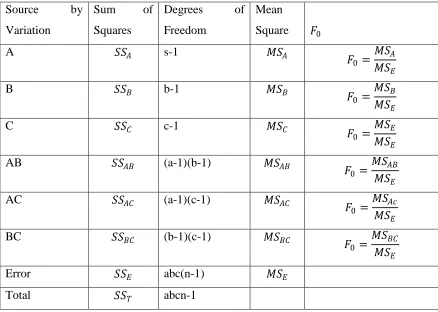
[image:33.612.108.546.214.526.2]factors on the output. However, interactions between more than two factors are assumed to be negligible in this research. The formulation of the analysis of variance for a three factor levels factorial experiment is presented in the Table 2.2 considering a level of factor A, b level of factor B, c level of factor C and n replicates.
Table 2.2: The Analysis of Variance Table for the Three-Factor Model
Source by
Variation
Sum of
Squares
Degrees of Freedom
Mean
Square 𝐹0
A 𝑆𝑆𝐴 s-1 𝑀𝑆𝐴
𝐹0 = 𝑀𝑆𝐴 𝑀𝑆𝐸
B 𝑆𝑆𝐵 b-1 𝑀𝑆𝐵
𝐹0 = 𝑀𝑆𝐵 𝑀𝑆𝐸
C 𝑆𝑆𝐶 c-1 𝑀𝑆𝐶 𝐹
0 =
𝑀𝑆𝐸 𝑀𝑆𝐸
AB 𝑆𝑆𝐴𝐵 (a-1)(b-1) 𝑀𝑆𝐴𝐵
𝐹0 =𝑀𝑆𝐴𝐵 𝑀𝑆𝐸
AC 𝑆𝑆𝐴𝐶 (a-1)(c-1) 𝑀𝑆𝐴𝐶
𝐹0 =
𝑀𝑆𝐴𝑐 𝑀𝑆𝐸
BC 𝑆𝑆𝐵𝐶 (b-1)(c-1) 𝑀𝑆𝐵𝐶
𝐹0 = 𝑀𝑆𝐵𝐶 𝑀𝑆𝐸
Error 𝑆𝑆𝐸 abc(n-1) 𝑀𝑆𝐸
Total 𝑆𝑆𝑇 abcn-1
The analysis of the variance computation are done using a statistics Design of Experiment software package. However, the formulas for the sums of squares are introduced in the following :
The total sum of squares is calculated by the following formula
𝑆𝑆𝑇 = 𝑖=1𝑎 𝑗 =1𝑏 𝑘=1𝑐 𝑙=1𝑛 𝑦𝑖𝑗𝑘𝑙2 − 𝑦⋯2
24
The sums of squares for the main effects are formulated as follows:
𝑆𝑆𝐴 = 1
𝑏𝑐𝑛 𝑦𝑖…
2 𝑎
𝑖=1 −
𝑦….2
𝑎𝑏𝑐𝑛 (2.8)
𝑆𝑆𝐵 = 1
𝑎𝑐𝑛 𝑦.𝑗 .. 2 𝑏
𝑗 =1 −
𝑦….2
𝑎𝑏𝑐𝑛 (2.9)
𝑆𝑆𝐶 = 1
𝑎𝑏𝑛 𝑦..𝑘. 2 𝑐
𝑘=1 −
𝑦….2
𝑎𝑏𝑐𝑛 (2.10)
Finally , the sums of squares of two factor interactions are calculated as:
𝑆𝑆𝐴𝐵 = 1
𝑐𝑛 𝑦𝑖𝑗 ..
2 𝑏 𝑗 =1 𝑎
𝑖=1 −
𝑦….2
𝑎𝑏𝑐𝑛 − 𝑆𝑆𝐴− 𝑆𝑆𝐵 (2.11)
𝑆𝑆𝐴𝐶 = 1
𝑏𝑛 𝑦𝑖.𝑘.
2 𝑐 𝑘=1 𝑎
𝑖=1 −
𝑦….2
𝑎𝑏𝑐𝑛 − 𝑆𝑆𝐴− 𝑆𝑆𝐶 (2.12)
𝑆𝑆𝐵𝐶 = 1
𝑎𝑛 𝑦.𝑗𝑘 .
2 𝑐 𝑘=1 𝑏
𝑗 =1 −
𝑦….2
𝑎𝑏𝑐𝑛 − 𝑆𝑆𝐵− 𝑆𝑆𝐶 (2.13)
2.10.5 The Residual Analysis
The use of the ANOVA analysis method requires the certain assumptions be satisfied. The validity of the results can be checked by the examination of residuals. The residual for observation j in treatment i is defined as follows :
𝑒𝑖𝑗𝑘 =𝑦𝑖𝑗𝑘 − 𝑦 𝑖𝑗𝑘 (2.14)
𝑦𝑖𝑗𝑘 is an estimate of the corressponding observation y obtained as follows:
68
REFERENCES
Cagliano, R., & Spina, G. (2000). Advanced manufacturing technologies and strategically flexible Production. Journal of Operations Management, 18(2), 169–190.
Asfahl, C.R. (1992). Robots and manufacturing automation (2nd Ed.). John Wiley & Sons Inc.
Blackstone, J.H., Phillips, D.T., & Hogg, G.L. (1982). State of the art survey of dispatching rules for manufacturing job shop operations. International Journal of Production Research, 20(1), 27-45.
Choi, R.H., & Malstrom, E.M. (1988). Evaluation of traditional work scheduling rules in a flexible manufacturing system with a physical simulator. Journal of Manufacturing Systems, 7(1), 33-45.
Chung, C.A. (2004). Simulation modeling handbook: A practical approach. CRC Press. Conway, R.W. (1965a). Priority dispatching and work-in-process inventory in a job
shop. Journal of Industrial Engineering, 16(2), 123-130.
Conway, R.W. (1965b). Priority dispatching and job lateness in a job shop. Journal of Industrial Engineering, 16(4), 228-236.
Drake, G.R., Smith, J.S., & Peters, B.A. (1995). Simulation as a planning and scheduling tool for flexible manufacturing systems. Winter Simulation Conference, Proceedings of the 27th Conference on Winter Simulation, Arlington, Virginia, USA, 805-812.
Hong, H.C., & Chou, S.H. (2002). Comparing dispatching rules in an open shop-a simulation study. Proceedings of the 2002 IIE Annual Research Conference, (CD-ROM, Paper No. 2082).
Chan, F.T.S; Chan, H.K; Lau, H.C.W; Ip. R.W.L (2003). Analysis of dynamic dispatching rules for flexible manufacturing system. Journal of materials Processing Technology.
69
Holthaus, O., & Rajendran, C. (1997). New dispatching rules for scheduling in a job shop - an experimental study. International Journal of Advanced Manufacturing Technology, 13(2), 148-153.
Jones, A., & Rabelo, L.C. (1998). Survey of job shop scheduling techniques. Gaithersburg, MD: Technical Report, National Institute of Standards and Technology.
Kelton, W.D., & Law, A.M. (1984). An analytical evaluation of alternative strategies in steady-state simulation. Operational Research, 32(1), 169-184.
Mohanasundaram, K.M., Natarajan, K., Viswanathkumar, G., Radhakrishnan, P., & Rajendran, C. (2003). Scheduling rules for dynamic shops that manufacture multi-level jobs. Computer and Industrial Engineering, 44(1), 119-131.
Montgomery, D.C. (2001). Design and analysis of experiments (5th Ed.). John Willey & Sons Inc.
Montazeri, M., & Van Wassenhove, L.N. (1990). Analysis of scheduling rules for an FMS. International Journal of Production Research, 28(4), 785-802.
Nagalingam, S.V., & Lin, G.C.I. (1999). Latest developments in CIM. Robotics and Computer Integrated Manufacturing, 15(6), 423-430.
OpenCIM (2004). OpenCIM Intro and OpenFMS, computer integrated manufacturing for industrial training applications, software version 4.0, user manual. Catalog No. 100094 Rev. E, Intelitek.
Persi, P., Ukovich, W., Pesenti, R., & Nicolich, M. (1999). A hierarchic approach to production planning and scheduling of a flexible manufacturing system, Robotics and Computer Integrated Manufacturing, 15(5), 373-385.
Rajendran, C., & Holthaus, O. (1999). A comparative study of dispatching rules in dynamic flow shops and job shops. European Journal of Operational Research, 116(1), 156-170.
Sabuncuoglu, I., & Lejmi, T. (1999). Scheduling for non regular performance measure under the due window approach. Omega, The International Journal of Management Science, 27(5), 555-568.
70
Theodorou, P., & Florou, G. (2008). Manufacturing strategies and financial performance - the effect of advanced information technology: CAD/CAM systems. Omega, The International Journal of Management Science, 36(1), 107-121.
Tseng, M.C. (2004). Strategic choice of flexible manufacturing technologies. International Journal of Production Economics, 91(3), 223-227.