International Journal of Emerging Technology and Advanced Engineering
Website: www.ijetae.com (ISSN 2250-2459, Volume 2, Issue 4, April 2012)682
Software Testing Strategies and Techniques
Sheetal Thakare
1,
Savita Chavan
2,
Prof. P. M. Chawan
31,2MTech, Computer Engineering VJTI, Mumbai
3Associate Professor, Computer Technology Department, VJTI, Mumbai. 1[email protected]
2
3[email protected] Abstract: This paper discusses different software
strategies such as unit testing, integration testing, validation testing and techniques such as white box and black box testing for conventional and object oriented software development. Strategy provides a guideline to conduct testing. The testing carried out at different stages in software development life cycle is described by the various testing methods.
Keywords: Test cases, integration, cyclomatic complexity, security testing, performance testing, stress testing, recovery testing.
I.
I
NTRODUCTIONA process of executing a program with the goal of finding errors is Software Testing. A Software Testing Strategy helps to convert test case designs into a well-planned execution steps that will result in the construction of successful software. Software testing aims at uncovering the errors in software. So the primary goal of test cases is to derive set of tests that have highest probability of uncovering the errors. Software testing is a series of process which is designed to make sure that the computer code does what it was designed to do. Software testing is a destructive process of trying to find the errors. The main purpose of testing can be quality assurance, reliability estimation, validation or verification.
II.
S
OFTWARET
ESTINGS
TRATEGYTesting is the set of activities that can be planned in advance and conducted systematically. To define these activities templates are provided by different testing
strategies. All the strategies have following
characteristics:
1. A software team should conduct effective formal
reviews. This eliminates many errors before testing starts.
2. Testing begins at component level and works
“outward” towards the integration of entire computer based system.
3. Different testing techniques are appropriate at
different points in time.
4. Testing is conducted by the developer and for large
project, an independent test group.
5. Testing and debugging are different activities, but
debugging must be included in any testing strategy.
For large projects independent test group (ITG) is hired to remove conflict of interest that may be present if software is been tested by developers only. This is because ITG is paid to find errors.
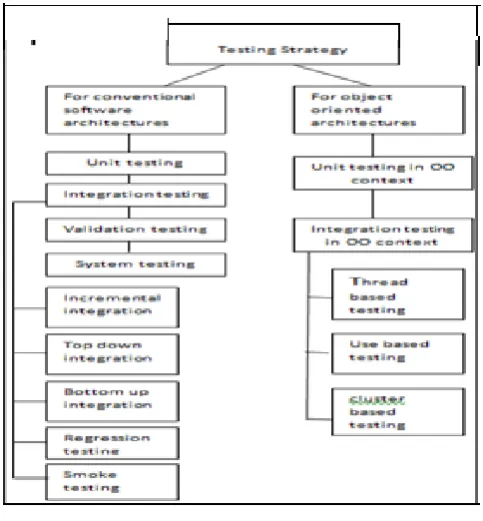
1.1 Strategy for conventional software Architecture Conventional software development is a spiral process. The testing may also be viewed in context of spiral.
2.1.1 Unit testing:
At vertex of spiral, testing begins with unit testing. It aims at testing each component or unit of software to check its functionality, independently. Ensures that it works properly as a unit. Typical units are
Interface: tested to check proper flow of information into
and out of the program unit under test.
Local data structures: tested to check integrity of data
during execution.
Boundary conditions: tested to ensure unit operates
properly at boundaries to limit processing.
Independent paths: tested to ensure all statements in the
unit are executed at least once.
Error handling paths: tested to check whether error
messages are user friendly and corresponds to error encountered, whether they reroute or terminate process when error occurred.
Common errors found during unit testing are: incorrect
International Journal of Emerging Technology and Advanced Engineering
Website: www.ijetae.com (ISSN 2250-2459, Volume 2, Issue 4, April 2012)683
2.1.2 Integration testing: Further progressing the testing process, these units must be assembled or integrated to form complete software package. So integration testing focuses the problems of verification and construction.2.1.3 Validation testing: Taking one more outward turn along spiral, comes validation testing. It consists of higher order tests using validation criteria defined during requirement analysis phase. This test assures that software meets all functional, behavioral and performance requirements.
1.2 Strategy for object oriented Architecture
Strategy for object oriented Architecture are:
2.2.1 Unit testing in Object oriented context
Concept of unit testing in OO context differs from conventional approach. Operation is the smallest unit of testing. As here operation may be inherited, it will have different context in different classes. So unit testing for OO software is driven by operations encapsulated by the class and state behavior of the class.
2.2.2 Integration testing Object oriented context
Three approaches used are:
Thread based testing- threads are sets of classes in OO approach. All the classes responding to one input or event form a set. Each thread is tested individually.
User based testing- focuses on independent classes. These classes don’t collaborate with other classes. Then dependent classes, those which use independent classes, are tested.
Cluster testing- collaborating classes form a cluster, this testing is used to uncover errors in the collaboration.
2.2.3 Validation Testing: It follows the integration testing. At this level testing procedures are same in conventional as well as OO approach. It focuses on user visible actions and user recognizable output from the system, so that software functions in the way required by customer. All the requirements of the customer are specified in a document called as software requirement specification (SRS).
[image:2.595.319.561.232.493.2]This testing uses SRS’s validation criteria section for reference. This testing also includes alpha and beta tests. Both are performed by users. The reason is developers can never predict or know how user will be really using the software. Alpha testing is done at developer’s place by end-user while beta testing is done by user at user-site.
Figure 1: Software Testing Strategies
III.
S
YSTEMT
ESTINGInternational Journal of Emerging Technology and Advanced Engineering
Website: www.ijetae.com (ISSN 2250-2459, Volume 2, Issue 4, April 2012) [image:3.595.63.268.235.453.2]684
A variation of stress testing called sensitivity testing identifies the data combinations within valid input classes that can cause improper processing. After performing all above tests finally performance test is conducted to check run time performance of software within the context of an integrated system.Figure 2: General classification of tests techniques
IV.
S
OFTWARET
ESTINGM
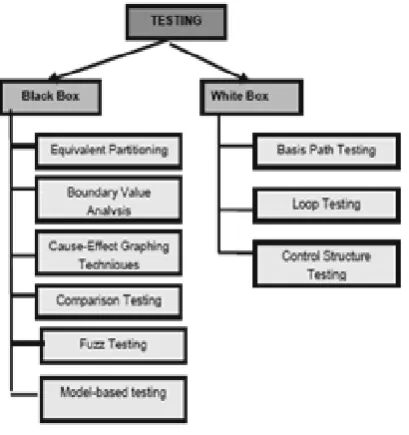
ETHODOLOGIESTo accomplish the goal of finding errors two methodologies are used in conventional as well as object oriented approach: white box testing and black box testing.
White box tests focus on control structure in program, to verify all the statements in program are executed at least once as well as all logical conditions are exercised. It includes basis path testing, condition and data flow testing, program logic and loop testing.
Unlike white box testing Black box testing does not require knowledge of program internal working. Testing is carried out to verify functional requirements. It includes equivalent partitioning, boundary value analysis, fault based testing, random testing, partition testing, cause effect graphic technique.
4.1 White Box Testing
Method is also called as glass box testing. Includes the test cases that guarantee that
1) Independent paths within a module have been
exercised at least once.
2) All logical decisions are tested for their both
sides, true and false.
3) All loops are tested at their boundaries and
within their operational bounds.
4) Internal data structures are ensured for their
validity.
4.1.1 Basic Path Testing: test cases are designed to satisfy goal 1) as listed above. The different techniques used in these tests are:
1. Flow graph notation: Main components of that graphs are:
Node – it represents one or more procedural statements. Node which contains a condition is
called predicate node.
Edges between nodes – represent flow of control. Each node must be bounded by at least one edge, even if it does not contain any useful information. Region – an area bounded by nodes and edges.
Figure 3: Different versions of Flow Graph Notation
2. Independent Paths: The path which includes at least one new set of processing statement or new condition is said to be a independent path. For flow graph, it moves along at least one edge that has not been traversed before the path is defined. For figure 6 independent paths are :
Path 1: 1-2-4-7-8
Path 2: 1-2-3-5-7-8
Path 3: 1-2-3-6-7-8
International Journal of Emerging Technology and Advanced Engineering
Website: www.ijetae.com (ISSN 2250-2459, Volume 2, Issue 4, April 2012)685
How many paths to look for is decided by a software metric called cyclomatic complexity. The value evaluated for cyclomatic complexity defines the number of independent paths in the basis set of a program. For the given graph G, cyclomatic complexity V (G) is equal to:1. The number of regions in the flow graph.
2. V (G) = E - N + 2, where E is the number of edges, and N is the number of nodes.
3. V (G) = P + 1, where P is the number of predicate nodes.
The core of this technique is: one draws the flow graph according to the design or code, one determines its cyclomatic complexity; cyclomatic complexity can be determined without a flow graph in that case one computes the number of conditional statements in the code after that, one determines a basis set of the linearly independent paths; the predicate nodes are useful when necessary paths must be determined at the end, one prepares test cases by which each path in the basis set will be executed. Each test case will be executed and compared to the expected results.
Figure 4: Flow graph
Cyclomatic complexity for flow graph which is represented in Figure 4 is:
V (G) = E – N + 2 = 17 – 13 + 2 = 6. So, the basis set of independent paths is:
Path 1:1-2-10-11-13
Path 2:1-2-10-12-13
Path 3:1-2-3-10-11-13
Path 4:1-2-3-4-5-8-9-2
Path 5:1-2-3-4-5-6-8-9-2
Path 6:1-2-3-4-5-6-7-8-9-2.
4.1.2 Control Structure Testing: test cases are designed to satisfy goal 2) and 3) as listed above. The different techniques used in these tests are:
Condition Testing: tests all logical conditions in program.
Data Flow Testing : test cases are selected as per
locations of definitions and uses of variables in the program
4.1.3 Loop Testing: focuses on validity of loop constructs. There are four types of loops:
a. Simple loops
b. Concatenated loops
c. Nested loops
d. Unstructured loops
a. Simple loops
It is possible to execute the following tests:
1. Skip the loop entirely
2. Only one pass through the loop
3. Two passes through the loop
4. m passes through the loop where m<n
5. N-1, N, N+1 passes through the loop, where n is the
maximum number of allowable passes through the loop. A typical simple loop is depicted in Figure 5.
Figure 5: Simple Loop
b. Nested Loops
If one uses this type of loops, it can be possible that the number of probable tests increases as the level of nesting grows. So, one can have an impractical number of tests. To correct this, it is recommended to use the following approach:
1. Start at the innermost loop, and set all other loops to
minimum values.
2. Conduct simple loop tests for the innermost loop and
International Journal of Emerging Technology and Advanced Engineering
Website: www.ijetae.com (ISSN 2250-2459, Volume 2, Issue 4, April 2012)686
3. Work outward, performing tests for the next loop.
4. Continue until all loops have been tested. A typical
[image:5.595.92.241.194.282.2]nested loop is depicted in Figure 6.
Figure 6: Nested Loop
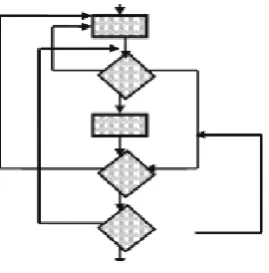
c. Concatenated Loops
[image:5.595.96.195.417.499.2]These loops are tested using simple loop tests if each loop is independent from the other. Otherwise, nested loops tests are used. A typical concatenated loop is presented in Figure 7.
Figure 7: Concatenated Loop
d. Unstructured Loops
[image:5.595.99.234.586.723.2]This type of loop should be redesigned. A typical unstructured loop is depicted in Figure 8.
Figure 8: Unstructured Loops
4.2 Black Box Testing
Method is also called as behavior testing. Finds errors of types Incorrect or missing function, Interface error, Errors in data structures or external database access, behavior or performance of error, initialization and termination errors. White box testing is performed before Black box testing.
4.2.1 Equivalent Partitioning
Divided program input domain into classes of data that consist of set of valid or invalid states for input conditions. Input condition takes the form of one among numeric value, a set of related values, a range of values or a Boolean condition.
4.2.2 Boundary Value Analysis
Most of the errors occur at the boundary values than
center. So this analysis is one of
testing method. Test cases verify program execution at each boundary value and are derived from output domain also.
4.2.3 Cause-Effect Graphing Techniques
Used when one wants to translate a policy or procedure specified in a natural language into software’s language.
Input conditions and actions are listed for a module, an identifier is allocated for each one of them, cause-effect graph is created, this graph is changed into a decision table, and the rules of this table are modified to test cases.
V.
C
ONCLUSIONInternational Journal of Emerging Technology and Advanced Engineering
Website: www.ijetae.com (ISSN 2250-2459, Volume 2, Issue 4, April 2012)687
REFERENCES[1] Introduction to software testing available at http://www.onestoptetsing.com/introduction.
[2] Software testing for Wikipedia available at http://en.wikipedia.org/wiki/grey_box_testing#grey_box_tetsing.
[3] Mohd. Ehmer Khan,”Different Forms of Software Testing Techniques for Finding”, IJCSI International Journal of Computer Science Issues, Vol. 7, Issue 3, No 1, May 2010.
[4] Guide to the Software Engineering Body of Knowledge, Swebok – A project of the IEEE Computer Society Professional Practices Committee, 2004.
[5] “Software Engineering: A Practitioner’s Approach, 6/e; Chapter 14: Software Testing Techniques”, R.S. Pressman & Associates, Inc., 2005.
[6] Myers, Glenford J., IBM Systems Research Institute, Lecturer in Computer Science, Polytechnic Institute of New York, “The Art of Software Testing”, Copyright 1979. By John Wiley & Sons, Inc.
[7] White box testing from wikipedia, the free Encyclopedi.
First Author is MTech student studying in VJTI, Mumbai. She has 9 year of teaching experience in Bharati Vidhyapeeth’s College of Engineering, Navi Mumbai, India.
Second Author is MTech student studying in VJTI, Mumbai. She has 4 year of teaching experience in Yadavrao Tasgoankar College of Engineering, Karjat, India.
Third Author:
Pramila M. Chawan is currently working as an Associate Professor in the Computer Technology Department of “Veermata Jijabai Technological Institute (V.J.T.I.), Matunga, and Mumbai (INDIA)”. She received her Bachelors’ Degree in Computer Engineering from V.J.T.I., Mumbai University (INDIA) in 1991 & Masters’ Degree in Computer Engineering from V.J.T.I., Mumbai University (INDIA) in 1997.