Lancaster University Management School
Working Paper
2007/036
Learning to build a supply network: an exploration of
dynamic business models
Katie Mason and Sheena Leek
The Department of Marketing Lancaster University Management School
Lancaster LA1 4YX UK
© Katie Mason and Sheena Leek
All rights reserved. Short sections of text, not to exceed two paragraphs, may be quoted without explicit permission,
provided that full acknowledgement is given.
The LUMS Working Papers series can be accessed at http://www.lums.lancs.ac.uk/publications/
Submitted to Lancaster University Management School Working Paper Series 4th Oct 2007:
LEARNING TO BUILD A SUPPLY NETWORK: AN EXPLORATION OF DYNAMIC BUSINESS MODELS
Katy. J. Mason
Lancaster University Management School, Lancaster, United Kingdom
Sheena Leek
Birmingham University Business School Birmingham, United Kingdom.
Email: [email protected]
Corresponding email: [email protected]
Department of Marketing
1 LEARNING TO BUILD A SUPPLY NETWORK:
AN EXPLORATION OF DYNAMIC BUSINESS MODELS
ABSTRACT
Firms are confronted with the challenge of learning how to develop and manage supply networks, which reduce their operating costs and maximize their effectiveness in the marketplace. In pursuit of such goals they are increasingly turning to the use of dynamic business models. Dynamic business models represent continuous change and therefore make firms learn constantly new and better ways of doing things. These changes are manifestations of inter-firm knowledge transfer. The aim of this research is to explore dynamic business models as an example of inter-firm knowledge transfer. Adopting a case study approach, we examine three components of dynamic business models, 1) network structure, 2) inter-firm routines and 3) knowledge forms and describe their integration through a problem solving approach to building an offshore supply network. Our empirical findings suggest that dynamic business models help organizations identify and link key actors with each other (at the firm and individual level), and aid the identification and specification of appropriate knowledge types and knowledge transfer mechanisms for different actors, in different contexts.
2 LEARNING TO BUILD A SUPPLY NETWORK:
AN EXPLORATION OF DYNAMIC BUSINESS MODELS INTRODUCTION
Confronted with the challenge of learning how to build supply networks that reduce operating costs and maximize effectiveness in the marketplace firms are increasingly adopting dynamic business models (Schweizer, 2005). Dynamic business models are conceptualized as the emergent outcomes of preconceived network structures built through the development of routines that guide problem solving (Hamel et al., 1994; Morris et al., 2005). Business models
have received much attention in the outsourcing (Fill et al., 2000; Jennings, 2002; Scheuing,
1999), industrial network (Jűttner et al., 2006) and strategy (Morgan, 2003; Quinn, 1999; Wang
et al., 1997) literature. A principal implication of this literature is that dynamic business
models constantly evolve as managers and frontline workers learn new and better ways of doing things (c.f.Hamel, 2000). While there is considerable agreement about the value of dynamic business models (Cohen et al., 2006; Kodama, 2004; Papagiannidis et al., 2005) the
specification of how knowledge is accumulated, shared and applied is less clear.
Learning can be understood as the improvement of practices resulting from knowledge transfer among firms (see for example, Bångens et al., 2002; Brown et al., 1998; Cook et al.,
1999). Learning how to build a supply network requires managers to build problem-solving capability to facilitate improvements to structures and routines within (c.f. Argote, 1982; Argote et al., 2000; Morris et al., 2005; Zollo et al., 2002) and between firms in the supply
network (Möller et al., 2006). In this way, a firm’s ability to co-create and transfer knowledge
within the network seems likely to be central to the building and continuous development of dynamic business models. Yet the concepts of learning and knowledge transfer have not been applied in work that highlights the dynamic character of business models. The aim of this paper is to go some way towards addressing this gap through the exploration of dynamic business models as an illustration of inter-firm knowledge transfer.
3 models; 1) network structure, 2) inter-firm routines and 3) forms of knowledge and describe their integration through a problem solving approach. Specifically, we ask; how is inter-firm knowledge transfer involved in the creation of dynamic business models?
In exploring this question, the paper starts with an examination of previous research to arrive at a conceptualization of the iterative process of building a supply network through the use of dynamic business models. A description of the empirical study is then presented. The discussion of empirical results suggests that different types of knowledge are transferred and co-created through ‘hard’ and ‘soft’ inter-firm knowledge transfer mechanisms. The ‘hard’ and ‘soft’ knowledge transfer mechanisms interact in a way that makes the business model dynamic. Transparency of inter-firm knowledge transfer mechanisms, amongst actors, makes the transfer and co-creation of new knowledge easier. The paper concludes with theoretical and managerial implications of findings.
DYNAMIC BUSINESS MODELS AND INTER-FIRM KNOWLEDGE TRANSFER Dynamic Business Models
With the escalating use of the term ‘business models’ in the business press and increasing recognition of their value as a managerial tool for capturing, sharing and realizing strategic intent, recent research has focused on clarifying the business model concept (Linder et al.,
2000; Morris et al., 2005; Schweizer, 2005). This research is grounded in the observations of
Hamel and Parahald (1994) who identify two cornerstones of business models explored in this literature; 1) structure: how firms perceive the structure of their firm, their business network and their position within it and 2) routines: how firms develop effective operational routines to exploit the potential value of the network.
Structure has been explored from a firm perspective and a network perspective. At the firm level, internal hierarchies, their departments and their functions have been shown to affect organizational efficiency and effectiveness (Hayek, 1945; Kodama, 2004; Wildavsky, 1983). Similarly, at the network level, the way firms identify, interact and exploit network value has been shown to influence organizational performance and learning (Lampel et al., 2003; Möller
et al., 2006). Principally, information and knowledge flows (vertically and horizontally) within
organizational and network structures appear to affect organizational performance (Araujo et
4 In contrast, routines have largely been explored at the level of the firm and focus on the development of a firm’s dynamic capabilities (Salvato, 2003; Zollo et al., 2002;
Zuniga-Vicente et al., 2006). Zollo and Winter (2002: 340) define dynamic capabilities as
“…a learned and stable pattern of collective activity through which the organization
systematically generates and modifies its operating routines in pursuit of improved
effectiveness.”
While the dynamic capabilities literature recognizes that the external environment affects learning (Argote, 1982; Teece et al., 1997), and that routines evolve as a result of dialogue and
interaction within and across units, departments or functions, these studies have not attempted to adopt a network perspective1 or explore how firms co-evolve inter-firm routines within their business network. This observation is important for two reasons. First, it suggests a relationship between the structures and routines captured by a firm’s business model. Second, it suggests a constant and iterative need for creating and sharing ‘know-how’ to drive improvements to both structure and routines (Kogut et al., 1992; Nelson et al., 1982; Teece et
al., 1997; Zahra et al., 2006; Zollo et al., 2002). This makes the business model ‘dynamic’ in a
way that moves beyond the boundaries of the firm. In line with this literature we conceptualized dynamic business models as preconceived organizational and network structures built through the development of interdependent operational and administrative routines that evolve through problem solving activities.
Additionally, the extant literature suggests organizations conceptualize their business models in a sequence; managers first conceive the structure of the network they wish to build (c.f. Morris et al., 2005). Routines are then established to support work and knowledge flows
(Bångens et al., 2002; Brown et al., 1998). Finally, as the networked organizations encounter
problems, problem solving generates the development of knowledge that feeds back into improved structures and routines in a cyclical way. Thus, dynamic business models evolve through inter-firm learning and knowledge transfer (c.f. Zollo et al., 2002).
The dynamic business model sequence described suggests that the way managers model their initial network structure is likely to affect the routines that emerge. For example, the geographically dispersed structure of an offshore business model may result in less frequent face-to-face meetings with senior personnel, supported by frequent and detailed written reports in order to track work-in-progress (WIP). Conceivably, a network structure that encompasses only local firms may evolve different routines for WIP monitoring. In this regard, the initial
5 network structure brings cultural and institutional influences to bear on the application of shared knowledge and practices (Gertler, 2003; Whitley, 2005), that co-evolve through problem solving activities.
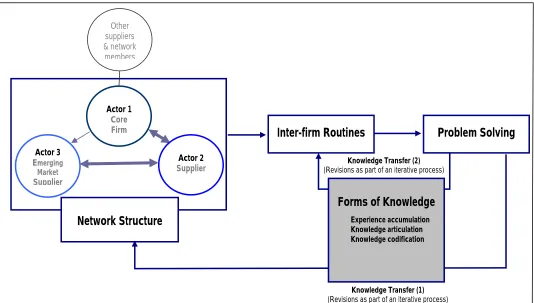
Figure 1. A Dynamic Business Model
Problem Solving in Dynamic Business Models
Problem solving has been a recurrent theme in the knowledge transfer and organizational learning literature (Argyris, 1977; Bångens et al., 2002; Brown et al., 1998; Hayek, 1945).
Argyris, (1977:116) defines learning in terms of problem solving. He explains, “Learning is a
process of detecting and correcting error”. In this way problem solving is manifest in changes
to practices, structures and routines. Problems faced by firms seeking to reduce their cost base might be solved by seeking outsourcing or offshoring activities that change their network structure (see Figure 1. Knowledge Transfer (1)).
Knowledge Transfer (1)
(Revisions as part of an iterative process)
Knowledge Transfer (2)
(Revisions as part of an iterative process)
Inter-firm Routines Problem Solving
Network Structure
Other suppliers & network members
Actor 1 Core Firm
Actor 2 Supplier Actor 3
Emerging Market
Supplier
Forms of Knowledge
• Experience accumulation
• Knowledge articulation
6
Problem Solving and Network Structure
In order for organisations to operate as part of a network, the organisational and network structures need to interact (Araujo et al., 2003). New network structures associated with the
offshore business models may present problems that could be solved by changes to organisational level structures. In this way, organisational structures form the substructures of network structures. Consequently, to maximise the effectiveness of network interactions and the resultant improvements to structure, we need to understand the relationship between inter-firm knowledge transfer and improvements to network structure (see Figure 1; Knowledge Transfer (1)). To date, there has been little research in this area. The research that does exist tends to focus on either: 1) how organisations are structured to facilitate intra-firm learning (see for example, Dunbar et al., 2006; Hayek, 1945) or 2) how networks are structured to facilitate
inter-firm learning. Karamanos (2003), for example, recognizes the value of knowledge transfer within networks and links this to network structures. Despite the valuable contributions from these studies, the interactions within network structures (at the network and organisational level) and inter-firm knowledge transfer has largely been ignored; this represents an important gap in the current literature.
Problem Solving and Inter-firm Routines
Routines have been defined as “a repetitive, recognizable pattern of interdependent actions,
involving multiple actors”, (Feldman et al., 2003:96). Every time a customer places an order, a
series of predictable and interrelated actions are initiated which conclude with delivery. Much effort has been dedicated to exploring and understanding the role of routines in improving organizational effectiveness (Feldman, 2000; Feldman et al., 2003; Nelson et al., 1982).
However, little attention has been given to the role of inter-firm routines that co-evolve as components of the dynamic business model. Consider our example of the Offshore business model. When these new network structures are introduced firms are faced with new problems associated with tracking and monitoring outsourced work. In this context, problem solving drives improvements to inter-firm work-in-progress review routines (see Figure 1. Knowledge Transfer (2)). This is consistent with the description of the knowledge evolution cycle. This cycle models an interactive process of constant improvement from problem identification to evaluation, problem solving and retention through emergent improvement in practice.
7
al., 1994; Zollo et al., 2002). Experience accumulation can be understood as accumulation of
tacit knowledge where knowledge is experiential (Schultz, 2006). Knowledge articulation is concerned with how individuals and groups figure out what does and what does not work. Knowledge codification is the systemisation of understanding the performance implications of specific ways of doing things. Knowledge codification in a network context might take the form of contracts, review procedures or decision support systems. However, the creation and inter-firm transfer of this knowledge requires resources and investment. Zollo and Winter (2002) suggest that problem features (for example, frequency, memory of individuals involved in the task, the costs of coordinating the task) affect the appropriateness of the knowledge form. This suggests that knowledge transfer investments are likely to be an important consideration for firms striving to improve their dynamic business models.
As we have seen, much of this literature suggests a relationship either between structure and knowledge transfer or routines and knowledge transfer. We know very little of inter-relationships between these cornerstones of dynamic business models. Exploration of these relationships may help generate valuable insights into our understanding of inter-firm knowledge transfer. Hence, we ask, how is inter-firm knowledge transfer involved in the creation of dynamic business models? To explore this issue we ask two further questions: What are the types of knowledge that make the business model dynamic? How are these knowledge types transferred between actors within the supply network?
EMPIRICAL STUDY
This longitudinal study was designed to identify and record the types of knowledge that were created and shared between actors, as they learned to build a supply network (Eisenhardt, 1989; Pettigrew, 1990). The study focuses on a single business model of an offshore supply network in the aerospace industry. Using the method of a single case study (Easton, 2003; Flyvbjerg, 2007; Halinen et al., 2005), the exploration of an offshore dynamic business model is likely to
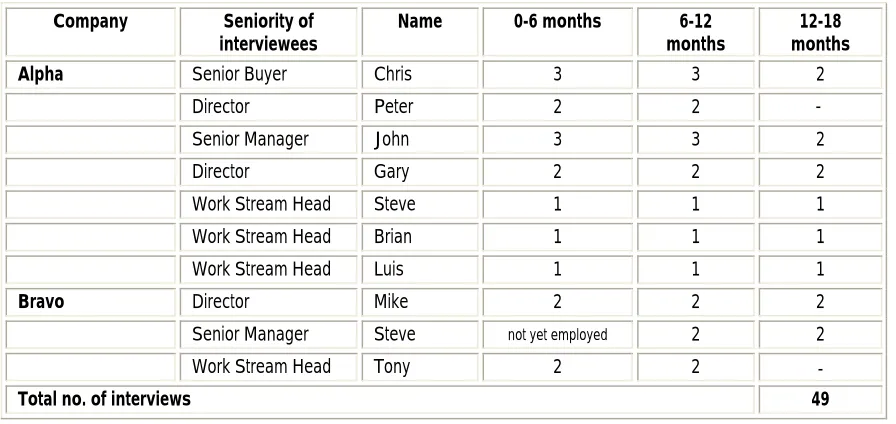
8 agreements with other offshore firms. All firms and employees have been renamed, using the phonetic alphabet, to protect their identity. The collected data included personal interviews, contracts, minutes of meetings, quarterly reports and various procedure and review documents that represented the codified knowledge emerging from interactions between all three firms. Other sources of data included detailed field notes that recorded our impressions from each visit and archive materials. It was a key requirement of the research design to discover who was responsible for developing and managing the business model. Key informants included the heads of each of the key functions involved in the offshore business model, the managers and the heads of each work stream from both Alpha and Bravo (see Figure 3). Thus, directors, middle managers and executives and front-line workers were identified as the most relevant sources as their day-to-day involvement with strategic development and operations cast them in this role (Table 1).
Table 1: Interviews
Company Seniority of
interviewees Name 0-6 months 6-12 months months 12-18
Alpha Senior Buyer Chris 3 3 2
Director Peter 2 2 -
Senior Manager John 3 3 2
Director Gary 2 2 2
Work Stream Head Steve 1 1 1
Work Stream Head Brian 1 1 1
Work Stream Head Luis 1 1 1
Bravo Director Mike 2 2 2
Senior Manager Steve not yet employed 2 2
Work Stream Head Tony 2 2 -
Total no. of interviews 49
As our objective was to generate in-depth insight, more weight was placed on the repeated semi-structured, personal interviews with the above key informants (Yin, 1994). A total of forty-nine interviews were carried out. We developed a guide for conducting the semi-structured interviews based on the conceptualization of the dynamic business model (Figure 1.). The guide helped us explore inter-firm knowledge transfer used for different problem solving activities. We consider the companies’ task of ‘learning to build a supply network’ as a knowledge transfer process in
9 and inter-firm routines that they had recently been involved in establishing and developing. The remainder of the interview consisted of open questions based around the changes made to business practice and why, how, when and with which actors the changes were developed. The interviews covered the same broad issues with each respondent. Respondents were re-interviewed approximately every three months through the period of the study (subject to availability). The geographic distance between the offshore firm, Charlie, and the researchers, made it impossible to secure face-to-face interviews. This meant that we had to rely on second hand reports from Alpha and Bravo respondents and minutes from meetings and procedural documents.
Interviews typically lasted around two hours. They were conducted individually, and were audio-recorded and transcribed. Data analysis placed a significant emphasis on verbatim quotations from informants. All recorded interviews were analyzed via methods of inductive reasoning and comparative methods. Following the procedure recommended by Strauss and Corbin (1998), three types of coding were adopted to analyze the data. First, ‘open coding’ was used to discover and
identify the properties and dimensions of concepts in the data. Second, ‘axial coding’ was employed
to link the core categories together at the level of properties and dimensions. Third, ‘selective coding’
was used as a process of integrating and refining theory. To organize this process, a systematic approach to the analysis of transcripts was adopted in a procedure akin to that of Turner (1981). Analysis was carried out simultaneously with data collection creating an iterative process between interviews, literature reviews and analysis. The case analysis that follows illustrates both successful and unsuccessful knowledge transfer in the building of the supply network.
EMPIRICAL RESULTS
In this section we discuss the empirical findings of the study.
Inter-firm Knowledge Transfer in the Pre-contract Period: Months 0-6
For some years Alpha had subcontracted design engineers from local agencies, at an hourly rate, to cope with the peaks and troughs associated with industry demand. Local agencies supplied locally based design engineers (referred to as “bums on seats”) that were managed
10 countries with a very low cost basis. This faced Alpha with the opportunity and challenge of developing a new network structure through the sourcing of specialist, overseas, design engineering at low variable cost; something they had not previously done. As a result of the make/buy analysis Alpha’s four-stage contract review process was initiated (see Figure 2).
Figure 2. Alpha’s Review Process for Strategic Sourcing
Contract Review Board (CRB)
CRB 1:
Strategy Outline CRB 2: Pre-Negotiation CRB 3: Post Negotiation CRB 4: In Contract Review
Strategic Sourcing process over time
Make/Buy
Analysis RFI RFP Supplier Conference Invitation to Tender Contract Award
Activities that feed into Contract Review Boards
Key:
CRB: Contract Review Board RFI: Request for Information RFP: Request for Progress
The outcome of the first Contract Review Board (CRB1) was to conceptualize an offshore business model for the strategic sourcing of specified design engineering services. Following this review, Alpha identified six potential suppliers from their experience and knowledge of the marketplace. These suppliers were contacted and Alpha personnel spent time with each supplier discussing the broad strategic aim of the offshore business model. Next, CRB 2 was carried out. Using their new knowledge of potential suppliers, Alpha identified their ‘most
desirable outcome’ and their ‘least acceptable alternative’, to create parameters for negotiation
with potential suppliers. Alpha then held a Supplier Conference and asked potential suppliers to demonstrate; 1) their potential to develop a supply network in the medium and long-term, and 2) their ability to manage outsourced work, offshore. Chris [Alpha] explained, “by this
time [the time of the conference] we’d already got our eye on Bravo and [A.N.other], as
possibly the only two [firms] that could really provide a solution…”
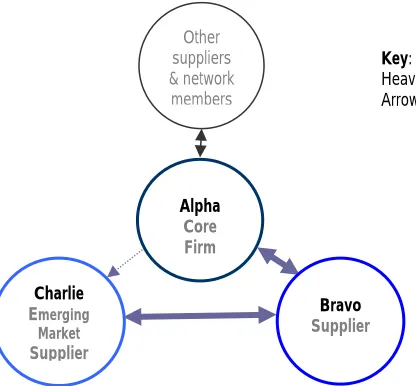
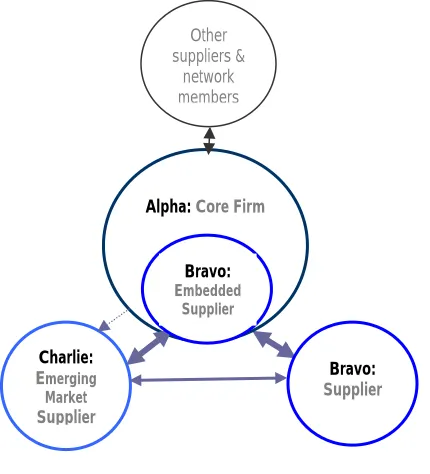
11 illustrated the interactions between the organizations in an attempt to show how the supplier network was going to work. In this sense, the business model was trying to capture the actors’ understanding of the types of knowledge needed and how it will be shared. The network structure represented the ‘hard’ architecture of the business network through which knowledge could transfer (Hasselbladh et al., 2000; Morris et al., 2005).
Figure 3. The Network Structure at the Time of Contracting
A Europe-based provider (Bravo) was awarded the contract nearly six months after the initial approach from Alpha. Gary [Alpha] explained, “In the end there wasn’t really a choice… one
company stood out a mile…”, Chris observed, “They [Bravo] were the only company that got
it”. Alpha felt that the majority of suppliers at the conference did not understand their offshore
business model. Chris commented, “I couldn’t close the gap…I couldn’t get them [the other
suppliers] to grasp the issue of the business model being new and not business as usual.”
Why was this? Interestingly, two suppliers at the conference had previously subcontracted to Alpha through the ‘bums on seats’ approach. They did not appear to accept
Alpha’s new objective, to shift to a long-term relationship approach where interactions between firms would promote joint problem solving. The unsuccessful suppliers remained focused on
‘cost reduction’. This gave Alpha serious quality concerns. Chris explained, “I finished my
presentation with a slide that I overlaid with ‘our reputation in your hands’, but they just didn’t
get it.”
Alpha was using the conference to facilitate interaction and learning between the actors. At this stage the type of knowledge the actors wanted to transfer seemed to be framed around understanding the overall aim of the business model (articulated by Alpha) and how this might
Other suppliers & network members
Alpha Core Firm
Bravo Supplier Charlie
Emerging Market
Supplier
Key:
12 be realized (articulated by the potential suppliers). The business model aim might usefully be labeled as the actors’ need to ‘know-what’ is to be achieved, while the second type of knowledge being sort pertains to the more familiar concept of ‘know-how’(Bångens et al.,
2002; Brown et al., 2000).
As an inter-firm knowledge transfer mechanism, the conference worked well for Bravo and Alpha, but not for the other suppliers. Alpha and Bravo were learning by talking to each other, through social interaction (Amin, 2003). Alpha explained how they codified their aggregated knowledge in criteria for the invitation to tender. The other potential suppliers did not appear to draw on the articulated knowledge at the supplier conference, but instead referred back to their previous experience with Alpha’s historic cost focus. Their previous experience of routine dealings with Alpha was framing the way they interpreted the business model that Alpha tried to present. In contrast, Bravo, used a professional communications company to help codify their ‘know-what’ knowledge of the offshore business model into a detailed tender document. Gary observed that this document had, “a clear and consistent strategic aim
running all the way through it...which closely matched ’what’ we’d been talking about…”
(Emphasis added).
This suggests that Bravo’s investment in the codification of ‘know-what’ and ‘know-how’ put the right type of learning into an effective form for inter-firm knowledge transfer, and thus provided, “a convincing picture… they [Bravo] showed us they knew where we wanted to be,
and that they had some ideas about ‘how’ they were going to help us get there.” (Chris;
emphasis added). Our impression was that Bravo and Alpha had a positive, shared vision. The key actors appeared to like each other and to genuinely want to help each other make the offshore business model work. There seemed to be an acceptance between the actors that both companies were entering “uncharted waters” and that both had to learn.
Bravo’s tender document added details to the business model to include Bravo’s use of an offshore supplier – Charlie. Alpha would put ‘work packages’ to Bravo at a hourly flat-rate for work done, regardless of the work type; Bravo would identify the ‘high-skill’ work, to
be carried out by themselves and the ‘low-skill’ work would be outsourced to Charlie. Bravo
13 An interesting feature of the tender document was that it outlined some of the ‘soft’ inter-firm knowledge transfer mechanisms whereby actors would work together to continue the development of the business model. The objective was to help actors learn from the experiences of each other. This is what Nohria et al. (1997) refer to as the social production of
new knowledge and focuses around the interactions between actors as they support each other in their daily practices. Wenger (1998) labels these social networks of learning as ‘communities of practice’. In our case, we could see an inter-firm community of practice being engineered despite the fact that there would be several hundred miles between the firms. ‘Space’ between actors has become an important focus for researchers endeavoring to understand knowledge transfer (Amin, 2003; Faulconbridge, 2006; Spring, 2003). Principally, Amin (2003) argues that space need not be a barrier to inter-firm knowledge transfer, but that to facilitate knowledge transfer, firms must invest and support geographically dispersed communities of practice.
To engineer a geographically dispersed community of practice Alpha, Bravo and Charlie agreed to each assign a team dedicated to developing the offshore business model. At this point, inter-firm knowledge articulation would become central to building the network. John [Alpha] explained,
“If we’re putting this work out, we can’t just expect them [Bravo and Charlie] to pick
it up. There has to be a learning curve. And we can help them in that… it’s in our
interest.”
14 knowledge transfer rather than as a dichotomy of two distinct mechanisms. This point is further illustrated when we explore the different forms that knowledge takes.
While experience [accumulation] was explicitly recognized as a valuable form of
knowledge, knowledge articulation would take the form of inter-firm reviews and knowledge
codification would result in standard recording procedure documents for shared inter-firm
routines. Inter-firm routines represented the hard inter-firm knowledge transfer mechanisms that would be used in the early stages of the dynamic business model. They represented the manager’s understanding of the types of knowledge needed to be transferred: know-what, and know-how. In this sense, it was easier for the tender document to capture the mechanisms for generating ‘know-what’ and ‘know-how’ but difficult to capture the significance of the deeper learning associated with ‘know-why’. That is, to present justification for the ‘know-how’ decisions. This has important implications for the effectiveness of problem solving as the supply network develops.
The tender document and the following inter-firm discussions provided the grounding for the codification of knowledge into contracts. The contract between Alpha and Bravo specified the broad areas of responsibility and thus the principal interactions between the actors (Figure 3.) for anticipated workloads, flows and types of work. The contractual norms laid down by each organization were used as a framework within which the business model could be developed. The contracts, based on forecasts of workloads and flows, later became problematic because of its rigid nature, as the organizations had little accumulated experience and forecasts proved to be inaccurate. The following section explores a series of problems that emerged as the business model was put into practice, and describes the attempts of the actors to reach solutions.
Problem Solving in the Post Contract Period: Months 6-12
Problem Solving and Structure
Respondents were asked to identify the problems they encountered and the process they went through to solve them. Brian [Alpha] explained the design engineering process for some of the first work packages to come out of his work stream.
“The plan was for [Bravo] to manage the process and return the completed work.
They were to do the investigation, compile the drawing alteration, get the
pre-15
release the definition…They were supposed to do this. The Bravo guys are doing the
work, but we [Alpha] are now managing it because they don’t have the capability.”
Brian identified the need for experience accumulation. He was keen to develop know-how and know-why so that the Bravo engineers would become more independent. To facilitate this, he eventually made changes to the network structure.
“Now we’re having them [Bravo] in with us. They can work more effectively
because they’re in with people they need to ask questions of…” (Brian)
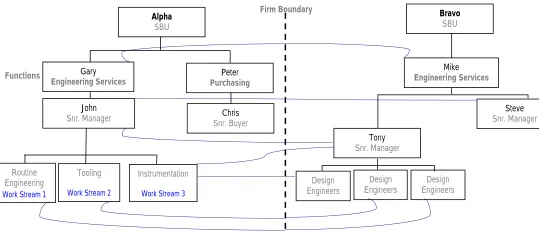
So instead of working remotely, the network structure changed to an embedded structure (Figure 4). These changes took just over six months to institute. By changing the structure,
actors were being asked to change their frames of reference and consequently, this met with resistance. However, with this structural change Bravo design engineers secured access to the Alpha hierarchy. This decision had transferred a different type of knowledge, know-who. The transparent hierarchy enabled them to solve problems directly as they arose, instead of escalating problems up the Bravo hierarchy, then horizontally across to Alpha, before being referred down to Alpha front-line workers. Changes to the hard knowledge transfer mechanisms made the sub-structure of the network more transparent to the actors and enabled them to develop more effective soft knowledge transfer mechanisms by identifying key actors to participate in communities of practice.
The structures of Alpha and Bravo represent the sub-structures of the network. The organizational structures gave individual actors a clear sense of their remit. This appeared to provide a frame within which they felt able to exercise their creativity in problem solving at an intra-firm and inter-firm level. As with Brian’s experience, hierarchical boundaries may disable as well as enable inter-firm knowledge transfer. For this reason, the use of the dynamic business model to identify and develop soft inter-firm knowledge transfer mechanisms can help drive improvements to the network structure. Brian went on to explain,
“We’re not blameless in this. We didn’t identify the behavior and the capability that
was required for the various roles in the process…and all this came out in time”
It could be argued that Brian did not identify the correct type of knowledge needed to make the supply agreement work. The ‘know-what’ was missing. When asked if identifying what needed to be changed had been difficult, Brian agreed,
“Yes … you’re rolling out to new people, it’s a mother hen type of thing, so at first
16 Here, the experience of working with Bravo co-created knowledge regarding how to best develop supplier relationships. Had this knowledge been captured in a way that might be drawn on in the development of future supplier relationships? Brian acknowledged,
“We haven’t done much of that. I would think… [pause] I hope, that Gary is doing that”
[image:18.595.34.573.251.502.2]Gary is Brian’s senior, and as such was thought to hold the responsibility for codifying this knowledge.
Figure 4. Inter-firm Information Flows between Alpha and Bravo
Key:
Horizontal information flows Vertical information flows Firm boundary
The observation that hierarchy influences knowledge flows is further illustrated by a comparison of the hierarchal structure of the Alpha, Bravo and Charlie teams. For example, Gary’s (Director of Engineering Services, Alpha) interactions are predominantly with Mike, (Director of Engineering, Bravo). Mike has a Senior Project Manager, Steve, dealing directly with his equivalent at Alpha and Charlie. Our findings suggest that intra-firm information flows were predominantly vertical, while inter-firm information flows were predominantly horizontal. Hierarchical structures seem to influence both intra and inter-firm information flows and that these structures become the rigid mechanisms for inter-firm knowledge transfer. In other words, the structure represents how and where knowledge transverses firm boundaries
Firm Boundary Units Functions Alpha SBU Peter Purchasing Routine Engineering
Work Stream 1
John
Snr. Manager
Tooling
Work Stream 2
Instrumentation
Work Stream 3
17 (see Hayek, 1945). Building the network structure became part of the knowledge transfer mechanism as well as representing an outcome of inter-firm knowledge transfer as actors made structure improvements to the business model (Figure 1, Knowledge Transfer (1)).
Figure 5. The Network Structure Three Months After Contracting
Another issue raised by Brian’s story is that hierarchical structures seem to be related to where the knowledge is articulated and codified. An example, cited by multiple interviewees was that of access to IT systems. Bravo front-line workers experienced problems accessing Alpha’s computer networks. Initially, each front-line worker, through talking to colleagues, would eventually find the right person to speak to at Alpha, who would then seek authority and come back with the appropriate access rights to solve the problem. This typically took six to nine weeks. As the outsourcing volume grew, the time delay associated with computer access became a major issue. Eventually, senior Alpha team members got involved and codified the procedure. As a result, the time it took to get computer access was reduced to five days. In this case, it appears that at the firm level, the type of problem identified is likely to affect the seniority of the actor most likely to drive business model improvements. At the individual level, hierarchy seems to influence the form of knowledge adopted for inter-firm knowledge transfer by the actor. Knowledge codification happened only when senior managers got involved and was specifically designed to improve the business model in some way.
Other suppliers &
network members
Alpha: Core Firm
Bravo: Supplier Charlie:
Emerging Market
Supplier
Bravo:
18 Respondents were asked to describe the effects that changes made to part of the network, had on other network members. Mike [Bravo] was asked to explain how changes to the network structure had affected Charlie.
“We’ve discussed the learning curve [with Alpha], and in principle they understand
this… they’re directly involved with the training and getting our people and, where
we’ve needed it, the Charlie people, up to speed…and that’s great.” (Mike)
Within six months of Brian’s structural change, Bravo had brought Charlie engineers to their European office for a four-month period, to provide them with experience of inter-firm routines between Alpha-Bravo and the type, quality, and timing of outsourced work to be managed within the Bravo-Charlie relationship. In this regard, the knowledge types identified for transfer were know-how and know-why. This inter-firm knowledge transfer for the most part, took the form of experience accumulation and knowledge articulation. Very little was being invested in knowledge codification by any of the actors at this stage. The industrial network literature explains that problem solving tasks are thought to be performed more efficiently face to face (Morris et al., 2002; Thompson et al., 2002). However, Amin (2003:125) has argued
that “through the varied architectures of modern corporate organization, a rich spatial ecology
of knowledge has become rendered as domestic or relational knowledge and ‘being there’ is no
longer a constraint of geographical proximity or a special property of place.” This apparent
contradiction in the literature goes some way towards explaining the temporal role of face-to-face learning in the initial establishment and development of communities of practice that once initiated through close proximity of actors, can continue to function and develop regardless of spatial change.
Problem Solving and Inter-firm Routines
19 was a quarterly review, including all team members from Alpha and Bravo. Tony explained the objective of the quarterly review as follows,
“If we get everyone together, we can check we’re meeting our objectives, in terms of
quality and deliverables, and if we’ve got the guys managing the work there as well,
we can understand and deal with any issues arising.”
Hence, the hierarchical structure influenced who would be present at the review meetings. The objective was to create an inter-firm review routine that contained enough seniority to effect agreement and improvement. The knowledge transfer focused on know-how and know-why, through knowledge articulation rather than codification. Again here, the interplay between hard and soft knowledge transfer mechanisms makes their separation problematic. The routine review meeting forms part of the hard knowledge transfer mechanisms, while the discussions within the meetings may represent the social production of knowledge.
Some respondents reported their frustrations with these reviews. They felt that, while problems were often identified, prioritized and discussed, discussions where not always acted upon. Perhaps this was because knowledge needed to be re-codified so that protocols relevant to the specific context could be developed. Perhaps re-codification was needed before the various network actors could make improvements. This re-codification would drive changes to the business model, making it dynamic and flexible for problem solving. This suggests that the ‘social’, soft knowledge transfer mechanism was ineffective. Other inter-firm routines were also problematic, for example, Bravo was not being paid on time. These observations illustrate the constant tensions between hard and soft knowledge transfer mechanisms. While hard knowledge transfer mechanisms aim at steady state monitoring and evaluation, the very nature of soft knowledge transfer mechanisms, (in that they tend to create new knowledge that challenges the status quo), necessitates change.
Problems and Problem Solving: Months 6-12
Inter-firm Routine Problems
20
“I was supposed to be delivering to Alpha, [a total solution] and because of the fact
that communications weren’t really happening we didn’t get any targets as such. We
put arbitrary teams in place; we worked them up as best we could. We got the quality
right, the delivery dates we weren’t too sure about so we just put arbitrary teams in
place and there were delays before we actually got to grips with the fact that another
part of Bravo was supplying them…”
The problem was discussed and John (Alpha) and Tony (Bravo) worked with each other and with the units in their respective firms to develop business routines to prevent the reoccurrence of this problem. Had the correct knowledge need been identified? The problem appears to be that Tony did not know what should be happening. Tony again,
“We’ve resolved this [problem] now, and now we talk to Alpha every two weeks…and
we have developed a form that gives us transparency and records all work in
progress, where it resides, responsibilities, time, costs and targets…”
In this case, the problem had significant financial implications for Alpha. Where the costs of error are high the need to institutionalize knowledge in hard knowledge transfer mechanisms, is greater (Lanzara et al., 2007). Alpha and Bravo codified knowledge in order to prevent
re-occurrence of this problem. The transparency afforded daily problem solving facilitated by the embedded structure enabled Tony and John to share experience accumulation and knowledge articulation of their environment. They were able to improve inter-firm routines to increase the effectiveness of the business model. The information flows that the network and organizational structures support, represent the inter-firm routines that begin to emerge. However, where problems did not appear to have significant implications for Alpha, problem solving attempts appeared to be less effective.
One problem, that had little consequence for Alpha was that Bravo was not being paid on time. Alpha engineering units are responsible for confirming work completed and the Alpha procurement function for actioning payment. Constant challenges, regarding evidence of completed work, were made by the procurement function. The problem lay in the tracking work done in a ‘simultaneous engineering environment’. Simultaneous engineering requires
21
“In the design process you have a series of design gates that you go through to make
sure you’re doing the right things at the right time…You’d have a Preliminary Design
Review; the guys would get together and look at very early concepts of what you were
trying to do, and you’d have a couple of senior engineers from [Alpha] and some of our
guys and they’d agree between them - yes, we’re going in the right direction, lets get on
with it. The next review would be a Critical Design Review where you’ve firmed up the
design itself, you’ve got some nice 3D models, and you’ve perhaps done some stress
work, and this is really the final sign-off before you would do all the detailed drawings.
However, because Alpha had previously had problems with the qualities of drawings, Alpha engineers were insisting that all detailed drawings were completed in time for the Critical Design Review. Steve again,
“Some of the large stuff, you can have up to 20 sheets of drawings…If it’s got to be
changed that can be done…. but we had to go back and alter all 20 sheets. That’s a lot
of work being thrown away. And all the time we’ve got our guys [Bravo] looking at
budgets and costs and their [Alpha] engineers insisting that we get up to this level. And
it was causing… well a lot of money was spent.
Steve highlighted the tension between the different roles and objectives of the actors by trying to propose a solution that brought a closer alignment between the two.
“I suggested to Alpha that their engineers should be given some commercial
responsibility. Because what happens, is you get the engineers disease where they want
it completed, polished and just so – and sometimes you’ve just not got the time, You’ve
not the money and if you can get it so that it’s functional, and it does the job… it’s ok.
What happens is that when you get the thing designed, the commercial side is kind-a
left.”. (Steve)
22 Bravo knew that the problem lay in the engineering unit placing a low priority on the tracking paperwork but could not identify an individual actor prepared to institute the required change; perhaps because Alpha knew that Bravo were reluctant to cease supply until payments were made (Alpha were important customers for Bravo). Bravo did not have the transparency of Alpha’s structure beyond the engineering units directly involved in the three work streams. The type of inter-firm knowledge transfer Bravo needed was know-who. In this regard, developing appropriate inter-firm routines to solve this problem required greater structure transparency. This would perhaps allow Bravo to identify appropriate actors to discuss inter-firm routine improvements. This issue highlights a limitation of ‘communities of practice’. Where individuals do not share common practices (for example our engineers and purchasers) they do not appear to co-create solutions and new knowledge. One party can perceive a problem as insignificant, regardless of its importance to other actors. Our finds suggest that where communities of practice do not emerge, hard knowledge transfer mechanisms are put in place,
Problem Solving: Months 12-15
A problem that became prevalent in this period was facilitating network transparency so that the relevant actors had visibility of work-in-progress. Fortnightly meetings with frontline network managers from the different work streams began to incorporate effectiveness measures including, work stream allocation and completion rates, satisfaction with work-in-progress, work completed, and delivery time scales. Changes to inter-firm routines took the form of minor modification. Almost all modifications took place on the basis of knowledge articulation and emerged through the social interaction of actors. This is in keeping with Howard-Grenville’s (2005) observations of flexible routines. That is, actors involved in the routines apply their judgment and choose which aspects of routines to invoke and how to invoke them. Further, these judgments are made, almost exclusively through knowledge articulation. The actors focused on learning know-how and know-why and it appears to be this combination of knowledge types that leads to the development of flexible routines.
Problem Solving: Months 15-18
inter-23 firm routines. The creation of this role was a direct response to some of the problems being faced by the network. Part of Steve’s role was to identify key personnel within Alpha (and other network firms) who might drive change to improve the effectiveness of the offshore business model; in other words, identifying to whom knowledge should be transferred. He
explained how he had tried to persuade Alpha to give Bravo ‘design/make authority’, for a new
work stream. He had been unsuccessful. His argument was that if he had ‘design/make
authority’ he could avoid many current problems. The new inter- firm routines that this would
have created for the procurement function were met with resistance (Uzzi, 1997). The procurement function’s lack of flexibility with inter-firm routines frustrated Alpha’s own objectives as well as those of other actors. Here the hard knowledge transfer mechanisms acted as disablers of knowledge transfer, being rigid and inflexible when the need for change had been identified. Steve described the benefits that might have accrued.
“…, we should have been able to try and bring cost down. I would have liked to have
been able to secure that procurement [the manufacturing of the tooling] and to
manage that on site …..It would have helped us manage the delivery; we could have
controlled it more.”
Being able to identify individual actors, to whom knowledge can be transferred (know-who), seems to be important to the effectiveness of knowledge transfer mechanisms effecting improvements in the business model. Identifying individual actors, within specific functions or units, appears to be an important part of the knowledge articulation and codification. But again a tension can be identified here. The social life of information, as Brown and Duguid (2000), call it, works on the principle that you cannot control and codify the co-creation of new knowledge. Rather the focus of mangers should be on creating learning spaces (Nonaka et al.,
1998) which might be physical (the office), virtual (e-mail, teleconferences) or mental (shared experience, ideas).
The ‘design/make authority’ event described above raises a further issue regarding the
disparate nature of knowledge (Tsoukas, 2000). The objectives of the different functions are conflicting, and in this way do not represent the ‘whole pattern of changes of the larger
economic system’ (Hayek, 1945). Thus, knowledge remains fragmented and dispersed within
24 affects their judgment of how to apply and enforce inter-firm routines. Therefore, they make decisions in the best interest of the procurement functions rather than improvements in the business model. As Hayek (1945) observes,
“…practically every individual has some advantage over all others in that he
possesses unique information of which beneficial use might be made, but of which use
can be made only if the decisions depending on it are left to him or made with his
active cooperation.” (521-522)
It appears that in order for inter-firm routines to stay flexible, frontline actors, (what Hayek (1945) refers to as, “the man on the spot”) operating in communities of practice need to be
empowered to solve their day-to-day operational problems.
CONCLUSIONS AND IMPLICATIONS
This longitudinal study generates insights into inter-firm knowledge transfer through the examination of a dynamic business model incorporating three firms. Inter-firm knowledge transfer was found to play an integral role in making the offshore business model dynamic. The structures, routines and problem solving activities that comprise the business model were found to act as inter-firm knowledge transfer mechanisms for multiple types of knowledge. The analysis of empirical findings has uncovered the need for both ‘hard’ and ‘soft’ inter-firm
knowledge transfer mechanisms to drive improvements to dynamic business models. While structures and routines were found to act as the ‘hard’ inter-firm knowledge transfer mechanisms of the supply network portrayed in the business model, changes to structures and routines were found to be manifestations of soft inter-firm knowledge transfer. These changes represent the realization of skilled performance, learned through situated practice and emulation of experienced performers (Bångens et al., 2002). Soft inter-firm knowledge
transfer mechanisms emerged through the development of inter-firm communities of practice. Thus, the model presented in Figure 1. appears to be representative of the different mechanisms of inter-firm knowledge transfer. The process is initially sequential, beginning with choice of network structure, development of routines, problem identification and ultimately problem solving through iterative change to structure and routines. The cyclical nature of dynamic business models is consistent with knowledge evolution theory both within the firm (Nonaka, 1994; Zollo et al., 2002), between firms (Koza et al., 1998) and across geographic ‘space’
25 learning that emerge as managers discover how to build a supply network. These findings provide a contribution in two key ways.
The first contribution relates to the types of knowledge that are involved in inter-firm knowledge transfer. To-date the knowledge literature has typically focused on two types of knowledge: know-how (Bångens et al., 2002; Brown et al., 2000) and know-why
(Faulconbridge, 2006; Zollo et al., 2002). Adopting a longitudinal, network perspective on
knowledge types our findings revealed that other knowledge types can be fundamental in learning to build a supply network. Specifically, know-what is crucial in developing shared frames of what the supply network is trying to achieve. Similarly, know-who is central to instigating improvements in practice. These findings contribute to a more holistic approach to what inter-firm knowledge transfer might mean for managers learning in networks (Möller et
al., 2006). In this regard, holding a broader set of classification that can be used to identify the
different types of knowledge that firms need, to work effectively together, represents an important contribution to how we understand inter-firm knowledge transfer.
The second contribution relates to how these different types of knowledge are transferred between firms. Two distinct types of knowledge transfer mechanisms are identified: ‘hard’ and ‘soft’. Hard inter-firm knowledge transfer mechanisms act as both enablers and disablers for inter-firm knowledge transfer. Hard mechanisms can be understood as the architecture of the business network that ‘institutionalizes’ how firms interact and learn from each other (Hasselbladh et al., 2000; Morris et al., 2005). This architecture is provided by
26 Our findings suggest that increasing the transparency of hard knowledge transfer mechanisms, (codifying and sharing visible hierarchies across organizational boundaries, explicit allocation of roles and responsibilities, documented procedures and routines) together with the fostering of ‘soft’ knowledge transfer mechanisms might go some way towards addressing this issue.
Hard knowledge transfer mechanisms can lead to what Faulconbridge (2006:537) calls
‘difficulties associated with the implementation of culturally and institutionally sticky best
practice outside the place of production.” That is, the direct application of Alpha routines at
Charlie may not be appropriate, practicable or possible. Hard inter-firm knowledge transfer mechanisms represent ways of circulating knowledge to develop shared best practice. Transparent hard mechanisms make it easier for actors to identify other key actors and develop ‘soft’ knowledge transfer mechanisms through joint problem solving activities.
Soft knowledge transfer mechanisms promote the social production of new knowledge that allows for the development of new ideas and knowledge through social practice. Here, the aim is not to replicate what is being done in other parts of the network, but to learn from others’ ideas and experiences. Our findings show that when learning how to carry out specific
engineering design tasks, social production of knowledge was fostered and individual actors worked together across firm boundaries to identify and solve engineering problems (Nohria et
al., 1997). In this regard, soft inter-firm knowledge transfer mechanisms might be better
understood as the social production of new knowledge rather than knowledge transfer per se.
On one level, two distinct approaches to learning and practice can been identified. Hard knowledge transfer mechanisms allow for the circulation and ‘transfer’ of inter-firm knowledge relating to management practices, while soft knowledge transfer mechanisms foster the social production of new knowledge allowing actors to adapt and apply their learning about specific skill sets (in our case, engineering design) in their own specific cultural and institutional contexts. However, as distinct as the two approaches to learning and practices appear, they also seem difficult to divorce from each other.
Our findings suggest that there is interplay between hard and soft inter-firm knowledge transfer mechanisms. While hard knowledge transfer mechanisms create a framework within which to operate, soft knowledge transfer mechanisms continuously identify ways to change the steady state, thus extending the concept of dynamic capabilities to the wider business network (Möller et al., 2005). This is consistent with the findings of Brown and Duguid (2000)
27
organizational innovation.’ In this way, the design of hard inter-firm knowledge transfer
mechanisms (network structure and inter-firm routines), though necessary, is not by itself sufficient for the production of novelty (Amin, 2003). Rather, the need for firms to foster, support and value the problem solving activities that emerge within the ‘soft’ knowledge transfer mechanism of ‘communities of practice’ seems central to business model improvement. Further, the ‘space’ that these communities of practice inhabit need not be restricted by geography (Faulconbridge, 2006). When Bravo brought Charlie design engineers to their offices to learn about their routines and practices, the continued interaction between them, via email and telephone, bridged the physical space so that problem solving could be continued after their return to Charlie, some thousands of miles away. These observations have two important implications.
First, it highlights the need for networks of firms to jointly foster and support soft knowledge transfer mechanisms beyond each individual firm’s own boundaries, regardless of geographic distance. When our organizations did not value the proposed solutions and
innovations emerging from the inter-firm communities of practice, problems persisted. This is consistent with the works of Wenger (1998), Orr (1996) and Brown and Duguid (2000) who suggest that communities of practice emerge through the support of daily interactions of actors held together by shared purpose and expertise. Amin (2003) suggests ways by which ‘learning in talk’ might be engineered within these communities; away-days, regular meetings and (tele)conferences. This poses significant questions for managers pursuing offshore business models where their focus is primarily on efficiency. The resources and investment required for the promotion and mobilization of communities of practice appears central to the success of the business model, forcing managers to re-evaluate the efficiency versus effectiveness tradeoffs
they might be prepared to make.
28 perhaps not surprising. In line with Zollo and Winter (2002), we found that using knowledge in this way, meant our organizations were focused on building the ‘know-how’ (hard mechanisms) of the business network (Bångens et al., 2002), and failed to capitalize on the
‘know-why’ or ‘know-who’ (soft mechanisms). Know-why is important because it offers firms the advantage of being able to work out when inter-firm routines can simply be adopted and when they need to be adapted and flexible (Argote, 1982; Brown et al., 1997;
Howard-Grenville, 2005). For example, ‘know-why’ might have changed the procurement functions approach to the Bravo payment problem. This contributes to inter-firm knowledge transfer literature by extending our understanding of investments in knowledge transfer mechanisms (Dunbar et al., 2006; Hayek, 1945; Karamanos, 2003).
In sum, our findings suggest that dynamic business models are useful tools for organizations working out types of knowledge that need to be transferred between firms and inter-firm knowledge transfer mechanisms designed to solve inter-firm problems. Detailed dynamic business models allow firms to identify what types of knowledge are needed, where valuable knowledge resides within the network and facilitates the accumulation, sharing and co-creation of new knowledge. As we have seen, the process of conceptualizing and developing a dynamic business model is an inter-firm knowledge transfer initiative itself, but the level of investment in knowledge transfer mechanisms appears to fluctuate depending on time and context. Despite the recognition that a dynamic business model facilitates a high level of investment in knowledge transfer at the start of its operation, it also encourages a continued investment in soft inter-firm knowledge transfer mechanisms to continuously improve network structures and inter-firm routines. This is what makes the business model ‘dynamic’. Hard inter-firm knowledge transfer mechanisms are used to frame how actors
might do things better. Yet our findings suggest that it might be possible for networks to build a competitive advantage, improving effectiveness and efficiency, if they also learn to use soft knowledge transfer mechanisms to understand what, with whom and why the improvements
occurred. An implication of this finding is that firms need to invest in both hard and soft knowledge transfer mechanisms to leverage the effectiveness of the supply network.
29
“I kept six honest serving men: (They taught me all I knew)
Their names are What and Where and When
And How and Why and Who.”
If we were to precede each of Kipling’s ‘honest serving men’ with the word ‘know’:
know-what, know-where, know-when, know-how, know-why, know-who, a rich tapestry of possible inter-firm knowledge transfers emerge. Taking a more holistic approach to the types of knowledge that need to be created and transferred, in different contexts, might generate valuable insights.
A limiting factor in our research was the inability to secure direct access to the offshore company. Little is known about the impact of culture and language on inter-firm knowledge transfer. This represents a worthy route of enquiry for scholars. Equally, our research focused on a single business model. Different business models, in different industries and countries, are likely to reveal different problems. It would be both valuable and insightful to explore the characteristics of a wide variety of problem solving activities as manifestations of inter-firm knowledge transfer. Related to this issue, further research is needed to help managers identify when to invest valuable and scarce resources in the development of communities of practice across significant physical distances. In the offshore business model we investigated, there was potential for competition between the internal engineering units and the outsourced engineering units and this may have been responsible for the lack of knowledge codification in certain circumstances. While this issue fell beyond the remit of this study, it would be interesting to examine how the tensions between cooperation and competition affect inter-firm knowledge transfer. Finally, bearing in mind the emphasis placed on the value of knowledge codification in this study, further research into the investments made, the value and the significance of different manifestations of knowledge would be beneficial.
Endnotes:
1 For a detailed explanation of activities in the knowledge evolution cycle, see Zollo and Winter
(2002: 343)
REFERENCES
Amin A. 2003. Spaces of Corporate Learning. Sage Publications: London
Araujo L, Dubois A, Gadde L-E. 2003. The Multiple Boundaries of the Firm. Journal of
30 Argote L. 1982. Input Uncertainty and Organizational Coordination in Hospital Emergency Units. Administrative Science Quarterly 27(3): 420
Argote L, Ingram P. 2000. Knowledge transfer: A basis for competitive advantage in firms.
Organizational Behavior and Human Decision Processes 82(1): 150-169
Argyris C. 1977. Double Loop Learning in Organizations. Harvard Business Review
55(September/October): 115-125
Bångens L, Araujo L. 2002. The structures and processes of learning. A case study. Journal of
Business Research 55: 571-581
Brown JS, Duguid P. 1998. Organizing Knowledge. Californian Management Review 40(3):
90-111
Brown JS, Duguid P. 2000. The Social Life of Information. Harvard Business School Press:
Boston, MA
Brown SL, Eisenhardt KM. 1997. The Art of Continuous Change: Linking Complexity Theory and Time-paced Evolution in Relentlessly Shifting Organizations. Administrative Science Quarterly 42(1): 1-34
Cohen MA, Agrawal N, Agrawal V. 2006. Winning in the Aftermarket. Harvard Business
Review 84(5): 129-138
Cook S, Brown JS. 1999. Bridging Epistemologies: The Generative dance between organizational knowledge and organizational knowing. Organization Science 10(4): 381-400
Doh JP. 2005. Offshore Outsourcing: Implications for International Business and Strategic Management Theory and Practice. Journal of Management Studies 42(3): 695-704
Dunbar RLM, Starbuck WH. 2006. Learning to Design Organizations and Learning from Designing Them. Organization Science 17(2): 171-178
Easton G. 2003. One case study is enough, Academy of Marketing Annual Conference Aston
University, Birmingham
Eisenhardt KM. 1989. Building Theories From Case Study Research. Academy of
Management. The Academy of Management Review 14(4): 532
Farrell D. 2005. Offshoring: Value Creation through Economic Change. Journal of
Management Studies 42(3): 675-683
Faulconbridge JR. 2006. Stretching tacit knowledge beyond a local fix? Global spaces of learning in advertising professional service firms. Journal of Economic Geography 6: 517-540
Feldman MS. 2000. Organizational routines as a source of continuous change. Organization
31 Feldman MS, Pentland BT. 2003. Reconceptualizing organisational routines as a source of flexibility and change. Administrative Science Quarterly 48: 94-118
Fill C, Visser E. 2000. The outsourcing dilemma: A composite approach to the make or buy decision. Management Decision 38(1/2): 43
Flyvbjerg B. 2007. Five misunderstandings about case-study research. Sage: London and
Thousand Oaks, C.A.
Gertler MS. 2003. Tacit knowledge and the economic geography of context, or the undefinable tacitness of being (there). Journal of Economic Geography 3: 75-99
Glynn MA, Lant TK, Miliken JM. 1994. Mapping Learning Process in Organizations: A
multi-level framework linking learning and organizing. JAI Press: Greenwich, CT
Halinen A, Tornroos J-A. 2005. Using case methods in the study of contemporary business networks. Journal of Business Research 58(9): 1285-1297
Hamel G. 2000. Leading the Revolution. Harvard Business School Press: Boston
Hamel G, Prahalad CK. 1994. Competing for the Future. Harvard Business School Press:
Boston. M.A.
Hargadon A. 1998. Firms as knowledge brokers. California Management Review 40: 209-228
Hasselbladh H, Kallinikos J. 2000. The project of rationalization: A critique and reappraisal of neo-institutionalism in organization studies. Organization Studies 21(4): 697-720
Hayek FA. 1945. The use of knowledge in society. The American Economic Review XXXV(4):
514-530
Howard-Grenville JA. 2005. The Persistence of Flexible Organizational Routines: The Role of Agency and Organizational Context. Organization Science 16(6): 618
Ivancevich JM, Szilagyi ADJ, Wallace MJJ. 1977. Organizational Behavior and Performance.
Goodyear Publishing Company Inc.: Santa Monica, CA
Jennings D. 2002. Strategic sourcing: Benefits, problems and a contextual model. Management Decision 40(1/2): 26
Jűttner U, Christopher M, Baker S. 2006. Demand Chain Management-Integrating Marketing and Supply Chain Management. Industrial Marketing Management forthcoming
Karamanos AG. 2003. Complexity, Identity and the Value of Knowledge-intensive Exchanges.
Journal of Management Studies 40(7): 1871-1890