The extended and generalized Shapley
value: Simultaneous consideration of
coalitional externalities and coalitional
structure
McQuillin, Ben
University of East Anglia
11 November 2008
The extended and generalized Shapley value: Simultaneous consideration of coalitional
externalities and coalitional structure
Ben McQuillina y
aSchool of Economics, University of East Anglia, Norwich NR4 7TJ, UK
I am grateful to Bob Sugden for many helpful discussions and for several suggestions that have substantially improved this paper. I am also grateful to Maria Montero, to the Associate Editor, and to two anonymous referees for helpful comments. Any errors are mine. My work has been supported by ESRC award no. R42200134332.
Abstract
The Shapley value assigns, to each game that is adequately represented by its characteristic
function, an outcome for each player. An elaboration on the Shapley value that assigns, to
char-acteristic function games, a “partition function” outcome is broadly established and accepted,
but elaborations to encompass games with externalities (represented by partition functions) are
not. Here, I show that simultaneous consideration of the two elaborations (“generalization” and
“extension”) obtains a unique Shapley-type value for games in partition function form. The key
requirement is that the “Extended, Generalized Shapley Value” (EGSV) should be “recursive”:
the EGSV of any game should be the EGSV of itself. This requirement forces us to ignore all
but the payo¤s to bilateral partitions. The EGSV can be conceptualized as the ex ante value of a
process of successive bilateral amalgamations. Previous Shapley value extensions, if generalized,
are not recursive; indeed, they iterate to the EGSV.
JEL classi…cation: C71; D62
Keywords: Coalition structure; Externalities; Partition function games; Recursion; Shapley
1. Introduction
Though the potential usefulness of an extension of the Shapley value - to encompass games
in partition function form - has often been noted, of various extensions that have been proposed
none has yet become widely accepted. On the other hand, ageneralization of the Shapley value
- that encompasses the possibility of a prior “coalition structure” - is widely accepted. In this
paper I argue that if we consider the two problems of extension and generalization at the same
time, then the widely accepted solution to the problem of generalization forces a unique solution
to the problem of extension. Indeed, it forces us to omit from consideration the additional
information about the underlying event that the partition function provides. This …nding could
be read as an impossibility result: in a certain sense we cannot have an extended and generalized
value that makes use of all the information in the partition function. An alternative reading
might be that certain information should (where the Shapley value is seen as a normative, or
rightful, outcome) orwould (where the Shapley value is seen as a positive, or expected, outcome)
be extraneous to the determination of a rightful or expected division of a cooperative surplus.
In cooperative game theory the conventional game primitive is acharacteristic functionwhich,
subject to the “transferable utility” assumption, assigns real numbers -“payo¤s” - to coalitions.
But a drawback of the characteristic function form is that it cannot di¤erentiate between various
situations in which the payo¤s that a coalition can obtain depend on the external coalitional
arrangement of players. Externalities to coalescence are an important feature of many situations
that are of present interest to economists, including many situations to which the cooperative
game theory approach otherwise appears to recommend itself: for example, an important feature
of environmental treaties is their consequence to non-signatories, and an important feature of
mergers in oligopolistic markets is their e¤ect on other remaining …rms. The partition function
to the “transferable utility” assumption) assigns real numbers - payo¤s - toembedded coalitions:
pairs, comprising a coalition and a partition to which the coalition belongs.
Since the present paper focusses on games in partition function form, these shall generally be
referred to as “games”. Games in which the payo¤s assigned to an embedded coalition depend
only on its …rst element (the coalition) shall be regarded as special cases: games that can be
adequately represented by a characteristic function.
An important solution concept in the study of cooperative games is that of a value: a
func-tion that associates utility outcomes with games belonging to some class, where these utility
outcomes can be interpreted as the ex ante expected (positive), or alternatively as the
right-ful (normative), utilities associated with playing a game. The best-known and most widely
used value - the Shapley value - assigns, to each game that can be adequately represented by
a characteristic function, a utility outcome for each player. The Shapley value was originally
axiomatically grounded, and has since proven to be usefully tractable and robust; the original
axioms are in a sense corroborated by the fact that the same value re-emerges from a number of
apparently unrelated approaches. The present paper is a contribution to a recently active
liter-ature that has been concerned with identifying, by the axiomatic method, an extended Shapley
value that accommodates the wider class of games in partition function form while preserving
the properties of tractability and robustness associated with the Shapley value itself and of
course reducing to the Shapley value for those partition function games that are adequately
rep-resented by a characteristic function. Other contributions to this literature include Myerson [8],
Bolger [1], Potter [12], Pham Do and Norde [11], Maskin [7], Macho-Stadler, Pérez-Castrillo and
Wettstein [6] and de Clippel and Serrano [3]. It should be noted that other solution concepts in
cooperative game theory identify outcomes that are reasonable in a di¤erent sense, that might
con-stitute equilibria of speci…c bargaining processes. This approach has also been applied to games
in partition function form: important contributions include Ray and Vohra [13] and Bloch [2].
Extension to the wider class of games in partition function form is just one kind of
elabora-tion on the Shapley value; a novelty in the approach taken by this paper lies in simultaneous
consideration of a second kind of elaboration. The well-established Owen value, or coalition
structure value [5, 10] assigns, to each game that is adequately represented by a characteristic
function, a utility outcome for each pair comprising a player and a partition of all the players,
and these utility outcomes are interpreted as the expected or rightful utilities associated with
playing a game where some prior coalition structure exists. A less re…ned version of the Owen
value that assigns, to each game that is adequately represented by its characteristic function, a
utility outcome for each embedded coalition (by summing over the Owen values of the players
belonging to the embedded coalition) has sometimes been referred to (see for example [4]) as
the generalized Shapley value. Extending the generalized Shapley value to games in partition
function form gives us an elegant function that transforms one partition function (that which
associatespayo¤s with embedded coalitions: the game) into another (which associatesoutcomes
with embedded coalitions: the “extended, generalized value” of the game). We suppose, in
e¤ect, that the underlying event is to be preceded by “play” : an unspeci…ed process (which
we can view as an expected, or alternatively as a rightful process) of bargaining, arbitration, or
allocation. The game itself describes the underlying event, and its extended, generalized value
describes (in toto) the combination of the underlying event and the precedent process; both
descriptions take the same, partition function, form.
Though there is a reasonable consensus in recent literature that an extended Shapley value
should satisfy the original Shapley axioms and also that it should be weakly monotonic (players’
once these requirements are met the class of candidate values remains quite large. Extending the
generalized value gives us a way of narrowing the class to one. It turns out that the axioms that
generate the Owen value already also characterize a generalization of any prospective extended
value. Furthermore, since the generalized value itself comprises a partition function, there is a
very natural requirement - which I shall call recursion - that we would want to impose on it: if
one partition function is the extended, generalized value of some other, then it should also be
the extended, generalized value of itself. An “extended, generalized value” that is not recursive
cannot be regarded as a “solution.” The main theorem in this paper isolates a single candidate
for the extended Shapley value by requiring that its generalization has the recursion property.
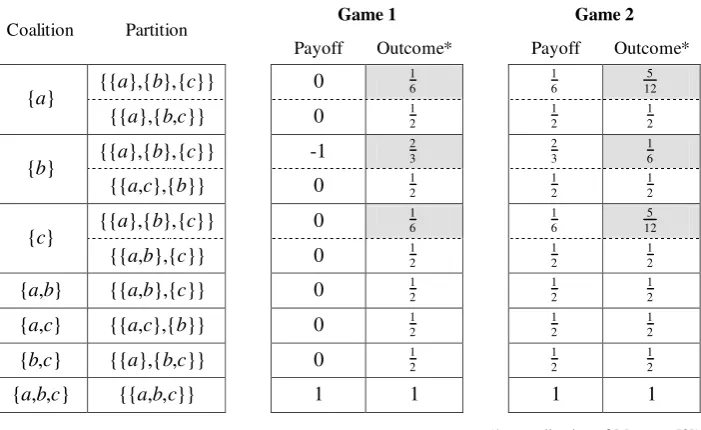
By way of an example consider Game 1 in Figure 1: it is a unanimity game involving three
players (a, b and c), which has been perturbed by reducing b’s payo¤ to minus one in the
eventuality that no coalitions form. A prospective extension of the Shapley value to games in
partition function form must assign, to this game, outcomes fora,band csubject to the proviso
that there are no “prior” coalitions; in essence, it must determine how b’s outcome should be
a¤ected by the perturbation of the symmetric game. The shaded cells in the “outcome” column of
Game 1 are the outcomes that are assigned by the extended value originally proposed by Myerson
[8], which is one out of many candidate values that satisfy the original Shapley axioms. If the
prospective value is also generalized, then it also assigns outcomes for the remaining embedded
coalitions, where these outcomes are interpreted to be the (expected or rightful) utilities assigned
to members of an a priori coalition structure. In Figure 1, I follow the well established approach
of Owen [10] and Hart and Kurz [5] that treats embedded coalitions approximately as if they
were individual, indivisible players: this means that any a priori structure of two coalitions splits
the remaining surplus in half. But there are two problems with the resulting outcomes. The …rst
Game 1 Game 2
Coalition Partition
Payoff Outcome* Payoff Outcome*
{{a},{b},{c}} 0 1
6
1 6
5 12
{a}
{{a},{b,c}} 0 1
2
1 2
1 2
{{a},{b},{c}} -1 23 23 16
{b}
{{a,c},{b}} 0 1
2
1 2
1 2
{{a},{b},{c}} 0 16 16 125
{c}
{{a,b},{c}} 0 1
2
1 2
1 2
{a,b} {{a,b},{c}} 0 12 12 12
{a,c} {{a,c},{b}} 0 1
2
1 2
1 2
{b,c} {{a},{b,c}} 0 1
2
1 2
1 2
{a,b,c} {{a,b,c}} 1 1 1 1
(*generalization of Myerson [8])
Figure 1. Two example games in partition function form, with outcomes generated by the
generalization of a prospective extension of the Shapley value.
It is very di¢cult to see whybshould do better in this game than in the symmetric, unanimity
game: my contention here (in common with authors of other recent papers listed above) is that,
if anything, it should do worse. The second problem emerges when we look at Game 2, the
payo¤s of which are the outcomes from Game 1. The outcomes that are assigned to the Game
2 (by again using Myerson values) deviate from those assigned to Game 1. My contention in
this paper is that a property of any solution concept should be that once a solution is found
-solving the solution should not change it.
The Weak Monotonicity axiom (which is common to many recent papers) eliminates candidate
values that exhibit the “…rst problem” above, and the Recursion axiom (which is original to this
[image:8.595.122.473.136.351.2]The …rst theorem in the paper derives the established approach to generalization - which will
be termedThe Rule of Generalization- directly from two axioms (CohesionandGeneralized Null
Player) that recollect the axioms of Owen and Hart and Kurz. The second (and main) theorem
in the paper characterizes an extended and generalized Shapley value using the conventional
E¢ciency, Symmetry, Null-Player, and Linearity axioms together with Weak Monotonicity,
The Rule of Generalization and Recursion. This value assigns symmetrical outcomes to a, b,
and c in the game depicted in Figure 1, and more generally it omits from consideration all but
the payo¤s to the coarsest partition containing any coalition.
The paper also includes further results, which corroborate the Extended, Generalized Shapley
Value that has been singled out by the axioms. These results can be viewed as tentative
indications that the Extended, Generalized Shapley Value shares some of the properties of
tractability and robustness that make the Shapley value itself so useful.
The Shapley value of a game is often conceptualized as the expected outcome to each player
if the players were to arrive at a meeting point in a random order and to each receive the
marginal payo¤ that their addition brings to the coalition of those players who arrived ahead.
The Extended Shapley Value proposed here can be conceptualized in the same way, provided we
suppose that this marginal payo¤ is calculated by assuming there are only two coalitions: one
of the players who have arrived, and another of those who have not. Since this proviso seems
somewhat ad hoc, I propose an alternative conceptualization. Suppose the “underlying event”
is preceded by a number of time periods and that in each time period two existing coalitions
are chosen at random to coalesce, with the “gain from coalescence” (which in fact might be
negative) split equally between the two. The third theorem in this paper establishes that as
the number of time periods becomes large, the partition function that encompasses both the
Value that was singled out by the axioms.
Finally, it seems natural to consider, in the case of previously proposed extensions to the
Shapley Value, how the type of process introduced above in Figure 1 ends. If we again suppose
that the “underlying event” is preceded by a number of time periods, but this time that each
time period e¤ects a transformation on the partition function that corresponds with the value
proposed by Myerson [8] in conjunction with The Rule of Generalization then as the number of
time periods is increased, the outcome to bchanges in accordance with a sequence that begins
2
3;16;125; ::: : If we use the value proposed by Pham Do and Norde [11] then we generate a
sequence beginning 0;16;14; ::: , and if we use the value proposed by Potter [12] or by
Macho-Stadler, Pérez-Castrillo and Wettstein [6] we generate then we generate a sequence beginning
1
6;247;3196; ::: . All of these sequences converge, and they share a common limit: the outcome
of 13 that is assigned to bby the Extended, Generalized Shapley Value, that has been proposed
here. The fourth theorem in this paper generalizes this …nding to all games and all candidate
extended Shapley values that ful…l the four conventional Shapley axioms and a less intuitive but
no less compelling alternative to the Weak Monotonicity condition.
The organization of the paper is as follows. In the next section, I formalize the key concepts in
the paper. The …rst and second of the theorems described above are presented and interpreted in
section 3. In section 4, I establish the alternative conceptualization of the Extended, Generalized
Shapley Value (Theorem 3) described above. In section 5, I set out the extensions of the Shapley
value that have been proposed previously in the literature. I show (Theorem 4) that wherever
any one of the previously proposed extended values can be represented by a closed form equation
then, when generalized, besides not proving recursive, it iterates to the Extended, Generalized
Shapley Value. Proofs of the theorems, together with examples that establish independence of
2. Preliminaries
2.1. Games
Let N denote a …nite set of players andV the set of all mappings v: 2N !R withv(;) = 0.
We refer tov2V as a transferable utility (TU)game in characteristic function form, onN. We
de…ne the set to be the set of all partitions ofN. It should be noted that fNgand ffigi2Ng
are both elements of ; the …rst is the grand coalition, and the second is the …nest partition
and shall henceforth be written[N]. We de…neM, sometimes referred to as theset of embedded
coalitions, to be the set f(I; ) : 2 ; I 2 g; andW to be the set of all mappingsw:M !R
withI =; !w(I; ) = 0. We refer to w2W as a transferable utility (TU) game in partition
function form, on N. In this paper the term “game,” unless otherwise quali…ed, shall mean a
TU game in partition function form.
2.2. Types of Game
It will be convenient to refer later to two subsets of W.
Shubik [17] coined the term “c-games” to describe games that are adequately represented
by their characteristic functions, and we shall use the term here in a closely-related way. Let
Wc W comprise allw2W such that for somev2V,wis de…ned byw(I; ) =v(I). Ac-game
on N is an element ofWc. We refer tov2V such thatw2Wc is de…ned byw(I; ) =v(I) as
thecorrespondent element in V to w.
All games on N can be constructed by a linear combination of games which shall be referred
to here as “ -games.” Let W W comprise all w 2W such that for some (J; 0)2 M, w is
de…ned byw(I; ) = 1where(I; ) = (J; 0),0otherwise. A -gameon N is an element of W .
2.3. Value Concepts
We shall depart somewhat from convention in the way that we denote a “value”, though not in
the meaning that we ascribe to the term. shall always denote a mapping fromW toW that is
referred to as anextended, generalized value. Ifwis an element ofW then (w)is also an element
of W, so (where (I; ) is an embedded coalition) w(I; ) and (w)(I; ) are two real numbers
of which w(I; ) is interpreted as the utility payo¤ prescribed to coalition I given partition
in the game w, and (w)(I; ) is interpreted as the (expected or rightful) utility outcome
associated with coalition I whenever is the coalition structure prior to playing the game w.
Formally, a mapping is a set of ordered pairs, so we can write f(w; (w)) :w 2Wg:This
notation enables us to think ofgeneralized values (such as that of Gul [4] - which is a less re…ned
version of Owen [10] and Hart and Kurz [5]), extended values (such as those of Myerson [8],
Bolger [1], Potter [12], Pham Do and Norde [11], Maskin [7], Macho-Stadler, Pérez-Castrillo
and Wettstein [6] and de Clippel and Serrano [3]) and standard values (such as the original
Shapley value itself [15]) as more restricted sets of ordered pairs. A generalized value becomes
f(w; (w)) : w 2 Wcg, or j
Wc. Given w 2 W, L M, let (w)jL denote the restriction of
(w)toL M: so (w)jL is a mapping fromLtoRde…ned by 8 2L; (w)jL( ) = (w)( ).
Note thatf(fig;[N]) : i2Ng M is the set of embedded coalitions comprising singletons and
the …nest partition. An extended value then becomes f(w; (w)jf(fig;[N]) :i2Ng) :w2 Wg, and
a standard value becomesf(w; (w)jf(fig;[N]) :i2Ng) :w2Wcg:
2.4. Carriers and Null-Players
The complementary notions of carrier sets and null-players are well established for games in
characteristic function form. Here, we extend these notions to games in partition function form.
We shall say that K N is a carrier of w 2 W if and only if 8(I; );(J; 0) 2 M; I \K =
null-player in w 2 W if and only if Nnfig is a carrier of w. These de…nitions are consistent
with the de…nitions used by Bolger [1] and Macho-Stadler, Pérez-Castrillo and Wettstein [6];
it should be noted that alternative de…nitions have been proposed by Myerson [8], Potter [12],
and Pham Do and Norde [11] and that these alternatives class additional sets as “carriers,” or
additional players as “null” and thereby strengthen axioms that a¤ect carriers or nullplayers
-I discuss this point further in section 5 below.
3. The Extended, Generalized Shapley Value
3.1. Axiomatic Derivation of an Extended, Generalized Shapley Value
Our …rst four axioms are familiar variants of the original Shapley [15] axioms, except that
Linearity will be used here instead of “additivity” (the conventional “additivity” axiom entails
4(i) alone); but they are extended to bear upon games in partition function form. All axioms in
the paper are assumed to prevail for allw; w0 2W, and allj 2N.
Axiom 1 (E¢ciency) Pi2N (w) (fig;[N])
Let P denote the set of permutations of N, and given 2 P, J N, 2 , w 2 W; we
de…ne J to be the image under ofJ; we de…ne 2 to be the setf( I)I2 g; and we de…ne
w2W by w( J; ) =w(J; ).
Axiom 2 (Symmetry) 8 2P, ( w) (f (j)g;[N]) = (w)(fjg;[N])
Axiom 3 (Null-Player) If j is a null-player in w, then (w)(fjg;[N]) = 0
Axiom 4 (Linearity) (i) (w+w0)(fjg;[N]) = ( (w) + (w0))(fjg;[N])
(ii) 8 2R, ( w)(fjg;[N]) = (w)(fjg;[N])
Similar extensions of the original Shapley axioms are common to all previous “extensions” of
be assumed when games have externalities. I retain the conventional approach, on the grounds
that the Shapley Value is used primarily as a normative solution concept and that there seems
no reason to suppose that the normative arguments for Axioms 1-4(i) hold only for c-games.
The implicit supposition in the E¢ciency axiom that w(N;fNg) = max 2 PI2 (w)(I; ) is
often posited as arising from a superadditivity assumption that was present in von Neumann
and Morgenstern [9] and that has commonly been retained since. Though superadditivity seems
reasonable for c-games, it is less so for games in which coalescence can generate positive
exter-nalities: for example, it is well known (see [14]) that where three or more …rms are engaged
in Cournot competition then coalescence (or merger) between any two …rms can be to their
disadvantage in so far as the increased total producer surplus is less than the positive
exter-nality that is enjoyed by …rms that are not parties to the merger. But the assumption that
w(N;fNg) = max 2 PI2 (w)(I; ) is in itself much weaker than superadditivity, and is no
less reasonable with regard to games with externalities - such as the Cournot game - than with
regard to c-games, since where the grand coalition arises from any prior partition of the players
there are no remaining parties to whom externalities can be spilled. At the point where the grand
coalition is formed, externalities to coalescence are necessarily internalized. It should therefore
be emphasized that where Maskin [7] drops the E¢ciency axiom it is not because he believes
the grand coalition is less likely to be e¢cient in the presence of externalities to coalescence, but
it is because he believes the grand coalition is less likely to form. Elsewhere (for example, [6]),
E¢ciency is sometimes imposed as part of the de…nition of a “solution” or of a “value”.
While the second part of Axiom 4 is redundant in the characterization of the (standard)
Shapley value, Macho-Stadler, Pérez-Castrillo and Wettstein [6] show that it is not redundant in
the characterization of an extended value. However, it is hard to imagine - bearing in mind that
for Axiom 4(i) (“additivity”) that does not also encompassLinearity and therefore also Axiom
4(ii).
We now de…ne the Shapley Value.
De…nition 1 (Shapley Value) f(w; (w)jf(fig;[N]) :i2Ng) : w 2 Wcg is the Shapley Value if
and only if 8i2N;8w2Wc;
(w)(fig;[N]) = X
S N
(jSj 1)!(jNj jSj)!
jNj! (v(S) v(Snfig))
where v is the correspondent element in V tow.
We know (see [15]) that if satis…es E¢ciency,Symmetry,Null-Player, and Linearity, then
f(w; (w)jf(fig;[N]) :i2Ng) :w2Wcg is the Shapley Value. We also know (see [6]) that the same
four axioms do not su¢ce to uniquely determine f(w; (w)jf(fig;[N]) :i2Ng) :w2Wg:
The next axiom entails that if some game would be a “null-game” except that there is one
coalition which in the context of one particular partition obtains a positive payo¤ (= 1), then
the outcome to members of that coalition should not be less than zero. If Linearity holds then
Axiom 5 is equivalent to the “coalitional monotonicity” axiom described by Young [19] whereby
“an increase in the value of a particular coalition implies, ceteris paribus, no decrease in the
allocation to any member of that coalition.” (p. 68). This, as Young (citing [16]) observes, is
a necessary property for any value that is to be used in problems such as cost assignment in a
…rm without creating perverse incentives.
Axiom 5 (Weak Monotonicity) 8(I; )2M; i2I ! (w(I; ))(fig;[N])>0
Several of the more recently proposed extensions of the Shapley value cite Myerson’s [8]
con-travention of Weak Monotonicity as a motivation for readdressing the extension of the Shapley
It should be emphasized that Axioms 1-5 bear only on the outcomes assigned to individuals
in the …nest partition (i.e. f(w; (w)jf(fig;[N]) :i2Ng) : w 2 Wg). The remaining axioms bear
more generally on .
The following axiom prescribes a generalized value from any standard value. The Rule of
Generalization entails, for any partition that is coarser than [N], treating one member of each
coalition as its “representative,” treating all other players as null, and assigning to each
coali-tion the outcome that is assigned to its representative in the game that is thereby created on
representatives and Null-Players.
Given 2 , let denote the set of injective mappings from to N such that 8S 2 ,
2 ! (S) 2S. Given 2 , we de…ne to be the image under of , and we de…ne
w2W by w(J; 0) w(Si2(J\ ) 1(i);f(Si2(S\ ) 1(i))S2 0g).
Axiom 6 (The Rule of Generalization) 8(I; )2M;8 2 ; (w)(I; ) = ( w)( (I);[N])
Owen’s “value of a game with a priori unions” [10] - also known as the Coalition Structure
Value [5] - entailsThe Rule of Generalizationand goes further, in that it apportions the outcome
assigned to an embedded coalition between the members of that coalition. Owen’s value has
been so widely accepted that a “Generalized Shapley Value” formula (consistent with De…nition
2 below) is sometimes adopted without further justi…cation (see especially [4]). Our …rst theorem
(below) establishes that The Rule of Generalization is on its own weaker than the conjunction
of two axioms (closely related to the axioms used by Owen [10] and by Hart and Kurz [5]) that
have their own intuitive appeal.
The …rst of these axioms isCohesion; it entails that, once some partition of players has formed,
dissolute partitions - coalition structures that entail one or more existing coalition breaking up
- become irrelevant. Put more precisely: in the following axiom we suppose that the outcome
dissolute partitions. Given 2 , we de…ne the set of embedded coalitions entailing
non-dissolute partitions from , M =f(J; 0)2M:8I 2 ;8I0 2 0; I0 \I 6=; !I I0g.
Axiom 7 (Cohesion) 8(I; )2M;(8 2M ; w( ) =w0( ))! (w)(I; ) = (w0)(I; )
If we are to ascribe any meaning to a priori coalitions at all, then we must assume that they
cohere to some extent: in other words, we cannot suppose that coalitions dissolve at the
out-set of bargaining, allocation, or arbitration and simply out-set 8w 2W;8(I; ) 2M; (w)(I; ) =
P
i2I (w)(fig;[N]). Given this constraint, then theCohesionaxiom represents the natural
(op-posite) position to take: we suppose that coalitions will stay together and therefore in assigning
outcomes between coalitions that are presently formed we do not consider payo¤s to embedded
coalitions that entail such coalitions breaking up. The Cohesion axiom is used by Owen [10] (it is
his Axiom A3) and reappears as the slightly weaker “Inessential Game” axiom in Hart and Kurz
[5]; the Inessential Game axiom imposes 8(I; ) 2 M;(8 2 M ; w( ) = 0)! (w)(I; ) = 0:
In the context of other axioms the Inessential Game axiom quickly entails the present Cohesion
axiom, the transparency of which is preferred here.
The next axiom entails the Null-Player axiom, plus a requirement that null-players are
strate-gically irrelevant: an a priori coalition neither gains nor loses nor a¤ects other coalitions by
merging with a null-player.
Axiom 8 (Generalized Null-Player) If j is a null-player in w, then j is a null-player in
(w)
The original Null-Player axiom has an important function: it enables us to concentrate our
analysis on any carrier set instead of having to worry about which players matter, or having to
worry about a whole universe of players. If this advantage is to be carried over to generalized
axiom is also incorporated into the axiom systems of Owen [10] and Hart and Kurz [5] - where
it is incorporated, with E¢ciency, into the “Carrier” axiom.
We can now state our …rst theorem and its corollary.
Theorem 1 satis…es both Cohesion and Generalized Null-Player if and only if satis…es both
Null-Player and The Rule of Generalization.
Theorem 1 is proved in the appendix.
De…nition 2 (Generalized Shapley Value) jWc is the Generalized Shapley Value if and
only if8(I; )2M;8w2Wc;
(w)(I; ) = X
T
(jTj 1)!(j j jTj)!
j j! v
S
A2T
A v S
A2(TnfIg)
A
!!
where v is the correspondent element in V tow.
Corollary 1 If satis…es E¢ciency, Symmetry, Linearity, Cohesion, and Generalized
Null-Player, then jWcis the Generalized Shapley Value.
The …nal axiom in our system entails that does indeed “solve” (we could say “resolve”) the
underlying game. If one game is the “solution” of another, then “solving” the solution does not
change it. We call this property Recursion.
Axiom 9 (Recursion) ( (w)) = (w)
The Recursion axiom is the only axiom being proposed here that is not widely used
else-where, but it is perhaps the easiest of all to justify. The generalized value of a game is, itself,
a game in partition function form. It is, as was noted in the introduction, a transformation of
the original game that encompasses both the underlying event that the original game describes
Our axioms are supposed to describe characteristics of a (positively or normatively) reasonable
process, and the transformed game is supposed to represent a “solution” (we could say a
“reso-lution”) of the underlying game. If a generalized value is not recursive then we are making the
very di¢cult claim that one “round,” or “iteration,” of a bargaining, arbitration, or allocation
process is reasonable (either positively or normatively), while two rounds of the same process
are not. A process does not “solve” (or “resolve”) the underlying event unless reapplications of
the same process are nugatory; so an “extended, generalized value” is not really a “solution”
concept at all unless it satis…es Recursion.
We can now state our second (and main) theorem and its corollary.
De…nition 3 (Extended, Generalized Shapley Value) is the Extended, Generalized
Shap-ley Value if and only if 8(I; )2M;8w2W;
(w)(I; ) = X
T
(jTj 1)!(j j jTj)!
j j! v
S
A2T
A v S
A2(TnfIg)
A
!!
where v2V is de…ned by v(S) =w(S;f(NnS); Sg).
Theorem 2 satis…es E¢ciency, Symmetry, Linearity, Weak Monotonicity, Cohesion,
Gen-eralized Null-Player, and Recursion (or, equivalently, E¢ciency, Symmetry, Null-Player,
Lin-earity, Weak Monotonicity, The Rule of Generalization, and Recursion) if and only if is the
Extended, Generalized Shapley Value.
Theorem 2 is proved in the appendix.
De…nition 4 (Extended Shapley Value) f(w; (w)jf(fig;[N]) :i2Ng) : w 2 Wg is the
Ex-tended Shapley Value if and only if 8i2N;8w2W;
(w)(fig;[N]) = X
S N
(jSj 1)!(jNj jSj)!
jNj! (v(S) v(Snfig))
Corollary 2 If satis…es E¢ciency, Symmetry, Null-Player, Linearity, Weak Monotonicity,
The Rule of Generalization, and Recursion, then f(w; (w)jf(fig;[N]) :i2Ng) : w 2 Wg is the
Extended Shapley Value.
3.2. Interpretation of Theorem 2
The Extended, Generalized Shapley Value of any w2W equates to the Generalized Shapley
Value of a c-game, w 2Wc where w is obtained by assigning, for all (I; ) 2M, w (I; ) =
w(I;f(NnI); Ig). It therefore excludes from consideration the payo¤s to embedded coalitions
that entail partitions of more than two coalitions. This exclusion is forced on us by axioms that
do not seem, in any obvious way, to pre…gure it.
It should be emphasized that it is not my intention in this paper to suggest that the detail
that is excluded from consideration is in any general sense redundant: this detail is very likely
to be relevant to more descriptive solution concepts, or to solution concepts that encompass
di¤erent sets of normative principles. Instead, I am making the milder claim that the payo¤s to
embedded coalitions that entail partitions of more than two coalitions should or would be ignored
in a process of bargaining, allocation, or arbitration that encompasses the sort of normative
principles re‡ected speci…cally in the Shapley value solution.
4. A Procedural Account of the Extended, Generalized Shapley Value
Shapley [15] provided the following procedural account of his value: it is the expected value
outcome to each player, if the players are to arrive at a meeting point in a random order and
to each receive the marginal payo¤ that their addition brings to the coalition of those players
who arrived ahead. Though the procedure is purely mechanistic (in contrast to modern
non-cooperative bargaining models such as that of Gul [4]) it nevertheless provides a useful way of
properties of (expected or rightful) bargaining, arbitration or allocation alongside at least one
procedure that we know ful…ls the axioms.
It is straightforward to generalize Shapley’s procedure to situations with a priori coalitions
- the generalization just entails constraining the order of arrival so that members of any
pre-existing coalition arrive consecutively (see [5]) - but a di¢culty arises inextending the procedure
to the wider class of games in partition function form. In order to calculate the “marginal payo¤”
that a player brings to some coalition, some assumption has to be made about the coalitional
con…guration of players outside. We obtain the Extended Shapley Value (above) by assuming
that the outside players are all coalesced together, so the “marginal payo¤ that the addition of
ibrings to C” is v(C[ fig) v(C) where v 2V is de…ned by v(S) =w(S;f(NnS); Sg). Since
this assumption is ad hoc, and also since it directly pre…gures the distinctive property of the
Extended Shapley Value, it is somewhat unsatisfactory.
An alternative procedure - a simpli…ed, mechanistic version of the bargaining procedure
pro-posed by Gul - avoids the need for any ad hoc assumption: we can view the Shapley value, its
generalization and its extension, as the expected value outcome to each player (or coalition)
if the players (or coalitions) are to engage in a su¢ciently long process of successive bilateral
amalgamations. Suppose thatw0 2W describes an “underlying event,” and then suppose that
this event will be preceded by a time period (“one round of bargaining”) in which two existing
coalitions will be chosen at random to coalesce with the “gain from coalescence” (which in fact
might be negative) split equally between the two. We use w1 2 W to describe (in toto) the
combination ofw0 and the round of bargaining: i.e. eachw1(I; ) is an expected value outcome
to coalition I, given an existing coalition structure , if there is going to be one round of
bar-gaining followed by a payo¤ according to the …nal coalition structure andw0. More generally we
wt(I; )
1
j j(j j 1) 0
@ X
J;K2 nfIg
wt 1(I;( nfJ; Kg)[ fJ[Kg)
+ 2 X
J2 nfIg
wt 1(I; ) +(wt 1(I[J;( nfI;Jg)[fI[J2g) wt 1(J; ) wt 1(I; ))
1
A:
wt then describes (in toto) the combination of w0 and t rounds of bargaining. It transpires
that as tbecomes large, wt tends to the Extended, Generalized Shapley Value.
Theorem 3 8w0 2W;limt !1 wt is the Extended, Generalized Shapley Value of w0:
Theorem 3 is proved in the appendix.
The alternative procedure (Theorem 3) demonstrates that the elimination from consideration
of payo¤s to embedded coalitions entailing partitions that contain more than two elements,
besides arising from axioms that in no way seem to pre…gure it, arises also from reasonable
procedures that do not seem to pre…gure it either. It can be tentatively viewed as evidence that
the Extended, Generalized Shapley Value shares some of the robustness of the original Shapley
Value. Another corroboration of the Extended, Generalized Shapley Value emerges at the end
of the next section.
5. Alternative Extensions of the Shapley Value
5.1. Previous extensions of the Shapley value
Thrall and Lucas [18] originally proposed the partition function representation; [13] and [6, 7]
are important recent papers that make a case for its usefulness. In addition to the last two of
these, [1,3,8,11,12] propose extensions of the Shapley Value to games in partition function form.
In this section I consider the previously proposed extensions.
Maskin’s [7] approach to “solving” a game in partition function form stands somewhat apart
E¢ciency on the solution of games in which coalescence has positive externalities - so he departs
even from Axioms 1-4(i) above. His solution is in e¤ect obtained as an expected value outcome of
a procedure that adds an extra dose of reality to the original procedural conceptualization of the
Shapley Value described in the …rst paragraph of section 4 above. On arriving at a meeting point
a player can choose either to accept the highest bid from coalitions already formed at the point, or
to remain independent and to bid against the existing coalitions in order to attract supervenient
players as they arrive. Because existing coalitions bid strategically and simultaneously, there
are some underlying games with non-unique outcomes. In this sense, and also since it is neither
e¢cient nor additive, Maskin’s solution - while it coincides with the Shapley Value for c-games
- cannot be accorded thenormative interpretation that is more usually accorded to the Shapley
Value itself.
Bolger [1] and Macho-Stadler, Pérez-Castrillo and Wettstein [6] take more conventional
ap-proaches: they each add, to the standard Shapley axioms, axioms that impose equivalent
out-comes in situations that look (from particular standpoints) as if they present individuals with
equivalent bargaining power.
Given 2 , let (j) denote the coalition in to which j 2 N belongs and let Ij 2
denote the partition formed from by movingj from (j) toI. Bolger demonstrates that if, in
addition to requiring that satis…es Axioms 1-4, we also require, given w; w0 2W and j 2N
that (w)(fjg;[N]) = (w0)(fjg;[N]) whenever8 2 ;
P
I2( nf (j)g)(w( (j); ) w( (j)nfjg; Ij)) =
P
I2( nf (j)g)(w0( (j); ) w0( (j)nfjg; Ij))(which
is to say that for every partition, the sum of the consequences for the coalition to which i
be-longs ofileaving to join another coalition is the same inwandw0), then we obtain an extended
value. Bolger does not make the case for his additional requirement for circumstances other than
broader class of games. His additional requirement entails, for example, (where N =fa; b; cg)
(w(fa;bg;ffa;bg;fcgg))(fag;[N]) = ( 2w(fbg;ffa;cg;fbgg))(fag;[N]), which - though it would be a
plausible property to uncover - is a signi…cant imposition. Bolger’s value then has the
inconve-nient property that when a null-player is added to the set of players, the outcomes to existing
players change: so in any given situation the outcomes depend on which null-playersare players,
and which are not.
Macho-Stadler, Pérez-Castrillo and Wettstein demonstrate that if, in addition to requiring that
satis…es Axioms 1-4, we require for all (I; )2M and for alli; j2NnI, (w(I; ))(fig;[N]) =
(w(I; ))(fjg;[N]), and if we also require for all(I; );(I; 0)2M thatfi; jg 2 ;ffig;fjgg 2 0;
and ( nffig;fjgg) = ( 0nffi; jgg) imply (w(I; ))(fig;[N]) = (w(I; 0))(fig;[N]) and
(w(I; ))(fjg;[N]) = (w(I; 0))(fjg;[N]), we then obtain an extended value. The …rst
require-ment turns Symmetry into “Strong Symmetry” and narrows the class of prospective values to
those - such as the Extended Shapley Value proposed here - that equate the value of anyw2W
to the Shapley value of a c-game, w 2 Wc, obtained by assigning each coalition a weighted
average (with the weights themselves constrained by Symmetry and Null-Player) of its payo¤s
in w across partitions of the other players. The second requirement - “Similar In‡uence” - is
not ful…lled by the Extended Shapley Value proposed here.
In the presence of the E¢ciency axiom, the Null-Player axiom is a necessary (though, as
Bolger demonstrates, not su¢cient) criterion to absolve the game theorist of the problem of
deciding who counts as a “player.” Furthermore, it seems intuitively defensible that a player
whose position in the coalition structure is irrelevant to payo¤s in the underlying event should
be assigned a value of zero. But several extensions of the Shapley Value are obtained by classing
more sets as “carriers,” or more players as “null,” than either necessity or intuition warrant.
M; w(J; ) =w(J\S;f(L\S)L2 g [ f(L\(NnS))L2 g), and then if we impose Axioms 2 and 4,
and use (as Shapley did) a “carrier e¢ciency” axiom in place of Axioms 1 and 3, we then obtain
an extended value. Consider a pure externality game, w , on N = fa; b; cg where in which a
payo¤ of 1 accrues to a if b and c coalesce: i.e. w = w(fag;ffag;fb;cgg)+w(fa;b;cg;ffa;b;cgg). By
the de…nition given in section 2 above, the only carrier of w is fa; b; cg, but Myerson requires
us to treatfag(though, it might be noted, not fa; bg) as a carrier ofw and therefore to assign
(w )(fag;ffag;fbg;fcgg) = 1. This is a strong imposition as it is not obvious that ais in as
strong a position inw as in, for example, a “unanimity game” whereby a payo¤ of1 accrues to
those embedded coalitions that contain a, and of 0 to those that do not. Myerson’s extended
value has some counter-intuitive properties: for example, it is not weakly monotonic.
In a similar vein, Potter [12] and Pham Do and Norde [11] obtain extended values by classing
additional players as “null.” If N = fa; b; cg then for Pham Do and Norde all three players
are null in w(fag;ffag;fb;cgg), while for Potter all three players are null in (w(fag;ffag;fbg;fcgg)
w(fag;ffag;fb;cgg)). These impositions strongly pre…gure the extended values that Potter and Pham
Do and Norde respectively obtain.
Pham Do and Norde’s value counterpoints the Extended Shapley Value by equating (for any
w2W)to the Shapley value of a c-game (w 2Wc)that is obtained by assigning each coalition
its payo¤ inw where the external players are arranged as singletons. The same value emerges
in de Clippel and Serrano [3]. De Clippel and Serrano develop Young’s ( [19]) marginality
axiomatization of the Shapley value so that it can be applied to games in partition function
form: the Linearity and Null-Player axioms are dropped and replaced by progressively stronger
5.2. Convergence to the Extended, Generalized Shapley Value
It is easy to check that if we derive by using any of the extended values in section 5.1
in conjunction with The Rule of Generalization then we contravene Recursion: i.e. for some
w 2 W; (w) 6= ( (w)). It is therefore natural to ask the following: if ful…lls the original
Shapley axioms and the Rule of Generalization, but if does not necessarily ful…ll either Weak
Monotonicity or Recursion, then, de…ning tby 1= ;and t(w) = ( t 1(w)), what happens
to the sequencef tg1t=0? It turns out that, subject to a magnitude constraint on (w(I; ))(I; ),
the sequenceconverges, and moreover,in its limit is Weakly Monotonic with respect to the
un-derlying game; it also preserves the original axioms, solimt !1 tis the Extended, Generalized
Shapley Value. The following theorem formalizes this.
Theorem 4 De…ne t by 1 = ; and t(w) = ( t 1(w)) for any positive integer t. If
satis…es E¢ciency, Symmetry, Linearity, Cohesion, and Generalized Null-Player (or,
equiva-lently, E¢ciency, Symmetry, Null-Player, Linearity, and The Rule of Generalization) and if for
all (I; ) 2 M, j j > 2 implies j jj j1 < (w(I; ))(I; ) < j jj j1 then f tg1t=0 converges and
limt !1 t is the Extended, Generalized Shapley Value.
Theorem 4 is proved in the appendix.
Theorem 4 provides an additional corroboration of the Extended, Generalized Shapley Value.
Candidate extensions of the Shapley Value have tended to ful…ll the magnitude constraint, in
Theorem 4, on (w(I; ))(I; ). For example, the extended values proposed by [3, 6, 8, 11, 12] can
all be represented by straightforward formulae, and it is easy to check that if we derive by using
any of these extended values in conjunction withThe Rule of Generalization, then the constraint
holds. So, by Theorem 4, if one round or iteration of a bargaining, arbitration or allocation
process implements de…ned by the generalization of any of these candidate extensions of the
value that converges eventually to the Extended, Generalized Shapley Value.
A. Appendix
A.1. Proof of Theorem 1
It is obvious that Generalized Null-Player implies Null-Player, and that The Rule of
Gen-eralization implies Cohesion. I show …rst thatCohesion and Generalized Null-Player together
imply The Rule of Generalization. Consider any (I; ) 2 M,w 2 W, and 2 . Note that,
8 2 M , w( ) = w( ); so by Cohesion, (w)(I; ) = ( w)(I; ). Also note that is a
carrier in w; and that by Generalized Null-Player any carrier in w must also be a carrier in
( w). I\ = (I), andf(L\ )L2 g=f(L\ )L2[N]g, so ( w)(I; ) = ( w)( (I);[N]).
I show second that Null-Player and The Rule of Generalization together imply Generalized
Null-Player. Consider any w2 W, such that i2N is a null-player inw 2W or, equivalently,
Nnfig is a carrier of w. Consider any two embedded coalitions, (I; );(J; 0) 2 M, such that
I\(Nnfig) =J \(Nnfig) and f(L\(Nnfig))L2 g=f(L\(Nnfig))L2 0g. Note that ifI 6=;
andJ 6=;, then there exists 2 ; 0 2 0such that I = 0J and w= 0w. In this case, by
The Rule of Generalization, (w)(I; ) = ( w)( (I);[N]) = ( 0w)( 0(J);[N]) = (w)(J; 0).
If, on the other hand, either I = ; or J = ;, then for any 2 ; 0 2 0 by The Rule
of Generalization, and Null-Player (w)(I; ) = ( w)( (I);[N]) = 0 = ( 0w)( 0(J);[N]) =
(w)(J; 0). So Nnfigis a carrier of (w), or, equivalently, iis a null-player in (w).
Throughout the remainder of this appendix, EGSV shall denote the Extended, Generalized
Shapley Value.
A.2. Proof of Theorem 2
It is easy to see that the EGSV satis…es E¢ciency, Symmetry, Null-Player, Linearity, The
Symmetry, Linearity, Cohesion, Generalized Null-Player, and Weak Monotonicity). We prove
here that it also satis…esRecursion.
Let w(A; )denote w(A;fA; NnAg). For anyw2W, and for any (I; )2M,
EGSV(w)(I; ) = P
T
(jTj 1)!(j j jTj)!
j j!
h
w SA2TA; w SA2TnfIgA; i
= P
T
(jTj 1)!(j j jTj)!
j j!
"
w SA2TA; w SA2TnfIgA; 2
+w Nn S
A2TnfIgA; w Nn
S
A2TA; 2
#
EGSV(EGSV(w))(I; ) = P
T
(jTj 1)!(j j jTj)!
j j! EGSV(w)
S
A2T A;
EGSV(w) SA2TnfIgA; i
Also, 8T ;
EGSV(w) SA2T A;f:; :g EGSV(w) SA2TnfIgA;
= w SA2T A; +w(N;fNg) w S
A2TA; w Nn
S
A2TA; 2
!
w(SA2TnfIgA; ) +w(N;fNg) w
S
A2TnfIgA; w Nn
S A2TnfIgA; 2 ! = w S
A2TA; w
S
A2TnfIgA;
2 +
w NnSA2TnfIgA; w NnSA2TA; 2
So,
EGSV(EGSV(w))(I; ) = P
T
(jTj 1)!(j j jTj)!
j j!
"
w SA2TA; w(SA2TnfIgA; ) 2
+w Nn S
A2TnfIgA; w Nn
S
A2TA; 2
#
=EGSV(w)(I; )
We next prove that only one function satis…es E¢ciency, Symmetry,Null-Player, Linearity,
The Rule of Generalization,Weak Monotonicity, andRecursion (or equivalently, by Theorem 1,
E¢ciency, Symmetry, Linearity, Cohesion, Generalized Null-Player, Weak Monotonicity, and
Recursion).
Proposition 1 If satis…es E¢ciency and The Rule of Generalization, then 8w 2 W;8 2
Proof. By The Rule of Generalization, 8w 2 W;8 2 ;8 2 ;PJ2 (w)(J; ) = P
J2 ( w)( (J);[N]). By E¢ciency, 8w 2 W;8 2 ;8 2 ;
P
J2 ( w)( (J);[N]) =
w(N;fNg).
Proposition 2 If satis…es Linearity and The Rule of Generalization, then8w2W;8(I; )2
M; (w)(I; ) =P 2Mw( ) (w )(I; ):
Proof. FromLinearity andThe Rule of Generalizationwe obtain8w; w0 2W;8 2M,8 2R,
(w+w0)( ) = ( (w) + (w0))( ) and ( w)( ) = (w)( ). This proposition is then trivial.
Proposition 3 If satis…es Cohesion and Generalized Null-Player, then8(I; )2M;8(J; 0)2
MnM ; (w(J; 0))(I; ) = 0.
Proof. Note that by Cohesion (J; 0) 2= M ! (w(J; 0))(I; ) = (w0)(I; ), where w0 2 W
is a game in which all players are null; andGeneralized Null-Player requires (w0)(I; ) = 0:
Proposition 4 If satis…es E¢ciency, Symmetry, Null-Player, Linearity, The Rule of
Gener-alization, Weak Monotonicity, and Recursion, then8 2 ;8I; J 2 ;j j>2! (w(I; ))(I; ) =
(w(I; ))(J; ) = 0.
Proof. Suppose that satis…es E¢ciency, Symmetry, Null-Player, Linearity, The Rule of
Generalization,Weak Monotonicity, and Recursion. By Proposition 2 andRecursion:
8( );( 0)2M; (w 0)( ) = X
002M
(w 0)( 00) (w 00)( ): (1)
Consider any 2 such that j j>2, and anyI 2 :Using Proposition 3 and equation (1):
(w(I; ))(I; ) =X
J2
(w(I; ))(J; ) (w(J; ))(I; )
= (w(I; ))(I; ) 2+ X
J2 nfIg
By Proposition 1, Symmetry andThe Rule of Generalization,
8J 2 nfIg; (w(I; ))(J; ) = (w(J; ))(I; ) = (w(I; ))(I; )
(j j 1) : (3)
Using (3), we can rewrite the right hand side of (2) to give
(w(I; ))(I; ) = (w(I; ))(I; ) 2+ (j j 1) 0
@ (w(I; ))(I; ) (j j 1)
1
A
2
: (4)
Solving (4) gives
(w(I; ))(I; ) =either 0or (j j 1)
j j : (5)
We can proceed to rule out (w(I; ))(I; ) = (j jj j1): Recall (from section 3.1) the previous
de…nitions of and (for 2 ) of and w. Now consider any 2 , i = (I),
j2( nfig). By The Rule of Generalization,
(w(I; ))(I; ) = ( (w(I; )))(fig;[N]):
Also, where (J; 0)2M :i2J; (L\ )L2 0 =ffkgk2 g is the set of embedded coalitions
containing iand such that no players in are coalesced together,
(w(I; )) = X
(J; 0)2M:i2J;f(L\ )L2 0g=ffkgk2 g
w(J; 0):
By Linearity, then
(w(I; ))(I; ) = X
(J; 0)2M:i2J;f(L\ )L2 0g=ffkgk2 g
(w(J; 0))(fig;[N]): (6)
Note that P(J; 0)2M:i2Jw(J; 0) denotes an inessential game, in which coalitions containing i
receive a payo¤ of 1 and other coalitions receive zero. All players exceptiare null in this game so,
by theNull-Player and E¢ciency axioms P(J; 0)2M:i2Jw(J; 0) (fig;[N]) = 1:ByLinearity,
then
X
(J; 0)2M:i2J
P
(J; 0)2M:fi;jg Jw(J; 0) denotes a game in which coalitions containing players i and j
re-ceive 1 and in which coalitions missing i or j receive zero. This game is symmetric with
re-spect to i and j, and all other players are null. So by Null-Player, Symmetry and E¢ciency,
P
(J; 0)2M:fi;jg Jw(J; 0) (fig;[N]) = 1
2:By Linearity, then
X
(J; 0)2M:fi;jg J
(w(J; 0))(fig;[N]) = 1
2: (8)
(J; 0)2M :i2J; (L\ )L2 0 =ffkgk2 g andf(J; 0)2M :fi; jg Jgare disjoint
sub-sets of f(J; 0)2M :i2Jgso, using (6), (7), (8), and Weak Monotonicity
(w(I; ))(I; )61 1 2
< (j j 1)
j j :
So, by (5) and (3),8J 2 ; (w(I; ))(I; ) = (w(I; ))(J; ) = 0:
Proposition 5 If satis…es E¢ciency, Symmetry, Null-Player, Linearity, The Rule of
Gener-alization, Weak Monotonicity, and Recursion, then8(I; );(J; 0)2M;j j>2! (w(I; ))(J; 0) =
0.
Proof. Consider any(I; )2M such thatj j>2. Suppose the following:
(i) 8(J; 0)2M;j 0j< n! (w(I; ))(J; 0) = 0
(ii) 8(J; 0);(K; 00)2M;( 00= 0;j 0j> n 1)! (w(J; 0))(K; 00) = 0:
Now consider any (K; 00)2M such thatj 00j=n. Recalling (1),
(w(I; ))(K; 00) = X
(J; 0)2M
(w(I; ))(J; 0) (w(J; 0))(K; 00)
= X
(J; 0)2M:( 0<n) (J; 0)2M:( 00= 0;j 0j>n 1)
(J; 0)2M:( 02=M 00)
(w(I; ))(J; 0) (w(J; 0))(K; 00)
So (i) and (ii) together imply 8(J; 0)2M;j 0j< n+ 1! (w(I; ))(J; 0) = 0. By Proposition
3, (i) holds for n = 3, and, by Proposition 4, (ii) holds for n > 2, so (i) holds where n is any
positive integer.
By Proposition 5, if (w) satis…esE¢ciency,Symmetry,Null-Player,Linearity,The Rule of
Generalization,Weak Monotonicity, and Recursion, then for any w 2W, (w) = (w0) where
w0 2 Wc is de…ned by w0(I; ) = w(I;fI; NnIg)). Corollary 1 established that E¢ciency,
Symmetry,Linearity,Cohesion, and Generalized Null-Player obtain jWc, so by Proposition 5,
E¢ciency, Symmetry, Linearity, Cohesion, Generalized Null-Player, Weak Monotonicity, and
Recursion obtain .
A.3. Independence of axioms in Theorem 2
Theorem 2 entails seven axioms: E¢ciency,Symmetry,Linearity,Cohesion,Generalized
Null-Player,Weak Monotonicity, andRecursion. Here, I establish that these axioms are independent
by providing examples of extended generalized values that satisfy each combination of six from
the seven axioms while contravening the seventh.
Let N =f1;2;3g:
write: 0 B B B B B B B B B B B B B B B B B B B B B B B B B B B B B B B B B B B @
(w)(f123gff123gg)
(w)(f12gff12gf3gg)
(w)(f3gff12gf3gg)
(w)(f13gff13gf2gg)
(w)(f2gff13gf2gg)
(w)(f23gff1gf23gg)
(w)(f1gff1gf23gg)
(w)(f1gff1gf2gf3gg)
(w)(f2gff1gf2gf3gg)
(w)(f3gff1gf2gf3gg) 1 C C C C C C C C C C C C C C C C C C C C C C C C C C C C C C C C C C C A =A 0 B B B B B B B B B B B B B B B B B B B B B B B B B B B B B B B B B B B @
w(f123gff123gg)
w(f12gff12gf3gg)
w(f3gff12gf3gg)
w(f13gff13gf2gg)
w(f2gff13gf2gg)
w(f23gff1gf23gg)
w(f1gff1gf23gg)
w(f1gff1gf2gf3gg)
w(f2gff1gf2gf3gg)
w(f3gff1gf2gf3gg)
1 C C C C C C C C C C C C C C C C C C C C C C C C C C C C C C C C C C C A where A= 0 B B B B B B B B B B B B B B @
w(f123gff123gg) (f123gff123gg) w(f123gff123gg) (f3gff1gf2gf3gg)
w(f12gff12gf3gg) (f123gff123gg) w(f12gff12gf3gg) (f3gff1gf2gf3gg)
w(f3gff12gf3gg) (f123gff123gg) w(f3gff12gf3gg) (f3gff1gf2gf3gg)
..
. . .. ...
w(f3gff1gf2gf3gg) (f123gff123gg) w(f3gff1gf2gf3gg) (f3gff1gf2gf3gg)
1 C C C C C C C C C C C C C C A :
By Theorem 2 satis…es E¢ciency, Symmetry, Linearity, Weak Monotonicity, Cohesion,
A1 = 0 B B B B B B B B B B B B B B B B B B B B B B B B B B B @
1 12 12 13
0 12 12 13
0 12 12 13
0 0 0 16
0 0 0 16
..
. ... ... . .. ...
0 0 0 0
0 0 0 0
1 C C C C C C C C C C C C C C C C C C C C C C C C C C C A ;
A1 being given by the Extended, Generalized Shapley Value.
However, satis…es the same seven axiomsexcept Recursion if, for example,A=A2 where
A2 =
0 B B B B B B B B B B B B B B B B B B B B B B B B B B B @
1 12 12 13
0 12 12 13
0 12 12 16
0 0 0 16
0 0 0 121
..
. ... ... . .. ...
0 0 0 121
0 0 0 16 1 C C C C C C C C C C C C C C C C C C C C C C C C C C C A ;
A2 being given by any of the extensions of the Shapley value proposed by [1, 6, 12] (these
extensions coincide for 3-player games) - I might alternatively have used the extension proposed
satis…es the original seven axioms except Generalized Null-Player (while still satisfying
Null-Player) if, for example,A=A3 where
A3 =
0 B B B B B B B B B B B B B B B B B B B B B B B B B B B @
1 0 0 13
0 1 0 13
0 0 1 13
0 0 0 16
0 0 0 16
..
. ... ... . .. ...
0 0 0 0
0 0 0 0 1 C C C C C C C C C C C C C C C C C C C C C C C C C C C A ;
A3 entailing that f(w; (w)jf(fig;[N]) :i2Ng) : w2 Wg is the Extended Shapley Value, but that
6
= [N]! (w)(I; ) =w(I; ).
It is worth noting that with 4 or more players f(w; (w)jf(fig;[N]) :i2Ng) : w 2 Wg needn’t
be the Extended Shapley Value: by setting 6= [N] ! (w)(I; ) = w(I; ), and = [N] !
(w(i; ))(I; 0) = 0 it is relatively easy to construct extended, generalized values that satisfy
Ef-…ciency, Linearity, Symmetry, Null-Player, Weak Monotonicity, Cohesion and Recursion without
satis…es the original seven axiomsexcept Cohesion if, for example, A=A4 where
A4 =
0 B B B B B B B B B B B B B B B B B B B B B B B B B B B @
1 23 13 13
0 13 13 13
0 0 0 0
0 16 16 16
0 0 0 0
..
. ... ... . .. ...
0 16 16 16
0 13 13 13 1 C C C C C C C C C C C C C C C C C C C C C C C C C C C A ;
A4 entailing that f(w; (w)jf(fig;[N]) :i2Ng) : w 2 Wg is the extension of the Shapley value
proposed by [3, 11] - I might alternatively have used any of the extensions proposed by [1, 6, 12]
- and that (w) is inessential.
satis…es the original seven axiomsexcept Weak Monotonicity ifA=A5 where
A5 =
0 B B B B B B B B B B B B B B B B B B B B B B B B B B B @
1 12 12 13
0 12 12 13
0 12 12 13
0 0 0 16
0 0 0 16
..
. ... ... . .. ...
0 0 0 13
0 0 0 23 1 C C C C C C C C C C C C C C C C C C C C C C C C C C C A :
satis…es the original seven axioms except Linearity if it is obtained using the Rule of
Gener-alization in conjunction with the following extended value: f(w; (w)jf(fig;[N]) :i2Ng) :w2Wg
the the payo¤ to the grand coalition equally between the remaining players. To see this, note
that if is obtained in this way then it will self-evidently satisfy Null-Player and the Rule
of Generalization, and that by Theorem 1 it will therefore satisfy Generalized Null-Player and
Cohesion; it is easy to see that it will also satisfy E¢ciency and Symmetry. To see that will
satisfy Weak Monotonicity note that Weak Monotonicity only entails non-negative outcomes to
certain singleton players in a limited class of games, and that if is obtained as speci…ed here
then it will entail non-negative outcomes to all singleton players in the games belonging to this
class. To see that will satisfy Recursion, note that 8 2 ;8 2 ;in wand in (w) the
set of null-players, and the payo¤ to the grand coalition, remains the same.
Now let N =f1;2g. satis…es the original seven axiomsexcept Symmetry if
0 B B B B B B @
(w)(f12gff12gg)
(w)(f1gff1gf2gf3gg)
(w)(f2gff1gf2gf3gg) 1 C C C C C C A = 0 B B B B B B @
1 23 13
0 13 13
0 23 23 1 C C C C C C A 0 B B B B B B @
w(f12gff12gg)
w(f1gff1gf2gg)
w(f2gff1gf2gg)
1 C C C C C C A
and, …nally, satis…es the original seven axiomsexcept E¢ciency if8w2W, (w) =w:
A.4. Proof of Theorem 3
To economize on space, I shall write “AB” instead of “A [ B,” “ AB” instead of
“( nfA; Bg)[ fA[Bg,” andw0(A; ) instead ofw0(A;fA; NnAg). Note the following:
8(I; )2M;8w02W;
(i) EGSV(w0)(I; )
X
T nfIg
jTj!(j j jTj 1)!
j j! [w0(
S
A2(T[fIg)A; ) w0(
S
A2T A; )]
(ii) 8t>1;j j 2!wt(I; ) =w1(I; ) =EGSV(w0)(I; ):
Given any w0 2 W, and supposing 8(I; ) 2 M;j j n 1 ! fwt(I; )g1t=0 converges to
EGSV(w0)(I; ), we seek to prove that 8(I; ) 2 M;j j n ! fwt(I; )g1t=0 converges to
EGSV(w0)(I; ).
8(I; )2M;
wt(I; )
1
j j(j j 1) 0
@ X
J;K2 nfIg
wt 1(I; JK)
+ X
J2 nfIg
(wt 1(IJ; IJ) wt 1(J; ) +wt 1(I; ))
1
A
= 1
j j(j j 1) 0
@ X
J;K2 nfIg
wt 1(I; JK) +
X
J2 nfIg
wt 1(IJ; IJ)
X
J2
wt 1(J; )
!
+j j:wt 1(I; )
!
:
By the induction hypothesis,
8J; K 2 nfIg;fwt 1(I; JK)g1t=0 converges toEGSV(w0)(I; JK)
and
8J 2 nfIg;fwt 1(IJ; IJ)g1t=0 converges toEGSV(w0)(IJ; IJ)):
So
8 <
: X
J;K2 nfIg
wt 1(I; JK) +
X
J2 nfIg
wt 1(IJ; IJ)
9 = ; 1 t=0 converges to 0 @ X
J;K2 nfIg
EGSV(w0)(I; JK) +
X
J2 nfIg
EGSV(w0)(IJ; IJ)
1
A:
Using
EGSV(w0)(I; JK)
= X
T nfI;J;Kg
jTj!(j j jTj 3)! (j j 1)!
"
(j j jTj 2) w0 S A2(T[fIg)
A;
!
w0 S
A2T A;
!
+ (jTj+ 1) w0 S A2(T[fI;J;Kg)
A;
!
w0 S
A2(T[fJ;Kg)
A;