Microcontroller based speed control of three phase
induction motor using v/f method
Mrs.DeepaliS.Shirke, Prof. Mrs.Haripriya, H.Kulkarni
Electrical Dept. PES’s Modern College of Engg. Pune
Abstract- Induction motors are widely used AC motors in industrial area. Advanced semiconductor technology & use of microcontroller have made the speed control of induction motor easier. The proposed paper represents variable speed control application of induction motor using v/f method. In this system, the speed of the induction motor can be adjusted to user defined speed. The actual speed & reference speed is compared & the difference is adjusted by changing the firing angles of IGBTs. The system is tested & experimental results are recorded for variable speed under various load conditions.
Index Terms- Inverter, rectifier, microcontroller, squirrel cage induction motor.
I. INTRODUCTION
n industrial drive system basically consists of a mechanical working equipment, or load, which can be kept in motion to turn out mechanical work with the help of prime mover. To transfer energy from prime mover to mechanical load gearing or belt may be used. The transmission may also be required to convert rotary to linear motion and vice versa. Thus a combination of prime mover, transmission equipment, and
mechanical working load is called a DRIVE. An electric drive can be defined as a drive, using an electric motor as a prime mover. The electric motors used may require some types of control equipment to achieve speed control and torque control. These controls make the motor work on a specific speed torque curve and may be operated using open loop or closed loop control.
II. PROPOSEDWORKANDANALYSIS
The present work makes use of DSPIC30F2010 microcontroller, in order to operate induction motor using V/F method. The various factors which make the microcontroller based system attractive are,
1. Improved reliability and increased flexibility. 2. Simplicity of implementation in variable speed drives 3. Low cost and high accuracy
4. Possible to change torque speed characteristics of drive by software modification.
The simplicity of this project is that it can be operate by any person who need not know microcontroller programming.
Block Diagram:
Fig. 1 Block diagram of system
Fig.1 shows the block diagram of closed loop control of induction motor using microcontroller DSPIC30F2010. The hardware includes squirrel cage induction motor, rectifier, bridge inverter, microcontroller, speed sensor, and switches for user interface. As shown in the figure single phase A.C. supply is given to the rectifier, rectifier DC output is given to inverter & three phase squirrel cage induction motor is connected to the three phase supply, which is the output of the inverter. Speed of the motor is sensed by sensor and feedback is given to
microcontroller, microcontroller generates error signal send it to inverter. Three phase supply generated by the inverter drives the motor at user defined speed.
Design specification for each block are given below,
Design Specifications:-
1. Rectifier Block: - A bridge of Diodes
Diode Rating: - 3Amp/1000V
A
Rectifier Unit
Bridge Inverter 1ph. AC
Supply Micro Controller Speed Sensor Speed Display
3 ph.
375Watt Current passing through diodes = --- = 0.8 Amp. 440 V
Output Voltage of bridge rectifier = 440V A.C. x 1.414 = 622 V D.C
Diode PIV should be greater than 622V (with +/- 10% tolerance)
2. Capacitor Bank:-
SelectedRating :- 470μF/450V 2series, 2parallel 375Watt
D.C. Current = --- = 0.5 Amp.
622V for 1Amp 1000μF is used by thumb rule
so for 0.5 Amp 500μF is used.
3.
Selected Rating: - 60A/900V IGBT voltage > 622V IGBT current > 0.5Amp.
4. Three Phase Squirrel Cage Induction Motor with mechanical load arrangement
0.5 H.P.(375 watt), 3 Phase, 1Amp, 440V, 1440 rpm
III. IMPLEMENTATION
In this project we have selected uncontrolled bridge rectifier, voltage control inverter, and squirrel cage induction motor, DSpic2010 microcontroller.
Initially user select the speed range from three modes s1=1440 r.p.m. s2=1200 r.p.m, s3=500r.p.m with the help of start key. After selection of the speed range, with increase in the supply voltage motor reaches to reference speed at no-load. With increase in the load gradually the motor speed start to drop, this speed is sensed by speed sensor & converted to voltage in feedback circuit. The actual speed is compared with set speed in controller & if the speed is less than set speed, controller decrease the total time period (T) of PWM so ∆t/T increases and the output voltage of PWM i.e. Vout = [(∆t/T) x Vin] increases. In this way the PWM waveform generated by inverter drives the induction motor at set speed by keeping v/f ratio constant.
Fig.2 shows total period of the PWM pulse.
∆t
T Fig.2
∆t
PWM Output Voltage =--- * Vin T
Where,
∆t = ON time (which is constant) T = Total time period
Vin = Supply Voltage
Main Circuit:
YES
Fig.3
STARTIS START KEY PRESSED
IS STOP KEY PRESSED
START PWM
NO
IS PWM ON
F/B > SET RPM F/B <
SET RPM
PWM
IS STOP KEY PRESSED
NO
YES YES
NO
YES
YES NO
YES
NO
INITIALISE ALL PORTS
A/E/C
INITIALISE LCD (PORT A),PWM
(PORT E)
PWM
STOP PWM
CHANGE REF SPEED
Feedback Circuit:
Fig.4
START
INITIALISE PORT A,B&C
A/E/C
INITIALISE LCD (PORT A)
INITIALISE INTRUPT FOR FRQ COMP.
READ PULSES AT RB0
IS 1sec TMR OVER
FLOW
OUTPUT DIGITAL COUNT AT DAC & UPDATE DISPLAY
CLEAR PULSE COUNTER, RESET
TMR
NO
IV. RESULTS
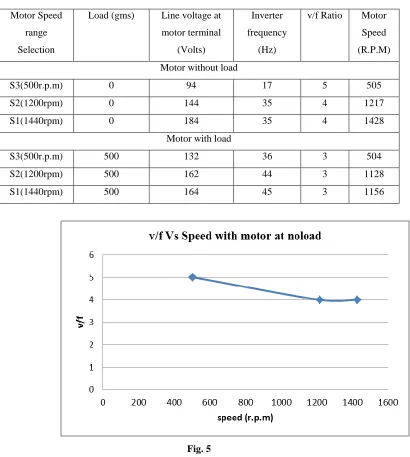
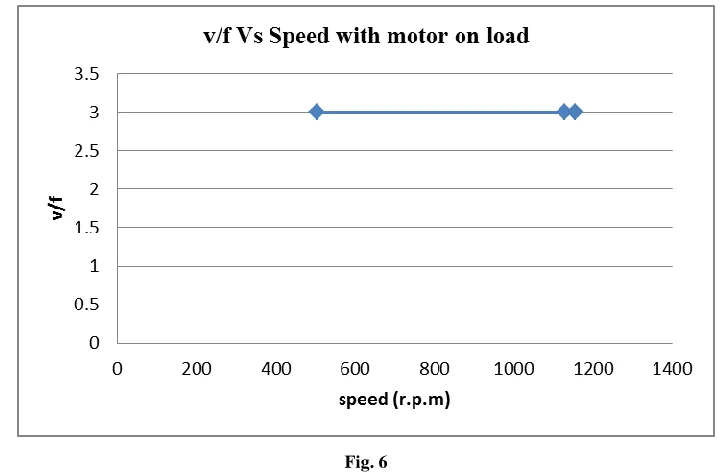
The complete hardware system has been developed and tested. The motor with ratings of 1440 RPM, 230V,
1Amp, 0.5 H.P. has been tested on no load to full load at user defined speed. The results are tabulated below.
Motor Speed
range
Selection
Load (gms) Line voltage at
motor terminal
(Volts)
Inverter
frequency
(Hz)
v/f Ratio Motor
Speed
(R.P.M)
Motor without load
S3(500r.p.m) 0 94 17 5 505
S2(1200rpm) 0 144 35 4 1217
S1(1440rpm) 0 184 35 4 1428
Motor with load
S3(500r.p.m) 500 132 36 3 504
S2(1200rpm) 500 162 44 3 1128
[image:5.612.107.517.116.573.2]S1(1440rpm) 500 164 45 3 1156
Fig. 6
V. CONCLUSION
When induction motor is connected to the supply directly it runs at rated speed at no load. If the motor is loaded then speed of the motor starts to drop. So to run the motor below rated speed constantly with load and without load v/f method is used. For that to generate PWM waveform and to measure speed of the motor PIC microcontroller is used. The paper represents two algorithms one for measurement of motor speed and other to generate error signal from set speed and actual speed and to adjust the voltage and frequency of the PWM waveform. From the observation it is concluded that by maintaining constant v/f ratio motor runs at variable speed with load and without load below rated speed. Appendix
Appendixes, if needed, appear before the acknowledgment.
ACKNOWLEDGMENT
I, the author of this paper express my foremost and deepest gratitude to PES’s Modern College of Engineering and Marathwada Mitramandal’s College of Engineering Pune(India) their help and encouragement.
REFERENCES
[1] P.S.Chaudhari, Dr. Pradeep M.Patil, Sharad S. Patil, P.P.Kulkarni, R.M.Holmukhe, “Comparison Of Performance Characteristic of Squirrel Cage Induction Motor by Three Phase Sinusoidal and PWM Inverter Supply using MATLAB Digital Simulation”, Third International Conference on Emerging Trends in Engineering and Technology, 2010 IEEE.
[2] F.A.Ramirez, M.A.Arjona, and C.Hernandez, Mexico, “Space-Vector PWM Voltage-Source Inverter for a Tree-Phase Induction Motor based on the dsPIC30F3011”, Electronics, Robotics and Automation Mechanics Conference, 2009 IEEE.
[3] K.Sandeep Kumar, K.Pritam Satsangi, “Microcontroller Based Closed Loop Control of Induction Motor Using V/f Method”, IET-UK International Conference on Information and Communication Technology in Electrical Sciences (ICTES 2007), Dr. M.G.R.University, Chennai, Tamilnadu, India. Dec. 20-22, 2007.
[4] G.K.Singh, D.K.P.Singh, K.Nam, “A Simple Indirect Field-Oriented Control Scheme for Multiconverter-Fed Induction Motor”, IEEE Transaction on Industrial Electronics, vol.52, No.6, December 2005. [5] katsunori Taniguchi, member, IEEE, Yasumasa Ogino, and Hisaichi IRIE,
“PWM Technique for Power MOSFET Inverter”, IEEE transaction on Power Electronics, vol.3, no.3, July 1988.
[6] S.Flora Viji Rose, Mr. B.V.Manikandan, “Simulation and Implementation of Multilevel Inverter Based Induction Motor Drive”.
[7] Vedam Subrahmanyam, “Electric drives” Tata McGraw-Hill 2005.
AUTHORS
First Author – Shirke Deepali S., B.E.Electrical, PES’sModern
College of Engineering Pune, [email protected]
Second Author – Prof. Kulkarni Haripriya K., M.E.Electrical,
PES’sModern College of Engineering Pune, [email protected]
Correspondence Author – Shirke Deepali S.