CORE TRAINING’S OUTCOME ON SELECTED PHYSICAL
VARIABLES EXPLOSIVE POWER AND FLEXIBILITYIN MEN
FOOTBALL PLAYERS
Dr. S. Binthu Mathavan., (Ph.D )
Post -Doctoral Fellow
Department of Physical Education and Sports, Pondicherry University, Puducherry-605014
ABSTRACT
In this study showing impact of core training to explosive power and flexibility physical variables in men football players, twelve healthy men football players were acted as subject for this investigation. Before starting experiment researcher explained need and importance their role in this study and pre -test data were collected for participated subjects. In this study selected core exercises were chosen for giving this experiment. The training were implemented in morning session weekly 3 alternative days minimum 45-90 minutes programme after that subject insisted to play football game / training related skills were practiced. After completion of twelve weeks experiment selected physical variables such as explosive power (vertical jump) and flexibility (sit & reach test) data were collected for evaluating differences between pre & post- test performances, for statistical analysis paired ‘t’ test were done in SPSS package 16th
version, the confidence level were fixed at 0.05 level.Results; the given twelve weeks core training programme were showing positive influence to selected men football group on the variables explosive power and flexibility.
Introduction
Core strength training is feasible, safe (without injuries) this kind of exercises process improving better motor qualities like flexibility and strength moreover speed, balance as well co-ordination physical fitness components to healthy male and female youths (Grancher, 2014). In football game every motor quality are involving while playing especially
International Research Journal of Human Resources and Social Sciences
Vol. 4, Issue 1, January 2017 Impact Factor- 5.414
ISSN(O): (2349-4085) ISSN(P): (2394-4218)
endurance, strength, flexibility and agility, so that the investigator to identify through core exercises how can we develop explosive power and flexibility to football players. Because these two parameters are also playing a vital role in football game and their performance in various aspects as well playing situation. For that reason the investigator has inquire core training’s impact of selected parameters to college level men football players.
Reason for chosen this problem
In historical days Indian were strong in motor qualities like speed, strength, endurance, flexibility, power, co-ordination, agility and so on, because they used to hunt animal for their food, so while hunting they have got knowingly or unknowingly good quality of running, jumping, throwing, lifting and agility this kind of activities were done to maintain their daily routine life. In modern days because of technology development in agriculture and other modern food culture most of the people are having obesity because they are lack in physical activity, among said motor qualities explosive strength and flexibility is also essential for all sports and games players / athletes. In football players these mentioned variables were helpful for developing as well performing most of the football skills and drills especially goal keeping.
Objective of study
For this exploration to identify effect of core training for explosive power and flexibility physical variables to college level men football players.
Hypotheses
In this investigation based on review of related literature and experts guidance the following hypothesis were framed there would be a significant development because of twelve weeks core training programme on the variables of Explosive Power and Flexibility to selected men soccer players group.
Subjects and methods
jump) and flexibility (sit and reach test) variables data were collected from selected college level men soccer players. Then the training were implemented to selected group for 12 weeks morning session minimum 45-90 minutes training programme after that training adaptation to game, skill practice, practice matches and various playing situation were practiced to selected football group. For this study the following exercises were given such as plank, side plank, bridge, side lying hip abduction, oblique crunch, straight leg raise, cycling and lying wind screen wipers. After completion of twelve weeks training again selected explosive power (Vertical Jump Test) and flexibility (Sit Reach Test) variables data were collected, for analyzing collected data paired ‘t’ test were used and analysis were done through SPSS package 16th version moreover the level of significance were fixed at 0.05 level.
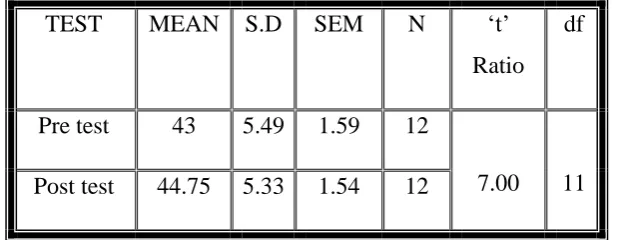
PRE AND POST- TEST MEAN, STANDARD DEVIATION, STANDARD ERROR MEAN AND ‘t’ RATIO ON THE VARIABLE OFEXPLOSIVE POWER
(Vertical Jump)
TEST MEAN S.D SEM N ‘t’ Ratio
df
Pre test 43 5.49 1.59 12
7.00 11 Post test 44.75 5.33 1.54 12
[image:3.595.144.453.337.457.2]*Significant difference degrees of freedom 1 & 11 table value is – 2.201
The diagram showing the results of mean and standard deviation on the variable of explosive power
PRE AND POST- TEST MEAN, STANDARD DEVIATION, STANDARD ERROR MEAN AND ‘t’ RATIO ON THE VARIABLE OF FLEXIBILITY
(Sit and Reach)
TEST MEAN S.D SEM N ‘t’ Ratio
df
Pre test 33.83 5.06 1.46 12
2.365* 11 Post test 37.42 4.68 1.35 12
*Significant difference degrees of freedom 1 & 11 table value is – 2.201
Table- II showing flexibility variable pre-test and post- test performance from men football players group, inthis Pre-test mean value 33.83 is lesser than post-test performance mean value 37.42 and pre-test standard deviation 5.06 is higher than post- test standard deviation 4.68 moreover calculated ‘t’ ratio value 2.365 is higher than table value 2.201 with significance level of 0.05 and 1 & 11 degrees of freedom. Hence researcher concluded that given twelve weeks coretraining programmewere influenced positively in flexibility variable to selected men football group. It is showing that the framed research hypothesis was accepted for this investigation in the variable of Flexibility.
0 20 40 60
mean SD
43
5.49 44.75
5.33
The diagram showing the results of mean and standard deviation on the variable of flexibility
Results and Discussion
The above diagram presenting the data which collected from selected group on the variable explosive power and flexibility before and after implementing 12 weeks core training programme. In flexibility out of twelve subjects three were showing same performance one subject shown low than the Pre - test performance other eight subjects are showing positive significant changes. Hence, researcher considering, the given core training influenced explosive power and flexibility it shows core muscles were stronger than pre -test
0 10 20 30 40
mean SD
33.83
5.06 37.42
4.68
pretest post test
0 10 20 30 40 50 60
1 2 3 4 5 6 7 8 9 10 11 12
FLEXIBILITY- POST TEST
FLEXIBILITY-PRE TEST
EXPLOSIVE POWER-POST TEST
performance moreover body fat were reduced through this training. In summary the given core training is suitable to developing flexibility and explosive power for all sport and games players / athletes especially football payers, because who are all having good core strength they can jump higher, kicking shooting and they can generate more force for all skills which are all involving in soccer game.
References
Araujo, S., Cohen, D., & Hayes, L. (2015). Six Weeks of Core Stability Training Improves
Landing Kinetics Among Female Capoeira Athletes: A Pilot Study.Journal of human
kinetics, 45(1), 27-37.
Arnold, C., Lanovaz, J., Oates, A., Craven, B., & Butcher, S. (2015). The effect of adding
core stability training to a standard balance exercise program on sit to stand
performance in older adults: a pilot study. Journal of aging and physical activity, 23(1),
95-102.
Au, M. K., Chan, W. M., Lee, L., Chen, T. M., Chau, R. M., & Pang, M. Y. (2014). Core
stability exercise is as effective as task-oriented motor training in improving motor
proficiency in children with developmental coordination disorder: a randomized
controlled pilot study. Clinical rehabilitation, 28(10), 992-1003.
Calatayud, J., Borreani, S., Martin, J., Martin, F., Flandez, J., &Colado, J. C. (2015). Core
muscle activity in a series of balance exercises with different stability conditions. Gait
& Posture.
Chuan-fang, Z., Qiang-min, H., & Jin-feng, P. (2014).Theoretical foundation and
development of core stability training. Chinese Journal of Tissue Engineering
Research, 11, 026.
Czaprowski, D., Afeltowicz, A., Gębicka, A., Pawłowska, P., Kędra, A., Barrios, C., &Hadała, M. (2014). Abdominal muscle EMG-activity during bridge exercises on
stable and unstable surfaces. Physical Therapy in Sport, 15(3), 162-168.
DAI SUGIMOTO, G. D., BUSH, H. M., & HEWETT, T. E. (2014).Effects of Compliance on
Trunk and Hip Integrative Neuromuscular Training on Hip Abductor Strength in
Female Athletes. Journal of strength and conditioning research/National Strength &
Elvira, J. L., Barbado, D., Flores-Parodi, B., Moreside, J. M., & Vera-Garcia, F. J.
(2014).Effect of movement speed on trunk and hip exercise performance.European
journal of sport science, 14(6), 547-555.
Huang, B. (2014, June). Linear Regression Analysis Between Core Stability and Jump Shot.
In Applied Mechanics and Materials (Vol. 539, pp. 911-914).
Juan-Recio, C., López-Vivancos, A., Moya, M., Sarabia, J. M., & Vera-Garcia, F. J.
(2015).Short-term effect of crunch exercise frequency on abdominal muscle
endurance. The Journal of sports medicine and physical fitness, 55(4), 280-289.
Kachanathu, S. J., Tyagi, P., Anand, P., Hameed, U. A., &Algarni, A. D. (2014).Effect of
Core Stabilization Training on Dynamic Balance in Professional Soccer
Players. PhysikalischeMedizin, Rehabilitationsmedizin, Kurortmedizin, 24(06),
299-304.
Mayer, J. M., Quillen, W. S., Verna, J. L., Chen, R., Lunseth, P., &Dagenais, S. (2015).
Impact of a Supervised Worksite Exercise Program on Back and Core Muscular
Endurance in Firefighters. American Journal of Health Promotion, 29(3), 165-172.
MEDICA—TORINO, E. M. Core Stability Training Program (CSTP) effects on static and
dynamic balance abilities.
Mok, N. W., Yeung, E. W., Cho, J. C., Hui, S. C., Liu, K. C., & Pang, C. H. (2015). Core
muscle activity during suspension exercises. Journal of Science and Medicine in
Sport, 18(2), 189-194.
Saeterbakken, A., Andersen, V., Brudeseth, A., Lund, H., &Fimland, M. S. (2015). The
Effect of Performing Bi-and Unilateral Row Exercises on Core Muscle
Activation. International journal of sports medicine, 36(11), 900-905.
Sekendiz, B., Cug, M., &Korkusuz, F. (2010). Effects of Swiss-ball core strength training on
strength, endurance, flexibility, and balance in sedentary women. The Journal of
Strength & Conditioning Research, 24(11), 3032-3040.
Silfies, S. P., Ebaugh, D., Pontillo, M., &Butowicz, C. M. (2015).Critical review of the
impact of core stability on upper extremity athletic injury and performance. Brazilian
journal of physical therapy, 19(5), 360-368.
Willardson, J. M. (2007). Core stability training: applications to sports conditioning