International Journal of Scientific and Research Publications, Volume 8, Issue 11, November 2018 144 ISSN 2250-3153
Effect of Growth Regulators In in vitro Micropropagation of
Ixora coccinea
1Rania Ahmed Hassan Onsa, 2Igbal Abdelgadir Abdellatif, 3Magdoleen Gamar Eldeen Osman4Thohira Lee Abdullah
1
Department of Horticulture, Faculty of Agriculture, University of Al zaiem Al azhari , Khartoum, Sudan
2
Department of Horticulture, Faculty of Agriculture, Sudan University of Science and Technology, Khartoum, Sudan 3 Plant Tissue Culture, National Centre of Research, Khartoum, Sudan
4 Department of Crop Science, Faculty of Agriculture, University of Putra Malaysia DOI: 10.29322/IJSRP.8.11.2018.p8320
http://dx.doi.org/10.29322/IJSRP.8.11.2018.p8320
Abstract- Ixora coccinea is one of many purpose shrubs, it used as ornamental shrub or as important medical plant, traditionally Ixora is propagated from stem cuttings from mature shrubs this method is not economical since the multiplicate rate is low to fulfilled market demand and the collection of stem cuttings leads to arrest the growth of the mother plant. This study concentrated on the effect of growth regulators on an in vitro
micropropagation of Ixora coccinea. Shoot tip explants were cultured on Murashige and Skoog(1962) (MS) media supplemented with different concentrations (0.0, 0.5, 2.0 and 4.0 mg/l) of different type of cytokinins (Benzyl aminopurine (BAP), Kinetin and Zeatin) for multiplication of shoot. , the combined effect of MS media fortified with different concentrations of Indole-3-butyric acid (IBA) (0.0,0.25, and 0.5 mg/l) and 2.0 mg/l BAP was study .Callus initiate was evaluate using different types of explants (leaves and flower petals) and different types of growth regulators namely 2,4-dichlorophenoxyacetic acid (2,4-D),Thidiazuron (TDZ) and Naphthalene acetic acid (NAA) in different concentrations (0.0,2.5, 5.0,7.5 and 10.0 mg/l). Plantlet with 3.0cm in length were rooted in MS media containing different types of auxins namely Naphthalene acetic acid (NAA), Indole-3-butyric acid (IBA) and Indole-3-acetic acid (IAA) in different concentration (0.0, 2.0,5.0 and 10.0mg/l). The result showed that the uses of different types of cytokinin alone had low effect on shoot morphogenesis of Ixora and no data recorded exception on a number of leave in 1.0mg/l zeatin and 2.0 mg/l BAP (5.9 and 5.7 respectively) without significance different between them. The addition of 2.0 mg/l BAP and 0.5 mg/l IBA to MS media enhanced the multiplication rate of shoot significantly. There was significantly different among different concentration of auxin on initiation of roots, 10.0mg/l NAA encourage not only on roots inanition but also number and length of roots after 25 days from culture. After 60 days from culture small size of callus was observed on the edge of leave explant on MS supplemented with 10.0 mg/l 2,4-D.
Index Terms- Ixora coccinea, micropropagation, in vitro, growth regulators BAP; NAA; IBA; 2,4-D; TDZ
http://dx.doi.org/10.29322/IJSRP.8.11.2018.p8320
I. INTRODUCTION
I
xora coccinea is belonged to the family Rubiaceae, it hasnumerous named like jungle - geranium, flame of the forest and other names (Griffiths, 1994; Liogier, 1997). In Sudan it named Ixora (El Amin,1990). There are over 400 species of Ixora around the world (Willis, 1966), cultivars differ in both flower color (yellow, pink, orange, white, red) and plant size. Many new cultivars and hybrids of Ixora coccinea have come to the market in the last couple of decades. Ixora is one of the world’s most popular tropical flowering shrubs, it makes ideal flowering hedges, borders, screens or as a specimen planting, and it may be pruned at any time. In laboratory tests, extracts of Ixora have shown antibacterial (Kumer et al., 1997) and antitumor or anti-carcinogens activities(Latha and Panikkar, 2001; Malathy and Pai, 1998, Serrame and Lim-Sylianco, 1995). Traditionally Ixora has propagated from stem cuttings from mature shrubs this method is not economical since the multiplicate rate is low to fulfilled market demand and the collection of stem cuttings leads to arrest the growth and development of the mother plant. Although Ixora is a large genus in family Rubiaceae yet less number of researches in micropropagation has been carried out in this genus, Usha et al. (2016) recorded that there are 6 researches in micropropagation of Ixora sp.
The aim of this study was to establish an in vitro technique for
Ixora coccinea and to investigate the responses of different types
of explants to different growth regulators in order to identify optimum conditions for direct and in direct shoot regeneration.
II. MATERIALS AND METHODS
Mother plants of Ixoracoccinea (pink) about four years old were used as a source of explants. They were well irrigated, regularly fertilized and pruned to produce new vegetative growth. Shoot tip about 1.5 cm length was used as an explant for shoot initiation while leaves and flower petals were used as an explant for callus initiation experiments. The explant was sterilized by immersing in 20% sodium hypochlorite solution (v/v) and 2- 3 drops of Tween 20 with continuous shaking for 15 mints. For culture establishment MS (Murashige and Skoog(1962)) was used
and incubation room temperature was adjusted to 25ºC ± 2 under light intensity of 1000 lux using white fluorescent lamb.
The sterile shoot tip explants were cultured on MS media supplemented with different concentrations (0.0, 0.5, 2.0 and 4.0 mg/l) of each type of cytokinins (BAP, Kinetin and Zeatin) to evaluate their effect on shoot morphogenesis. Another experiment was conducted to evaluate the combined effect of MS media fortified with different concentrations of IBA (0.0,0.25, and 0.5 mg/l) and 2.0 mg/l BAP. Number of leaves, number of shoots, length of shoots and number of nodes were measured after 8 weeks as growth parameters.
To initiate callus induction different concentrations (0.0, 2.5,5.0, 7.5 and 10.0mg/l) of 2,4-D, TDZ and NAA were tested, using two different types of explant (leaves and flower petals). Callus color, size, and texture were measured after 8 weeks from culture to evaluate callus initiation.
Plantlets proximately 3.0 cm length with 6 leaves were transferred to MS media supplemented with different concentrations (0.0, 2.0, 5.0, and 10.0 mg/l) of IBA, NAA and IAA to evaluate their effect on root formation. Rooting percentages, number of roots, length of roots was measured after 30 days from culture and data were recorded.
Experiments were arranged in completely randomized design with five replications. Recorded data were analyzed using a Statistic Analysis System software program (SAS) using analysis of variance (ANOVA).Treatments mean comparisons of data were performed using Duncan Multiple Range Test (DMRT) at a 5% probability.
III. RESULT AND DISCUSSION
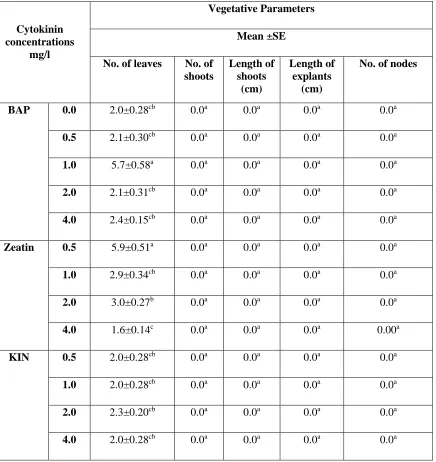
The effect of adding different types of cytokinins to MS culture media appeared only on initiation of leaves on shoot tip of Ixora
coccinea after 8 weeks from culture. The best result obtained on
1.0 mg/l Zeatin (5.9 leaves) followed by 2.0 mg/l BAP (5.7 leaves) treatments without significant difference between them, but both of which has a significant difference from others treatments. Table (1). This result was confirmed by Lakshmanan (1997) who reported that 2.0 and 2.5 mg/l BAP in culture media had an effect on shoot tips explant of Ixora coccinea that by continued to grow as a single shoot and did not branch even after 3 months. A similar observation was achieved also by Khan (2004) in Ixora chinensis.
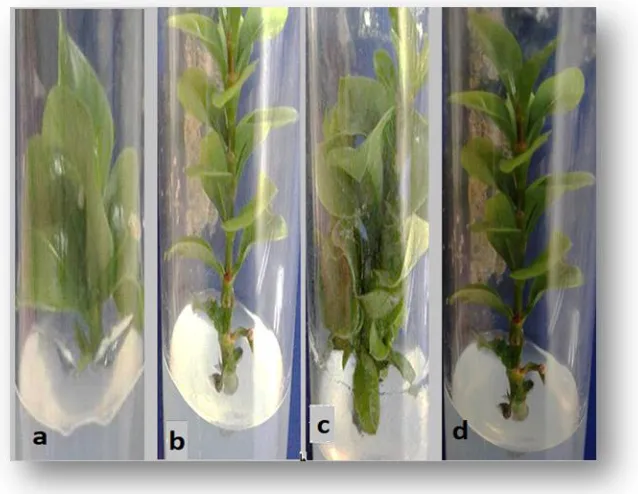
The effect of different concentrations of IBA (0.1, 0.25, 0.5 mg /l) combined with 2.0 mg/ l BAP on Ixora coccinea direct shoot regeneration was highly significance (Table 2). 2.0 mg/l BAP combined with 0.5 mg/l IBA gave the highest number of all measured parameters, 0.5mg/l and 0.1 mg/l with 2.0mg/l BAP gave a comparable number of leave, shoot and nod which was significantly higher than all other treatments(Plate:1). This result emphasizes the previous finding that the high concentration of cytokinin and low concentration of auxins promote vegetative growth (George et al.,2008).This also in agreement with Lakshmanan et.al.(1997) who found that 2.5 mg/l BAP with 0.25 mg/l IAA gave the best result on shoot multiplication of Ixora
coccinea, and also in the same line with Amin (2002) who found
that 100% of lxora fulgens explant proliferation on media containing 0.5mg/l BAP and 0.1mg/l NAA while in same concentration of BAP but with IBA instead of NAA 60% of shoot tip explant grown normally and healthy.
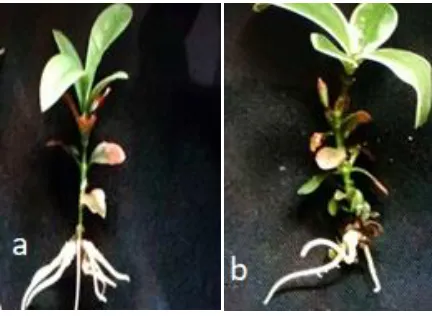
Different types and concentrations of auxins showed a significant effect on rooting of plantlet.100% of rooting occurred on 10.0 mg/l NAA followed by 80% on 5.0 mg/l NNA and 5.0 mg/l IBA. Other treatments including all concentrations of IAA did not initiate rooting in plantlet. 10.0 mg/l NAA gave the best result
regarding the number and length of roots among all treatments (6.6, 6.1cm). (Table3) and(Plate:2).This result agreed with Lakshmanan (1997) who found that 10.0 mg/l NAA and IBA gave 100% and 60 % of roots initiation respectively. Amin (2002 ) founded that 0.2 mg/l IBA was effectively more than other auxin and 100% rooting percentage happened in IBA and NAA
on Ixora fulgens plantlets.
For callus initiation, Ixora coccinea sterile leaves or flower petals explant showed little to respond to different concentrations (0.0, 2.5, 5.0 ,7.5 and 10.0 mg/l) of 2,4-D, TDZ and NAA. After 60 days ,7.5 mg/l and 10.0 mg/l 2,4-D initiated callus on the edge of the leaves explant and the size of the callus about 5mm2 on 10.0 mg/l 2,4-D. Morphological feature evaluation revealed that callus color was off-white to pale yellow with friable texture. Plat (1). In the case of flowers petals, there was no response to the above treatments and it remained normal and healthy for more than 3 months Plate(2). This result dis-agreed with Noreen, (2001) who found 80% callus formation with maximum fresh weight (1.16 g)
in Ixora chinensis leave explant cultured in MS fortified with
3.0mg/l 2,4 -D , after 8 days from culture in contrast with 60 days in this studied in the same study 2.0 mg/l of 2,4-D, yielded 73% callus formation with 0.35g fresh weight on 15 days from culturing and the lowest callus (5%) was observed at control. In this study, the less response of Ixora coccinea to initiate callus might be due to low endogenous hormone level.
IV. CONCLUSION
To obtain well rooted Ixora coccinea explant drive from shoot tips microprpagated plantlet under greenhouse condition it can culture on MS media supplemented by 2.0mg/l BAP combine with 0.5mg/l IBA.Added 10.0 mg/l NA to MS culture media promoted roots induction, number and length of roots.
REFERENCES
[1] Amin, M.N.; Ahmed. S, Alam.M. R and Azad.M.A.K .2002. In vitro rapid clonal propagation of an ornamental plant Ixora fulgens. Journal of biological sciences 2:(7)485-488
[2] El Amin, H.M.1990. Trees and shrubs of Sudan. Food and Agricultural Organization (FAO).
[3] George, E. F., Hall. M.A. and De Klerk, G.,2008. Plant Propagation by Tissue Culture. Published by Springer, 3ed Edition.
[4] Griffiths, M. 1994. Index of garden plants. Timber Press, Portland, OR. 1,234 p.
[5] Khan, S. Iftikhar, M. Saeed, B. 2004.An economical and efficient method for mass propagation of Ixora coccinea Pak. J. Bot., 36(4): 751-756.
[6] Kumar, T.K. Rajini, C.E., Sasidharan, V.K., and Kumar, T. Krishna. 1997. The antibacterial and antifungal activity of secondary metabolites from some medicinal and other common plant species. Journal of Life Science 2: 14-19. [7] Lakshmanan, P., Lee, C.L. and Goh, C.J. 1997.An efficient in vitro method for mass propagation of a woody ornamental Ixora coccinea. Plant Cell Rep., 16: 572-577.
[8] Latha, P.G., Panikkar, K.R. 2001.Chemoprotective effect of Ixora coccinea L. flowers on cisplatin-induced toxicity in mice. Phytother Res., 15: 364-366. [9] Liogier, H. A. 1997. Descriptive flora of Puerto Rico and adjacent islands. Editorial de la Universidad de Puerto Rico, San Juan, Vol. 5. PR. 436 p [10] Malathy, S. and Pai, J.S. 1998.Micropropogation of Ixora singaporensis
(Linn) - An ornamental shrub. Curr. Sci., 75 (6): 545-547.
[11] Murashige, T. and F. Skoog, 1962. A revised medium for rapid growth and bioassays with tobacco tissue culture. Physiol. Plant., 15: 473–97.
[12] Noreen, Rabia, Khan, M. Aslam, Jaskani, M. Jafar and Hussain, Nazir. 2001.Callogenesis and Embryogenesis from Leaf Disks of Ixora chinensis.
International journal of agriculture and biology.
[13] Serrame, E. and C.Y. Lim-Sylianco. 1995. Antitumor-promoting activity of decoctions and expressed juices from Philippine medicinal plants. Philippine Journal of Science 124(3): 275-281.
Table (1): Effect of different kinds and concentrations of cytokinins on shoot proliferation of Ixora coccinea after 8 weeks from the culture in MS
Cytokinin concentrations
mg/l
Vegetative Parameters
Mean ±SE
No. of leaves No. of
shoots
Length of shoots
(cm)
Length of explants
(cm)
No. of nodes
BAP 0.0 2.0±0.28cb 0.0a 0.0a 0.0a 0.0a
0.5 2.1±0.30cb 0.0a 0.0a 0.0a 0.0a
1.0 5.7±0.58a 0.0a 0.0a 0.0a 0.0a
2.0 2.1±0.31cb 0.0a 0.0a 0.0a 0.0a
4.0 2.4±0.15cb 0.0a 0.0a 0.0a 0.0a
Zeatin 0.5 5.9±0.51a 0.0a 0.0a 0.0a 0.0a
1.0 2.9±0.34cb 0.0a 0.0a 0.0a 0.0a
2.0 3.0±0.27b 0.0a 0.0a 0.0a 0.0a
4.0 1.6±0.14c 0.0a 0.0a 0.0a 0.00a
KIN 0.5 2.0±0.28cb 0.0a 0.0a 0.0a 0.0a
1.0 2.0±0.28cb 0.0a 0.0a 0.0a 0.0a
2.0 2.3±0.20cb 0.0a 0.0a 0.0a 0.0a
4.0 2.0±0.28cb 0.0a 0.0a 0.0a 0.0a
[image:3.612.65.501.99.561.2]Table (2): The combination effect of 2.0 mg/l BAP and different concentrations of IBA on morphogenesis of Ixora coccinea
explant after 8 weeks of culture in MS media:
IBA
(mg/l)
No. of leaves No. of shoots Length of
shoots(cm)
Length of explants
(cm)
No. of nodes
Mean ±SE
0.0 7.5±1.01c 0.0b 0.0c 0.2±0.04c 3.0±0.24c
0.1 16.2±1.21a 2.3±0.35a 1.3±0.40b 0.6±0.15 b 7.0±0.62a
0.25 10.0±1.27 b 1.4±0.35a 1.1±0.36b 0.6±0.19b 4.0±0.61b
0.5 17.1±1.75a 2.5±0.19a 3.4±0.55a 1.9±0.39a 7.0±0.77a
Means with the same letters in the same column are not significantly different at 5% using Duncan multiple range test. SE= Standard Error
Plat (1): Effect of 2.0mg/l BAP combined by different concentration of IBA on Ixora coccinea shoot tip explant after 8 weeks from culture
(a)2.0mg/lBAP+0.0mg/l IBA (b)2.0mg/lBAP+0.1mg/l IBA
[image:4.612.154.473.370.617.2]Table 3: Effect of different types and concentrations of auxins on root initiation of Ixora coccinea plantlet derived from shoot tip explant.
Auxin (mg/l) % of rooting per
explant
Number of
roots
Length of
roots (cm)
Days to root
formation
Mean ±SE
0.0 0.0 0.0c 0.0c -
NAA
1.0 0.0 0.0c 0.0c -
2.0 0.0 0.0c 0.0c -
5.0 80.0 3.0±0.56b 3.7±1.35b 30
10.0 100 6.6±0.76a 6.1±1.14a 25
IBA
1.0 0.0 0.0c 0.0c -
2.0 0.0 0.0c 0.0c -
5.0 80.0 2.9±0.53b 2.0±0.55b 65
10.0 80.0 2.9±0.60b 3.1±1.19b 65
IAA
1.0 0.0 0.0c 0.0c -
2.0 0.0 0.0c 0.0c -
5.0 0.0 0.0c 0.0c -
10.0 0.0 0.0c 0.0c -
Means with the same letters in the same column are not significantly different at 5% using Duncan multiple range test. SE=Standard Error
Plate (2): Ixora coccinea rooted plantlet affected by 10.0 mg/l NAA or IBA
Plat (3): Callus formation on edge of leaves explant cultured on MS supplemented with 10 mg/l of different types of auxin after 60 days from culture
(a)
2,4-D,
(b)
TDZ and
(c)
NAA
Plate (2) Flower petal explant in MS with10.0mg/l 2,4-D , TDZ and NAA