Understanding the Impact of E-Logistics Capability on
National Statistical System E-Data Performance: A Case
Study on Ghana
Emmanuel Dwamena Sasu, PhD.
*
Senior Programme Management & Evaluation Specialist, Ghana Statistical Service, Part-time Lecturer, Accra Institute of Technology, Accra, Ghana.
Email: [email protected]. DOI: 10.29322/IJSRP.8.7.2018.p7925
http://dx.doi.org/10.29322/IJSRP.8.7.2018.p7925
ABSTRACT
This study focused on understanding the impact of e-logistics capability involving the Ghana Statistical Service corporate website, and its electronic data interchange (corporate email, SharePoint among others) on the performance of the National Statistical System in e-data transactions. In relying on Wengmann (2008) knowledge management tool and Kaplan & Norton (1996) scorecard on corporate performance (employee learning and growth, and employee satisfaction) theoretical orientation, the study applied SPSS statistical software with principal component and multiple regression analysis to establish that Ghana Statistical Service corporate website and its other electronic data interchange contribute significantly to the performance of the National Statistical system in e-data transactions.
Keywords: e-logistics, corporate website, electronic data interchange, corporate performance, National Statistical System.
I. INTRODUCTION
E-transactions are undertaken on the internet through online applications involving web browsers, electronic mail, electronic data interchange among others (Lewis, 2001, p. 8). These categories of electronic transactions consists of interrelated group of organizations from diverse industries through organization’s intranet, website embedded with online transaction capability involving electronic communication of information often performed through electronic means (Mooddley & Morris, 2004, p. 157). In their studies, Wyn & Katz (1995) discovered that except fora for interactive exchange, corporate websites are largely a mixture of information already available in printed media, and that the web provides a medium for social processes involving orderliness of talk, shared understanding, and accountability.
As an example of genre organizational communication, corporate web presence may embrace multiple identities which are acknowledged as social actions on behalf of members of a corporate organization facilitating interactions among members in order, structure, and process (Brown & Coupled, 2004). Earlier studies conducted on electronic transactions mainly focused on e-commerce, with a few ones which established relationships between e-logistics capability of firms and financial performance (Delong & McLean, 2004; Droge & Germain, 2000; London and Hall, 2011). This study sought to breach the research gap on e-logistics capability and corporate performance by assessing the impact of e-logistics capability and performance of e-data transactions in a National Statistical System (NSS). The research relied on survey responses from four hundred and fifty six (456) staff employed in organizations constituting the National Statistical System in Ghana. The purpose of this empirical research is to contribute to the body of knowledge; a number of significant variables on e-data transactions with tendency to impact on organizational performance.
1.1 Theoretical Framework
warehousing, business intelligence, and business performance management. The second theoretical framework in line with Kaplan & Norton (1996) scorecard perspective of; employee learning and growth, and customer satisfaction reviewed literature on value added per employee to corporate growth, staff communication, employee satisfaction, leadership development among others (Niven, 2002 & Wegmann, 2008).
2. 0 REVIEW OF LITERATURE
E-business occurs on the internet using applications such as web browsers, electronic mail and other forms of electronic data interchange (EDI). Business to business (B2B) commerce deals with commercial transactions involving ICT to perform public internet transactions involving worldwide web-based auctions, and mutual trade arrangements between business partners on organizations extranet, and websites infused with electronic technology involving data interchange (Moodley & Morris, 2004, p. 157). This research reviewed literature on the roles play by corporate website and electronic data interchange in e-data transaction activities. Corporate websites are array of information available through print media which organizes information for shared understanding on a common platform. Electronic data interchange (EDI) serves as a common platform where employees and customers in performing inter-company, computer-to-computer exchange of business documents; in standardized format to streamline transactions devoid of paper work, reduced personnel and inventory costs, reduced order lead time and data errors as a result of electronic transactions replacing manual ones (Droge & Germain, 2000).EDI are mostly employed by large organizations with capacity to process higher volumes of information for easy sharing of these information with their external stakeholders (Al-namlah & Rawashdeh, 2017)
The benefits associated with the electronic transactions include higher service levels, improved communication, product availability, better accuracy in ordering, and reduction in labour costs (Peffers, Dos Santos & Thumer, 1998). Kaplan & Norton (1996) linked corporate performance to four scorecard perspectives involving: (1) Financial performance which describes shareholders and their expectations from the organization, (2) Employee learning and growth- , (3) Customer satisfaction, and (4) Business process perspective- focused on creating value and innovation (Niven, 2002 & Wegmann, 2008). Overall employees and client satisfaction in electronic data transactions can emanate from quality of information being shared, effectiveness of the systems being used to distribute information, and how quickly client data needs are met. Researchers agree that satisfaction comes with being impressed with service, being attractive to service delivery, and that institutional satisfaction is a key element in determining organizational performance (Fry, 2014 & Kerai, 2017). This study seeks to understand the performance of the National Statistical System in Ghana through two major scorecard perspective involving employee learning and growth, customer and employee satisfaction in e-data transactions.
3.0 METHODOLOGY
This study employed survey research approach with a Likert Scale within interval of 1-5; where 1 represents disagree strongly and 5 represents agree strongly. The study relied on survey responses from employees of seven government institutions who are members of the National Statistical System in Ghana. Using a systematic random sampling technique, 470 employees of these institutions where selected from a total of 950 employees who constituted the total sampling frame.The research employed the corporate e-logistic capability of corporate website, and electronic data interchange (employee corporate SharePoint and extranet) of Ghana Statistical Service as key independent variables with impact on dependent variables (corporate performance based on employees growth and, customer satisfaction).The study’s independent variables consisted of e-logistics capability in line with Wengmann (2008) knowledge management tool for corporate performance. These variables were: (1) Corporate website with decision support, (2) Electronic data interchange with executive information system, (3) Corporate website with executive information system, (4) Corporate website with data warehousing, (5) Electronic data interchange with data warehousing, (6) Corporate website with business intelligence, (7) Electronic data interchange with business intelligence, and (8) corporate website with business performance management. The dependent variables employed were: (1) Improved knowledgeability of employees on statistical data (2) Enhanced corporate relationship with customers, (3) Improved corporate communication with customers, (4) Improved data needs of clients, (5) Improved data quality, (6) Enhanced capacity of staff in data communication and reporting, (7) Improved intra and inter-agency exchange of data and statistical reporting, (8) Reduction in data errors associated with information sharing, (9) Improved communication and knowledge sharing between employees and customers, and (10) Improved organization-customer relationship in data sharing.
H1a.: The Ghana Statistical Service corporate website contributes significantly to the performance of the National Statistical System.
H0a: The Ghana Statistical Service corporate website does not contributes significantly to the performance of the National Statistical System (NSS).
H1b: The Ghana Statistical Service electronic data interchange system contributes significantly to the performance of the National Statistical System.
Hb0: The Ghana Statistical Service electronic data interchange system does not contribute significantly to the performance of the National Statistical System (NSS).
4.0 DATA ANALYSIS AND FINDINGS
Out of the 470 employees of the National Statistical System who were contacted for the study, 456 (97.0%) provided responses to questions on e-data transactions involving the Ghana Statistical Service, institutions constituting the NSS in Ghana, and their customers. The data which were analyzed with SPSS statistical software applied principal component analysis to reduce the large number of variables being studied. The data extraction technique helped reduced independent variables into five (5) and the dependent variables into four (4). The independent variables were (electronic data interchange with executive information system, corporate website with executive information system, corporate website with data warehousing, electronic data interchange with data warehousing, and corporate website with business intelligence). The dependent variables were (satisfying clients data needs, improved relationship with customers, improved organization-client communication, and improve intra and inter-agency data exchange and data reporting. See Appendix Table 1 for details. The adequacy of sampling used in this research was subjected to KMO and Bartlett’s test which produced a sampling adequacy 0.65. Cronbach alpha test of reliability yielded a coefficient of 0.71 to confirm data reliability.
The results from the data extraction indicated that electronic data interchange with data warehousing accounted for the highest variance (87.9%) indicating a higher contribution in predicting the performance of National Statistical System in e-data transaction. It recorded an explained variance of 18.2%; which implies that 18.2% of explained variation can be predicted from independent variables. Again, the results show that electronic data interchange with executive information system accounted for 61.8 % of variance. This implies that 12.6% of the variance can be predicted from independent variables. Corporate website with data warehousing accounted for 58.0% of variance. The 58.0% for corporate website with data warehousing also accounted for 12.0% of total explained variation. This implies that 12.0% of the variance can be predicted from independent variables. A correlation coefficient involving both dependent and independent variables revealed a low correlation relationship between dependent and independent variables (r < 0.5); an indication of absence of multi- collinearity. We therefore proceed to Appendix Table 1 and 2 to discuss other outputs.
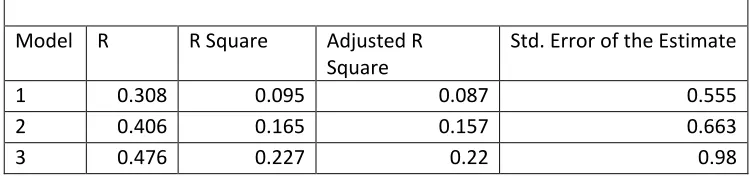
From the mode1 summary in Appendix Table 1, coefficient of determination (R2= 9.5%) in model 1 implies that 9.5% performance of National Statistical System in e-data transactions associated with meeting client data needs can be attributed to four predictors: GSS electronic data interchange with data warehousing, corporate website with data warehousing, electronic data interchange with executive information system, and corporate website with business intelligence. A higher F value of 11.794 compared to smaller p< 0.01 confirms that the independent variables (GSS electronic data interchange with data warehousing, corporate website with data warehousing, electronic data interchange with executive information system, and corporate website with business intelligence) significantly predict dependent variable (met clients data needs). See Appendix Table 2 for details.
Similarly, coefficient of determination (R2= 16.5%) in model 2 shows that 16.5% of National Statistical System in e-data transactions (improved data communication with clients) can be predicted by electronic data interchange with data warehousing, corporate website with data warehousing, electronic data interchange with executive information system, corporate website with business intelligence. The results is confirmed by larger F (22.17) compared to smaller p value (0.00) that the independent variables (electronic data interchange with data warehousing, corporate website with data warehousing, electronic data interchange with executive information system, corporate website with business intelligence) significantly predict dependent variable (improved data communication with clients) as shown in Appendix Table 2.
dependent variable (improved inter-agency exchange of data and other statistical reports). We conclude by accepting the hypotheses: H1a: that Ghana Statistical Service corporate website contributes significantly to the performance of the National Statistical System and H1b: that Ghana Statistical Service electronic data interchange system contributes significantly to the performance of the National Statistical System.
5.0 CONCLUSIONS
The research sought to understand the impact of e-logistics capability (corporate website and electronic data interchange) on performance of National Statistical System (employee learning and growth, employee and customer satisfaction). The study’s theoretical orientation was founded on Wengmann (2008) knowledge management tool and Kaplan and Norton (1996) organizational performance attributed to: employee learning and growth, and customer satisfaction. The review of literature focused on the role of corporate website, and that of electronic data interchange. In relying upon survey responses from 456 Ghanaian employees found on the National Statistical System, a principal component analysis performed on data with SPSS statistical software reduced the relatively large dependent and independent variables to 4 and 5 respectively. The independent variables were (electronic data interchange with executive information system, corporate website with executive information system, corporate website with data warehousing, electronic data interchange with data warehousing, and corporate website with business intelligence). The dependent variables were (satisfying clients data needs, improved relationship with customers, improved organization-client communication, and improve intra and inter-agency data exchange and data reporting.
The results from the data extraction indicated that electronic data interchange with data warehousing accounted for the highest variance (87.9%) indicating a higher contribution in predicting the performance of National Statistical System in e-data transaction. In addition, electronic data interchange with executive information system accounted for 61.8 % of variance. These revelations confirmed that the independent variables predict the dependent variables. The study further showed that 9.5% performance of National Statistical System in e-data transactions associated with meeting client data needs were attributed to predictors: GSS electronic data interchange with data warehousing, corporate website with data warehousing, electronic data interchange with executive information system, and corporate website with business intelligence. Similarly, coefficient of determination (R2= 16.5%) meant that 16.5% of National Statistical System in e-data transactions (improved data communication with clients) is predicted by electronic data interchange with data warehousing, corporate website with data warehousing, electronic data interchange with executive information system, corporate website with business intelligence.
APPENDICES
Appendix Table 1: Communalities
Extraction
R
%
GSS electronic data interchange with executive
information system in e-data services
0.40
40.0
GSS corporate website with executive
information system in e-data transaction
0.403
40.3
GSS corporate website with improved e-data
warehousing
0.60
60.0
GSS electronic data interchange with corporate
e-data warehousing
0.36
36.0
GSS corporate website with improved
organizational corporate business intelligence in
e-data production
0.39
39.0
GSS electronic data interchange with corporate
business performance management in e-data
production
0.36
36.0
GSS corporate website has enhanced the
working relationship between our organization
and customers in e- data services
0.372
37.20
GSS corporate website has improved
communication between our organization clients
in e-data services
0.375
37.50
GSS corporate website has facilitated e-data
transactions in meeting clients data needs
0.40
40.0
GSS corporate website with quality of our data
being produced
0.47
47.0
GSS electronics data interchange with improved
intra and inter-agency exchange of data and
other statistical reports
0.63
63.0
Appendix Table 2: Model Summary
1. Dependent Variable: Met client data needs.
Predictors: (Constant). Corporate electronic data interchange with data warehousing, corporate website with data warehousing, electronic data interchange with executive information system, corporate website with business intelligence.
2. Dependent Variable: Improved data communication with clients.
Predictors: Electronic data interchange with data warehousing, corporate website with data warehousing, electronic data interchange with executive information system, corporate website with business
intelligence.
3. Dependent variable: Improve intra and inter-agency exchange of data and statistical reports.
[image:6.612.118.493.118.208.2]Predictors: Corporate website with business intelligence, corporate website with executive information system, corporate website with data warehousing, electronic data interchange with data ware-housing.
Table 3: ANOVA
Model R R Square Adjusted R
Square Std. Error of the Estimate
1 0.308 0.095 0.087 0.555
2 0.406 0.165 0.157 0.663
3 0.476 0.227 0.22 0.98
Model Sum of Squares df Mean Square F Sig. 1. Regression
Residual Total
14.555 138.842 153.398
4 450 454
3.639
0.309 11.794 0.00
2. Regression Residual Total
38.986 197.836 236.822
4 450 454
9.747
.440 22.17 0.00
3. Regression Residual Total
126.924 432.360 559.284
4 450 454
31.731
For peer review send you research paper in IJSRP format to [email protected].
After submission IJSRP will send you reviewer comment within 10-15 days of submission and you can send us the updated paper within a week for publishing.
This completes the entire process required for widespread of research work on open front. Generally all International Journals are governed by an Intellectual body and they select the most suitable paper for publishing after a thorough analysis of submitted paper. Selected paper get published (online and printed) in their periodicals and get indexed by number of sources.
After the successful review and payment, IJSRP will publish your paper for the current edition. You can find the payment details at: http://ijsrp.org/online-publication-charge.html.
REFERENCES
[1] Al-namlah, L., & Rawashdeh, A. (2017). Factors influencing electronic data interchange adoption among SMEs in Sasudi Arabia. Asian Journal of Business and Accounting, 10(2). Retrieved from Google Scholar. [2] Brown, A.D., & Coupland, C.(2004). Constructing organizational identities on the Web: A case study of Royal
Dutch. Journal of Management Studies 41(8), 1326-1350. Retrieved November 30, 2016 from EBSCO Academic Research Database.
[3] Delone, H.W and McLean, E.R. (2004). Measuring e-commerce success: applying the Delone & Mclean information systems success model. International Journal of Electronic Commerce, 9(1), 31–47. Retrieved November 6, 2016 from EBSCO Academic Research Database.
[4] Dominic, S., & Reagle, D. (2001). Statistics and Econometrics. Schaum’s Outline Series. New York: McGraw-Hill.
[5] Droge, C., & and Germain, R. (2000).The relationship of electronic data interchange with inventory and financial performance. Journal of Business Logistics, 21(2), 209-231. Retrieved November 30, 2016 from EBSCO Academic Research Database.
[6] Lewis, I. (2001). Logistics and electronic commerce: an international systems perspective. Journal of Transport
Logistics, 6-14. Retrieved November 28, 2016 from EBSCO Academic Research Database.
[7] London, M., Hall, M. J. (2011). Web 2.0 support for individual, group and organizational learning. Human Resource Development International, 14(1), 103–113. DOI: 10.1080/13678868.2011.542902. Retrieved November 23, 2016 from EBSCO Academic Research Database.
[8] Kerai, S., & Saleh, A. (2017). Applying the balanced scorecard to improve student satisfaction, market share and profitability. Apply Management Review, Vol.1, 27-38. Retrieved from Google Scholar.
[9] Moodley, S & Morris, M. (2004). Does e-commerce fulfill its promise for developing country (South African) garment export producers? Journal of Development Studies, 32(2). Retrieved January 13, 2017 from EBSCO Academic Research Database.
[10] Niven, P.R. (2002). Balance scorecard step-by-step: Maximizing Performance and Maintaining Results: New York: Wiley & Sons.
[11] Peffers, K., Dos Santos, B.L., & Thurner, F.P. (1998). Motivation, implementation, and impact of electronic data interchange among US and German firms. Journal of Information Services, 18, 177-189.Retrieved November 30, 2016 from EBSCO Academic Research Database.
[12] Scott, E.J. (2000). Facilitating inter-organizational Learning with Information Technology. Journal of Management Information Systems, 17(2), 81-113. Retrieved November 23, 2016 from EBSCO Academic Research Database.
[13] Seidmann, W. (1995). Electronic Data Interchange: competitive externalities and strategic implementation
policies. Management Science Journal, 41(3), 401-420. Retrieved November 30, 2016 from EBSCO
Academic Research Database.
[14] Sun, T. (2009). Knowledge required to achieve entrepreneurial success. Unpublished Doctoral Dissertation: University of Phoenix.
AUTHOR
Author – Emmanuel Dwamena Sasu Qualification: PhD, MPM, PGDip, B.Com
Affiliate Institutions: Programme Management and Evaluation Expert- Ghana Statistical Service, Part-time Lecturer- Accra Institute of Technology
Email: [email protected].
Correspondence Author – Dr. Emmanuel Dwamena Sasu Email address: [email protected]