A QR Code Based Processing for Dynamic and
Transparent Seat Allocation
Mehul Yadav
*, Sumedh Kurundkar
*, Anushka Barve
*, Mrugesh Verekar
**
B.E (Computers), Vidyalankar Institute of Technology, Mumbai, India
Abstract- In Indian Railways transport system and in most other
public transport system a passenger cannot book for a ticket after the charting of train is done and a seat remains unused if a passenger did not board a train or cancels his ticket after the charting of train is done our approach to overcome it is by a dynamic seat allocation system using QR Code containing the URL to an online website for railway reservation has been developed. In a QR code a passenger specific URL is stored, when Hand held Terminal device running on android OS encodes this URL by the Check-in an passenger which is updated in the central database and any passenger who don’t board on the train his QR code check-in procedure is not done and after the specific time interval the ticket for it is automatically made available in the system for booking to other passengers.
Index Terms- QR code, Dynamic Seat Allocation, android, TTE
.
I. INTRODUCTION
Indian Railway is largest human transport system in the world. Over 20 million passengers travel daily by train all over India. A dynamic seat allocation system using QR Code containing the URL to an online website for railway reservation has been developed. A passenger can create an account online and check for availability of tickets online and on availability of a seat book a seat for oneself until the train departs.
In the proposed system, in the QR code a passenger specific URL is stored, when Hand held Terminal android device encodes this URL by the Check-in process it redirects to the SQL database server and verifies the data stored of the passenger and updates the information of all passengers boarded the train. DSA server allot the seats of absent passengers to the waitlisted passengers and if still some seats remain vacant then reflect them as available across the railway network from where any passenger willing to board the train can book their ticket.[2] It also assures transparency in the berth allocation system and also make the ticket checking process fast.
II. EXISTINGSYSTEM
The current Indian Railway System being one of the world’s largest railway networks has less exposure to the current advanced technology. Lack of optimization in seat allocation and procurement of tickets by touts decreases the revenue of railway being one of its major drawbacks. [1]
The main drawback of the old railway reservation system is the reservation charts which are prepared 4 hours prior to the train departure. Whether a passenger has boarded the train or not
his berth still remains reserved till his destination. A seat may also go vacant if a passenger cancels his ticket after the train’s charting is done.
Also the transparency in the existing ticketing system is compromised at various levels this results in more space for touts to book tickets illegally and sell them at exaggerated price. Lack of optimization in seat allocation, for example whether passenger has boarded or not his seat remains reserved till his destination.
III. PROPOSEDSYSTEMS
The system proposes evolutionary changes in seat allotment procedures of Indian Railway system, some specifications are as follows: [2]
Dynamic seat allocation will enhance the chances of fair and efficient seat allocation for passengers in waiting list. With the help of CHECK-OUT procedure, a passenger willing to discontinue his journey can inform PRS system and thus a vacant seat available can be allotted to a passenger in waiting list.
The TTEs will not have to carry the complex reservations charts, also the passengers will be benefited by using the E-Tickets so this reduces a lot of paper work.
Figure 1: Flow Architecture.
Dynamic Seat Allocation Model
Our proposed DSA model is divided in the following sub-module:
Little Modification in Current Passenger Reservation System Today PRS is available at 8000 counters more than 2380 locations throughout the countries, including all major stations, and important non-railhead locations such as tourist centres and district headquarters. The PRS services are available to passengers for 23 hours in a day. Passengers can reserve a berth for any train 120 days in advance. In addition to the railway counters, multiple delivery channels have been provided to Rail passengers to access the PRS services. I-Ticketing and E-ticketing and through Internet was launched in year 2002 and 2005 respectively. Booking through Post offices was launched in year 2007.Besides all these facilities provided by Indian Railway one attempt that was tried to make is to reduce the usage of paper as much as possible. Passengers are requested to use their Mobile Phones as journey tickets, because the ticket is stored in Mobile Phone either as an SMS sent by IRCTC or in the PDF format store in memory card in the case of e-ticket. In an attempt with the Indian Railway our proposed Model suggest the use of QR code in the ticket generated from the counter and e-ticket, which contains the URL.[6]
Check-In, Check-Out and Booking Procedure.
In Check-In, a passenger places his Mobile Phone or ticket in his hand near Hand Held Terminal of TTEs to read QR code. A TTEs uses application of his Android HHT to read the QR Code over the ticket or from the screen of passenger’s phone and verifies it. In Check-out, the TTE makes an entry that the passenger has disembarked from the train. In booking procedure, the TTE can make a booking while in the train in case any seats
are vacant after all passengers have boarded and all the waiting list passengers have been allotted a seat.
Up gradation Policy
Availability of seat on train when it is running is depends upon the following policy:
First the berth is provided to waiting list passengers who are on the train and only those waiting passenger are given first priority whose journey in km is maximum. It means waiting list passengers are arranged in descending order according to their distance to be travel. [2]
Second condition will apply if there will be no waiting list passengers, only then the seat or berth can be booked from counter or through online to the passenger who is willing to start the journey from the next station when the train has to arrive.
Dynamic Seat Allocation Procedure
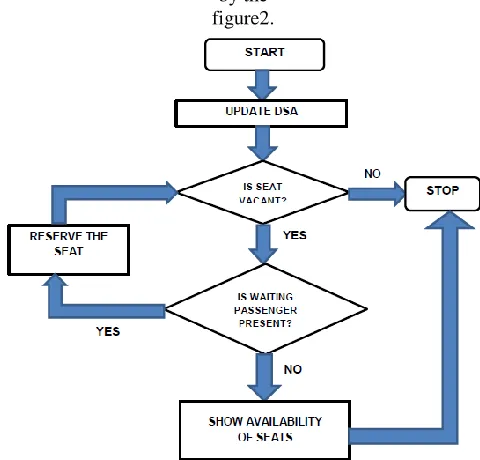
Once the DSA Server updates its database it will get the current vacant seat information. Next, if the waiting list passengers are
on the train and the seat are vacant then DSA SERVER will automatically allocate the seat to waiting list passenger otherwise it will be booked from counter or through online. In this way it is
possible to allocate seat dynamically during the journey of waiting list passenger. The above concept can be best understood
by the figure2.
Figure 2: System Working model.
IV. IMPLEMENTATION
Android based HHT device:
[image:2.612.323.563.342.572.2]Trains List Screen:
After authentication of the TTE is done Trains List activity is invoked. We have used Scroll View and Linear Layout, we have used a Spinner for the button so that a list view can be provided. Once the Next button is clicked TTE will be redirected to the next Activity in sequence called Menu activity.
Menu:
In this activity, there are 4 buttons provided, Check In-Out, Booking, Feedback and View Chart. Depending on which button is clicked the TTE will be redirected to that particular activity
Booking:
In this activity, TTE needs to enter the details of the passenger like Name, Age etc. and also provide the starting station, destination and fare amount. The calculation of fare is done on a basis of formula based on distance between starting station and destination. Once the Submit button is pressed, the QR Code with above information is generated. For generation of QR Code, Zxing library is used. We call the encode Barcode function which takes a String as parameter. TTE can share the generated QR Code image via Bluetooth, email or any other way suitable for the user. There is also provision of booking 5 tickets at the time by entering the right amount of details. All of the information is stored in the SQL database.
Check In-Out:
In this activity, TTE can scan the QR Code image which is the ticket of the passenger. This is done by calling the Scanner application installed on the device. [7]
View Chart:
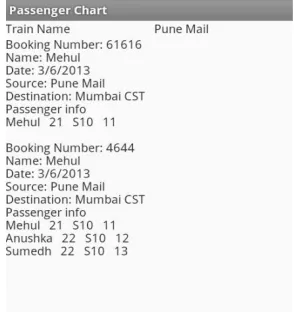
Here, all the tickets booked can be seen in the form of a chart. This is done by accessing all the data stored in the SQLite database.
Website: Home page:
On this page, there is an option for the user to login by clicking on the Log In link.
Login:
On this page, a user is required login providing his login details. In case the user does not have an account on the website he can click on the Register link provided which will redirect him to the Registration page where he can create a new account by providing details. All the required validations are done on the page and username and password are case sensitive.
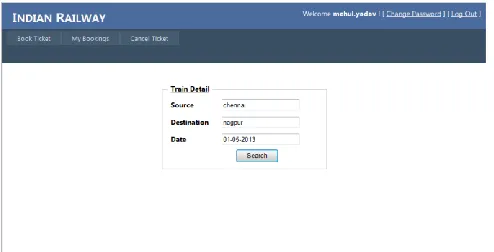
Train Details:
On this page, user needs to provide details of his journey in text boxes. Database is checked for the trains which are available for the given journey details on pressing the search button. This is done by searching every train in database for given details.
Availability:
On this, we can see if the train is available for the provided details. We can also see if the ticket is available for the provided
details. On pressing Book button we are redirected to a new page called RESERVATION DETAILS.
On pressing Fare button we can see the fare of the journey. Fare is calculated depending on the distance between the source and destination.
Reservation Details:
User needs to provide his details on this page like, Name, Age, and Gender. All this details are stored in the database and depending on the availability of the berth a seat is assigned to the passenger. On pressing Book button user is redirected to CARD DETAILS page.
Card Details:
User needs to provide details for making the payment of the journey. User will need to provide his Credit Card details for payment. On pressing Book a berth will be reserved for the passenger that is the entry will be made in the database.
Ticket:
Ticket details are displayed on this page along with the QR Code image which can be downloaded. [8]
Figure 3: QR Code Ticket 61
Cancel Ticket:
After the user logs in there are links at every page for cancelling the ticket named Cancel Ticket. On clicking this link, user is directed to cancellation page where we can see table with all the entries made so far. After cancellation, entries are removed from database & seat is allocated to waiting list passenger.
[image:3.612.323.570.579.705.2]V. GRAPHICALUSERINTERFACE
Figure 5: Reservation Window
[image:4.612.46.286.212.625.2]Figure 6. Ticket with the QR Code
Figure 7: Cancel Ticket Window
Figure 8: Admin login homepage
Android based HHT device:
In Fig. 1 there are four main options, they are Check in-out, Booking, Feedback, View Chart options. The Check in-out directly opens the QR code Scanner via the camera installed in the device.
In Fig. 2 the TTE will find the booking window where he is required to fill the necessary fields as found in the booking website.
Figure 9: Option Screen Figure 10: Booking Screen
In the view chart option, TTE can view all the passengers who have boarded the train until now.
Figure 11: Passenger Chart status
VI. CONCLUSION
This model proposes High degree of efficiency in the ticket booking system and also maintain high level of transparency in the procedure. In case of any last minute ticket cancelation or non-boarding of a passenger the QR code based check-in using the android based HHT system given to TTE system ensures a dynamic allocation of tickets to waitlisted passengers or makes available for booking by any other passenger. A Check-out and Booking process is also provided to the TTE by this HHT. Check-out process provides the passenger to break his journey at any station by getting his remaining money back and at the same time his vacant seat is provided to a waitlisted passenger. Booking interface provides capability to book the ticket for passengers on board.
VII. FUTUREWORK
[image:4.612.370.517.304.460.2]gets confirmed. The project is highly scalable and can be extended for use with other transport systems like Bus, Airline, etc.
REFERENCES
[1] Indian railway budget 2012 http://www.nr.indianrailways.gov.in
[2] Man Mohan Swarup, Abhiram Dwivedi, Chanchal Sonkar, Rajendra Prasad, Monark Bag, Vrijendra Singh “A QR Code Based Processing For Dynamic and Transparent Seat Allocation in Indian Railway” Cyber Law and Information Security Division, Indian Institute of Technology, Allahabad, India
[3] Yu-Hsan Chang, Chung-Hua Chu and Ming-Syen Chen, A General Scheme for Extracting QR Code from a non-uniform background in Camera Phones and Applications, Ninth IEEE International Symposium on Multimedia 2007.
[4] Jerry Zeyu Gao, “Understanding 2D-BarCode Technology and Application in M-Commerce- Design and Implementation of A 2D Barcode Processing Solution”, IEEE 31st Annual International Computer Software and Application Conference 2007.
[5] Viamana Varta, India’s Complete Aviation. Automobiles. Transport News Portal, WR anti-tout squad raids travel agent for ticket frauds http://vimanavarta.com/2012/02/18/wr-anti-tout- squad-raids-travel-agent-ticket- frauds/#axzz1sZbbsgz6. (accessed on 18 February 2012)
[6] Center for Railway Information System, Passenger Reservation System. http://cris.org.in/CRIS/Projects/PRS.
[7] http://developer.android.com/training/basics/firstapp/index.html [8] http://asp.net-tutorials.com/basics/introduction/
AUTHORS
First Author – Mehul Yadav, B.E (Computers), Vidyalankar
Institute of Technology, Mumbai. Email: [email protected]
Second Author – Sumedh Kurundkar , B.E (Computers),
Vidyalankar Institute of Technology, Mumbai., Email: [email protected]
Third Author – Anushka Barve, B.E (Computers), Vidyalankar
Institute of Technology, Mumbai. Email: [email protected]
Fourth Author – Mrugesh U. Verekar, B.E (Computers),
Vidyalankar Institute of Technology, Mumbai. Email: [email protected]
Correspondence Author – Mrugesh Verekar, B.E (Computers),