www.ijsrp.org
I
International Journal of Scientific and Research Publications, Volume 9, Issue 10, October 2019 749 ISSN 2250-3153
Developing Teaching and Learning Materials Based
On Guided Discovery Model to Improve Problem Solving
Skills and Student Learning Outcomes On Heat Topic
Rahmadi1, Wasis2, Rudiana Agustini3
1Postgraduate Study of Science Education, Postgraduate, Surabaya State 2,3 Lecture of Postgraduate Study of Science Education.
University DOI: 10.29322/IJSRP.9.10.2019.p9494 http://dx.doi.org/10.29322/IJSRP.9.10.2019.p9494
Abstract- The purpose of This research is to develop teaching and learning of physics in high school based on guided discovery learning model that usable to improve problem-solving skills and student learning outcomes on heat topic. Teaching and Learning materials was developed using 4-D models (define, design, develop, and disseminate) that limited to develop stage and tested using one group pretest-posttest design. The test of teaching and learning materials was conducted for class XI of SMAN 1 Batu Engau in 2017/2018 year. The data collected through observation, tests and questionnaires. The data analysis was performed by descriptive quantitative analysis and qualitative analysis. The results obtained demonstrate the validity material includes RPP, Student Worksheet (LKS), Textbook Student (BAS), and the knowledge and skills assessment sheets valid category. Practicality learning device includes adherence to the RPP and student activity category, and the problem can be solved during the learning process. The Effectiveness of learning materials developed by of positive student responses in learning, and to improve problem solving skill and student learning outcome on best category. Based on the results, we can conclude that the guided discovery model in teaching and learning of physics is usable to improve problem-solving skills and learning outcomes of high school student.
Index Terms- learning material, guided discovery models,
problem-solving skills, learning outcomes.
I. INTRODUCTION
n the class XI high school physics subject for semester 1 of the curriculum 2013 the subject of heat requires students to be able to analyze the effect of heat on a substance, how to transfer heat, and apply the Black principle in problem solving. Learning concepts and principles contained in the heat material is very important to understand because it is the basis for students to learn the science of thermodynamics. Einstein's estimation of spontaneous emission and research on the thermodynamics of black bodies began when humans began to think about heat as Aristotle had done before BC [1].
Although the concept of heat is the basic material in learning thermodynamics, the discussion of heat is still considered difficult by students. This is consistent with the results of the study that the level of difficulty of some Physics subject matter namely;
26% in Temperature and Heat material, 25% in Optical material, 21% in Static Fluid material, 17% in Elasticity and Hooke Law material, and 11% in Kinematics material [2]. One factor that causes students to have difficulty understanding the heat material is because the learning model applied is still dominated by Teacher Centered Learning (TCL). This condition is also in accordance with the opinion of Simamora R E, Sidabutar D R and Surya E states that conventional teaching causes students to be less able to follow lessons well, sometimes even saturated. [3].
One effort that can be done is to design interested learning for students is the guided discovery model because its prioritizes student involvement. This is in accordance with Slavin E R's opinion that learning guided discovery models provides several benefits in the form of increased student motivation to continue their work until finding answers and arousing student curiosity [4]. In line with Salavin, Eggen P and Kauchak D revealed that the guided discovery learning model was effective in encouraging student involvement and motivation while helping them gain an understanding of natural topics [5]. In addition to encouraging active student involvement the main benefits of the guided discovery model can also improve students' high-level cognitive skills, one of which is problem solving skills. Bamiro A States that the use of guided discovery is capable of promoting learning through discovery, which eventually leads to the development of higher quality cognitive skills, which in effect enhances problem- solving skills in students. Based on the findings of this study, it is hereby recommended that teachers should make a guided discovery model in science classroom [6]. Ufi, Rizal M and Hadjar I also showed that in harmony with the increase in high-level cognitive skills student learning outcomes also increased by up to 20% with the application of guided discovery learning models [7].
II. METHOD
International Journal of Scientific and Research Publications, Volume 9, Issue 10, October 2019 750 ISSN 2250-3153
detailed in stages, systematic and directed, making it easier for researchers to apply it.
After the process of developing the learning device, to find out how the feasibility of the device is tested using one group pretest- posttest design. The design is in accordance with Creswell J W's research which involves one group observed in the pretest (O1) and
followed by a certain treatment (X) and Post test (O2) [9]. The
pre-experimental one-group pretest-posttest design can be written in the form of:
O1 X O2
Explanation:
O1: preliminary test (pretest) to determine the problem solving skills and student learning outcomes of the subject matter before learning
O2: the final test (post test) to determine the problem solving skills and student learning outcomes of the subject matter after learning
X : the treatment of learning by using a guided discovery model of learning tools
The object taken in this study is not random, because this study aims to find out how the feasibility of the learning device developed, so that the object is only one experimental class and two replication classes without using a control class. The replication class is intended that the experimental results of the device being developed have strength and are not obtained by chance.
III. FINDING AND DISCUSSION
Learning devices as described in the introduction, said to be of good quality must have three aspects of quality, those are: Validity, Practicality, and Effectiveness. The validation results show that the developing RPP (learning devices) has an average score of 3.98, which means that the RPP (learning devices) has been categorized as good for improving problem-solving skills and high school student learning outcomes in heat material with little revision. RPP (learning devices) with good category is appropriate used in learning (Ratumanan G T and Laurens T) [10].
Practicality can be measured by the implementation of lesson plans and student activities. The results of the assessment of the RPP (learning devices) implementation in teaching and learning process with a value of 4.36 as an excellent category. only in time management as good category or have a value of 3.74. Time management is one that must be considered in applying the guided discovery learning model, because students are required to be more involved in learning. This is in accordance with the opinion tasvierrahma in patandang, the teacher often feels unsatisfied if can not motivate and guide students learning well [11]. Decreasing the time in providing motivation and guidance as the solution has been done in this study, researchers conducted guidance at the beginning of each learning phase, then given the discretion for students to be creative and find their own ideas, it's just still in the control of the teacher.
Student activities in this study are more dominant thereby reducing teacher dominance in learning. It was found that students did more activities than listening to the teacher's explanation.
Student activities in worksheets and discuss assignments, conduct the experiments and observations such as worksheets instructions, take notes, draw conclusions and discuss in groups include contributing ideas, asking questions and presentations in order to decrease the activities outside of the learning context. It shows that in learning activities students have an active role, and the teachers is just as facilitators who guide and direct students in learning. This is in accordance with the opinions of Njoo and De Jong in Nur H and Nidha AB, it has been found that for discovery learning to be successful, students must have the discovery activities, including formulating hypotheses, experimental designs, predictions, and data analysis or other regulatives skills activities [12].
The effectiveness of the lesson plan can be determined by two components are student response and student learning outcomes. Students' responses to the guided learning model were positive can be seen from students' interested in the material component / content of 95% and students' interested in problem solving skills of 92.86% and 100% of students were interested in the guided discovery learning model. In line with these conditions Mahlail F I, Endang S. M and Anggraito Y U stated the guided discovery model moved the active role of students with mental processes in order students do not get bored and interested in learning activities [13].
The learning outcomes of attitudes aspects are obtained from observing students' attitudes during learning. Based on observations of the students' scientific attitudes as a whole, it is categorized as good, even though the attitude of prudence and cooperation attitude is initially below 75% but can be increased at the next meeting. This improvement is brought by the use of guided discovery tools that provide opportunities for students to satisfy their curiosity and thus make learning fun. This opinion is consistent expressed by Thorndike in Nur M if a behaviour is followed by a pleasant thing in the environment, then increasing the possibility of the action will be repeated in a similar atmosphere [14].
The results of N-gain calculations for cognitive tests of students as a whole increased a relatively high because they have an average score of 0.79 or 79%. The lowest test score is 0.58 with medium criteria and the highest is 1 with high criteria. The lowest value of 58% is due to the students concerned in activities outside the context of guided discovery learning and have the less optimal scientific attitude at the beginning of learning, but it can be changed by the teacher guidance to increase the student knowledge learning outcomes. In accordance with these results, Adhim A Y and Jatmiko B also concluded that applying the guided discovery learning model will increase the learning outcomes of knowledge consistently [15]. It is also supported by Eggen P and Kouchak opinion, that applying the guided discovery learning model causes a higher level of student thinking and deeper understanding of material (student knowledge) with no more effort or additional class time.
www.ijsrp.org International Journal of Scientific and Research Publications, Volume 9, Issue 10, October 2019 751 ISSN 2250-3153
[image:3.612.45.294.88.540.2]ISSN 2250-3153
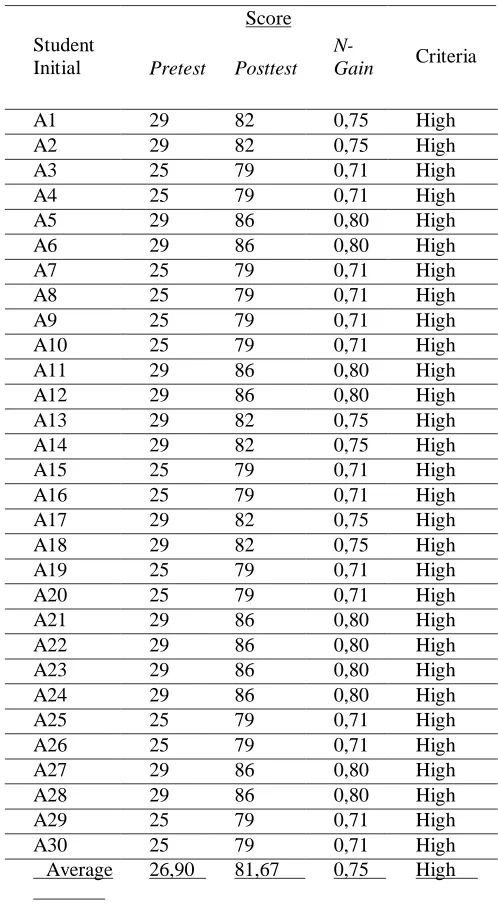
Table 1 Results of problem solving skills tests Score
Student
Initial Pretest Posttest N-
Gain Criteria
A1 29 82 0,75 High A2 29 82 0,75 High A3 25 79 0,71 High A4 25 79 0,71 High A5 29 86 0,80 High A6 29 86 0,80 High A7 25 79 0,71 High A8 25 79 0,71 High A9 25 79 0,71 High A10 25 79 0,71 High A11 29 86 0,80 High A12 29 86 0,80 High A13 29 82 0,75 High A14 29 82 0,75 High A15 25 79 0,71 High A16 25 79 0,71 High A17 29 82 0,75 High A18 29 82 0,75 High A19 25 79 0,71 High A20 25 79 0,71 High A21 29 86 0,80 High A22 29 86 0,80 High A23 29 86 0,80 High A24 29 86 0,80 High A25 25 79 0,71 High A26 25 79 0,71 High A27 29 86 0,80 High A28 29 86 0,80 High A29 25 79 0,71 High A30 25 79 0,71 High Average 26,90 81,67 0,75 High
The improvement in problem solving skills caused by the high interested and enthusiasm of students in learning, with the fact that 92.86% of students are interested in the problem solving skills component and 95% of students can be easy to follow the problem solving skills taught by the teacher, even though at first students must be guided in the problem solving stage because students feel new to the learning component provided by the teacher. It is also corroborated by Dahar's opinion, that specifically learning discovery aims to teach problem-solving skills [16]. In addition to the above learning physics according to Blue J, Tailor B and Jan YR are not seen only from the knowledge students have in showing higher levels of thinking, but assessments that need to be developed are based on academic performance that means as a way to demonstrate student knowledge in solving problems [17].
IV. CONCLUSION
Based on the analysis, discussion of results, and research findings can be concluded that the developing physics learning device with the guided discovery model to improve problem solving skills andhigh school student learning outcomes on heat material based on the requirements of validity, practicality, and effectiveness and appropriate to use.
V. RECOMMENDATION
The author suggests the following points to the readers:
a) Because this type of research is limited to students in class XI of SMA Negeri 1 Batu Engau, so the authors advise researchers to conduct the research for a broader scope or to the Disseminate stage.
b) Learning with the guided discovery model requires a relatively longer time so it needs to be introduced first to students in the learning stages.
c) Considering students' responses to the guided discovery learning model to improve their positive problem solving skills, it is hoped that this model can be applied to other material / physics subjects.
ACKNOWLEDGEMENTS
1. The author of this study wishes to offer his sincere gratitude and appreciation to East Kalimantan Government who granted a full scholarship for Post Graduation Program State in University of Surabaya.
2. He also extends special thanks to his principal advisors; Dr. Wasis, M. Si and Prof. Dr. Hj. Rudiana Agustini, M.Pd for their valuable advice and guidance to complete this research
3. He owes his heartfelt thanks to his beloved mother, his wife--Rochmalia Swastati, his daughter--Hafshah Aniqah Al-Qibtiyah, his son--Yafi’ Wijdan Hilmi Al-Banna, and all the big family of him who always encourage and support him during his study life
REFERENCES
[1] Sabayang D 2019 Heat physics. https://www.academia.edu/17492481/physics_heat. Accessed January 22, 2019
[2] Azizah, Rismatul, Yuliat L, dan Latifah E, 2015 The physic problem solving difficulties on high school student. Jurnal Penelitian Fisika dan Aplikasinya (JPFA). Vol 5, No 2, pp. 44-50
[3] Simamora R E, Sidabutar D R dan Surya E 2017 Improving learning activity and students’ problem solving skill through Problem Based Learning (PBL) in junior high school. International Journal of Sciences: Basic and Applied Research (IJSBAR) Volume 33, No 2, pp 321-331
[4] Slavin E R 2011 Educational psychology: Theory and practice of the ninth edition, volume I. Jakarta. Indeks Permata Puri Media
[5] Eggen P dan Kouchak D 2012 Learning strategies and models: teach content and thinking skills. Jakarta. Indeks Permata Puri Media
International Journal of Scientific and Research Publications, Volume 9, Issue 10, October 2019 752 ISSN 2250-3153
[7] Ufi, Rizal M dan Hadjar I 2017 The application of guided discovery learning models to improve student learning outcomes in class VII SMP negeri 19 Palu in material relationships, between lines and angles. Journal AKSIOMA mathematics education, Vol. 6 No. March 1, 2017. pp. 86-98
[8] Thiagarajan S, Semmel D S and Semmel M I 1974 Intructional depelopment for training teacher of exceptional Childrent. Indiana: Indiana University [9] Creswell J W 2010 Research design approaches qualitative, quantitative and
mixed. Yogyakarta : Pustaka Pelajar
[10] Ratumanan G T dan Lourens T 2006 Evaluate results that are relevant to solving learning and teaching problems. Bandung: CV Alfabeta.
[11] Patandang 2017 The effect of discovery learning on increasing students' science learning motivation. Jurnal of Education Science and Technology (EST). Vol. 3 No. 1 pp. 9-7
[12] Nur H dan Nidha A B 2016 Improvement students’activitiesand cognitive learning outcomesof Hasyim Asy’ari University through guided discovery learning. journal of Biology education. Vol. 3 pp. 206-214
[13] Mahlail F I, Endang S M dan Anggraito Y 2018 Developing Guided Discovery Based Biology Teaching Material Supported by Pictorial Analysis Vol.1 pp 25-35
[14]Nur M 2011 Science process skills module. Surabaya: Science Center and mathematics at Surabaya State University.
[15]Adhim A Y dan Jatmiko B 2015 Application of guided discovery learning models with laboratory activities to improve student learning outcomes. [16]Journal of physics education innovation. Vol. 04 pp. 77-82
[17]Dahar, R. W.(1989). Learning theories. Jakarta. Erlangga
[18]Blue J, Tailor B dan Jan Y R 2008 Full cycle assessment of critical thingking in an ethcis and sciences cource. International journal dor the scholarship of teaching and learning. Vol.1 pp. 1-24
AUTHORS
First Author – Rahmadi, Postgraduate Study of Science
Education, Postgraduate, Surabaya State University, [email protected]
Second Author – Wasis, Lecture of Postgraduate Study of
Science Education, Postgraduate, Surabaya State University, [email protected]
Third Author – Rudiana Agustini, Lecture of Postgraduate
www.ijsrp.org http://dx.doi.org/10.29322/IJSRP.9.10.2019.p9494