Identify Knowledge of Basic Cardiac Life Support
among Nursing Student
Misbah Sabir
Lahore School of Nursing University of Lahore Pakistan
Abstract
The knowledge of Basic Cardiac Life Support (BCLS) is very important among nurses to give basic life support the patient with
cardiac arrest in routine work at hospital and in community. Every nurse has to face emergency situation in her life and it is necessary
for her to gain sound and effective knowledge of BCLS. Increase survival ratio and decrease death rate is basic concern of health care
provider. Purposes To identify knowledge of basic cardiac life support among student nurses. Method Quantitative experimental
study was selected. It was an interventional study. Instrument The knowledge was analyzed by using the questionnaires prepared
from Basic Life Support (BLS) manual of American Heart Association (AHA). A workshop has been conducted on basic cardiac life
support and skills of cardiopulmonary resuscitation among Post RN BSN nursing students of Lahore School of nursing at the skill lab
of University of Lahore. Where effect of training of Basic Life Support (BLS) was evaluated based on pretest and posttest training
assessment scores. First theoretical Knowledge was explained through power point presentation and practical skills were
demonstrated on manikins in skill lab. Result The results were analyzed by using paired t test. Out of 62 participants only 3.2% (n=2)
participants get high scores in pretest the rest of participant 93.5% (n=58) has moderate knowledge level and 3.2% (n=2) had low
knowledge level. Posttest assessment was done with the same question paper showed 96.8% (n=60) secured high score and remaining
3.2% (n=2) passed with moderate score. Mean difference was -9.4 and P value 0.000 showed the workshop highly effective and
improved knowledge level in posttest. Conclusion Hence BCLS workshop is essential to improve knowledge and skills of
cardiopulmonary resuscitation (CPR).
Key Words: Basic Cardiac Life Support (BCLS), Cardiopulmonary resuscitation (CPR), Knowledge, Students, Workshop.
INTRODUCTION
Basic cardiac life support means given to the life support a patient in such a situation like sudden cardiac arrest (SCA), heart attack,
stroke and foreign body airway obstruction (FBAO). (Chaudhary, Parikh et al. 2011). Basic cardiac life support knowledge and
practices for health care provider is a key element or pillar to decreasing the death rate and increasing survival ratio. (Roshana,
Batajoo et al. 2012). Globally one third population of the world died each year with cardiovascular diseases. Health care personnel did
not have knowledge of effective cardiopulmonary resuscitation techniques. (Meaney, Sutton et al. 2012).
Nurses are the first person who deals to the patients with cardiac in hospital. So, nurses need a good knowledge and effective
practices of cardiopulmonary resuscitation. (Xanthos, Akrivopoulou et al. 2012) Student nurses need to be complete the courses of
Basic Cardiac Life Support prior to start clinical practices in actual life. (Kardong-Edgren and Adamson 2009).
Post RN BSN students are going to complete their degree program after diploma holding. It is necessary for them to have qualified
knowledge and skills especially in cardiopulmonary resuscitation.
Nurses have low level of knowledge of cardio pulmonary resuscitation and skills. It should be required to arrange
community to have knowledge of cardiopulmonary resuscitation (CPR) and basic life support for increasing the survival rate in life
threatening condition especially health care workers like doctors, nurses and paramedic’s staff should have basic and authentic
knowledge of cardiopulmonary resuscitation to improve the quality of life. (Chandrasekaran, Kumar et al. 2010).
Basic life support knowledge is a fundamental knowledge and skills for nurses. To retaining BCLS skills among nurses it is
necessary to arrange periodically workshop. As health care professional nurses should have fully skilled and competent in their
knowledge and skills regarding BCLS as they are close to the patient first when patient went into cardiac arrest.
Cardiac arrest is still leading cause of death around the world. Initial chest compression is the only source for cardiopulmonary
resuscitation.(Sidney, Rosamond et al. 2013). In under developing countries like Pakistan even though the person is a health care
worker who has to face emergency condition, fails to give basic life support to patient with cardiac arrest. It is generally observe
doctors and nurses fails to give proper and effective resuscitation in emergency situation when patient present with cardiac arrest.
Study finding helped the organization to plan and organize similar type of educational and training workshop for not only
nursing students but also all Allied Health Science students prior to join an organization in actual life and work in community.
The study was quantitative experimental study. The population selected the student nurses of Post RN BSN year I semester II
and Year II semester II. The students who are from Post RN BSN and give consent to become part of the study included. The sample
size was (n=62)
RESEARCH ELABORATION
Cardiac arrest is the most serious issue in hospital and out hospital setting, which require immediate CPR for reversal of the
victim. (Karim 2016). According to American Heart Association victim with cardiac arrest should provide basic life support for
cardiopulmonary resuscitation and work up on cardiopulmonary resuscitation services among public to improve survival ratio.
(Meaney, Bobrow et al. 2013). The “2010 American Heart Association Guidelines for Cardiopulmonary Resuscitation and
Emergency Cardiovascular Care” increased the focus on methods to improve high quality cardiopulmonary resuscitation (CPR). AHA
introduce 5 critical component to improve quality of cardiopulmonary resuscitation as minimise the interuption of chest compression,
provide adiquate rate and depth, avoid lean the body during perform compression, avoid excessive ventilation and provide minimum
rate of ventilation according guidelines. (Meaney, Bobrow et al. 2013).
A prospective quesi experimental study conduct on a single group pre test and post test after BLS class on registered nurses
at Jordianian hospital. Data show significant improvement as pre test scores (M=4.6, SD=2.9, range=0-9) and post test scores as
(M=7.5, SD=1.7, range=4 to 9). The score in pre test and post test indicate that nurses gain better score in post test. The study shows
the effectiveness of BLS simulation class.(Toubasi, Alosta et al. 2015)
A cross-sectional study conducted among medical students and doctors in Rawalpindi-Islamabad Pakistan to assess the
knowledge of cardiopulmonary resuscitation from June to September 2011. Results of the study was as inadequate awareness of
cardiopulmonary resuscitation among medical/dental students and doctors and recommended to give training of basic life support.
(Zamir, Nadeem et al. 2012)
RESULTS
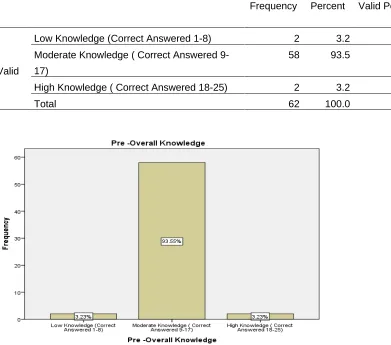
Pre-test over all knowledge as 3.2% (n=2) give 1-8 correct answer and have low knowledge level. 93.5% (n=58) have moderate
[image:3.612.43.434.120.465.2]knowledge. Only 3.2% (n=2) have high knowledge with (2.00+0.25) shows in (Table 1) (Fig 1)
Table 1 Pre -Overall Knowledge
Frequency Percent Valid Percent Cumulative
Percent
Valid
Low Knowledge (Correct Answered 1-8) 2 3.2 3.2 3.2
Moderate Knowledge ( Correct Answered
9-17)
58 93.5 93.5 96.8
High Knowledge ( Correct Answered 18-25) 2 3.2 3.2 100.0
[image:3.612.43.366.256.465.2]Total 62 100.0 100.0
Fig 1 Pre Overall Knowledge
Post Overall Knowledge
After attending workshop of BCLS knowledge level improved as 96.8% (n=60) have high knowledge as they gave correct answer
18-25 question out of 18-25 question. Only 3.2% (n=2) passed with moderate level of knowledge as they gave 9-17 correct answers with
(2.97+0.17) illustrate in (Table 2) (Fig 2)
Table 2 Post-Overall Knowledge
Frequency Percent Valid Percent Cumulative
Percent
Valid
Moderate Knowledge (Correct Answer
9-17)
2 3.2 3.2 3.2
High Knowledge (Correct Answer 18-25) 60 96.8 96.8 100.0
Fig 2 Post Overall Knowledge
Among 62 participants 40 were from year II semester II of post RN and remaining 22 were from year I semester II. Among all student
nurses only 3.2% (n=2) secured high score in pretest and remaining students have moderate knowledge. In post workshop assessment
as 96.7% participant secured high score. By paired t test data analysis pretest mean (11.9+2.51). In Posttest knowledge level was high
[image:4.612.38.403.420.498.2]with mean (21.4+1.64) shows in (Table 3)
Table 3 Paired Samples Statistics
Mean N Std. Deviation Std. Error
Mean
Pair 1 Pre-Test Score 11.9839 62 2.51221 .31905
Post-Test Score 21.4194 62 1.66496 .21145
Table4 shows paired sample significant correlation as 0.562.
Table 4 Paired Samples Correlations
N Correlation Sig.
Pair 1 Pre-Test Score & Post-Test Score 62 .562 .000
The p value of p<0.05 used to determine for the significant results. In short analysis of paired t test such as BCLS knowledge
increased significantly from the pretest (M=11.9) to the posttest (M=21.4), Mean differences= -9.4, p value 0.00. Intervention was
highly effective and statistics mean scores was high in post-test and improved knowledge level after attending workshop of Basic
Cardiac Life Support (BCLS).
Workshop Participant
N Pre Test mean Post Test
mean
Mean Differences Paired t test P value
Student Nurses of Post RN BSN
62 11.3 21.4 -9.4 .000
Conclusion:
The study emphasizes to teach basic cardiac life support skills to student nurses. All students have maximum experience to serve
health care organization of 4 to 7 years. On finding of this study students were fail in certain questions: how long should a pulse
check, correct compression rate, a child is gasping bus has pulse rate 100 per minute what should rescuer response, response of
rescuer on infant become responses after chocking, what should done after AED shock, breath and compression ratio of child among
second rescuer, correct compression placement in infant, alone find victim first response, when should use two thumb encircling
technique in infant, after scene is clear what should second step, when second rescuer come with AED what should next step, bag
valve mask is effective when controlled by two rescuer and best method to hold mask to deliver ventilation via bag valve mask.
Pre overall knowledge was moderate among all nursing students except two secured high scores and two secured low scores.
After attending workshop there is significant change in knowledge as all students secured high scores and two person passed with
moderate knowledge level. Paired t test and p value >0.05 was used to analyze the significant results. The study was highly effective
as on evaluation p value was 0.000 and mean differences between pre and post mean was -9.4. Results significantly show the
effectiveness of workshop among nursing student.
In North-karela a cross-sectional study conducted to evaluate knowledge of BLS among health care workers. Study shows
results as inadequate knowledge of BLS among health care professionals and recommended BLS Training to improve knowledge.
(Nambiar, Nedungalaparambil et al. 2016)
AKNOWLEDGEMENT
I want to acknowledge my parents for their support at every step and MisRobina, Mr M Hussain, Mis Hajra Sarwarand a very special
friend without their support I cannot achieve my goal.
REFERENCES
Chandrasekaran, S., et al. (2010). "Awareness of basic life support among medical, dental, nursing students and doctors. Indian journal of Anaesthesia54(2): 121. Chaudhary, A., et al. (2011). "Current scenario: Knowledge of basic life support in medical college." National journal of medical research1(2): 80-82.
Kardong-Edgren, S. and K. A. Adamson (2009). "BSN medical-surgical student ability to perform CPR in a simulation: Recommendations and implications. Clinical Simulation in Nursing5(2): e79-e83.
Karim, H. N. (2016). "Cardiac Arrest: A Need To Understand The Determinants Of Basic Life Support-A Nursing Perspective. i-Manager's Journal on Nursing6(1): 42.
Meaney, P. A., et al. (2013). "Cardiopulmonary resuscitation quality: improving cardiac resuscitation outcomes both inside and outside the hospital. Circulation128(4): 417-435.
Nambiar, M., et al. (2016).Is current training in basic and advanced cardiac life support (BLS & ACLS) effective? A study of BLS & ACLS knowledge amongst healthcare professionals of North-Kerala."World Journal ofEmergency Medicine7(4): 263.
Rajeswaran, L. and V. J. Ehlers (2014). "Cardiopulmonary resuscitation knowledge and skills of registered nurses in Botswana.curationis37(1): 1-7.
Roshana, S., et al. (2012). "Basic life support: knowledge and attitude of medical/paramedical professionals. World J Emerg Med3(2): 141-145.
Sidney, S., et al. (2013). The “heart disease and stroke statistics—2013 update” and the need for a national cardiovascular surveillance system, Am Heart Assoc. Toubasi, S., et al. (2015). "Impact of simulation training on Jordanian nurses' performance of basic life support skills: A pilot study☆. Nurse Education Today35:
999-1003.
Xanthos, T., et al. (2012). "Evaluation of nurses’ theoretical knowledge in Basic Life Support: a study in a district Greek hospital. International emergency nursing20(1): 28-32.
Zamir, Q., et al. (2012). "Awareness of cardiopulmonary resuscitation in medical-students and doctors in Rawalpindi-Islamabad, Pakistan." JPMA. The Journal of the Pakistan Medical Association62(12): 1361-1364.
AUTHORS
First Author: Misbah SabirSpecialization in ICU/CCU, Post RN BSN
Email; [email protected]
Corresponding Author:
Mis. Robina Kousar