ISSN 2250-3153
Design And Implementation Of Class Attendance
Management System Using Fingerprint Recognition
Sogbaike .C. O 1 and Ahoro .V.O 2
Delta State Polytechnic12
Otefe-Oghara Delta State
DOI: 10.29322/IJSRP.9.05.2019.p89110
http://dx.doi.org/10.29322/IJSRP.9.05.2019.p89110
ABSTRACT
Attendance is the action or state of going regularly to or being present at a place or event. Attendance in an
organization is important to ensure the continuous operation as it determines the strength of the organization. In
most institutions the current attendance monitoring system for students is still being manually done. This
method is time consuming, error prone and fosters laziness on the part of students, nonchalance attitude to
classroom lectures and activities, student nepotism and deliberate lecture skipping which may prevent students
from obtaining good academic performance. One reliable and efficient way to curb and totally do away with the
error prone, student nepotism etc. is employing computerized fingerprint recognition attendance monitoring
system which will enable management of the department ascertain the academic strength of each student in
terms of student punctuality, regularity, commitment to classroom lectures and generate reliable attendance
report for each student stored in a secured database. The system will also enable parents/guardian to monitor
their wards as attendance report will be sent to them via email anytime the student misses a class. This paper
presents an attendance system was designed using Visual Basic.Net which was used to connect the text field to
ISSN 2250-3153
KEYWORD: DATABASE, ATTENDANCE SYSTEM, FINGERPRINT, FINGERPRINT RCOGNITION,
ISSN 2250-3153
INTRODUCTION
Attendance register system is very important in the learning process and one of the main aspects that determine
students’ performance. Even though there is no causal relationship between students high attendance and good
academic performance, but there is a positive link between them. Usually, students with good or excellent
academic performance have high attendance rate (kamal 2015). The student’s academic information consists of
monitoring their performance and progress periodically which seems to be a huge workload on lecturers to
handle and update on the progress of subjects for the respective classes (Somasundaram et.al 2016). Keeping
these issues in mind a system is designed to overcome the problems associated with attendance system.
Biometric systems have been widely used for the purpose of recognition (Tabassam 2009). These recognition
methods refer to automatic recognition of people based on some specific physiological or behavioral features
such as facial, iris/ retina, voice, DNA and fingerprint. fingerprint recognition has a very good balance of all the
desirable properties. Every human being possesses fingerprints with the exception of any hand related
disabilities. Fingerprints are very distinctive fingerprint details are permanent, even if they may temporarily
change slightly due to cuts and bruises on the skin or weather conditions. Live-scan fingerprint sensors can
easily capture high-quality images and they do not suffer from the problem of segmentation of the fingerprint
from the background. The deployed fingerprint-based biometric systems offer good performance and
fingerprint sensors have become quite small and affordable because fingerprints have a long history of use in
forensic divisions worldwide for criminal investigations. A fingerprint is the pattern of ridges and valleys on the
surface of a fingertip. The end points and crossing points of ridges are called minutiae. It is a widely accepted
assumption that the minutiae pattern of each finger is unique and does not change during one's life. Ridge
endings are the points where the ridge curve terminates, and bifurcations are where a ridge splits from a single
path to two paths at a Y-junction.an example of a ridge ending and a bifurcation is illustrated in Figure 1. In this
ISSN 2250-3153
Figure 1 Example of a ridge ending and a bifurcation (Rishabh & Prashant 2011)
Attendance Management System is software developed for daily student attendance in schools, colleges and
institutes (Saurabh et. al 2017). An attendance management system is a combination of software and hardware
system developed for daily student attendance in schools and institutions. This facilitates access to the
attendance of a particular student in a particular class. This system will also help in generating reports and
evaluating the attendance eligibility of a student (sogbaike et.al 2018). The students tend to sign for their
friends who are not present for that day. Manually computing for the total percentage of attendance a student
meet is as tedious as the attendance sheet could be irregular or even misplaced. The verification and
authentication of student to determine the student eligibility for exam with the use of identity cards can be
inadequate since the plastic identity cards can be forged. The use of hand held attendance management device
as presented in sogbaike et.al 2018 has drawbacks such limited attendance space of 100 students (small size
memory), the device has an operation time of maximum fifteen minutes caused by limited power supply
(device is battery powered). All of these problems present in sogbaike et.al (2018) this paper seeks to solve.
Review of related works
Tabassam et.al 2009 developed an Academic Attendance Monitoring System Using Fingerprint Identification
for four (4) courses and fifty (50) students. The system was developed using Digital Persona’s Software
ISSN 2250-3153
biometric Identification. There are five algorithms implemented in this system firstly, Capture the student’s
fingerprint sample and create a feature set i.e a set of unique features created to match fingerprint, secondly,
Retrieve the stored templates from the repository (database), thirdly, Perform a one-to-n comparison between
the fingerprint feature set and the fingerprint templates stored in database, make a decision of match or
non-match. Fourthly, if match is found retrieve student’s information (Registration number, Department, Subjects)
from the database. And finally obtain the scheduled lecture from the database and mark attendance if student is
within the specified time i.e. within 30 minutes of the lecture’s starting time. If verification is not done or there
is some error in enrollment of fingerprint, system goes back to its initial state without marking the attendance.
Upon testing of the system there where 50 (fifty) identifications forty nine had successful identification one was
unsuccessful meaning 98% performance but the system didn’t incorporate a feedback mechanism In the
presence of impersonation.
Kamal 2015 in a project titled development of academic attendance mangement system using bluetooth
technology, designed and developed a system that manages attendance of students. The system consist of
Arduino UNO, Adafruit Fingerprint Sensor , HC-05 Bluetooth Module (Master/Slave), and a laptop computer.
The aforementioned components are connected together to obtain attendance from the student which is
transmitted through the Bluetooth to the laptop for collation. The drawbacks of this system is that the operation
time for the hand held device is not stated, the attendance size was not stated and the Bluetooth device has a
communication distance of 10 meters thus exceeding 10 meters there will be no communication.
Somasundaram et.al 2016 in a paper titled Mobile based Attendance Management System, deployed an
attendance management system where students takes attendance by first login on to a webpage to register and
then after registration attendance taking process begins. The student on the other hand uses a mobile phone with
an android mobile application which enable communication between the lecturer and students via sms. A
ISSN 2250-3153
Neha et.al 2013 in a paper titled an efficient automatic attendance system using fingerprint reconstruction
technique developed an attendance management system using finger print recognition system. The attendance
system consist of Fingerprint Scanner, LCD/Display Module, Computer (4)LAN connection . This attendance
system consists of 100 fingerprint scanners , 100 desktop computers and a LAN infrastructure. Fingerprint
scanner will be used to input fingerprint of teachers/students into the computer software. LCD display will
Software will be interfacing fingerprint scanner and LCD and will be connected to the network. It will input
fingerprint, will process it and extract features for matching. After matching, it will update database attendance
records of the students.
Ikuomola (2015) designed and developed an Educational Time and Attendance Management System
(eduTAMS). The system is fingerprint-based comprehensive attendance management system for universities
and colleges. It employs the use of electronic fingerprint scanner interfaced to the digital computer system for
verifying student identity. The student Identity is authenticated by the fingerprint-based biometric system which
compares the captured fingerprint image with fingerprint templates stored in a database. The student is granted
or denied specific lecture attendance based on the result of the comparison by the backend software system
running on the PC to which the fingerprint scanner is interfaced. The main purpose of this system is to take
attendance of the students for lectures, calculate the attendance rate of each student and use this record with
specified percentage requirement to perform authentication for access into examination venues. eduTAMS was
implemented on a network environment using C# and Microsoft SQL Server 2008. Testing of eduTAMS
showed no false acceptance or false rejection but showed true rejection and true acceptance.
Akinduyite et.al (2013) developed a Fingerprint-Based Attendance Management System that
consists of two processes namely; enrolment and authentication. During enrolment, the fingerprint of the user
is captured and its unique features extracted and stored in a database along with the users identity as a template
for the subject. The unique features called minutiae points were extracted using the Crossing Number (CN)
ISSN 2250-3153
neighborhoods of each ridge pixel using a 3 x 3 window. During authentication, the fingerprint of the user is
captured again and the extracted features compared with the template in the database to determine a match
before attendance is made. The fingerprint-based attendance management system was implemented with
Microsoft’s C# on the. NET framework and Microsoft’s Structured Query Language (SQL) Server 2005 as the
backend. The experimental result shows that the developed system is highly efficient in the verification of users
fingerprint with an accuracy level of 97.4%. The average execution time for the developed system was 4.29
seconds as against 18.48 seconds for the existing system. Moreover, the result shows a well secured and reliable
system capable of preventing impersonation.
System design
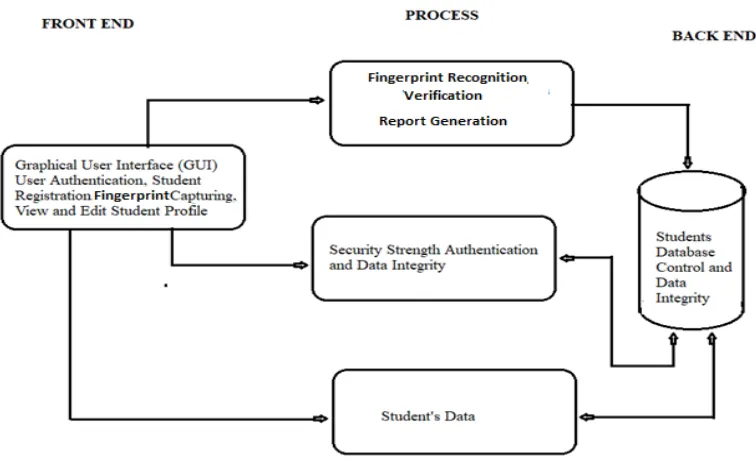
In figure 2 is the architectural diagram of the students’ attendances management system using fingerprint
[image:7.612.114.492.377.613.2]recognition
Figure 2 Architectural Diagram
The system design is more reliable and robust than the existing system as in sogbaike et.al 2018 in terms of
ISSN 2250-3153
student data including capturing of their fingerprint. Once this is can be done, the software recognizes the
student based on the biometric (fingerprint) data entered
SYSTEM REQUIREMENT
Computer system is made up of units that are put together to work as one in order to achieve a common
goal. The requirements for the implementation of the new system (student attendance management system) are:
a) The Software
b) The hardware
Software Requirement
For the effective implementation of the new system, the following software has to be installed on the computer
system.
i. Windows 7 operating system or later
ii. MySQL
iii. Visual basic.NET
Hardware requirement
i. Pentium VI and above
ii. 256 MB RAM and above
iii. 40GB HD and above
iv. CD-ROM drive
The design language is VB.NET and for the database administration system, MySQL database was utilized as a
part of dealing with information's inside the system. With this system Security is ensured: Student won't have
the capacity to stamp attendance for their kindred colleague since it requires understudy's fingerprint to check
ISSN 2250-3153
information and data or misusing of information and data which will prompt harm. Just approved clients will be
permitted to approach the database system
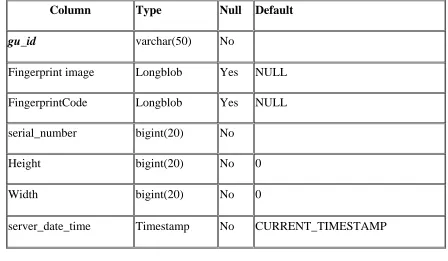
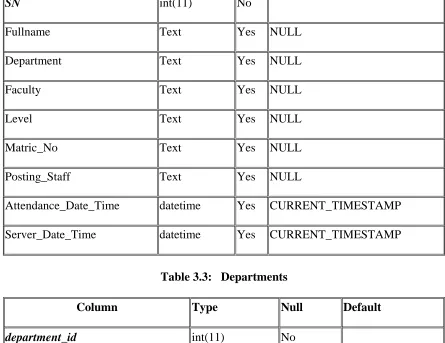
The database name is Attendance and consists of five tables some of the tables are shown below:
1. fingerprint_capture
2. Attendance
3. Departments
4. faculty
5. levels
[image:9.612.80.528.355.616.2]6. table person
Table 1.1: Fingerprint_capture
Column Type Null Default
gu_id varchar(50) No
Fingerprint image Longblob Yes NULL
FingerprintCode Longblob Yes NULL
serial_number bigint(20) No
Height bigint(20) No 0
Width bigint(20) No 0
server_date_time Timestamp No CURRENT_TIMESTAMP
Table 2.2: Attendance
Column Type Null Default
ISSN 2250-3153
SN int(11) No
Fullname Text Yes NULL
Department Text Yes NULL
Faculty Text Yes NULL
Level Text Yes NULL
Matric_No Text Yes NULL
Posting_Staff Text Yes NULL
Attendance_Date_Time datetime Yes CURRENT_TIMESTAMP
[image:10.612.81.534.0.758.2]Server_Date_Time datetime Yes CURRENT_TIMESTAMP
Table 3.3: Departments
Column Type Null Default
department_id int(11) No
Department text Yes NULL
Faculty text Yes NULL
faculty_id int(4) Yes NULL
Table 4.4: Faculty
Column Type Null Default
faculty_id int(11) No
Faculty varchar(50) Yes NULL
[image:10.612.82.527.61.404.2]ISSN 2250-3153
Table 5.5: Levels
Column Type Null Default
SN int(11) No
Level varchar(10) No
posting_staff varchar(200) No
server_date_time Timestamp No CURRENT_TIMESTAMP
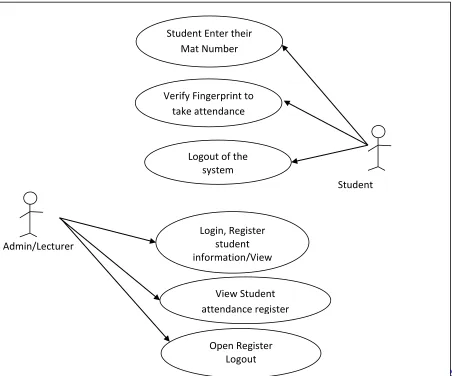
A use case diagram as shown in figure 3 graphically depicts the interactions between the system, the external
system and the user. Use case diagrams play a major role in system design because it acts as a roadmap in
constructing the structure of the system
Admin/Lecturer
Student
View Student attendance register
Open Register Login, Register
student information/View Logout of the
system Verify Fingerprint to
take attendance Student Enter their
ISSN 2250-3153
Figure 3: Use case diagram for the system
IMPLEMENTATION AND DOCUMENTATION
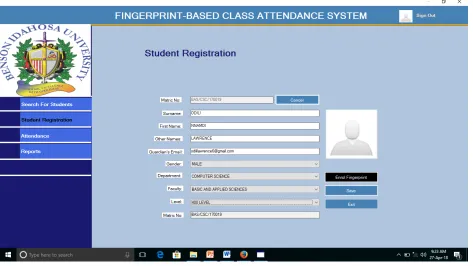
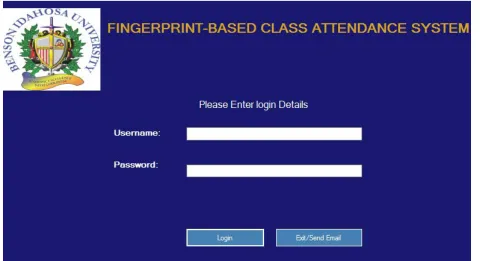
Figure 4 and figure 5 shows an implementation of the finger print based class attendance system showing
[image:12.612.72.545.258.524.2]student registration form and login interface respectively
ISSN 2250-3153
ISSN 2250-3153
Figure 6 is shows the attendance summary of the fingerprint class attendance system generated during the
[image:14.612.72.544.111.369.2]attendance process
Figure 6 generated report
Test Result
This is the result obtained after testing the system with the test plan and test data. During the testing, the
actual and expected results were compared to ensure they produced same result or if there is a difference, it
should be slight and negligible. Hence the result:
Table 6: Comparison between expected and actual results
TEST CONDUCTED EXPECTED RESULT ACTUAL RESULT
Admin enters
username and
password
Admin should be able to access the
main menu if the correct user name
and password is entered properly.
Admin that enters the correct
username and password was
granted access to the main menu
[image:14.612.50.564.553.714.2]ISSN 2250-3153
information Information to get his or her user
details.
system and view student details
Lecturer/admin clicks on
take attendance
A form will be displayed to the user,
the form enables the students to
capture and take attendance
The lecturer/admin was able to
take students attendance.
Conclusion
The enhanced student attendance management system using fingerprint authentication solves the problem of
buddy signing, lopsided records and impersonation. The system preregisters and authenticate student during
attendance process, determines the eligibility of a student for exam based on the threshold number of times of
attendance by each student and finally validates if there is a case of impersonation prior to examination and
send sends e-mail if there is such occurrence.
Reference
WAN .M. KAMAL (2015) Development Of Academic Attendance Management System Using Bluetooth
Technology Thesis Faculty of Electrical Engineering Universiti Teknologi Malaysia pp 1-66
Saurabh K. J, Uma .J., Bhupesh .K. S Attendance Management System project Rajasthan Technical
University, Kota. Pp 1-33
Somasundaram V. , Kannan M. and Sriram .V. (2016) Mobile based Attendance Management System Indian
Journal of Science and Technology, Vol 9(35)pp 1-4
Tabassam. N, Saim. P, Arash.K, Azuhar.U.D (2009): Development of Academic Attendance Monitoring
System Using Fingerprint Identification (IJCSNS) International Journal of Computer Science and Network
ISSN 2250-3153
Sogbaike C. O , Sogbaike A.S, Edafeadhe .G, and Enukpere V.E (2018) Design and construction of a hand
held attendance management system using fingerprint authentication. international conference on education
science, technology and innovations in development in Africa
Neha .V, Komal .S, Megha .R (2013) AN EFFICIENT AUTOMATIC ATTENDANCE SYSTEM USING
FINGERPRINT RECONSTRUCTION TECHNIQUE, International Journal Of Advance Research In Science
And Engineering 2(3)
Ikuomola .A. J. (2015): Fingerprint-Based Authentication System for Time and Attendance, Management
British Journal of Mathematics & Computer Science 5(6): pp 735-747,
Rishabh .M and Prashant .T (2011): Student Attendance System Based On Fingerprint Recognition and
One-to-Many Matching, A thesis for Bachelor of Technology National Institute of Technology Rourkela
Akinduyite C.O*, Adetunmbi A.O, Olabode O.O, Ibidunmoye E.O (2013) Fingerprint-Based Attendance
Management System Journal of Computer Sciences and Applications 1(5) pp 100-105