R E S E A R C H
Open Access
Systematic detection of putative tumor
suppressor genes through the combined use
of exome and transcriptome sequencing
Qi Zhao
1†, Ewen F Kirkness
2†, Otavia L Caballero
1†, Pedro A Galante
3, Raphael B Parmigiani
3, Lee Edsall
4,
Samantha Kuan
4, Zhen Ye
4, Samuel Levy
5, Ana Tereza R Vasconcelos
6, Bing Ren
4, Sandro J de Souza
3,
Anamaria A Camargo
3, Andrew JG Simpson
1*, Robert L Strausberg
1*Abstract
Background:To identify potential tumor suppressor genes, genome-wide data from exome and transcriptome sequencing were combined to search for genes with loss of heterozygosity and allele-specific expression. The analysis was conducted on the breast cancer cell line HCC1954, and a lymphoblast cell line from the same individual, HCC1954BL.
Results:By comparing exome sequences from the two cell lines, we identified loss of heterozygosity events at 403 genes in HCC1954 and at one gene in HCC1954BL. The combination of exome and transcriptome sequence data also revealed 86 and 50 genes with allele specific expression events in HCC1954 and HCC1954BL, which comprise 5.4% and 2.6% of genes surveyed, respectively. Many of these genes identified by loss of heterozygosity and allele-specific expression are known or putative tumor suppressor genes, such asBRCA1, MSH3andSETX, which
participate in DNA repair pathways.
Conclusions:Our results demonstrate that the combined application of high throughput sequencing to exome and allele-specific transcriptome analysis can reveal genes with known tumor suppressor characteristics, and a shortlist of novel candidates for the study of tumor suppressor activities.
Background
Cancer arises from the accumulation of genetic and epi-genetic changes that disrupt the normal regulatory con-trols in cells. Recently, next generation sequencing technology has been employed to identify variations in protein-coding sequences and genome structure for sev-eral types of cancers [1-9]. These studies have revealed the effectiveness of high throughput sequence analysis to identify somatic genomic alterations, such as point muta-tions, and structural variamuta-tions, including gain and loss of chromosome regions. An important finding is that inte-grated analysis of the various somatic alterations is key for identifying genes that may drive cancer development and progression through oncogenic or tumor suppressor
functions. Here, we combine the detection of two types of molecular events, loss of heterozygosity (LOH) and allele-specific expression (ASE), to identify genes with known and potential tumor suppressor characteristics.
The common feature of LOH and ASE is loss of expres-sion from one allele, which has frequently been observed for tumor suppressor genes. In ASE, a dominant gene pro-duct is expressed from the selected allele. For some genes, subtle changes in expression level and balance between alleles could be physiologically significant. Haploinsuffi-ciency of many tumor suppressor genes promotes tumori-genesis and metastasis [10].
ASE is classically associated with epigenomic regulation, and can be heritable. Two extreme examples are inactiva-tion of genes on the X chromosome in female cells, and imprinting of autosomal genes [11]. ASE can arise from epigenetic modification of the genome, including DNA methylation and histone modification [12,13]. Genetic var-iations in the coding or non-coding regions of a gene are * Correspondence: [email protected]; [email protected]
†Contributed equally
1
Ludwig Collaborative Group, Department of Neurosurgery, Johns Hopkins University, 1550 Orleans Street, Baltimore, MD 21231, USA
Full list of author information is available at the end of the article
likely to influence these epigenetic controls [14]. However, allelic differences in gene expression are variable among populations and among tissue types [15,16], suggesting that ASE can be context specific with regard to cell type, cell differentiation status, and exposure to external stimuli. Recently, subtle differences in allelic expression have been detected for numerous human genes, and in a few cases, have been associated with a genetic predisposition to dis-ease, including cancer [17,18].
Previously, genome-wide quantification of ASE events has been estimated by hybridization-based [15,19,20] and sequencing-based [17] methodologies. Recently, sev-eral studies have highlighted specific roles of ASE in oncogenesis, many as germline ASE [18,21,22]. Here, we have applied comprehensive sequence-based approaches using exome capture and transcriptome sequencing in a breast cancer cell line, HCC1954, to identify potential cancer-specific and somatically driven LOH and ASE events, and to discern their functional characteristics. This cell line, derived from a ductal breast carcinoma, is estrogen negative, progesterone receptor negative and ERBB2 positive, and has been particularly well studied at the molecular level [2,7,23]. A matching control cell line, HCC1954BL, which was established from lympho-blast cells of the same patient, was studied in parallel. We demonstrate that combined analysis of exome and transcriptome sequences provides a dynamic image of tumor cells that is particularly relevant to tumor sup-pressor networks.
Results
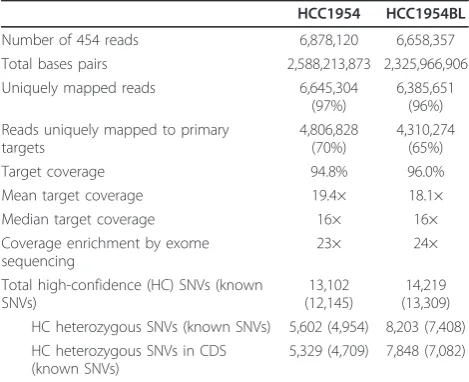
Application of exome sequencing to LOH detection For both HCC1954 and HCC1954BL, exome capture was performed with the NimbleGen 2.1 M array, followed by 454 Titanium sequencing of captured DNA from each cell line. The 454 reads were mapped uniquely to the human reference genome (hg18) using GS Reference Mapper (gsMapper). Variants and variant allele frequen-cies were called from high-confidence single nucleotide variants (SNVs) detected by gsMapper (see Materials and methods; Tables S1 and S2 in Additional file 1) and were used for the subsequent analysis. Table 1 summarizes the sequencing and mapping results from the exome sequen-cing effort. We identified 13,102 and 14,219 SNVs in the 26.4 Mb of primary target sequence for HCC1954 and HCC1954BL, respectively.
With variant allele frequencies ranging from 10% to 90%, 8,754 preliminary heterozygous SNVs were defined in HCC1954BL. For these mostly exomic SNVs in HCC1954BL, we examined the variant allele frequencies at the corresponding loci in HCC1954, requiring ten unique reads of the same genotype to support a homozy-gous locus (P< 0.001). Comparison of variant allele fre-quencies between HCC1954 and HCC1954BL identified
many LOH events in large genomic clusters across the genome and in isolated genes (Figure 1; Figure S1 in Additional file 2). LOH occurred on all chromosomes, with particularly large blocks on chromosomes 5, 8, 12 and 17. Our results are in agreement with LOH data gen-erated using the Affymetrix SNV array 6.0 [24] for regions of large genomic deletions on chromosomes 5, 8, 12, 17, 19, 22 and X by approximate genome coordinates. However, there are discrepancies for chromosome 9. Our data do not support a major LOH block on 9q (Figure 1c). As expected, 9q12 and 9q13 are gene deserts. From 9q21 to the telomeric end of 9q, allele variations are con-sistently detected across this region.
[image:2.595.304.539.111.302.2]To identify specific genes displaying LOH in HCC1954, we used more stringent criteria that required a heterozy-gous locus with variant allele frequency between 20% and 80% in HCC1954BL, together with homozygosity in HCC1954 (P < 0.001). In HCC1954BL, 8,203 heterozy-gous SNV loci were defined, with 7,848 in the coding sequence (CDS). LOH events are thus detected in 403 genes as revealed by 609 SNVs, among which 544 are known SNPs (Tables S1, S2 and S3 in Additional file 1). Most of the LOH genes are clustered together in large blocks as described above. For those single LOH genes that are isolated, we also required that the homozygous SNV in HCC1954 has been defined previously in dbSNP, that no conflicting allelic status is detected within 25 kb, and that the homozygosity of the SNV locus is supported by transcriptome reads. Genes with LOH are located on 15 chromosomes, with most on chromosomes 5 and 17, includingBRCA1(Figure 1a; Additional file 2). Using the same criteria, only one LOH gene was detected in HCC1954BL (RRAS2).
Table 1 Statistics of exome sequencing and reads mapping
HCC1954 HCC1954BL
Number of 454 reads 6,878,120 6,658,357
Total bases pairs 2,588,213,873 2,325,966,906
Uniquely mapped reads 6,645,304
(97%)
6,385,651 (96%) Reads uniquely mapped to primary
targets
4,806,828 (70%)
4,310,274 (65%)
Target coverage 94.8% 96.0%
Mean target coverage 19.4× 18.1×
Median target coverage 16× 16×
Coverage enrichment by exome sequencing
23× 24×
Total high-confidence (HC) SNVs (known SNVs)
13,102 (12,145)
14,219 (13,309) HC heterozygous SNVs (known SNVs) 5,602 (4,954) 8,203 (7,408) HC heterozygous SNVs in CDS
(known SNVs)
5,329 (4,709) 7,848 (7,082)
We compared the allelic status of SNPs that were defined in our LOH analysis with those that were geno-typed by Affymetrix Genome-Wide Human SNP Array 6.0 [GEO:GSE13373]. In HCC1954BL, heterozygous SNP calls matched perfectly between the two platforms for all 345 known SNPs that were shared. Only one of 224 homozygous SNPs identified by SNP array was revealed as heterozygous by sequencing. For HCC1954, heterozygous SNPs calls were also 100% consistent between the two platforms for all 172 SNPs that are shared. However, 29 of 270 (11%) homozygous SNPs, defined by SNP array, were identified as heterozygous
by exome sequencing. Thus, there was a high level of consistency between the two platforms, with sequencing possibly providing greater sensitivity for cancer genomes that carry a wide spectrum of copy number variations.
[image:3.595.58.540.87.525.2]and drug metabolism with 29 LOH genes. Thirteen LOH genes, including BRCA1and MSH3, are in the DNA replication, recombination and repair pathway.
mRNA allelotyping by transcriptome sequencing
High throughput sequencing of transcriptomes for HCC1954 and HCC1954BL was performed, with 14.0 Gbp and 13.6 Gbp generated by short read paired-end sequencing, respectively. Sequence reads were subse-quently aligned to the RefSeq gene set [25] as well as to the human reference genome with CLCBio Genomic Workbench (see Materials and methods). With a cutoff of 1× average coverage across each gene, 14,397 and 14,251 genes were found to be expressed in HCC1954 and HCC1954BL, respectively. These numbers are com-parable to previous transcriptome studies [26,27]. The average base pair coverage for the detected transcrip-tome is approximately 120× for HCC1954 and 115× for HCC1954BL. For HCC1954, 7,173 transcripts displayed SNVs at a minimum of one locus per transcript, indicat-ing that these genes are expressed from both alleles (see Materials and methods). The remaining 7,224 tran-scripts lack detectable allelic variation. These include many cases in which coverage is not sufficient to make a call for allelic variation. For HCC1954BL, 7,595 genes have detectable allelic variation within transcribed regions, while variants were not detectable in transcripts of 6,656 genes.
Allele-specific expression detection
With genotyping information acquired by exome sequencing, the ASE mining process is summarized in
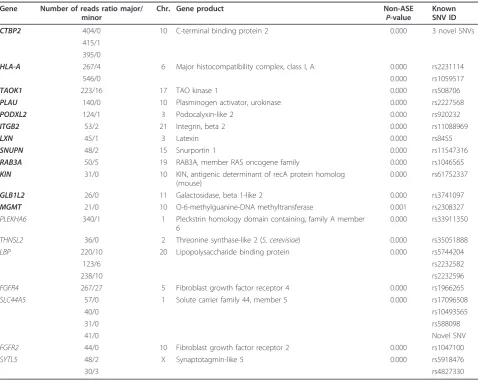
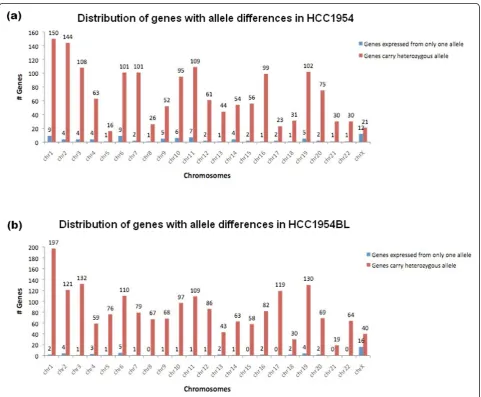
[image:4.595.57.522.101.319.2]Figure 2 for HCC1954. We started with 3,123 genes that carry heterozygous loci at the genomic level as shown by 5,329 SNVs detected in the CDS by exome sequencing. Of 5,329 SNVs, 620 (11.6%) have not been reported in dbSNP130 [28]. The 5,329 SNVs were checked for coverage by transcriptome sequence reads. The binomial test was utilized to calculate the distribu-tion of alleles represented by numbers of reads that are expected by chance, and led to the requirement that each SNV locus was covered by at least 20 transcrip-tome reads. Of 5,329 SNVs, 2,534 SNVs in 1,591 genes met this minimum coverage requirement. A stringent criterion of allele drift ratio (< 0.2 or >0.8) was applied to all expressed variant alleles to be considered as biased. A binomial test was then calculated with two adjustments to determine if there was biased expression from one allele (see Materials and methods). Due to the pseudo-tetraploid nature of the HCC1954 genome and copy number changes across the genome, the probabil-ity of success (p_s) ratio was adjusted based on variant allele frequency from the exome sequencing data instead of the static 0.5 for the normal diploid genome. A second adjustment was made to correct for multiple sampling. With a cutoff of P < 0.05, 221 SNVs in 86 genes were found to be expressed preferentially from one allele (Table S5 in Additional file 1). Table 3 lists a selection of ASE genes with the most significant P-values (P < 0.001) in HCC1954. Consistently, all the ASE calls were supported by the transcriptome sequence across the entire transcript length, including SNVs detected by the transcriptome reads in the 5’and 3’UTRs for the 86 genes. Out of 221 SNVs utilized in Table 2 Top categories of general molecular types
General molecular function Number of genes Examples
LOH genes
Enzyme 80 USP26,INPP5K,PTPRS,MAT2B
Kinase 25 CDK7,DGKE,MAP2K4,PDGFRL
Transporter 21 ATP2B3,SLC36A3,SIL1,ABCA7
Transcription regulator 20 BRCA1,FOXD4,SOX5,VEZF1
G-protein coupled receptor 19 GPR174,OR1A2,TAS2R7,GRM6
Transmembrane receptor 9 SEMA5A,IL31RA,ITGB3,OSMR
Cytokine 7 IL3,ERBB2IP,EDA,CXCL16
Ion channel 6 CCT8L2,CNGA2,GABRA6,GRIN3B
ASE genes
Enzyme 18 MGMT,PLCH1,GUCY1A3,PYGL
Transcription regulator 7 CTBP2,SMARCA4,BCLAF1,SPEN
Kinase 6 FGFR2,FGFR4,IP6K2,TAOK1
Transporter 5 SLC44A5,SLC25A5,SNX15,LBP
Transmembrane receptor 3 HLA-DQA1,HLA-A,TNFRSF10D
G-protein coupled receptor 2 ADORA1,GPR107
Figure 2Schematic diagram of allele-specific expression events detected by combination of exome sequencing and transcriptome sequencing.
Table 3 Selected list of allele-specific expression genes detected in the HCC1954 cell line
Gene Number of reads ratio major/ minor
Chr. Gene product Non-ASE
P-value
Known SNV ID
CTBP2 404/0 10 C-terminal binding protein 2 0.000 3 novel SNVs
415/1 395/0
HLA-A 267/4 6 Major histocompatibility complex, class I, A 0.000 rs2231114
546/0 0.000 rs1059517
TAOK1 223/16 17 TAO kinase 1 0.000 rs508706
PLAU 140/0 10 Plasminogen activator, urokinase 0.000 rs2227568
PODXL2 124/1 3 Podocalyxin-like 2 0.000 rs920232
ITGB2 53/2 21 Integrin, beta 2 0.000 rs11088969
LXN 45/1 3 Latexin 0.000 rs8455
SNUPN 48/2 15 Snurportin 1 0.000 rs11547316
RAB3A 50/5 19 RAB3A, member RAS oncogene family 0.000 rs1046565
KIN 31/0 10 KIN, antigenic determinant of recA protein homolog
(mouse)
0.000 rs61752337
GLB1L2 26/0 11 Galactosidase, beta 1-like 2 0.000 rs3741097
MGMT 21/0 10 O-6-methylguanine-DNA methyltransferase 0.001 rs2308327
PLEKHA6 340/1 1 Pleckstrin homology domain containing, family A member
6
0.000 rs33911350
THNSL2 36/0 2 Threonine synthase-like 2 (S. cerevisiae) 0.000 rs35051888
LBP 220/10 20 Lipopolysaccharide binding protein 0.000 rs5744204
123/6 rs2232582
238/10 rs2232596
FGFR4 267/27 5 Fibroblast growth factor receptor 4 0.000 rs1966265
SLC44A5 57/0 1 Solute carrier family 44, member 5 0.000 rs17096508
40/0 rs10493565
31/0 rs588098
41/0 Novel SNV
FGFR2 44/0 10 Fibroblast growth factor receptor 2 0.000 rs1047100
SYTL5 48/2 X Synaptotagmin-like 5 0.000 rs5918476
30/3 rs4827330
[image:5.595.57.536.334.715.2]the ASE analysis, 72 (33%) are novel. The higher ratio of novel SNVs seen in ASE genes compared to that of 11% in the whole exome analysis can be explained by the fact that, among 86 ASE genes reported, 13 ASE genes carry multiple novel SNVs. This led to a large random standard deviation. The chromosomal distribu-tions of the 86 ASE genes, and the 1,591 transcripts containing >20× coverage of CDS SNVs is shown in Figure 3a.
A similar data mining process was performed for HCC1954BL. There were 7,848 SNVs in 4,441 genes identified by exome sequencing. Of these, 766 (9.7%) are novel. A total of 3,086 of the 7,848 SNVs were found in 1,918 genes, each of which was represented by at least 20 transcriptome reads. Comparison of SNVs in the exome and transcriptome data suggests that 50 genes are under ASE regulation as demonstrated by 117 SNVs (Table S6 in Additional file 1). The chromosomal
distribution of the 1,918 candidate genes and the 50 ASE genes is shown in Figure 3b.
Biological categorization of the 86 ASE genes in HCC1954 shows that many of them are associated with cell-cell signaling and interactions, with 16 encoding cell surface proteins and five encoding extracellular matrix proteins. Of the 16 cell surface proteins, seven are trans-membrane receptors, including kinases in the FGFR family and G-protein coupled receptors (Table 2).
For HCC1954 and HCC1954BL combined, approxi-mately two-thirds of the ASE genes had a single SNV locus as supported by the exome data in their CDSs while the remainder had multiple exomic SNVs for ASE concordance (Table 3). In the latter cases, the most sig-nificantP-value of the ASE locus was used.
[image:6.595.58.540.315.712.2]Twenty-two ASE genes are shared by both cell lines, and five of these are located on chromosome X. For all shared ASE genes that are not on the X chromosome,
the same allele was preferentially expressed in both cell lines, suggesting that common genomic sequence var-iants are the controlling factors for these ASE events. For 24 genes that display ASE in HCC1954, there was no pre-ferential expression from either allele in HCC1954BL. For 26 ASE genes in HCC1954, it was not possible to determine their status in HCC1954BL because of low or undetectable expression. The remaining 14 ASE genes in HCC1954 have no genotyping status in HCC1954BL due to low exome sequencing coverage, but are likely to be ASE genes in HCC1954BL since 93% of the exome geno-types are in dbSNP, and all have biased allele expression patterns detected in the transcriptome. Only three ASE genes are unique to HCC1954BL, which are expressed in both alleles in HCC1954.
As expected, chromosome X carries ASE genes most frequently in both cell lines. The other ASE genes are dis-tributed across most of the autosomes (Figure 3). Cluster-ing of ASE genes is not observed in the same genomic regions; thus, ASE events are more likely to be individually controlled. Chromosome X harbors none of the unique ASE genes in HCC1954, but two unique ASE genes in HCC1954BL, suggesting that there has been differential escape from X-inactivation between the two cell lines.
Genotyping by exome sequencing and allelotyping by transcriptome sequencing revealed additional genomic aberrations. For example, local genomic disruption at a locus may result in detection of a single allele from transcriptome sequencing. Indeed, in our previous report on transcriptome studies of the same HCC1954 cell line [29], we identified a genomic inversion event at the PHF20L1 gene locus. It was predicted that transcrip-tion of PHF20L1 would be impaired for the rearranged allele, leaving the other allele intact. Identification of PHF20L1 as a gene expressed from only one allele in this study agrees with our previous findings. This indir-ectly demonstrates that our strategy can detect a spec-trum of ASE events in the genome.
We identified two additional genes in HCC1954, GPR56 and FAAH2, for which the transcriptome sequence data were ambiguous. Although each gene is heterozygous at two known SNP loci, only one SNP locus has monoallelic expression while the other distant SNP is expressed from both alleles. We speculate that either local genomic rearrangement or transcription from the opposite strand occurs in HCC1954. It is also possible that there are alternative transcript forms for these two genes, and only one form has unbalanced expression.
Experimental validation of allele-specific expression events
Three loci were genotyped and allelotyped in HCC1954 to validate three corresponding genes with putative ASE
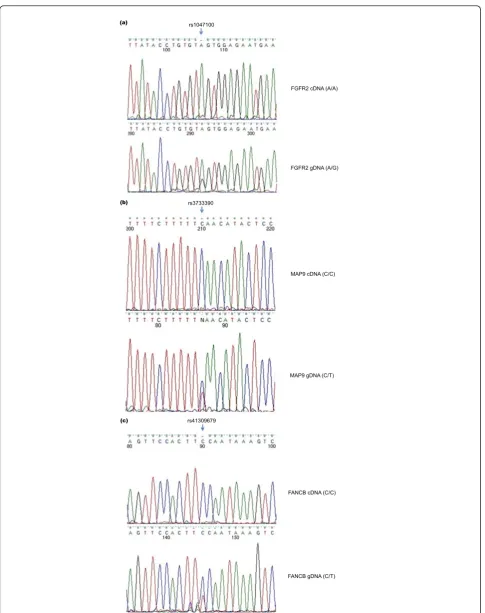
(FGFR2,MAP9,FANCB). PCR was performed to amplify genomic sequences surrounding the SNV loci, while reverse transcription PCR (RT-PCR) was applied to determine if a single allele is preferentially transcribed. Sanger sequencing chemistry was used to confirm the allelic status in both preparations. All three loci were validated as ASE events (Figure 4).
Interestingly, FGFR2, a kinase receptor gene, under-goes ASE in HCC1954 (Figure 4a). TheFGFR2 gene is known to be expressed in multiple alternative splicing forms. It is transcribed in the form ofFGFR2bin mam-mary epithelial cells, and FGFR2c in surrounding mesenchymal cells [30]. After de novoassembly of the Illumina cDNA reads, FGFR2bwas found to be the only isoform expressed in HCC1954.FGFR2is heterozygous as shown by exonic SNV of rs1047100, which is a synonymous SNV at V232 (GTA versus GTG), but tran-scribed as FGFR2b only from one strand (GTA) as revealed by mRNA reads at rs1047100 (Figure 4a).
Another validated ASE gene is MAP9on chromosome 4, a microtubule-associated protein required for spindle function, mitotic progression, and cytokinesis (Figure 4b).FANCB, a member of Fanconi anemia complemen-tation group (FANC) on chromosome X, was also con-firmed to be inactivated on one allele in HCC1954 (Figure 4c). Unequal peak heights between two genomic DNA alleles likely result from the pseudo-tetroploidy genome status and copy number variation in HCC1954.
Discussion
Exome and transcriptome sequencing captures a snap-shot of the active genome in a cell population. In addi-tion to revealing SNVs and relative gene expression levels in a sample, the combined data can be used to distinguish active from inactive alleles. By mining sequence data from exomes and transcriptomes, we have identified LOH events and ASE genes in the breast cancer cell line HCC1954 and a lymphoblast cell line from the same individual, HCC1954BL. Our approach demonstrates that the search for genome-wide allele-specific events is feasible with systematic application of sequencing technologies.
in the cancer cell line, yielding fewer SNVs with deep transcript coverage for ASE mining. The combined use of exome-capture and transcriptome sequencing focuses on SNVs in genes and captures novel SNVs that were absent from previously published array-based approaches [17,19,31,32].
In general, the total number of heterozygous SNVs detected by the exome-capture sequencing is less than that identified by transcriptome sequencing. This can be attributed to heterozygous allelic variations residing in 5’ and 3’UTRs of mRNAs that are not targeted by probes on the exome array. Expansion of targeted regions of the exome array to non-CDS exons would provide additional informative SNVs.
In recent years, experimental evidence has shown that haploinsufficiency of tumor suppressor genes can serve to drive the tumorigenic process [10]. Genetic, epigenetic and environmental factors can modify this haploinsuffi-ciency to promote the tumor phenotype. First, association between LOH and tumor susceptibility is significant only when several tumor suppressor genes are involved in the LOH events [10,33]. Second, in addition to common tumor suppressor genes shared by many cancer types like RB1 and TP53, many tumor suppressor genes are specific to a particular tumor type and/or cell type that originate the tumor. Deficiency ofBRCA1andBRCA2is mainly found in breast and ovarian cancers thus far. Third, epige-netic silencing of tumor suppressor genes is achieved by different mechanisms, such as DNA methylation and his-tone modification. These observations suggest that
additional tumor suppressor genes remain to be discov-ered for specific tumor types.
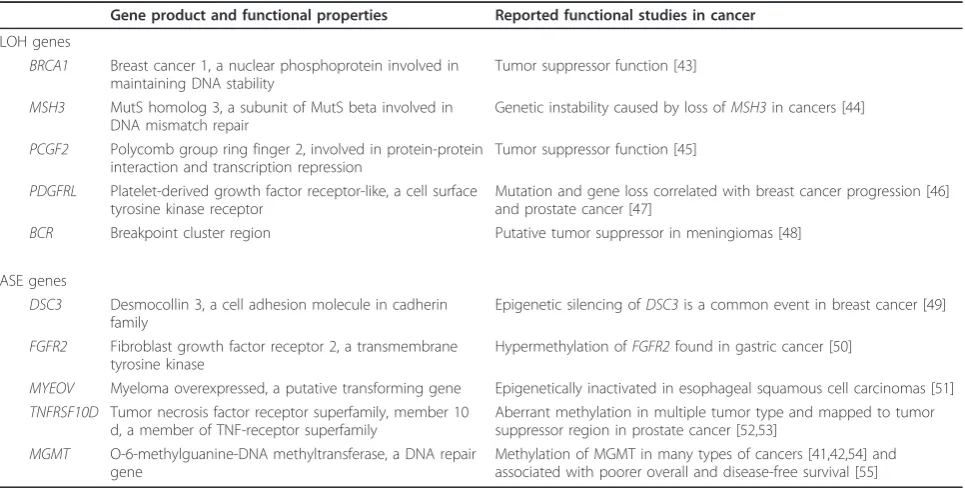
Many genes identified in our study are either known tumor suppressor genes (for example, BRCA1) or pre-viously identified putative tumor suppressor genes (for example,BCR). Moreover, genomic instability or epige-netic alterations have been reported in breast cancer and other cancer types for several of the genes in our list. A selection of the LOH and ASE genes and their associated molecular functions is listed in Table 4. For example, LOH is a frequent event forBRCA1 in breast and ovarian cancers, for MSH3in breast, bladder and non-small cell lung cancers, and forPDGFRLin spora-dic hepatocellular carcinomas, colorectal and non-small cell lung cancers. In addition, FHOD3 and MAP2K4 were previously defined as candidate cancer genes (CAN gene) by integrated analysis of homozygous deletions and sequence alterations in breast and colorectal cancers [34]. Meanwhile, epigenetic silencing caused by methyla-tion was previously observed for at least five ASE genes identified in our study, including DSC3, FGFR2 and MGMTin breast cancer and/or in other cancer types. However, a survey of related literature indicates that allelic-specific methylation has not yet been reported for ASE genes identified in this study.
[image:9.595.57.540.478.723.2]FGFRs, which have been implicated in breast cancer development, are reported to be allele-specifically expressed for the first time in a breast cancer cell in this study. FGFR2 has been identified as a risk factor in breast cancer by association studies [30,35-37]. Two
Table 4 Selected list of LOH or ASE genes: known or putative tumor suppressor genes
Gene product and functional properties Reported functional studies in cancer
LOH genes
BRCA1 Breast cancer 1, a nuclear phosphoprotein involved in maintaining DNA stability
Tumor suppressor function [43]
MSH3 MutS homolog 3, a subunit of MutS beta involved in DNA mismatch repair
Genetic instability caused by loss ofMSH3in cancers [44]
PCGF2 Polycomb group ring finger 2, involved in protein-protein interaction and transcription repression
Tumor suppressor function [45]
PDGFRL Platelet-derived growth factor receptor-like, a cell surface tyrosine kinase receptor
Mutation and gene loss correlated with breast cancer progression [46] and prostate cancer [47]
BCR Breakpoint cluster region Putative tumor suppressor in meningiomas [48]
ASE genes
DSC3 Desmocollin 3, a cell adhesion molecule in cadherin family
Epigenetic silencing ofDSC3is a common event in breast cancer [49]
FGFR2 Fibroblast growth factor receptor 2, a transmembrane tyrosine kinase
Hypermethylation ofFGFR2found in gastric cancer [50]
MYEOV Myeloma overexpressed, a putative transforming gene Epigenetically inactivated in esophageal squamous cell carcinomas [51] TNFRSF10D Tumor necrosis factor receptor superfamily, member 10
d, a member of TNF-receptor superfamily
Aberrant methylation in multiple tumor type and mapped to tumor suppressor region in prostate cancer [52,53]
MGMT O-6-methylguanine-DNA methyltransferase, a DNA repair gene
Methylation of MGMT in many types of cancers [41,42,54] and associated with poorer overall and disease-free survival [55]
intronic SNVs in FGFR2 have been reported to increase susceptibility to breast cancer by regulating the downstream gene expression level [35]. FGFR2was identified as aCANgene by combined genomic studies in breast and colorectal cancers [34]. Moreover, pros-tate and bladder cancers with reducedFGFR2b expres-sion show poorer prognosis due to increased potential for invasion and metastasis [38,39]. We can speculate that FGFR2 functions as a tumor suppressor in breast cancer, as well as FGFR4, for which functions are still unknown.
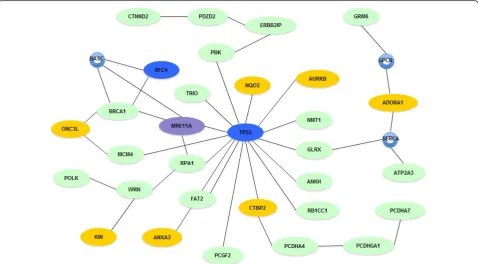
MGMT encodes a DNA methyltransferase, a DNA repair protein. The promoter of the MGMT gene has been found to be hypermethylated at a high frequency in many types of cancers, including colorectal cancer and glioblastoma [40-42]. This indicates that MGMT may serve as a tumor suppressor in many types of cancer. A protein-protein interaction analysis that inte-grates all genes that have been found to carry a somatic change in HCC1954, including the LOH and ASE genes identified in this study, genes that carry somatic point mutations [6], as well as a gene mutated by chromoso-mal translocation [29] yielded a prominent functional network that focuses on DNA recombination, replica-tion and repair (Figure 5). The network is formed by at least 31 molecules composed of 21 genes with LOH,
seven genes with ASE, two genes with somatic point mutation and one gene with a translocation.
Conclusions
[image:10.595.59.538.424.688.2]Our analysis of the combined effect of LOH and ASE in HCC1954 reveals additional genes that may have tumor suppressor or other functions within this breast cancer cell (summarized in Additional file 1). Recently, several studies have demonstrated the importance of compre-hensive characterization of diverse molecular events toward discerning genes and pathways that potentially play a role in tumorigenesis. For example, gene activa-tion can result from various events, such as point muta-tions that activate a protein product, gene amplification, and gene fusion, as well as epigenetic alteration. Here we demonstrate that the combined approach of exome sequencing and transcript analysis can reveal LOH and ASE events that can each result in haploinsufficiency for specific genes. ASE reflects various types of fluidic geno-mic alterations, including those that are epigenetic, and thus provides a unique insight to the changing status of cancer cells. This approach will further facilitate the process of identifying additional CANgenes and better define drivers of the tumorigenesis process. We note that genetic alterations in immortalized cell lines may not accurately reflect those changes in the cells from
Figure 5DNA recombination, replication and repair network. In HCC1954, genes that have somatic point mutations (blue), ASE (yellow), LOH (green), or translocations (purple) form a DNA repair network. Small circles represent protein complexes or protein families with
which they were derived. Nevertheless, the proof of principle study described here demonstrates that appli-cation of this approach to clinical samples such as tumor cells, stromal cells, fibroblasts, and infiltrating T-cells would likely provide additional definition to the significance of ASE in cancer. Our study demonstrates the feasibility of such approaches based on the ever-increasing power of next generation sequencing.
Materials and methods Exome sequencing and mapping
The cell lines HCC1954 and HCC1954 were obtained from ATCC. They were maintained in RPMI medium containing 10% fetal bovine serum, 2 mM L-glutamine and non-essential amino acids. Total DNA was isolated from the cell pellets using the DNeasy Blood and Tissue Kit (Qiagen, Valencia, CA, USA). Genomic DNA was treated with RNase Cocktail™ (Ambion, Austin, TX, USA), followed by phenol-chloroform extraction and precipitation of the aqueous phase in 1/10 volume 3 M sodium acetate and 100% ethanol.
Exome capture was performed using 5 μg of input DNA according to the manufacturer’s protocol (Roche Nimblegen, Madison, WI, USA). Briefly, genomic DNA was nebulized for 1 minute using 45 psi of pressure. Sheared DNA fragments were subsequently cleaned with the DNA Clean and Concentrator-25 Kit (Zymo Research, Orange, CA, USA) and a fragment size distri-bution ranging from 300 to 500 bp was verified via Bioanalyzer (Agilent, Santa Clara, CA, USA). After end-polishing of the genomic fragments, the GS FLX Titanium adaptors were ligated to the sheared genomic fragments. Ligated fragments were next hybridized to the Nimblegen Sequence Capture 2.1 M exome array within Maui hybridization stations, followed by washing and elution of array-bound fragments from the arrays within elution chambers (Nimblegen). Captured frag-ments were next subjected to 27 rounds of PCR amplifi-cation using primers targeting the Nimblegen linkers. Following elution, the capture efficiency was evaluated via quantitative PCR reactions. Six full runs of 454 Tita-nium were performed for the captured fragments for each cell line. 454 reads were aligned to the human reference genome (hg18) using gsMapper. All raw reads have been deposited to the EBI Sequence Read Archive (SRA; submission ID ERA010917).
Transcriptome sequencing and mapping
Total RNA was isolated from the cell pellets using the RNeasy Mini Kit (Qiagen). Total RNA was treated with DNase I (New England Biolabs, Ipswich, MA, USA) and purified with Qiagen RNeasy columns (Qiagen). DNA-free RNA yield and purity were initially assessed by
spectrophotometry. PolyA+ RNA was prepared from 500 μg of total RNA with oligo(dT) beads using the Oligotex mRNA Mini Kit (Qiagen). First-strand cDNA was pre-pared from 1μg of poly(A)+ RNA with 200 pmol oligo random primers by using 300 units of Superscript II reverse transcriptase (Invitrogen, Carlsbad, CA, USA). Second-strand synthesis was performed in 20μl at 16°C for 2 h after addition of 10 units ofEscherichia coliDNA ligase, 40 units ofE. coliDNA polymerase, and 2 units of RNase H (all from Invitrogen). T4 DNA polymerase (5 units) was added and incubated for 5 minutes at 16°C. Double-strand cDNA was purified by phenol-chloroform extraction and precipitation of the aqueous phase in 1/10 volume 3 M sodium acetate and 100% ethanol.
The Illumina GAII sequencing procedure was carried out for paired-end short read sequencing. The RefSeq gene set was queried from NCBI website on 3 December 2009. The approximately 75-Mb dataset comprises 41,249 transcript entries. The longest alternative form for each gene was used as reference in the assembly process. Human reference genome build 36 was also used as the assembly reference. Solexa short reads were mapped to the references using the CLC Bio Genomic Work Bench suite (CLC Bio,8200 Arhus N, Denmark). A stringent cutoff was used, requiring unique read map-ping and allowing 2-bp mismatch for each read. Expres-sion level was calculated by RPKM as the number of reads that map per kilobase of exon model per million mapped reads for each gene. Transcriptome reads are accessible through the EBI-SRA (submission ID ERA011762).
Single nucleotide variant calling
For exome sequencing, SNVs for variant alleles were drawn from the default high-confidence SNV calls by gsMapper (the 454HCDiffs.txt file), which is defined as the variant allele supported by at least three non-dupli-cated high quality reads with at least 10% variant allele frequency. An annotated SNP file (snp130) was down-loaded from NCBI to identify known SNPs. Only SNVs in the CDS were used for downstream LOH and ASE analysis.
For transcriptome sequencing, SNVs were called on all assembled contigs using CLCBio SNV detection tools. A minimum quality of 30 was required for the central SNV base and 15 required for the surrounding bases. A SNV for a minor allele required at least four reads or at least 30% variant allele frequency.
Statistical significance (P-value) of LOH and ASE
The cumulative binomial distribution is:
B x n p b y n p
y x
( ; , )= ( ; , )
=
∑
0For biased reads coverage:P= BINOMDIST(#reads for rare allele, #total reads, p_s, TRUE). p_s is probability of success in each trial. For a normal diploid genome like HCC1954BL, 0.5 is applied to p_s. However, the p_s value is adjusted for the HCC1954 genome based on variant allele frequency data from exome sequencing. Multiple correction was also applied to theP-values at uneven alle-lic loci in transcriptome sequencing. We used 2,534 SNVs that have the minimum 20× coverage in the transcriptome for multiple correction calculation in HCC1954.
Validation of allele-specific expression
In general, genomic DNA flanking the SNV loci to be tested was amplified by using intronic primer pairs. The cDNA fragments were produced by RT-PCR using exonic primer pairs crossing adjacent exons. Sanger sequencing was applied to the amplified genomic DNA and cDNA. Total RNA and DNA from the cell pellets were isolated using the RNeasy Mini Kit and DNeasy Blood and Tissue Kit (Qiagen). Genomic DNA was treated with RNase Cocktail™(Ambion), followed by phenol-chloroform extraction and precipitation of the aqueous phase in 1/10 volume 3 M sodium acetate and 100% etha-nol. Total RNA was treated with DNase I (New England Biolabs) and purified with Qiagen RNeasy columns (Qia-gen). DNA-free RNA yield and purity were assessed by spectrophotometry and denaturing agarose gels. A total of 0.5 to 1.0μg of RNA was reverse transcribed into cDNA by using an Omniscript RT kit according to the manufac-turer’s protocol using oligo (dT)18primers. PCRs from the
genomic DNA and RT-PCR were undertaken using High-Fidelity Platinum Taq (Invitrogen) plus 10 pmol of each of the primers listed in Table S7 in Additional file 1. After gel purification, the amplicons were submitted to Sanger sequencing with the PCR primers.
Molecular functional network
Primary molecular functions and networks involved were analyzed with the IPA software developed by Inge-nuity (Redwood City, CA, USA).
Additional material
Additional file 1: Supplemental tables. Table S1: exome genotyping in HCC1954. Table S2: exome genotyping in HCC1954BL. Table S3: LOH genes in HCC1954. Table S4: LOH genes in HCC1954BL. Table S5: ASE genes in HCC1954. Table S6: ASE genes in HCC1954BL. Table S7: primers used in ASE events validation. Table S8: summary of putative tumor suppressor genes identified by LOH and ASE events.
Additional file 2: Supplemental figures. LOH events detected across each chromosome.
Abbreviations
ASE: allele-specific expression; BP: base pair; CDS: coding sequence; LOH: loss of heterozygosity; RT-PCR: reverse transcription PCR; SNP: single nucleotide polymorphism; SNV: single nucleotide variant; SRA: Sequence Read Archive; UTR: untranslated region.
Acknowledgements
We thank Dr Jiaqi Huang and Dr Pauline Ng for technical assistance and discussions. This work is supported in part by the Hilton-Ludwig Cancer Metastasis Initiative, funded by the Conrad N Hilton Foundation and the Ludwig Institute for Cancer Research.
Author details
1
Ludwig Collaborative Group, Department of Neurosurgery, Johns Hopkins University, 1550 Orleans Street, Baltimore, MD 21231, USA.2J. Craig Venter
Institute, 9704 Medical Center Drive, Rockville, MD 20850, USA.3Ludwig
Institute for Cancer Research, São Paulo Branch at Hospital Alemão Oswaldo Cruz, Rua João Julião 245, 01323-903 São Paulo, Brazil.4Ludwig Institute for
Cancer Research, San Diego Branch, 9500 Gilman Drive, La Jolla, CA 92093-0660, USA.5Scripps Translational Science Institute, 3344 North Torrey Pines
Court, La Jolla, CA 92037, USA.6Laboratório Nacional de Computação Científica, Laboratório de Bioinformática, Av. Getúlio Vargas 333, Petrópolis, RJ 25651-075, Brazil.
Authors’contributions
QZ, EFK and PAG performed data analysis; OLC and RBP performed the experiments; LE, SK and ZY generated the data; QZ, EFK, SL, ARV, BR, SJdS, AAC, AJGS and RLS contributed to research design and discussion of the manuscript; QZ, ERK and RLS wrote the manuscript. All authors read and approved the final manuscript.
Received: 6 July 2010 Revised: 27 September 2010 Accepted: 25 November 2010 Published: 25 November 2010
References
1. Bignell GR, Greenman CD, Davies H, Butler AP, Edkins S, Andrews JM, Buck G, Chen L, Beare D, Latimer C, Widaa S, Hinton J, Fahey C, Fu B, Swamy S, Dalgliesh GL, Teh BT, Deloukas P, Yang F, Campbell PJ, Futreal PA, Stratton MR:Signatures of mutation and selection in the cancer genome.Nature463:893-898.
2. Stephens PJ, McBride DJ, Lin ML, Varela I, Pleasance ED, Simpson JT, Stebbings LA, Leroy C, Edkins S, Mudie LJ, Greenman CD, Jia M, Latimer C, Teague JW, Lau KW, Burton J, Quail MA, Swerdlow H, Churcher C, Natrajan R, Sieuwerts AM, Martens JW, Silver DP, Langerød A, Russnes HE, Foekens JA, Reis-Filho JS, van’t Veer L, Richardson AL, Børresen-Dale AL, et al:Complex landscapes of somatic rearrangement in human breast cancer genomes.Nature2009,462:1005-1010.
3. Pleasance ED, Stephens PJ, O’Meara S, McBride DJ, Meynert A, Jones D, Lin ML, Beare D, Lau KW, Greenman C, Varela I, Nik-Zainal S, Davies HR, Ordoñez GR, Mudie LJ, Latimer C, Edkins S, Stebbings L, Chen L, Jia M, Leroy C, Marshall J, Menzies A, Butler A, Teague JW, Mangion J, Sun YA, McLaughlin SF, Peckham HE, Tsung EF,et al:A small-cell lung cancer genome with complex signatures of tobacco exposure.Nature463:184-190.
4. Pleasance ED, Cheetham RK, Stephens PJ, McBride DJ, Humphray SJ, Greenman CD, Varela I, Lin ML, Ordóñez GR, Bignell GR, Ye K, Alipaz J, Bauer MJ, Beare D, Butler A, Carter RJ, Chen L, Cox AJ, Edkins S, Kokko-Gonzales PI, Gormley NA, Grocock RJ, Haudenschild CD, Hims MM, James T, Jia M, Kingsbury Z, Leroy C, Marshall J, Menzies A,et al:A comprehensive catalogue of somatic mutations from a human cancer genome.Nature 463:191-196.
Karchin R, Papadopoulos N, Parmigiani G,et al:An integrated genomic analysis of human glioblastoma multiforme.Science2008,321:1807-1812. 6. Wood LD, Parsons DW, Jones S, Lin J, Sjöblom T, Leary RJ, Shen D,
Boca SM, Barber T, Ptak J, Silliman N, Szabo S, Dezso Z, Ustyanksky V, Nikolskaya T, Nikolsky Y, Karchin R, Wilson PA, Kaminker JS, Zhang Z, Croshaw R, Willis J, Dawson D, Shipitsin M, Willson JK, Sukumar S, Polyak K, Park BH, Pethiyagoda CL, Pant PV,et al:The genomic landscapes of human breast and colorectal cancers.Science2007,318:1108-1113. 7. Sjöblom T, Jones S, Wood LD, Parsons DW, Lin J, Barber TD, Mandelker D,
Leary RJ, Ptak J, Silliman N, Szabo S, Buckhaults P, Farrell C, Meeh P, Markowitz SD, Willis J, Dawson D, Willson JK, Gazdar AF, Hartigan J, Wu L, Liu C, Parmigiani G, Park BH, Bachman KE, Papadopoulos N, Vogelstein B, Kinzler KW, Velculescu VE:The consensus coding sequences of human breast and colorectal cancers.Science2006,314:268-274.
8. Beroukhim R, Mermel CH, Porter D, Wei G, Raychaudhuri S, Donovan J, Barretina J, Boehm JS, Dobson J, Urashima M, Mc Henry KT, Pinchback RM, Ligon AH, Cho YJ, Haery L, Greulich H, Reich M, Winckler W, Lawrence MS, Weir BA, Tanaka KE, Chiang DY, Bass AJ, Loo A, Hoffman C, Prensner J, Liefeld T, Gao Q, Yecies D, Signoretti S,et al:The landscape of somatic copy-number alteration across human cancers.Nature463:899-905. 9. Chiang DY, Getz G, Jaffe DB, O’Kelly MJ, Zhao X, Carter SL, Russ C,
Nusbaum C, Meyerson M, Lander ES:High-resolution mapping of copy-number alterations with massively parallel sequencing.Nat Methods 2009,6:99-103.
10. Payne SR, Kemp CJ:Tumor suppressor genetics.Carcinogenesis2005, 26:2031-2045.
11. Knight JC:Allele-specific gene expression uncovered.Trends Genet2004, 20:113-116.
12. Li E, Beard C, Jaenisch R:Role for DNA methylation in genomic imprinting.Nature1993,366:362-365.
13. Carr MS, Yevtodiyenko A, Schmidt CL, Schmidt JV:Allele-specific histone modifications regulate expression of the Dlk1-Gtl2 imprinted domain. Genomics2007,89:280-290.
14. Pickrell JK, Marioni JC, Pai AA, Degner JF, Engelhardt BE, Nkadori E, Veyrieras JB, Stephens M, Gilad Y, Pritchard JK:Understanding mechanisms underlying human gene expression variation with RNA sequencing. Nature2010,464:768-772.
15. Lo HS, Wang Z, Hu Y, Yang HH, Gere S, Buetow KH, Lee MP:Allelic variation in gene expression is common in the human genome.Genome Res2003,13:1855-1862.
16. Yan H, Yuan W, Velculescu VE, Vogelstein B, Kinzler KW:Allelic variation in human gene expression.Science2002,297:1143.
17. Zhang K, Li JB, Gao Y, Egli D, Xie B, Deng J, Li Z, Lee JH, Aach J,
Leproust EM, Eggan K, Church GM:Digital RNA allelotyping reveals tissue-specific and allele-tissue-specific gene expression in human.Nat Methods2009, 6:613-618.
18. Valle L, Serena-Acedo T, Liyanarachchi S, Hampel H, Comeras I, Li Z, Zeng Q, Zhang HT, Pennison MJ, Sadim M, Pasche B, Tanner SM, de la Chapelle A:Germline allele-specific expression of TGFBR1 confers an increased risk of colorectal cancer.Science2008,321:1361-1365. 19. Serre D, Gurd S, Ge B, Sladek R, Sinnett D, Harmsen E, Bibikova M, Chudin E,
Barker DL, Dickinson T, Fan JB, Hudson TJ:Differential allelic expression in the human genome: a robust approach to identify genetic and epigenetic cis-acting mechanisms regulating gene expression.PLoS Genet2008,4:e1000006.
20. Milani L, Gupta M, Andersen M, Dhar S, Fryknas M, Isaksson A, Larsson R, Syvanen AC:Allelic imbalance in gene expression as a guide to cis-acting regulatory single nucleotide polymorphisms in cancer cells. Nucleic Acids Res2007,35:e34.
21. Yan H, Dobbie Z, Gruber SB, Markowitz S, Romans K, Giardiello FM, Kinzler KW, Vogelstein B:Small changes in expression affect predisposition to tumorigenesis.Nat Genet2002,30:25-26. 22. Raval A, Tanner SM, Byrd JC, Angerman EB, Perko JD, Chen SS,
Hackanson B, Grever MR, Lucas DM, Matkovic JJ, Lin TS, Kipps TJ, Murray F, Weisenburger D, Sanger W, Lynch J, Watson P, Jansen M, Yoshinaga Y, Rosenquist R, de Jong PJ, Coggill P, Beck S, Lynch H, de la Chapelle A, Plass C:Downregulation of death-associated protein kinase 1 (DAPK1) in chronic lymphocytic leukemia.Cell2007,129:879-890.
23. Bignell GR, Santarius T, Pole JC, Butler AP, Perry J, Pleasance E, Greenman C, Menzies A, Taylor S, Edkins S, Campbell P, Quail M, Plumb B, Matthews L, McLay K, Edwards PA, Rogers J, Wooster R, Futreal PA, Stratton MR:
Architectures of somatic genomic rearrangement in human cancer amplicons at sequence-level resolution.Genome Res2007,17:1296-1303. 24. Catalogue of Somatic Mutations in Cancer - COSMIC.[http://www.sanger.
ac.uk/genetics/CGP/cosmic].
25. NCBI Reference Sequence (RefSeq).[http://www.ncbi.nlm.nih.gov/RefSeq]. 26. Sugarbaker DJ, Richards WG, Gordon GJ, Dong L, De Rienzo A, Maulik G,
Glickman JN, Chirieac LR, Hartman ML, Taillon BE, Du L, Bouffard P, Kingsmore SF, Miller NA, Farmer AD, Jensen RV, Gullans SR, Bueno R: Transcriptome sequencing of malignant pleural mesothelioma tumors. Proc Natl Acad Sci USA2008,105:3521-3526.
27. Jongeneel CV, Delorenzi M, Iseli C, Zhou D, Haudenschild CD, Khrebtukova I, Kuznetsov D, Stevenson BJ, Strausberg RL, Simpson AJ, Vasicek TJ:An atlas of human gene expression from massively parallel signature sequencing (MPSS).Genome Res2005,15:1007-1014. 28. The Single Nucleotide Polymorphism database (dbSNP).[http://www.
ncbi.nlm.nih.gov/projects/SNP].
29. Zhao Q, Caballero OL, Levy S, Stevenson BJ, Iseli C, de Souza SJ, Galante PA, Busam D, Leversha MA, Chadalavada K, Rogers YH, Venter JC, Simpson AJ, Strausberg RL:Transcriptome-guided characterization of genomic rearrangements in a breast cancer cell line.Proc Natl Acad Sci USA2009, 106:1886-1891.
30. Katoh M:Cancer genomics and genetics of FGFR2.Int J Oncol2008, 33:233-237.
31. Gimelbrant A, Hutchinson JN, Thompson BR, Chess A:Widespread monoallelic expression on human autosomes.Science2007, 318:1136-1140.
32. Tuch BB, Laborde RR, Xu X, Gu J, Chung CB, Monighetti CK, Stanley SJ, Olsen KD, Kasperbauer JL, Moore EJ, Broomer AJ, Tan R, Brzoska PM, Muller MW, Siddiqui AS, Asmann YW, Sun Y, Kuersten S, Barker MA, De La Vega FM, Smith DI,et al:Tumor transcriptome sequencing reveals allelic expression imbalances associated with copy number alterations.PLoS One5:e9317.
33. Hanby AM, Kelsell DP, Potts HW, Gillett CE, Bishop DT, Spurr NK, Barnes DM: Association between loss of heterozygosity of BRCA1 and BRCA2 and morphological attributes of sporadic breast cancer.Int J Cancer2000, 88:204-208.
34. Leary RJ, Lin JC, Cummins J, Boca S, Wood LD, Parsons DW, Jones S, Sjöblom T, Park BH, Parsons R, Willis J, Dawson D, Willson JK, Nikolskaya T, Nikolsky Y, Kopelovich L, Papadopoulos N, Pennacchio LA, Wang TL, Markowitz SD, Parmigiani G, Kinzler KW, Vogelstein B, Velculescu VE: Integrated analysis of homozygous deletions, focal amplifications, and sequence alterations in breast and colorectal cancers.Proc Natl Acad Sci USA2008,105:16224-16229.
35. Meyer KB, Maia AT, O’Reilly M, Teschendorff AE, Chin SF, Caldas C, Ponder BA:Allele-specific up-regulation of FGFR2 increases susceptibility to breast cancer.PLoS Biol2008,6:e108.
36. Easton DF, Pooley KA, Dunning AM, Pharoah PD, Thompson D, Ballinger DG, Struewing JP, Morrison J, Field H, Luben R, Wareham N, Ahmed S, Healey CS, Bowman R; SEARCH collaborators, Meyer KB, Haiman CA, Kolonel LK, Henderson BE, Le Marchand L, Brennan P, Sangrajrang S, Gaborieau V, Odefrey F, Shen CY, Wu PE, Wang HC, Eccles D, Evans DG, Peto J,et al:Genome-wide association study identifies novel breast cancer susceptibility loci.Nature2007,447:1087-1093.
37. Hunter DJ, Kraft P, Jacobs KB, Cox DG, Yeager M, Hankinson SE, Wacholder S, Wang Z, Welch R, Hutchinson A, Wang J, Yu K, Chatterjee N, Orr N, Willett WC, Colditz GA, Ziegler RG, Berg CD, Buys SS, McCarty CA, Feigelson HS, Calle EE, Thun MJ, Hayes RB, Tucker M, Gerhard DS, Fraumeni JF Jr, Hoover RN, Thomas G, Chanock SJ:A genome-wide association study identifies alleles in FGFR2 associated with risk of sporadic postmenopausal breast cancer.Nat Genet2007,39:870-874. 38. Bernard-Pierrot I, Ricol D, Cassidy A, Graham A, Elvin P, Caillault A, Lair S,
Broet P, Thiery JP, Radvanyi F:Inhibition of human bladder tumour cell growth by fibroblast growth factor receptor 2b is independent of its kinase activity. Involvement of the carboxy-terminal region of the receptor.Oncogene2004,23:9201-9211.
39. Ricol D, Cappellen D, El Marjou A, Gil-Diez-de-Medina S, Girault JM, Yoshida T, Ferry G, Tucker G, Poupon MF, Chopin D, Thiery JP, Radvanyi F: Tumour suppressive properties of fibroblast growth factor receptor 2-IIIb in human bladder cancer.Oncogene1999,18:7234-7243.
Identification of regions correlating MGMT promoter methylation and gene expression in glioblastomas.Neuro Oncol2009,11:348-356. 41. Hibi K, Goto T, Mizukami H, Kitamura Y, Sakata M, Saito M, Ishibashi K,
Kigawa G, Nemoto H, Sanada Y:MGMT gene is aberrantly methylated from the early stages of colorectal cancers.Hepatogastroenterology2009, 56:1642-1644.
42. Hibi K, Sakata M, Yokomizo K, Kitamura YH, Sakuraba K, Shirahata A, Goto T, Mizukami H, Saito M, Ishibashi K, Kigawa G, Nemoto H, Sanada Y: Methylation of the MGMT gene is frequently detected in advanced gastric carcinoma.Anticancer Res2009,29:5053-5055.
43. Narod SA, Foulkes WD:BRCA1 and BRCA2: 1994 and beyond.Nat Rev Cancer2004,4:665-676.
44. Haugen AC, Goel A, Yamada K, Marra G, Nguyen TP, Nagasaka T, Kanazawa S, Koike J, Kikuchi Y, Zhong X, Arita M, Shibuya K, Oshimura M, Hemmi H, Boland CR, Koi M:Genetic instability caused by loss of MutS homologue 3 in human colorectal cancer.Cancer Res2008,68:8465-8472. 45. Guo WJ, Zeng MS, Yadav A, Song LB, Guo BH, Band V, Dimri GP:Mel-18
acts as a tumor suppressor by repressing Bmi-1 expression and down-regulating Akt activity in breast cancer cells.Cancer Res2007, 67:5083-5089.
46. Seitz S, Korsching E, Weimer J, Jacobsen A, Arnold N, Meindl A, Arnold W, Gustavus D, Klebig C, Petersen I, Scherneck S:Genetic background of different cancer cell lines influences the gene set involved in chromosome 8 mediated breast tumor suppression.Genes Chromosomes Cancer2006,45:612-627.
47. Komiya A, Suzuki H, Ueda T, Aida S, Ito N, Shiraishi T, Yatani R, Emi M, Yasuda K, Shimazaki J, Ito H:PRLTS gene alterations in human prostate cancer.Jpn J Cancer Res1997,88:389-393.
48. Wozniak K, Piaskowski S, Gresner SM, Golanska E, Bieniek E, Bigoszewska K, Sikorska B, Szybka M, Kulczycka-Wojdala D, Zakrzewska M, Zawlik I, Papierz W, Stawski R, Jaskolski DJ, Och W, Sieruta M, Liberski PP, Rieske P: BCR expression is decreased in meningiomas showing loss of heterozygosity of 22q within a new minimal deletion region.Cancer Genet Cytogenet2008,183:14-20.
49. Oshiro MM, Kim CJ, Wozniak RJ, Junk DJ, Muñoz-Rodríguez JL, Burr JA, Fitzgerald M, Pawar SC, Cress AE, Domann FE, Futscher BW:Epigenetic silencing of DSC3 is a common event in human breast cancer.Breast Cancer Res2005,7:R669-680.
50. Park S, Kim JH, Jang JH:Aberrant hypermethylation of the FGFR2 gene in human gastric cancer cell lines.Biochem Biophys Res Commun2007, 357:1011-1015.
51. Janssen JW, Imoto I, Inoue J, Shimada Y, Ueda M, Imamura M, Bartram CR, Inazawa J:MYEOV, a gene at 11q13, is coamplified with CCND1, but epigenetically inactivated in a subset of esophageal squamous cell carcinomas.J Hum Genet2002,47:460-464.
52. Shivapurkar N, Toyooka S, Toyooka KO, Reddy J, Miyajima K, Suzuki M, Shigematsu H, Takahashi T, Parikh G, Pass HI, Chaudhary PM, Gazdar AF: Aberrant methylation of trail decoy receptor genes is frequent in multiple tumor types.Int J Cancer2004,109:786-792.
53. Hornstein M, Hoffmann MJ, Alexa A, Yamanaka M, Muller M, Jung V, Rahnenfuhrer J, Schulz WA:Protein phosphatase and TRAIL receptor genes as new candidate tumor genes on chromosome 8p in prostate cancer.Cancer Genomics Proteomics2008,5:123-136.
54. Piperi C, Themistocleous MS, Papavassiliou GA, Farmaki E, Levidou G, Korkolopoulou P, Adamopoulos C, Papavassiliou AG:High incidence of MGMT and RARbeta promoter methylation in primary glioblastomas: association with histopathological characteristics, inflammatory mediators and clinical outcome.Mol Med16:1-9.
55. Taioli E, Ragin C, Wang XH, Chen J, Langevin SM, Brown AR, Gollin SM, Garte S, Sobol RW:Recurrence in oral and pharyngeal cancer is associated with quantitative MGMT promoter methylation.BMC Cancer 2009,9:354.
doi:10.1186/gb-2010-11-11-r114
Cite this article as:Zhaoet al.:Systematic detection of putative tumor suppressor genes through the combined use of exome and transcriptome sequencing.Genome Biology201011:R114.
Submit your next manuscript to BioMed Central and take full advantage of:
• Convenient online submission
• Thorough peer review
• No space constraints or color figure charges
• Immediate publication on acceptance
• Inclusion in PubMed, CAS, Scopus and Google Scholar
• Research which is freely available for redistribution