International Journal of Emerging Technology and Advanced Engineering
Website: www.ijetae.com (ISSN 2250-2459, ISO 9001:2008 Certified Journal, Volume 4, Issue 1, January 2014)
591
Agile Data Collection Tool for Computing Agility
Sonia
1, Archana Singhal
21Department of Computer Science, University of Delhi, Research Scholar, Delhi, India 2Department of Computer Science, University of Delhi, IP College for Women, Delhi, India
Abstract—To deliver any working software at faster rate is the requirement of today’s software industry. Thus, agile methods are emerging as most promising software development processes for the organizations. These methods ensure better customer collaboration, simplicity, changes at any stage with least emphasis on documentation. In this paper, we have suggested a tool ADCT (Agile Data Collection Tool). This designed tool will assist software developers in collecting data from the experts to compute agility degree possessed by an agile process. Data collection is a key component for any computation. Thus, through this tool, agile values can be assigned based on agility features possessed by that agile process. Weightage for each of these features have been assigned on the basis of on their relative importance for calculating agility. This tool will be useful for the developers in selecting appropriate agile process for any software development project from the various options available.
Keywords— Agile Software Development, Agility, Agile Methods, Data Collection Tool, Extreme Programming
I. INTRODUCTION
The traditional methods for data collection are interviews, feedback collection, telephonic conversation etc. However, nowadays, computers have drastically changed the method of data collection. Computerized forms or questionnaire are designed and data is collected via e-mails, survey tools like survey monkey etc. and social media. During data collection, our focus should be on quality, accuracy and reliability [8] since crucial decisions are taken on the basis of collected data. Some sort of guidelines must be prepared for the responder to get deep insight of the purpose of data collection. Thus, developers who usually are experts in their fields, the guidelines will not allow them to deviate from the objective the collected data is going to serve.
Nowadays, most of the software companies are engaged in providing better softwares according to customer‘s requirement in minimum possible time. With agile processes being preferred by most of the software companies, developers are expected to select method based on maximum agility. However, several challenges are faced by them while acquiring knowledge about such method. Outside experts are usually called in to help development teams of organizations to overcome these challenges.
Based on their experience and knowledge they provide very useful and effective responses to various data collection methods adopted by developers. In this paper, we have proposed a tool ADCT which will assist developers in collecting data for calculating agility possessed by each agile process. According to this tool, features affecting agility of the software have been determined first. Then based on the relative importance of considered agility features weights have been assigned within range 1 to 3. Next, we have collected data from the experts in the field to get the agile value. This value describes how much agility is being provided by a particular feature to the process. Data collection is the only way to gather raw data for some purpose. The collected data is then integrated and analyzed to provide relevant information for use during the decision making process. Likewise, the suggested data collection tool of this research can be used further for deciding about maximum agility possessed by any method out of given set of agile methods.
Rest of the paper is organized as follows. Section II provides summary of existing literature. Section III presents brief overview required to understand our approach. Section IV explains the objective behind the research and Section V describes need for proposing this tool. Section VI presents the designed ADCT tool. Section VII illustrates an experimental study of this tool on Planning Game activity of Extreme Programming (XP) method. Section VII concludes our work with scope of future research in this area.
II. RELATED WORK
Several approaches for data collection have been suggested in literature [7, 8]. The process of collecting data from experts and researchers in the relevant field is known as data collection. However, ways of data collection have changed with time. Earlier data was collected by doing face to face interaction but, nowadays, computer plays a major role in data collection. It processes data quickly within given constraints and cost which is not possible in traditional methods [8]. Data collection for agility measurement is also necessary. Number of approaches have been suggested to measure agility index. Several
International Journal of Emerging Technology and Advanced Engineering
Website: www.ijetae.com (ISSN 2250-2459, ISO 9001:2008 Certified Journal, Volume 4, Issue 1, January 2014)
592 According to them agility index is a combination of various agile factors. Tisni J. Kurian has given a fuzzy approach for estimating agility of an embedded software process [11]. Bohdana Sherehiy has provided a review of enterprise agility on the basis of its concepts, frameworks and attributes [12]. In our previous work [1] an approach for finding agility degree of security activity is suggested. Some agility features useful for measuring agility of an activity have also been suggested in this paper. Moreover, most agility related publications have focused on theoretical description of agility. Only few authors have defined metrics for agility, but practical application of these metrics is still challenging due to lack of data required to calculate these measures. Thus, ADCT tool, suggested in this paper, is useful in collecting data for quantifying the agility of agile methods.
III. BACKGROUND
This section provides brief description of Agility and various features affecting agility used in the proposed approach.
A. Agile Software development and agility
Agile software development is preferred by software organizations nowadays, as the problem of dealing with heavily regulated, rigid traditional methodologies has been solved by agile methodologies. Agile processes are lightweight in nature and supports changes at any stage during software development. Agile methods such as extreme programming, scrum, crystal clear and adaptive software development are all based on some general principles defined by agile alliance [5] and manifesto of agile software development [6]. Agile Software Development is based on the concept of agility. Agility can be described as an ability to provide effective response to change, communication among team members and delivery of working software in a short duration. However, agility has been defined in various ways. Qumer and Henderson Sellers [3] defines agility as ‗‗The persistent behavior or ability of a sensitive entity that exhibits flexibility to accommodate expected or unexpected changes rapidly, follows the shortest time span, uses economical, simple and quality instruments in a dynamic environment and applies updated prior knowledge and experience to learn from the internal and external environment.‘‘ Tisni J. Kurin in [4] defined agility as ―The ability of the process to successfully cope with changes in requirement‖.
B. Major attributes affecting agility
Agility Computation requires some quantitative measures. Thus, data must be collected for describing agile nature of an activity. However, before data collection, we must identify some agile attributes that could have a significant contribution in providing agility of an agile method as shown in table I. These agility features have already been described in [1]. We are using them here for data collection.
TABLEI
AGILE CHARACTERISTICS AND THEIR RELATED ATTRIBUTES [1]
IV. RESEARCH OBJECTIVE
International Journal of Emerging Technology and Advanced Engineering
Website: www.ijetae.com (ISSN 2250-2459, ISO 9001:2008 Certified Journal, Volume 4, Issue 1, January 2014)
593 V. NEED FOR ADCT TOOL
Data filled in questionnaires or formats should contain certain restrictions like no field should be left blank and only data from the options provided should be selected etc. But many times data filled in the forms is not as per the instructions given to fill the form. However, our ADCT tool has taken care of all such limitations. Also, data filled can be posted through mails or other online methods. Thus, this tool saves developer‘s time for decision making and provides more accurate and relevant data.
This tool helps in measuring the ‗Agile Value‘ of each agility feature for an agile method. In this paper, few agile methods have been taken up for reference but this tool is not limited to these methods only. The data collection process using ADCT tool is generic and helpful in collection of data for various agile methods.
VI. PROPOSED ADCT TOOL (AGILE DATA COLLECTION TOOL) FOR COMPUTING AGILITY
Software industries are showing significant interest in developing softwares using agile software development methodology. This methodology consists of various agile methods and developers have to choose the most agile method from the various options. Therefore, in this section, an ADCT tool has been proposed that is helpful in collecting data from the user on the basis of agility possessed by them. Now, we are going to elaborate our ADCT tool in several steps, as explained below.
To start with, features for measuring agility should be selected. Agility can be measured in terms of the nine features with their sub-features as described in section III. It includes Flexibility, Leanness, Documentation level, Development Style, Team Structure and behavior, Automation Level, Learning & knowledge development, Reusability and Role of customer. An agility measure requires the integration of agile values of all isolated agility features and can be defined as a combination of Flexibility, Leanness etc. However, it may be difficult to say that how much agility each feature contains. Agility feature selection is not a part of this tool. Thus, it has been taken as an initial step and these features are similar for all agile activities.
Now, our tool starts after selecting features. At the main screen of the tool, an overview has been provided that assists users of tool in analyzing and determining the values of various agile activities of the selected agile method.
Brief description of agile methods collected through literature survey has been provided in the form of guidelines which can be used by developers to fill data in ADCT.
Using general descriptive information, user will answer questions on a 5-point Likert scale ranging from 0 to 4. On this scale, higher value indicates more influence of a particular agility feature and lower value indicates less influence. From this exploratory research, agile values for each feature have been determined and an insight is gained on how agility is related with agile methods. Before entering these values in the space provided by tool, the respondent must have done a detailed study of features [1, 2]. Brief overview describing each feature has also been provided in our tool.
All necessary restrictions have been taken care of during tool designing, e.g.,
1. Filling all values on the Likert scale is mandatory. 2. Once you have selected an agile activity for an
agile method, you can‘t go back to previous screen.
3. Radio buttons are given so that multiple values for an agility feature can‘t be selected.
4. Filling user details or Login is must for using the tool.
5. If you want to collect data for agility of an agile method, you should ask the respondent to fill the value of each agile activity related to that method only once.
6. Data collected in this form has been stored in a database for future reference, which is, however, beyond the scope of this paper. We have just provided a data collection tool and further calculation of agility is not a part of this work. and so on.
After collecting this data, for each factor, relative weightage has been assigned. This weightage factor is based on the fact that some agility features are more significant than others during agile development. We will assign this weightage in range 1 to 3, where 1 is for factor having least importance and 3 for factor having highest importance. In ADCT tool, weightages related to these values have already been stored in database as shown on the screen.
International Journal of Emerging Technology and Advanced Engineering
Website: www.ijetae.com (ISSN 2250-2459, ISO 9001:2008 Certified Journal, Volume 4, Issue 1, January 2014)
594 VII. EXPERIMENTAL STUDY OF ADCT TOOL
In our approach, we have considered certain agile features necessary to describe degree of agility in various agile activities. As it is very difficult to assess how much flexibility, leanness or documentation an agile activity possess, we have used ADCT tool for assigning numerical values to these activities. Brief overview of these features has been given earlier but here we are presenting steps which help us in determining the usage of proposed ADCT tool.
ADCT tool has been designed on WAMP server running on local host. Operating System used for its development is windows XP. Server side coding has been done using PHP. Databases are stored in MYSQL.
Due to non availability of data, problems arise in taking decisions about relative agility of various methods. These problems can be resolved by using an ADCT tool proposed here for data collection.
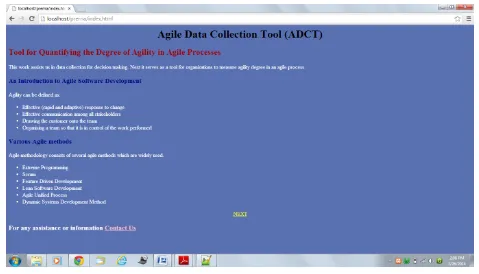
First of all, for filling all agile values of agile methods, a developer, expert or researcher must be familiar with the concept of agility and various agile methods. Thus, startup screen of the tool gives brief overview of Agile Software Development (ASD) as shown in snapshot of fig. 1. For feedback or any other problem regarding the tool a ‗Contact Us‘ link has been provided.
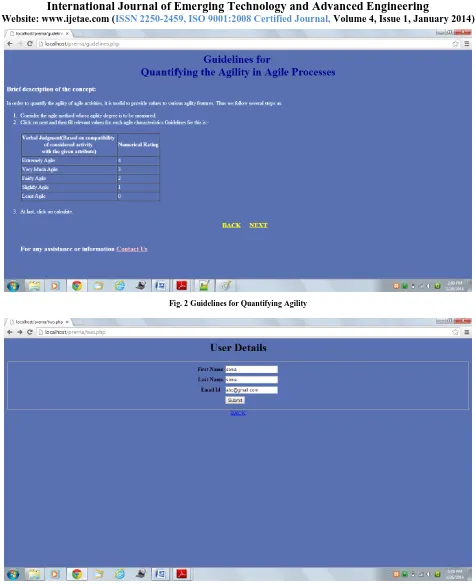
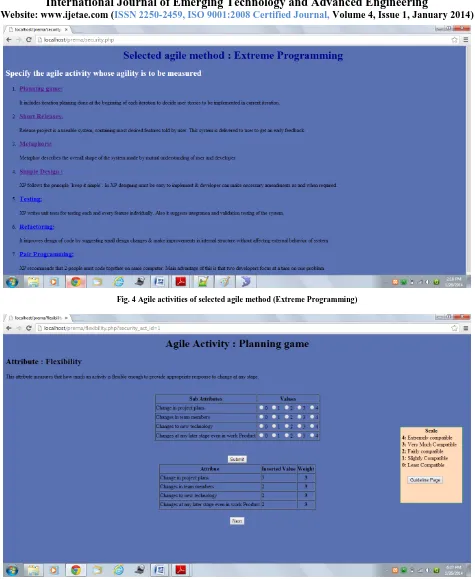
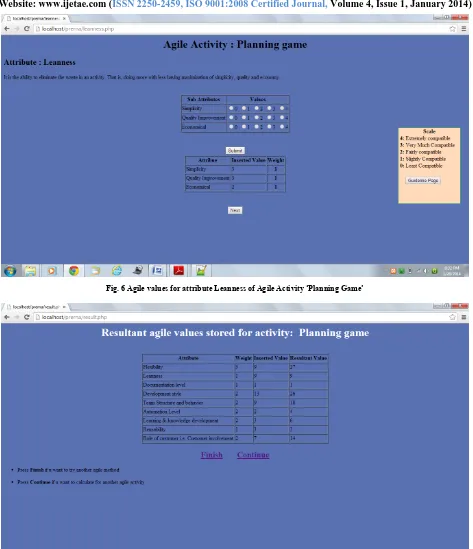
[image:4.612.66.545.436.710.2]After getting brief knowledge about ASD, next screen as shown in fig.2 provides guidelines related to the tool and brief description about how to use the tool. When user becomes familiar with the tool, he should login before starting the process of data collection using the login form as shown in fig. 3. After login, list of agile methods is displayed on the screen. User selects one agile method from the list. Accordingly, in this study, we have selected Extreme Programming method. After selection of this method, various agile activities or practices related to that method are displayed as shown in fig. 4. From the listed agile activities, one agile activity is to be selected. Now, we have clicked on ‗Planning Game‘ activity from the list. Then each attribute of planning activity comes one by one. After filling all the values of one attribute along with its sub-attributes, we can go to next attribute of considered activity. In fig. 5 and 6 the values filled for ‗Flexibility‘ and ‗Leanness‘ attribute of ‗Planning Game‘ agile activity have been shown. Scale used for filling up these values has also been displayed in the snapshot. Summarized values for the considered agile activity have been shown in fig. 7. Here, one button ‗Continue‘ is given to select for another agile activity of considered agile method and another button ‗Finish‘ has been provided to come out of the process.
International Journal of Emerging Technology and Advanced Engineering
Website: www.ijetae.com (ISSN 2250-2459, ISO 9001:2008 Certified Journal, Volume 4, Issue 1, January 2014)
[image:5.612.68.544.106.690.2]595
Fig. 2 Guidelines for Quantifying Agility
International Journal of Emerging Technology and Advanced Engineering
Website: www.ijetae.com (ISSN 2250-2459, ISO 9001:2008 Certified Journal, Volume 4, Issue 1, January 2014)
[image:6.612.69.544.110.689.2]596
Fig. 4 Agile activities of selected agile method (Extreme Programming)
International Journal of Emerging Technology and Advanced Engineering
Website: www.ijetae.com (ISSN 2250-2459, ISO 9001:2008 Certified Journal, Volume 4, Issue 1, January 2014)
[image:7.612.71.544.121.670.2]597
[image:7.612.69.544.415.689.2]Fig. 6 Agile values for attribute Leanness of Agile Activity ‘Planning Game’
International Journal of Emerging Technology and Advanced Engineering
Website: www.ijetae.com (ISSN 2250-2459, ISO 9001:2008 Certified Journal, Volume 4, Issue 1, January 2014)
598 Thus, this tool enables the user to give data required for decision making or developer can send it to others developers or experts to know their opinion about the agile values allocated to various agility features.
VIII. CONCLUSION AND FUTURE WORK
As Agile becomes main-stream development process, the agility possessed by agile methods is continuously challenged in many ways during its adoption in different situations. Teams and organizations want to be agile as much as possible in order to maximize the value delivered to the customer. However, there are several challenges that developers face when they want to know about the agility possessed by an agile activity. Data related to this is scarce till date. Thus, this paper suggests an ADCT tool for data collection that enables developers in acquiring knowledge related to agility possessed by agile methods. First step to get any quantitative measure is data collection. Thus, this tool is helpful in making any decision on the developer‘s part. Using the data collected with this tool a developer can move ahead and decide the method which is most agile among the various options available. For future work, various methods which could be used for calculating agility can be explored. Moreover, using the data collected from this tool, certain results can be drawn to compare agility of these methods.
REFERENCES
[1] Sonia, A. Singhal, Integration Analysis of Security Activities from the perspective of agility. In International Conference on Agile and Lean software methods (AI 2012), FEBRUARY 17 -19, Bengaluru, India.
[2] Conboy, K., Fitzgerald, B. (2004). Toward a conceptual Framework of Agile Methods: A study of Agility in Different Disciplines. In proceedings of WISER‘04, California, USA. ACM, Nov. 2004 [3] Qumer A and Hendersons-Sellers B, ―An evaluation of the degree of
agility in six agile methods and its applicability for method engineering‖ Information and Software Technology 50, 280–295, 2008.
[4] Kurian ,Tisni ,2005,―Agility in IT :Creating Software through Agile Techniques ―.Proceedings of the IEI-International Conference on Agility Design & Manufacturing (ADEMSE-05),Bangalore ,India [5] The Agile Alliance Home Page, http://www.agilealliance.org/home. [6] Beck, K., et al. (2001).Manifesto for Agile Software Development,
February 2001.
[7] John DIXIE and Kenneth ANDERSON ―Harnessing New Technologies to Improve Data Collection from Local Education
Authorities and Schools in England‖ http/
epp.eurostat.ec.europa.eu/cache/ITY_PUBLIC/NTTS2001/63.pdf [8] McDonald, Heath and Adam, Stewart ―A comparison of online and
postal data collection methods in marketing research, Marketing intelligence & planning‖ vol. 21, no.2, pp. 85-95 2003.
[9] Yusuf, Y.,Y., Ren, J., and Bums, N. D., ‗A Method for Evaluating Enterprise Agility- an Empirical Study‖, 16th Intemational
Conference on Production Research, 29 July-3 August 2001 F‘rague, Czech Republic, 2001.
[10] Youssuf, M., A.The impact of the intensity level of computer-based technologies on quality, International Jowal of Operations & Production Management 14 (4) (1993) 4-25.
[11] Kurian ,Tisni, 2006, "Agility Metrics: A Quantitative Fuzzy Based Approach for Measuring Agility of a Software Process" IEE- ISAM Proceedings of International Conference on Agile Manufacturing '06(ICAM-2006), Norfolk, U.S.A