International Journal of Emerging Technology and Advanced Engineering
Website: www.ijetae.com (ISSN 2250-2459, ISO 9001:2008 Certified Journal, Volume 9, Issue 10, October 2019)
143
Energy Efficient and High Throughput WSN using Dynamic
Cluster Head Selection and Fuzzy Interference System
Monika Soni
1, Dr. Dhanpratap Singh
2, Sushil Kumar
31,2,3M. Tech. Scholar, Associate Professor, Department of Information Technology, LNCT, Bhopal
Abstract--The collection of enormous amount of homogenous sensor nodes forms the Wireless Sensor Network. These sensor nodes have restricted battery power and memory and so the limited amount of energy is considered as the major issue. To overcome this issue several mechanisms were proposed, among them clustering is a popular way which minimizes the consumption of energy in the sensor nodes and thus the life span of the Wireless Sensor Network can be increased. Grouping the sensor nodes in an energy efficient and distributed approach is considered as the important issue in clustering.So in order to triumph over these issues, a Fuzzy Based Dynamic Clustering (FDC) in Wireless Sensor Network is proposed. A fair comparison is done between this proposed algorithm and some existing algorithms. The simulation results obtained reveals that our proposed algorithm increases the lifetime and has better energy efficiency.
Keywords—Wireless Sensor Network, Fuzzy Logic System, Packet Delivery Ratio, Dead Node, Energy
I. INTRODUCTION
Although wireless transmission has history of more than a century, it has found wide spread use in communication systems only in the last 3 decades. One of the most transformative technology trends of the past decade is the availability and growing expectation of ubiquitous connectivity and wireless networks are at the epicenter of this trend.
The recent advancements in the technology and manufacturing of small and low-cost sensors have made application of these sensors technically and economically feasible. These sensor nodes are designed to possess certain sensing, computing and wireless communication capabilities. These sensors measure ambient conditions in the environment surrounding them and then convert these measurements into signals that can be processed to reveal some information about phenomena located in the area around these sensors. A large number of these sensors can be networked in many applications that require unattended operations, hence creating a wireless sensor network (WSN) [1].
One of the advantages of wireless sensors networks (WSNs) is their ability to operate unattended in harsh environments in which present-day human monitoring schemes are risky, inefficient and sometimes in feasible [2].
1.1 Localization
The locational data assumes a crucial part in scope, organization reason, directing data, locational benefit, target following and safeguard operations in remote sensor systems. The restriction data is vital where there is an uncertainty about some situating. On the off chance that the sensor organize is utilized for watching the temperature in a building, it is evident to knowthe exact area of every hub [2,3]. On the unfriendly, if the sensor organize is utilized for watching the climatic condition in a remote timberland, sensor hubs might be spread out in the area via plane and the separate area of most sensors might be obscure. A confinement calculation can utilize all the accessible restriction data from the bits to figure every one of the positions. Hubs are sent with a Global Positioning System (GPS), however this is an exorbitant arrangement as far as volume, cash and power consumption.For this reason numerous limitation conventions are proposed [4]. Restriction in remote sensor systems is performed by following these 3 stages:
1. Separation estimation - This stage includes estimation systems to appraise the relative separation between the hubs [4].
2. Position calculation - It comprises of calculations to figure the directions of the obscure hub concerning the area of known grapple hubs or other neighboring hubs. Triangulation, multi-lateration, and vicinity are a few procedures that are utilized for detecting location.It utilizes the geometric properties of triangles to compute hub areas. Triangulation are grouped into lateration and angulation. lateration is figured utilizing separation estimations and angulation is computed utilizing edge information.
2-measurement strategy is to ascertain the hub area utilizing lateration ,remove data from 3 reference focuses is required and utilizing angulation, 2 point estimations and 1 separate data is required [5].
International Journal of Emerging Technology and Advanced Engineering
Website: www.ijetae.com (ISSN 2250-2459, ISO 9001:2008 Certified Journal, Volume 9, Issue 10, October 2019)
In this paper, go free restriction calculation in particular MAP-M&N and meta-heuristic calculation Tabu Search was proposed alongside MAP-M&N and the normal blunder in limitation was investigated utilizing these calculations [6, 7].
II. WIRELESS SENSOR NETWORK
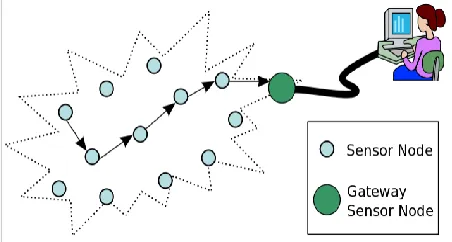
[image:2.612.54.280.459.580.2]Wireless sensor systems (WSN), are like remote specially appointed systems as in they depend on remote availability and unconstrained development of systems so sensor information can be transported remotely. Once in a while they are called clean systems, alluding to minute sensors as little as tidy. Shrewd clean is a U C Berkeley venture supported by DARPA. Tidy Networks Inc., is one of the early organizations that created remote sensor arrange items. WSNs are spatiallydistributed self-ruling sensors to screen physical or natural conditions, for example, temperature, sound, weight, and so on and to agreeably go their information through the system to different areas. The more present day systems are bi-directional, likewise empowering control of sensor movement. The advancement of remote sensor systems was roused by military applications, for example, war zone reconnaissance; today such systems are utilized as a part of numerous mechanical and shopper applications, for example, modern process observing and control, machine wellbeing checking, et cetera [8, 9].
Figure 1: Typical multi-hop wireless sensor network architecture
Application:-
Region Monitoring:- Area checking is a typical use of WSNs. In territory observing, the WSN is sent over a district where some marvel is to be checked. A military case is the utilization of sensors identify adversary interruption; a regular citizen illustration is the geo-fencing of gas or oil pipelines.
Social insurance checking:- The sensor systems for therapeutic applications can be of a few sorts: embedded, wearable, and condition installed. The implantable medicinal gadgets are those that are embedded inside human body. Wearable gadgets are utilized on the body surface of a human or exactly at nearness of the client. Condition inserted frameworks utilize sensors contained in the earth [10]. Conceivable applications incorporate body position estimation, area of people, general checking of sick patients in healing facilities and at homes. Gadgets implanted in the earth track the physical condition of a man for nonstop wellbeing finding, utilizing as information the information from a system of profundity cameras, a detecting floor, or other comparative gadgets. Body-zone systems can gather data around a person's wellbeing, wellness, and vitality consumption. In medicinal services applications the security and genuineness of client information has prime significance. Particularly because of the joining of sensor systems, with IoT, the verification of client turn out to be all the more difficult; in any case, an answer is displayed in late work [11].
Ecological/Earth detecting:- There are numerous applications in observing natural parameters,[10] cases of which are given beneath. They share the additional difficulties of brutal situations and decreased power supply [11].
Air contamination observing:- Wireless sensor systems have been conveyed in a few urban communities (Stockholm, London, and Brisbane) to screen the centralization of perilous gasses for residents. These can exploit the impromptu remote connections instead of wired establishments, which likewise make them more versatile for testing readings in various zones.
III. DYMANIC CLUSTER HEAD SELECTION
In this paper, a clustering algorithm based on clustering is proposed to solve the heterogeneity caused by random selection of LEACH protocol cluster head. First, the k- Medoids clustering algorithm is used to divide the nodes of the whole network area into several classes, and then select the first cluster head and the second cluster head in the cluster.
International Journal of Emerging Technology and Advanced Engineering
Website: www.ijetae.com (ISSN 2250-2459, ISO 9001:2008 Certified Journal, Volume 9, Issue 10, October 2019)
145 Considering E as the set of energy of all the N nodes, Kis the expected number of clusters and X and Y are the set of locations of various nodes in the Wireless Sensor Network the algorithm for cluster head selection in EELEACH-C works as follows:
Algorithm CH-Selection (E, N, K, X, Y)
1. Asc - sort(E) 2. i = 1
3. whileI ≤ N do
4. if(Ei>=EAvg and i<= k) then 5. Eligible(i) = True
6. else
7. Eligible(i) = False 8. end if
9. i=i + 1 10. end while
11. if(disti>distj and Eligible (i)) then 12. CHi=CMj
13. end if
14. return(CHi , CHj)
Here, we explain in detail our new energy efficient EELACH-C protocol whose goal is to increase the longevity of the network. Let us assume that all the sensor nodes are equipped with equal amount of initial energy.
We assume that all nodes are distributed uniformly over the sensor field. Our approach is to assign a weight wito the
probability of a node to become cluster head pch. This
weight must be equal to the initial energy of each node divided by the residual energy. Only nodes which are having the highest weights will be eligible to become a cluster head (CH) in next round. The probability of a member node (CM) to be the node to die first is less than the probability of an already chosen cluster head node to die. Simulation results attest our expectation.
IV. FUZZY INFERENCE SYSTEM
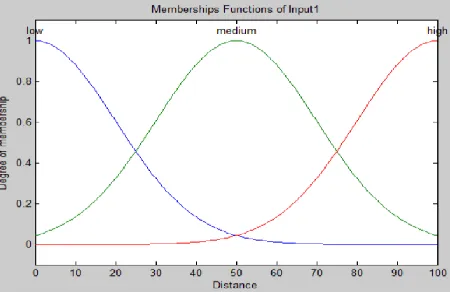
Mechanism of fuzzy decision making involves manipulation of fuzzy variable through linguistic equations or fuzzy rules. The below Figure 3.4 explains the whole mechanism.
Fuzzification: In fuzzification, membership degree is computed for each input variable with respect to its linguistic term.
Rule matching: In rule matching, the firing strength (degree of satisfaction) of individual rule is calculated.
[image:3.612.339.553.133.275.2]Fuzzy Inference: The recommendation of rules according to firing strengths and rule conclusions are determined in fuzzy inference.
Figure 2. The structure of a fuzzy logic system
Fuzzy Aggregation: Fuzzy aggregation combines recommendations from individual rules into an overall implied fuzzy set.
[image:3.612.330.561.361.510.2]Defuzzification: Defuzzification involves determination of a crisp value based on implied fuzzy sets derived from the rules, as final result or solution.
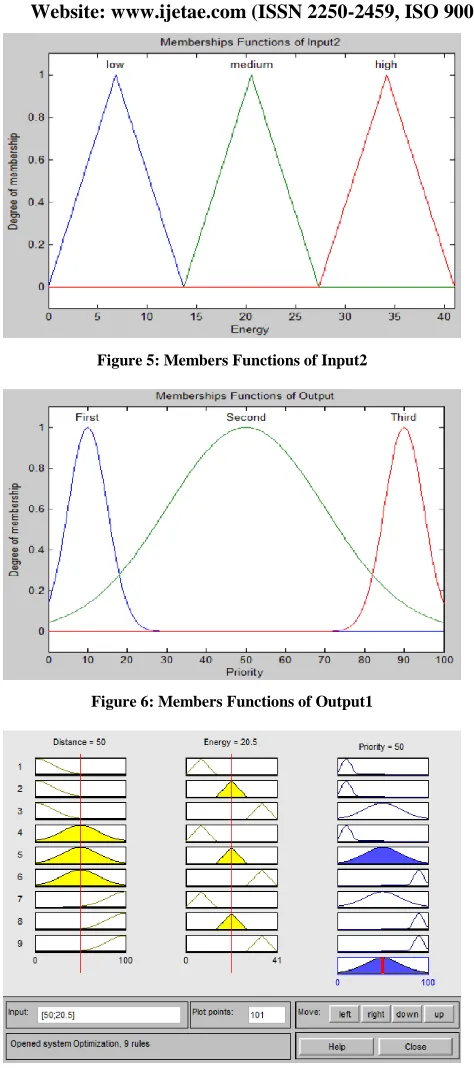
Figure 3: System Optimization of 2 inputs, 1 outputs and 9 rules
[image:3.612.332.557.537.686.2]International Journal of Emerging Technology and Advanced Engineering
[image:4.612.52.289.120.654.2]Website: www.ijetae.com (ISSN 2250-2459, ISO 9001:2008 Certified Journal, Volume 9, Issue 10, October 2019)
Figure 5: Members Functions of Input2
Figure 6: Members Functions of Output1
Figure 7: Rule Viewer Optimization
Fuzzy logic is an augmentation of Boolean rationale managing the idea of fractional truth which signifies the degree to which a suggestion is valid. Though established rationale holds that everything can be communicated in parallel terms (0 or 1, dark or white, yes or no), fuzzylogic replaces Boolean truth esteems with a level of truth. Level of truth is frequently utilized to catch the loose methods of thinking that assume a fundamental part in the human capacity to settle on choices in a domain of vulnerability and imprecision. Fluffy Inference Systems (FIS) are adroitly exceptionally basic. They comprise of an info, a preparing, and a yield arrange.
V. SIMULATION RESULT
In this subsection we evaluate the performancedynamic cluster head selection using fuzzy system in terms of:
Packet delivery ratio (PDR): The proportion of successful data packets delivered to the destination compared to the total generated data packets.
The information arrange maps the data sources, for example, recurrence of reference, recency of reference, et cetera, to the suitable enrollment capacities and truth esteems.
The preparing stage summons each fitting principle and produces a relating result. It at that point joins the outcomes. At long last, the yield organize changes over the joined outcome once again into a particular yield esteem.
If (LS=HIGH) and (LC=HIGH) and (PD=HIGH) and (NH=LOW) then Cache
If (LS=LOW) and (LC=HIGH) and (PD=LOW) and (NH=HIGH) then No Cache
Where,
International Journal of Emerging Technology and Advanced Engineering
Website: www.ijetae.com (ISSN 2250-2459, ISO 9001:2008 Certified Journal, Volume 9, Issue 10, October 2019)
147 Round = 250
Round = 500
International Journal of Emerging Technology and Advanced Engineering
Website: www.ijetae.com (ISSN 2250-2459, ISO 9001:2008 Certified Journal, Volume 9, Issue 10, October 2019)
Round = 1000
Round = 1200
Table 1:
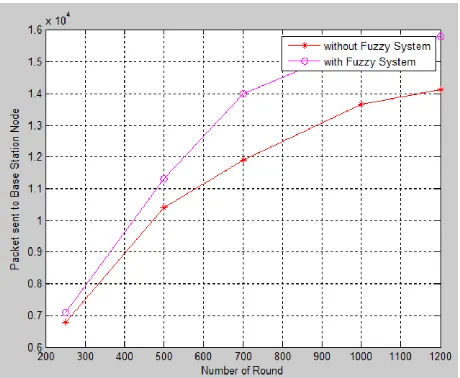
Packet Sent to Base Station Node
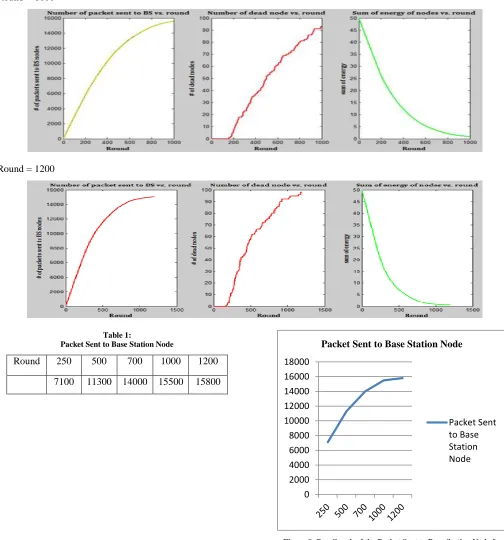
Round 250 500 700 1000 1200
[image:6.612.51.555.145.685.2]7100 11300 14000 15500 15800
Figure 8: Bar Graph of the Packet Sent to Base Station Node for Different Round
0 2000 4000 6000 8000 10000 12000 14000 16000 18000
Packet Sent to Base Station Node
International Journal of Emerging Technology and Advanced Engineering
Website: www.ijetae.com (ISSN 2250-2459, ISO 9001:2008 Certified Journal, Volume 9, Issue 10, October 2019)
[image:7.612.329.559.135.324.2]149 Table 2
Dead Node vs Round
Round 250 500 700 1000 1200
11 58 65 91 93
[image:7.612.54.284.138.337.2]Figure 9: Bar Graph of the Dead Node for Different Round
Table 3: Sum of Energy vs Round
Round 250 500 700 1000 1200
22 8 4 2 1
Figure 10: Bar Graph of the Sum of Energy for Different Round
Figure 11: Bar Graph of the Previous and Proposed Algorithm for PDR
VI. CONCLUSION
In this paper, a Tabu search and Fuzzy Inference System based routing algorithm for wireless sensor network is proposed to increase network stability, data rate, link strength, communication efficiency, and decrease data loss.
Fuzzy Based Dynamic Clustering in Wireless Sensor Networks (FDC) is proposed. Simulation results shows that the proposed algorithm is much better than existing algorithm in terms of energy efficiency and lifetime of the network.
REFERENCES
[1] Anjali Bharti, Chandni Devi and Dr. Vinay Bhatia, “Enhanced Energy Efficient LEACH (EEE- LEACH) Algorithm using MIMO for Wireless Sensor Network”, 2015 IEEE International Conference on Computational Intelligence and Computing Research.
[2] Abdul Razaque, MusbahAbdulgader and Chaitrali Joshi, “P-LEACH: Energy Efficient Routing Protocol for Wireless Sensor Networks”, International Conference on Computational Intelligence and Computing Research, IEEE 2014.
0 50 100
250 500 700 10001200
Dead Node vs Round
Dead Node vs Round
0 10 20 30
250 500 700 1000 1200
Sum of Energy vs Round
[image:7.612.54.283.380.548.2]International Journal of Emerging Technology and Advanced Engineering
Website: www.ijetae.com (ISSN 2250-2459, ISO 9001:2008 Certified Journal, Volume 9, Issue 10, October 2019)
[3] N.G. Palan, B.V. Barbadekar and SuahsPatil, “Low Energy Adaptive Clustering Hierarchy (LEACH) Protocol: A Retrospective Analysis”, International Conference on Inventive Systems and Control (ICISC-2017).
[4] Hongjun Wang, Huiqing Chang Hui Zhao and YoujunYue, “Research on LEACH Algorithm Based on Double Cluster Head Cluster Clustering and Data Fusion”, International conference of IEEE 2017.
[5] Asaduzzaman and Hyung Yun Kong, “Energy Efficient Cooperative LEACH Protocol for Wireless Sensor Networks”, Journal of Communications and Networks, Vol. 12, No. 4, August 2010. [6] SameeraPoduri and Gaurav S. Sukhatme,”Constrained Coverage for
Mobile Sensor Networks”, IEEE International Conference on Robotics and Automation,2004
[7] Rahul C. Shah and Jan M. Rabaey,” Energy Aware Routing for Low Energy Ad Hoc Sensor Networks”, communication / Computation Piconodes for Sensor Networks.
[8] N. Javaid, M. Waseem, Z. A. Khan$, U. Qasim£, K. Latif, A. Javaid, “ ACH: Away Cluster Heads Scheme for Energy Efficient Clustering Protocols in WSNs”, IEEE,2013
[9] K. Padmanabhan and P. Kamalakkannan,”Energy Enhanced Base Station Controlled Dynamic Clustering Protocol for Wireless Sensor Networks”, Journal of Advances in Computer Networks, Vol. 1, No. 1, March 2013.
[10] Imad S. AlShawi, Lianshan Yan, Wei Pan and Bin Luo, “A Fuzzy-Gossip Routing Protocol for an EnergyEfficient Wireless Sensor Networks”, 978-1-4577-1767-3/12/$26.00 ©2012 IEEE