International Journal of Emerging Technology and Advanced Engineering
Website: www.ijetae.com (ISSN 2250-2459,ISO 9001:2008 Certified Journal, Volume 5, Issue 6, June 2015)
540
Performance Analysis of Wireless Link Operating in α-µ Fading
Channel
Dharmraj
1, Himanshu Katiyar
21Joint Director in Defence Research and Development Organization, CEMILAC, RCMA Lucknow.
2Associate Professor in BBDNIIT, Lucknow, India.
Abstract— The α-µ distribution is a generalized fading distribution which explores nonlinearities of the wireless propagation medium. This distribution includes the other distributions such as Gamma, Nakagami, exponential, Gaussian, Rayleigh etc. This makes α-µ distribution very interesting. In this paper probability density function and performance metrics such as outage and bit error rate of α-µ distribution is discussed with Monte-Carlo simulation results.
Keywords— α-µ Distribution, Bit Error Rate (BER), Generalized Fading Channels, Outage Probability, Probability Density Function.
I. INTRODUCTION
There are many type of distributions which describe the mobile radio signal. In the recent past alpha-mu (α-µ) fading model [1] has been proposed considering two important phenomenon of radio propagation non-linearity and clustering. The α-µ represents a generalized fading distribution for small-scale variation of the fading signal in a non line-of-sight fading condition. The α-µ distribution is flexible, general and has easy mathematical tractability. In fact, the Generalized Gamma Distribution (GGD) also known as Stacy distribution [2, 24] has been renamed as α-µ distribution, indicating the physical parameters involved. As given in its name, alpha-mu distribution is written in terms of two physical parameters, namely α and µ. The power parameter (α > 0) is related to the non-linearity of the environment i.e. propagation medium, whereas the parameter (µ > 0) is associated to the number of multipath clusters.
In earlier works by indoor and outdoor field trial measurements [3], the autocorrelation and power spectrum functions of α-µ distribution have been derived and validated whereas in [5] the probability density function has been obtained. The accurate approximations for the outage probability of equal gain receivers subject to arbitrary independent co-channel interferers are proposed in [4].
International Journal of Emerging Technology and Advanced Engineering
Website: www.ijetae.com (ISSN 2250-2459,ISO 9001:2008 Certified Journal, Volume 5, Issue 6, June 2015)
541
Capacity analysis of dual-hop wireless communication systems over α-µ fading channels is carried out in [28]. BER for i.i.d. α-µ fading channel with a maximal ratio combining receiver is carried out in [29]. Performance analysis of wireless communication over α-η-µ fading channel has been investigated in [31], and outage, PDF and CDF of received signal to interference ratio has been derived. In reference [32] two new generalized fading distribution namely α-η-µ and α-κ-µ distributions have been discussed. The [33] explains how cognitive wireless networks fulfills the need of additional wireless spectrum. Deployment of multi-input multi-output antenna systems with orthogonal frequency division multiplexing over wireless channels has been identified in [34] as one of the most promising techniques for future wireless services.
The evolution of α-µ distribution can be traced in [35] where two-variate PDF, for correlated variates, each of which has marginal Gaussian distribution is explained. The physical basis for the GGD is discussed in [36]. In [37] authors have brought out that GGD is a flexible distribution and has exponential, gamma, and Weibull as subfamilies, and lognormal as limiting distribution. In flat fading environment channel estimation has been done in [38] using phase estimation of the transmitted signal. A framework based on Mellin-transform for deriving closed form expression for symbol error rate of α-µ fading channel for single branch and maximal ratio combining receivers have been presented in [39]. In [40] the problem of energy detection of an unknown deterministic signal over fading channel is revisited. Reference [41] presents the κ-µ fading distribution, which is used for characterising the mobile radio propagation under severe fading conditions. Whereas in [42] natural generalization of the κ-µ fading channel in which the line of sight component is subject to shadowing is investigated. A novel characterisation of fading experienced in body to body communication channels is carried out in [43] for fire and rescue personnel using the κ-µ distribution.
Further, exact closed-form expression is derived for outage probability in η-µ fading channels in [44]. Closed-form expressions for the averages of the Gaussian Q-function and product of two Gaussian Q-Q-functions over the generalised η-µ and κ-µ distributions have been obtained in [45]. BER performance of switched diversity receivers is analyzed in [46] over κ-µ and η-µ fading channels using moment generation function based approach. Performance analysis of α-η-µ fading channel is carried out in [47], when the communication is subjected to influence of co-channel interference. In [48], MATLAB based approach for mobile radio channels modelling for flat fading is presented. End-to-end performance of two-hops wireless communication systems with non regenerative relays over flat Rayleigh-fading channels is presented in [49]. An overview of the physical insight and the various performance metrics of fading channels is discussed in [50]. Unified analytical framework is presented in [51] to determine the exact average symbol-error rate of linearly modulated signals over generalized fading channels. Unified approach for evaluating the error rate performance of digital communication systems operating over a generalized fading channel is given in [52]. Reference [53] develops a novel generic framework for the capacity analysis of L-branch equal gain combining/maximal ratio combining over generalized fading channels.
II. THE ALPHA-MUFADING MODEL REVISITED
International Journal of Emerging Technology and Advanced Engineering
Website: www.ijetae.com (ISSN 2250-2459,ISO 9001:2008 Certified Journal, Volume 5, Issue 6, June 2015)
[image:3.612.108.491.154.448.2]542
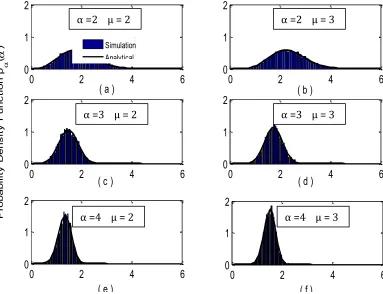
Fig. 1. Matching of analytical and simulated results of PDF of α for various α and μ (a) α=2 and μ=2, (b) α=2 and μ=3, (c) α=3 and μ=2, (d) α=3 and μ=3, (e) α=4 and μ=2, (f) α=4 and μ=3
0
2
4
6
0
1
2
( a )
0
2
4
6
0
1
2
( c )
P
ro
b
a
b
il
it
y
D
e
n
s
it
y
F
u
n
c
ti
o
n
p
(
)
0
2
4
6
0
1
2
( e )
0
2
4
6
0
1
2
( b )
0
2
4
6
0
1
2
( d )
0
2
4
6
0
1
2
( f )
α =2 μ = 2
0 1 2 3 4 5 6 7 8 9
0 0.05 0.1 0.15 0.2 0.25 0.3 0.35 0.4 0.45
Fading envelope
P
ro
b
a
b
il
it
y
D
e
n
s
it
y
F
u
n
c
ti
o
n
p
(
)
Matching of analytical and simulated results for fading envelop
Simulation Analytical
α =2 μ = 3
α =3 μ = 2
α =3 μ = 3
International Journal of Emerging Technology and Advanced Engineering
Website: www.ijetae.com (ISSN 2250-2459,ISO 9001:2008 Certified Journal, Volume 5, Issue 6, June 2015)
[image:4.612.105.492.153.435.2]543
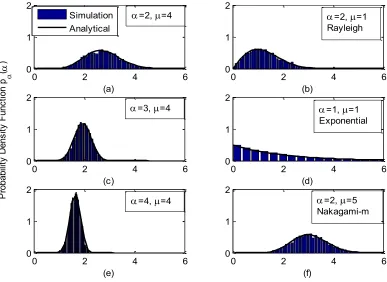
Fig. 2. Matching of analytical and simulated results of PDF of α for varying α and μ (a) α=2 and μ=4, (b) α=2 and μ=1, (c) α=3 and μ=4, (d) α=1 and μ=1, (e) α=4 and μ=4, (f) α=2 and μ=5
Assuming that the received signal at the ith branch (i =1,
...,M) includes a certain number ni of multipath clusters,
the resulting α-μ envelope Ri at the ith branch is written as
(1) Where αi > 0 is power parameter, Xil and Yil are zero mean mutually independent Gaussian processes with identical variances i.e.
With E(·) and V (·) are mean & variance operators respectively.
Thus, for a (α-µ) fading signal with envelope R, an arbitrary parameter (α > 0), a α-root mean value of Rα is given as
The α-µ probability density function (PDF), fR(r) of R is given [1] as
(2) Where µ ≥ 0, is the inverse of the normalized variance of Rα
The outage probability (Pout) of α-μ is defined in [4] as the probability that the error rate exceeds a pre-defined value or equivalently, the received SNR drops below a pre-defined threshold (γthr).
(3)
0 2 4 6
0 1 2 (a) Simulation Analytical
0 2 4 6
0 1 2
(b)
0 2 4 6
0 1 2
(c)
0 2 4 6
0 1 2
(d)
0 2 4 6
0 1 2
(f)
0 2 4 6
0 1 2 (e) P ro ba bi lit y D en si ty F un ct io n p ( )
=2, =4
=3, =4
=2, =1 Rayleigh
=1, =1 Exponential
=2, =5 Nakagami-m
=4, =4
(
)
2
2ˆ
E
R
r
i i ni il il
i
X
Y
R
1 2 2 2 ˆ ( ) ( ) 2 i i il il ii
r
V X V Y
n
i
ˆ
the
root mean value of
i i(
i)
i i i
r
R
E R
International Journal of Emerging Technology and Advanced Engineering
Website: www.ijetae.com (ISSN 2250-2459,ISO 9001:2008 Certified Journal, Volume 5, Issue 6, June 2015)
544
The BER of α-µ fading channel is derived in [16, (7)] using MGF approach.
III. SIMULATION RESULTS AND DISCUSSIONS
The PDF of fading envelope of α-μ fading channel is simulated using MATLAB environment by choosing 5000 samples. The result presented in Fig.1 and Fig.2. are simulated and analytical results obtained by varying the values of α and μ as follows:
Case –I: Fig.1.(a), (c), (e); varying α from 2 to 4, and μ =2. Case –II: Fig.1.(b), (d), (f); varying α from 2 to 4, and μ =3. Case –III: Fig.2.(a), (c), (e); varying α from 2 to 4, and μ =4.
Case –IV: Fig.2.(b), (d), (f); varying α and μ for special cases of Rayleigh, Exponential and Nakagami-m.
The simulated results matches with analytical curve. It is observed that by increase in α the base of the PDF curve shrinks which means variance decreases and vice versa. Whereas by increase in μ the curve becomes more peaky which means probability of mean increases.
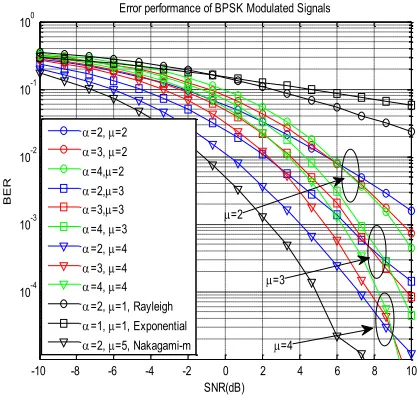
[image:5.612.335.544.140.340.2]Outage performance and BER for BPSK modulated α-μ fading channel is shown in Fig. 3 and Fig.4 respectively. In these simulation 500000 samples have been considered for each combination of α and μ. It is observed that for a given value of μ, at zero dB SNR outage is same irrespective of α but outage decreases with increase in α at higher value of SNR. BER for α-μ fading channel is shown in Fig.4. Here following cases of BER curves are illustrated:
[image:5.612.63.267.492.685.2]Fig. 3. Outage performance of α-μ fading channel
Fig. 4. Bit Error Rate of α-μ fading channel
Case –I: Varying α from 2 to 4, and keeping μ =2. It is seen that at 7 dB SNR the curves crosses each other. Case –II: Varying α from 2 to 4, and keeping μ =3. It is seen that at 8 dB SNR the curves crosses each other. Case –III: Varying α from 2 to 4, and keeping μ =4. It is seen that at 9 dB SNR the curves crosses each other.
Let us call the SNR on these crossing points as critical SNR (i.e. SNRc) for a given value of μ. It is observed that if SNR of the channel is below SNRc then BER is proportional to α but for SNR greater than SNRc the BER is inversely proportional to α.
Fig. 5. BER of α-μ fading channel α varied from 1 to 7, keeping μ=1
-10 -8 -6 -4 -2 0 2 4 6 8 10 10-4
10-3 10-2 10-1 100
SNR(dB)
Pout
Outage Performance
=2, =2
=3, =2
=4, =2
=2, = 3
=3, =3
=4, =3
=2, =4
=3, =4
=4, =4
=2, =1
=1, =1
=2, =5
=3
=2
=4
-10 -8 -6 -4 -2 0 2 4 6 8 10 10-4
10-3 10-2 10-1 100
SNR(dB)
BER
Error performance of BPSK Modulated Signals
=2, =2
=3, =2
=4,=2
=2,=3
=3,=3
=4, =3
=2, =4
=3, =4
=4, =4
=2, =1, Rayleigh
=1, =1, Exponential
=2, =5, Nakagami-m =4
=3
=2
-5 0 5 10 15 20 25 30 35 40 45 10-4
10-3 10-2 10-1 100
SNR(dB)
BER
Error performance of BPSK Modulated Signals
=1
=2
=3
=4
=5
=6
[image:5.612.337.544.507.668.2]International Journal of Emerging Technology and Advanced Engineering
Website: www.ijetae.com (ISSN 2250-2459,ISO 9001:2008 Certified Journal, Volume 5, Issue 6, June 2015)
[image:6.612.63.272.139.310.2]545
Fig. 6. Outage of α-μ fading channel α varied from 1 to 7, keeping μ=1
[image:6.612.336.570.140.315.2]In Fig.5 and Fig.6 BER and outage curves are illustrated for α varying from 1 to 7, while keeping μ =1. Inference can be drawn from Fig.5 and Fig.6 that after certain level, further increase in α there is no significant improvement in BER and outage respectively.
Fig. 7. BER of α-μ fading channel μ varied from 1 to 7, keeping α=1
Fig. 8. Outage of α-μ fading channel μ varied from 1 to 7, keeping α=1
In Fig.7 and Fig. 8 μ has been varied from 1 to 7 and α is equal to 1, BER and outage plot are shown. It is observed that as the value of μ increases there is improvement in BER and outage. At very high level of μ, further improvement in BER and outage does not happen.
IV. CONCLUSION
In this correspondence, PDF, Outage and BER of α-μ fading model have been discussed. The simulated and analytical results of performance metrics have been illustrated. The effect of α and μ parameters variation on BER and outage is discussed. The result obtained in this letter motivates researcher to explore more the α-μ generalized fading model.
Acknowledgment
This work is supported by Defence Research & Development Organisation (DRDO), Ministry of Defence, Government of India. The support is gratefully acknowledged.
-5 0 5 10 15 20 25 30 35 40 45 10-4
10-3 10-2 10-1 100
SNR(dB)
Pout
Outage Performance
=1
=2
=3
=4
=5
=6
=7
-5 0 5 10 15 20 25 30 35 40 45 10-4
10-3 10-2 10-1 100
SNR(dB)
BER
Error performance of BPSK Modulated Signals
=1
=2
=3
=4
=5
=6
=7
-5 0 5 10 15 20 25 30 35 40 45 10-4
10-3 10-2 10-1 100
SNR(dB)
Pout
Outage Performance
=1
=2
=3
=4
=5
=6
[image:6.612.63.270.405.569.2]International Journal of Emerging Technology and Advanced Engineering
Website: www.ijetae.com (ISSN 2250-2459,ISO 9001:2008 Certified Journal, Volume 5, Issue 6, June 2015)
546
REFERENCES
[1] Michel Daoud Yacoub, ―The α-µ Distribution: A General Fading Distribution‖, IEEE International Symposium on Personal, Indoor and Mobile Radio Communication PIMRC 2002, vol.2, pp. 629-633, 2002.
[2] Michel Daoud Yacoub, ―The α-µ Distribution: A Physical Fading Model for the Stacy Distribution‖, IEEE Transactions on Vehicular Technology, vol. 56, no. 1, pp. 27-34, 2007.
[3] Ugo Silva Dias and Michel Daoud Yacoub, ―On the α-μ Autocorrelation and Power Spectrum Functions: Field Trials and Validation‖ IEEE Globecom Proceedings 2009.
[4] Moraes, A.C., da Costa D.B., Yacoub, M.D., ―A Simple, Accurate Approximation for the Outage Probability of Equal-Gain Receivers with Cochannel Interference in an alpha-mu Fading Scenario‖ IEEE Wireless Communications and Networking Conference, 2008. [5] Camila Lopes Selvati, Ugo Silva Dias, Arvind Krishnan and Michel
Daoud Yacoub, ―On the Fading Parameters Characterization of the α-μ Distribution: Measurements and Statistics‖ XIX Simp´osio Brasileiro de Telecomunicac¸ ˜oes - Sbrt 2011, de 2 a 5 de outubro de 2011, Curitiba, PR
[6] Daniel Benevides da Costa, Jose Candido Silveira Santos, Michel Daoud Yacoub, and Gustavo Fraidenraich, ―Crossing Rates and Fade Durations for Diversity Combining- Schemes over α-μ Fading Channels‖ IEEE Transactions on Wireless Communications, vol. 6, no. 11, pp. 1-5, 2007.
[7] Leonardo, E.J. Yacoub, M.D., ―The Product of Two α-µ Variates and the Composite α-µ Multipath-Shadowing Model‖ IEEE Transactions on Vehicular Technology, 2013.
[8] Rabelo G.S., Yacoub M.D., de Souza R.A.A., ―On the Multivariate α – μ Distribution: New Exact Analytical Formulations‖ IEEE Transactions on Vehicular Technology, vol. 60, Issue 8, 2011. [9] Rausley Adriano Amaral de Souza, and Michel Daoud Yacoub, ―The
Multivariate alpha-mu Distribution‖ IEEE Wireless Communications and Networking Conference, 2008.
[10] Rausley Adriano Amaral de Souza, and Michel Daoud Yacoub, ―On the Mulitvariate α-µ Distribution with Arbitrary Correlation and Fading Parameters‖ IEEE International Conference on Communications, 2008.
[11] Rausley Adriano Amaral, de Souza, Santa Rita do Sapucai, Gustavo Fraidenraich and Michel Daoud Yacoub, ―On the Mulitvariate α-µ Distribution with Arbitrary Correlation‖ International Telecommunications Symposium, 2006
[12] Daniel Benevides da Costa, and Michel Daoud Yacoub, ―A Simple and accurate α-μ approximation to crossing rates in EGC and MRC receivers undergoing Nakagami-m fading‖ IEEE International Microwave and Optoelectronics Conference, 2007.
[13] Daniel Benevides da Costa, Michel Daoud Yacoub, and Gustavo Fraidenraich, ―Second-Order Statistics of Equal-Gain and Maximal-Ratio Combining for the α-μ (Generalized Gamma) Fading Distribution‖ IEEE 9th International Symposium on Spread Spectrum Techniques and Applications, 2006
[14] Daniel Benevides da Costa, and Michel Daoud Yacoub,―Average Channel Capacity for Generalized Fading Scenarios‖ IEEE Communications Letters, vol. 11, 2007.
[15] Daniel Benevides da Costa, Michel Daoud Yacoub, and Jose Candido Silveira Santos F, ―Highly Accurate Closed-Form Approximations to the Sum of α-μ Variates and Applications‖ IEEE Transactions on Wireless Communications, vol. 7, Issue 9, 2008.
[16] Amer M Magableh, Mustafa M Matalgah, ―Moment Generating Function of the Generalized α-μ Distribution with Applications‖ IEEE Communications Letters, vol. 13, Issue 6, 2009.
[17] Amer M Magableh, Mustafa M Matalgah, ―Channel Characteristics of the Generalized α-μ Multipath Fading Model‖ 7th International Wireless Communications and Mobile Computing Conference, 2011 [18] Xin Wang, Norman C. Beaulieu, ―Switching Rates of Two-Branch
Selection Diversity in κ-µ and α-µ Distributed Fadings‖ IEEE Transactions on Wireless Communications, vol. 8, Issue 4, 2009. [19] Xin Wang, Norman C. Beaulieu, ―Switching Rates of Dual
Selection Diversity in κ-µ and α-µ Fading Channels‖ IEEE Wireless Communications and Networking Conference, 2009.
[20] Sood, N., Sharma A.K., Uddin.M., ―BER Performance of OFDM-BPSK and -QPSK over Generalized Alpha-Mu Fading Distribution‖ IEEE International Advance Computing Conference, (IACC 2009), pp. 1197–1199, 2009.
[21] Mohamed R., Ismail, M.H., Newagy, F.A., Mourad, H.M., ―Capacity of the alpha-mu fading channel with SC diversity under adaptive transmission techniques‖ 19th International Conference on Telecommunications (ICT), 2012.
[22] S.R. Panic, M.C. Stefanovic, A.V. Mosic, ―Performance Analyses of Selection Combining Diversity Receiver over α-μ Fading Channels in the presence of Co-channel Interference‖ IET Communications, vol. 3 , no. 11, 2009.
[23] M Stefanovic, D Krstic, J Anastasov, S Panic, and A Matovic, ―Analysis of SIR-based Triple SC System over Correlated α-µ Fading Channels‖ 5th Advanced International Conference on Telecommunications, 2009.
[24] E W Stacy, ―A Generalization of the Gamma Distribution‖ The Annals of Mathematical Statistics, vol. 33, no.3, pp. 1187-1192, 1962.
[25] Michel Daoud Yacoub, ―The κ-µ Distribution and the η-µ Distribution‖ IEEE Transactions on Antennas and Propagation Magazine, vol. 49, no. 1, pp. 68-81, 2007.
[26] M. C Stefanovic, et all, ―SSC Diversity Receiver over Correlated α-µ Fading Channels in the Presence of Co-channel Interference‖ Eurasip Journal on Wireless Communication and Networking. 2010. [27] M. C Stefanovic, et all, ―Outage Probability Analysis of System
with dual Selection Combining over correlated Weibull Fading Channel in the Presence of α-µ Co-channel Interference‖ Electrotechnology 2013.
[28] Amer M Magableh, Taimour Aldalgamouni, Nemah M Jafreh, ―Capacity Analysis of duel-hop Wireless Communication Systems over α-µ Fading Channels‖ ELSEVIER, Computer and Electrical Engineering 2014.
[29] Taimour Aldalgamouni, Amer M. Magableh, Ahmad Al-Hubaishi, ―Performance of Selected Diversity Techniques over the α-μ Fading Channels‖ WSEAS Transactions on Communications, vol. 12, Issue 2, pp 41-51, 2013.
[30] Yasser Fathi, Hazim Tawfik, ―Generalization of Energy Detector Performance using α-µ Fading Model‖ Proc. Innovations on Communication Theory, Istanbul, 2012.
[31] M. C Stefanovic, et all, ―Performance Analysis of Wireless Communication System in General Fading Environment subjected to shadowing and interference‖ EURASIP Journal on Wireless Communication and Networking. 2014
International Journal of Emerging Technology and Advanced Engineering
Website: www.ijetae.com (ISSN 2250-2459,ISO 9001:2008 Certified Journal, Volume 5, Issue 6, June 2015)
547
[33] Satwant Kaur, ―Intelligence in Wireless Networks with CognitiveRadio Networks‖ IETE Technical Review, vol. 30, Issue 1, 2013. [34] Ilesanmi B. Oluwafemi and Stanley H. Mneney, ―Review of
Space-time Coded Orthogonal Frequency Division Multiplexing Systems for Wireless Communication‖ IETE Technical Review, vol. 30, Issue 5, 2013.
[35] A S Krishnamoorth and M Parthasarthy, ―A Multivariate Gamma-Type Distribution‖ The Annals of Mathematical Statistics, 1951 [36] John H. Lienhard and Paul L. Meyer, ―A Physical Basis for
Generalised Gamma Distribution‖ Quarterly of Applied Mathmatics, vol. XXV, no. 3, 1967
[37] Morteza Khodabin, Alereza Ahmadabadi, ―Some Properties of Generalized Gamma Distribution‖ Mathematical Sciences, vol. 4, no. 1, pp. 09-28, 2010
[38] Neetu Sood, Ajay K. Sharma, and Moin Uddin, ―On the Channel Estimation of OFDM-BPSK and QPSK over Generalized α-μ Fading Distribution‖ Int. J. Communications, Network and System Sciences, 3, pp. 380-384, 2010.
[39] Moataz M H, El Ayadi, Mahmoud Hamed Ismail, ―Novel Closed-Form Exact Expressions and Asymptotic Analysis for the Symbol Error Rate of Single and Multi-Branch MRC and EGC Receivers over α-µ Fading‖ IEEE Transactions on Vehicular Technology, Issue 04, 2014.
[40] Hikmat Y. Darawsheh, Ali Jamoos, ―Performance Analysis of Energy Detector Over α-µ Fading Channels with Selection Combining‖ Springer, Wireles Pers Communication, 2014. [41] Guilherme Silveira Rabelo, Ugo Silva Dias and Michel Daoud
Yacoub, ―The κ-μ Extreme Distribution: Characterizing Severe Fading Conditions‖ IEEE International Microwave & Optoelectronics Conference, IMOC 2009.
[42] Jose F. Paris, ―Statistical Characterization of κ-µ Shadowed Fading‖ IEEE Transactions on Vehicular Technology, vol. 63, iss. 2, 2014. [43] Simon L. Cotton, William G. Scanlon, and Jim Guy ―The κ–μ
Distribution Applied to the Analysis of Fading in Body to Body Communication Channels for Fire and Rescue Personnel‖ IEEE Antennas and Wireless Propagation Letters, vol. 7, 2008.
[44] David Morales-Jimenez and Jose F. Paris, ―Outage Probability Analysis for η-µ Fading Channels‖ IEEE Communication Letters, vol. 14, no. 6, 2010.
[45] N Y Ermolova, ―Useful Integrals for Performance Evaluation of Communication Systems in Generalized η-µ and κ-µ Fading Channels‖ IET Communication, vol. 3, iss. 2, pp. 303-308, 2009. [46] Kalpant Pathak, P R Sahu, ―BER Performance of Switched Diversity
Receivers over κ-µ and η-µ Fading Channels‖ National Conference on Communication, IIT Kanpur, 2014.
[47] Stfan R. Panic, Sinisa Ninkovic, Dejan Jaksic, William G. Scanlon, and Jim Guy, ―Performance Analysis of Wireless Communication System over α–η–μ Fading Channels in the Presence of CCI‖ Infoteh-Jahorina, vol. 12, 2013.
[48] Nikolay Kostov, ―Mobile Radio Channels Modelling in MATLAB‖ Radio Engineering, vol. 12, no. 4, 2003.
[49] Mazen O. Hasna, Mohamed-Slim Alouini, ―End-to-End Performance of Transmission Systems with Relays over Rayleigh-Fading Channels‖ IEEE Transactions on Wireless Communications vol. 2, no. 6, 2003.
[50] M K Simon, and M S Alouini, ―Digital Communications over Fading Channels‖, 2nd ed. Hoboken: Wiley, 2005.
[51] Mohamed-Slim Alouini and Andrea J. Goldsmith, ―A Unified Approach for calculating Error Rates of Linearly Modulated Signals over Generalized Fading Channels‖ IEEE Transactions on Communications, vol.47, no.9, pp. 1324-1334, 1999.
[52] Marvin K. Simon, and Mohamed-Slim Alouini, ―A Unified Approach to the Performance Analysis of Digital Communication over Generalized Fading Channels‖ Proceedings of the IEEE, vol. 86, no. 9, pp. 1860-1887, 1998.
[53] Ferman Yilmaz, and Mohamed-Slim Alouini, ―A Unified MGF-Based Capacity Analysis of Diversity Combiners over Generalized Fading Channels‖ IEEE Transactions on Communications, vol. x, no. xx, pp. 1-26, 2010.
AUTHOR‘S PROFILE
Dharmraj: Working as Joint Director, Scientist ‗E‘,
in Defence R&D Orgn (DRDO), CEMILAC, Ministry of Defence, Govt of India, at RCMA, Lucknow. 1985-1995: worked in Indian Air Force, 1995-1999: faculty at Naval College of Engg, Lonavala. 1999 onwards: carrying out airworthiness certification for accessories of Military Aircraft and Helicopters. Received AMIE degree in Electronics and Telecomn Engg, M.E. in Control Systems, M.B.A. in Operations Research and persuing Ph. D. in Wireless Communication from BBD University Lucknow. He is a research scholar at BBD University Lucknow. phone: +91 9450301218.
Himanshu Katiyar received his B.E. degree in