Open Access
Study protocol
Structured information during the ICU stay to reduce anxiety:
study protocol of a multicenter randomized controlled trial
Steffen Fleischer*
1, Almuth Berg
1, Thomas R Neubert
2, Michael Koller
3,
Johann Behrens
1, Ralf Becker
2, Annegret Horbach
4,5, Joachim Radke
6,
Mathias Rothmund
7and Oliver Kuss
8Address: 1Institute of Health and Nursing Science, Medical Faculty, Martin-Luther-University Halle-Wittenberg, Germany, 2Department of Nursing
Research, University Hospital Giessen and Marburg, Location Marburg, Germany, 3Center for Clinical Trials, University Hospital Regensburg,
Germany, 4Sana Herzchirurgische Klinik Stuttgart, Germany, 5Department 4: Health and Social Work, University of Applied Sciences, Frankfurt/
Main, Germany, 6Department of Anesthesiology and Intensive Care Medicine, University Hospital, Martin-Luther-University Halle-Wittenberg,
Germany, 7Institute for Theoretical Surgery/Department of Visceral, Thoracic and Vascular Surgery, University Hospital Giessen and Marburg,
Location Marburg, Germany and 8Institute of Medical Epidemiology, Biostatistics, and Informatics, Medical Faculty, Martin-Luther-University
Halle-Wittenberg, Germany
Email: Steffen Fleischer* - [email protected]; Almuth Berg - [email protected]; Thomas R Neubert - [email protected]; Michael Koller - [email protected]; Johann Behrens - [email protected]; Ralf Becker - [email protected]; Annegret Horbach - [email protected]; Joachim Radke - [email protected]; Mathias Rothmund - [email protected]; Oliver Kuss - [email protected] * Corresponding author
Abstract
Background: ICU stay is often associated with negative experiences for the individual patient.
Many patients are disabled and their communication is restricted during the ICU stay. Specific information on procedures, sensations and coping behavior are thought to reduce anxiety on the ICU. Until now information programs to reduce anxiety were mainly delivered preoperatively, completely neglecting informational needs of non-elective ICU patients.
Methods: The trial is designed as a prospective multicenter randomized controlled trial in the
cities of Marburg, Halle and Stuttgart. Elective and non-elective ICU patients will be included. The trial includes an intervention and a control group on the ICU. The control group receives a trivial conversation without any ICU-specific information. The intervention group receives an information program with specific procedural, sensory and coping information about their ICU stay. Both conversations take place in the ICU and are planned to take about 10 minutes.
Discussion: In contrast to former trials on information programs on the ICU-stay our
intervention will take place in the ICU itself. This approach will ensure to compensate for memory effects due to anesthesia or preoperative stress. Further the results will be applicable to non-elective ICU-patients.
Trial Registration: ClinicalTrials NCT00764933
Published: 14 September 2009
Trials 2009, 10:84 doi:10.1186/1745-6215-10-84
Received: 22 May 2009 Accepted: 14 September 2009
This article is available from: http://www.trialsjournal.com/content/10/1/84
© 2009 Fleischer et al; licensee BioMed Central Ltd.
Background
ICU stay for ventilated patients is associated with severe impairments and limitations of communication. Addi-tionally, these patients are restricted regarding their activ-ities and ability to participate. These restrictions are mainly due to structural and procedural necessities including therapeutic interventions. The patients are not only handicapped by their vocal restraints, but also by the unknown and unfamiliar situation in the ICU. Nonethe-less, ventilated patients are able to actively communicate with their environment. Research shows that nurse-initi-ated nurse-patient communication is lacking in this phase of ventilation [1]. If the nurses are interacting with the patient, the interaction is nonverbal and rather instru-mental. With the patient getting more and more awake and able to respond, nurse-initiated communication increases [1].
Research into the communication behavior in intensive care units, not limited to ventilated patients, showed interactions and interaction conditions which had pre-dominantly been perceived as problematic by patients [2-10]. ICU patients often experience these ineffective com-munication situations with feelings of anxiety, insecurity but also irritation. Particularly ventilated patients evaluate the communication during their ventilation as non-suc-cessful [3,10,11]. In this context, Alasad and Ahmad [2] found that communication with patients in ICUs is not continuous and strongly depends on the patient's condi-tion. Intensive care nurses found work with awakened patients being able to communicate verbally as more exhausting, as compared to still unconscious patients. Here, communication was also not perceived as a possi-bility of informing and supporting the patient.
Similarly, Scheer [12] observed that the nursing staff in ICUs often feels overstrained and tends to withdraw from the patients' bedsides. Similar results were obtained by means of a video analysis which investigated the commu-nication and interaction between ventilated patients and nursing staff in an ICU [1]. This analysis focused on the patient's remaining possibilities of expression in the dif-ferent treatment stages taking into account also aspects of initiative and responsive communication. As a result, les-sons in specific communicative abilities for nursing staff in intensive care were proposed, as the staff had acted upon "normal" social communication patterns and had not sufficiently observed the particularities of the setting [1].
The high priority of successful communication with com-municatively challenged patients, however, is also appre-ciated by the ICU nursing staff [11,13]. In their qualitative study, Usher and Monkley [13] investigated the point of view of nursing staff on successful and effective
communi-cation in an ICU and were able to identify three main issues: "perception of caregivers", "presence" and "strain relief" - whereas the category "strain relief" is mainly made up of the situational information of the patient. This per-ception of successful conscious communication is opposed by the notion that communication is always something random and natural [13]. Against the back-ground and as a consequence of Liedtkes [1] results, a con-crete and conscious communication intervention for the information of the ICU patient and with "strain relief" in mind would be necessary.
Only one randomized controlled study (RCT), could be found which deals with a information intervention in the ICU [14]. For their research approach in cardiac surgery patients, Hwang et al. [14] chose a recorded tape informa-tion from the attending physician which was played to the patients after recovering from anesthesia. The contents of the 6 to 8 minute recordings included the course as well as the result of the operation and further treatment plans. The intervention group showed significantly superior val-ues regarding anxiety, tension, depression and pain per-ception compared to the control group. The results of this study suggest the effectiveness of postoperative situational information intervention for a positive influence on psy-chological parameters. Therefore a nursing care informa-tion program comparable to and modeled on the brief medical information is to be tested in the planned trial with ICU patients.
Trial objective
The aim of the project is to evaluate the effectiveness of a structured information program for patients who are stay-ing in an ICU and thus havstay-ing an associated induced com-munication restriction. In line with notions of control theory and nursing theory, the communication of knowl-edge is regarded as a means to enhance patients' capacity to understand, classify and predict the many unfamiliar events related to the ICU stay [15-17]. In this way it is not only possible to achieve an improvement of the difficult communication situation, but a cognitive reframing of the anxiety provoking ICU-stay. This can result in an increased perceived locus of control and eventually in stress reduction.
The key study hypothesis is:
Besides this main point there are also other, secondary hypotheses particularly assuming effects on individual quality of life 3 months after discharge.
Methods
The trial is designed as a multicenter trial with concealed random allocation and central data monitoring (coordi-nating center: Marburg; 3 study centers). The multicenter design was chosen to increase the generalizability of the study results. Within the framework of the Medical Research Council [18,19] this corresponds to the main phase of the evaluation of complex interventions, because the trial is designed as an extension to a previous study of our working group [20,21]. Study methods include the randomization on the patient level and the delivery of the intervention by members of the study group. Potential contaminations of the intervention and control group will be avoided by restricting recruitment to one patient per room on the ICU at the same time.
Inclusion and exclusion criteria
Cardiac surgery, general surgery and internist patients with scheduled and unscheduled ICU stay (including High Dependency Units) will be eligible for inclusion in this trial. Exclusion criteria, besides a refusal to take part in the trial, are: no opportunity to fill in the mailed fol-low-up questionnaire, impaired cognitive ability and/or ability of judgment, language problems, accommodation in one room with another study patient, or age under 18 years.
Recruitment of participants
Information and instruction of the patients is done per-sonally and in written form by executive persons, the con-sent is obtained in writing (see Figure 1).
All patients who are to be admitted electively to the ICU will be informed about the possibility of taking part in the trial before the transfer to the ICU or before the surgery and their informed consent will be obtained. This applies
[image:3.612.77.534.340.694.2]Obtaining patient consent Figure 1
Obtaining patient consent. Patient information leaflet and patient consent form (translated version).
[name, address, and logo of the study site]
[responsible study site coordinator: name, contact information]
Patient information leaflet
for the trial “Structured inform ation during the I C U stay to reduce anxiety”
D ear patient,
D uring your stay in our hospital you are accommodated on the intensive care unit. To allow for best
patient care we are conducting a trial to evaluate the impact of an additional patient information program on IC U stay. We intend to reduce anxiety during IC U stay with our information program. We would like
to ask for your support in this trial.
Trial participation is absolutely voluntary. You can withdraw your consent at any time without giving
reasons. You will not have any disadvantages from a withdrawal from study participation.
D escription of the trial:
You will be allocated randomly to one of two groups. O ne of these groups will receive structured
information during the first phase of their IC U stay. Trial staff will give you the oral structured
information in this group. The second group will receive information regarding the IC U stay by the
regular staff as usual and will be offered an ordinary conversation with the trial staff. G roup allocation will
not have any additional impact on your care in the hospital.
O n the first three days we will visit you for about 5 to 10 minutes in the IC U and document your health
state. Additionally all patients will get 2 questionnaires with questions on their general condition and experiences in the IC U . Therefore we ask to complete a total of 2 questionnaires:
- the first one after your allocation from the IC U (will take approximately 20 minutes)
- the second one 3 months after you have left hospital, this one will be send by mail (will take
approximately 15 minutes)
For data analysis it is necessary to complement the questionnaire with basic medical data from your hospital stay (e.g. medical diagnoses). All questionnaires will have an anonymous ID.
O f cause all of your data will be handled confidential and is obliged to professional discretion and the
G erman Federal D ata Protection Act. All data will be stored pseudonymous and will only be analyzed in
context with the whole study group (no connection to your personal data is possible). Pseudonymization
means that your real name is replaced by a pseudonym in the case of our study an arbitrary number that
cannot be connected to your person, thereby preventing identification of you. A key list will exist that is
stored separately from the trial data. At no given time point in the trial this list will be combined with
your trial data.
We intend to improve patient care in IC U with our trial. Therefore we ask for your support.
Many thanks for paying attention!
[name, address, and logo of the study site]
[responsible study site coordinator: name, contact information]
Patient consent form
I was extensively informed about the trial “Structured information during the IC U stay to reduce
anxiety”.
I have read the patient information and understood its content. I had the opportunity to ask
additional questions, understood all given answers and accept them.
I had enough time to make a decision about the participation to this trial. My participation is
voluntary. I know that I can reject to participate at any given time point without stating any
reason. I know that a rejection to participate in the trial is not associated with any negative
consequences for me.
I am aware that all my personal trial data will be stored in anonymous and encrypted form.
I have received a copy of the patient information leaflet and of this consent form.
H ereby I declare my voluntary participation in the trial:
N ame, First N ame D ate of Birth Place, Date Signature
My mailing address for the second questionnaire:
to the major part of cardiac surgery patients as well as to a minor part of the general surgery patients. All other patients, particularly those of internal medicine and trauma surgery, will be informed about the trial in the early stages of their intensive care stay and will be asked to take part. In case custodians are appointed, they will be informed about the possibility of taking part in the trial and will be asked for a participation of their charge in the trial.
Randomization
The group allocation is done via concealed randomiza-tion (concealed allocarandomiza-tion) on the patient level, stratified by center and unit into 2 study groups:
▪ structured information at the beginning of the ICU stay (Intervention group) or
▪ sham comparator, unspecific conversation (Control group).
The randomization list will be computer-generated before the start of the trial (Institute of Medical Epidemiology, Biostatistics, and Informatics, Halle/Saale). Concealed randomization will be realized by using opaque, consecu-tively numbered envelopes after the inclusion of the study patients.
Blinding
Patients and field researchers are not blinded to group allocation. A blinded statistician not involved in the trial process will be responsible for the final analysis.
Study procedure
The experimental intervention is planned as a conversa-tion with ICU-specific informaconversa-tion on the ICU during the first stage of the ICU stay. The control intervention is planned as a non-specific conversation of the same dura-tion and at the same point of time as the experimental intervention.
During the information intervention a standardized and an individualized part are combined: a guided conversa-tion corresponding to the individual choice in the dia-logue. Thereby patients will be given sensory and procedural information (e.g. sources of noise in the ICU, chronology) as well as coping information (e.g.: What can you do if you are feeling strained?).
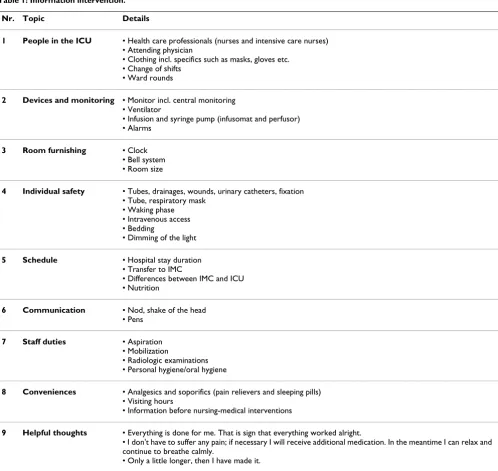
The first, standardized part of the intervention comprises information on nine topics, that have been identified in preliminary studies [22,23] as relevant for patients in ICUs. The topics of the standardized part of the informa-tion program are described in Table 1.
In the second part of the intervention the patients' indi-vidual information need on particular topics will be deter-mined and further addressed. In addition, the patient will be given the opportunity to receive information on other topics.
Following preliminary studies, a length of about 10 min-utes is scheduled for the intervention [14]. A second inter-vention time will not explicitly be ruled out if the patient's information need could not be met with due to exhaus-tion, failing concentration or an interruption for other reasons.
The control patients will be offered a semi-structured, non-specific conversation with a member of the study group. This conversation with the patient will also take about 10 minutes. Priority will be given to topics such as mental state, experienced pain, sleeping habits and expe-rienced anxiety.
Accompanying close relatives or friends can stay during the (control-) intervention if the participant agrees. As this can enhance the message, this will be documented in the case report form.
Before the experimental and control intervention the patients' level of consciousness and concentration will be recorded using the Richmond Agitation and Sedation Scale - RASS [24] and the Confusion Assessment Method for the ICU - CAM-ICU [25,26]. The interventions will only be carried out at RASS values ≥ -3 and a negative test outcome of the four CAM-ICU criteria. In case of lower values the patient will be re-assessed at a later date (→ 24 h interval).
The study procedure will be carried out in each center by one of the study members who are not involved in the standard care in order to receive information on the effi-cacy. The comparability of the intervention taking place over the different centers is guaranteed by preliminary instructions of the study personnel for the implementa-tion of the informaimplementa-tion program and the control interven-tion. Additionally, the coordinating center in Marburg will centrally monitor the whole trial.
Measures
Primary Outcome
the following items: death related fear, fear of severe suf-fering, fear of a handicap, fear of the future, fear of uncer-tainty, panic, strain, depression, loneliness, melancholy, lack of orientation, uncertainty, anger optimism and con-fidence. All items are rated on a 4-point Likert-scale from "never" to "always" (see Figure 2).
Secondary Outcomes
In addition to the anxiety-related part of the CINT ques-tionnaire a Visual Analogue Scale-Anxiety - VAS-A [27] supported by the Faces Anxiety Scale [28] is used. Evalua-tion of potential discrepancies between the retrospectively
reported anxiety and the measured anxiety during the ICU-stay is of particular interest. The State and Trait Anxi-ety Inventory - STAI [29] as a further anxiAnxi-ety-related instrument will be recorded to compare anxiety after ICU-stay.
Furthermore the CINT questionnaire [20,22] measures additional parameters of the ICU related experiences.
[image:5.612.57.555.90.561.2]As a secondary variable, the patients' level of conscious-ness and concentration regarding a potential ICU-caused state of confusion will be surveyed with the Confusion
Table 1: Information intervention.
Nr. Topic Details
1 People in the ICU • Health care professionals (nurses and intensive care nurses) • Attending physician
• Clothing incl. specifics such as masks, gloves etc. • Change of shifts
• Ward rounds
2 Devices and monitoring • Monitor incl. central monitoring • Ventilator
• Infusion and syringe pump (infusomat and perfusor) • Alarms
3 Room furnishing • Clock • Bell system • Room size
4 Individual safety • Tubes, drainages, wounds, urinary catheters, fixation • Tube, respiratory mask
• Waking phase • Intravenous access • Bedding
• Dimming of the light
5 Schedule • Hospital stay duration • Transfer to IMC
• Differences between IMC and ICU • Nutrition
6 Communication • Nod, shake of the head • Pens
7 Staff duties • Aspiration • Mobilization
• Radiologic examinations • Personal hygiene/oral hygiene
8 Conveniences • Analgesics and soporifics (pain relievers and sleeping pills) • Visiting hours
• Information before nursing-medical interventions
9 Helpful thoughts • Everything is done for me. That is sign that everything worked alright.
• I don't have to suffer any pain; if necessary I will receive additional medication. In the meantime I can relax and continue to breathe calmly.
• Only a little longer, then I have made it.
Assessment Method for the ICU - CAM-ICU [25,26]. The test procedure CAM-ICU, also appropriate for ventilated patients, comprehends cognitive as well as process-related components. These components are illustrated using the Richmond Agitation and Sedation Scale - RASS [24] and the four delirium main criteria "acute onset", "inatten-tion", "disorganized thinking" and "altered level of con-sciousness".
For the analysis of additional effects the duration of stays (ICU, intermediate care, standard ward, hospital) and routine date on the course of inpatient treatment are recorded. Socio-demographic data like age, gender, mari-tal status and routine treatment data like medical diag-noses will be documented thoroughly.
Uncertainty tolerance will be measured using the Uncer-tainty Tolerance Scale [30] and semi-structured questions on convalescence are asked to get a qualitative impression of the participants health state.
Expected results will contribute to an improved commu-nication in the ICU and finally to an improved quality of life as a desired treatment goal [31-33]. Therefore we will measure quality of life using the Schedule for Evaluation of Individual Quality of Life - SEIQoL [34], and the SF-12 [35]. For this reason we implemented a paper question-naire version of the SEIQoL to test for acceptance of a self evaluation form for this kind of quality of life question-naire.
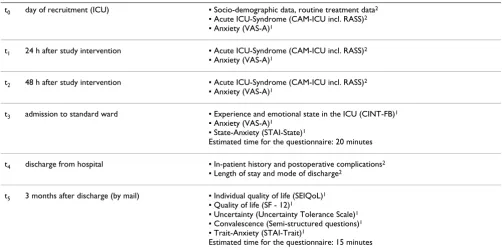
All measurements and the timeline are summarized in Table 2.
Sample size calculation
The sample size calculation is based on the anxiety-related part of the CINT questionnaire as particular aspects of the ICU-patients' quality of life [21]. This sum score can be represented on a scale from 0 to 100 and has added up to a mean value of M = 28.0 and a standard deviation of SD = 17.0 in an earlier unpublished trial. The basis for the sample size calculation was formed by the following
[image:6.612.150.459.90.429.2]Measurement of anxieties during the ICU stay Figure 2
Measurement of anxieties during the ICU stay. Anxiety-related part of the CINT questionnaire (translated version).
D uring your I CU stay: H ow often did you feel … ?
never somet imes often always
... deat h related fear ͕ ͕ ͕ ͕
... fear of severe suffering ͕ ͕ ͕ ͕
... fear of a handicap ͕ ͕ ͕ ͕
... fear of t he f uture ͕ ͕ ͕ ͕
... fear of uncertainty ͕ ͕ ͕ ͕
D uring your I CU stay: H ow often did you feel … ?
never somet imes often always
... panic ͕ ͕ ͕ ͕
... strain ͕ ͕ ͕ ͕
... depression ͕ ͕ ͕ ͕
... loneliness ͕ ͕ ͕ ͕
... melancholy ͕ ͕ ͕ ͕
... lack of orientat ion ͕ ͕ ͕ ͕
... uncertaint y ͕ ͕ ͕ ͕
... anger ͕ ͕ ͕ ͕
... optimism ͕ ͕ ͕ ͕
assumptions: α = 0.05; β = 0.20; Δ = 8.50 scale points. The determination of the expected difference Δ was done on the notion that in quality of life measures the differences within the scope of half a standard deviation are consid-ered as minimally clinically relevant [36]. Under these conditions at least 70 patients per group have to be included to ensure the effect statistically. In order to com-pensate potential drop-outs the sample size was deter-mined n = 100 per group, corresponding to a total sample size of N = 200 (n = 100 vs. n = 100). In the centers Stutt-gart and Halle respectively n = 30 patients per study group will be recruited, in Marburg n = 40 per study group.
Drop-outs
Drop-outs will be documented thoroughly and included in the data analysis until the point of drop-out. Reasons for drop-out will be reported and analyzed.
Data analysis
Descriptive analyses will be carried out by standard meth-ods, taking into consideration the scale of the respective variables. For analysis of the primary endpoint we will use an ANCOVA model with the primary endpoint as the response, and the center as a covariate, thus allowing for the stratified randomization procedure. The treatment effect will be reported as an adjusted difference in means with a corresponding 95% confidence interval. Secondary endpoints will be assessed with the respective adjusted models, using standard ANCOVA models for continuous
outcomes and logistic regression for binary outcomes. In case of repeatedly measured outcomes, mixed models will be used for analyses to adjust for within-patient correla-tions [37]. Secondary endpoints analyses are considered as merely exploratory. The analysis of all outcomes will obey to the intention-to-treat principle. Subgroup analy-ses will be conducted as interaction tests, also in a non-confirmatory fashion [38].
Protection of data privacy
We will create a pseudonym for all trial participants to col-lect and analyze the trial data. Key lists will be stored sep-arately from the trial data and erased after final data analysis. Data will be analyzed in a way that no conclu-sions can be drawn to individual participants. Trial data is stored in lockable cabinets in lockable rooms.
Quality assessment
The trial is part of the Nursing Research Network "Mitte-Süd". A report system is established within the network. Annual quality reports have to be prepared for the Ger-man Federal Ministry of Education and Research.
[image:7.612.54.556.458.708.2]As the process of a multicenter trial demands high stand-ards of quality to warrant comparable conditions and results among the centers all procedures were developed and documented in joint commissions.
Table 2: Measurements.
t0 day of recruitment (ICU) ▪ Socio-demographic data, routine treatment data2
▪ Acute ICU-Syndrome (CAM-ICU incl. RASS)2
▪ Anxiety (VAS-A)1
t1 24 h after study intervention ▪ Acute ICU-Syndrome (CAM-ICU incl. RASS)2
▪ Anxiety (VAS-A)1
t2 48 h after study intervention ▪ Acute ICU-Syndrome (CAM-ICU incl. RASS)2
▪ Anxiety (VAS-A)1
t3 admission to standard ward ▪ Experience and emotional state in the ICU (CINT-FB)1
▪ Anxiety (VAS-A)1
▪ State-Anxiety (STAI-State)1
Estimated time for the questionnaire: 20 minutes
t4 discharge from hospital ▪ In-patient history and postoperative complications2
▪ Length of stay and mode of discharge2
t5 3 months after discharge (by mail) ▪ Individual quality of life (SEIQoL)1
▪ Quality of life (SF - 12)1
▪ Uncertainty (Uncertainty Tolerance Scale)1
▪ Convalescence (Semi-structured questions)1
▪ Trait-Anxiety (STAI-Trait)1
Estimated time for the questionnaire: 15 minutes
Points of measurement and outcome measures according to case report form.
Publication policy
We plan to publish the trial results in a peer-reviewed, international, Medline-listed journal, independent of study results. This mainly serves the purpose to avoid pub-lication bias. Additionally, we are obliged by the Federal Ministry of Education and Research to report our results within 6 months after study termination. All trial results will be reported within context to this study protocol.
Ethical considerations
The study protocol is approved by the ethics committees of the universities in Marburg, Halle and Tübingen. If changes to the study procedures are necessary they will be proposed to the local ethics committees as amendments. All changes will be described and discussed in the publi-cation of the trial's results.
Discussion
In contrast to former trials on information programs on the ICU-stay our intervention will take place in the ICU. This approach will ensure to compensate for memory effects due to anesthesia or preoperative stress. Further the results will be applicable to non-elective ICU-patients. Thus our research will particularly contribute to the evi-dence on ICU-related information and communication.
Competing interests
The authors declare that they have no competing interests.
Authors' contributions
SF, AB, TRN, MK, JB and AH were responsible for the gen-eral study design. OK and MK planned the statistical anal-ysis, carried out the sample size calculation and were responsible as biometric counselors. TRN, JB, JR, MR and AH are the responsible project coordinators in the three participating study centers and the main investigators. RB is responsible for central monitoring. All authors were responsible for the drafting of this paper and approved the final manuscript.
Acknowledgements
The trial is funded by the German Federal Ministry of Education and Research (BMBF grant 01GT0601 and 01GT0603 as a project in the Nurs-ing Research Network "Mitte-Süd").
We thank Prof. R. Moosdorf (University Hospital Giessen and Marburg, Location Marburg, Germany), and R. Thomiczny (Sana Herzchirurgische Klinik Stuttgart, Germany) for supporting the trial. Furthermore we want to thank S. Dyczek for her support with the English draft of the article.
References
1. Liedtke A: Kann der beatmete Patient aktiv kommunizieren? Eine explorative Studie mittels Videoanalyse zur Interaktion zwischen beatmeten Patienten und Pflegepersonal auf einer Intensivstation. Hallesche Beiträge zu den Gesundheits- und Pflegewis-senschaften 2006, 5(1):.
2. Alasad J, Ahmad M: Communication with critically ill patients.
J Adv Nurs 2005, 50(4):356-362.
3. Fowler SB: Impaired verbal communication during short-term oral intubation. Nurs Diagn 1997, 8(3):93-98.
4. Hagland MR: Nurse-patient communication in intensive care: a low priority? Intensive Crit Care Nurs 1995, 11(2):111-115. 5. Llenore E, Ogle KR: Nurse-patient communication in the
intensive care unit: a review of the literature. Aust Crit Care
1999, 12(4):142-145.
6. Magnus VS, Turkington L: Communication interaction in ICU-Patient and staff experiences and perceptions. Intensive Crit Care Nurs 2006, 22:167-180.
7. Rundell S: A study of nurse-patient interaction in a high dependency unit. Intensive Care Nurs 1991, 7(3):171-178. 8. Salyer J, Stuart BJ: Nurse-patient interaction in the intensive
care unit. Heart & Lung 1985, 14(1):20-24.
9. Turnock C: Communicating with patients in ICU. Nurs Stand
1991, 5(15/16):38-40.
10. Wojnicki-Johansson G: Communication between nurse and patient during ventilator treatment: patient reports and RN evaluations. Intensive Crit Care Nurs 2001, 17:29-39.
11. Hafsteindottir TB: Patients' experiences of communication during the respirator treatment period. Intensive Crit Care Nurs
1996, 12(5):261-271.
12. Scheer JW: Psychische Verarbeitung von Krankenhau-saufenthalten. In Medizinische Psychologie und Soziologie Edited by: Wilker F, Bischoff C, Novak P. München: Urban und Schwarzenberg; 1994.
13. Usher K, Monkley D: Effective communication in an intensive care setting: Nurses' stories. Contemp Nurse 2001, 10(1-2):91-101.
14. Hwang SL, Chang Y, Ko WJ, Lee MB: Stress-reducing effect of physician's tape-recorded support on cardiac surgical patients in the intensive care unit. J Formos Med Assoc 1998,
97(3):191-196.
15. Frey D, Jonas E: Die Theorie der kognizierten Kontrolle. In The-orien der Sozialpsychologie Motivations-, Selbst- und Informationsverarbei-tungstheorien Edited by: Frey D, Irle M. Bern: Huber; 2002:13-50. 16. Shuldham C: A review of the impact of pre-operative
educa-tion on recovery from surgery. Int J Nurs Stud 1999, 36:171-177. 17. Teasdale K: Information and anxiety: a critical reappraisal. J
Adv Nurs 1993, 18:1125-1132.
18. Medical Research Council (MRC): A framework for development and evaluation of RCTs for complex interventions to improve health. 2000 [http://www.mrc.ac.uk].
19. Campbell NC, Murray E, Darbyshire J, Emery J, Farmer A, Griffiths F, Guthrie B, Lester H, Wilson P, Kinmonth AL: Designing and eval-uating complex interventions to improve health care. BMJ
2007, 334(7591):455-459.
20. Berg A, Fleischer S, Koller M, Neubert TR: Preoperative informa-tion for ICU patients to reduce anxiety during and after the ICU-stay: protocol of a randomized controlled trial [NCT00151554]. BMC Nurs 2006, 5:4.
21. Berg A, Fleischer S, Koller M, Moosdorf R, Neubert TR: Akzeptanz eines präoperativen Informationsprogramms zur Reduz-ierung von Angst während und nach Aufenthalt auf der Intensivstation. In Optimierung und Evidenzbasierung pflegerischen Handelns: Ergebnisse und Herausforderungen der Pflegeforschung Edited by: Schaeffer D, Behrens J, Görres S. Weinheim Juventa; 2008:232-254.
22. Neubert TR, Koller M, Bohrer T: Wie erleben Patienten den Aufenthalt auf einer chirurgischen Intensivstation? Eine prospektive Beobachtungsstudie aus Sicht der Pflege. Intensiv
2004, 12:1-10.
23. Berg A, Fleischer S, Neubert TR, Koller M: Entwicklung und Pre-test eines Programms mit spezifischen Informationen zum Intensivstationsaufenthalt. Hallesche Beiträge zu den Gesundheits-und Pflegewissenschaften 2004, 3(3):18-20.
24. Sessler CN, Gosnell MS, Grap MJ, Brophy GM, O'Neal PV, Keane KA, Tesoro EP, Elswick RK: The Richmond Agitation-Sedation Scale: validity and reliability in adult intensive care unit patients. Am J Respir Crit Care Med 2002, 166(10):1338-1344. 25. Ely EW, Margolin R, Francis J, May L, Truman B, Dittus R, Speroff T,
Gautam S, Bernard GR, Inouye SK: Evaluation of delirium in crit-ically ill patients: Validation of the confusion assessment method for the intensive care unit (CAM-ICU). Crit Care Med
Publish with BioMed Central and every scientist can read your work free of charge "BioMed Central will be the most significant development for disseminating the results of biomedical researc h in our lifetime."
Sir Paul Nurse, Cancer Research UK
Your research papers will be:
available free of charge to the entire biomedical community
peer reviewed and published immediately upon acceptance
cited in PubMed and archived on PubMed Central
yours — you keep the copyright
Submit your manuscript here:
http://www.biomedcentral.com/info/publishing_adv.asp
BioMedcentral
26. Ely EW, Truman B, Ely EW: The confusion assessment method for the ICU (CAM-ICU). Training manual Nashville, TN: MPH and Vanderbilt University; 2002.
27. Chlan LL: Relationship between two anxiety instruments in patients receiving mechanical ventilatory support. J Adv Nurs
2004, 48(5):493-499.
28. McKinley S, Coot K, Stein-Parbury J: Development and testing of a Faces Scale for the assessment of anxiety in critically ill patients. Journal of Advanced Nursing 2003, 41(1):73-79.
29. Laux L, Glanzmann P, Schaffner P, Spielberger CD: Das State-Trait-Angstinventar: Theoretische Grundlagen und Handanweis-ung. In Weinheim Beltz Testgesellschaft; 1981.
30. Dalbert C: Die Ungewissheitstoleranzskala (UGTS). In Diag-nostische Verfahren in der Psychotherapie Edited by: Brähler E, Schu-macher J, Strauß B. Göttingen [u.a.]: Hogrefe, Verl. für Psychologie; 2003:374-377.
31. Behrens J: Die Verwechslung von Zielen und Mitteln und von interner und externer Evidence. Lebensqualitätsforschung in der Onkologie. Forum Deutsche Krebsgesellschaft 2004, 4:42-45. 32. Koller M, Lorenz W: Quality of life: a deconstruction for
clini-cians. J R Soc Med 2002, 95:481-488.
33. Shuldham C: Pre-operative education - a review of the research design. Int J Nurs Stud 1999, 36(2):179-187.
34. Hickey AM, Bury G, O'Boyle CA, Bradley F, O'Kelly FD, Shannon W:
A new short-form individual quality-of-life measure (SEIQoL-DW); application in a cohort of individuals with HIV/AIDS. Br Med J 1996, 313:29-33.
35. Bullinger M, Kirchberger I: SF-36: Fragebogen zum Gesundheitszustand: Handanweisung Göttingen [u.a.]: Hogrefe, Verl. für Psychologie; 1998. 36. Norman GR, Sloan JA, Wyrwich KW: Interpretation of changes in health-related quality of life: the remarkable universality of half a standard deviation. Med Care 2003, 41(5):582-592. 37. Brown H, Prescott R: Applied mixed models in medicine 2nd edition.
Chichester [u.a.]: Wiley; 2006.