ISSN: 1992-8645 www.jatit.org E-ISSN: 1817-3195
IDENTIFICATION OF PRINTING PAPER BASED ON
TEXTURE USING GABOR FILTERS AND
LOCAL BINARY PATTERNS
1SHIHAB HAMAD KHALEEFAH, 2MOHAMMAD FAIDZUL NASRUDIN
Centre for Artificial Intelligence Technology, Faculty of Information Science & Technology, Universiti Kebangsaan Malaysia, 43600 UKM, Bangi Selangor, Malaysia
E-mail: [email protected], [email protected]
ABSTRACT
There are many causes of deformation in an image and one of which during its acquisition to a digital image. The deformation takes different forms or causes different effects on the acquired image comparing with the original image including poor resolution, shear, noise, variation in the intensity and etc. A paper scanned by a scanner is a good example of possible deformation in images. Consequently, paper texture identification or fingerprinting is one of the research fields of pattern recognition that exposed to the deformation problem. Applications such as documents authentication deemed to be constrained by the deformation problem. Subsequently, one of the well-known methods in images texture extraction is the Locale Binary Pattern (LBP) method. However, the LBP method show a number of drawbacks in paper images texture extraction and two of which are neglecting some texture information of the images and incompetent to some images deformation due to its local view. In this paper combinations of Gabor filters and a LBP operator are proposed to reduce the effects of the mentioned drawbacks in papers fingerprinting domain. We use self-collected textures from 102 paper images in the test. The images are acquired in three resolutions of 50 DPI, 100 DPI and 150 DPI in order to manifest robust results. Consequently, the testing results of the proposed combinations improve paper images identification accuracy. This paper finds that applying Gabor filters prior to LBP method improve the LBP operator description and the fingerprinting accuracy.
Keywords: Pattern recognition, Paper fingerprinting, Local Binary Pattern (LBP), Gabor Filters(GF), Gabor Filter Local Binary Pattern (GFLBP), Chi square
1. INTRODUCTION
Paper texture identification or fingerprinting is one of the well-known techniques in authenticating documents [1]. Scanned papers are regularly involved in the fingerprinting process [2]. A recent work suggested that Local Binary Pattern (LBP) method is able to handle deformation problems resulting from images acquisition and generate decent paper fingerprints [3]. However, the LBP operator filters out some texture information that can be useful in the images description [4]. In addition, the variance of the intensity values within a particular region of a paper’s image is very low which makes a small noise or a change in the magnitude intensity of an image affects its description [5]. Subsequently, there are number of texture analysis methods that are applied in many computer image analysis applications. The methods segment and identify images based on variations in their textures’ intensity or color and one of which is a Gabor filter [6]. Gabor filters have the ability to
highlight interesting patterns of an image by using different scales and orientations [7].
ISSN: 1992-8645 www.jatit.org E-ISSN: 1817-3195
Figure 1: Original Image Versus LBP Image And Gabor Image [5]
There are numerous methods developed to evaluate various authentication and pattern recognition applications, but there are few that have been developed for physical paper texture fingerprinting. This work aims to propose and develop a method that uses Gabor filters prior to the LBP method in order to enhance documents fingerprinting accuracy. To achieve this aim, a LBP operator is implemented in a scanned paper texture identification problem using ideal and sheared paper images. Sheared images are obtained by slight rotating of paper on flatbed scanner’s glass to imitate the real paper image acquisition. Subsequently, a number of Gabor filters prior to the LBP operators are proposed and implemented to improve the paper texture description of the fingerprinting.
The remainder of this paper is organized such that; Section two provides a review to the LBP and the Gabor filter related work; Section three presents the research methodology of the work; Section four presents the experiments and results; Section five presents the discussion; finally, Section six presents the conclusions and future directions of the work.
2. LITERATURE REVIEW
Different features extraction approaches and models are proposed in the literature and each of which is built based on some arguments and offers solutions that resolve specific texture analysis issues. This section presents the utilization of the LBP method and/or Gabor filters in images texture extraction.
Grain & Halder [8] proposed an automatic authenticity verification method for document authentication including bank checks, air tickets and lottery tickets. The tested data consists of original and duplicate documents. First, the documents are captured as images, then the method extracts six features of each image. Subsequently, the feature vectors of the original and the duplicate images are generated as histograms. Finally, an authentication procedure applies to the extracted
feature vectors using a kernel-based Support Vector Machine (SVM) classifier and a set of classes that defines the feature space. The method is able to identify 99.5 % of the duplicate documents.
Clarkson et al. [9] acquired physical blank paper images via a commodity scanner to generated scanned paper dataset. The dataset contains 25 texture samples that are acquired from five papers. They proposed a paper texture identification method for documents fingerprinting. The method consists of three features extraction stages. The first stage involves scanning the papers in four orientations, which are 0˚, 90˚, 180˚, and 270˚. The secondly stage involves obtaining a 3200 bits feature vector. A feature vector consists of 100 patches each patch contains 32 bits. The third stage involves applying hashing function to compress the feature vector. The testing results show similarity measurement of 95% correctly verified fingerprints. Clarkson method is not validated to be robust as the tested dataset has only 5 main classes which minimize the similarity matching possibilities. Moreover, the extracted features vector is not concise, since, it has 3200 bits length which makes it computationally costly.
Cowburn and Buchanan [10] also acquired paper images via a commodity scanner to generated scanned paper dataset. The paper images are acquired in different orientations to ensure robust testing dataset. They proposed a fingerprinting method that extracts paper fiber texture as each paper has a unique distribution of its fibers. However, the extracted feature vectors are not as concise as they might have thousands of values. Each feature vector length depends on the paper texture.
ISSN: 1992-8645 www.jatit.org E-ISSN: 1817-3195 Li et al. [5], proposed a combination of Gabor
filters and LBP operators for hyperspectral imagery features’ extraction. The aim of this combination is to provide a method that improves the description of spatial texture information. They used Gabor filters to extract global features and LBP operators to extract local features. However, the Gabor filters and LBP operators are independently applied, which results heterogeneous feature vectors. This approach reduces the compatibility of the results and might produce nonlinear feature space. Nevertheless, the results show that the approach yields an improved hyperspectral imagery spatial feature extraction.
Chen et al. [4], proposed a Gabor-filtering-based completed local binary patterns (GCLBP) method. The GCLBP method is used for land-use scene classification in remote sensing applications. The method consists of Gabor filters to capture global texture information and LBP operators to capture local texture information. The combination of the Gabor filters and LBP operators produced homogeneous feature vectors. Particularly, Gabor filters produced multiple Gabor feature images and LBP operators produced feature vectors from the images. This approach allows the LBP operators to capture textures with different scales and orientations. The combination of Gabor filters and LBP operators of the GCLBP method shows an enhanced spatial histogram.
3. THE RESEARCH METHODOLOGY
The research methodology of the work is represented by five phases. The first phase includes the experimental scanned paper images dataset preparation and preprocessing. The second phase includes processing the dataset via LBP operator and extracting the images’ feature vectors as a benchmark. The third phase includes processing the dataset via a proposed GFLBP method and extracting the images’ feature vectors. The fourth phase includes applying Chi-square similarity matching technique on the LBP feature vectors and obtains the first results, then applying Chi-square similarity matching technique on the GFLBP feature vectors and obtains the second results. Finally, phase five includes comparing the two results and concludes the findings. The following subsections detailed the scanned paper dataset, the Gabor filters, the LBP operators, the Gabor filter local binary pattern and the Chi-square similarity matching technique.
3.1 The Scanned Paper Dataset
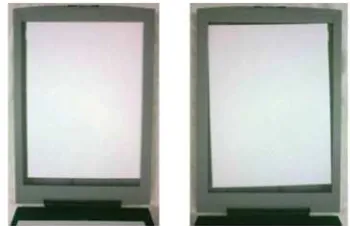
[image:3.612.327.502.254.367.2]The testing dataset is a scanned paper dataset that is obtained from [11]. It related to the Scanned Paper Fingerprint Project that belongs to the Pattern Recognition Research Group of UKM University. The scanned paper dataset is generated via an Epson GT-2500 scanner in which 51 A4 blank papers are scanned twice in an ideal and shear position [3]. Figure 2 shows the acquisition process of the scanned paper dataset including two samples of an ideal and shear images [2].
Figure 2: An Ideal And A Shear Paper Image Samples
ISSN: 1992-8645 www.jatit.org E-ISSN: 1817-3195
Figure 3: The Scanned Paper Four-Patches Feature Vector
3.2 The Gabor Filter
Gabor filter is a leaner filter that belongs to the mainstream paradigm. It is a widely used in pattern recognition problems for its sensitivity to orientation changes [1]. Gabor filters have ranges of frequencies and orientations that are represented according to the humans’ visual system [14]. They are used in image processing for edge detection [5], texture representation [4] and texture discrimination [6]. Subsequently, they are found to be useful to process images prior to the LBP’s feature extraction [15]. A Gabor filter basic formula is represented by
(
,)
(
,) (
,)
g x y′ =s x y w x y′ ′ (1)
Where s x y′
(
,)
is the Gabor filter carrier (complexsinusoidal), w x y′
(
,)
is the Gabor filter envelope (2D Gaussian-shaped function) [16]:(
,)
exp( (2 ( 0 0 ) ))s x y′ = j π u x v y− + ′P (2)
where
(
u v0, 0)
and P′ define the spatial frequency and the phase of the sinusoid respectively.( )
(
)
' 2 2 2 2
0 0
, ( ( ( ) ))
r
w x y =Kexp−π a x−x r +b y−y r (3)
where
(
x y0, 0)
is the peak of the function, a and bare scaling parameters of the Gaussian, and the r
subscript stands for a rotation operation which is clockwise.
3.3 The Local Binary Pattern
The Local Binary Pattern (LBP) is a texture descriptor that is proposed by Ojala et al. [12, 13]. The LBP method has been recognized as a reliable texture detector [6]. The basic concept of the LBP method involves comparing each centre pixel of a grayscale image with its neighbors. Figure 4 shows a local pattern that has a central pixelgc, neighbors
P and a radius R. Where g denotes the gray value of a sampling point in an evenly spaced circular neighborhood of 8 bits of an image s, i
represents the sounding 8 bit indexes given a rotational invariant and i goes from 1 to 8. The following formula is a generic representation of the LBP method:
Figure 4: Local Pattern Of A Grayscal Image
(
)
( )
1
, 0
1 0
2 ,
0 0
P
P
P R p c
P
x
LBP s g g s x
x
−
=
≥
= − =
<
∑
(4)where gc is a gray value of an arbitrary central pixel, P represents the circularly of gc (i.e. number of the gc neighbors), gp is a gray value of
a LBP circular neighborhood of p in which
[
0, 1]
p= P− , R is a rotational value that
ISSN: 1992-8645 www.jatit.org E-ISSN: 1817-3195
accordingly gp coordinate is
(
)
(
)
(
Rcos 2πp P/ , Rsin 2πp P/)
.3.4 The Gabor Filter Local Binary Pattern
The Gabor Filter Local Binary Pattern (GFLBP) method is proposed in [17] for paper fingerprinting. The combination is meant to improve the fingerprinting by considering both the global view of the Gabor filter and the local view of the LBP during features extraction.
(
)
(
)
1
, 0
, , 2
P
P
P R p c
P
GFLBP s g x y g x y −
=
′
=
∑
− ′ (5)where g′ is a Gabor filter formula that takes a set of predefined scaling and rotation values.
3.5 The Chi Square Similarity Measure
Chi Square is used as a statistic matching method to compare the similarity between the feature vector values of papers images. The matching results represent a similarity distance between a pair of ideal and shear paper images. First, the extracted feature vector normalized to enhance the statistical measurement of the Chi-square. The normalized feature vector values scaled from 0-255 to 0-1 using the following equation:
( )
( )
( )
min i i
V V
V
max V min V
− =
− (6)
where V is a four-patches feature vector of an image, Vi is a value that belongs to the V , i is an index of a particular value of a V , min is a function that finds the minimum number of the V and max is a function that finds the maximum number of theV .
Let VI represents an ideal paper image feature vector, VS represents a shear paper image feature vector, then the Chi-square formula is defined in (7):
(
)
(
)
20
( )
,
n I S
I S i i
I S
i i i
V V
d V V
V V
=
− =
+
∑
(7)where d represents the similarity distance; n
represents the length of the extracted feature vector
V (in our case n = 2500); ViI represents the feature
value of an ideal paper image and ViS represents the feature value of a share paper image.
4. THE EXPERIMENTS AND RESULTS
This section presents the conducted experiments in paper texture extraction and fingerprinting. Subsequently, it presents the results and the analysis.
4.1 Experiments
Two experiments are conducted on the scanned paper dataset. The first experiment includes a basic LBP operator of Ojala et al. [12]
(
LBPP Rbasic,)
thatit’s P and R are accordingly 4, 1; 8, 1; 12, 2 and 24, 3. The second experiment includes Gabor filters that are applied prior to the LBP
(
GFLBPP Rbasic,)
. [image:5.612.312.523.404.588.2]The Gabor filters have the scales of 3, 5, 7, 9 and 11 pixels and orientations of 0, π/4, π/2, 3π/4 and π degrees. Table I details the steps of the first experiment.
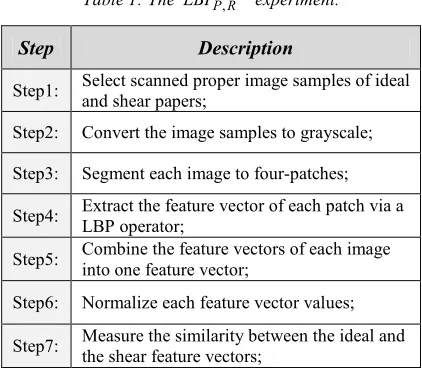
Table 1: The LBPP Rbasic, experiment.
Step Description
Step1: Select scanned proper image samples of ideal and shear papers;
Step2: Convert the image samples to grayscale;
Step3: Segment each image to four-patches;
Step4: Extract the feature vector of each patch via a LBP operator;
Step5: Combine the feature vectors of each image into one feature vector;
Step6: Normalize each feature vector values;
Step7: Measure the similarity between the ideal and the shear feature vectors;
The second experiment
(
GFLBPP Rbasic,)
differsfrom the first experiment
(
LBPP Rbasic,)
by applyingISSN: 1992-8645 www.jatit.org E-ISSN: 1817-3195
images. Figure 5 shows the topology of the
, basic P R
LBP and theGFLBPP Rbasic, experiments.
Figure 5: The topology of the experiments
4.2 Results
The first experiment of the LBPP, R consists of 4 tests for each of the 50 DPI, 100 DPI and 150 DPI datasets, i.e., 12 tests in total. Subsequently, the second experiment of the GFLBPP, R consists of 100 tests for each of the 50 DPI, 100 DPI and 150 DPI datasets, i.e., 300 tests in total. The test results represent normalized sets of feature vectors that are
extracted from the ideal and shear images respectively. Subsequently, the feature vectors for a particular pair of ideal and shear images are matched via Chi-square. Each matching result represents a similarity distance between the pair. The fingerprints of the ideal and shear feature vector with the highest similarity are considered identical. This section presents the results and the analysis of the GFLBPP, Rbasic and LBPP, Rbasic tests.
They include the LBP4, 1basic and GFLBP4, 1basic,
basic 8, 1
LBP and GFLBP8, 1basic, LBP12, 2basic and
basic 12, 2
GFLBP and the LBP24, 3basic and GFLBP24, 3basic
.Table 2 presents the results of the LBP4, 1basic and
basic 4, 1
GFLBP .
Table 2: The Similarity Results Of The.GFLBP4,1basic/LBP4,1basic
4, 1basic
GFLBP GFLBP4, 1basic/LBP4, 1basic
S O 50 DPI
100 DPI
150 DPI
50 DPI
100 DPI
150 DPI
3
0 53.59 84.65 73.39 3.50 -6.04 6.19
π/4 53.63 84.65 73.39 3.54 -6.04 6.19
π/2 53.59 84.65 73.39 3.50 -6.04 6.19
3π/4 53.59 84.65 73.39 3.50 -6.04 6.19
π 53.63 84.65 73.39 3.54 -6.04 6.19
5
0 57.05 87.00 92.65 6.96 -3.69 25.45
π/4 57.17 87.73 92.11 7.08 -2.96 24.91
π/2 57.40 87.58 92.50 7.31 -3.11 25.3
3π/4 57.01 87.04 92.73 6.92 -3.65 25.53
π 56.93 87.77 91.96 6.84 -2.92 24.76
7
0 74.58 54.01 94.77 24.49 -36.68 27.57
π/4 74.20 55.40 95.04 24.11 -35.29 27.84
π/2 74.54 54.55 94.92 24.45 -36.14 27.72
3π/4 74.12 53.82 94.88 24.03 -36.87 27.68
π 73.77 54.74 94.88 23.68 -35.95 27.68
9
0 47.63 39.06 38.98 -2.46 -51.63 -28.22
π/4 71.16 42.63 73.43 21.07 -48.06 6.23
π/2 78.54 44.05 82.12 28.45 -46.64 14.92
3π/4 48.01 38.67 39.67 -2.08 -52.02 -27.53
π 66.66 41.75 68.39 16.57 -48.94 1.19
11
0 51.05 51.13 51.05 0.96 -39.56 -16.15
π/4 50.24 47.52 47.94 0.15 -43.17 -19.26
π/2 51.01 50.59 51.01 0.92 -40.1 -16.19
3π/4 51.01 51.21 51.13 0.92 -39.48 -16.07
π 50.48 48.01 48.44 0.39 -42.68 -18.76
Table 3 Presents The Similarity Matching Results Of The
basic 8, 1
ISSN: 1992-8645 www.jatit.org E-ISSN: 1817-3195 Table 3: The Similarity Results Of
The.GFLBP8,1basic/LBP8,1basic
8, 1 basic
GFLBP GFLBP8, 1basic/LBP8, 1basic
S O DPI 50 DPI 100 DPI 150 DPI 50 DPI 100 DPI 150
3
0 57.28 92.38 81.96 1.31 -1.31 3.26
π/4 57.24 92.38 81.96 1.27 -1.31 3.26
π/2 57.24 92.34 81.93 1.27 -1.35 3.23
3π/4 57.28 92.38 81.96 1.31 -1.31 3.26
π 57.24 92.38 81.96 1.27 -1.31 3.26
5
0 60.36 92.69 94.34 4.39 -1 15.64
π/4 60.51 92.73 94.27 4.54 -0.96 15.57
π/2 60.16 92.54 94.38 4.19 -1.15 15.68
3π/4 60.09 92.65 94.46 4.12 -1.04 15.76
π 60.28 92.81 94.38 4.31 -0.88 15.68
7
0 75.70 57.51 97.50 19.73 -36.18 18.8
π/4 75.58 57.97 97.61 19.61 -35.72 18.91
π/2 75.39 57.24 97.57 19.42 -36.45 18.87
3π/4 75.74 57.74 97.46 19.77 -35.95 18.76
π 75.39 57.55 97.50 19.42 -36.14 18.8
9
0 49.90 36.25 53.47 -6.07 -57.44 -25.23
π/4 65.62 41.17 92.11 9.65 -52.52 13.41
π/2 76.85 42.67 93.88 20.88 -51.02 15.18
3π/4 50.28 36.17 55.40 -5.69 -57.52 -23.3
π 63.28 39.75 90.23 7.31 -53.94 11.53
11
0 50.94 50.78 50.90 -5.03 -42.91 -27.8
π/4 49.71 46.32 48.44 -6.26 -47.37 -30.26
π/2 50.78 50.44 51.05 -5.19 -43.25 -27.65
3π/4 51.05 50.78 51.01 -4.92 -42.91 -27.69
π 50.09 47.09 49.40 -5.88 -46.6 -29.3
Table 4 presents the similarity matching results of the LBP12, 2basic andGFLBP12, 2basic. Table 5 presents the
similarity matching results of the LBP24, 3basic
andGFLBP24, 3basic.
Table 4: The Similarity Results Of The.GFLBP12, 2basic/LBP12, 2basic
12, 2basic
GFLBP GFLBP12, 2basic/LBP12, 2basic S O 50
DPI 100 DPI
150 DPI
50 DPI
100 DPI
150 DPI
3
0 53.74 93.46 87.96 -11.11 -1.34 -2.19
π/4 53.74 93.46 88.00 -11.11 -1.34 -2.15
π/2 53.74 93.50 87.96 -11.11 -1.3 -2.19
3π/4 53.74 93.50 87.96 -11.11 -1.3 -2.19
π 53.74 93.46 88.00 -11.11 -1.34 -2.15
5
0 64.01 93.50 95.57 -0.84 -1.3 5.42
π/4 63.86 93.34 95.46 -0.99 -1.46 5.31
π/2 64.39 93.42 95.57 -0.46 -1.38 5.42
3π/4 64.09 93.46 95.57 -0.76 -1.34 5.42
π 63.97 93.50 95.54 -0.88 -1.3 5.39
7
0 79.54 70.62 97.27 14.69 -24.18 7.12
π/4 79.54 70.58 97.19 14.69 -24.22 7.04
π/2 79.46 70.51 97.15 14.61 -24.29 7
3π/4 79.58 70.51 97.23 14.73 -24.29 7.08
π 79.27 70.70 97.23 14.42 -24.1 7.08
9
0 56.43 38.44 76.77 -8.42 -56.36 -13.38
π/4 70.70 45.52 97.27 5.85 -49.28 7.12
π/2 77.39 45.98 97.57 12.54 -48.82 7.42
3π/4 57.20 38.83 79.27 -7.65 -55.97 -10.88
π 68.85 44.59 96.65 4.00 -50.21 6.5
11
0 50.86 50.44 50.90 -13.99 -44.36 -39.25
π/4 51.05 43.86 50.78 -13.08 -50.94 -39.37
π/2 50.82 50.13 50.90 -14.03 -44.67 -39.25
3π/4 50.98 50.51 50.94 -13.87 -44.29 -39.21
π 50.90 44.09 51.09 -13.95 -50.71 -39.06
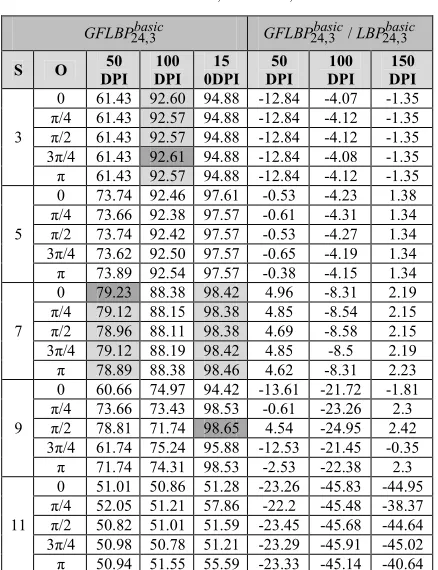
Table 5: The Similarity Results Of The.GFLBP24, 3basic/LBP24, 3basic
24, 3basic
GFLBP GFLBP24, 3basic/LBP24, 3basic
S O 50
DPI 100 DPI
15 0DPI
50 DPI
100 DPI
150 DPI
3
0 61.43 92.60 94.88 -12.84 -4.07 -1.35
π/4 61.43 92.57 94.88 -12.84 -4.12 -1.35
π/2 61.43 92.57 94.88 -12.84 -4.12 -1.35
3π/4 61.43 92.61 94.88 -12.84 -4.08 -1.35
π 61.43 92.57 94.88 -12.84 -4.12 -1.35
5
0 73.74 92.46 97.61 -0.53 -4.23 1.38
π/4 73.66 92.38 97.57 -0.61 -4.31 1.34
π/2 73.74 92.42 97.57 -0.53 -4.27 1.34
3π/4 73.62 92.50 97.57 -0.65 -4.19 1.34
π 73.89 92.54 97.57 -0.38 -4.15 1.34
7
0 79.23 88.38 98.42 4.96 -8.31 2.19
π/4 79.12 88.15 98.38 4.85 -8.54 2.15
π/2 78.96 88.11 98.38 4.69 -8.58 2.15
3π/4 79.12 88.19 98.42 4.85 -8.5 2.19
π 78.89 88.38 98.46 4.62 -8.31 2.23
9
0 60.66 74.97 94.42 -13.61 -21.72 -1.81
π/4 73.66 73.43 98.53 -0.61 -23.26 2.3
π/2 78.81 71.74 98.65 4.54 -24.95 2.42
3π/4 61.74 75.24 95.88 -12.53 -21.45 -0.35
π 71.74 74.31 98.53 -2.53 -22.38 2.3
11
0 51.01 50.86 51.28 -23.26 -45.83 -44.95
π/4 52.05 51.21 57.86 -22.2 -45.48 -38.37
π/2 50.82 51.01 51.59 -23.45 -45.68 -44.64
3π/4 50.98 50.78 51.21 -23.29 -45.91 -45.02
[image:7.612.309.528.440.725.2]ISSN: 1992-8645 www.jatit.org E-ISSN: 1817-3195
From the presented data in the result tables, the
basic P, R
LBP highest identification percentage of the scanned paper texture is 96.69% and it is achieved in the 100 DPI dataset when the pattern is 24 and the radius is 3. In theGFLBPP, Rbasic, the Gabor filters
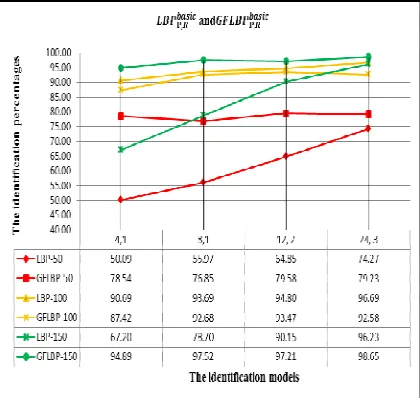
show positive effect in general on the LBPP, Rbasic method description accuracy comparing with its performance without Gabor filters. Consequently, the GFLBPP, Rbasic highest identification percentage of the scanned paper texture is 98.65% and it is achieved in the 150 DPI dataset when the pattern is 24 and the radius is 3. Figure 6 illustrates the analysis of the results of the proposed GFLBPP, Rbasic
[image:8.612.91.301.329.528.2]compared with the LBPP, Rbasic.
Figure 6: The Summary Of The Results
The LBP4, 1basic identification score for 50 DPI
images is 50.09%. In the GFLBP4, 1basic and for 50 DPI images, the results recorded a 9.53% overall improvement for all the applied scales and orientations. The highest identification result of a particular scale in average is 74.24% with an improvement of 24.15% when the scale is 7. The highest identification result of a particular scale and orientation is 78.54% with an improvement of 28.45% when the scale is 9 and the orientation is π/2. The LBP4, 1basic identification score for 100 DPI images is 90.69%. Consequently, in the
basic 4, 1
GFLBP and for 100 DPI images, there is an
overall decline average of -27.18% in the identification for all the applied scales and orientations. The decline is recognizably improved in a particular scale and orientation. The highest identification result of a particular scale in average is 87.42% when the scale is 5. The highest identification result of a particular scale and orientation is 87.77% with an improvement of 14.73% when the scale is 5 and the orientation is π. The LBP4, 1basic identification score for 150 DPI images is 67.20%. Consequently, in the
basic 4, 1
GFLBP and for 150 DPI images, the results recorded a 7.02% overall improvement for all the applied scales and orientations. The highest identification result of a particular scale in average is 94.89% with an improvement of 27.69% when the scale is 7. The highest identification result of a particular scale and orientation is 95.04% with an improvement of 27.84% when the scale is 7 and the orientation is π/4.
The LBP8, 1basic identification score for 50 DPI
images is 55.97%. In the GFLBP8, 1basic and for 50 DPI images, the results recorded a 4.98% overall improvement for all the applied scales and orientations. The highest identification result of a particular scale in average is 76.85% with an improvement of 19.59% when the scale is 7. The highest identification result of a particular scale and orientation is 76.85% with an improvement of 20.88% when the scale is 9 and the orientation is π/2. The LBP8, 1basic identification score for 100 DPI images is 93.69%. Consequently, in the
basic 8, 1
GFLBP and for 100 DPI images, there is an overall decline average of -27.50% in the identification for all the applied scales and orientations. The decline is recognizably improved in a particular scale and orientation. The highest identification result of a particular scale in average is 92.68% when the scale is 5. The highest identification result of a particular scale and orientation is 92.81% when the scale is 5 and the orientation is π. The LBP8, 1basic identification score for 150 DPI images is 78.70%. Consequently, in the
basic 8, 1
ISSN: 1992-8645 www.jatit.org E-ISSN: 1817-3195
improvement of 18.91% when the scale is 7 and the orientation is π/4.
The LBP12, 2basic identification score for 50 DPI
images is 64.85%. In the GFLBP12, 2basic and for 50 DPI images, there is an overall decline average of -1.95% in the identification for all the applied scales and orientations. However, there is a recognizable improvement in a particular scale and orientation. The highest identification result of a particular scale in average is 79.47% with an improvement of 14.62% when the scale is 7. The highest identification result of a particular scale and orientation is 79.58% with an improvement of 14.73% when the scale is 7 and the orientation is 3π/4. The LBP12, 2basic identification score for 100 DPI images is 94.80%. Consequently, in the
basic 12, 2
GFLBP and for 100 DPI images, there is an overall decline average of -25.20% in the identification for all the applied scales and orientations. The decline is recognizably improved in a particular scale and orientation. The highest identification result of a particular scale in average is 93.476% when the scale is 3. The highest identification result of a particular scale and orientation is 93.50% when the scale is 5 and the orientation is π. The LBP12, 2basic identification score for 150 DPI images is 90.15%. Consequently, in the
basic 12, 2
GFLBP and for 150 DPI images, there is an overall decline average of -5.91% in the identification for all the applied scales and orientations. The decline is recognizably improved in a particular scale and orientation. The highest identification result of a particular scale in average is 97.21% when the scale is 7. The highest identification result of a particular scale and orientation is 97.57% when the scale is 9 and the orientation is π/2.
The LBP24, 3basic identification score for 50 DPI
images is 74.27%. In the GFLBP24, 3basic and for 50 DPI images, there is an overall decline average of -7.32% in the identification for all the applied scales and orientations. However, also there is a recognizable improvement in a particular scale and orientation. The highest in the identification result of a particular scale in average is 79.06% with improvement of 4.79% when the scale is 7. The highest identification result of a particular scale and orientation is 79.23% with an improvement of 4.96% when the scale is 7 and the orientation is 0.
The LBP24, 3basic identification score for 100 DPI images is 96.69%. Consequently, in the
basic 24, 3
GFLBP and for 100 DPI images, there is an overall decline average of -17.02% in the identification for all the applied scales and orientations. The decline is recognizably improved in a particular scale and orientation. The highest identification result of a particular scale in average is 92.584% when the scale is 3. The highest identification result of a particular scale and orientation is 92.61% when the scale is 3 and the orientation is 3π/4. The LBP24, 3basic identification score for 150 DPI images is 96.23%. Consequently, in the GFLBP24, 3basic and for 150 DPI images, there is an overall decline average of -7.91% in the identification for all the applied scales and orientations. The decline is recognizably improved in a particular scale and orientation. The highest identification result of a particular scale in average is 98.41% when the scale is 7. The highest identification result of a particular scale and orientation is 98.65% when the scale is 9 and the orientation is π/2.
5. DISCUSSION
The shear deformation is very common transformation in applications utilize scanners for purpose of images acquisition. This results a challenge of texture identification in many applications such as documents authentication. The base work such as [1] suggested applying LBP operators as a method that can deal with shear problem. However, LBP has been found to be limited in dealing with global view of the texture and neglecting useful information about the images. Hence, applying Gabor filters as a supplementary to LBP is visible in the texture identification literature. They are found to be capable of improving the performance of the LBP operators’ texture identification results.
Consequently, in this paper, it is proposed to develop a combination of Gabor filters and LBP operator in paper fingerprinting. In order to evaluate the performance of the proposed Gabor Filters and LBP operators’ combinations, two experiments are proposed. The first experiment includes applying LBP operators without Gabor filters in order to set an evaluation benchmark, i.e.,LBPP, R. The second
experiment
(
GFLBPP, R)
includes applying theISSN: 1992-8645 www.jatit.org E-ISSN: 1817-3195
novel work of Gabor filters’ and LBP operators’ combination in paper fingerprinting shows that Gabor filter improves the LBP operators in general. The overall improvement is clearly shown in Figure 6.
The highest accuracy achieved by GFLBP24, 3basic with 150 DPI resolution is 98.65%. The grate advantage of Gabor filters is visible in the low resolution of 50 DPI. The Gabor filter enhances the results of the 50 DPI images by an average of 17.25%. However, the analysis of the results also shows that Gabor filters negatively affects the extracted features quality of the LBP operators when the images have higher DPIs. We explain this phenomenon by to issues: (1) different combinations of feature extraction methods produce different fingerprinting results and (2) a combination of methods that produces high fingerprinting results in specific circumstances might not produce the same results in other circumstances. Hence, we study the posability of a mechanism that dynamically invokes Gabor filters based on the LBP identification quality to insure highly robust results.
6. CONCLUSION
In this paper, a proposed GFLBPP Rbasic, method for paper fingerprinting is presented. The results show that the method is superior to the LBPP Rbasic, operator in paper fingerprint. For the 50 DPI images, the
basic ,
LBPP R operator scores the highest identification percentage of 74.27%. Subsequently, with the aid of Gabor filters, the highest identification percentage becomes 79.58% and it is achieved when the scale is 7 and the orientation is 3π/4. For the 100 DPI images, the LBPP Rbasic, and the GFLBPP Rbasic, almost show same results. For the 150 DPI images, the
basic ,
LBPP R operator scores the highest identification percentage of 96.23%. Subsequently, with the aid of Gabor filters, the highest identification percentage becomes 98.65% and it is achieved when the scale is 9 and the orientation is π/2. The use of lower bins in GFLBPP Rbasic, is good enough since the method records on average high accuracy with the lower resolution (50 DPI). Thus, the proposed method can identify low resolution images and save computation time. We conclude that using Gabor filters as supplementary to LBP operators in paper
fingerprinting improve the LBP’s texture identification.
In the results analysis, it is found that Gabor filters have positive effect in the LBP performance when the LBP produces poor feature vectors and vice versa. We suggest a mechanism that dynamically invokes Gabor filters based on the LBP identification quality to insure highly robust results.
ACKNOWLEDGEMENT
The authors wish to thank Assoc. Prof. H. K. Abdulkadir for his valuable, detailed comments that improve both the content and representation of this study.
REFRENCES:
[1] Wahdan, O. M., “Geometrical Insensitive-to Shear and Half Rotation Texture Descriptor from Local Binary Pattern for Paper Fingerprinting”, (UKM, PhD thesis, 2015). [2] Nasrudin, M.F., Wahdan, O.M., and Omar, K.,
“Irregular Rotation Deformation from Paper Scanning: An Investigation”, Procedia Computer Science, 2012, Volume 13, Pages 152–161.
[3] Wahdan OM, Nasrudin MF, Omar K., “SITD and across-bin matching for deformed images acquired by scanners”. In Signal Processing & its Applications (CSPA), 2014 IEEE 10th International Colloquium on 2014 Mar 7, Pages 14-19.
[4] Chen, C., Zhou, L., Guo, J., Li, W., Su, H., and Guo, F., “Gabor-Filtering-Based Completed Local Binary Patterns for Land-Use Scene Classification”, In Multimedia Big Data (BigMM), IEEE International Conference on 2015 Apr, Pages 324-329.
[5] Li, Wei, Chen Chen, Hongjun Su, and Qian Du., “Local binary patterns and extreme learning machine for hyperspectral imagery classification”, Geoscience and Remote Sensing, IEEE Transactions on 53, 2015 Jul, Volume:53 , Issue: 7, Pages 3681–3693. [6] Li, M., and Staunton, R.C., “Optimum Gabor
ISSN: 1992-8645 www.jatit.org E-ISSN: 1817-3195
[7] Moeini, A., Faez, K., and Moeini, H., “Real-world gender classification via local Gabor binary pattern and three-dimensional face reconstruction by generic elastic model”, IET Image Processing, 2015 May, Volume:9 , Issue: 8, Pages 690–698.
[8] Garain, U. & Halder, B., “On automatic authenticity verification of printed security documents”. In Computer Vision, Graphics & Image Processing, ICVGIP'08. Sixth Indian Conference on, 2008 Dec, Pages 706-713. [9] Clarkson, William, Tim Weyrich, Adam
Finkelstein, Nadia Heninger, J. Alex Halderman, and Edward W. Felten., “Fingerprinting blank paper using commodity scanners”, In Security and Privacy, 2009 30th IEEE Symposium on, Pages 301-314.
[10] Cowburn, R.P. and Buchanan, J.D.R., Ingenia Holdings Limited, 2011, Verification of authenticity. U.S. Patent 8,078,875.
[11] Scanned Paper Fingerprint Project, UKM Pattern Recognition Research Group, 2012,
retrieved 31/12/2014,
<http://www.ftsm.ukm.my/pr/index.php/muat-turun?id=103>
[12] Ojala, T., Valkealahti, K., Oja, E., and Pietikäinen, M., “Texture discrimination with multidimensional distributions of signed gray-level differences”, Pattern Recognition, 2001 Mar, Volume: 34, Issue: 3, Pages 727-739. [13] Ojala, T., Pietikäinen, M., and Mäenpää, T.,
“Multiresolution gray-scale and rotation invariant texture classification with local binary patterns”, Pattern Analysis and Machine Intelligence, IEEE Transactions on, 2002 Jul, Volume:24 , Issue: 7, Pages 971-987.
[14] Shan, C., Gong, S., and McOwan, P.W., “Facial expression recognition based on local binary patterns: A comprehensive study”, Image and Vision Computing, 2009 May, Volume: 27, Issue 6:, Pages 803-816.
[15] Pietikäinen, M., Hadid, A., Zhao, G., and Ahonen, T., “Local binary patterns for still images”, In Computer Vision Using Local Binary Patterns’ (Springer, 2011), Volume:40, Pages 13-47.
[16] Movellan, J.R.: “Tutorial on Gabor filters ”, Open Source Document, 2002.
![Figure 1: Original Image Versus LBP Image And Gabor Image [5]](https://thumb-us.123doks.com/thumbv2/123dok_us/8909030.958304/2.612.89.299.74.189/figure-original-image-versus-lbp-image-gabor-image.webp)