A NOVEL MULTIUSER INTERFERENCE CANCELLATION
METHOD FOR MULTICARRIER DIRECT SEQUENCE CDMA
SYSTEM USING MAXIMUM LIKELIHOOD SEQUENTIAL
DECODING
S.PRAVEEN CHAKKRAVARTHY1, N.NAGARAJAN2, V.ARTHI3
1 Electronics and Communication Engineering, Coimbatore Institute of Engineering and Technology, Coimbatore
2Computer Science Engineering, Coimbatore Institute of Engineering and Technology, Coimbatore
3
Electronics and Communication Engineering,Sri Krishna College Of Technology,Coimbatore
[email protected], Tel. No:0422- 2425984
ABSTRACT
It is well known that sequential decoding techniques such as Enhanced Maximum Likelihood sequential decoding (EMLSD) technique can obtain significant performance improvement over conventional decoding techniques in multicarrier direct sequence Code Division Multiple Access (MC-DS-CDMA) systems. Due to its simplicity and usefulness the EMLSD has received significant attention for several years. In this proposed work, three contributions are done for evaluation of the performance of the Multicarrier CDMA receiver. An expression is derived for Bit Error Rate (BER) with arbitrary spreading gain and Signal to Noise Ratio (SNR) requirements. The performance of maximum likelihood decoder under various ordering criteria is then examined based on spreading, path loss and SNR/BER requirement. A set of frequencies is then obtained using a multiuser interference cancellation algorithm. These subcarrier frequencies are very near the optimum in terms of minimizing error rate, thereby increasing the number of users.
Keywords:EMLSD (Enhanced Maximum Likelihood Sequential Decoding), MUSIC (Multiple Successive Interference Cancellation)
1 INTRODUCTION
Multicarrier CDMA systems have received considerable attention in recent years due to their bandwidth efficiency, frequency diversity, parallel processing and interference rejection capability in high data rate transmission system. The frequency diversity may be obtained by using an adaptive code as an error correction code across subcarriers [1]. However, when error correction codes are used, the transmitted data must be redundant, resulting in reduction of bandwidth efficiency [1]. The conventional Multicarrier Direct Sequence CDMA system is affected by Inter Symbol Interference (ISI), Multi-path Interference, Multiple Access Interference (MAI) and when the number of users increases the system performance degrades as there is increased complexity in the receiver circuit. The proposed Transceiver with fixed set of transmitting
for each channel. Rake reception can also be employed to exploit the channel diversity by channel matching in the frequency domain .The data rate of wireless communication systems are limited by time varying characteristics of dispersive fading channel. [4]. To improve the performance with no frequency or time redundancy and to compensate for BER, it is shown that MC-DS-CDMA system with multiuser interference cancellation provides better performance than an MC-DS-CDMA without multiuser interference cancellation in terms of its computational complexity of BER.
Spread spectrum techniques were originally proposed to allow secure communication by spreading the signal over a wide bandwidth, allowing the signal power spectral density to be reduced. This is achieved by transmitting a higher frequency pseudo-noise sequence in place of a single modulated symbol. This signal looks almost like noise and because wideband interference has little effect compared to narrowband interference. The signal can be detected by correlating with the pseudo-noise sequence. In multi-path channels, the multi-path diversity can be exploited by using a channel matched (rake) receiver, giving the optimal performance (for a single user)[5].
By using a number of different pseudo-noise sequences, multiple users can transmit simultaneously using the same bandwidth. In all practical cases, at the receiver, all the user’s pseudo-noise sequence will not be orthogonal and therefore the capacity of the system will be limited by this multiple access interference.
A suitable structure of transmit and receive pre-processing matrices ensure that all equivalent sub channels share a common average signal to interference ratio which is further maximized based on channel statistics[6]. For complete suppression of multiple access interference, exponential orthogonal codes or selecting a particular subset of Walsh Hadamard code proves to be the best solution [7].
Multiuser detection for CDMA systems usually relies on some a priori channel estimates, which are obtained either blindly or by using training sequences and the covariance matrix of the received signal that are usually replaced by the sample covariance matrix. Multiuser detection can be obtained by optimizing the worst case performance over two bounded uncertainty sets pertaining to the types of estimation errors [8].
Multicarrier CDMA is a promising protocol in a 2 path frequency selective slow Rayleigh fading channel [9].
The multiple access capability of the system is achieved by means of DS/SS which helps to combat the presence of several paths. DS/SS is also attractive to decrease the multiple access interference [10]. Multicarrier signaling technique has a desirable property of exhibiting a narrow band interference suppression effect, along with robustness to fading by the use of band limited spreading waveforms to prevent self- interference over a frequency selective fading channel[11] The transmission bandwidth of the system is more efficiently used, the effect of frequency selective multipath interference can be mitigated and frequency/ time diversity is achieved. The multicarrier system is able to outperform the RAKE receiver when the system parameters are selected properly [12]. The Multicarrier system is capable of supporting ubiquitous communications over diverse communication environment without BER performance degradation [13].The survey on the conventional techniques results in achieving desired error free transmission by compromising Bandwidth, number of users and Average Throughput.
2 SYSTEM MODEL
Consider Orthogonal Frequency Division Multiplexing of ‘M’ signals given by,
( )
t( )
t cos[
2 t( )
t]
Yi i M
1
i
a
if
φ
∑
π +=
= (1)
Where
a
i( )
t and( )
t iφ
represent amplitude and phase modulation of ith carrier signal respectivelyf
i is the ith carrier frequency.The received signal is of the form
( )
t Rey =
{
∑
=( )
[
]
}
π M
1
i
s
i t exp j2f
it (2)( )
ts
i represents symbol vector of the receivedsignal
On definition, the complex envelope ofY
( )
t isy
( )
t =∑
Mi1y~( )
t exp(
2πf
0t)
= (3)
Where, for the moment f0 remains arbitrary
The complex envelope of is ~y
( )
t is expressed as
( )
t( )
t exp[
j( )
t]
exp[
j2(
)
t]
y~
a
f
f
0 i i
M 1
i i π −
=
∑
φ
= (4)
The direct and quadrature components of FDM signals are given by
( )
t( )
t cos[
2(
)
t( )
t]
i 0 i M 1 i i
d
a
f
f
y
=∑
π − +φ
= (5)
and
( )
t( )
t sin[
2(
)
t( )
t]
i 0 i M 1 i i
q
a
f
f
y
=∑
π − +φ
= (6)
Assume FDM signal with four carriers, suppose that the signal of interest is
( )
tx2
and thatthe simulation is being performed in order to examine multiuser interference and intermodulation distortion, since signal of interest is
( )
tx
2 ,letf
f
0= 2so thatx
2( )
t is translated to f=0 when thecomplex envelope of the composite signal y
( )
t is formed. Withf
0=f
2, the complex envelope of( )
t y is( )
t( )
t exp[
j2(
)
t]
y ~
f
f
x
i 24 1
i i π −
=
∑
= (7)
3 RECEIVER MODEL
Let
y
m be the allocation (frequency allocation) tobe determined for a total of ‘m’ symbols out of ‘M’signals, and
n
ij be the number of codes ofactive carrier ‘j’ of signal ‘i’.Then the optimal allocation of Bandwidth for the allocation function
R
ifor all ’m’ symbols over all active carrier ‘j’ canbe obtained as
Maximize
R
( )
T
j m1
i i
∑
= (8)
T
jis the allocated bandwidth for ‘m’ symbols and‘j’ active carriers over ‘M’signals in the range 0≤t≤
T
b, whereT
bis the bit intervalSubjected to
n
R
T
maxj i M
1 i ij ≤
∑
= (9)0 max
T
R
i≤ j≤
where
T
maxj is the maximum bandwidth
available.
3.1 Multiuser Interference Cancellation
Algorithm:
The decoding procedure involves
(a). Make equation (8) solvable in polynomial time.
(b). Approximate original allocation function
R
i.(c). Completely linearize the objective function and split the flow in parallel sub flows, each corresponding to a linear segment of allocation function.
(d). For a subcarrier k of total carriers i,the allocation is constrained through the allocation function levels
T
kj as
t
kjT
kjT
kj−1−
≤ (10)
where
t
kj is utilization efficiency of subcarrier
(e). Subflow allocation variables are determined based on estimation.
(f). Estimation of received signal is expressed as
p
A
e
j ni W( )
n1
i i +
ω =
∑
(11)K-active users for a particular time period; i- being active carrier for ‘M’ signals;
( )
nW -additive noise
It is assumed that amplitude
A
iis complex
A
A
e
jii i
φ
With
φ
ibeing uncorrelated random variable that are uniformly distributed over the interval[-π,π].
(g). Calculating the power spectrum ofy
( )
t , a set of ‘p’ impulses of area 2πA
iat frequencyω
i fori=1,2,...K in addition with power spectrum of additive noise w
( )
n .3.2 Analytical determination of BER:
With the selection of suitable carrier, considering a symbol
s
1 istransmitted, an error is made if
{
errors}
(
{
(
nx sx)
n( )
ny sy n}
)
dnxdnypr /1=∫∫1/2πσ2.exp− − 2/2σ2− − 2/2σ2
(13)
(
~sx+n
x,~
s
y+n
y)
∈d
1Inference from decision region implies that the following condition
{
error/}
(
,)
dx.(
,)
dypr x x n ny y y n
0 nx 1
s
~
n
f
s
~
n
f
s
∫
σ
∫
σ
∞ ∞ − ∞ − ÷ ÷ 〈 (14)
is a metric that decides probability of Error with the respect to Optimal Allocation function (Ri)
{
error/}
(
,)
dnx.(
,)
dnypr x x n ny y y n
0 nx 1
s
~
n
f
s
~
n
f
s
∫
σ
∫
σ
∞ ∞ − ∞ − ÷ ÷ 〈 (15)
Conditional probability bound is given by
{
error/s
1}
〈Q(
Re( )
~
s
1 ÷σ
n)
+Q(
Im( )
s
1 ÷σ
n)
pr (16)
{
}
∑
= − − = N 1 k 2 k 1 k ks
s
s
s
p
1/N prerror/ , , (17)The approach implies that the recovery of a selected symbol impose the conditional Probability of the received symbol given the transmitted symbol
4 SIMULATION RESULTS
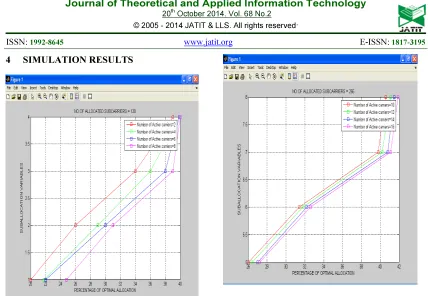
Fig. 1. Percentage Of Optimal Allocation Vs Sub Allocation Variables Using A Target BER Of 10- 7 And
SNR Of 40db With Allocated Subcarriers Of 128
From Fig.1 it is observed that the Multiuser Interference Cancellation algorithm achieves better performance in terms of bandwidth allocation for active carrier ‘j’ which increases the overall efficiency of the system thereby mitigating the probability of interference getting added up with the desired carrier for the optimal allocation
R
i which varies as a function of sub allocationvariables [1, 2, 3, 4] for kth subcarrier out of available subcarriers i =128.The results depict that the increase in sub allocation variables from 1 to 4 preserves 60 percent of the available bandwidth which in turn reflects the accurate decoding of the desired carrier based on target BER and available SNR.
Fig. 2. Percentage Of Optimal Allocation Vs Sub Allocation Variables Using A Target BER Of 10- 7 And
SNR Of 40db With Allocated Subcarriers Of 256
[image:5.595.287.505.80.358.2]Fig. 3 Percentage Of Optimal Allocation Vs Sub Allocation Variables Using A Target BER Of 10- 7 And
SNR Of 40db With Allocated Subcarriers Of 512
From Fig.3 it is observed that the Multiuser Interference Cancellation algorithm achieves better performance in terms of bandwidth allocation for active carrier ‘j’ which increases the overall efficiency of the system thereby mitigating the probability of interference getting added up with the desired carrier for the optimal allocation
R
i which varies as a function of sub allocation [image:6.595.92.345.98.381.2]variables [9, 10, 11, 12] for kth subcarrier out of available subcarriers i =512.The results depict that the increase in suballocation variables from 9 to 12 preserves 56 percent of the available bandwidth which in turn reflects the accurate decoding of the desired carrier based on target BER and available SNR.
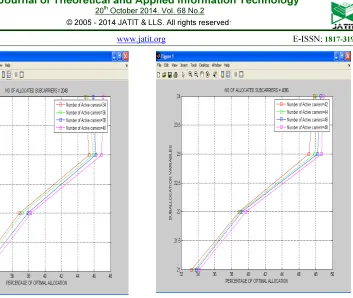
Fig. 4. Percentage Of Optimal Allocation Vs Sub Allocation Variables Using A Target BER Of 10- 7 And
SNR Of 40db With Allocated Subcarriers Of 1024
Fig. 5.Percentage Of Optimal Allocation Vs Sub Allocation Variables Using A Target BER Of 10- 7 And
SNR Of 40db With Allocated Subcarriers Of 2048
From Fig.5 it is observed that the Multiuser Interference Cancellation algorithm achieves better performance in terms of bandwidth allocation for active carrier ‘j’ which increases the overall efficiency of the system thereby mitigating the probability of interference getting added up with the desired carrier for the optimal allocation
R
iwhich varies as a function of sub allocation variables [17, 18, 19, 20] for kth subcarrier out of available subcarriers i =2048.The results depict that the increase in suballocation variables from 17 to 20 preserves 52 percent of the available bandwidth which in turn reflects the accurate decoding of the desired carrier based on target BER and available SNR.Fig. 6. Percentage Of Optimal Allocation Vs Sub Allocation Variables Using A Target BER Of 10- 7 And
SNR Of 40db With Allocated Subcarriers Of 4096
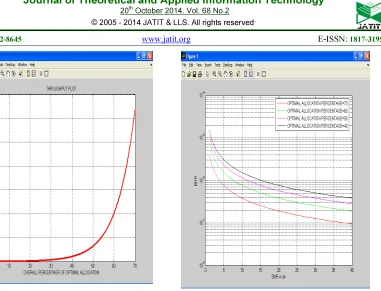
[image:7.595.89.299.106.370.2]Fig. 7. Overall Percentage Of Optimal Allocation Vs Throughput Using A Target BER Of 10- 7 And SNR Of
40db
[image:8.595.89.302.106.360.2]From Fig.7 it is observed that the bandwidth allocated for each uninterrupted user is maintained constant for very low throughput values indicating the optimal level of interference cancellation for active carriers. When the throughput of the system is increased, signifying the increase in percentage of optimal allocation in a continuous manner .The result indicate that the system executes in a very efficient manner for high throughput values with which the level of SNR and BER are maintained to the required level even though the amount of interference getting added up with the system increases.
Fig . 8. BER Performance Of Multicarrier CDMA System With Percentage Of Allocation [70, 60, 50, 40] And Allocated Subcarriers [128, 256, 512, 1024, 2048,
4096] For MLSD Receiver.
From Fig.8. it is observed that the BER of the MC-DS-CDMA system is reduced to the desired level reaching up to 10-7 and enhancing the performance of the system thereby maintaining the level of SNR to 40 db with total number of subcarriers ranging from [256, 512 , 1024 , 2048 , 4096].It is evident that the system operated with high efficiency from the fact that increase in number of active carriers of the system reduces BER to 10-7 maintaining a constant SNR of 40 db throughout for different frequency ranges.
5 CONCLUSION
demonstrate that interference can be mitigated by using Multiuser Interference Cancellation algorithm and by assigning random spreading sequence over all subcarriers of a given user. The performance improvement was shown to depend on the number of subcarriers. An expression for approximate BER was obtained and was shown to match simulation results well in heavily loaded systems. These approaches can be directly used in future wireless communication systems. It will be interesting to evaluate and analyse the results for time varying conditions with unknown channel estimation parameters.
REFERENCES:
[1].Heng yang and Xian – Da Zhang “A Fast Maximum Likelihood Sequence Decoding Method for Multicarrier DS-CDMA using Frequency Spread Coding”., IEEE Transactions on Wireless Communications., Vol.3 , pp.770-780, May 2004.
[2]. See-May Phoong, Yubing chang and chung-yang chen “DFT Modulated Filterbank Transceivers for Multipath Fading Channels”
IEEE Transactions on signal processing, vol
53, .NO.I, January 2005
[3]. Lie-Liang Yang, Lajos Hanzo, “Serial Acquisition Performance of Single-Carrier and Multicarrier DS-CDMA Over Nakagami-m Fading Channels” IEEE transactions on wireless communications, vol. 1, no. 4, October 2002
[4].Chin-liang wang,Chinan-Hsu Chen, “On the Selection of partial cancellation factor for a Two stage Hard Decision PPIC Scheme in DS-CDMA System” IEEE Transactions on Wireless Communications., Vol.10,issue 12 , pp 4008-4017, 2011.
[5].Jun Ma,Orlik P.V,Jinyum Zhang,Li,G.Y, “Statistics based ICI Mitigation in OFDM over high mobility Channels with line Of Sight Components” IEEE Transactions on Wireless Communications., Vol.10,issue 11 , pp 3577-3582, 2011.
[6]. Jun Ma,Orlik P.V,Jinyum Zhang,Li,G.Y, “Reduced-Rate OFDM Transmission For Inter-Subchannel Interference Self cancellation over High mobility Fading Channels”, ” IEEE Transactions on Wireless Communications., Vol.11,issue 6 , pp 2013-2023, 2012.
[7].Sanguinetti.L ,Taponecco.L ,Morelli .M “Interference Free Code Design for MC-CDMA Uplink Transmissions”. IEEE Transactions on Wireless Communications., Vol.8 ,issue11 , pp 5461-5465.2009
[8].Rensheng Wang, Hongbin Li “ Robust Multiuser Detection for Multi Carrier CDMA systems”.IEEE Journal on Selected areas in Communications,vol.24.No.3.pp 673 – 683 March 2006
[9] R. Prasad and S. Hara, “Overview of multicarrier CDMA,” IEEECommun. Mag., pp. 126–133, Dec. 1997.
[10] L. Vandendorpe, “Multitone spread spectrum multiple access communicationssystem in a multipath Rician fading channel,” IEEE
Trans. Veh.Technol., vol. 44, pp. 327–337,
1995.
[11] S. Kondo and L. B. Milstein, “Performance of multicarrier DS CDMAsystems,” IEEE Trans.
Commun., vol. 44, pp. 238–246, Feb. 1996.
[12] E. A. Sourour and M. Nakagawa, “Performance of orthogonal multicarrierCDMA in a multipath fading channel,” IEEE Trans. Commun., vol.44, pp. 356–367, Mar. 1996.
[13] Yang.L. and L.Hanzo “Performance of Broadband Multicarrier CS-CDMA using Space-Time Spreading assisted Transmit Diversity”. IEEE Transactions on Wireless
Communications Vol.4.No.3.pp 885-894.May