COOPERATION INNOVATION OF VIRTUAL INDUSTRY
CLUSTER----BASED ON EVOLUTIONARY GAME
LU CHENG,HONGYAN HUO, HE ZHOU
School of Marketing Management, Liaoning Technical University, Huludao 125105, Liaoning, China
E-mail: [email protected]
ABSTRACT
In this paper, we researched on effects of knowledge resources to the enterprise cooperation innovation strategy select, and established an evolutionary game model of cooperative innovation between members of Virtual Industry Cluster. This study got some results like: the probability of cooperative strategy has positive correlation with income coefficient of knowledge resources and mutual confidence level between partners, and has negative correlation with costs and risks of knowledge resources getting. And based on these results, our team put forward the strategy advice to incentive members of virtual industry cluster to cooperation based on knowledge network.
Keywords: Virtual Industry Cluster, Cooperative Innovation, Evolutionary Game, Knowledge Resource
1. INTRODUCTION
Virtual Industrial Clusters originally derived from the concept of the EU 'SACFA in 1997, which funded by 7 universities such as Brazil University of Sao Paulo formed a research network. The network will be defined VIC as The rapid construction and operation of virtual enterprises based platform, by having a certain specialty enterprise composed of aggregates, the main function is to provide and regulate through members of the core ability of the enterprise, participate in the virtual enterprise operation in order to allow members to share the market opportunities [1]-[2]. Along with the domestic and foreign scholars study on the virtual industry clusters deeply, there are quite a few scholars believe that the virtual industrial cluster is the combination of virtual enterprise and industry cluster, this new type of cluster organization model of enterprise played a great role in promoting innovation ability advantages of cluster innovation to maintain and upgrade. Businesses and other organizations mechanism use virtual space agglomeration, its ultimate purpose is to access to innovative resources needed (mainly is the knowledge resources) [3].
Koh & Kim (2004), Murray (2006), Lu Cheng (2010) etc., in-depth analysis on according to knowledge sharing, communication, cooperation and innovation connect closely. Along with the development and popularization of network techniques, cross region cooperation reduce the dependence on material resources, logistics and
other factors, to cooperate and focus on knowledge resources sharing and communication [4] -[6]. At the same time, the reduction of transaction costs, innovation risk factors have also been shown to be cooperative innovation driving factors ( Robertson 1998, Maria 2005, Sheng Yanchao 2007, Cao Xing, Chen Qi, Guo Ran 2010 ) [7] -[10]. In fact, based on the knowledge resources of cooperative innovation between members and information sharing are usually require sensitive knowledge , but with the cooperation , the main body of the existence of the relationship of competition, will cause conflicts because of share or exclusive cooperative innovation achievements, thus main body of cooperation of innovation in the process of game ( Cyert&Goodman 1997, Chung 2003, Chen Xu, Li Shiming 2007, Zhang Qi 2009, Deng Guangjun Ceng Yong 2011 ) [11]- [15].
that finding the right potential partners based on knowledge resource and identified it, confirm whether it has the possibility of cooperation. In addition, their learning and knowledge absorptive capacity also affects the knowledge resource using cost, if their knowledge accumulation is insufficient, this will lead to increase the cost of knowledge resources utilization. (Costing of cooperative innovation) Thus affecting the cooperative innovation activities carried out smoothly.
2. MODEL CONSTRUCTION OF
COOPERATIVE EVOLUTIONARY GAME
According to the replication dynamic evolution game method [16], the VIC members between enterprises based on knowledge resources cooperation innovation process. As an assumption, the cooperation between enterprises depends on knowledge resources sharing and complementary. To meet this condition, the enterprises choose "cooperation" for more revenue. And the parties have bounded rationality, i.e., they can not play game only one time for finding the best income strategy, but have go through repeated games to achieve that. In addition to the above content outside, for simplify the analysis process; put forward the premise in constructing game model.
(1)There are only two enterprises (
A
andB
) play on knowledge resources cooperation innovation game in VIC. The strategy set are {cooperation, not cooperation}, due to the existence of bounded rationality,A
orB
can adjustment their strategies according to the other strategy. A and B are adopt cooperative strategy, their incomefor
U
A,U
B, if both of them will not cooperationstrategy, their income for
E
A andE
B.( 2 ) When
A
andB
take cooperationstrategy, if
A
pay knowledge asI
A ,B
payknowledge as IB , we use
Q
A andQ
B to beincrease of knowledge resources through the
cooperation (knowledge resource income),
r
A andB
r
represent respectively thatA
andB
knowledge resources income coefficient. Now weget
Q
A=
r
AI
A,Q
B=
r
BI
B ,(
r
A,
r
B>
0
)
.(3)
C
is used to be cost of knowledge resources acquisition, related to some factors like knowledge resources quantity, quality, some learning costs.A
,B
based on knowledge resourcescooperation cost for
A A
A
c
I
C
=
,
C
B=
c
BI
B ,among themc
A ,c
B forcost coefficient.
( 4 ) Besides cooperative innovation, the enterprise itself also has the self-study, a new ability; it will bring additional knowledge, the extra income. This part of the extra income mainly comes
from its self-study and innovation ability, with
V
said,
V
A=
k
AI
A ,V
B=
k
BI
B ,(
k
A,
k
B>
0
)
,including
k
A,
k
B said enterpriseA
andB
self-study ability coefficient.
(5)As a matter of fact, Cooperation process have to face some risk, including knowledge overflow objectively which leading to cooperation revenue decline, partner defaulting will bring trust risk, The renewal of the knowledge resources caused by the decrease of the prospective earnings , etc. Thus, it can be argued that cooperation risk
D
and knowledge resource income coefficient, cooperation risk factor. Knowledge pay level and the level of trust related. A cooperation risk factoras
l
, the enterprise mutual trust levelfor
t
ij(
t
ij∈
[ ]
0
,
1
,
i
≠
j
)
.Thus(
AB)
A A AA
t
l
r
I
D
=
1
−
,
D
A=
(
1
−
t
BA)
l
Br
BI
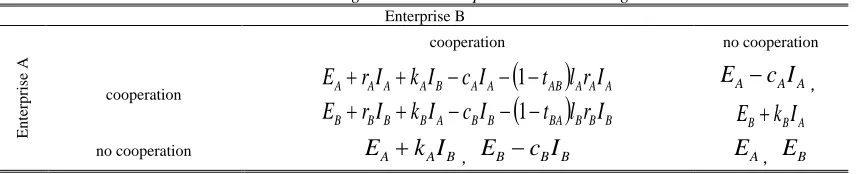
B [image:2.612.98.527.646.733.2]According to the above conditions, we construct a game matrix, as is shown in Table 1:
Table 1 Based on the knowledge resources cooperation innovation game matrix
Enterprise B
E
n
ter
p
ris
e A
cooperation no cooperation
cooperation
E
A+
r
AI
A+
k
AI
B−
c
AI
A−
(
1
−
t
AB)
l
Ar
AI
A(
BA)
B B B BB A B B B
B
r
I
k
I
c
I
t
l
r
I
E
+
+
−
−
1
−
A A
A
c
I
E
−
,A B B
k
I
E
+
3. STABILITY ANALYSIS
Usually,
A
andB
will get more income than sum of each cost plus risk, if they choosecooperative strategy both. That is,
Q
> +
C
D
. Assume thatA
choose the probability ofcooperation as
p
A, not choose the probability ofcooperation as
1
−
p
A,B
choose the probability ofcooperation for
p
B, not choose to the probability ofcooperation as
1
−
p
B ,(
0
≤
p
A,
p
B≤
1
)
, and achoice of cooperation strategy, knowledge resource income for:
(
)
[
AB A]
B A B A A AA B A
A =E + p I r − −t l +p k I −c I
′
1 1
ϑ
A
not choose to cooperation strategy, knowledge resource income for:(
A A B) (
B)
A A B A BB
A = p E +k I + −p E =E +p k I
″
1
ϑ
Thus,
A
knowledge resources average income for:(
A)
A A A B A A[
(
AB)
A]
B A B A A AA A
A
p
p
=
E
+
p
p
r
I
−
−
t
l
+
p
k
I
−
p
c
I
″
−
+
′
=
ϑ
1
ϑ
1
1
ϑ
By the same token cans B average knowledge resource income for?
(
B)
B B A B B B[
(
BA)
B]
A B A B B BB B
B
p
p
=
E
+
p
p
r
I
−
−
t
l
+
p
k
I
−
p
c
I
″
−
+
′
=
ϑ
1
ϑ
1
1
ϑ
(
A)
A{
BA[
(
AB)
A]
A}
B
A p p I p r t l c
dt
dp = 1− 1− 1− −
(1)
(
B)
B{
A B[
(
BA)
B]
B}
A
B
p
p
I
p
r
t
l
c
dt
dp
=
−
−
−
−
1
1
1
(2)
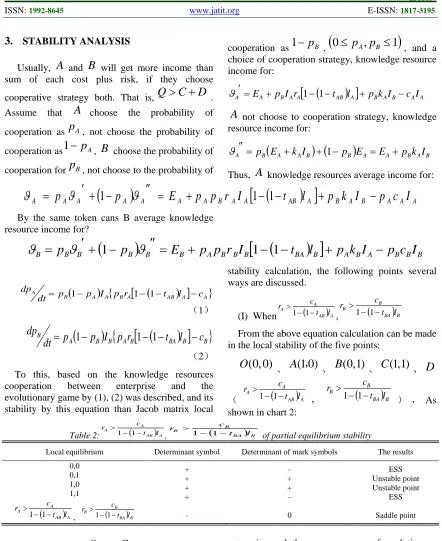
To this, based on the knowledge resources cooperation between enterprise and the evolutionary game by (1), (2) was described, and its stability by this equation than Jacob matrix local
stability calculation, the following points several ways are discussed.
(I) When ( AB)A A A l t c r − − > 1
1 ,
(
BA)
BB B l t c r − − > 1 1
From the above equation calculation can be made in the local stability of the five points:
(0, 0)
O
、A
(1 0)
,
、B
(0,1)
、C
(1,1)
、D
(
(
AB)
AA A l t c r − − > 1
1 ,
(
BA)
BB B l t c r − − > 1
1 ) ,
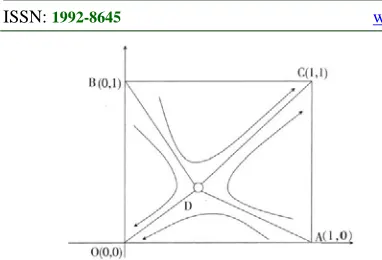
[image:3.612.89.531.71.612.2]As shown in chart 2:
Table 2: ( AB)A
A A l t c r − − > 1
1 , ( BA)B
B B l t c r − − > 1
1 of partial equilibrium stability
Local equilibrium Determinant symbol Determinant of mark symbols The results 0,0
0,1 1,0 1,1
( AB)A
A A l t c r − − > 1
1 , ( BA)B
B B l t c r − − > 1 1 + + + + - - + + - 0 ESS Unstable point Unstable point ESS Saddle point
Obviously, point
O
andC
with local stability, known as the ESS (evolutionary stable strategy).Point
O
corresponding to the enterpriseA
andB
are the enterprise not to cooperation strategy, pointC
corresponding to theA
andB
whenA
choose cooperative strategy. Points
A
andB
for unstable point, pointD
for saddle point. Based on the knowledge resources cooperation betweenFigure 1: Cooperative game evolution process
In the figure above, enterprise cooperative innovation game different state of critical path by
A
,D
,B
three connection into curve said,A
,B
,C
,D
four constitute area, on behalf of thegame both sides adopt
A
cooperative strategy, theevolutionary game theory at
C
(11)
,
pointconvergence.
A
,D
,B
,O
consisting of four area, game both sides take not cooperation strategy,evolutionary game theory in
O
(0 0)
,
pointconvergence. If the saddle point (i.e. point
D
) change, the evolution in different direction will the equilibrium convergence.(II) If
A
andB
both choose cooperative strategy, it will get above results, but if through the cooperation , the knowledge resource income less than the sum of the cost and risk,namely
Q
<
C
+
D
, there will be three kinds of circumstances, will to be discussed respectively(1)When ( AB)A A A l t c r − − < 1
1 , ( BA)B
B B l t c r − − < 1 1
The stability analysis such as shown in Table 3,
the system has four local stable point.
O
(0, 0)
,(1 0)
A
,
[image:4.612.92.283.73.203.2]and
B
(0 1)
,
,C
(1,1)
, system in pointO
convergence, the enterprise will take no cooperation strategy.Table 3: ( BA)B
B B l t c r − − > 1
1 , ( BA)B
B B l t c r − − < 1
1 of partial equilibrium stability
Local equilibrium Determinant symbol Determinant of mark symbols The results 0,0 0,1 1,0 1,1 + - - + - Uncertainty Uncertainty + ESS Saddle point Saddle point Unstable point
(2)When ( AB)A A A
l t c r > − −
1
1 , ( BA)B
B B l t c r − − < 1
1 ,means a
cooperative enterprise strategy, its knowledge resources earnings are more than cooperation cost and risk, the enterprise
B
knowledge resourceincome less than cooperation cost and risk, the local stability of the point, see Table 4, thus,
A
andB
are not to cooperation strategy is the evolutionary stable strategy, its evolution track convergence in [image:4.612.94.527.81.774.2]point
O
.Table 4: ( AB)A A A l t c r − − > 1
1 , ( BA)B B B l t c r − − < 1
1 partial equilibrium stability
Local equilibrium Determinant symbol Determinant of mark symbols The results 0,0 0,1 1,0 1,1 + - - - - + Uncertainty Uncertainty ESS Unstable point Saddle point Saddle point
(3)When ( AB)A A A l t c r − − < 1
1 , ( BA)B
B B l t c r − − > 1
1 , it
indicates that the enterprise a cooperative strategy, the knowledge resource income less than cooperation cost and risk, the enterprise b knowledge resource income more than cooperation
cost and risk, the local stability of the point Table 5, thus, a and b are not to cooperation strategy is the evolutionary stable strategy, its evolution track
convergence in point
O
.Table 5: ( AB)A
A A
l t c r < − −
1
1 , ( BA)B
B B l t c r − − > 1
1 of partial equilibrium stability
0,0 0,1 1,0 1,1
+ - + -
- Uncertainty
+ Uncertainty
ESS Saddle point Unstable point
Saddle point
4. PARAMETER ANALYSIS AND
INCENTIVE COOPERATION STRATEGY
Based on the analysis results, it can be seen that
the main system evolution path with
r c t
, ,
three coefficient correlation. The following are discussed and design the corresponding VIC incentive strategy.1) Knowledge resource income coefficient
r
. Through the cooperation r of the prospectiveearnings,
ABCD
area, the system to(1,1)
point of convergence of the greater the probability, that is to say, the enterpriseA
andB
both choose cooperative strategy probability will then increase. This means that knowledge resource gains good - - - - - - enterprise more willing to cooperate with you - - - better knowledge resource benefits, so as to form a virtuous cycle. To promote the benign lectured formation, improvingr
can adopt the following measures: ①To strengthen cooperation in the process of communication, VIC has the characteristics of cross-domain, since as traditional cluster that, in the cooperation between partners besides formal communication outside, still can use "it" and so on. Based on the network, virtual space has formed cross practice; span space communication characteristic, though it should make full use of the virtual cluster communicationadvantages. ②Both parties should promote their
cooperation knowledge overflow level and knowledge learning ability, avoiding objective overflow or inadequate learning ability that will cause knowledge resources prospective earnings
decline. ③Should build knowledge in VIC
management platform, keep VIC internal knowledge network integrity and stability, and create a good and stable external environment for cooperation among VIC members.
(2)Cooperation cost coefficient
c
. Usually, thec
depends on the knowledge environment of theenterprise. When
c
is small,ABCD
area islarger, convergence in
(1,1)
point may be the greater. VIC inside enterprise tends to choose cooperation strategy. Therefore can adopt the following measures: ①VIC information platform construction, the use of network to realize long distance information collection and search betweendifferent enterprises, shorter time, lower cost of an cooperation, so that enterprises can meet the purpose of cost reduction coefficient. ②Increasing default cost, not only keep default cost within the cooperation agreement, but also should be by means of laws, policies, and other means to reduce the probability of default.
(3)Trust level and cooperation risk factor l. Cooperation between the two sides increased trust coefficient t with risk coefficient l is reduced, thus ABCD area will be increased. T and l depend on cluster atmosphere, credit line, members of the factors such as the credit decision. This can be used
as follows measures: ①The construction b knowledge resources VIC cooperation atmosphere.
Culture, encourage cluster members of knowledge sharing and transfer, policies, the members of the enterprise cooperation based on certain policy, financial help and support (of course, this cannot leave the relevant government department's
support). ②Establish VIC
evaluation system. The establishment of the evaluation system in addition to members behavior with constraint, but also help potential partners for the enterprise to carry out the recognition, so as to shorten the practice of building trust, and to reduce the cost of cooperation and cooperation the purpose of risk.
5. SUMMARY
This paper by means of the evolutionary game theory and methods, based on the knowledge resources cooperation between enterprise and the evolutionary game model. Research on cooperative innovation strategy selection problem which based on knowledge resources of enterprises. The results of the study show that, the probability to choose cooperation strategy is positive correlation with knowledge resource income, enterprise mutual trust levels. And Negative correlation with knowledge resources cost and risk. Based on this, this paper puts forward to promote enterprise between knowledge resources as the foundation of cooperation innovation measures.
ACKNOWLEDGMENT
National Natural Science Foundation of China 71172218 and 71202117.
REFERENCES:
[1] Molina A,Pongta S,and Bremer C F etc, “Framework for Global Virtual Business”,
Agility & Global Competition, Vo.l2, 1998, pp.56-69.
[2] Molina A,Bremer C F,and Eversheim W,“Achiecing Critical Mass:A Global Research Network In System Engineering”,
Foresight, Vol.3,No.1,2001,pp.59-64.
[3] Wieser M,“Virtual high tech clusters -the modern Silicon Valley”, Computer Supported Cooperative Work in Design, Vol.9, 2002, pp.397-399.
[4] Koh L,Kim.S.Y, “Knowledge sharing in virtual communication an e-business perspective”,
Expert Systems with Applications, Vol. 26, No.2, 2004, pp.155-166.
[5] Murray F, “The Development of a Knowledge Framework Through Innovation Between SME and a Multinational Corporation”,Springer Boston, 2006, pp.105-119.
[6] Cheng Lu, “ High technology industry cluster virtual knowledge transfer mechanism research”, Harbin: Harbin engineering university press, 2011, pp.145-152.
[7] Robertson T S and Gatignon H, “Technology Development Mode: A Transaction Cost Conceptualization”, Strategic Management Journal,Vol.19, 1998, pp.515-531.
[8] Maria J, Nikolaos C and Vicente O, “Cooperative R&D with endogenous technology differentiation”, Journal of Economics &Management Strategy,
Vol.14,No.2,2005,pp.461-476.
[9] ShengYanChao, “Enterprise technical ability and technological innovation mode selection”,Management science, Vol.14,No.4,2007,pp.23-29.
[10] Caoxin, ChenQi, and GuoRan, “High technology enterprise growth model reconstruction and the way to realize ”, Journal of management, Vol.7 ,No.4,2010,pp.570-576. [11] Cyert R M and Goodman P S, “Creating
Effeetive University—Industry Alliances: An Organizational Learning Perspective”,
Organizational Dynamics, Vol.7 ,No.1,1997,pp.51-73.
Chung-Jen Chen, “The Effects of Environment and partner Characteristics on the Choice of Alliance Forms”,International Journal of Project Management, Vol.21,2003,pp.115-124. [13] ChenXu and LiShiMing, “Industry cluster in
duopoly game analysis enterprise cooperative innovation”,Journal of management, Vol.7 , No.01,2007, pp.41-47.
[14] ZhangJi, ZhangZhiGang and WangXiaoPeng, “Based on the technology license school-enterprise cooperation innovation game model constructing”, Science of sciences research, Vol.27,No.6,2009, pp. 941-946.
[15] DengGuangJun and CengYong, “Double asymmetric competition of technology investment decision”, Journal of management science,Vol.14,No.02, 2011,pp.1-18.
[16] Clemens C and Richman T,“Evolutionary dynamics in public good games”,Computational Economics,