RULE-BASED REASONING ALGORITHM FOR
INTUITIONISTIC FUZZY PETRI NETS
1
ARUNDHATI LENKA, 2 DR.CHAKRADHAR DAS
1
Research scholar S.O.A University Odisha,India
2
Dean & professor Department of computer Science, SynergyInstitute of Engineering & Technology Odisha, India
E mail:[email protected] , [email protected]
ABSTRACT
Looney’s fuzzy reasoning algorithm supported by Fuzzy Petri Net(FPN)is further extended for representing the fuzzy production rules in a knowledge based system which is provided with fuzzy reasoning ability of fuzzy systems . In intuitionistic fuzzy sets(IFS)there is an extension of Zadeh Fuzzy sets that possess a new additional attribute function i,e non membership and intutionistic index take into account with stronger expression ability to deal with uncertain information. In this paper a rule based reasoning algorithm is presented for intuitionistic fuzzy petrinets. intuitionistic fuzzy members are used to represent the confidence degree and threshold of the transition along with token values of each place. A generalized fuzzy petri net to intuitionistic fuzzy petri net and vice versa is presented in an effective way . Some new features are added to take care of the generalization of the intuitionistic nature of the fuzzy petri nets.
Keywords - Intuitionistic Fuzzy Set, Intuitionistic Fuzzy Petri Nets, Fuzzy Reasoning, Fuzzy Relations, Intuitionistic Fuzzy Numbers
1. INTRODUCTION
Petri Net (PN) is an excellent mathematical modeling language for the representation of Discrete Event Systems (DES). It is one of the quite effective tools for graphical modeling, mathematical modeling, simulation and real time control by the use of places and transitions. However there was an intuitive need for a system which would be able to address uncertainties and imprecision of the real world system because of increase complexity of industrial and communication systems.
Looney [1] first presented Fuzzy reasoning algorithm supported by Fuzzy Petri Nets(FPN).The model can be successfully used for exhibiting the Fuzzy production rules in a knowledge based system, comprising with not only the graphical and structural ability of Petri Nets(PN), but also provides with the Fuzzy reasoning ability of Fuzzy system.We come across two types of reasoning: forward and backward reasoning in graphical structure by
using PN’s graphical nature, which helps in visualizing the structure of rule-based system
and making the modelsimple and legible. The
second reasoning is based on PN’s mathematical foundation which allows one to express the dynamic behavior of a system in algebric forms [2, 3].
ISSN: 1992-8645 www.jatit.org E-ISSN: 1817-3195
follows, in section 1, we present introduction and brief review of work done in FPN . In section 2,we present fuzzy production rule concept.In section 3we include preliminaries on Instuitionistic Fuzzy Sets.Section 4 represents definition and notation of IFPN along with the conversion of FPN toIFPN.In section 5 we
present the algorithm.Section 6 represents an illustrative example.Section 7 represents the conversion of IFPN to FPN.The last section contains the conclusion and future scope of the work.
2.
FUZZY PRODUCTION RULES
Let R = { R1,R2,….Rm } be a finite set of
production rules such that ith
production rules
Ri is presented as Ri: if A then B, ( CF= µi )
where, A= { α1, α2,…αn } represents the
antecedent part which comprises of one or more propositions connected by either “AND” or “OR” in the rule.
B= {B1, B2….Bn} represents the
consequent part consist of one or more propositions connected by “AND” or “OR” and
µi denotes the certainty factor (CFi) of the rule
Ri.
Following [7, 8] and [9], fuzzy production rules can be classified into four types as follows:
Type 1: Ri(µi) : P1(α1) 𝛬 P2(α2)
Λ…..Λ Pk- 1(αk-1) → Pk(αk) α k = min (α1, α2,
….αk-1) * µi
Type 2 : Ri(µi) : P1(α1) → P2(α2) Λ
P3(α3) Λ ...ΛPk-1(αk-1) Λ Pk(αk)
α2 = α1 * µi
α3 = α1 * µi
: :
α k = α1 * µi
Type 3 : Ri(µi) : P1(α1) V P2(α2) V
…V Pk-1(αk-1) →Pk(αk)
α k = max( α1, α2, …αk-1 ) * µi
Here αi denotes the truth degree of
antecedent consequence part of Pi in fuzzy rule
Ri and µ1 denotes the confidence degree of
applying rule Ri.
Rule Representation
In rule representation, proposition is represented by PN places. Tokens inside the places represent the truth degree of the proposition. The Transition of PN serves as rule ,the reasoning process can be initiated by firing the transition in FRNs.The mutual casuality interconnects among the proposition and reasoning rules can be expressed by means of the analogy with thearcs connecting the
Transitions and places.
p1(α1
µi
The pictorial representations of the first three type of FRPN are shown inFig 1, Fig 2 and Fig 3
⋮ P2(α2) Pk(αk)
⋮
Pk-1(αk-1) Ri
Figure 1:(Type-1 FRPN)
µi
p2(α2)
P1(α1)
P3(α3)
⋮
Pk(αk)
Ri
Figure 2: (Type-2 FRPN)
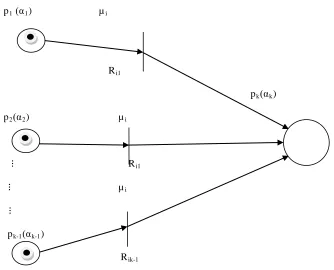
Type – 3 is normalized as
Ri1(µi) : P1(α1) → Pk(αk)
Ri2(µi) : P2 (α2)→ Pk(αk)
: :
Rik-1(µi) : Pk-1(αk-1) → Pk(αk)
and the PN structure is given as :
p1 (α1) µi
Ri1
pk(αk)
p2(α2) µi
⋮ Ri1
⋮ µi
⋮
pk-1(αk-1)
[image:3.612.99.433.438.708.2]Rik-1
ISSN: 1992-8645 www.jatit.org E-ISSN: 1817-3195
2.2 Rule based issues
Consider the rule which is shown in the following figure.
R1 ( 0.80) : IF P1AND P2 THEN P6
R2(0.90) : IF P2 AND P3AND P4
THEN P7 AND P8
R3(0.80) : IF P4 AND P5 THEN P9
R4(1.0) : IF P6 THEN P7
R5(0.80) : IF P8 AND NOT P9 THEN
P10
p1(.80)
R1(.80) p6(.70) R4(1.0) p7(0)
P2(.70)
P3(.75)
R2(.90)
P8(.60)
P4(.65) R5(.80p10(0)
P5(.50) R3(.80) p9(.50)
Figure 4
2.3 Some of the salient features of FRPNs
a) Number of tokens in a place
cannot be greater then one since token is associated with degree of truth between zero and one .
b) FRPNs are always conflict-free
sets.
c)
On transition firing, tokens arenot removed from the input places. This is because the evolution of the rules means the only the truth propagation of the propositions. In other words, the truth of proposition will not disappear because of
the rule reasoning
.
3. PRELIMINARY ON
INTUITIONISTIC FUZZY SETS
Intuitionistic Fuzzy Sets (IFS) is the generalization of fuzzy sets [2, 3] to represent vague and uncertainty.
Definition 1 (IFS): Given an universal set X, an intuitionistic fuzzy set (IFS) .A is a set of ordered triples,
A= {(x,μA(x),γA(x)) | x ∈ X }
(1)
Where μA(x) : x →[0,1] , γA(x) : x→ [0,1]
Representing membership and non-membership functions respectively of A .Moreover for every
x ∈ X in A, 0 ≤ μA(x) + γA(x) ≤ 1, holds and
(μA(x) , γA(x) ) is called intuitionistic fuzzy
number. For every common fuzzy subset Aon X, we define πA(x) = 1- μA(x) – γA(x), πA(x) is
intuitionistic index of X in A. Obviously, for
every x ∈ X, 0 ≤ πA(x) ≤ 1,and for common
fuzzy subset A on X,
πA(x) = 1- μA(x) – [1- μA(x) ] = 0,∀x ∈
X
Definition 2: Let A and B be two intuitionistic fuzzy subsets on X ,then
A+B = {‹ x, μA(x) + μB(x) - μA(x).
μB(x) , γA(x). γB(x) › | ∀x ∈ X }
(2)
A.B = { ‹ x , μA(x). μB(x) , γA(x)
+ γB(x) - γA(x). γB(x) › | ∀x ∈ X }
(3)
4. REVIEW OF IFPN
4.1. Basic IFPN
IFPN model is defined as 7-tuples as
follows:
IFPN=(P,T,D,I,O,τ,θ) (4) where
P = {p1, p2, p3… pn } is a finite set of places
T = {t1,t2,t3 ……tm} is a finite set of transitions
D = {d1,d2,d3,……dn} is a finite set of
propositions attached to each place
I = {aij} : P × T → [0,1] is an n× m weighted
input matrix defining the directed arcs from pi
to tj , then aij = wij (weight attached to the arc
from pi to tj ) or else aij = 0, for i=1, .., n, j=1, ..
,m
O = {bij} : T × P → [0,1] is m× n output
matrix defining directed arcs from transitions to
places. If there is a directed arc from tj to pi
,then bij = cj or else bij = 0, where cj = (Cμj ,
Cγj ) is an intuitionistic fuzzy number ,Cμj
means the support degree of tj and Cγj means
non-support degree of tj , j = 1,2, ….,m , I =
1,2, ….,n
τ = ( τ1 , τ2 ,….𝜏Rm ) represents the threshold
vector whose components represent the condition of the rule that a transition can be fired, τj = (αj ,βj ), 0 ≤ αj + βj ≤ 1 holds, αj
and βj both non-negative representing the
threshold support / non-support degree.
θ: P × T → [0,1] is an associate function which
assigns a token value to each place .It is a fuzzy value of each proposition.The initial state vector θ0 = ( θ
10 , θ20 ,…. ,θn0 ) where θi0 =
(θμi0 , θγi0)
is an intuitionistic fuzzy number .Moreover P∩ T∩ D = ∅ , |P| = |D| = n , |T| =m
4.2 Conversion from FPN to IFPN
We mapped a FPN structure to IFPN
ISSN: 1992-8645 www.jatit.org E-ISSN: 1817-3195
introduce both the membership and non-membership of propositions, rules and the threshold of rules by intuitionistic fuzzy numbers. The conversion is shown in Fig 4 from the FPN presented in Figure 5.
4.3 Knowledge Representation of IFPN Fuzzy production rules can be suitably modeled through intuitionistic fuzzy Petri nets. Rule R :
If d1 and d2 and … dn Then dk (CF= μ )
λ1, w1,w2,….. wn
(5)
Where d = (d1,d2,d3,…. dn) is the antecedent
portion comprising of proposition dk represent
the consequent part ,wi (i= 1,2,..,n) is the weigh
of di to rule Ri. λ is the threshold value of R. μ
is the confidence degree of R.Moreover all
antecedent propositions, consequent
propositions ,λ, μ are intuitionistic fuzzy
numbers .We may replace antecedent
propositions d1,d2,….dn by places
p1,p2……….,pn and consequent proposition dk
by pk .If is the token value of pi is θi then the
token value of pk is θk = (μk , γk ) where,
μk =(∑ 𝑤𝑛𝑖=1 Riμi ) × [ 1+ (Cμ –Cγ ) / 2]
γk =( ∑𝑛𝑖=1𝑤Riγi ) × [1+ (Cγ – Cμ ) / 2]
(6)
4.4 Execution rules of IFPN
We use max algebra to introduce four operators of matrix algebra.
(1) Addition operators ⊕ : C=A⊕ B ⇔
cij=max(aij ,bij) , Where A,B are n× m
intuitionistic matrices
(2) Multiplication operator ⊗ : C=A ⊗B
⇔ cij = max1<𝑘<𝑙( 𝑎Rik , bkj ) Where A
is n× l , B is l× m , C is n× m matrices
(3) Comparison operator © : C = A© B ⇔
cij = {1 , if aij ≥ bij
0, if aij < bij }
(4) Product operator Θ : C = AΘ B ⇔ cij =
aij . bij , where A,B,C are n× m
intuitionistic fuzzy matrices.
Moreover if the elements of A, B, C are intuitionistic fuzzy numbers, the operations among the elements are in accordance with intuitionistic fuzzy logic such as
aij . bij = ( μ(aij) . μ(bij) , γ(aij) + γ(bij) -
γ(aij) . γ(bij) )
max ( aij , bij ) = (max ( μ(aij) , μ(bij)) , min
( γ(aij) , γ(bij)))
and aij ≥ bij ⇔μ(aij) ≥ μ(bij) and γ(aij) ≤
γ(bij)
5. IFPN ALGORITHM
Input: Given quantities are initial token
vector θ0
of places, the threshold vector τ of transition, the weighted input matrix n × m and the output matrix m × n
Output: The final token vector θ and number
of iterations k
Step 1: Set k = 0
Step 2: Compute the equivalent fuzzy token vector of input places of the transitions
E = IT × θK
(7)
E € Rm , E = (ei) ,ei = (Eμi , Eγi ),
i=1,2,3…….,m
is intuitionistic fuzzy number θK
token vector at kth iteration ,θ0 is
known.
Step 3: Compare vector E with τ , then get rid of the item which can not touch off the transition
τ I = (αi ,βi ) and Eμi ≥ αi and Eγi ≤
βi
. Then gi = ei or else gi = 0 , i= 1,2,
……,m
Step 4: Compute token value of the exporting
place , let
S = O ⊗G (9)
Step 5: Compute θK+1 =θK⊕
S (10)
Step 6: If θK+1 ≠ θK
,go to Step 2 else STOP
6. ILLUSTRATIVE EXAMPLE
Consider the rule which is shown in the following Fig 5:
R1 : IF P1(.80) and P2(.70) THEN P6 (
CF(.8,.18) ( τ1 = (.25,.65))
R2 : IF P2(.70) AND P3(.75) AND P4(.65)
THEN P7 AND P8 ( CF (.9,.01) (τ2 =(.70,.20))
R3 : IF P4(.65) AND P5(.50) THEN P9 ( CF(
.8,.15) (τ3 =(.40,.55))
R4 : IF P6(.70) THEN P7 (CF( 0,1) (τ4 =(
.30,.60))
R5 : IF P8(.60) AND P9(.50) THEN P10 (CF (
.10,.80) ( τ5 = (.81,.10))
P1 p2 p3 p4
p5
0.80 0.70 0.75 0.65 0.50
τ1 =(.25,.65) (.8,.18) (.9,.01) τ2 = (.70,.20) (.80,.15) τ3 =
(.40,.55 )
p6 p8 p9
0.70 0.60 0.50
τ4 = (.30,.60) (0,1) (.10,.80) τ5 = (.80,.10)
P7 p10
ISSN: 1992-8645 www.jatit.org E-ISSN: 1817-3195
The input matrix
R1 R2 R3 R4 R5
I = p1 . 80 0 0 0 0
P2 .70 . 70 0 0 0
P3 0 .75 0 0 0
P4 0 .65 .65 0 0
P5 0 0 .50 0 0
P6 0 0 0 .70 0
P7 0 0 0 0 0
P8 0 0 0 0 .60
P9 0 0 0 0 .50
P10 0 0 0 0 0
The output matrix
R1 R2 R3 R4 R5
O= p1 (0,1) (0,1) (0,1) (0,1) (0,1)
p2 (0,1) (0,1) (0,1) (0,1) (0,1)
p3 (0,1) (0,1) (0,1) (0,1) (0,1) O( pi , Rj ) = { (0,1) , arc from pi to Rj
p4 (0,1) (0,1) (0,1) (0,1) (0,1) CF, Otherwise}
p5 (0,1) (0,1) (0,1) (0,1) (0,1)
p6 (.8,.18) (0,1) (0,1) (0,1) (0,1)
p7 (0,1) (.9,.01) (0,1) (0,1) (0,1)
p8 (0,1) (.9,.01) (0,1) (0,1) (0,1)
p9 (0,1) (0,1) (.8,.15) (0,1) (0,1)
The initial truth degree vector ∝P
0
=( ∝R1
0
,∝R2
0
,
……… , ∝Rn
0
) ∝ : P→(μ,γ)
Where μ is membership function and γ is non-membership function
The initial token value
𝜃P
0
= ∝P
0
= [( .8,.15), (.25,.7), (.35,.6), (.3,.65), (.5,.45), (0,1), (0,1), (0,1), (0,1), (0,1)]T
The threshold of transition
τ = [(.25,.65), (.2,.7), (.1,.85), (.3,.6), (.80,.10)]
According to IFPN algorithm, the reasoning result is:
θ1
= [(.8,.15), (.25,.7), (.35,.6), (.3,.65), (.51,.28), (.5,.45), (.23,.43), (.23,.43), (.2,.35), (0,1)]
θ2= θ1
(𝛼P
2
= 𝛼P
1
)
Due to θ2 = θ1
, the inference is finished.
Hence p1 = (.8,.15) is the most probable
causation and p5 is the next.
7. CONVERSION OF IFPN TO FPN
We use the inverse transformation of IFPN to FPN. We mapped a IFPN structure to FPN structure by introducing the knowledge of fuzzy
principles. The conversion is shown in Fig 5 from the FPN presented in Figure 4.
P = { p1 , p2 , p3 , p4 , p5 , p6 ,p7 , p8 , p9, p10 }
R = { R1, R2, R3, R4, R5}
R1 R2 R3 R4 R5
O = p1 0 0 0 0 0
P2 0 0 0 0 0
P3 0 0 0 0 0
P4 0 0 0 0 0
P5 0 0 0 0 0
P6 1 0 0 0 0
P7 0 1 0 1 0
P8 0 1 0 0 0
P9 0 0 1 0 0
ISSN: 1992-8645 www.jatit.org E-ISSN: 1817-3195
C = diag ( 𝜇R1 , 𝜇R2 , 𝜇3 , 𝜇4 ,𝜇5 )
R1 R2 R3 R4 R5
R1 0.8 0 0 0 0
R2 0 0.9 0 0 0
R3 0 0 0.8 0 0
R4 0 0 0 1 0
R5 0 0 0 0 0.8
R1 R2 R3 R4 R5
I = p1 1 0 0 0 0
p2 1 1 0 0 0
p3 0 1 0 0 0 I ( pi , Rj ) = { 1 , arc from pi to Rj
p4 0 1 1 0 0 0 , Otherwise
p5 0 0 1 0 0
p6 0 0 0 1 0
p7 0 0 0 0 0
p8 0 0 0 0 1
p9 0 0 0 0 1
R1 R2 R3 R4 R5
H = p1 0 0 0 0 0
p2 0 0 0 0 0
p3 0 0 0 0 0 H(pi ,Rj ) = { 1 , if ∋ complementary arc from pi toRj
p4 0 0 0 0 0 0 , Otherwise
p5 0 0 0 0 0
p6 0 0 0 0 0
p7 0 0 0 0 0
p8 0 0 0 0 0
p9 0 0 0 0 0
p10 0 0 0 0 0
The initial marking vector: : P→[0,1]
𝛾P
0
= ( 𝛾R1
0
, 𝛾R2
0
, …… , 𝛾Rn
0
)T 𝛾Ri
0
= { 1, if
there is marks in pi
= (1, 1, 1, 1, 1, 0, 0, 0, 0, 0) 0, otherwise}
The initial truth degree vector ∝P
0
=( ∝R1
0
,∝R2
0
,
……… , ∝Rn
0
)
∝ : P→[0,1]
𝜃P
0
= ∝P
0
= ( 0.8 , 0.7 , 0.75 , 0.65 , 0.5 , 0 , 0 , 0 , 0 , 0 )T
µ = (µ1, µ2, ….µ5)T µj = { 1 if rj fire 0
otherwise }
Here µ0 = ( 1, 1, 1, 0, 0 )T R1, R2 and R3 fire
Now, firing R1, R2 and R3 has been done.
Firing vector µ1 = ( 1, 1, 1, 1, 1 )T all rj’s are
firable
r1 = [ 1, 1, 1, 1, 1, 1, 1, 1, 1, 0 ]
𝜃P
1
= 𝛼P
1
= [ .8, .7, .75, .65, .5, .56, .27, .27, .4, 0 ]T
𝜌P
1
= ( .7, .3, .5, .44, .27 )T
𝛾P
2
= ( 1, 1, 1, 1, 1, 1, 1, 1, 1, 1 )T
𝛼P
2
= 𝜃P
2
= ( .8, .7, .75, .65, .5, .56, .44, .27, .4, .216 )T
𝛾P
3
= 𝛾P
2
, 𝜃P
2
= 𝜃P
3
( 𝛼P
3
= 𝛼P
2
)
ISSN: 1992-8645 www.jatit.org E-ISSN: 1817-3195
8. CONCLUSION AND FUTURE SCOPE
A special type of FPN model has been extended to represent IFPN taking the advantage of both FPN and IFPN. It gives wider practical description and precision in reasoning. It is shown that the negation issue can also be addressed in IFPN.The matrix equation based format that is similar to PN’s for knowledge representation in IFPN is suitably addressed. It has great potential to be used to solve other complex problems effectively.
We emphasize a lot of future works can be extended from the present analysis. We can convert IFPN to FPN and vice versa and study the related problems. We can use it for generalized IFPN to capture more practical use.
REFERENCE
[1] C G. Looney, “Fuzzy Petri nets for turbaned
decision making”,IEEE Transactions on
system, man, and cybernetics part A, Vol. 18 No. 1, 178~183, 1988.
[2] Y. J. Lei, B. S. Wang, and Y. L. Lu, “Techniques for approximate reasoning based on intuitionistic fuzzy logic”, Control and Decision,Vol. 21 No. 3, 305~310, 2006. (In Chinese).
[3] Shyi-Ming Chen, “Weighted Fuzzy Reasoning Using Weighted Fuzzy Petri Nets”, IEEE
Transactions on Knowledge and Data
Engineering(S1041-4347), Vol. 14 No. 2, 386~397, 2002.
[4] Ioannis K. Vlachos and George D. Sergiadis,
“Intuitionistic fuzzy
information-Applications to pattern recognition”, Pattern Recognition Letters, Vol. No. 28, 197~206, 2007.
[5] M. M. Gao, M. C. Zhou and Y. Tang,
“Intelligent Decision Making in
Disassembly Process Based on Fuzzy
Reasoning Petri Nets”,IEEE Transactions
on Systems, Man and Cybernetics, Part B, Vol.34 No. 5, 2029~2034, 2004.
[6] J. Cardoso, R. Valette, and D. Dubois, “
possibilistic Petri nets,” IEEE trans. Syst.,
man, cybern. B, vol. 29, pp. 573-582, Oct. 1999.
[7] S. M. Chen, J. S. Ke, and J. F. Chang, “ knowledge representation using fuzzy Petri
nets,” IEEE Trans. Knowl. Data Eng., vol.
2, pp. 311-319, Mar. 1990.
[8] S. M. Koriem. “ A fuzzy Petri net tool for modeling and verification of
knowledge-based systems,” Comput. J., vol. 43, no. 3,
pp. 206- 223, 2000.
[9] L. X. Jia, J.Y. Xue and F. Ru, “Fuzzy Petri
Net Based Formalized Reasoning
Algorithm with Applications”, Journal of