PATTERN DISCOVERY AND ANALYSIS FROM
SEMI-STRUCTURED DATA: THE AUTOMATIC
REGENERATION OF PATTERNS
1ASMÂA ELOUERKHAOUI, 2DRISS ABOUTAJDINE
1
LRIT, Unité associée au CNRST n 29, Faculty of Sciences, Mohamed V-Agdal University,
B.P. 1014, Rabat 10000, Morocco.
Tel : (212) 6-69466359
2LRIT, Unité associée au CNRST n 29, Faculty of Sciences, Mohamed V-Agdal University,
B.P. 1014, Rabat 10000, Morocco.
Tel : (212) 3-7778973
E-mail: [email protected], [email protected]
ABSTRACT
Web-mining is the application of data mining techniques to extract knowledge from the world wide web, including web documents, hyper-links between documents, etc. Content-mining is the second step in Web data mining which mines web pages text to determine the relevance of the content to the search query. In 2008, we have proposed WIEBMat (Wrapper Induction Environment Based on Matrices) a new web
content mining method[1]. This paper aims to optimize pattern discovery of WIEBMat. Effectively, the
process of discovering frequent patterns from semi-structured data is one of the most important weaknesses in every web-mining technique .
Keywords: Web-Mining, Semi-Structured Data, Pattern Discovery.
1. INTRODUCTION
WIEBMat is an application for extracting and
gathering data from several web sources in order to generate a dedicated Meta-search engine. This approach is based on the analysis of resultspages structure that highly reduce and limit human intervention to input at maximum three instances examples in order to configure the meta-search engine with an existent web source.
A wrapper means both a proceeding for extracting tuples from a particular information
source [3][4][5], and a function applied to query
responses.
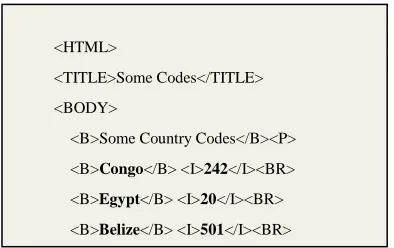
Taking as example the response to a specific query (fig.1) that allows displaying the countries names and their telephone codes. Initially, the web page contains structure errors, so as to be comprehensible by a learning machine expected to be converted into XML language. Add to this, the wrapper has to use delimiter strategy to indicate the relevant information context. Figure 2 below show it.
Some Country Codes Congo 242
[image:1.612.336.504.450.561.2]Egypt 20 Belize 501 Spain 34 End
Figure 1: A Fictitious Internet Site Providing Information About Countries And Their Telephone Country Codes
Given An Example Query Response.
From figure 2, it appears that this resource displays
tuples by surrounding countries names with markups <B> and </B>, and country codes with markups <I> and </I>. The occurrences of this tuple are:
{(Congo, 242); (Egypt, 20); (Belize, 501); (Spain, 34)}
a wrapper induction system to extract information from web sources. Add to this, this simple left-right (LR) strategy, fails because not all occurrences of <B>... </B> indicate a country name. However, the string <P> can be used to distinguish the head of the page from the correct tuples.
Figure 2: HTML Text From Which The Figure 1 Was Rendered
In short, an information extraction system consists in extracting a set of tuples from one or many query responses. Therefore, the information to be extracted is a set of fragments that have regular structure. Furthermore, this regularity (i.e., displaying countries' names in bold face and codes in italic) is not available as a machine-readable specification, but rather as a lack of normality aspect of the country/code resource. The term
'semi-structured' is used simply to guide the
intuitions about the kinds of information resource in which we are interested, and so we will not provide a precise definition.
Thereby, the process of a wrapper induction system is to parse web document represented as a query response to extract the relevant content while discarding the irrelevant ones.
2. WIEBMAT
WIEbMat (Wrapper Induction
Environment based on Matrices) [1][11][12][13][14][15] is
an information extraction (IE) system. The main
task of IE system is extracting structured
information from unstructured/semi-structured
documents. WIEBMat lies on an inductive
environment as the Gene/Clone method [2][9] which
we have proposed in earlier work.
Summarily, a web wrapper induction system can be either a system that need labeled examples or a system that can search for important information autonomously. In other words, the first kind of wrapper takes as input instance example of a chosen relation to extract the second technique,
analyses the structure of a web document to output the repetitive data in a regular format so that the user can chose which one is relevant for him.
WIEBMat as an inductive approach using instance
examples on its input which are used to generate a pattern (This phase is certainly preceded by a pretreatment of web document). The pattern discovery is regular expressions describing context and delimiters of the relation to be extracted. The use of a matrix in WIEBMat approach allows the system to re-evaluate the calculated pattern in case where the matrix contains null elements.
Thus, we build an initial matrix which contains relevant and noisy data, by means of some calculated parameters we delete each row which contains at least one null element and we obtained at the end of the process a final matrix which contains only relevant data. We obtained very
satisfying results by using this technique (yield
relevant data at a rate of almost 96%). The real
problem which reduce this rate is the process of
XML-isation (transforming a web pages coded in
HTML language into XML format), that’s why we have introduced a new parameter which calculates
the capacity of the system to XMLisate a web page
before performing information extraction (
XML-isation rate must be higher than 0.37%), thus, the experiments we conducted over several data sources have shown that web sources which has a rate of XML-isation lower than 0.37 cannot be efficient for WIEBMat algorithm). We implement this approach to create a Meta Search Engine called
BERG. It uses in its back-office as many search
engines as the user configure. BERG is a price
comparison tool based on several commercial site (Cdiscount, Amazon, Pixmania, Priceminister, Rueducommerce).
<HTML>
<TITLE>Some Codes</TITLE>
<BODY>
<B>Some Country Codes</B><P>
<B>Congo</B> <I>242</I><BR>
<B>Egypt</B> <I>20</I><BR>
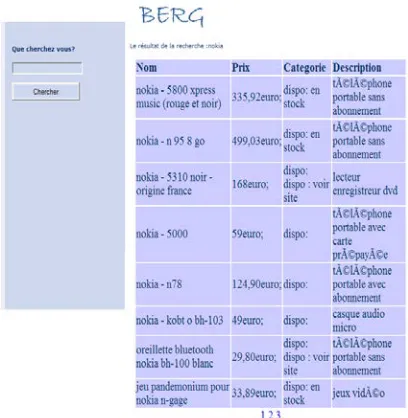
Figure 3: The Main Graphical Interface Of BERG
Figure 4: A Response Web Page Of BERG
Once one or several keywords are entered
in the text box shown in the figure 1 we obtained as
much as results found using the search engines
configured in the back office. The utility of BERG
lies in the conception of meta-search engines which fit to users need (eg. Filter results).
To configure a web source in the BERG’s back-office we have to enter first of all the information shown in the third figure which are the source URL (Unified resource Locator) using at least two key words, and the URL of the second response web pages. Add to this we enter the name of the search engine to identify it and the number of results found in one single web page.
Figure 5: First Graphical Interface Of BERG Back Office's
After that, we are redirected to the second graphical interface where we enter two example instances as shown in the figure four. This pattern may then be used to retrieve other instances.
The tuple used in this example is:
[image:3.612.329.460.468.610.2]{(Name, price, Category, description)}
Figure 6: Second Graphical Interface Of BERG Back Office's
from these sources. The contexts of these instances are then extracted from a set of result pages. This method has several advantages with regard to the previous methods; it allows users to express simply their needs of information as a set relation instances to be extracted. The number of example instances to be given is often reduced: generally two or three instances for each source are enough.
3. PATTERN DISCOVERY AND ANALYSIS FROM SEMI-STRUCTURED DATA
There are several approaches which allows to obtain a wrapper, they are distinguished by the type of data they take as input. The most efficient ones are the inductive approaches; they consist on building a wrapper from a set of labeled examples pages introduced by the user, the structural approach which allows building patterns by analyzing the structure of per-formatting HTML pages to a comprehensible machine format as XML. Thus, this pattern is used to retrieve other instances
In this paper, we detect the patterns behavior so that we can improve them. This analysis has allow us to regenerating the pattern used to extract data instead of remain on the first calculated one. The idea is to use extracted occurrences from the generated pattern as new instances examples to reestablish it.
[image:4.612.87.294.456.536.2]This technique is summarized in the following figure:
Figure 7: Pattern Analysis By Generating New Pattern From Extracted Occurrences (Duality Pattern-Relation)
The behavior of the pattern is associated with the evaluation of the F-measure (equation (1)). The F-measure combines the precision and recall rate.
F=2∗Precision∗Recall Precision+ Recall
Equation (1)
Precision (equation (2)) and Recall rates (equation
(3)) are defined as follow:
Precision= tp tp+ fp
Equation (2)
Recall= tp tp+ fn
Equation (3)
Precision Recall measure the ratio between the quantity of extracted relevant data and the quantity of extracted one.
Recall measure the ratio between the quantity of extracted relevant data and the quantity of relevant one existing in the used document.
TP: Number of extracted relevant occurrences
FP: Number of extracted non-relevant occurrences
FN: Number of non-extracted relevant occurrences
Considering a d document used to extract
data using a p Pattern, we applied WIEBMat
approach pattern to extract the following relation:
{(label), (price), (description)}.
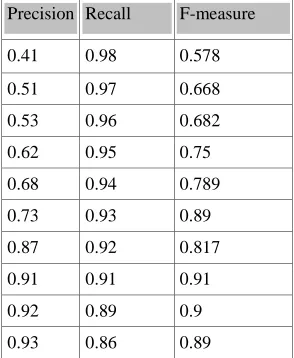
Using initially two instance examples which are extracted from five preconfigured web sources 283 occurrences (the Precision rates, the Recall rates and the measure are evaluated below), we have applied the technique defined below. The found results are describde in the following diagram:
TABLE 1:EVALUATION OF INDICATOR :PRECISION/RECALL/ F-MEASURE.
Precision Recall F-measure
0.41 0.98 0.578
0.51 0.97 0.668
0.53 0.96 0.682
0.62 0.95 0.75
0.68 0.94 0.789
0.73 0.93 0.89
0.87 0.92 0.817
0.91 0.91 0.91
0.92 0.89 0.9
0.93 0.86 0.89
[image:4.612.344.491.528.707.2]Figure 8: Evolution Of F-Measure According To Precision And Recall Rate
We concluded during these experiments that this servo mechanisms allow to calculate independently for each web source an optimal pattern retained when the system obtain the higher F-measure.
4. CONCLUSION
The automatic generation of wrappers that can extract relevant data objects embedded in semi-structured HTML pages expects that this mechanism generate a pattern which represents the structure of the data objects in the data-rich section. Thereafter, this pattern is used to extract data objects from a web page for a subsequent querying. In this paper, we evaluated the used pattern so that it can be steadily regenerated according to the highest F-measure found for the specific chosen relation and with the preconfigured web sources
(eg. F-measure=0.9, Precision=0.92 and
Recall=0.89 for www.ebay.com). This experience
has demonstrated that an optimized pattern is not based on a high precision and recall rates, but on the duality between the relation to extract and the used pattern. Ultimately, the F-measure depends on the selected relation which designates the appropriate pattern.
REFRENCES:
[1] Asmâa Elouerkhaoui, Abdelaziz Sdigui Doukkali, “WIEBMat, a new information extraction system” IJCSNS International Journal of Computer System and Network Security, vol. 8, N.11, November 2008.
[2] El Habib BEN LAHMER, Abd Elaziz
SDIGUI DOUKKALI, ElOuerkhaoui Asmaa. (2006). A new solution for data extraction: Gene/Clone method. IJCSNS volume 6.
[3] Kushmerick, N. , Weld, D. ,and Doorenbos,
R. , Wrapper induction for information extraction. Proceeding of the 5th International conference on artificial intelligence (IJCAI), pp.729-735, 1992
[4] Kushmerick, N. , Weld, D. ,and Doorenbos,
R. , Wrapper induction for information extraction. Proceeding of the 5th International conference on artificial intelligence (IJCAI), pp.729-735, 1992
[5] Conference paper or contributed volume
Habegger, B., Extraction d’information à partir du Web, thèse pour obtenir le grade de docteur de l’Université de Nantes, 200
[6] El Habib BEN LAHMER, Abd Elaziz
SDIGUI DOUKKALI, Mohamed OUMSIS. La Meta recherché générique: vers la génération des Meta moteurs de recherche. CopStic’03 Rabat, Mar
[7] El Habib BEN LAHMER, Abd Elaziz
SDIGUI DOUKKALI, Mohamed OUMSIS. Towards an automatic extraction of data from half-structured documents. In ISCCSP2006.
[8] El Habib BEN LAHMER, Abd Elaziz
SDIGUI DOUKKALI, Mohamed OUMSIS, 2004, WBERG, un Meta annuaire WAP, in isivc’04 Brest France.
[9] El Habib BEN LAHMER, Abd Elaziz
SDIGUI DOUKKALI, ElOuerkhaoui Asmaa. (2006). A solution for data extraction by a new approach: The method of Gene/Clone. ICT4M: Kuala Lumpur, Malaysia.
[10] El Habib BEN LAHMER, Abd Elaziz
SDIGUI DOUKKALI, ElOuerkhaoui Asmaa. (2006). BERG 2.2: a Meta search engine for on-line directories. ISCIT’06, Bangkok, Thailand.
[11] ElOuerkhaoui Asmaa, Abd Elaziz SDIGUI
[12] Elouerkhaoui Asmâa, Abdelaziz Sdigui Doukkali, 'Comment rendre le contenu informationnel sur Internet intelligible'. WOTIC'07, Rabat, Maroc.
[13] Elouerkhaoui Asmâa, Abdelaziz Sdigui
Doukkali, 'Extraction d'information à partir d'Internet' AMINA'08, Monastir, Tunis.
[14] Elouerkhaoui Asmâa, Abdelaziz Sdigui
Doukkali, 'Génération d'adaptateurs à partir de pages étiquetées'. WOTIC'09, Agadir, Maroc.
[15] Elouerkhaoui Asmâa, Abdelaziz Sdigui