ISSN: 1992-8645 www.jatit.org E-ISSN: 1817-3195
189
RESEARCH ON MULTI-LEVEL LOG-BASED RELEVANCE
FEEDBACK SCHEME FOR IMAGE RETRIEVAL
1WEIFENG SUN, 2JING LUO, 3KAIXIAN HU, 4CHUANG LIN
1
School of Software of Dalian University of Technology 116620 Dalian Liaoning, China
ABSTRACT
Content-based Image Retrieval (CBIR) using relevance feedback technique is applied to improve the results of traditional techniques in image retrieval. Since the results returned by system cannot fully satisfy users and the iteration process of feedback can be very time-consuming and tedious, log-based relevance feedback is introduce to the system. In previous work, we have already introduced multi-level log-based relevance feedback scheme for image retrieval to accelerate the iteration process and to increase the hit rate. In this paper, we improve the novel algorithm and apply it in a demo image retrieval system which presents refined results based on multi-level log-based relevance feedback for Content-based Image Retrieval.
Keywords: Image Retrieval, Multi-Level, Content-Based, Log-Based
1. INTRODUCTION
Nowadays, with the development of digital era, governments, enterprises and personal users produce a huge amount of data, the majority of which is image. And the number keeps going up. Effective data management and image retrieval tool is necessary. Traditional text-based image retrieval face the difficulties that manually image annotation requires a vast amount of labor and that annotation asks for objectivity while people always work subjectively. To overcome the difficulties, Content-based image retrieval is introduced, which can
automatically detect the low-level features,
including color, shape, texture, and find similar target images (Ru Liyun, Peng X, Su Z, and Ma S, 2003). Considering the complexity of images, judging an image by its low-level features is semantically ambiguous (LI Xiangyang, Zhuang Y, and Pan Y, 2001). To make up the semantic gap between low-level features and high-level concepts, relevance feedback is applied to CBIR and has caused a wide research interests among scientists. User’s feedback improves the results of CBIR greatly, and meanwhile the tedious iteration process
and time-consuming property makes users
impatient to wait for the refined results. However, the previous users’ feedback log contains lots of effective user information about images, which can help to cut off the semantic gap between high-level concept and low-level features as well as shorten the iteration process. In this paper we use a novel algorithm developed in previous work to discuss log-based image relevance and apply it in an image retrieval system to test the results.
The rest of this paper is organized as follows. Related work is presented in Section 2. Section 3 introduces a novel algorithm which mines the multi-level log-based relevance of images. Section 4 presents performance in an image retrieval system. Section 5 is the conclusion.
2. RELATED WORK
ISSN: 1992-8645 www.jatit.org E-ISSN: 1817-3195
190 the system. After the same procedure mentioned above, users will be asked to label the relevant images and irrelevant images. Then, the relevance feedback learning machine (Meng W, Hua X, 2011) will update the search conditions and rematch all the images in the image database, refine the result after every feedback session until user finds desired target (Wu Hong, Lu H, Ma S D, 2005). Though it enhances the results, the iteration process and response time are too much to cause the users of impatience. To reduce the waiting time for users finding the desired target, log-based relevance feedback is introduced. Informative previous users’ logs help construct the relevance relationship between the images in the database and rank them according to the log-based relevance degree computed by the system. Some typical approaches use support vector machine (Fu Yan, Wang Y W, Wang W Q, Gao W, 2003) or soft label support vector machine (S. C. H. Hoi, M. R. Lyu, and R. Jin, 2006) to solve the problem, however, there still are drawbacks in those approaches.
Different from schemes mentioned above, we use a multi-level algorithm to compute the log-based relevance degree in a CBIR system. When computing the log-based relevance, our multi-level log-based relevance feedback (MLLR) scheme is more efficient. It fully uses the connections between positive samples to find the target image for user.
3. BRIEF INTRODUCTION ON
MULTI-LEVEL LOG-BASED RELEVANCE
Typical Log-based Relevance Feedback Scheme
Using SVM : Typical log-based relevance
feedback scheme uses user logs in two ways. First, the system counts the log-based relevance image to target image; second, those log-based images are used as the training samples for the learning machine. Learning machine’ performance can be affected by the quality of samples. Among all the samples, those relevant sample are marked as positive samples while irrelevant ones are marked negative. After all the samples are sorted into positive and negative, they will be used to classify all the rest images in database. In most log-based relevance feedback scheme using SVM (Fu Yan, Wang Y W, Wang W Q, Gao W, 2003) or SLSVM (S. C. H. Hoi, M. R. Lyu, and R. Jin, 2006) , both positive and negative feedbacks are used, we can call it a two-class SVM learning in image retrieval (Y Chen, X S Zhou, T S Huang, 2001). After samples are engaged to the learning machine classifier, images in the dataset will be ranked by the support vector machine or soft label support
vector machine. If two images are fed back as positive samples in one round of feedback session, these two images are marked as relevant “1” while if one image is fed back as positive and the other one as negative, those two images are marked as irrelevant “-1”. And by adding up all the corresponding relevance degree in every round of feedback session, the degree of the log-based relevance can be computed. According to the former user logs database, the log-based relevance of image to the user’s desired image is the difference between the image’s log-based relevance to user’s positive feedback and log-based relevance to user’s negative feedback.
ISSN: 1992-8645 www.jatit.org E-ISSN: 1817-3195
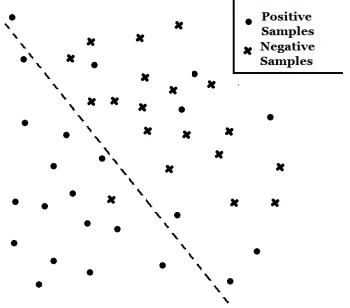
[image:3.612.110.285.147.301.2]191 estimate the distribution of negative images in the database based on relevant feedback (H Yu, J Hen, and K C Chang, 2004). Fig 1 shows what it looks like in a more direct way.
Fig 1. Dot Represents Positive Samples, And Cross Represents Negative Samples
Figure 1 shows that the system may have a high chance to miss some “good” samples if not knowing the distribution of negative samples.
To solve the problems, we use a novel algorithm named multi-level log based relevance (MLLR) feedback scheme (H C Zhang, W F Sun, S C Dong, 2010). We made an assumption that when a user gives a feedback containing two positive images, there is a virtual link built between those two images. As the rest images are done in the same manner, the virtual links between images construct a multi-level structure of log-based relevance. Assuming that A is a positive sample fed back by user, B is relevant to A, C is relevant to B, and D is fed back being relevant to C, then D will be relevant to A, though indirectly. In the case above, A is in the top level, B is in a lower level than A, C is in a lower level than B, and the same manner for D. In MLLR, upper level images’ log-based relevance can be transmitted to the lower level images through those logical virtual links which makes the algorithm full uses both direct and indirect multi-level relevance. Therefore, the algorithm can full mine the log-based relevance. Besides, MLLR only use positive feedbacks which can both save users time from picking up irrelevant images and reduce the noise impact negative feedbacks bring. Also, manually collected negative samples could be biased and detrimental due to human’s unintentional prejudice.
Multi-level Log-based Relevance Feedback
Scheme : In multi-level log-based relevance
feedback scheme, when user cannot find his desired
target in the initial results which come from the content-based relevance feedback system, he will choose to start the relevance feedback procedure. The system will give user some images, then user can pick some of which as positive samples. After that the system will begin the iteration session. Each round of iteration process is regarded to be one feedback session. Through all the sessions, how the log information is stored is vital. MLLR assumes that there exists a virtual link between two
images and has
c
ijrepresents the number of virtuallinks between image i and image j. After one
feedback session is finished, all the
c
ij in thedatabase will be updated. In order to manage the logs well, we build a virtual link vector (H C Zhang, W F Sun, S C Dong, 2010):
{ , ,
ij}
ILV
=
i j c
(1)
The vector is used to represent the information about the number of virtual links between any too images in the database. The first element represents image i, the second element represents image j and
the third element
c
ij represents the number ofvirtual links between image i and image j. After each feedback session, the CBIR system knows which images are marked positive by user. And if any of the positive images has a virtual link with images from former feedback session, the number
of virtual links of the image (
c
ij ) should beupdated. For n images, the MLLR system has to
update
2 n
C
ILV (there is
2 n
C
ways to choose every pair of images from those n images) in the log database by adding a certain number to the
corresponding
c
ij.MLLR measures the relevance degree by set a criterion value c. That the number of virtual links
between image i and image j
c
ij is larger than cmeans image i and image j are same whereas
MLLR will uses
c
ij/
c
as the relevance degree if isij
c
ISSN: 1992-8645 www.jatit.org E-ISSN: 1817-3195
192 by the same c is not reasonable while manually setting c in every query is no possible, so we have to use a dynamic value of c. In MLLR, c is defined as following equation (2):
1 2 1 1
(
) /
x y n ni i n
x y x
c
c
C
−
= = +
=
∑ ∑
(2)
Since MLLR assumes all the feedback positive images equals, so c equals the average number of virtual links between any two images in the
database. While
c
ijis less than c, it happens thatsometimes
c
ij is too small to use the methodsmentioned above. That’s what we call as minority user noise. This phenomenon is due to disuse of the search system or special perception of images. So, here we try to find a suitable threshold value t. If
ij
c
is less than t, the relevance degree will be set to zero. t is defined as the equation t = a * c. a is a coefficient which can be manually set ranging from
0 to 1. To sum up, the relevance degree
r
ij can becomputed as the equation (3) below:
1
/
0
{
ijij ij ij
ij
c
c
r
c
c
t
c
c
c
t
≥
=
<
<
≤
(3)
In MLLR, each image is given a label level based on the round of the feedback session. In the first round, user gives back the feedback images
1
, ,...,
2 ni i
i
as the initial value and all the images in the first round are given level label 0. Images in the second round of iteration process will be give a level label 1, and the rest can be done in the same manner. The reason we give each image only one level label is that each image can only belong to one level, that’s one round of iteration process. For in every round of iteration process, only images which don’t have a level label will be computed. Another reason is that log-based relevance of each image is only effected by the image that in the upper level.
MLLR has R(i) denotes the log-based relevance between the image to the desired target and Set
1 2
( )
( )...
( ) 1
nR i
=
R i
=
R i
=
as the initial value since all the user’s feedback images are treated the same.
In every iteration, the log-based relevance of all the unlabeled i is computed as the following equation (4). 1
( )
(
(
* ( ))) /
x n ii x xR i
r
R i
n
=
=
∑
(4)* ( )
x ii xr
R i
is the log-based relevance from
i
xto i via virtual links, n is the number of the image. And the average R(i) of all the images to i will be used as the final log-based relevance.
Images with R(i)>0 will be labeled level 1 that means images in the first round of iteration. And we
have
I
1=
{ ,
i i
11 12,...,
i
1m}
represents level 1images.
In the second round of iteration, all the images which have not been labeled in the image database will be computed the relevance between user’s desired image and themselves according to the equation (5). 1 1 1
( )
(
(
* ( ))) /
x m ii x xR i
r
R i
m
=
=
∑
(5)
And again, images with R(i)>0 will be labeled level 2 that means images in the second round of iteration.
The iteration keeps going until:
1
( )
(
(
* (
))) /
0
y x
p
ii yx
x
R i
r
R i
p
=
=
∑
=
(6)
1 2
{ ,
,...,
}
y y y yp
I
=
i
i
i
represents the images labeled level y. If for all the unlabeled images, R(i)=0, the whole multi-level log-based relevance feedback iteration process is finished.
When the iteration ends, all the images in the database has a log-based relevance value according to previous user logs.
4. EVALUATION
Simulation Of Collecting Log Data: Different
ISSN: 1992-8645 www.jatit.org E-ISSN: 1817-3195
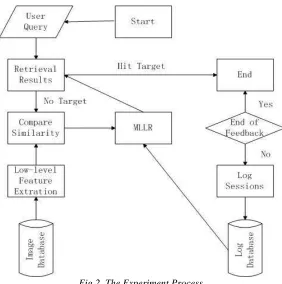
193 relevant images. When users finish choosing and press search button again, the feedback will be given to the MLLR and new retrieval results will be presented. The whole process is shown in Fig 2.
Evaluate MLLR In An Image Retrieval System:
In the experiment, we pick up 20 categories each of which contains 100 images. First our tester selects a query, and pick up some images as positive
[image:5.612.169.451.199.483.2]feedback. Meanwhile, taking noise into account, we inject 15% of the whole number of feedback images in to the log session. Then, after computing, system will retrieve images from image database and rank them according to relevance degree.
Fig 2. The Experiment Process.
In the experiment, we pick up 20 categories each of which contains 100 images. First our tester selects a query, and pick up some images as positive feedback. Meanwhile, taking noise into account, we inject 15% of the whole number of feedback images in to the log session. Then, after computing, system will retrieve images from image database and rank them according to relevance degree.
To evaluate our multi-level log-based relevance feedback (MLLR) system, we use the performance results in the log-based relevance feedback using SLSVM (LRF) (S. C. H. Hoi, M. R. Lyu, and R. Jin, 2006) and compare it to MLLR.
In the first experiment, we have q represents the query the user selects from the query database we mentioned above, PF represents user’s positive feedback image samples, and NF represents user’s negative feedback image samples. Num1(q)
represents the number of images that in the same category as q and it is given positive relevance based on the PF. Num2(q) represents the number of images that in the different category from q and it is given negative relevance based on the NF.
The experiment compared schemes which are evaluated on 50 queries that are selected randomly from the data set. For each query, the number of labeled sample acquired from the real-world user feedback is 10. Two measure metrics are applied in first experiment to evaluate the quality of multi-level log-based relevance feedback scheme.
ISSN: 1992-8645 www.jatit.org E-ISSN: 1817-3195
[image:6.612.84.305.148.266.2]194 SLSVM. This is because MLLR has virtual links between images and therefore can fully mine the direct and indirect relevant images while LRF only count those direct relevant images.
Table 1. Average Ratio Of Num1 Average Num1/100
MRRL 0.40
LRF 0.34
Table 2. Average Num2 Average Num2
MRRL 20.3
LRF 349.68
[image:6.612.93.299.399.573.2]In the second measurement, the average Num2(q) is counted over 50 queries. In table 2, we can find out that MLLR gives less irrelevant images than LRF. This is because MLLR only uses positive feedback which can avoid negative effects caused by negative feedback as we mentioned above while LRF uses negative feedback. For detail, logically, a negative image to a negative feedback can be positive, so some positive images LRF choose can actually be strongly negative. This is why MLLR can perform better than LRF.
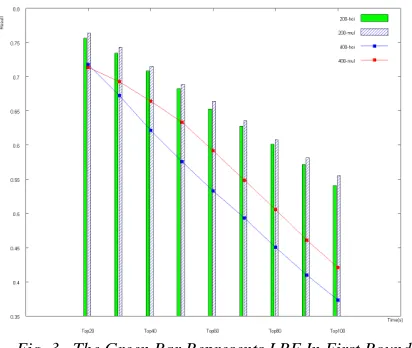
Fig. 3. The Green Bar Represents LRF In First Round While The While Bar Represents MLLR. The Blue Line Represents LRF And The Red Line Represents MLLR In
Second Round.
In the second experiment, In first round, we collected 200 images as the scale of images; in second round, a scale of 400 images is used. It turned out that MLLR performed better than LRF. In Fig 3, we found out that MLLR has a higher precision ratio than LRF, and as the number of retrieved images goes up, both MLLR and LRF’s
precision ratio go down. Therefore, we can tell that the experiment matches real world situation, and MLLR does improve the results of log-based relevance feedback image retrieval.
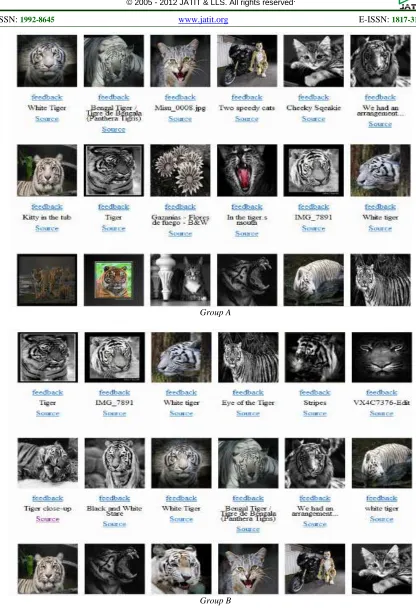
In the third experiment, we apply MLLR in a test image retrieval system. First, we choose the query and search “white tiger” in the search engine without using MLLR. Then, we record the top18 images retrieved by the search engine and name them as group A. Second, we use the same query in the search engine using MLLR. Again, we record the top 18 images and name them as group B. After comparison in Fig 4, we can see that in group A, 10 out of 18 images are our desired target while in group B, 15 of the whole 18 images are our desired target. So, it proves that a search engine with MLLR performs better than one does not apply MLLR (Huanchen Zhang, H J Li, S C Dong, and W F Sun, 2011).
5. CONCLUSION AND FUTURE WORK
Multi-level Log-based Relevance Feedback scheme for image retrieval prove to have a better retrieval results and shorter iteration process in the experiment compared to Log-based Relevance Feedback scheme. It fully mines the potential images via using the valuable user log information, and therefore gives users a better user experience. However, limitation still exists in MLLR. First, the noise ratio cannot be decided automatically. Manually choosing noise ration cannot avoid
subjective judgment. Second, the lower limit of
c
ijdoes not have a standard method to compute which may affect the final result. We plan to investigate into problems mentioned above and enlarge the image database to have a further study about MLLR in the future.
ACKNOWLEDGEMENT
This work is supported in part by Natural Science Foundation of China under grant No. 61103233,
60903153, NSFC-JST under grant
No.51021140004; Nature Science Foundation of China under grant No. 60673046, 90715037. Zhejiang Provincial Natural Science Foundation of China under Grant No. Y108685, the Fundamental
Research Funds for Central Universities
ISSN: 1992-8645 www.jatit.org E-ISSN: 1817-3195
195 Group A
[image:7.612.95.511.62.672.2]Group B
ISSN: 1992-8645 www.jatit.org E-ISSN: 1817-3195
196
REFERENCES
[1] Huang Xianglin, Shen Lansun, 2002. Research
on content-based image retrieval techniques. Acta Electronica Sinica, 30(7): 1065-1071
[2] H. Yu, J. Hen, and K. C. Chang, 2004. PEBL :
Web page classification without negative examples. Trans. on Knowledge and Data Engineering, 16:70–81
[3] Huanchen Zhang, Weifeng Sun, Shichao Dong,
2010. Multi-level log-based relevance feedback scheme for image retrieva. Computer Science
[4] Huanchen Zhang, Haojie Li, Shichao Dong, and
Weifeng Sun, 2011. RoboGene: An Image Retrieval System with Multi-Level Log-Based
Relevance Feedback Scheme. Computer
Science
[5] Fu Yan, Wang Yaowe, Wang Weiqiang, Gao
Wen, 2003. Content-based Natural Image
Classification and retrieval using SVM.
Chineses Journal of Computers, 26(10): 1261-1265
[6] LI Xiangyang, Zhuang Yueting, and Pan
Yunhe, 2001. The technique and systems of content-based image retrieval. Journal of Computer Research & Development, 38(3): 344-353
[7] Meng, W., Xian Sheng, H, 2011. Active
learning in multimedia annotation and retrieval: a survey. ACM Transactions on Intelligent Systems and Technology, ACM New York, NY, USA
[8] Ru Liyun, Peng xiao, Su Zhong, and Ma
Shaoping, 2003. Feature performance
evaluation in content-based image retrieval.
Journal of Computer Research and
Development, 40(11): 1566-1570
[9] S. C. H. Hoi, M. R. Lyu, and R. Jin, 2006. A
unified log-based relevance feedback scheme for image retrieval. IEEE Trans. Knowl. Data Eng, 18(4): 509–524
[10]Wu Hong, Lu Hanqing, Ma Songde, 2005. A
survey of relevance feedback techniques in content-based image retrieval. Chinese Journal of Computers, 28(12): 1969-1979
[11]Y. Chen, X. S. Zhou, T. S. Huang, 2001.