Val ui n g of a l t r ui s m a n d h o n e s t y
in n u r si n g s t u d e n t s : a t w
o-d e c a o-d e r e p li c a ti o n s t u o-d y
Jo h n s o n , M , H a i g h , CA a n d Yat e s-Bol t o n , N
h t t p :// dx. d oi.o r g / 1 0 . 1 1 1 1 /j. 1 3 6 5-2 6 4 8 . 2 0 0 6 . 0 4 1 1 9 .x
T i t l e
Valui n g of al t r u i s m a n d h o n e s t y in n u r s i n g s t u d e n t s: a t w
o-d e c a o-d e r e p li c a tio n s t u o-d y
A u t h o r s
Jo h n s o n , M , H a i g h , CA a n d Yat e s-B olt o n , N
Typ e
Ar ticl e
U RL
T hi s v e r si o n is a v ail a bl e a t :
h t t p :// u sir. s alfo r d . a c . u k /i d/ e p ri n t/ 2 2 8 5 /
P u b l i s h e d D a t e
2 0 0 7
U S IR is a d i gi t al c oll e c ti o n of t h e r e s e a r c h o u t p u t of t h e U n iv e r si ty of S alfo r d .
W h e r e c o p y ri g h t p e r m i t s , f ull t e x t m a t e r i al h el d i n t h e r e p o si t o r y is m a d e
f r e ely a v ail a bl e o nli n e a n d c a n b e r e a d , d o w nl o a d e d a n d c o pi e d fo r n o
n-c o m m e r n-ci al p r iv a t e s t u d y o r r e s e a r n-c h p u r p o s e s . Pl e a s e n-c h e n-c k t h e m a n u s n-c ri p t
fo r a n y f u r t h e r c o p y ri g h t r e s t r i c ti o n s .
U
N
C
O
R
R
E
C
T
E
D
P
R
O
O
F
Valuing of altruism and honesty in nursing students: a two-decade
replication study
Martin Johnson
1, Carol Haigh
2& Natalie Yates-Bolton
3Accepted for publication 5 September 2006
1Martin Johnson RN PhD
Professor in Nursing and Research Director
2
Carol Haigh, RN PhD
Senior Lecturer in Nursing Research
3Natalie Yates-Bolton, RN, MSc (Hons)
Lecturer
CNMCR, University of Salford, Greater Manchester, UK
Correspondence to Martin Johnson: e-mail: [email protected]
J O H N S O N M . , H A I G H C . & Y A T E S - B O L T O N N . ( 2 0 0 7 )
J O H N S O N M . , H A I G H C . & Y A T E S - B O L T O N N . ( 2 0 0 7 ) Valuing of altruism and honesty in nursing students: a two-decade replication study.Journal of Advanced Nursing57(4), 1–9
doi: 10.1111/j.1365-2648.2006.04119.x
Abstract
Title. Valuing of altruism and honesty in nursing students: a two-decade replication study
Aim.This paper reports a study investigating changes in the self-reported values of nursing students over the period 1983–2005 in the light of changes in student demography.
Background. Nurses’ values have been studied by both qualitative and survey methods over half a century. Generally idealism and altruism are said to wane as a result of professional socialisation, whilst honesty has been rarely examined.
Method.Building on an instrument designed by William Scott, further items were developed which addressed value orientations in a nursing context. Using a Likert scale and demographic items, a 1983 survey of three schools of nursing in England was repeated with a comparable population of students in 2005.
Findings.Student valuing of altruism and honesty has changed in important ways in the intervening decades. Nursing students are now generally less altruistic (P¼0Æ01) but value honesty with patients a great deal more (P¼0Æ01) than their counterparts in 1983.
Conclusion. The current situation, with older students having more domestic responsibilities and some students needing to have extra jobs besides their nursing course, seems to have led them to adopt a pragmatic approach. However, there are encouraging changes in the valuing of honesty with patients, which reflect in part students’ increased maturity and changed social attitudes to healthcare professional paternalism.
Keywords: attitudes, ethics, nurse education, psychology, replication study, survey designs
Introduction
Despite enormous changes in society and the way that nurse education and training is delivered, nursing is arguably still underpinned by key values and beliefs. These may include self control, independence and academic achievement. However, discussions of the nature of professionalism, such as that by
Rule (1978), commonly include altruism as a key character-istic. In its most general sense, altruism means benevolence at a cost to oneself. Scott (1959), who was the originator of the instrument we developed for use here, defines personal altruism as concern for the welfare of others rather than one’s own.
Until the 1980s research evidence across the western world showed that paternalistic deception of patients, especially
J A N
4
1
1
9
B
Dispatch: 26.10.06 Journal: JAN CE: AshokO R I G I N A L R E S E A R C H
JAN
U
N
C
O
R
R
E
C
T
E
D
P
R
O
O
F
about the nature and severity of their condition, was widespread (Glaser & Strauss 1965, Field 1989). Schrock (1980) suggested that nurses of that era rarely considered the extent to which, if the truth were told, ‘it was not the whole truth’. She argued that this had implications for patients’ rights. In this study, we define honesty as valuing the need to present information truthfully in all healthcare contexts, and report the outcomes of a large, two-decade, cross-sectional survey into nursing students’ beliefs about the value of honesty and altruism in the profession. The study of these values among nurses and other health and social care professionals is of international importance as ideologies such as managerialism, consumerism and increased account-ability to patients and service users now have a greater impact in the workplace.
Background
Studies of values
The literature in this field is extensive and so we have focused on important older works of considerable influence in the field and more recent approaches. The very early literature is explored in much greater depth elsewhere (Johnson 1983). Eron (1955) examined the values of both medical and nursing students using the Allport–Vernon– Lindzey approach (Allport et al. 1960) and his own ‘humanitarianism-cynicism’ scale sampling students cross-sectionally during their programmes at Yale University. Over 50 years ago, Eron was reporting that although senior nursing students were ‘less cynical’ than juniors, they were also ‘less humanitarian’, which he defined as ‘A regard for the interests of mankind (sic), benevolence, philanthropy’ (Eron 1955 p. 561).
Kramer’s Reality Shock: Why Nurses Leave Nursing (Kramer 1974) was widely influential but an earlier study of hers reports similarities and differences between British and American nurses (Kramer 1967). They were similar in that, when asked what main reasons had brought her respondents into nursing, both British and US nurses sugges-ted altruism (or service orientation) and a certain ‘romanti-cism’ to do with assisting important surgeons or ‘falling in love with doctors’. They differed in that US nurses (in 1967) emphasised knowledge more whilst British nurses valued ‘kindness, patience and a sense of humour’.
O’Neill (1973) used both the Gordon (1967) and the Allportet al.(1960) value instruments in a substantial study of nursing degree students’ (n¼465) values in three midwestern USA nursing programmes. Among a range of interesting findings she reports that on the social (altruistic)
value, nurses were ‘more altruistic’ than either the general female college population or medical students. Nurses valued power (political value) less than other students and notably less than medical students. Answering the question ‘Do values change over the training programme?’, O’Neill found that in one school junior students scored higher on ‘benevo-lence’ but this was not so in the other schools. In that school, therefore, students valued benevolence less over the period of their programme, but this trend was not consistent in the other schools.
More recently, in a Japanese study, Gregg and Magilvy (2004) used participant observation and interviews with 24 hospital nurses. Claiming a strong influence from Watson’s theory of ‘caring’ (Watson 1988
2 ), these researchers found
that their respondents:
strongly value ‘considering a patient’s feelings.’ During practice, they describe ‘being connected to the patient’, and said that they were ‘having a relationship as a human being’. They practise ‘being with a patient’, ‘listening to a patient’, ‘touching a patient’, and ‘advocating for their patients’. (p. 15).
Gregg and Magilvy’s paper, despite drawing on direct clinical observation, presents a warmly optimistic view of what nurses say they value, in sharp contrast to grittier ethno-graphic work by Lawton (2000) which draws attention to the conflicts and complexities of clinical work.
Moving away from traditional empirical research to an historical discourse analysis, Fealy (2004) notes that whilst the ways in which Irish nurses have been depicted in public discourses have similarities with international nursing ima-gery, there is a uniquely Irish version of the ‘good nurse’ ideal. He argues that this indicates that the image of the nurse is both culture-specific and changes to reflect the underlying socio-cultural context and prevailing system of political power and influence. He discusses issues such as vocation and self-sacrifice as aspects of the ‘good nurse’, debating the degree to which religion, in this case mainly Catholicism, provides a sound foundation for these values as suggested by its advocates.
Based on a recent study comparing associate degree and bachelor’s degree nursing students’ ‘professional’ values in Texas, Martinet al.(2003 p. 291) report the following:
U
N
C
O
R
R
E
C
T
E
D
P
R
O
O
F
health needs.Conclusions:Professional values in graduating nursing students were significantly related to sex and ethnicity, regardless of educational program.
The value items were drawn from codes of conduct. Analysis by subgroups pointed to lower scores on some value items for male students and various minority ethnic groups. The current fashion for reporting that statistically significant results are ‘significant’ in the sense of important is common in this paper. Martinet al.(2003) suggest that the range of their scale is 44–220, with higher scores indicating strong profes-sional values orientation. With 11 subscales, presumably a mean for one of these could be between 4 and 20. Despite reporting ‘significant’ results that minority groups scored lower on certain scales, in no case is the difference of means more than 2Æ68 (out of 20) and often it is nearer to one point. Nevertheless, the paper adds to the literature, particularly by highlighting gender, culture and ethnic background as important aspects in the development of values.
Whilst the degree to which honesty in nursing practice and with patients is valued may be inferred from a number of qualitative studies (Schrock 1980, Field 1989, Johnson 1997), this has not been systematically studied using survey designs. In her treatment of ‘Lying’ Bok (1980); p222), notes that lying to patients has always ‘seemed an especially excusable act’. It seemed to us important to begin to investigate students’ orientations towards this over the period in question.
Theoretical frameworks
Much of the literature is less specific about its theoretical framework than might be expected in the general field of social psychology. However, almost all contemporary theor-etical perspectives can at least partially explain human beings’ motivation for holding and expressing values, and reasons why they change. From the psychoanalytic viewpoint, Anna Freud argued that all pro-social (altruistic) behaviour results from conflict resolution in the unconscious mind (Freud 1946). Whilst empirical behaviourists generally felt that values were of little importance, Leon Festinger’s cognitive dissonance theory postulates that differing beliefs, attitudes and values cannot be held at the same time without the creation of tension, conflict or dissonance in the individual (Festinger 1957). This tension is a motive for change in values; thus, through education, or exposure to social influence, values strengthen or weaken over time. Bandura and Mac-Donald (1963) supply one of the strongest theories of value change, arguing that the observation of influential role models, especially when they appear successful, is a powerful mechanism for the adoption and evolution of personal values.
Certainly the influence of role models is widely assumed to be vital in nursing education as shown by the widespread use of mentors and preceptors whose role this is.
The study
Aim
The aim of the study was to investigate any changes in the self-reported values of nursing students over the period 1983– 2005 in the light of changes in student demography.
Design
The study was a replication in 2005 of an earlier one in 1983. The 1983 work was reported as a ‘pilot’ but, in surveying three locations and using a validated tool and quite detailed inferential statistics, we now consider that it had considerable rigour for the time. Human values have been studied by both qualitative and quantitative methods. Nursing students, in particular, have been a rich source of material for investiga-tors using informal interviews (Melia 1987) and participant observation (Johnson 1997). However valuable they are, such studies deal with relatively small numbers in a particular context. Human values can also be reliably studied on a larger scale by the use of well-designed questionnaires, provided appropriate limitations are acknowledged.
The 1983 study
In 1983, the sample included 176 nursing students. These consisted of 68 students in the first weeks of their programme and 74 third year nursing students. They were cohorts at three of the five Greater Manchester hospital-based schools of nursing. Greater Manchester is a large conurbation of towns and two cities (Salford and Manchester) in the northern part of England. There were 142 general nursing students and 34 children’s nursing students. These students were undertaking a hospital-based 3-year programme for state registration about 10 years before these programmes began to be amal-gamated into larger departments associated with, and then incorporated into, universities.
2005Participants
U
N
C
O
R
R
E
C
T
E
D
P
R
O
O
F
third of all students in the school). We used a similar approach to the first study, using class time and collecting the questionnaires before students left.
Instrument
Nursing value items
For the 1983 study, questions developed by Scott (1959) were supplemented with 20 further items which, based on relevant literature, had a more specifically ’nursing’ focus (Johnson 1983). In this paper, we focus on two of the core ‘nursing’ values investigated by this tool, ‘altruism’ and ‘honesty’. For all the items, the standard agree-disagree 5-point scale was used (see Table 1). The internal reliability data for the ‘nursing’ items was tested using a Cronbach’s alpha coeffi-cient, and a value of 0Æ83 was obtained.
Adaptations of the instrument
For the 2005 iteration, language had evolved such that gendered language was less appropriate. For example, an item such as ‘Always living one’s religion inhisdaily life’ was amended by deleting the word ‘his’. Demographic questions were adapted to reflect contemporary practice, for example in relation to educational qualifications.
Ethical considerations
Ethics approval processes were not as rigorous in 1983, but the investigator (MJ, who was not employed in those schools) spoke at length to school managers and then, with the cooperation of individual teachers and students, gave out the questionnaires personally in class time. Despite assurances to students that they could leave their questionnaires uncom-pleted if they wished, this approach yielded a 100% return with only a few items unanswered.
Since all nursing and midwifery education in the United Kingdom is now provided by universities, for the 2005 study we gained ethics approval from the University Research Governance and Ethics Committee, and the School Research Committee. Students were given a two-page information
sheet making clear that their participation was voluntary and that all individual responses were anonymous and confiden-tial but that analysed data might be reported in various ways. On this occasion the research team was employed by the School concerned, but we believe that students were not coerced by the process. In any event, they were at liberty to leave the instrument uncompleted.
While administering the questionnaire, we were sometimes asked about the relevance of particular items. Students wondered, for example, why they were being asked their religion or ethnic group and why there were questions about honesty. In such cases, we tried to reassure respondents that the data would be confidential and anonymous, and that the questions were simply about what behaviour they valued, rather than their own personal honesty.
Data analysis
Data collected in 1983 were analysed with the help of a statistician using a ‘mainframe’ computer and SPSSSPSS (SPSS
Inc.
3 ). A Kolmogorov–Smirnov one-sample test showed that they should be analysed nonparametrically. Although the 2005 data have the advantage of far greater volume and a more normal distribution, we have mainly retained the nonparametric approach for consistency. Ideally, we would have tested between and within groups variance using the appropriate nonparametric test. However, as the 1983 raw data were incomplete, we compromised by using StudyResult (2006). This software enables probabilities to be calculated when some raw data are unavailable. The technique makes assumptions about the data, including the assumption of normal distribution. For this reason, the statistical signifi-cance levels for comparisons of 1983 and 2005 students should be viewed with caution and as suggesting trends rather than fully tested relationships.
Results
Comparative Demographics
Using the approach of collecting data in class time produced 100% response from those present in both eras. Of 176
Table 1An example Nursing Value Item in Likert Scale format
Item
Strongly agree
Slightly agree
Not sure
Slightly disagree
Strongly disagree
Assuming that disciplinary action is often very severe, nurses ought to keep quiet about minor mistakes that cause no real harm
U
N
C
O
R
R
E
C
T
E
D
P
R
O
O
F
students in 1983, six (3Æ4%) were male. In the 2005 sample 68 (11%) of respondents were male. As can be seen in Figure 1, among many other changes, there are great differences in the age of entry to the profession. In 1983 only 5% of 176 students were over 22 years of age. By 2005, of 618 students at a school with a similar catchment area, 63% were over 22 years of age and nearly 37% were over 30. These are remarkable differences with considerable implica-tions which we discuss later.
In the two intervening decades secondary school qualifica-tions changed from being based on mainly unseen examina-tion to a mixture of coursework and summative assessment; however, despite some cynicism that they have become ‘easier’, General Certificate Advanced level qualifications are broadly comparable. The ’best’ universities still require three passes at the highest A or B grades for their most popular degree courses, and those lower down the league tables would still normally expect two average passes (for example at grades C or D) for vocational degree and diploma courses such as nursing.
Since the 1990s, when nurse education and training in the UK moved into higher education, requiring students to study at least up to university diploma level, it might be supposed that a general increase in educational attainment at entry would be evident; however, this is far from the case. Although it was not a requirement in 1983, two thirds of students undertaking hospital-based training had passed in at least one subject in the General Certificate of Education at Advanced Level (GCE A level – normally taken at 18 years of age). In 2005, this had dropped to 51%, but of even greater note is the increase in students withnoadvanced level general certificate qualification, from 35% to nearly half (48%) (see Table 2). In both decades, a minority of students held degrees (2Æ2% in 1983 compared with 4Æ2% in 2005)
Over the two decades, whilst there was an increase in the diversity of specific religions adhered to by students, the percentage claiming to be religious remained notably stable. We acknowledge the difficulties of classifying religions, the subtleties of definition of religious behaviour, and the fact that some people claim to have a spiritual aspect to their life irrespective of practising a formal religion. However, we simply asked the question: ‘Do you consider yourself to be a religious person at all? If you are, please write the name of the religion to which you belong.’ Students who felt that they were atheist or agnostic were asked to write ‘none’.
In 1983, 29% of students said they were atheist or agnostic, which remained at 28% in 2005. In the earlier study, 22% were Roman Catholic, but this dropped to 18% in the present study. The largest change was the shift in ‘Church of England’ affiliation from 33% in 1983 to 17% in 2005. However, participants from the 2005 sample showed greater diversity of adherence within Christianity, as shown by the membership of ‘other’ Christian churches, such as Pentecostal, Latter Day Saints and Baptist. In addition, 4% of students identified themselves as Muslim, compared with none in 1983.
Valuing altruism
Our measure of nursing altruism was drawn from the summed median scores across four value items from the questionnaire which were as follows:
• A good nurse should always be prepared to change work shifts at short notice to help out.
• Being calm and efficient is more important than being kind when you are very busy on the ward (reverse scored item). • There ought never to be any excuse for being unkind to a
patient.
• Nursing ought to drop the vocation or ‘Good Samaritan’ image and become just a skilled professional job.
In the 1983 cohort, we had found that the median score for altruism declined between year 1 (introductory course, n¼68, median 15Æ82) and year 3 (n¼74, median 12Æ53 P¼0Æ001, Mann Whitney U test). This finding supported
Students' ages in 1983 and 2005
94·9
37
4·5
26·2
0·6
36·8
0 10 20 30 40 50 60 70 80 90 100
Age bands
P
e
rcentage
18–22 23–30 >30
1983
n = 176
2005
[image:6.595.48.277.57.209.2]n = 618
Figure 1 Comparison of nursing students in 1983 and 2005 by per-centage in age groups 18–22, 23–30, and over 30.
Table 2Comparison of nursing students in 1983 and 2005 by edu-cational attainment
Number of subjects passed at General Certificate of Education
Advanced level 1983 students% 2005 students%
None 35 48
1 or 2 44 31
3 or 4 22 21
U
N
C
O
R
R
E
C
T
E
D
P
R
O
O
F
previous studies (Becker et al. 1961, Psathas 1968) which claimed that professional socialisation causes health profes-sional students to become less idealistic. Compared with 1983 students, the 2005 cohort were measurably less altruistic at the start of their programme, scoring 13Æ79 in year 1 (n¼311). From a lower base the reduction by year 3 (n¼229) was appreciably smaller (13Æ34) and was not statistically significant. This position can be summarised by saying that in 1983 students appeared more altruistic in orientation than their modern counterparts, but that their valuing of this traditionally important quality in nurses reduced over the course of their programme. Modern students begin by valuing altruism less, but generally maintain the same degree of value consistently over the programme.
As an illustration of this general trend, Figure 2 shows the percentage responses to one of the altruism items, the question about changing shifts at short notice to help out. In 1983, 54% of students agreed with the statement, whilst in 2005 this had dropped to 22Æ5%, more than a 30% change in attitude. Such a large difference is, however, not necessarily explained by a failure in moral character of modern students, as the data in the next section about valuing honesty will demonstrate.
It is important to recall that in 1983, many students lived in nurses’ homes owned by their hospital, and<1% were over 30 years of age compared with 37% now. Clearly, more mature students in a second career are likely to have greater domestic, financial and other responsibilities to contend with, which make staying late or ‘doing a split’ at short notice much less practical (Cuthbertsonet al.2004).
Valuing honesty
Our measure of nursing honesty was drawn from the summed median scores across four value items from the questionnaire which were as follows:
• There ought to be some circumstances in which it would be right to lie to a patient (reverse scored item).
• Assuming that disciplinary action is often very severe; nurses ought to keep quiet about minor mistakes that cause no real harm (reverse scored item).
• Keeping the truth about an illness from a patient ought to be considered unprofessional.
• Patients should always be told anything they want to know about their condition.
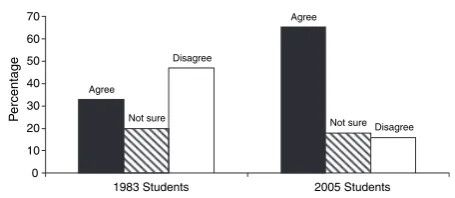
As with the other values, we analysed the data to compare first years against third years for both cohorts, and then compared the year 1 and year 3 groups for 1983 with 2005. Unlike altruism, in 1983 this value was relatively stable over the programme (year 1 median score 12Æ63,n¼68; year 3 median score 12Æ89,n¼74). Any suggestion that students in 2005 are morally inferior to their earlier counterparts is belied by the fact that, in 2005, students’ valuing of honesty actually increased slightly over the course of their programme from a median score of 14Æ53 in year 1 (n¼311) to 16Æ00 in year 3 (n¼229), although this difference is not statistically significant. A more important finding, which was highly statistically significant (P<0Æ001), was that the 2005 students (year 1, 14Æ53 and year 3, 16Æ00) scored higher than 1983 students (year 1, 12Æ63 and year 3, 12Æ89) in their admiration of this value. Figure 3 illustrates this, showing percentage responses to one of the items on the ‘honesty’ scale.
As can be seen from Figure 3, the percentage of students who agreed that it would be unprofessional to lie to patients doubled from 33% in 1983 to 66% in 2005. Whilst demographic differences may explain the difference in willingness to work changed off duty, we feel these have less to offer in this respect. Certainly, greater age may bring greater maturity and independence of opinion, but more probably the reassuring trend towards valuing greater hon-esty with patients is part of a wider change in social attitudes to honesty in health care, and the need to provide accurate information to patients.
Agree
Agree
Not sure Not sure
Disagree
Disagree
0 10 20 30 40 50 60 70
1983 Students 2005 Students
P
e
rcentage
Figure 3 Keeping the truth about an illness from a patient ought to be considered unprofessional, 1983 and 2005 whole sample responses. Agree
Agree
Not sure
Not sure Disagree
Disagree
0 10 20 30 40 50 60
1983 Students 2005 Students
P
[image:7.595.321.549.575.674.2]ercentage
U
N
C
O
R
R
E
C
T
E
D
P
R
O
O
F
Discussion
Study limitations
Our analysis would have benefited from access to the primary data set for the 1983 students. However, although some of the original 1983 raw data were unavailable, it was possible to carry out a between group analysis using StudyResultTM. We consider that we have demonstrated the effectiveness of replication studies and that the retention of primary data in perpetuity is therefore more valuable than commonly recog-nised. The regular ethics committee requirement to dispose of data after a certain period should be seriously questioned.
We recognise the limitations of cross-sectional surveys in drawing hard and fast conclusions about values and attitudes, and especially the dangers of inferring behaviour from these data. To deduce the specific cause of any important differences in students’ values, either over time within their programme, or over the two decades would be misplaced. For example, it is difficult to ascribe any differences to the relative curricula of the times, and values portrayed by the media can be important confounding factors. Only well-designed, prospective, quasi-experimental approaches would meet this need, and we urge that such studies be undertaken more frequently in the future. For now we can only speculate, we hope sensibly, on some of the explanations for these differences.
Replication
We report what we believe are important findings about the value nursing students place on altruism and honesty
across two decades. They are drawn from a replication of a questionnaire-based cross-sectional survey of nursing stu-dents in the Greater Manchester area. Almost contempora-neously with the earlier study, Connelly (1986) was arguing for the benefits of replication, a viewpoint which, two decades later, has not perhaps been sufficiently heeded. Where it has been, there are some interesting findings. For example, in the nursing education field, Burnard and Morrison (1994) repeated a survey of self-disclosure with 25 nursing students following the model Sydney Jourard had used some 30 years earlier. More recently, Jinks and Bradley (2004) repeated a 1992 survey on gender stereotypes after a decade, concluding that unflattering images of nursing were less credible for students in the later study than they had seemed 10 years earlier. Repli-cation, we would therefore argue, has a valuable place in research.
Changes in two decades
There is no question that health and education policy, and market forces, have produced a very different student population in 2005 from that of 1983. For example, in the UK, nursing education has moved from hospital-based schools of nursing to university departments. This has not meant, as we clearly show, that most students have higher academic qualifications on entering nursing programmes; rather, if general certificate education is any guide, the majority of students have less advanced secondary education than they did 20 years ago. What students do have is more life experience and personal responsibility. Although we did not ask this in any detail, we can safely assume that the 37% of 2005 students who are over 30 have much greater domestic and family responsibility than the 95% of 1983 students who were 21 or younger, and many will also have part time jobs.
We have noted that ‘vocational altruism’, such as willing-ness to change shifts, or to go out of one’s way to help others, scored quite high at the start in the cohorts of the 1980s, and declined over the course of their programme, perhaps tempered by the practicalities, stresses and strains of nursing itself. A wide literature (Becker et al.1961, Psathas 1968) refers to this as the ‘fate of idealism’ which, whilst seeming sad, may simply mean that students are injecting pragmatism, indeed survival in a complex and tough world, into their repertoire of values. Indeed, students are working even at ward level in a much more ‘business’ or ‘budget containment’ ethos, reminiscent of a more competitive culture. Modern students, with work and life experience, often as healthcare support staff and parents, are pre-warned in many of these
What is already known about this topic
• Replication is insufficiently exploited as a research method.
• Values of nursing students change over time with a loss of altruism common.
• Honesty has been studied very little.
What this paper adds
• Nursing students’ views suggest that altruism has gen-erally declined and honesty with patients has increased in the past two decades.
• Demographic reasons for these differences include nur-sing students being much older on entry and having much greater domestic and financial responsibilities. • Large surveys and replication studies have a place in the
U
N
C
O
R
R
E
C
T
E
D
P
R
O
O
F
respects, so it is no surprise that they start from a lower base on measures of this value.
In the case of the valuing of honesty, according to the relatively unsubtle measure of a Likert scale, we can be much more optimistic. It is reassuring that we can provide evidence that modern students are absorbing some of the important ideals of the patient empowerment movement. Our data show that in comparison with their 1983 counterparts, the 2005 students are very much less likely to consider lying to patients about their illness, or lying at all. We are not saying that in 1983 nursing students were liars: rather, they were much more accepting of astatus quoin which the deception of patients about serious illness was the default position. Field (1989), in fieldwork roughly contemporary with the 1983 students, called this ‘the silent conspiracy’, in which healthcare staff routinely deceived patients about their terminal diagnosis and prognosis. This trend has perhaps been reversed, although more work needs to be done to examine the details, perhaps using more open methods than Field and his colleague were able to use (Johnson 1992).
Conclusion
The whole tradition of qualitative sociology has much to offer in understanding the values of health professionals in general and nurses in particular. However, large surveys have the advantage of summarising the views of large numbers of people, which can be supplemented by qualitative work to look more deeply into these complex questions.
The demographic changes found in this study are clear and important. Students are more diverse in their educational attainments and life experiences because they are, on average, more than a decade older. Other studies have shown that they have more domestic and personal responsibilities (Kevern et al. 1999, Cuthbertsonet al. 2004). These factors partly explain the decline in altruism (at work) in students over that period, as well as the change in attitudes to patient informa-tion and greater willingness to see decepinforma-tion of patients as inappropriate. University programmes and placement staff need to recognise these changes and ensure appropriate flexibility and educational support.
Healthcare professionals’ values can be measured in useful ways and these data could, if collected in longitudinal and quasi-experimental studies, enable comparisons that could advance the rigorous evaluation of educational developments in the important fields of ethics and values. Similar studies should be undertaken internationally to examine the diversity of nursing values in differing cultural and demographic settings. The complexities behind these findings would also benefit from in-depth, qualitative exploration to examine
how values translate into practice. We do not doubt that these and other values are the backbone of nurses’ attitudes and behaviour towards their patients, and it is important that nurse education offers a climate for the development of values relevant to the very best patient experience.
Acknowledgements
We are grateful to nursing students of various Greater Manchester Schools of Nursing for their time and patience in helping us with these data. Colin Ashcroft and Professor Jean McFarlane advised on the 1983 study and Professor Caroline Carlisle and Steve Barrow gave useful help in modernising the questionnaire. The investigation forms part of a wider study of student values funded in part by the General Nursing Council Trust for whose support we are very grateful.
Author contributions
MJ, CAH and NYB were responsible for the study concep-tion and design and MJ was responsible for the drafting of the manuscript. MJ and NYB performed the data collection and MJ, CAH and NYB performed the data analysis. MJ and CAH obtained funding.
CAH provided statistical expertise.
CAH and NYB made critical revisions to the paper.
References
Allport G., Vernon P. & Lindzey G. (1960) Study of Values. Houghton Mifflin, Boston.
Bandura A. & MacDonald F. (1963) Influence of social reinforcement and the behaviour of models in shaping children’s moral judge-ments.Journal of Abnormal and Social Psychology67274–281. Becker H., Geer B., Hughes E. & Strauss A.L. (1961)Boys in White:
Student Culture in a Medical School. University of Chicago Press, Chicago.
Bok S. (1980) Lying: Moral Choice in Public and Private Life. Quartet Books, London.
Burnard P. & Morrison P. (1994) Self disclosure and nursing stu-dents: the replication of a Jourard study.????????, ???
4 .
Connelly C. (1986) Replication research in nursing. International Journal of Nursing Studies23(1), 71–77.
Cuthbertson P., Lauder W., Steele R., Cleary S., Bradshaw J. (2004) A comparative study of the course-related family and financial problems of mature nursing students in Scotland and Australia.
Nurse Education Today24, 373–381.
Eron J. (1955) Effects of medical education on medical students.
Journal of Medical Education10, 566–599
5 .
Fealy G. (2004) The good nurse: visions and values in images of the nurse.Journal of Advanced Nursing46(6), 649–656.
U
N
C
O
R
R
E
C
T
E
D
P
R
O
O
F
Field D. (1989)Nursing the Dying. Tavistock Routledge, London. Freud A. (1946)The Ego and the Mechanism of Defence.
Interna-tional Universities Press, New York.
Glaser B.G. & Strauss A.L. (1965) Awareness of Dying. Aldine, Chicago, IL.
Gordon L. (1967)Survey of Interpersonal Values. Science Research Associates, Chicago, IL.
Gregg M. & Magilvy J. (2004) Values in clinical nursing practice and caring.Japan Journal of Nursing Science1, 11–18.
Jinks A. & Bradley E. (2004) Angel, handmaiden, battleaxe or whore? A study which examines changes in newly recruited student nurses’ attitudes to gender and nursing stereotypes.Nurse Educa-tion Today24(2), 121–127.
Johnson M. (1983) Nurses’ Values and Nurse Training: A Pilot Survey of the Values of Student Nurses, MSc thesis. Department of Nursing, University of Manchester, Manchester
6 .
Johnson M. (1992) A silent conspiracy? some ethical issues of par-ticipant observation in nursing research.International Journal of Nursing Studies29(2), 213–223.
Johnson M. (1997)Nursing Power and Social Judgement. Ashgate, Aldershot.
Kevern J., Ricketts C., Webb C. (1999) Pre-registration diploma students: a quantitative study of entry characteristics and course outcomes.Journal of Advanced Nursing30(4), 785–95.
Kramer M. (1967) Comparative study of characteristics, attitudes and opinions of neophyte British and American nurses. Interna-tional Journal of Nursing Studies4, 281–294.
Kramer M. (1974) Reality Shock: Why Nurses Leave Nursing. Mosby, St Louis.
Lawton J. (2000)The Dying Process: Patients’ Experiences of Pal-liative Care. Routledge, London.
Martin P., Yarborough S. & Alfred D. (2003) Professional values held by baccalaureate and associate degree nursing students.
Journal of Nursing Scholarship35(3), 291–296.
Melia K. (1987)Learning and Working: The Occupational Sociali-sation of Student Nurses. Tavistock, London.
O’Neill M. (1973) A study of baccalaureate nursing students’ values.
Nursing Research22, 437–443.
Psathas G. (1968) The fate of idealism in nursing school.Journal of Health and Social Behaviour9, 52–64.
Robinson J., Shaver P. & Wrightsman L., (eds) (1991)Measures of Personality and Social Psychological Attitudes. Academic Press, San Diego, CA.
7
Rule J. (1978) The professional ethic in nursing.Journal of Advanced Nursing3(3–8).
Schrock R. (1980) A question of honesty in nursing practice.Journal of Advanced Nursing5(2), 135–148.
Scott W. (1959) Empirical assessment of values and ideologies.
American Sociological Review24, 299–310.
StudyResult (2006)Software for calculation of Pvalues and confid-ence intervals. Available at http://www.studyresult.com/ (accessed 8th Sept 2006).
8
Watson J. (1988) Nursing: Human Science and Human Care: A Theory of Nursing. National League for Nursing. ????, New York
9 .
Watson J. (1999)Post-modern nursing and beyond. Churchill Liv-ingstone, Edinburgh.
10
Williams M., Bloch D. & Blair E. (1978) Values and value changes of graduate nursing students: their relationship to faculty values and selected educational factors.Nursing Research27(3), 181– 189.
Author Query Form
Journal:
JAN
Article:
4119
Dear Author,
During the copy-editing of your paper, the following queries arose. Please respond to these by marking up your proofs with the necessary changes/additions. Please write your answers on the query sheet if there is insufficient space on the page proofs. Please write clearly and follow the conventions shown on the attached corrections sheet. If returning the proof by fax do not write too close to the paper’s edge. Please remember that illegible mark-ups may delay publication.
Many thanks for your assistance.