http://dx.doi.org/10.4236/ajibm.2014.42012
How Coal Miners Develop Path-Dependence and Lock in
to an Unsafe Behavioral Path
Zhengquan Xu, Qinren Cao, Ni Zhang
School of Management, China University of Mining & Technology, Xuzhou, China. Email: [email protected]
Received November 20th,2013; revised December 20th, 2013; accepted December 27th, 2013
Copyright © 2014 Zhengquan Xu et al. This is an open access article distributed under the Creative Commons Attribution License, which permits unrestricted use, distribution, and reproduction in any medium, provided the original work is properly cited. In accor-dance of the Creative Commons Attribution License all Copyrights © 2014 are reserved for SCIRP and the owner of the intellectual property Zhengquan Xu et al. All Copyright © 2014 are guarded by law and by SCIRP as a guardian.
ABSTRACT
Path dependence in behavioral agents can influence their actions. Creation of path dependence is a process of agents locking in their behavioral trajectory, which will increase the possibility of their certain actions occurring repeatedly. In China, most of coal mines’ working place is located in deep underground, so coal miners must work in very complex environment. In such environment, once behavioral path occurred in the coal miners, the chance of incurring coal mining accidents will be heavily increased. This article provides an empirical study on how coal miners develop path-dependence and lock-in to unsafe actions. It expands upon the external and inter-nal conditions that create path dependence in behavioral agents. Drawing on these conditions, we construct a process model of agents developing creation of path dependence and locking in their behavioral path, and then, by using the model, we elaborate why unsafe actions of coal miners in China frequently and easily occur, and why coal mine accidents reoccur in period.
KEYWORDS
Unsafe Action; Path Dependence; Behavioral Agents; Accidents; Behavioral Trajectory
1. Introduction
In China, unsafe actions of coal miners exhibit the cha-racteristics of occurring frequently, easily and suddenly, and they are considered to be one of main factors which incur coal mining accidents. In practice, it is also difficult for safety supervisors to enact effective control over these unsafe actions. Although China coal mining enter-prises have instituted very strict behavioral norms and invested heavily in safety equipment and techniques to prevent the unsafe actions, their effectiveness seems not very striking. Why is this happening to China coal min-ing? The extant literature hasn’t given a reasonable an-swer. Analysis of accident statistics demonstrates that possibility of a certain unsafe action incurring coal min-ing accidents is low, but repeat of such actions will heav-ily increase the possibility. Heinrich notes that 330 acci-dents are required to produce 1 major injury, which sug-gests that accumulative effect is needed to induce injury accidents. Recent work on path dependence in social and
management sciences has demonstrated that actions once repeated to some times will make the agents lock in a certain behavioral trajectory. The existence of path de-pendence in the behavioral agent raises the possibility that behavioral processes may be subject to considerable inertia. Thus path dependence can be used as the theoret-ical foundation for explaining why unsafe actions of China coal miners occur frequently, easily and suddenly. Most of China coal mines are located in deep under-ground, working places of which are very complex and change every day, therefore, someone likens the coal mine to moving factory. In such working environment, once path dependence occurred in the coal miners, the difficulty in controlling over their unsafe actions will be increased.
depen-dence in behavioral agents to illustrate the process of thecoal miners being pushed in an unsafe behavioral di-rection.
In Section 1 of the paper, we summarize theoretical li-terature on path dependence, and briefly introduce the impact of path dependence on behavior choice. In Sec-tion 2, we discuss in detail the internal and external con-ditions of creating path dependence and their impact on behavior choice. The third section constructs a process model on how behavioral agents evolving into path de-pendence and locking in their behavioral trajectory, and presents a simple example. The fourth section makes conclusions.
2. Theoretical Background of Path
Dependence
There is a lot of literature in the world of economy, management and social sciences that has illustrated im-portance of path dependence in exerting influence on agents’ behavior choice and performance [1-3]. Litera-ture on path dependence in the economy has emphasized ways in which economic processes can be self-reinforc- ing (Cowan, 1996). Self-reinforcements in the economy can lead to the existence of dynamic increasing returns and might drive the economy to an inefficient outcome [4]. Heffernan notes that inefficient technologies, institu-tions and social structure can be adopted and persist due to increasing returns, self-reinforcing mechanisms, and externalities [5]. Arthur has emphasized the chance that path dependence may lead to market failure [6]. Gartland argues that extant literature seldom describes impact of path dependence on an individual behavioral agent, en-terprise, and organization, and mainstream economists seem almost unaware of the theoretical work in the world of social and management sciences [7-9].
The extant theoretical work on path dependence theory [10,11] can help find the real reason why China coal mining accidents incurred by unsafe actions of coal min-ers occur repeatedly. There are three reasons for this. One is that rising coal price, special coal mining rules and complex working place facilitate coal miners to de-velop path dependence and lock in to unsafe behavior trajectory. The other difficulty faced by the safety super-visors is that they can’t find effective measures to unlock path dependence. The third one is that coal miners in China tend to exhibit risk-taking behavior and like de-veloping clans in their social network.
3. Conditions of Creating Path Dependence
in the Behavioral Agent
Gartland argues that rich literature on path dependence in the world of social and management sciences does not attract much attention from mainstream economists. The
key reason for this is that scholars from the world of economy almost agree on the conditions of creating path dependence in the economy, but scholars from other re-search world can’t achieve this. The extant literature has documented the external conditions of creating path de-pendence in the economy or behavioral agents, but it is silent about external conditions of path dependence created by the interaction among the economy or beha-vioral agents. There are various social contacts and inte-ractions among the behavioral agents because of their social properties. Thus agents’ actions once generated under some conditions have a tendency to spread over the agent’s social network, thereby developing externali-ties of the agent’s social network. Integrity of social network can make the different agents’ social network overlap, so that the externalities will reinforce behavior of agents in the social network and create path depen-dence. From above analysis, we can infer that besides internal conditions of path dependence that have been illustrated in vast literature, external conditions also exist. For the purposes of this analysis, we divide, in this article, these conditions into two types: the internal and external.
The internal conditions consist of agents’ adaptability, experience accumulation, and expectation, and they form the basis of developing path dependence in the agents. Coal miners often imprecisely judge their expectation returns through the costs they spent. In practice, they often don’t strictly comply with the rules and regulations, which can decrease their costs of action and increase their returns consequently. Adaptability shapes the con-ditions under which agents can switch from one beha-vioral trajectory opposed to another, so that the agents are able to adapt to the changing working environment and accumulate experience for optimizing their behavior choice. This process requires the agents to draw dynamic parallels between their expectation and outcome of beha-vior, make a minor adjustment to their behavioral trajec-tory until their behavior is locked in and path dependence is developed.
which contains some small ones. Thus knowledge and experience accumulated by the coal miners can be prom-ulgated over the social network and be shared, the exter-nalities is developed, which also influences their beha-vior choice in the social network. For the convenience of this analysis, we can refer to two behavior choices of coal miners: the safe action and unsafe one. In compari-son to safe action, the latter one can make the coal miner make less effort, save more time and money, but with higher uncertainty and risk. However, the externalities can reduce the uncertainty and risk, which will attract more coal miners to learn and imitate the unsafe actions. When unsafe actions have externalities in learning and imitating by the miners, such that the net benefit of tak-ing an unsafe action increases with the number of the miners currently taking it, unsafe actions of the coal miners in the social network are subject to increasing returns. Chua and Lim note that clan once formed by agents who work in the complex context will increase the possibility of their collective actions’ success [12]. There are two reasons for this. One is that close cooperation and coordination built during coal miners working to-gether in the long term require them to keep frequent interaction and form groups with strong social ties. The other is that coal miners once come to agreement on the adoption of unsafe actions, they will use peer monitoring and sanction to build order and accumulate social capi-tals. Furthermore, the rich interaction created by social networks also foster orders sustaining and rebuilding, such that the set of unsafe actions is limited and uncer-tainty caused by them is reduced.
When the above internal and external conditions are
satisfied, agents’ behavior will be driven to reinforce, and the reinforcing effects will also be promulgated over the social networks of different agents, make more agents choose the unsafe actions rather than the safe actions that are more determinate and subject to more containments. Thus behavioral expectation, network externality, and reduction of uncertainty are three resources of develop-ing co-reinforcdevelop-ing mechanism in behavioral agents in the social networks. The co-reinforcing mechanism facili-tates, through the rich interaction in the social networks, the coal miners to develop path dependence and lock in to one unsafe behavioral path.
4. Process Model on Path Dependence
Developed in Coal Miners
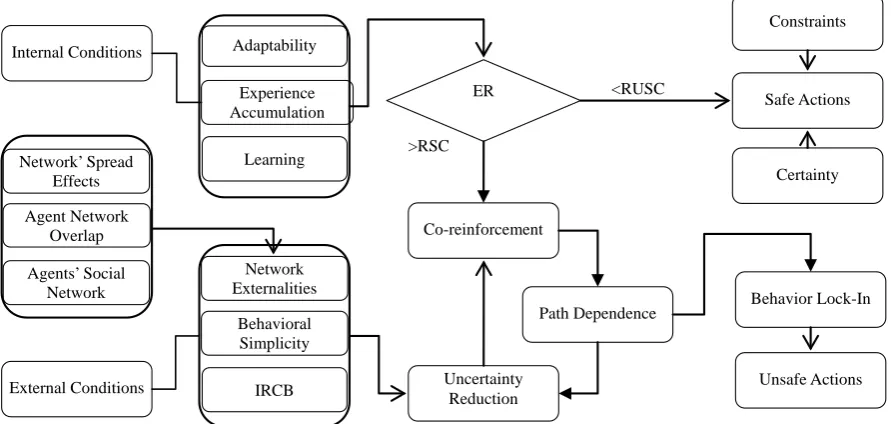
Creation of path dependence in the behavioral agents is a dynamic process, needs to satisfy various conditions. For these conditions, as discussed above, Figure 1 delineates their links. Drawing on the relationships among the con-ditions, we can construct a process model on the devel-opment of path dependence in the coal miners.
Internal conditions determine the expectation that ac-tions adopted by behavioral agents might incur. If the returns of adopting unsafe action are more than that of safe actions, this will lead to motivation of behavioral agents adopting unsafe action. Whether the motivation can switch to active action depends on the behavioral agents’ recognition on the external conditions. In China, entire underground workings of coal mining force the miners to construct rich interactions among them to rec-ognize the various risk taking place in the process of coal
Internal Conditions
Co-reinforcement
External Conditions
Adaptability
Experience Accumulation
Learning
Agents’ Social Network
Network Externalities Agent Network
Overlap
Behavioral Simplicity
IRCB Uncertainty Reduction Network’ Spread
Effects
>RSC
Unsafe Actions Constraints
Certainty
Path Dependence ER
Safe Actions <RUSC
[image:3.595.75.521.483.695.2]Behavior Lock-In
Figure 1. Process Model of Creating Path Dependence in Coal Miners. Notes: In Figure 1, IRCB denotes increasing returns of
collective behavior. BE denotes expectation returns, “<RUSC” denotes that expectation returns are less than returns of un-safe actions, “>RSC” denotes that expectation returns are more than returns of un-safe actions.
mining, while interaction also facilitate the accumulation of social capital and construction of social networks. Moreover, social network can create rich interaction among miners and further accumulation of social capital, foster collective actions at higher level, and improve miners’ ability to recognize the working environment, so that uncertainty of taking unsafe actions is reduced. In practice, coal miners are frequently adjusting their beha-vioral expectation and reduce uncertainty of unsafe ac-tions, through learning by doing, until they get approx- imate balance. Furthermore, the frequent adjustment of expectation interacting with the uncertainty reduction of unsafe actions through the rich feedback loops in the coal miners’ social networks reinforces the unsafe actions of different agents, which also develop the co-reinforcing mechanism discussed above. While path dependence in coal miners develops in the process of their behavior being reinforced through the feedbacks in the social net-works, behavior of the agents once is locked in, beha-vioral choice of them will depend on their experience and social capital accumulation, unless the agents suffer shock of coal mining accident or be coordinated by a new reinforcing mechanism, and be pushed to another behavioral trajectory.
Here, we present a very simple case to illustrate why coal mining accidents in China take place frequently? This case just describes the process of evolving path de-pendence in the coal miners. We know that the work force structure in China coal mining enterprises is very complex. Except for working relations, there exist many other relations, such as friendship, relative, fellow- townsman, and neighbor relation, among the coal miners. Although the rules and regulation in coal mining enter-prises in China is very strict, yet they are not imple-mented well in the practice. In the last 100 years between 1878-1978 China’s economy didn’t make remarkable change, however, since the reform in 1978, China's eco-nomic growth has been very rapid, which lead to imbal-ance between supply and demand in domestic coal mar-kets. So we can treat the reform as a contingent episode which activate the imbalance. The imbalance shapes the reinforcing mechanism, drives the coal prices, which also motivates the coal mining enterprises to increase produc-tion, even exceeding their production capacity. Some coal mining enterprises raise coal productions too rapidly, so that the rules and regulations are been implemented flexibly and some behavior of violating rules and regula-tions is tacitly permitted. Furthermore, entire under-ground workings and complex working environment in China coal mines also have negative effects on produc-tivity, then on returns, if all rules and regulations are strictly followed. While lowering the standards of the rules and regulations will not lead the accidents to come on the heel, but rather that it can improve production and
returns notably. However, the lowering requires the min-er to get a propmin-er balance between their expectations and the uncertainty caused by the lowering, and accumulate experiences and social capital to improve their cognitive ability. The above balancing is, in fact, a process of the expectation interplaying with uncertainty reduction to develop co-reinforcing mechanism. When the balance is achieved, the coal miners will have a tendency to adopt unsafe actions, even if they faced the complex working circumstance.
5. Conclusions
Path dependence, once developed in the coal miners, will have strong effects on their behavior choice. As path dependence creating is a process of behavioral agents obtaining behavior inertia, the agents in the face of sets of choices will be affected by their past experience to decide what to do next, and this leads the dominant ac-tions of the agents adopting not to be optimal. Although, over a long period of time, the total returns of miners taking safe actions exceed that of unsafe actions, unsafe actions prevail in the miners in the certain span of time. This is due to three factors: externalities of social net-works, uncertainty reduction of the unsafe actions and working circumstance, and improvement of cognitive ability. These factors combine to shape the positive feedbacks that reinforce unsafe actions of the miners, which make the unsafe actions more valuable as the number of coal miners taking unsafe actions increases. Thus the model, in this paper, theoretically explains the reasons why the coal miners in China have propensity to take unsafe actions.
Unsafe actions prevailing in the coal miners can evolve into accumulative effects. The possibility of one unsafe action incurring coal mining accident is low, but if it takes place repeatedly and accumulative effects are shaped, a number of the unsafe actions taking place in the coal mining process will increase the possibility that incurs the accidents. Thus unsafe actions incurring acci-dents exhibits a reoccurring feature. Acciacci-dents force the safety supervisors to adopt the stricter monitoring and coordinate mechanism, this combining to shock effects of the accidents drives the miners’ previous behavioral trajectory to be unlocked and switch to a new behavioral path. Thus the model also accounts for the reasons why the coal mining accidents take place in period.
Acknowledgements
Foun-dation of China (Grant No. 71173217/G0312) for their support.
REFERENCES
[1] W. B. Arthur, “Increasing Returns and Path Dependence in the Economy,” University of Michigan Press, Ann Ar-bor 1995.
[2] R. Cowen and P.Gunby, “Sprayed to Death: Path De- pendence, Lock-In and Pest Control Strategies,” Eco- nomic Journal, Vol. 106, No. 436, 1996, pp. 521-542.
http://dx.doi.org/10.2307/2235561
[3] D. C. North, “Institutions, Institutional Change and Eco-nomic Performance,” Cambridge University Press, New York, 1990.
http://dx.doi.org/10.1017/CBO9780511808678
[4] R. Cowan, “Nuclear Power Reactors: A Study in Tech-nological Lock In,” Journal of Economic History, Vol. 50, No. 3, 1990, pp. 541-567.
http://dx.doi.org/10.1017/S0022050700037153
[5] M. Heffernan, “Path Dependence, Behavioral Rules, and the Role of Entrepreneurship in Economic Change: The Case of the Automobile Industry,” The Review of Aus-trian Economics, Vol. 16, No. 1, 2003, pp. 45-62.
http://dx.doi.org/10.1023/A:1022905224020
[6] W. B. Arthur, “Competing Technologies, Increasing Re-turns, and Lock-In by Historical Events,” Economic Journal, Vol. 99, No. 394, 1989, pp. 116-131.
http://dx.doi.org/10.2307/2234208
[7] M. P.Gartland, “Interdisciplinary Views of Sub-Optimal Outcomes: Path Dependence in the Social and Manage-ment Sciences,” The Journal of Socio-Economics, Vol. 34, No. 5, 2005, pp. 686-702.
http://dx.doi.org/10.1016/j.socec.2005.07.003
[8] E. Goodstein, “The Economic Roots of Environmental: Decline Property Rights or Path Dependence?” Journal of Economic Issues, Vol. 29, No. 4, 1995, pp. 1029-1043.
[9] J. Vergne and R. Durand, “The Missing Link between the Theory and Empirics of Path Dependence: Conceptual Clarification, Testability Issue, and Methodological Im-plications,” Journal of Management Studies, Vol. 47, No. 4, 2010, pp. 736-759.
http://dx.doi.org/10.1111/j.1467-6486.2009.00913.x
[10] J. Sydow, F. Lerch and U. Staber. “Planning for Path Dependence? The Case of a Network in the Berlin- Brandenburg Optics Cluster,” Economic Geography, Vol. 86, No. 2, 2010, pp. 173-195.
http://dx.doi.org/10.1111/j.1944-8287.2010.01067.x
[11] R. Martin and P. Sunley, “Path dependence and regional economic evolution,” Journal of Economic Geography, Vol. 6, No. 4, 2006, pp. 395-473.
http://dx.doi.org/10.1093/jeg/lbl012