Investigating hadronic resonances
in pp interactions with HADES
Witold Przygoda1 for the HADES Collaboration:
J. Adamczewski-Musch2, O. Arnold10,9, E.T. Atomssa15, C. Behnke8, J.C. Berger-Chen10,9, J. Biernat1, A. Blanco4, C. Blume8, M. Böhmer10, P. Bordalo4, S. Chernenko7, C. Deveaux11, A. Dybczak1, E. Epple10,9, L. Fabbietti10,9, O. Fateev7, P. Fonte2,a, C. Franco4, J. Friese10, I. Fröhlich8, T. Galatyuk5,b, J. A. Garzón17, K. Gill8, M. Golubeva12, F. Guber12, M. Gumberidze5,b, S. Harabasz5,1, T. Hennino15, S. Hlavac3, C. Höhne11, R. Holzmann2, A. Ierusalimov7, A. Ivashkin12, M. Jurkovic10, B. Kämpfer6,c, T. Karavicheva12, B. Kardan8, I. Koenig2, W. Koenig2, B. W. Kolb2, G. Korcyl1, G. Kornakov5, R. Kotte6, A. Krása16, E. Krebs8, H. Kuc3,15, A. Kugler16, T. Kunz10, A. Kurepin12, A. Kurilkin7, P. Kurilkin7, V. Ladygin7, R. Lalik10,9, K. Lapidus10,9, A. Lebedev13, L. Lopes4, M. Lorenz8,f, T. Mahmoud11, L. Maier10, A. Mangiarotti4, J. Markert8, V. Metag11, J. Michel8, C. Müntz8, R. Münzer10,9, L. Naumann6, M. Palka1, Y. Parpottas14,d, V. Pechenov2, O. Pechenova8, V. Petousis14, J. Pietraszko2, B. Ramstein15, L. Rehnisch8, A. Reshetin12, A. Rost5, A. Rustamov8, A. Sadovsky12, P. Salabura1, T. Scheib8, K. Schmidt-Sommerfeld10, H. Schuldes8, P. Sellheim8, J. Siebenson10, L. Silva4, Yu.G. Sobolev16, S. Spataroe, H. Ströbele8, J. Stroth8,4, P. Strzempek1, C. Sturm2, O. Svoboda16, A. Tarantola8, K. Teilab8, P. Tlusty16, M. Traxler2, H. Tsertos14, T. Vasiliev7, V. Wagner16, C. Wendisch6,c, J. Wirth10,9, J. Wüstenfeld6, Y. Zanevsky7, P. Zumbruch2,a
1(HADES collaboration)
1Smoluchowski Institute of Physics, Jagiellonian University of Cracow, 30-348 Kraków, Poland 2GSI Helmholtzzentrum für Schwerionenforschung GmbH, 64291 Darmstadt, Germany 3Institute of Physics, Slovak Academy of Sciences, 84228 Bratislava, Slovakia
4LIP-Laboratório de Instrumentação e Física Experimental de Partículas , 3004-516 Coimbra, Portugal 5Technische Universität Darmstadt, 64289 Darmstadt, Germany
6Institut für Strahlenphysik, Helmholtz-Zentrum Dresden-Rossendorf, 01314 Dresden, Germany 7Joint Institute of Nuclear Research, 141980 Dubna, Russia
8Institut für Kernphysik, Goethe-Universität, 60438 Frankfurt, Germany
9Excellence Cluster ’Origin and Structure of the Universe’ , 85748 Garching, Germany 10Physik Department E12, Technische Universität München, 85748 Garching, Germany 11II.Physikalisches Institut, Justus Liebig Universität Giessen, 35392 Giessen, Germany 12Institute for Nuclear Research, Russian Academy of Science, 117312 Moscow, Russia 13Institute of Theoretical and Experimental Physics, 117218 Moscow, Russia
14Department of Physics, University of Cyprus, 1678 Nicosia, Cyprus
15Institut de Physique Nucléaire (UMR 8608), CNRS/IN2P3 - Université Paris Sud, F-91406 Orsay Cedex, France 16Nuclear Physics Institute, Academy of Sciences of Czech Republic, 25068 Rez, Czech Republic
17LabCAF. F. Física, Univ. de Santiago de Compostela, 15706 Santiago de Compostela, Spain
aalso at ISEC Coimbra, Coimbra, Portugal
e-mail: [email protected]
DOI: 10.1051/
C
Owned by the authors, published by EDP Sciences, 2015 /201
epjconf 5970 0 02
!
4
,*
balso at ExtreMe Matter Institute EMMI, 64291 Darmstadt, Germany calso at Technische Universität Dresden, 01062 Dresden, Germany dalso at Frederick University, 1036 Nicosia, Cyprus
ealso at Dipartimento di Fisica and INFN, Università di Torino, 10125 Torino, Italy f also at Utrecht University, 3584 CC Utrecht, The Netherlands
Abstract.In this paper we report on the investigation of baryonic resonance production in proton-proton collisions at the kinetic energies of 1.25 GeV and 3.5 GeV, based on data measured with HADES. Exclusive channelsnpπ+andppπ0as well asppe+e−were
studied simultaneously in the framework of a one-boson exchange model. The resonance cross sections were determined from the one-pion channels for Δ(1232) and N(1440) (1.25 GeV) as well as further Δand N∗ resonances up to 2 GeV/c2 for the 3.5 GeV
data. The data at 1.25 GeV energy were also analysed within the framework of the par-tial wave analysis together with the set of several other measurements at lower energies. The obtained solutions provided the evolution of resonance production with the beam en-ergy, showing a sizeable non-resonant contribution but with still dominating contribution ofΔ(1232)P33. In the case of 3.5 GeV data, the study of theppe+e−channel gave the
insight on the Dalitz decays of the baryon resonances and, in particular, on the electro-magnetic transition form-factors in the time-like region. We show that the assumption of a constant electromagnetic transition form-factors leads to underestimation of the yield in the dielectron invariant mass spectrum below the vector mesons pole. On the other hand, a comparison with various transport models shows the important role of intermediateρ production, though with a large model dependency. The exclusive channels analysis done by the HADES collaboration provides new stringent restrictions on the parameterizations used in the models.
1 Elementary reactions and their description
A path to understanding nuclear forces usually begins with the studies of nucleon-nucleon reactions. High precision measurements and a complete reconstruction of the final state provide invaluable in-sight into the nature of nucleon-nucleon interactions. These studies have to be performed with increas-ing energy since new processes are involved above the one-pion and two-pion production thresholds (for a review see [1]). Over the years various approaches were studied within the one-boson exchange (OBE) model (see i.e. [2–7]) successfully describing the data. The OBE potential describing the
nucleon-nucleon interaction assumes meson exchange (π, η, ρ...) and introduces free parameters like
coupling constants which are adjusted according to the data. For example, excitation of lower lying
baryon resonances likeΔ(1232) is realized with various form factor parameterizations. In the model
proposed by Suslenko and Gaisak [8], the dominance of the one-pion exchange term was assumed
leading to a qualitatively well description of experimental data collected in the energy range 0.6−1.0
GeV. The analysis of one-pion production channels in reactions pp → ppπ0 andpp → npπ+(see
[9–12]) leads to a good description of various differential distributions, yet the total cross sections
predicted by the model are lower than the reconstructed from the experimental data. Another model
describing the data in thenpπ+channel in the quite wide energy range 0.97−4.0 GeV (see [13–15]),
introduced by Dmitriev, Sushkov and Gaarde [16], had essentially similar assumptions of one-pion
exchange but different vertex parameterization. It became part of a more versatile resonance model
by Teiset al.[17] describing the production of mesons in elementary and heavy-ion collisions in the
from the OPE model [16] but replaced the parameterization ofΔresonance total width according
to the Moniz model [18], highly suppressing the high-mass tail of theΔresonance. In the case of
higher lying resonances, the resonance model [17], like many transport models (i.e. UrQMD [19] and GiBUU [20]), uses the isotropic distributions. The total cross sections is obtained as the incoherent
sum of all resonances contributing to a specific channel fixed by the fit to the data on 1π-,η,ρand 2π
production assuming constant matrix elements.
Another approach to the description of one-pion production is a partial wave analysis. The results discussed in this report utilize the framework of the Bonn-Gatchina group. It was successfully applied
for the description ofp+pdata measured at lower beam energies (see [11] and [12]). In the partial
wave analysis the total amplitude is described as a sum of partial wave amplitudes with corresponding angular dependencies:
A=
α
Aαtr(s)Qinμ1...μJ(S,L,J)A2b(j,S2,L2,J2)(si)×Q
f in
μ1...μJ(i,S2,L2,J2,S
,L,J), (1)
whereS,L,J are spin, orbital momentum and total angular momentum of the initial NN system,
S2,L2,J2are spin, orbital momentum and total angular momentum of the two-particle system in the
final state andS,Lare spin and orbital momentum between this two-particle system and the spectator
particle with indexj. The invariant mass of two-body system is defined bysj=(P−qj)2whereqjis
the four-momentum of the spectator and P is the total momentum of the reaction. The operatorsQin
andQf inare tensors constructed for each event from the momenta of the initial and the final particles.
Their explicit form is given in [21]. For the transition amplitude from initial NN toNNπsystem
Aαtrwe introduced the multi-indexαwhich summarizes all quantum numbers described above, in the
same form as it was done in [11, 12]:
Aαtr =
aα1+ √
s aα3
s−sα0
eiaα2, (2)
whereaα1,aα2,a3αandsα0 are real numbers and the poles ats=sα0 are located in the region of left-hand
side singularities of the partial wave amplitudes. TheA2b contribution for resonance production in
theπN channel was parameterized as relativistic Breit-Wigner amplitudes (for the exact form, see
e.g. [11]). Although it is not equivalent to a parameterization used in the resonance model (the above
mentioned Moniz parameterization), at the proton kinetic energy of 1.25 GeV the data are not very
sensitive for the resonance parameterization. The masses and total widths of the resonances were
taken from the Particle Data Group [22] and fixed in the fit. The non-resonantA2bcontributions in
theNN scattering channel were parameterized with a modified scattering length approximation (see
[11]), which corresponds exactly to the scattering-length formula from [23, 24] in the case ofS-waves.
There, the pnscattering length and effective range were fixed ata(1S0) =−23.7 fm,r(1S0) = 2.8
fm anda(3S1) = 5.3 fm, r(3S1) = 1.8 fm. In most of the fits, the only fitted function was the
transition amplitudeAαtr(s). The differential cross section calculated for this amplitude is maximized
with the event-by-event maximum likelihood method, which takes into account all correlations in the multidimensional phase space. The solution is based on the simultaneous fit to many experimental data samples, with the energy dependence (see Eq. 2). The resulting cross section is the coherent sum of both resonant and non-resonant contributions within a given initial partial wave.
An experimentally demanding but powerful way to explore the electromagnetic structure of baryon resonances (R) is the study of their decay into a nucleon and a massive virtual photon
convert-ing into dilepton pair, so called Dalitz decay. The description of interaction vertexNRγ∗by
electro-magnetic transition form factors (eTFF) is also challenging theoretically, since in the time-like region
be experimentally probed by measurements of the resonance Dalitz decays (Ne+e−) and indeed, many
theoretical calculations predict significant effects on the resulting dilepton invariant mass distribution
due to vector mesons (ρ/ω). The famous vector meson dominance (VMD) model by Sakurai [25]
cou-ples the virtual photon to a hadron by the intermediate vector meson fields. However, such couplings
lead to an overestimate of the radiativeR→ Nγdecay widths when the knownR→ Nρbranching
ratios are used in calculations, and various ideas to overcome this conflict have been used e.g. separate
NγandNρcouplings [26], or destructive interferences between contributions from higherρ/ωstates
[27] or different forms of the eTFF for the quark and the pion cloud coupling [28]). On the other hand,
such models should be effectively anchored in the space-like region (q2<0) where a rich data sample
on the eTFF for theΔ(1232), N(1440) and N(1520) has been obtained in a wideq2range (for a review
see [29]). To clarify the question about resonance production and the prominent role of the coupling
toρ, the exclusive data are necessary.
In this work we discuss the results from the exclusive hadronic channelspp→npπ+,pp→ppπ0
investigated at the kinetic beam energies of 1.25 and 3.5 GeV and a dilepton channelpp → ppe+e−
investigated at the kinetic beam energy of 3.5 GeV.
2 HADES experiments
The High Acceptance Di-Electron Spectrometer (HADES) [30] is installed at the GSI
Helmholtzzen-trum für Schwerionenforschung in Germany. In two of the experiments a proton beam of 107
parti-cles/s with kinetic energy of 1.25 GeV or 3.5 GeV was impinging on a liquid-hydrogen target. The
details about the track reconstruction and particle identification were described in [31, 32]. All spectra
were normalized to thep+pelastic scattering yield measured within the same experimental runs (for
details, see [31, 33]). The normalization error was estimated to be 8% in both cases. To study
one-pion production mechanisms events with one proton and one one-pion (pπ+) and two protons (pp) were
selected. For theppe+e−final state, events containing at least one proton track and onee+e−pair were
selected. The subsequent final states were identified via cuts in the one-dimensional missing mass
distributions around the value of the not detected particle, e.g. neutron,π0 or proton, respectively.
The momentum vectors of not detected particles were obtained from momentum conservation. The background estimation in hadronic channels was done with the help of missing mass spectrum
plot-ted at various parts of the two-dimensionalcosθCMpπ+ vsMinvpπ+ representation. Prior to the background
evaluation, the two-pion contribution was subtracted in the missing mass spectrum, then the fitting of the signal peak and various forms (polynomials) of the background were used to study systemat-ics. In dilepton channels, the combinatorial background (CB) was estimated using the like-sign pair technique (given as a sum of like-sign pairs), as described in [30, 31].
3 One-pion channels at 1.25 GeV
At the 1.25 GeV kinetic energy of the proton beam, the dominant contribution in thepp → npπ+
channel stems from the intermediateΔ++resonance. Comparison to the OPE model [16] requires an
adjustment of the cut-offparameterΛπin the vertex form factor:
F(t)= Λ
2 π−m2π
Λ2
π−t (3)
wheretis the square of the four-momentum of the virtual pion andm2
πis the pion mass squared. The
HADES data favourΛπ =0.75 GeV (see [31]). Further improvement was done with the
+ π p CM ) θ cos(
-1 -0.5 0 0.5 1
el
1/N
⋅
)
θ
cos(
d
N/
d
-3 10
-2 10
-1 10
-1 -0.5 0 0.5 1
preliminary
0 π p CM ) θ cos(
-1 -0.5 0 0.5 1
el
1/N
⋅
)
θ
cos(
d
N/
d
0 5 10 15
20×10-3
preliminary
[ GeV ] tot E 2.1 2.2 2.3 2.4
[ mb ]
σ
0 1 2 3 4 5
preliminary
Figure 1. Uncorrected angular distributions of the pπ+(left, notice the log scale) and pπ0 (middle, in linear
scale) system in the CM frame within the acceptance of the HADES spectrometer, normalized to the number of
ppelastic reactions (Nel). The total partial wave analysis (PWA) solution (black curve) with the resonance
com-ponents, red curve -Δ(1232)P33contribution, blue curve - N(1440)P11contribution is compared to the modified
OPE model (dashed curves, the same color code). Right: cross section of theppπ0channel (12 data points) and
the PWA solution (black curve) decomposed into intermediate resonancesΔ(1232) (red curve) and N(1440) (blue curve). The shaded bands represent the systematic uncertainties of the PWA solution.
adjusted to the experimental data. The feasibility of the model modification is exampled in Fig. 1
left, where the angular distribution of the pπ+system in the CM frame within the HADES
accep-tance is compared to the Monte-Carlo model simulation (dashed curves) in the log scale. Based on
the good model description and good acceptance coverage, the data were acceptance and efficiency
corrected, resulting in the total cross section 17.00±2.2 mb for thenpπ+channel. The systematic
error includes the uncertainties due to particle identification, background subtraction, normalization
error and the correction uncertainty. The modified OPE model was applied to theΔ+production in
theppπ0channel. The identification of two protons in the HADES acceptance results in the limited
inelastic reaction acceptance, covering high four-momentum transfer. Although slight discrepancies
between the data and the model, i.e. in the angular projection of thepπ0system in CM frame, are still
present (see Fig. 1 middle, dashed curves) the overall agreement is good. The acceptance correction
of the data with the model-driven extrapolation results in 3.87±0.55 mb of the cross section for the
ppπ0channel.
Although the corrected OPE model describes acceptably well the angular and mass distributions and can be used for the acceptance correction of the data it does not provide a fully physical
under-standing of the data and the role of other contributions which are not connected with theΔproduction
are introduced in a very simplified form. Therefore, the partial wave analysis of the Bonn-Gatchina group was enforced, starting from the solution found in [11]. The analysis was performed including
other available data sets (see [34], eleven measurements forppπ0and two for thepnπ+channel)
cov-ering mostly lower beam energies. For the proper HADES data description, high partial waves are
necessary, which contribute to the forward/backward peaked parts of the angular distributions of the
pπ+andpπ0 systems in the CM frame. Various solutions were investigated based on
parameteriza-tions of the transition amplitudeAtr(Eq. 2) and descriptions of resonance states (Δand in particular,
N∗). The obtained solutions generally describe the HADES data very well in various projections
(Fig. 1 left and middle, black solid curve). The analysis shows the dominantΔ(1232)P33contribution
innpπ+at the level of 75% (see Fig. 1 right, red band), stemming from the3P
2,3P1and3F4incoming
partial waves. It results in the total cross section 16.4±0.8 mb (model systematic error). In the case
ofppπ0, the intermediateΔ(1232)P
con-tributors and the extracted cross section is 4.2±0.15 mb. The N(1440)P11contribution is noticeably
higher than in the resonance model, and reaches several percent (12% fornpπ+and 20% for ppπ0
channel, see Fig. 1 right, blue band). The partial wave solutions include also notable interferences between non-resonant contributions and the N(1440) channel resulting in the larger systematic error on initial partial waves contribution. Based on the multidimensional PWA solution the acceptance correction can be done as in the resonance model case. The obtained cross sections are very close to
the PWA solution prediction but with larger systematic errors (16.3±2.0 mb for thenpπ+channel and
4.1±0.45 mb for theppπ0channel).
4 One-pion channels at 3.5 GeV
At 3.5 GeV kinetic energy of the proton beam the one-pion channels involve the decays ofΔand N∗
resonances with masses up to 2 GeV/c2. Starting the description with the resonance model [17] one
has to recall that the resonance with the anisotropic angular distribution is theΔ(1232), based on OPE
calculation [16]. The separation of the double (Δ++) and the single charged resonances (Δ+, N∗+) by
the analysis of thepπ+and thenπ+invariant mass distributions is feasible. Further procedure utilizes
parameterizations of the higher mass resonances taken from the Teiset al.model [17] but production
yields and the angular distributions are treated as free parameters. The latter one is assumed to be
governed by thetdependency:
dσR/dt∝A/tα (4)
wheretis the four-momentum transfer squared, calculated between the four-momentum vectors of
the outgoing resonance and the incoming nucleon,Aandαare constants to be derived from the
com-parison to the data. The yields of the resonances were obtained from simultaneous fits to the invariant mass and the four-momentum transfer distributions in the iterative procedure described in [32]. Al-though the identification of resonances is ambiguous in the nucleon-pion invariant mass region of overlapping states, the decomposition is still feasible. It is performed by a comparison of the
corre-sponding yields in thenπ+andpπ+invariant mass distributions for the N∗ andΔresonances and is
given as the product of the resonance cross section and the respective branching ratio. The
decom-position of the simulatedpπ+yields was also tested as a function ofcos(θ)CM
pπ+. Finally, the extracted
resonance yields and the angular distributions were included in the simulation of the pp → ppπ0
reaction channel. The cross sections for thepnπ+andppπ0final states are fixed by their isospin
rela-tions and an agreement between simulation and the data was also achieved for this reaction channel. The feasibility of the obtained multi-resonance fit was also tested on comparisons between the data and the angular distributions defined in the Gottfried-Jackson and the helicity reference frames. The modified resonance model can be used for the acceptance correction of the data (Fig. 2, black dots). The obtained cross sections can be then compared to the values predicted by the resonance model [17], but also other parametrization used, e.g. on GiBUU [20, 35] and UrQMD [19]. The detailed results are discussed in [32]. They are presented in Fig. 2 (lower row pictures with invariant masses
ofpπ+andnπ+). TheΔ(1232)+cross section obtained in the HADES analysis is slightly higher than
that of the resonance model [17] and GiBUU [35]. The total contribution of higher massΔresonances
is lower than in the fit of [17] but in line with the cross sections applied in the GiBUU version [35].
On the other hand the higher massΔresonances are by a factor 2-3 larger in the UrQMD code [19]
but lower for theΔ(1232). For the N∗ the cross sections of N(1440), N(1520) and N(1535) can be
studied directly. The constraint on the N(1535) production comes from the analysis of theppηDalitz
plot withηdecaying intoπ0π+π−identified in the same measurement [36]. The contribution of this
reaction channel amounts to about 47% leading to the total production cross sectionσN(1535)0.157
] 2 [ GeV/c 0 π p inv M
1 1.2 1.4 1.6 1.8 2 2.2
) ]
2
/dM [ mb/(GeV/c
σ d 0 1 2 3 4 5 6 7 data simulation (1232) Δ N(1440) N(1520) N(1535) N(1680) (1620) Δ (1700) Δ (1910) Δ 0 π p CM ) θ cos(
-1 -0.5 0 0.5 1
[ mb/sr ]
Ω /d σ d -3 10 -2 10 -1 10 1 ] 2 [ GeV/c + π p inv M
1.2 1.4 1.6 1.8 2 2.2
) ]
2
/dM [ mb/(GeV/c
σ d 0 10 20 30 40 50 ] 2 [ GeV/c + π n inv M
1 1.2 1.4 1.6 1.8 2 2.2
) ]
2
/dM [ mb/(GeV/c
σ d 0 2 4 6 8 10 12 14 16 18 model2 model1
Figure 2. Upper row pictures: ppπ0final state. Acceptance corrected
pπ0 invariant mass and the CM angular
distributions (black dots) compared to the simulation result (dashed curves). Resonance contributions are shown separately (line style described in the legend). Lower row pictures:npπ+final state. Acceptance correctedpπ+
andnπ+invariant mass distributions (black dots) compared to the simulation results using the resonance cross sections according to parameterization taken from the GiBUU [35] (red curve -model1) or from the UrQMD [19] (blue curve -model2).
transport models use much larger N(1535) cross sections: 0.53 mb (GiBUU) and 0.8 mb (UrQMD). GiBUU gives the largest weight to the N(1440) and a smaller one to the N(1675). The cross sections for N(1720) and N(1680) used in UrQMD [19] are much higher than the ones used in GiBUU [35]. In view of such discrepancies, even more constraints can be provided by the exclusive analysis of the dilepton channels.
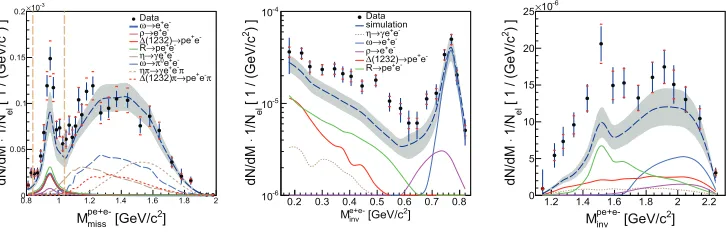
5 Dilepton channels at 3.5 GeV
The ppe+e− final state was selected by a cut on the pe+e− missing mass 0.8 GeV/c2 < Mmiss
pe+e− <
1.04 GeV/c2. This distribution and the e+e− and the pe+e− invariant mass distributions are used
] 2 [GeV/c pe+e-miss M
0.8 1 1.2 1.4 1.6 1.8 2
) ]
2
[ 1 / (GeV/cel
1/N ⋅ dN/dM 0 0.05 0.1 0.15
0.2×10⁻³
Data→e+e -ω→e+e -ρ(1232)→pe+e -Δ→pe+e -R→γe+e -η→π0e+e -ω π -e + e γ → π η π -e + pe → π (1232) Δ ] 2 [GeV/c e+e-inv M
0.2 0.3 0.4 0.5 0.6 0.7 0.8
) ]
2
[ 1 / (GeV/cel
1/N ⋅ dN/dM -6 10 -5 10 -4 10 Data simulation -e + e γ → η -e + e → ω→e+e
-ρ -e + pe → (1232) Δ→pe+e -R ] 2 [GeV/c pe+e-inv M
1.2 1.4 1.6 1.8 2 2.2
) ]
2
[ 1 / (GeV/cel
1/N ⋅ dN/dM 0 5 10 15 20 25×10-6
Figure 3. ppe+e−final state: pe+e−missing mass (left), dielectron (middle) andpe+e−(right) invariant mass distributions compared to the simulation result assuming a point-likeRNγ∗coupling [39]. The error bars rep-resent statistical (black) and the normalization (red) errors. The invariant mass distributions have been obtained for events inside the indicated window (vertical dashed lines in the left panel) on thepe+e−missing mass. The hatched area indicates the model errors (for more details see text). Number of counts is per mass bin width.
elastic scattering yields (Sec. 2) and the simulation results were filtered through the acceptance and
efficiency matrices followed by a smearing with the experimental resolution. The simulations assume
the production cross sectionsσR of baryon resonances deduced in the channels with one pion, as
described in Section 4 and [32]. Besides, the total cross sections of the exclusiveηandωproduction,
ση = 140±14μb ,σω = 146±15μb, respectively, were obtained from a parametrization of the
existing data [31, 37]. The total cross section forρmeson production was obtained from theωcross
section byσppρ =0.5σppω, as observed atEbeam=2.85 GeV in the DISTO experiment [38].
The comparison to the model [39], which assumes constant eTFF and a point-likeRNγ∗coupling,
establishes lower limits for thee+e− emission. The missing mass distribution of the pe+e− system
is shown in Fig. 3 (left). The distribution is compared with the result of the simulation (dashed
curve) including the baryon resonances andρ,ωandηmeson sources. The baryon resonances were
grouped into two contributions, originating from theΔ(1232) and the higher mass (Δ+, N∗) states. The
hatched area covers the model uncertainties related to the errors of resonance and meson production
cross sections. A description of the pe+e−missing mass distribution could be achieved with all the
sources, except for the yield in the proton missing-mass peak itself (for the discussion, see [32]). The
background under the proton peak, related to final states other thanppe+e−, is smaller than 6%. The
middle part of Fig. 3 displays thee+e− invariant mass distribution for the events within the pe+e−
missing mass window. It is compared to the simulation including dielectron sources originating from
the baryon resonance decays and the two-body mesonρ,ω → e+e−decays. The agreement in the
vector mass pole verifies also that the normalization and the simulations of the HADES acceptance and
reconstruction efficiencies are under control. On the other hand, an excess of the contributions from
the baryon resonances is visible below the vector meson pole. The effect is related to the excess in the
proton missing-mass window and can be explained by the contributions from off-shell couplings of
the resonances to the vector mesons. Such couplings should modify the respective eTFF which were
assumed to be constant in the simulations. The comparison of thepe+e−invariant mass distribution
with the simulation displayed in Fig. 3 (right) shows that the excess is indeed located around the
6 Summary
The HADES data measured for the pion production reactions in proton-proton collision were analyzed with a modified OPE resonance model [17] and with the Bonn-Gatchina [21] partial wave analysis method (for 1.25 GeV, the analysis of 3.5 GeV data is on-going). The results of OPE calculations and the obtained PWA solution allowed us to perform a full phase space acceptance correction of the measured data and to deduce the total cross sections of resonance contribution. The compari-son to transport models, like the GiBUU [20] and UrQMD [19], unraveled many discrepancies. In the dilepton channel (3.5 GeV), upper limits for the various resonance contributions have been ob-tained assuming point-like baryon-virtual-photon couplings. The calculated dielectron yields cannot
reproduce the measured yield and suggest strong off-shell vector meson couplings, which should
in-fluence the respective electromagnetic transition form-factors. Another approach for the Dalitz decay of resonances can be studied within the transport models (GiBUU [20, 35], UrQMD [19]), since they
implement the scheme of a two step factorizationR→ pρ→pe+e−in the dilepton production. It turns
out that not only resonance cross sections (as discussed in Sec. 4) but also the resonance-ρcouplings
are different, also when compared to the newest multichannel partial wave analyses e.g. the newest
Shrestha and Manley calculations [40], Bonn-Gatchina group [41] or the CLAS collaboration [42]
results (for the discussion, see [32]). The discrepancies call for further efforts, both on experimental
and theoretical sides. The recently measured pion-proton collisions with the HADES spectrometer should deliver valuable information on the resonance excitation and coupling to virtual photons.
Acknowledgements
The authors kindly thank A. V. Sarantsev for the collaboration in the partial wave analysis. The
HADES Collaboration gratefully acknowledges the support by the grants: PTDC/FIS/113339/2009
LIP Coimbra, NCN grant 2013/10/M/ST2/00042 SIP JUC Cracow, Helmholtz Alliance
HA216/EMMI GSI Darmstadt, VH-NG-823, Helmholtz Alliance HA216/EMMI TU Darmstadt,
283286, 05P12CRGHE HZDR Dresden, Helmholtz Alliance HA216/EMMI, HIC for FAIR
(LOEWE), GSI F&E Goethe-University, Frankfurt VH-NG-330, BMBF 06MT7180 TU München,
Garching BMBF:05P12RGGHM JLU Giessen, Giessen UCY/3411-23100, University Cyprus
CNRS/IN2P3, IPN Orsay, Orsay MSMT LG 12007, AS CR M100481202, GACR 13-06759S NPI
AS CR, Rez, EU Contract No. HP3-283286.
References
[1] P. Moskalet al., Prog. Part. Nucl. Phys.49, 1 (2002).
[2] A. Gersten, R. H. Thompson and A. E. S. Green, Phys. Rev. D3, 2076 (1971).
[3] R. A. Bryan and A. Gersten, Phys. Rev. D6, 341 (1972); Phys. Rev. D7, 2802 (1973).
[4] G. Schierholz, Nucl. Phys. B40, 335 (1972).
[5] K. Erkelenz, Phys. Rep.13C, 191 (1974).
[6] K. Holinde and R. Machleidt, Nucl. Phys. A247, 495 (1975); Nucl. Phys. A256, 479 (1976).
[7] R. Machleidt, K. Holinde, and Ch. Elster, Phys. Rep.149, 1 (1987).
[8] V. K. Suslenko and I. I. Gaisak, Yad. Fiz.43, 392 (1986).
[9] V. P. Andreev, A. V. Kravtsov, M. M. Makarov, V. I. Medvedev, V. I. Poromov, V. V. Sarantsev, S.
G. Sherman, G. L. Sokolov and A. B. Sokornov, Phys. Rev. C50, 15 (1994).
[10] V. V. Sarantsev, K. N. Ermakov, V. I. Medvedev, T. S. Oposhnyan, O. V. Rogachevsky and S. G.
[11] K. N. Ermakov, V. I. Medvedev, V. A. Nikonov, O. V. Rogachevsky, A. V. Sarantsev, V. V.
Sarant-sev and S. G. Sherman, Eur. Phys. J. A50, 98 (2014).
[12] K. N. Ermakov, V. I. Medvedev, V. A. Nikonov, O. V. Rogachevsky, A. V. Sarantsev, V. V.
Sarant-sev and S. G. Sherman, Eur. Phys. J. A47, 159 (2011).
[13] D. V. Bugg, A. J. Oxley, J. A. Zoll, J. G. Rushbrooke, V. E. Barnes, J. B. Kinson, W. P. Dodd,
G. A. Doran, and L. Riddiford, Phys. Rev.133, B1017 (1964).
[14] A. M. Eisner, E. L. Hart, R. I. Louttit, and T. W. Morris, Phys. Rev.138, B670 (1965).
[15] S. Coletti, J. Kidd, L. Mandelli, V. Pelosi, S. Ratti, V. Russo, L. Tallone, E. Zampieri, C. Caso,
F. Conte, M. Dameri, C. Grosso and G. Tomasini, Nuovo Cim. A49, 479 (1967).
[16] V. Dmitriev, O. Sushkov, C. Gaarde, Nucl. Phys. A459, 503 (1986).
[17] S. Teis, W. Cassing, M. Effenberger, A. Hombach, U. Mosel and G. Wolf, Z. Phys. A356, 421
(1997).
[18] J. H. Koch, E. J. Moniz and N. Ohtsuka, Ann. of Phys.154, 99 (1984).
[19] S. A. Bass, M. Belkacem, M. Bleicher, M. Brandstetter, L. Bravina, C. Ernst, L. Gerland, M.
Hofmann, S. Hofmann, J. Konopka, G. Mao, L. Neise, S. Soff, C. Spieles, H. Weber, L. A.
Winck-elmann, H. Stöcker, W. Greiner, Ch. Hartnack, J. Aichelin and N. Amelin, Prog. Part. Nucl. Phys.
41, 255 (1998).
[20] O. Buss, T. Gaitanos, K. Gallmeister, H. van Hees, M. Kaskulov, O. Lalakulich, A. B. Larionov,
T. Leitner, J. Weil and U. Mosel, Phys. Rept.512, 1 (2012).
[21] A. V. Anisovich, V. V. Anisovich, E. Klempt, V. A. Nikonov and A. V. Sarantsev, Eur Phys. J. A
34, 129 (2007).
[22] K. A. Oliveet al.(Particle Data Group), Chin. Phys. C38, 090001 (2014).
[23] K. M. Watson, Phys. Rev.88, 1163 (1952).
[24] A. B. Migdal, JETP1, 2 (1955).
[25] J. J. Sakurai, Ann. Phys.1, 1 (1960).
[26] N. M. Kroll, T. D. Lee and B. Zumino, Phys. Rev.157, 1376 (1960).
[27] M. I. Krivoruchenko, B. V. Martemyanov, Ann. Phys.296, 299 (2002).
[28] G. Ramalho and M. T. Peña, Phys. Rev. D85, 113014 (2012).
[29] I. G. Aznauryan and V. D. Burkert, Prog. Part. Nucl. Phys.67, 1 (2012).
[30] G. Agakishievet al.(HADES), Eur. Phys. J. A41, 243 (2009).
[31] G. Agakishievet al.(HADES), Eur. Phys. J. A48, 74 (2012).
[32] G. Agakishievet al.(HADES), Eur. Phys. J. A50, 82 (2014).
[33] G. Agakishievet al.(HADES), Eur. Phys. J. A48, 64 (2012).
[34] Data Base in http://pwa.hiskp.uni-bonn.de/
[35] J. Weil, H. van Hees and U. Mosel, Eur. Phys. J. A48, 111 (2012).
[36] K. Teilab, "The production of eta and omega mesons in 3.5 GeV p+p interaction in HADES"
-PhD Thesis, University of Frankfurt (2012).
[37] M. Abdel-Baryet al.(COSY-TOF), Eur. Phys. J. A44, 7 (2010).
[38] F. Balestraet al.(DISTO), Phys. Rev. Lett.89, 092001 (2002).
[39] M. Zetenyi and Gy. Wolf., Heavy Ion Phys.17, 27 (2003).
[40] M. Shrestha and D. M. Manley, Phys Rev. C86, 055203 (2012).
[41] A. V. Anisovich, R. Beck, E. Klempt, V. A. Nikonov, A. V. Sarantsev and U. Thoma, Eur. Phys.
J. A48, 15 (2012).

![Figure 2. Upper row pictures:[19] (blue curve -sections according to parameterization taken from the GiBUU [35] (red curve -distributions (black dots) compared to the simulation result (dashed curves)](https://thumb-us.123doks.com/thumbv2/123dok_us/8639443.1429151/7.482.46.416.60.394/figure-pictures-sections-according-parameterization-distributions-compared-simulation.webp)