Florida International University Florida International University
FIU Digital Commons
FIU Digital Commons
FIU Electronic Theses and Dissertations University Graduate School
11-2-2018
Automatic Extraction of Narrative Structure from Long Form Text
Automatic Extraction of Narrative Structure from Long Form Text
Joshua Daniel EisenbergFlorida International University, [email protected]
Follow this and additional works at: https://digitalcommons.fiu.edu/etd
Part of the Artificial Intelligence and Robotics Commons, Digital Humanities Commons, and the Other Computer Sciences Commons
Recommended Citation Recommended Citation
Eisenberg, Joshua Daniel, "Automatic Extraction of Narrative Structure from Long Form Text" (2018). FIU Electronic Theses and Dissertations. 3912.
FLORIDA INTERNATIONAL UNIVERSITY Miami, Florida
AUTOMATIC EXTRACTION OF NARRATIVE STRUCTURE FROM LONG FORM TEXT
A dissertation submitted in partial fulfillment of the Requirements for the degree of
DOCTOR OF PHILOSOPHY in
COMPUTER SCIENCE By
Joshua Daniel Eisenberg 2018
To: Dean John Volakis
College of Engineering and Computing
This dissertation, written by Joshua Daniel Eisenberg, and entitled Automatic Extraction of Narrative Structure from Long Form Text, having been approved in respect to style and intellectual content, is referred to you for judgement.
_______________________________________ Bogdan Carbunar _______________________________________ Shu-Ching Chen _______________________________________ Anthony Dick _______________________________________ Zhiming Zhao _______________________________________
Mark Finlayson, Major Professor Date of Defense: November 2, 2018
The dissertation of Joshua Daniel Eisenberg is approved.
_______________________________________
Dean John Volakis College of Engineering and Computing _______________________________________ Andres G. Gil Vice President for Research and Economic Development and Dean of the University Graduate School
© Copyright 2018 by Joshua Daniel Eisenberg All rights reserved.
DEDICATION
I explore, research, and write, for you, Aimee.
I wouldn’t be half the person I am (and I’m not just speaking genetically) if it wasn’t for the love, support, and guidance of my parents.
ACKNOWLEDGMENTS
This work was supported by several federal grants. First, by the National Institutes of Health (NIH) grant number 5R01GM105033-02. Second, by the National Science Foundation (NSF) under Grant No. HRD-1547798, which was awarded to Florida International University as part of the Centers of Research Excellence in Science and Technology (CREST) Program. Third, by the NSF under Grant Award #1129076, via the Partnerships for International Research and Education (PIRE) Open Science Data Cloud (OSDC) fellowship. Fourth, the narrative levels annotation study was funded by the Office of Naval Research (ONR) Grant No. N00014-17-1-2983.
I want to thank my friend Jared. Without your advice, I would have never read the writing of Haruki Murakami. Thanks to you, I found Murakami’s work, consumed thousands of pages of his stories, and was inspired to teach computers how to understand the interwoven and highly embedded narratives in his work.
I want to thank my advisor Mark Finlayson, for always providing the necessary dissents and criticism, which pushed me to find better problems and solutions. I also want to thank Mark for his encouragement, and always trying to give me the freedom to work on what I want, and not caring where I worked on it.
I want to thank W. Victor H. Yarlott for his help programming the feature extraction for the reimplemented story classifiers, and—more importantly—for always helping me brainstorm and come up with amazing, outlandish, and impractical ideas, which always end up being useful when I least expect it. I want to thank Deya, Labiba, Mireya, and Mohammed for the great conversations and experiences at the Indian buffet.
I would like to thank my annotators: Thanks to Fernando Serrano and Victor Alvarez for their work annotating the narrative point of view and diegesis of the first page of each book from the Corpus of English Novels. Thanks to Michael Alvarez and Guillermo Bonilla for their work annotating my narrative levels corpus. I couldn’t have taught my narrative level extractor programs if it wasn’t for your accurate annotations. A special thanks to Michael Alvarez for your in-depth insight into the usage of narrative levels, and for your help annotating the texts for the SANTA workshop.
ABSTRACT OF THE DISSERTATION
AUTOMATIC EXTRACTION OF NARRATIVE STRUCTURE FROM LONG FORM TEXT
by
Joshua Daniel Eisenberg Florida International University, 2018
Miami, Florida
Professor Mark Finlayson, Major Professor
Automatic understanding of stories is a long-held goal of artificial intelligence and natural language processing research communities. Stories explain the human experience. Understanding stories promotes the understanding of both individuals and groups of people; cultures, societies, families, organizations, governments, and corporations, to name a few. People use stories to share information. Stories are told–by narrators–in linguistic bundles of words called narratives.
My work has given computers understanding of some aspects of narrative structure. Specifically, where are the boundaries of a narrative in a text. This is the task of determining where a narrative begins and ends, a non-trivial task, because people rarely tell one story at a time. People don’t specifically announce when we are starting or stopping our stories: We interrupt each other. We tell stories within stories. Before my work, computers had no awareness of narrative boundaries, essentially where stories begin and end. My programs can extract narrative boundaries from novels and short stories with an F1 of 0.65.
Before this I worked on teaching computers to identify which paragraphs of text have story content, with an F1 of 0.75 (which is state of the art). Additionally, I have taught
computers to identify the narrative point of view (POV; how the narrator refers to theirself) and diegesis (how is the narrator involved in the story’s action) with F1 of over 0.90 for
both narrative characteristics. For the narrative POV, diegesis, and narrative level extractors I ran annotation studies, with high agreement, that allowed me to teach computational models to identify structural elements of narrative through supervised machine learning.
My work has given computers the ability to find where stories begin and end in raw text. This will allow for further, automatic analysis, like extraction of plot, intent, event causality, and event coreference. These are difficult when there are multiple narratives in one text. There are two key contributions in my work: 1) my identification of features that accurately extract information about narrators, and narrative levels and 2) the gold-standard data generated from running annotation studies on identifying these same elements of narrative structure.
TABLE OF CONTENTS CHAPTER PAGE 1 Motivation ...1 1.1 Outline ...5 1.2 Dissertation contributions ...6 2 Narrative Theory ...9
2.1 Narrative, narrators, and stories ...10
2.2 Narrative levels in literature ...12
2.2.1 Embedded narratives ...13
2.2.2 Interruptive narratives ...18
2.2.3 Time shifts: flashbacks and flashforwards ...24
2.2.4 Dreams and visions ...26
2.3 Narrative levels in scripts ...28
2.3.1 Dialogue ...29
2.3.2 Action ...32
2.3.3 Structural elements of scripts ...34
3 Annotating narrative levels ...37
3.1 Annotation study logistics...38
3.1.1 Annotators and training ...38
3.1.2 Annotation procedure ...43
3.2 Agreement metrics ...43
3.2.1 Cohen’s kappa for span agreement ...44
3.2.2 ARD for span agreement ...45
3.3 Results ...47
3.3.1 Short stories by Haruki Murakami ...47
3.3.2 Excerpts of novels ...48
3.3.3 TV show transcripts ...50
3.3.4 Court case transcripts ...51
3.4 SANTA Workshop ...52
4 Automatic extraction of narrative levels from text ...56
4.1 Designing the narrative level extractor ...57
4.1.1 Discussion of the scope of work ...57
4.2 Feature extraction ...59
4.2.1 Extraction of narrative characteristics features ...62
4.2.2 Extraction of character features ...66
4.2.3 Extraction of semantic embeddings ...69
4.3 Experimental procedure ...70
4.3.1 Leave-one-out cross-validation ...71
4.3.2 Undersampling ...72
4.3.4 From the gold-standard to sentence annotations ...74
4.4 Results ...75
4.4.1 Short stories by Haruki Murakmi ...75
4.4.2 Novels ...76
4.4.3 TV show scripts and court case transcripts ...77
4.4.4 Cross corpus experiments ...77
4.5 Contributions and discussion ...78
5 Automatic extraction of stories from text ...80
5.1 Motivation ...81
5.1.1 Task ...82
5.1.2 What is a story? ...82
5.1.3 Chapter outline ...83
5.2 Related work ...83
5.3 Developing the detector ...85
5.3.1 Verb features ...86
5.3.2 Character features ...88
5.3.3 Corpora ...90
5.3.4 SVM machine learning ...91
5.4 Experiments and results ...91
5.4.1 Undersampling ...93
5.4.2 Cross-validation ...93
5.4.3 Single corpus experiments ...95
5.4.4 Cross corpus experiments ...96
5.5 Prior work on story classification ...98
5.5.1 Design of Previous story classifiers ...99
5.5.1.1 Reimplemented Gordon story classifier ...99
5.5.1.2 Improved Gordon story classifier ...100
5.5.1.3 Reimplemented Corman story classifier ...101
5.5.2 Results ...105
5.5.2.1 Experimental results of the reimplemented story classifiers ...105
5.5.2.2 Cross-testing the classifiers ...106
5.5.3 Discussion ...108
5.6 Conclusions ...110
6 Automatic identification of narrative diegesis and POV ...112
6.1 Motivation ...113 6.2 Definitions ...116 6.2.1 POV ...116 6.2.2 Diegesis ...118 6.3 Corpus ...118 6.3.1 Inter-annotator agreement ...119
6.3.2 Interaction of POV with diegesis ...120
6.4.2 Experimental procedure ...121
6.4.3 Determining the best POV feature set ...122
6.4.4 Determining the best diegesis feature set ...124
6.5 Application of the classifiers to the news ...127
6.5.1 Reuters-21578 newswire ...128
6.5.2 EurekAlert press releases ...129
6.5.3 LexisNexis opinions and editorials ...130
6.5.4 Spinn3r blogs ...131
6.5.5 Islamic extremist text ...132
6.6 Related work ...133
6.7 Discussion ...134
6.8 Contributions ...136
7 Related work ...138
7.1 Computational models of narrative ...138
7.1.1 Learning Proppian functions ...138
7.1.2 Narrative event chains, narrative cloze, and story cloze ...139
7.1.3 Event extraction ...141
7.1.4 Temporal relationship of events ...141
7.2 NLP tools ...142
7.2.1 Stanford CoreNLP ...143
7.2.2 Story Workbench semantic role labeler ...143
7.2.3 It Makes Sense word sense disambiguation ...144
7.2.4 VerbNet, the Java VerbNet Interface, and event extraction ...145
8 Conclusion ...147
8.1 Future work ...147
8.1.1 Narrative levels extractor ...147
8.1.2 Story detector ...148
8.1.3 POV and diegesis extractor ...149
8.2 Automatic stock trading ...150
References ...153
LIST OF TABLES
TABLE PAGE
3.1 Summary of inter-annotator agreements ...47
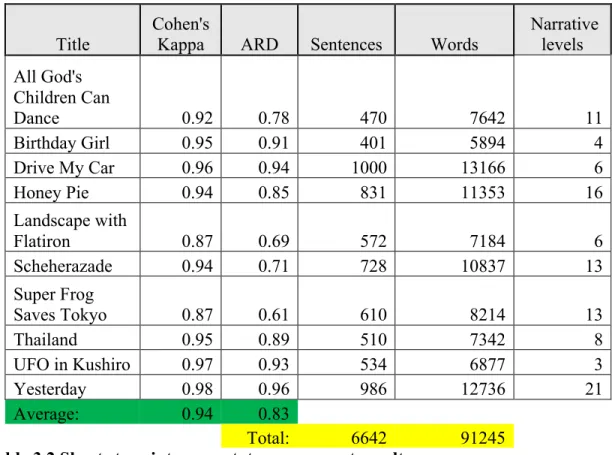
3.2 Short story inter-annotator agreement results ...48
3.3 Novel inter-annotator agreements ...49
3.4 TV show transcript inter-annotator agreement results ...50
3.5 Court case transcript inter-annotator agreement results ...51
4.1 Experiments on Haruki Murkami’s short stories ...75
4.2 Experiments on novel excerpts ...76
4.3 Experiments on the combined corpus ...77
5.1 Distribution of stories in extremist and blog corpora ...91
5.2 Results for the Corman Semantic triple based detector from Eisenberg (2016) ...92
5.3 Results of new detectors across all corpora from Eisenberg (2017) ...92
5.4 Results for Gordan classifiers on the web blog corpus ...106
5.5 Results for Corman classifiers on the extremist corpus ...106
6.1 Distribution of POV and diegesis ...120
6.2 Pronouns used for classification ...123
6.3 Results for POV classification experiments ...126
6.4 Results for diegesis classification experiments ...126
LIST OF FIGURES
FIGURES PAGE
2.1 Narrative level diagram for an embedded narrative ...14
2.2 Narrative level diagram for “1Q84” ...19
2.3 Narrative level diagram for an interruptive narrative ...21
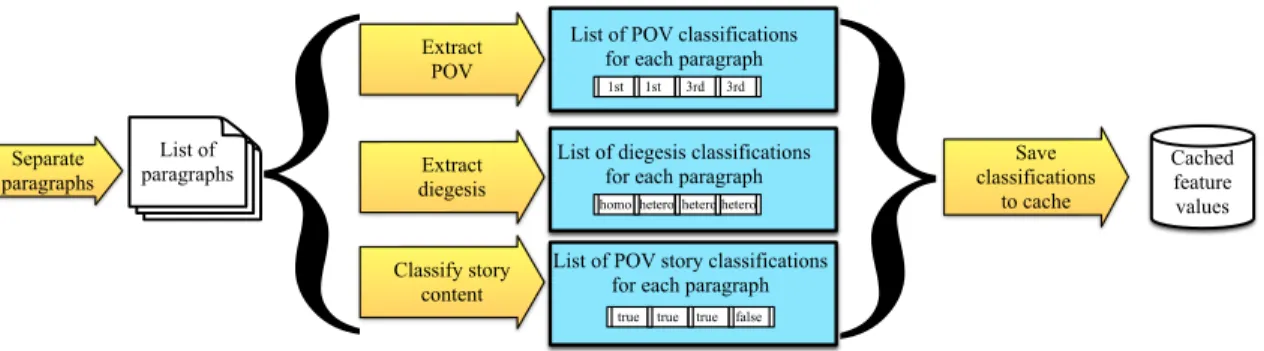
4.1 The two phases of programs for the narrative level extractor ...61
4.2 Pipeline for narrative characteristics feature extraction ...63
4.3 Procedure for paragraph to sentence propagation ...65
4.4 Pipeline for sorting coreference chains ...67
4.5 Excerpt from the gold-standard annotations ...74
5.1 Diagram of the story extractor feature extraction pipeline ...86
5.2 Visualization of character feature extraction pipeline ...90
6.1 POV extraction pipeline ...123
6.2 Diegesis extraction pipeline ...125
ABBREVIATIONS AND ACRONYMS
ARD Agreement relative to disagreement ML Machine learning
NER Named entity recognizer NLP Natural language processing PDF Portable document format POV Narrative point of view
SANTA Systematic analysis of narrative texts through annotation SRL Semantic role labeler
SVM Support vector machine
TF-IDF Term frequency-inverse document frequency WSD Word sense disambiguation
Chapter 1 Motivation
Stories explain the human experience. Understanding our stories promotes the understanding of both individuals and groups of people; cultures, societies, families, organizations, governments, and corporations, to name a few. People use stories to share information.
Stories are told–by narrators–in linguistic bundles of words called narratives. My work enables computers to have an awareness of the structural elements of narrative. In particular, computers can automatically determine where the boundaries of a narrative in a text are. This is the task of determining where a narrative begins and ends, a non-trivial task, because people often narrate multiple stories at a time. We don’t specifically announce when we are starting or stopping our stories. We interrupt each other. We tell stories within stories. Before my work, we had no ability to automatically detect where stories begin and end in long texts (specifically texts between 350 and 1,000 sentences long or 7,000 to 20,000 words), which I will discuss further in this dissertation.
My programs can automatically extract structural information about narrative, and this gives information about how a story is told. Extraction of finer grained information, like plot, character roles, and event relationships, cannot be accurately extracted without knowing which spans of text contain the telling of which stories. Imagine trying to figure out the plot of a chapter from a novel, but there are two distinct narratives. Typically, there is an original narrative, which tells a story about a group of characters, and then one of the
characters, possibly the protagonist, will tell a story about the past. Here are two distinct narratives, the original one, and the narrative embedded in the character’s speech. Note that not all speech is considered narrative, so this task is more complex than just finding quoted text.
A classic example of this can be found in the novel “Heart of Darkness” by Joseph Conrad (2016). There are two main narratives in “Heart of Darkness”: the original narrative begins with five men sitting on a boat, and one of these men, Marlow, is telling a story about his past. The second narrative, occurs in the speech of Marlow, which tells a story of his journey on the Congo River. The real action in “Heart of Darkness” occurs in the embedded narrative told by Marlow; his monologue to the other passengers of the boat. There is little action in the original narrative other than Marlow speaking, which provides a good example of an embedded narrative to annotate and examine.
What does the plot of “Heart of Darkness” look like? There are two distinct plots: first, a brief plot describing how Marlow tells his story to his four shipmates, and second, the plot of Marlow’s past, going to Africa, managing a trading post, and going through the Congo to search for Mr. Kurtz (the mysterious antagonist). The embedded narrative is rich with events. How would a computer be able to extract these two plots, if it treats all text the same way, and assumes that there is only one narrative?
My work gives computers the ability to detect where narrative boundaries are, and how long are the spans of each narrative level. Using my narrative level extractor, computers can be aware of which spans of text belong to different narrative levels, and these different levels should each be treated as their own distinct narratives. In order to
each narrative level. If the computer only tried to extract one plot from the entirety of “Heart of Darkness” then it would be convoluted, with events from different stories all smushed into the same plot. It is essential to distinguish different narrative levels, and treat them as unique narratives with their own plots, characters, and narrators.
Story understanding is an almost automatic awareness for people. According to cognitive psychologist Jerome Bruner (2003, pp. 8-9), “The telling of a story and its comprehension as a story depend on the human capacity to process knowledge in this interpretive way. …[T]here is compelling evidence to indicate that narrative comprehension is among the earliest powers of the mind to appear in the young child and among the most widely used forms of organizing human experience.” My work is the first to teach computers the awareness of narrative point of view and diegesis, as well as extraction of narrative levels. My research has also advanced the ability of story classification, from F1 of 0.65 to 0.75, using many orders of magnitude less features, and
is thousands of times more generalizable.
People can automatically process stories, but computers must be programmed to have these skills. My work teaches computers the ability to process structural information from stories, what is the POV, what is the diegesis, is a story being told, and where are the boundaries between narratives. Further work can be done to determine basic components of story understanding, such as what is the plot of the stories that are told in each narrative, who are characters, do events in the story of one narrative get mentioned in the telling of another narrative. At the time of writing this dissertation, computers have rudimentary ability to solve these tasks. Further, an important aspect to each of these tasks, is being able to distinguish which spans of text belong to which narrative. These answers depend on
where narrative levels occur, so automatic extraction of narrative levels is necessary for accurate extraction of plot, characters, and event-coreference for multi-narrative texts.
But why do computers need to understand stories? One reason is that stories will enable computers to understand people. If computers can understand the structure of stories, they can extract the information bundled into the story narrated by the person interacting with the computer. This information can be used to understand people based on their story, be it their history, their cultural narratives, or the narratives of the societal groups they belong. People use this information to understand other people, and computers should be aware of the people’s narrative when they are interacting with us.
Second, story understanding can be used by computers to make models of what is happening in the real world in real time. Every day, new articles are published reporting on current events. People discuss these events on social media platforms like Twitter and Facebook. If computers could extract plots from the stories that are contained in news articles, then they could automatically make models of what is happening in the real world. It is important to know how people report and react to current events. If computers could find references to the events mentioned in the news, to the discourse posted on social media and the internet, they could obtain a sample of people’s opinions on current issues.
My work will enable this type of story understanding because my work will allow the computer to find story content, specify which spans of text contain which narratives, and classify characteristics of the narrator. The applications for a system like this are endless. An obvious, and profitable, application of computational story understanding, is to automatically process the news, and social media, in real time, as a feature for making
time workers is published, it might affect the behavior of the stock. Knowledge of how people react to this article is useful in considering how to interpret this news and its impact. Computational understanding of stories will allow computers to automatically extract this information, incorporate it into its understanding of the world, and use this knowledge to make more educated decisions.
If understanding people, cultural narrative, and enabling computers to make informed decisions aren’t compelling reasons to research the computational understanding of stories, then consider the following: computational understanding of narrative could be used to automatically identify the spread of fake news. My programs can be used to figure out where stories begin and end in text. Once we know these spans, plot can be extracted, and the truth of these events, and relationships of events can be evaluated for facts. Without extraction of narrative levels, plot and event extraction would be carried out on too broad a scope.
1.1 Outline
The dissertation is organized as follows: Chapter 2 elucidates the elements of basic narratology, and narrative boundary theory. I define essential terms, including story, narrative, and narrative boundary. I will discuss plot and characters. I use examples from short stories, novels, and TV scripts to illustrate the usage of some common and not so common arrangements of embedded and interruptive narratives. In Chapter 3 I discuss the annotation study that I ran on the extraction of narrative boundaries in long form texts. I hired and trained two domain experts in narrative so that they could annotate the narrative
boundaries in a corpus of 287,777 words, spread across 26 unique English texts: excerpts from novels by a diverse set of authors, short stories by Haruki Murakami, American court transcripts, and TV show screenplays. Chapter 4 contains the most significant result of this dissertation. Narrative boundaries can be accurately extracted from natural texts when computers use three key features: the narrative point of view, the usage of stories, and occurrence of main characters. These features allow an SVM model to achieve F1 of 0.62
for detecting embedded narratives. Chapter 5 discusses the task of story classification in paragraphs of texts. I built a state of the art classifier, that is more accurate, generalizable, and computationally efficient with respect to the work of other researchers. The research in Chapter 6 is on the annotation of narrative diegesis and point of view from novels and news articles, and demonstrates the accurate computational extraction of these characteristics from natural texts. Chapter 7 is an exploration of the computational work that other researchers have conducted relating to the computational understanding of narrative. In Chapter 8 I conclude with summarizing my contributions and discussing future work and applications.
1.2 Dissertation contributions
There are two key sets of contributions in my dissertation:
1) The choice of which features are useful for automatically classifying different aspects of narrative. In chapter 4 I empirically show which features are best for
best for detecting which paragraphs of text have story content. In chapter 6 I show which features are best for classifying the narrative point of view and diegesis of novels. Although engineering programs to extract these features, is a non-trivial task, knowing which features to use for classifying a narrative phenomenon is a much harder task. The feature engineering is the most important kernel of knowledge produced by my dissertation research. Going forward, any programmer, looking to teach their computers computational understanding of narrative, can use my findings to guide their implementations. 2) The secondary contributions are the gold-standard annotations produced from
the annotation studies I ran, and the annotation guides that I wrote and used to run the annotation studies. It would be impossible to train and evaluate the machine learning models that classify elements of narrative structure without the annotated data produced in my annotation studies. It would also be impossible to determine which features can accurately classify the elements of narrative structure without these annotations. I include the annotation guides in this category of contribution, because these guides will help other people run their own annotation studies.
There is one final contribution that is worth mentioning: the Java (Gosling, 2014) programs that extract features, train SVM (Chang, 2011) classification models, and evaluate the performance of these models. The POV and diegesis extractors have already been open
sourced and are available online1. The remainder of these programs can be shared by
request2. The code is a secondary contribution; the features for how the computer should classify different aspects of narrative structure is key. Now anyone can use insights gained from my experiments on different sets of features to design more accurate and advanced systems that extract narrative structure.
In addition to the code being open sourced, I have been granted a patent for the “Features for the Automatic Classification of Narrative Point of View and Diegesis” (U.S. Patent No. 15/804,589), and I have a patent pending for the “Features for Classification of Stories” (U.S. Patent Application No. 62/728,380). Hence, the main contribution of my work is the features used to classify narrative structure, and the relationship of these features to the realities of narrative. I did not patent my programs, or my algorithms. Instead I patented the features that the computer needs to make correct decisions.
Chapter 2
Narrative theory
This chapter is a review of narratology, and the concepts that are essential for my research. A clear understanding of these narrative concepts is necessary for our discussions on extracting structural elements of narrative from text. I will first define the concepts of narrative, narrators, and story. Next, I will define two characteristics of narrators: point of view and diegesis. Then I discuss plot and characters. Finally, I will have a thorough discussion about narrative boundaries and levels, and explain how they can appear in real texts.
A by-product of explicitly defining and discussing the mechanics of these characteristics, is the ability to analyze which features of linguistics and semantics characterize them. This enabled me to make accurate decisions when doing my own annotations and when adjudicating annotations. My involvement in annotation POV, diegesis, and narrative boundaries enabled me to explain how I could decide the values for these characteristics. This was invaluable experience when it came time to decide which features to use for generating computational models.
The information in this chapter has been adapted from the annotation guides I wrote for my annotation studies on narrative boundaries, POV, and diegesis. I compiled this information to train my annotators. At a minimum, I wanted them to be aware of the narratological concepts that explain the phenomena they would be annotating. Ideally, I planned for my annotators to combine their natural ability to understand stories, with the
theoretical frameworks that are defined in the annotation guides, to help them think critically, and if possible quantitatively, about how they made their decisions about narrative structure.
2.1 Narrative, narrators and stories
A narrative is a discourse presenting a coherent sequence of events which causally and purposely relate, concerns specific characters and times, and overall displays a level of organization beyond the commonsense coherence of the events themselves, such as that provided by a climax or other plot structure.
Narrative is a linguistic representation of a story. A story is a series of events affected by animate actors or characters. A story is an abstract construct, with two essential elements: plot (fabula) (Bal, 2009, p. 5) and characters (dramatis personae) (Propp, 1968, p. 20). The art of storytelling is much more complicated than merely listing events carried out by characters. There is great importance in the storyteller’s choice of which details are revealed to the reader, the order in which plot events are told, whether to embed stories within each other, and whether to interrupt the telling of one story to make space for a new one. Even the choice of what details (character traits, setting, history) the author reveals to the reader is important.
Narrative is more concrete than story, in that narrative is made up of words, but a story is formed through the co-occurrence of characters who enact events which advance a plot forward. Narratives occupy spans of text, while stories are a more complex relationship
span of text that expresses the story, or simply narrative text. Note, narratives can also be delivered in the form of images, movies, and songs. In my dissertation, I focus on text narratives, but I do some work on automatic understand of TV show scripts, which is discussed in chapters 3 and 4.
Narrators tell narratives. “A narrative is narrated by a narrator to a narratee…” (Nelles, 1997, p. 9). A narrator is not the same as an author. In narratology, there is a framework of historical authors and readers, and implied authors and readers (Bal, 2009, p. 16). The historical author writes the narrative, while the historical reader either reads or hears the narrative. An implied author is closer to the concept of narrator: the implied author is the entity, with respect to the frame of the narrative, that is narrating, or telling the story. The implied author only exists within the text. The implied reader is the entity that the text is being read or written to. “The historical author writes, the history reader reads; the implied author means, the implied reader interprets; the narrator speaks, the narrate hears.” (Nelles, 1997, p. 9).
Narrative diegesis is whether the narrator is involved or not involved in the story’s action, heterodiegetic or homodiegetic, respectively. In a homodiegetic narrative, the narrator is not just a narrator, but a character as well, performing actions that drive the plot forward. In a heterodiegetic narrative, the narrator is observing the action but not influencing its course.
Narrators can tell stories in different ways and there are different types of narrators; different characteristics in which the narrator tells a story. The point of view (POV) of a narrator is whether the narrator describes events in a personal or impersonal manner. There are, in theory, three possible points of view, corresponding to grammatical person: first,
second, and third person. First person point of view involves a narrator referring to themself, and implies a direct, personal observation of events. By contrast, in a third person narrative the narrator is outside the story’s course of action, looking in. The narrator tells the reader what happens to the characters of the story without ever referring to the narrator’s own thoughts or feelings.
2.2 Narrative levels in literature
Narratives can be arranged in many interesting ways: a narrative can appear contiguously as one solid span of text, or it might be embedded in another narrative, or it might even interrupt the preceding narrative. There are infinite ways to arrange embedded and interruptive narratives. An embedded narrative can be interrupted. An interrupted narrative can have embedded narratives within it. Embedded and interruptive levels can be used by storytellers in any arrangement of their choice. Many novels and short stories contain multiple instances of embedded and interruptive narratives, often with intricate combinations of the two phenomena. This is also true of scripts of TV shows, movies and the transcripts of court cases.
Every narrative has at least two narrative boundaries: the start point—which I define here as the position in text of the first character of the first word in the narration— and the end point—which I define as the position of the last character after the last word in the narration. The simplest kind of narrative is an uninterrupted one. The start point of such a narration is the first character of the text, and the end point is the last character of
I woke up early in the morning, checked the weather app on my phone and decided it would be a perfect day to go to the beach. I grabbed a book, a towel, and sunglasses, got in my car, and drove to the beach. I read my book, watched the waves, and went for a quick swim. I dried off and drove home. It was a great day, even though I forgot to bring sun screen and got a sunburn.
Example 2.1: A simple example of uninterrupted narrative
Example 2.1 shows an uninterrupted narrative by a first-person narrator who tells the story of their trip to the beach. The narrator uses the first-person point of view to narrate. There are no shifts in time, and no interrupted narratives. The next two sections define embedded (§ 2.2.1) and interruptive (§ 2.2.2) narratives.
2.2.1 Embedded narratives
Narratives can be embedded in one another. An embedded narrative tells a story within a story. Before I discuss how embedded narratives occur in text, let’s define how I refer to the relationship between the layers. The original narrative is the narrative where the embedded narrative is told, and the original narrative contains an event (explicit or implied) that signals the telling of an embedded narrative. The embedded narrative is the narrative that is embedded within the original narrative.
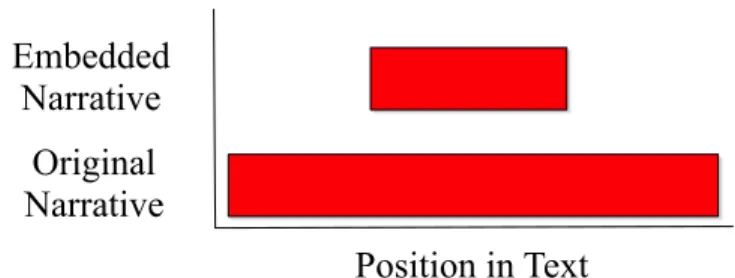
Figure 2.1 contains a narrative level diagram for a text that contains an embedded narrative. The lower bar represents the span of text that the original narrative appears in,
while the upper bar represents the spans of the embedded narrative. The horizontal axis represents the text under consideration. Progressing from left to right, the graph represents the position in the text advancing from the first word to the last. The horizontal axis can sometimes represent the progression of time, but time is not always linear in a narrative; there can be flashforwards, flashbacks, and other anachronisms.
Figure 2.1 Narrative level diagram for an embedded narrative.
An embedded narrative occurs when a plot event in the original narrative triggers the telling of another story in the story. The narrative that tells the second story is the embedded narrative. A common example of embedded narrative is a conversation that occurs in the original narrative. Within the dialogue, one (or both) of the participants narrates a story. The plot event in the original narrative that signals the embedded narrative is a character’s narration of a story via speech. This speaking is an event occurring on the original level. The events in the character spoken narrative belong to the plot of the story from the embedded narrative.
Recall Example 2.1, a story about a day at the beach. Example 2.2, is an altered version of Example 2.1, with the insertion of an embedded narrative. The span of text that
Original Narrative Embedded
Narrative
contains the embedded narrative is highlighted in green. The narrative boundaries in Example 2.2 are graphically represented in the narrative boundaries diagram in Figure 2.1.
I woke up early in the morning, checked my weather app on my phone and decided it would be a perfect day to go to the beach. I grabbed a book, a towel, and sunglasses, got in my car, and drove to the beach. I read my book, watched the waves, and went for a quick swim. As I emerged from the water a disheveled looking pirate washed ashore, “Aye Aye! I have just been washed ashore. I was the captain of the Shivering Sparrow, but there was a mutiny onboard. All of my crew including my parrot turned on me, and made me walk the plank. I clung onto a piece of driftwood for three days, and now I am here. Where am I?” I didn’t believe the pirate’s story, so I ignored him and walked away. I dried off and drove home. It was a great day, even though I forgot to bring sunscreen and got a sunburn.
Example 2.2: Simple example of an embedded narrative
Example 2.2 contains a basic example of an embedded narrative. The story is almost the same as Example 2.1’s, except when the original narrator gets out of the water, they encounter a pirate, who tells their story about being abandoned at sea, clinging to a piece of wood, and washing ashore. The pirate’s embedded narrative is highlighted in green, and is embedded in the narrative of the original narrator. The original narrative ends the same way in Example 2.1.
In Example 2.2’s original narrative, the original narrator witnesses the pirate telling a story. The pirate’s narration is a plot event in the lower level. This plot event in the
original narrative triggers the start of the embedded narrative. The plot events of the pirate’s story are part of the embedded story, since they are told in the pirate’s embedded narrative. The embedded narrative contains a story with events that are separate from the events in the story from the original narrative. It is also possible for the original narrator to tell an embedded narrative in the narrative text3. This type of narrative can occur via embedded flashbacks, which will be discussed in §2.2.3.
Example 2.3 is an excerpt from a novel. This excerpt contains an embedded narrative, highlighted in green. In the original narrative, Tsukuru Tazaki and Sara are on a date at a bar, and Tsukuru is telling Sara a story about his past. The highlighted text is part of the embedded narrative, since it contains Tsukuru narrating a story about his previous rejection.
This is a narration about Tsukuru Tazaki’s past; He is explaining how he felt, and why he acted a certain way. Only the highlighted text is part of the embedded narrative. The final paragraph is not part of the embedded narrative because it is not a telling of the embedded story. It is part of the original narrative, where Sara is trying to verbalize her empathy for Tsukuru by asking him a clarifying question.
Her mojito glass was empty. She signaled the bartender and asked for a wine list, and, after some deliberation, she chose a glass of Napa Cabernet Sauvignon. Tsukuru had only drunk half his highball. The ice had melted, forming droplets on the outside of his glass. The paper coaster was wet and swollen.
“That was the first time in my life that anyone had rejected me so completely,” Tsukuru said. “And the ones who did it were the people I trusted the most, my four best friends in the world. I was so close to them that they had been like an extension of my own body. Searching for the reason, or correcting a misunderstanding, was beyond me. I was simply, and utterly, in shock. So much so that I thought I might never recover. It felt like something inside me had snapped.”
The bartender brought over the glass of wine and replenished the bowl of nuts. Once he’d left, Sara turned to Tsukuru.
“I’ve never experienced that myself, but I think I can imagine how stunned you must have been. I understand that you couldn’t recover from it quickly. But still, after time had passed and the shock had worn off, wasn’t there something you could have done? I mean, it was so unfair. Why didn’t you challenge it? I don’t see how you could stand it.”
Example 2.3 Example of an embedded narrative from a novel (Murakami 2014, p.41).
It is important to note that the phrase “Tsukuru said” in the second paragraph is not part of the embedded narrative because it is an action that occurs in the original narrative. Tsukuru is having his conversation within the frame of the original narrative while he is on a date with Sara.
Before I move to interruptive narratives, let’s talk about a canonical example of an embedded narrative: Joseph Conrad’s “Heart of Darkness” (Conrad, 2016). In this novel, there is a homodiegetic narrator on a boat, listening to a story told by his shipmate Marlow. Marlow’s story, which is told in dialogue, is the main story of the novel. The original narrator’s story is quite simple, he is just a passenger on a boat listening to Marlow. The story with action, and a compelling plot, is the embedded story that Marlow is telling the original narrator, about Marlow’s experiences in Africa, searching for Mr. Kurtz on the Congo.
2.2.2 Interruptive narratives
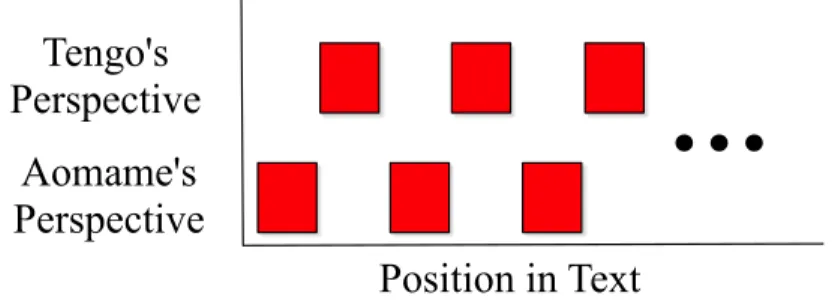
Narratives that interrupt the original narrator’s narration are called interruptive narratives, which are different from embedded narratives. An example is a book where each chapter has a different narrator. Namely, for the majority of the novel 1Q84 (Murakami, 2011), all the odd numbered chapters are narrated from the perspective of the heroine, Aomame, and the even numbered chapters are narrated from the perspective of the hero, Tengo. The boundaries at the end of each chapter in this novel mark interruptive narrative boundaries. For example, at the end of an odd numbered chapter, the narrator switches from the perspective of Aomame to Tengo, and at the end of each even numbered chapter, the narrator switches from the perspective of Aomame to Tengo.
Interruptive narratives can occur within chapters, or, for our purposes, within short stories, chapters of novels, or in the dialogue of a script. Sometimes the person narrating
narrator will suddenly shift to a third person impersonal narrator, or vice versa. If the narrator changes, there is usually an interruptive narrative boundary.
Figure 2.2 Narrative boundary diagram for “1Q84”.
Sometimes there will be a section break which indicates the change of narrator. Section breaks are visual markers that separate text. Sometimes a section break is signaled by a series of special characters, like an asterisk (*) or a horizontal rule (a thin, horizontal line). Sometimes there will just be many blank lines in a section break. Note that the presence of a section break does not guarantee the presence of an interrupted narrative. For example, there can be a section break, and immediately after the break the narration is continued by the same narrator, from the same point in time that the narrative before the section break left off.
The difference between interruptive and embedded narratives may seem subtle, but there is a difference. In an embedded narrative, a plot event occurs in the story of the original narrative, which triggers the telling of an embedded narrative. An interruptive narrative is triggered by the original narrative stopping. The trigger of an interruptive narrative is not a plot event in the original narrative, instead there is a meta-event, where something structural, where how story is being told, changes. Once the original narrative
Aomame's
Perspective
Tengo's
Perspective
...
has stopped, the interrupting narrative begins to be told. Even though the entity narrating the story can change, or the narrator remains consistent, the time in which the story is told changes. If you are questioning whether a narrative is interruptive, you should ask yourself: Is the telling of the span in question a plot event in the original narrative? If it is, then the span in question is embedded. If not, then it is interruptive.
I woke up early in the morning, checked my weather app on my phone and decided it would be a perfect day to go to the beach. I grabbed a book, a towel, and sunglasses, got in my car, and drove to the beach. I read my book, watched the waves, and went for a quick swim. As I emerged from the water a disheveled looking pirate washed ashore.
* * *
I have just been washed ashore. I was the captain of the Shivering Sparrow, but there was a mutiny onboard. All of my crew including my parrot turned on me, and made me walk the plank. I clung onto a piece of driftwood for three days, and now I am here.
* * *
The pirate looked like he just went through a tragic ordeal, but he was a pirate, so I decided it was best to ignore him. I dried off and drove home. It was a great day, even though I forgot to bring sun screen and got a sunburn.
Example 2.4: Example of an interruptive narrative
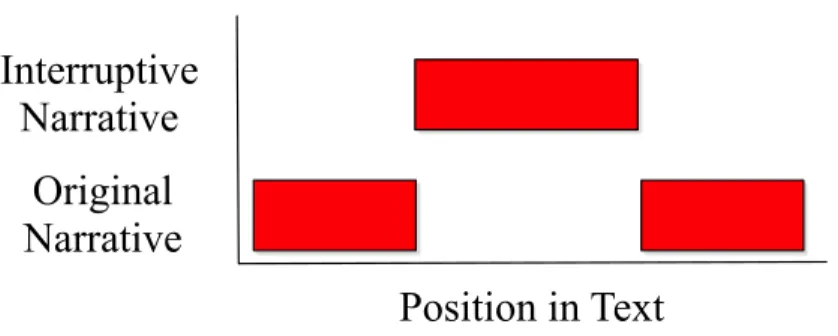
the narrator goes to the beach, reads, goes for a swim, and encounters a pirate upon exiting the water. After the original narrator observes the pirate washing ashore, there is a section break signaled by three asterisks. Highlighted in yellow is the interruptive narrative of the pirate, told in first person. The pirate telling this story is not an event in the original narrative, which is what happened in the embedded narrative of Example 2.2. There is no event, in the original narrative of Example 2.4, where the pirate tells a story. Instead, there is an interruption of the original narrative, the pirate tells his story, and then the original narrator begins telling his story. Figure 2.3 contains a narrative boundary diagram for this generic interruptive narrative.
Figure 2.3: Narrative level diagram for an interruptive narrative
A useful set of questions to ask when looking for interruptive narratives include: who is the narrator? Who is the narratee? And, does this change over the course of the text? In an interrupted narrative, there is usually a change to either who the implied narrator is or the narratee, or both.
Now let’s ask these questions about Example 2.4. The original narrative is narrated by the unnamed character who spends their day at the beach. The interruptive narrative is
Original
Narrative
Interruptive
Narrative
told by a new narrator: the pirate. It is unclear whether the narratee changes in these two narratives. The interruptive narrative could just be the pirate narrating his stream of consciousness to himself. There is not enough information to definitively say who the narratees are and whether they change. What is certain, is that the narrator changes during this interruptive narrator, and this is just another indication that the pirate’s story is told in an interrupted narrative.
“You can hide memories, but you can’t erase the history that produced them.” Sara looked directly into his eyes. “If nothing else, you need to remember that. You can’t erase history, or change it. It would be like destroying yourself.”
“Why are we talking about this?” Tsukuru said, half to himself, trying to sound upbeat. “I’ve never talked to anybody about this before, and never planned to.”
Sara smiled faintly. “Maybe you needed to talk with somebody. More than you ever imagined.”
• • •
That summer, after he returned to Tokyo from Nagoya, Tsukuru was transfixed by the odd sensation that, physically, he was being completely transformed. Colors he’d once seen appeared completely different, as if they’d been covered by a special filter. He heard sounds that he’d never heard before, and couldn’t make out other noises that had always been familiar. When he moved, he felt clumsy and awkward, as if gravity were shifting around him.
For the five months after he returned to Tokyo, Tsukuru lived at death’s door. He set up a tiny place to dwell, all by himself, on the rim of a dark abyss. A perilous spot, teetering on the edge, where, if he rolled over in his sleep, he might plunge into the depth of the void. Yet he wasn’t afraid. All he thought about was how easy it would be to fall in.
Example 2.5: Example of an interruptive narrative from a novel (Murakami 2014, p. 45).
Next, let’s will consider another excerpt from Murakami (2014). Example 2.5 contains two narratives, highlighted in red and yellow. The first narrative, highlighted in red, is a continuation of the original narrative from Example 2.3, when Tsukuru is on a date with
Sara. The first narrative is interrupted by a third person narrator, who tells a story about Tsukuru’s adolescence. There is a narrative break punctuating the two narratives. The narrative highlighted in yellow is an instance of an interruptive flashback, which is discussed in the next section.
2.2.3 Time shifts: flashbacks and flashforwards
There are two types of time shifts in story telling: flashbacks, (also known as analepsis), and flashforwards (also known as prolepsis). Both flashbacks and flashforwards are recurrent in storytelling. A flashback occurs when the time of the events told in the narration shift from the present to a time in the past. Flashbacks might occur when the narrator remembers something that happened in the past. A flashforward is similar, except the events are from the future. Flashforwards can come in the form of visions or prophecies. Other times, flashforwards foreshadow or reveal key events that will occur, even though the narrator might not know that these events will occur. Both flashbacks and flashforwards are popular storytelling devices in both literature and film. There are two ways flashbacks can be narrated:
Embedded flashbacks are embedded in the original narrative. In the original narrative, the narrator is narrating a story about the present, and then the narrator will shift the subject of their narration to telling a story about events that happened in the past. Sometimes the retelling of past events will use verbs in the past tense. The narrator is telling a story about the past from the present time, in which the events of the original narrative are unfolding. This is similar to the case where an embedded narrative is told in dialogue
(see Example 2.2), except in flashbacks the embedded narrative is told in the narrative text; the audience of the flashback is the reader, not another character in the story.
Interruptive flashbacks interrupt or replace the original narrative. The original narrative ends, and a new narrative of events occurring at a time before the original narrative begins. The key characteristic of the interruptive flashback, is that the narrator also shifts in time. The narrator of the original narrative and the flashback do not have to be the same narrator. Sometimes the person who is narrating the flashback will be a different character than the narrator of the original narrative. Sometimes the point of view of the flashback’s narrator will be different than that of the original narrator. Other times, the narrator of the flashback is identical to the original narrator, the only difference being the events in the flashback happened at a time before the original narrative. Interruptive flashbacks break the telling of the original narrative: they are not embedded in any other narrative.
Remember that the excerpt in Example 2.5 contains an interruptive flashback. The original narrative is interrupted by a new narrative, which takes place at a time before the original narrative. The narrator seems to be the same third person heterodiegetic narrator, but they are telling events from a story happened in a time prior to the events in the original narration.
Flashforwards can also either be embedded or interruptive. Flashforwards tend to be interruptive though, since narrators typically do not know what will happen in the future, so the original narrative must be interrupted, to provide an account of events from a future time. Flashbacks can be embedded into speech, but this is usually either a telling of a vision, or it can be the telling of a hypothetical future.
Flashbacks and flashforwards have elements of narrative structure that a simple mentioning of events from a different time lack. A time shift should have its own plot, characters, and story. Flashbacks and flashforwards are stories and not just details from an event that happened in the past or future.
2.2.4 Dreams and visions
Many stories contain dreams. There are two types of dreams, and they are similar to the two types of flashbacks. Dreams are either embedded into the original narrative, or they interrupt it. Embedded dreams occur when the narrator is narrating the memory of their experience of a past dream. Interruptive dreams occur when the narration is occurring from within the dream: the narrator is narrating as the dream unfolds.
Visions are similar to dreams. A vision, like a prophecy, could be a telling of the future. The events of the prophetic vision may or may not come true, but the actual telling of the vision is distinct from the original narrative. Other types of visions can be sudden recollections of images or events from the past. Like dreams, visions and prophecies can be either embedded in the original narrative, or interruptive of the original narrative.
The excerpt inExample 2.6 is also from “Colorless Tsukuru Tazaki…”(Murakami 2014). The original narrative is highlighted in green. This narrative is about Tsukuru talking to his friend Haida about classical music. Talking about classical music causes Tsukuru to have a vision, or a daydream, from his past. In Tsukuru’s vision, which is highlighted in green, he sees his old friend Shiro masterfully playing the piano in a very
Haida got quite talkative when it came to music. He went on, delineating the special characteristics of Berman’s performance of Liszt, but Tsukuru barely listened. Instead, a picture of Shiro performing the piece, a mental image, vivid and three-dimensional, welled up in his mind. As if those beautiful moments were steadily swimming back, through a waterway, against the legitimate pressure of time.
The Yamaha grand piano in the living room of her house. Reflecting Shiro’s conscientiousness, it was always perfectly tuned. The lustrous exterior without a single smudge or fingerprint to mar its luster. The afternoon light filtering in through the window. Shadows cast in the garden by the cypress trees. The lace curtain wavering in the breeze. Teacups on the table. Her black hair, neatly tied back, her expression intent as she gazed at the score. Her ten long, lovely fingers on the keyboard. Her legs, as they precisely depressed the pedals, possessed a hidden strength that seemed unimaginable in other situations. Her calves were like glazed porcelain, white and smooth. Whenever she was asked to play something, this piece was the one she most often chose. “Le mal du pays.” The groundless sadness called forth in a person’s heart by a pastoral landscape. Homesickness. Melancholy.
As he lightly shut his eyes and gave himself up to the music, Tsukuru felt his chest tighten with a disconsolate, stifling feeling, as if, before he’d realized it, he’d swallowed a hard lump of cloud. The piece ended and went on to the next track, but he said nothing, simply allowing those scenes to wash over him. Haida shot him an occasional glance.”
Example 2.6: Example of an interruptive vision in a novel (Murakami 2014, pp. 70– 71).
This vision interrupts the story told in the original narrative. The vision is not embedded because there is no action in the original narrative that triggers the telling of the vision. The last two sentences of the first paragraph inform the reader that Tsukuru is about to have a vision. These preparatory sentences are not part of the vision, since they describe events that are happening in the original narrative level: a “picture of Shiro…welled up in [Tsukuru’s] mind.” The actual vision is a departure from the original narrative. It describes what Tsukuru sees and feels when he is watching Shiro at the piano. This is not something that is happening at the time of the original narrative, it is something that Tsukuru is experiencing. The vision ends when the original third person narrator begins narrating about events that are actually happening in the present, “As he lightly shut his eyes and gave himself up to the music, Tsukuru felt his chest tighten with a disconsolate, stifling feeling…”. The music then continues to play, and Haida shoots Tsukuru “…an occasional glance.” These are events happening within the boundaries of the original narrative, and they signal the switch back to the original narrative from the interruptive vision.
2.3 Narrative levels in scripts
In addition to short stories and novels, I am interested in annotating the narrative boundaries in scripts. Specifically, this dissertation will focus on the scripts of TV shows, and the transcripts of court proceedings. There are two types of text in a script:dialogue and action. Dialogue contains the words that actors (or people) speak, and the action gives direction for what the actors do, how they do it, and what happens in the world that the
script describes. Scripts can either be used to tell actors what to say and how they should act, which dictates how they should behave during a performance, or scripts can be a recording of things that happened in real life, like a transcription of the dialogue in a court case.
2.3.1 Dialogue
In the context of scripts, dialogue is a type of structured text. There are two components of dialogue: the character’s name and the character’s speech. In a script, the character’s name will be stated. Typically, it will be bolded. Following the character’s name are the words that the character will speak. The character’s speech will not be in bold. Look at Example 2.7, which is an excerpt from the script of “Star Trek: Deep Space 9 – The Visitor” (Taylor 1995). This excerpt portrays a conversation between two characters, Old Jake and Melanie. They are having a conversation about Old Jake’s writings and how Melanie enjoys his writing. In this excerpt, there are four utterances in the dialogue. Old Jake speaks first, Melanie speaks next, and then they each speak one more time.
Now let’s think about the script of this conversation with respect to the narrative boundaries it contains. There are two narratives. The original narrative, where Old Jake and Melanie are having a conversation. This narrative makes up the entire span of text in Example 2.7. The span of the original narrative has been highlighted in blue.
It is important to note that the bolded character names have also been highlighted. The character names belong to the original narrative because this is a signal that a specific character will utter the proceeding text. The declaration of who is speaking in a script is
like the phrase “He said…” or “Old Jake said…” in a novel or short story. The character names are highlighted in the original narratives since they mark the beginning of a character speaking, which is an action in the original narrative.
OLD JAKE
I didn't realize people still read my books.
MELANIE
Of course they do. A friend recommended Anslem to me and I read it straight through, twice in one night.
OLD JAKE
Twice in one night...?
MELANIE
It made me want to read everything you'd ever written, but when I looked, all I could find were your "Collected Stories." I couldn't believe it.
I'd finally found someone whose writing I really admired, and he'd only published two books.
Example 2.7: An excerpt from “Star Trek: Deep Space 9 – The Visitor” with dialogue highlighted.
This excerpt from “Star Trek” (Taylor, 1995) also contains an embedded narrative delivered by Melanie. The embedded narrative is highlighted in yellow in Example 2.8. Her narration is about her experience reading Old Jake’sbooks, and how she reacted to his writing. In this embedded narrative, the bolded character names are not highlighted. This is because the action of Melaniespeaking belongs to the plot of the original narrative, and they do not belong to the plot of the narrative about Melanie’spast. It is important to notice that Old Jake’s speech is not part of the embedded narrative: he is not adding any information to the story of Melanie’spast, he’s just asking a clarifying question.
OLD JAKE
I didn't realize people still read my books.
MELANIE
Of course they do. A friend recommended Anslem to me and I read it straight through, twice in one night.
OLD JAKE
Twice in one night...?
MELANIE
It made me want to read everything you'd ever written, but when I looked, all I could find were your “Collected Stories.” I couldn't believe it.I'd finally found someone whose
writing I really admired, and he'd only published two books.
Example 2.8: An excerpt from “Star Trek: Deep Space 9 – The Visitor” with an embedded narrative in highlights.
2.3.2 Action
The action describes what is happening in the world that the script depicts. Typically, the action is written in present tense, since it describes what is happening in the present moment. Dialogue prescribes what each character says, and action dictates what each character does, including the way they speak. Consider Example 2.9, where the action is highlighted in green. Typically, the action in a script will be bolded, but it is not a requirement.
Now I will discuss the functions of each action sequence. The first sequence describes actions that Jake does before he speaks. The second action is during Jake’s dialogue. It is a note for the actor playing Jake to take a moment to consider what he is saying. If the script is being read, then this stage direction allows the reader to imagine the character considering their actions. The third action sequence describes how Melanie reacts to what Jake says, and how she responds to him. The fourth action sequence instructs Melanie’s next line to be said softly. The final action sequence describes an action Jake takes.
All five of these actions sequences describe actions that occur in the original narrative of this script. When considering the narrative boundaries for this excerpt, each action sequence is a part of the original narrative. In fact, the entire span of text in Example 9 belongs to the original narrative. There are no embedded or interruptive narratives in this excerpt.
MELANIE
So that I could read them again... like it was the first time.
Jake smiles, nods that he understands. As he sits down with the tray... OLD JAKE
There's only one "first time" for everything, isn't there?
(considers)
And only one last time, too. You think about that when you get to be my age. That today might be the last time you... sit in a favorite chair... watch the rain fall... enjoy a cup of tea.
Melanie looks at him, then cautiously asks the question that brought her here.
MELANIE (softly)
Can I ask you something... ?
He nods that she go ahead...
Example 2.9: An excerpt from “Star Trek: Deep Space 9 – The Visitor” highlighted in green to distinguish action.
2.3.3 Structural elements of scripts
Structural elements are a final component of scripts that are separate from action and dialogue. They allow the readers or actors to distinguish between scenes and acts, and they
angle. In the study, I do not include structural elements in our narratives. These elements are not part of the story being told, they just instruct the actors and crew when a scene begins or ends, and tell the camera operators logistics for how the scene is shot.
Example 2.10 is an excerpt from Star Trek: Deep Space 9 (Taylor, 1995). It has the structural elements highlighted in pink. In this example, the structural elements prescribe the camera fading out, the first act of the show ending, the second act beginning, and the camera fading back in. It is important to note that the action sequence “INT. JAKE'S HOUSE (DISTANT FUTURE)” is not a structural element, because it is telling the reader that the current scene is set at Jake’s house. This is equivalent to the author of a novel saying where the next scene occurs, which is an essential detail of the narrative, and not structural information. Following the location of the new scene, is a description of what is happening: Old Jake is sitting, and Melanie is watching him. Finally, the dialogue of the scene starts.
JAKE
Dad... ?
SISKO
What... what happened... ?
But before Jake can reply, Sisko's body starts to FLICKER and DISSOLVE like it did in the Defiant's Engineering room...
Jake watches as the terrible moment repeats itself... until Sisko completely completely DEMATERIALIZES again…
Off Jake's confused, pained expression we...
FADE OUT.
END OF ACT ONE
DEEP SPACE NINE: "The Visitor" - REV. 08/04/95 - ACT TWO 20. ACT TWO
FADE IN:
INT. JAKE'S HOUSE (DISTANT FUTURE)
Old Jake sits quietly, his thoughts far away in the past.
OLD JAKE
I told Dax about what'd happened...
Example 2.10: An excerpt from “Star Trek: Deep Space 9 – The Visitor” with structural elements highlighted.
Chapter 3
Annotating narrative boundaries
In 2017, I decided to work on narrative boundaries from natural text. Back then, there was no data annotated for this phenomenon. I needed a set of annotated data to teach computers to extract narrative boundaries from text, and to evaluate how accurate the computational models were. Therefore, I wrote an annotation guide, recruited annotators, trained them to annotate a text for narrative boundaries according to the rules in my annotation guide, and adjudicated their markings into a gold-standard corpus. This chapter is about my annotation study, and about a shared task I participated in regarding the annotation of narrative levels from text.
First, I will cover the logistics of the narrative boundary annotation study in §3.1. Then, in §3.2 I will talk about how inter-annotator agreement was measured. Next, I will discuss the results of the annotation study in §3.3. Finally, I will talk about the 2018 full name of SANTA before abbreviation (SANTA) workshop, in §3.4. The SANTA workshop in Hamburg, Germany, was about the construction of narrative level annotation guides. I lead one of the eight teams that participated, which involved submitting my annotation guide to be used for the workshop shared task, and doing a set of annotations according to my guide, as well as doing a set of one of the other team’s guides.
3.1 Annotation study logistics
I hired two graduate students with interest and expertise in narrative to be annotators in the narrative boundary annotation study. The annotator experts recorded their judgments on a corpus of 27 texts, making up 287,777 words from various sources. The corpus is comprised of; 91,245 words from the short stories of Haruki Murakami; 85,927 words from novel excerpts; 54,293 words from TV show screenplays; and 56,312 words from court transcripts. The annotations were recorded by highlighting spans of text in PDF files that represent each narrative level. The specifics of the annotation procedure are discussed in §3.1.2.
3.1.1 Annotators and training
During the study, both of my annotators were graduate students: one studying creative writing, and the other linguistics. I chose an annotator from the creative writing department because I thought it would be useful to have annotator who has already invested significant time thinking about narrative structures, and the structure’s function in telling stories. Having an annotator from creative writing was a great asset, not just for precise annotations, but for hearing specific explanations as to why they made particular choices while annotating. My conversations with the annotator positively influenced the feature design of the automatic boundary extractor.