Abstract
The application of silicalite for improvement of working characteristics of conductometric enzyme biosensors for determination of sucrose was studied in this research. Biosensors based on different types of silicalite-modified electrodes were studied and compared according to their analytical characteristics. Polyethylenimine/glutaraldehyde/ silicalite-modified biosensors showed higher sensitivity compared with others type of biosensors. Moreover, the polyethylenimine/glutaraldehyde/silicalite sucrose biosensors were characterized by high selectivity and signal reproducibility (relative standard deviation (RSD) = 2.78% for glucose measurements and RSD = 3.2% for sucrose measurements). Proposed biosensors were used for determination of sucrose in different samples of beverages. The obtained results had good correlation with results obtained by HPLC. Thus, polyethylenimine/glutaraldehyde/ silicalite-modified biosensors have shown perspective characteristics for the development of effective conductometric enzyme biosensors.
Keywords:Sucrose biosensor; Silicalite; Conductometric transducer
Background
In order to improve immobilization process which is cru-cial for creating of high-performance biosensors, various techniques are used. In recent time, very often different types of nanoparticles become more popular for biosensor creation. One of these perspective nanomaterials is zeolite. Zeolites are hydrated microporous crystalline minerals. They are composed mainly of silicon, aluminum and oxygen. The modification of crystal structures makes it possible to obtain zeolites with different properties [1,2]. The regular microporous structure of the zeolite guaran-tees an improvement of the chemical and physical stabili-ties of the immobilized agent, whereas the porosity of the zeolite keeps open the access of the guest molecules or ions to the ambient. Furthermore, zeolites are able to exchange ions with some compounds. An important
characteristic of zeolites is the Si/Al ratio. The increase of the Si/Al ratio results in higher thermal stability and hydrophobicity as in silicalite. Silicalite is one of the most studied zeolites that has both hydrophobic and organophi-lic selectivities. Also, siorganophi-licalite has high thermal and chem-ical stabilities and high adsorption properties [3,4].
It has been previously reported on the development of biosensors based on zeolites for glucose determination [5,6]. Glucose oxidase was immobilized on the electrode surface modified with different types of zeolites by physical ad-sorption and by standard glutaraldehyde (GA) method. It has been found that biosensors based on zeolites had higher sensitivity comparing with others biosensors. Sensi-tivity and response time of developed biosensors depend on the amount of zeolite on the transducer’s surface [7].
Few modifications were reported on the immobilization procedure using silicalite and zeolite Beta for the con-ductometric urea biosensor creation [8]. A natural zeolite clinoptilolite was also used for the same purpose [9]. It was demonstrated that the characteristics of the con-ductometric urea biosensors based on urease adsorbed * Correspondence:[email protected]
1Laboratory of Biomolecular Electronics, Institute of Molecular Biology and Genetics, National Academy of Sciences of Ukraine, 150 Zabolotnogo Str., 03680 Kyiv, Ukraine
2
Institute of High Technologies, Taras Shevchenko National University of Kyiv, 64 Volodymyrska Street, 01601 Kyiv, Ukraine
Full list of author information is available at the end of the article
on silicalite are better than those of the biosensors based on urease immobilized only in GA vapor [10].
The usage of zeolites for fabrication of the biosensors for H2O2detection based on cytochrome c [11] and the
bio-sensor for DNA determination based on Ag/NaA zeolite-modified carbon paste electrode [12] were also considered, which appeared to be a very promising approach to further zeolites usage.
Therefore, the application of silicalite for the improve-ment of working characteristics of conductometric biosen-sors for sucrose determination was studied in this research.
Methods Materials
The following enzymes and reagents were used: mutaro-tase (MUT) (ЕС5.1.3.3) from pig’s kidney with activity of 100 U/mg from Biozyme Laboratories Ltd. (Blaenavon, UK); glucose oxidase (GOx) from Penicillium vitale (ЕС 1.1.3.4) with activity of 130 U/mg from Diagnosticum
(L’viv, Ukraine); invertase (INV) (ЕС 3.2.1.26) from baker’s yeast with activity of 355 U/mg from Fluka AG -Chemische Fabrik (St. Galen, Switzerland); bovine serum albumin (BSA) (V fraction) from Sigma-Aldrich Chemie GmbH (Schnelldorf, Germany); 50% aqueous solution of GA, Sigma-Aldrich Chemie GmbH (Schnelldorf, Germany); glucose, maltose, lactose, and sucrose were from Sigma-Aldrich Chemie GmbH (Schnelldorf, Germany). Other non-organic compounds were of analytical grade.
Conductometric transducers
The conductometric transducers were 5 × 30 mm2in size and consisted of two identical pairs of stainless steel inter-digitated electrodes deposited onto a ceramic support. The usage of two electrode pairs enabled differential mode of measurements.
[image:2.595.57.541.89.237.2]The sensitive area of each electrode pair was about 1.5 × 2 mm2. The digits as well as interdigital spaces were 50 μm wide each. The image of stainless steel interdigi-tated electrodes obtained by scanning electron microscopy and the overall view of the conductometric transducer are presented in Figure 1.
[image:2.595.58.288.511.713.2]Figure 1Image of stainless steel conductometric transducer.
Figure 2Scanning electron microscope image of silicalite. Figure 3XRD spectrum of silicalite.
[image:2.595.303.540.542.717.2]Synthesis and characterization of silicalite
Silicalite was synthesized in the Middle East Technical University (Ankara, Turkey). The optimized molar com-position of the solution used for synthesis of silicalite-1 is 1TPAOH:4TEOS:350H2O. Tetraethylorthosilicate (TEOS,
95%) was used as the silica source. Tetrapropylammonium hydroxide (TPAOH, 25%) was used as a template. By hydrolyzing tetraethoxysilane (TEOS) with tetrapropylam-monium hydroxide (TPAOH) solution, a clear homoge-neous solution was obtained at room temperature for 6 h under stirring. Afterwards, the resulting solution was placed in oven for 18 h at 125°C. Then to remove the unreacted material, the crystallized solid particles were centrifuged at 13,000 rpm, washed with deionized water, and dried at 80°C. The SEM (scanning electron microscope) image of synthesized silicalite depicted in Figure 2 shows that the prepared silicalite particles have size about 400 to 500 nm. X-ray diffraction (XRD) spectrum of silicalite is shown in Figure 3.
Creation of PEI silicalite-modified electrode
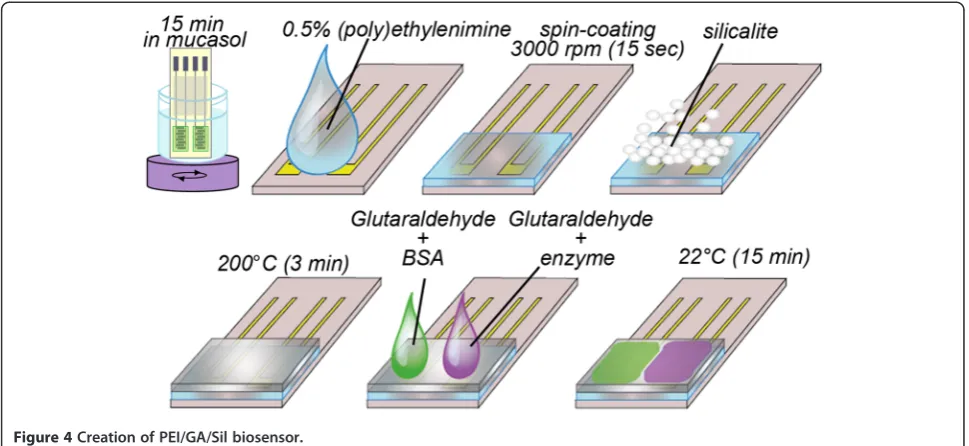
For preparing of biosensors based on PEI silicalite-modified electrodes, the electrode surfaces were dip-coated with mucasol for 15 min, rinsed with copious amount of distilled water, and dried under air. For formation of homogeneous layers of PEI, both drop coating and spin coating tech-niques have been tried since spin coating gave more
homogeneous layers, it was continued to be used. In our study, polyethylenimine (PEI) was used as a layer between electrode surface and silicalite. The suitable conditions for silicalite monolayer production were chosen as spin coating with 0.5% PEI in ethanol at 3,000 rpm with 15 s and 100°C for calcination temperature during 30 min. This kind of PEI silicalite-modified electrode was used as a base for the preparation of polyethylenimine/silicalite (PEI/Sil) and polyethylenimine/glutaraldehyde/silicalite (PEI/GA/Sil) biosensors.
Creation of silicalite-modified electrode
A silicalite layer on the transducer surface was formed using drop-coating technique. We used 10% (w/w) silica-lite solution in 5 mM phosphate buffer, pH 6.5. A con-stant amount of silicalite solution (0.2 ml) was deposited onto the active zone of each pair of electrodes, and then the transducer was heated for 2 min at 200°C. This temperature had no effect on the transducer working parameters. The procedure resulted in the formation of silicalite layer in the electrodes active zones. This kind of silicalite-modified electrode was used as a base for the preparation of Sil and GA/Sil biosensors.
Creation of biomembrane
[image:3.595.56.541.89.312.2]To create an active membrane of sucrose biosensors, 20 mM phosphate buffer solution at pH 7.0 which
[image:3.595.60.539.683.734.2]Figure 4Creation of PEI/GA/Sil biosensor.
Table 1 Responses of biosensors based on different types of enzyme immobilization
Biosensors with different type of enzyme immobilization
Biosensor with GA without silicalite
PEI/Sil biosensor PEI/GA/Sil biosensor Sil biosensor GA/Sil biosensor
contains 5% (w/w) of GOx, 5% (w/w) of MUT, 5% (w/w) of INV, and 5% (w/w) of BSA was mixed in 1:1 ratio with 2% (w/w) aqueous solution of GA for the immobilization on the surface of bare or silicalite-modified electrodes.
In order to obtain an active membrane of glucose bio-sensors, 20 mM phosphate buffer solution at pH 7.0 which contains 10% (w/w) of GOx and 5% (w/w) of BSA was mixed in 1:1 ratio with 2% (w/w) aqueous solution of GA in the same way as described above.
The mixture for reference membrane was prepared in analogous manner, except that the enzymes were replaced with BSA. Thus, the reference solution for sucrose biosen-sor contained 20% (w/w) BSA totally and 15% (w/w) BSA in the case of glucose biosensor. Enzyme and reference so-lutions were separately mixed with 2% (w/w) aqueous so-lution of GA in a ratio of 1:1. Immediately afterwards, we
deposited the mixture of enzyme solution with GA on one pair of electrodes and the mixture of reference so-lution with GA was placed on another one. The time of immobilization was 15 min; GA formed strong covalent bonds between the compounds of bioselective membrane, whereas the whole bioselective membrane was attached to the electrode surface through weak (i.e., Van der Waals) bonds. After immobilization, the electrodes were sub-merged in the working buffer for 15 min to wash out the unbound enzyme and GA excess.
An example of following the procedure of creation of PEI/GA/Sil biosensor is shown in Figure 4.
Electrochemical measuring system
[image:4.595.58.540.89.254.2]A portable conductometric analyzer was used to deter-mine changes in conductivity in the near-electrode layer.
Figure 5Selectivity test of PEI/GA/Sil sucrose biosensor.Measurements were carried out in 5 mM phosphate buffer solution.
Figure 6Signal reproducibility of PEI/GA/Sil sucrose biosensor.Responses of sucrose biosensor: (1) responses to 0.25 mM glucose, (2) responses to 0.25 mM sucrose.
[image:4.595.58.541.498.703.2]The portative measuring device (9.5 cm × 2.5 cm × 13.5 cm) was produced in the Institute of Electrodynamics of National Academy of Sciences of Ukraine (Kiev, Ukraine). The applied sinusoidal potential with frequency of 36.5 kHz and amplitude of 14 mV allowed avoiding such effects as Faraday processes, double-layer charging, and polarization of the microelectrodes. Illumination and temperature variations had practically no influence on the biosensor characteristics. The measurements were carried out in a glass cell filled with phosphate buffer (volume 1 ml), under vigorous magnetic stirring.
The conductometric determination of sucrose and glu-cose, using the prepared biosensors, was realized in a differential measuring mode, which ensured satisfactory detection accuracy and suppression of non-informative effects of the environment (variations of temperature,
рН, and background conductivity of working solution).
Measurement procedure
Measurements were carried out at room temperature in 5 mM phosphate buffer solution, pH 6.5, continuously stirred in an open 1 ml cell. The substrate concentra-tions in the cell were varied by the addition of the
different volumes of the stock solution. All experiments were repeated in triplicate. The data in the figures were expressed either as a mean of three repeated results of experiment or as a mean ± standard deviation (SD). The experiments were performed at least in three series.
Results and discussion
The cascades of enzymatic reactions for sucrose detec-tion by conductometric biosensor are presented below:
Three enzymes are used for measurement of sucrose while only one, glucose oxidase - for glucose. The en-zyme invertase decomposes sucrose into β-D-fructose and α-D-glucose, which is transformed intoβ-D-glucose by mutarotase. β-D-glucose is decomposed by GOD to hydrogen peroxide and glucolactone. In its turn, D-glucolactone is spontaneously hydrolyzed to gluconic acid, which dissociates to the acid residue and a proton. These reactions lead to changes in solution conductivity what can be registered by a conductometric transducer.
[image:5.595.59.539.89.289.2]First of all, we check the sensitivity of five types of bio-sensors based on different types of enzyme immobilization: (1) biosensors with GA without silicalite, (2) PEI silicalite-modified biosensors without immobilization in GA (PEI/ Sil biosensor), (3) PEI silicalite-modified biosensors with
Figure 7Calibration curves of PEI/GA/Sil sucrose biosensors.Responses are shown for adding of glucose (1) and sucrose (2) respectively.
Table 2 Comparison of biosensor and HPLC analysis of beverages samples
Samples of beverages Concentration of sucrose in samples, mM (n= 3)
Biosensor HPLC
Orange nectar‘Dooy’, Turkey 42.3 ± 3.4 46.3 ± 1.8
Orange juice‘Cappy’, Turkey 213.6 ± 6 241.8 ± 0.3
Apple juice‘Pinar’, Turkey 41.5 ± 3.8 48.2 ± 0.4
[image:5.595.56.291.642.733.2]immobilization in GA (PEI/GA/Sil biosensor), (4) silicalite-modified biosensors without immobilization in GA (Sil biosensor), and (5) silicalite-modified bio-sensor with immobilization in GA (GA/Sil biobio-sensor) (Table 1). The PEI/GA/Sil biosensors are characterized by much higher sensitivity than the biosensors without GA and biosensors based only on GA cross-linking.
Thus, the method of enzyme immobilization with GA on PEI silicalite-modified electrodes was chosen as the most appropriate for the further biosensor fabrication; for this reason, the next study was carried out using only PEI/GA/Sil biosensors.
First of all, we studied the selectivity of PEI/GA/Sil su-crose biosensors. Biosensor selectivity, one of important analytical characteristics, depends on choice of both bio-logical recognition element and transducer. An influence of interfering components (some carbohydrates) on response value was studied to test biosensor selectivity. For that pur-pose, glucose, maltose, sucrose, lactose, fructose, arabinose and galactose in concentration of 0.5 mM were added to a working cell (Figure 5).
In general, conductometric biosensors appeared to be sufficiently selective. There was no significant influence of common carbohydrates except of sucrose and glucose, which is expected. The sucrose biosensors are highly sensitive not only to sucrose but also to glucose because the enzyme membrane of sucrose biosensors contains also glucose oxidase. For this reason, to determine su-crose in multicomponent solution, we used two biosen-sors: sucrose biosensor that gives the summary response to both substrate (sucrose and glucose) and glucose bio-sensor that selectively determines only glucose.
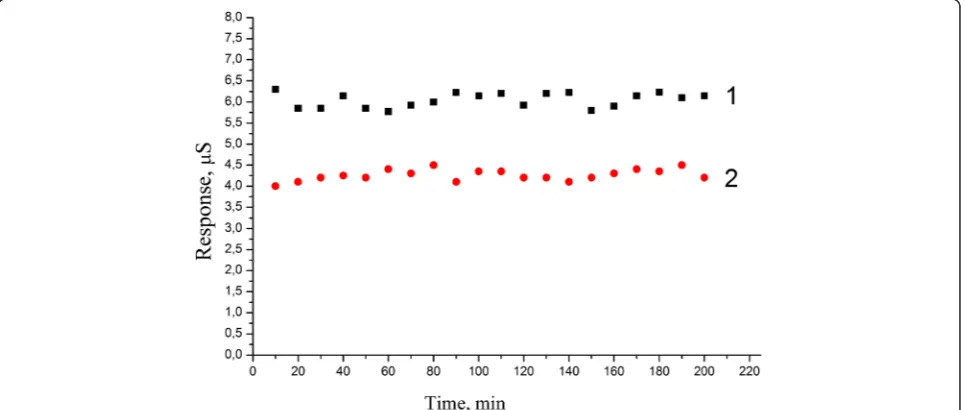
Reproducibility is one of the most important working characteristics of biosensors. To determine signal repro-ducibility, the biosensors’ responses to 0.25 mM glucose and sucrose were measured during one working day with 10- to 15-min intervals. The biosensors were kept in the continuously stirred buffer solution at room temperature during intervals between measurements. As seen from Figure 6, the biosensor responses were highly reprodu-cible. The relative standard deviation (RSD) for glucose measurements was 2.78% and for sucrose measurements was 3.2% which is quite acceptable value (Figure 6).
The calibration curves to glucose and sucrose by PEI/GA/Sil sucrose biosensor are shown on Figure 7. The PEI/GA/Sil sucrose biosensors showed extended linear range of sucrose detection comparing with trad-itional type of biosensors based on immobilization in GA without silicalite. The linear range of PEI/GA/Sil sucrose biosensors was 0.0035 to 4 mM for sucrose and 0.0015 to 1.75 mM for glucose (Figure 7). The limit of detection (LOD) for glucose determination was 1.5 μM and LOD for sucrose determination was 3.5μM.
We used PEI/GA/Sil biosensors for the determination of sucrose concentration in different sweet beverages. Ob-tained results were compared with results of high-performance liquid chromatography (HPLC) (Table 2). The correlation between the methods is high (R= 0.99).
It was concluded that the method of enzyme adsorp-tion on PEI silicalite-modified electrodes with GA is well suited for the biosensor manufacture.
Conclusions
Conductometric enzyme biosensors based on different type of silicalite-modified electrodes were created and compared. PEI/GA/Sil biosensors have shown higher sensitivity to substrate compared with others biosensors tested in this work. Moreover, the PEI/GA/Sil sucrose biosensors were characterized by high selectivity and sig-nal reproducibility (RSD = 2.78% for glucose measure-ments and RSD = 3.2% for sucrose measuremeasure-ments). PEI/ GA/Sil sucrose biosensors were used to determine the concentrations of sucrose in different beverage samples. The results of biosensor measurements of sucrose in beverages had a high correlation (R= 0.99) with the re-sults obtained by HPLC. Thus, the method of enzyme immobilization using PEI/GA/Sil composition is highly effective and perspective for biosensor creation.
Abbreviations
GA:glutaraldehyde; HPLC: high-performance liquid chromatography; LOD: limit of detection; PEI: polyethylenimine; RSD: relative standard deviation; Sil: silicalite.
Competing interests
The authors declare that they have no competing interests.
Authors’contributions
PVN and OYD performed enzyme immobilization on silicalite-modified conductometric electrodes and studied analytical characteristics of developed enzyme biosensors. BOK synthesized silicalite and deposited silicalite on the surface of the conductometric transducers. BAK planned the experiments, controlled the zeolites synthesis by electron microscopy, made XRD spectrum of silicalite. OYD, PVN, and OOS processed the results, wrote, and arranged the article. SVD and FL proposed an idea of the development of conductometric enzyme biosensors based on silicalite-modified electrodes. SVD and FL are supervisors of the whole work, the results of which are presented in this research. All authors read and approved the final manuscript.
Acknowledgements
The authors gratefully acknowledge the financial support of this study by Project European IRSES-NANODEV. Furthermore, this study was partly supported by National Academy of Sciences of Ukraine in the frame of complex scientific-technical program‘Sensor devices for medical-ecological and industrial purposes: metrology and trial performance.’
Author details
1Laboratory of Biomolecular Electronics, Institute of Molecular Biology and Genetics, National Academy of Sciences of Ukraine, 150 Zabolotnogo Str., 03680 Kyiv, Ukraine.2Institute of High Technologies, Taras Shevchenko National University of Kyiv, 64 Volodymyrska Street, 01601 Kyiv, Ukraine. 3Micro and Nanotechnology Department, Middle East Technical University, Ankara 06531, Turkey.4Université Claude Bernard Lyon 1, Institut des Science Analytiques, 5 rue de la Doua 69100 Villeurbanne, Lyon, France.
Biochem. 2013;439:65–72.
7. Soldatkin OO, Kucherenko IS, Shelyakina MK, Soy E, Kirdeciler K, Öztürk S, et al. Elaboration of new method of enzyme adsorption on silicalite and nano beta zeolite for amperometric biosensor creation. Biopolym Cell. 2014;30:291–8.
8. Kirdeciler SK, Soy E, Oztürk S, Kucherenko I, Soldatkin O, Dzyadevych S, et al. A novel urea conductometric biosensor based on zeolite immobilized urease. Talanta. 2011;85:1435–41.
9. Saiapina OY, Pyeshkova VM, Soldatkin OO, Melnik VG, Kurç BA, Walcarius A, et al. Conductometric enzyme biosensors based on natural zeolite clinoptilolite for urea determination. Mat Sci Eng. 2011;31:1490–7. 10. Kucherenko IS, Soldatkin OO, Kasap BO, Öztürk S, Akata Kurc B, Soldatkin AP,
et al. Elaboration of urease adsorption on silicalite for biosensor creation. Electroanal. 2012;24:1380–5.
11. Dai Z, Liu S, Ju H. Direct electron transfer of cytochrome c immobilized on a NaY zeolite matrix and its application in biosensing. Electrochim Acta. 2004;49:2139–44.
12. Azizi SN, Ranjbar S, Raoof JB, Hamidi-Asl E. Preparation of Ag/NaA zeolite modified carbon paste electrode as a DNA biosensor. Sensor Actuator. 2013;181:319–25.
Submit your manuscript to a
journal and benefi t from:
7Convenient online submission
7Rigorous peer review
7Immediate publication on acceptance
7Open access: articles freely available online
7High visibility within the fi eld
7Retaining the copyright to your article